Automation and workflow improvements can give independent pharmacies more capacity without treating hiring as the only answer. For owners asking how to improve pharmacy efficiency, start by identifying where avoidable manual work is limiting service and business oversight. That matters as PBM reimbursement pressures and ongoing reform discussions add to the demands on community pharmacy owners.
Those pressures can leave less time for managing the business. Technology can organize operational information and reduce administrative work, giving owners more room to review performance and make decisions that support the pharmacy’s sustainability. It won’t resolve PBM reimbursement challenges on its own, but it can free up time to manage them.
This guide explains how to identify workflow or staffing constraints and choose practical improvements in inventory, automation, prescription verification, and capacity measurement. You’ll learn how to assess processes, spot where technology may help, and track whether changes support smoother operations and more time for patient care.
Key Takeaways
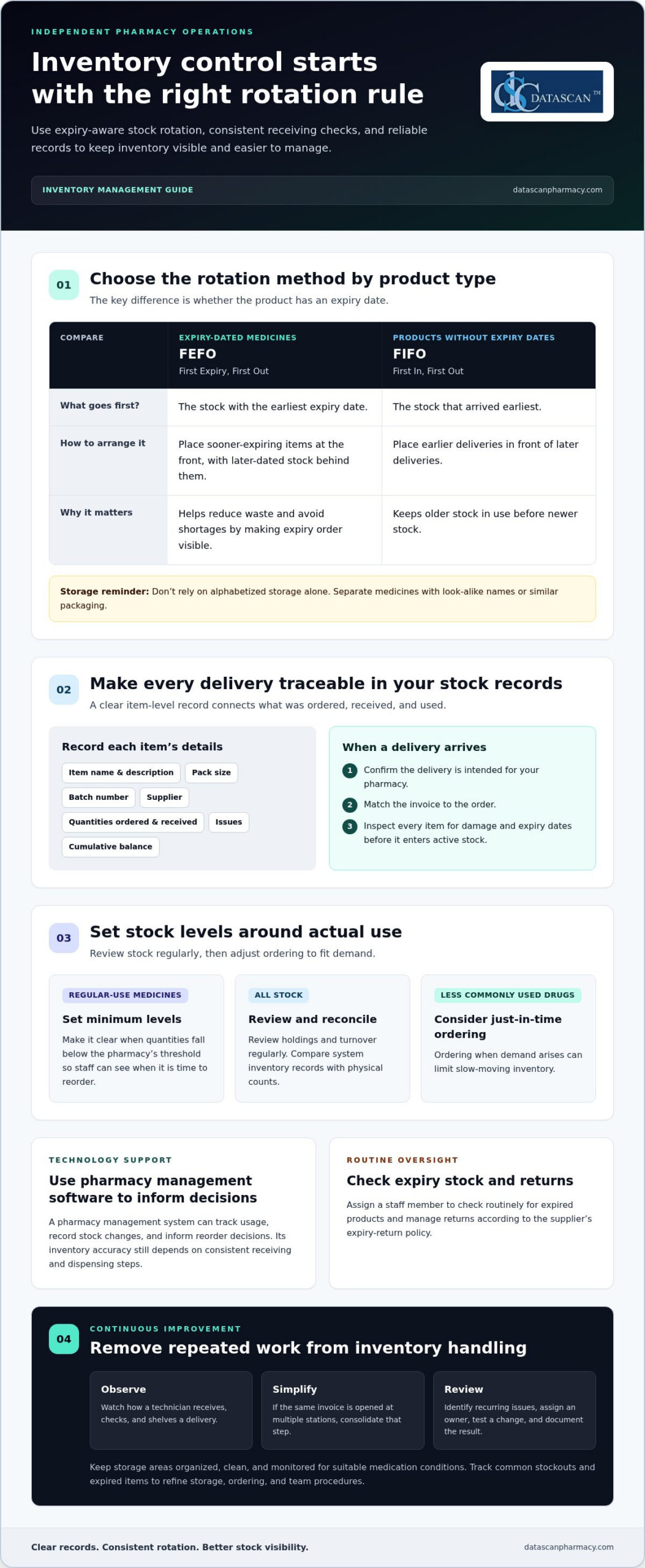
- Use FEFO for medicines with expiry dates and FIFO for products without them, then review stock records and reorder points to reduce waste and avoid shortages.
- Observe daily work, map bottlenecks, and keep standard operating procedures current to distinguish workflow friction from a staffing capacity problem.
- Target automation at repetitive tasks, such as refill requests and routine inventory work, so staff can focus more time on patient care.
- Organize prescription handoffs and workstations to reduce interruptions and give pharmacist verification the focus it requires.
- Track measures such as doses per labor hour, turnaround time, rework, overtime, and clinical hours monthly to see whether changes are improving capacity.
1. Inventory management
Inventory is easier to control when every medication has a clear record, storage location, and reorder point. Compare physical stock with an item-level record showing the item name, description, pack size, batch number, supplier, quantities ordered and received, issues, and cumulative balance. When a delivery arrives, confirm it is intended for your pharmacy, match the invoice to the order, and inspect each item for damage and expiry dates. This routine can catch discrepancies before products enter active stock.
Use FEFO, or First Expiry, First Out, for medications with expiry dates: place items expiring sooner at the front, with later-dated stock behind them. For products without expiry dates, use FIFO, or First In, First Out, by placing earlier deliveries in front. Assign a staff member to check routinely for expired products and manage returns according to the supplier’s expiry-return policy. Avoid relying on alphabetized storage alone, as it can contribute to mix-ups. Separate medicines with look-alike names or similar packaging.
Set minimum stock levels for regular-use medications so staff can see when quantities fall below the pharmacy’s threshold. Review stock holdings and calculate turnover regularly, then adjust ordering to match actual use. For less commonly used drugs, just-in-time ordering can limit slow-moving inventory by ordering when demand arises. A pharmacy management system can track usage, record stock changes, and inform reorder decisions. Compare its inventory records with physical counts, since accuracy depends on consistent receiving and dispensing steps.
Lean management helps teams remove repeated work from inventory handling. Observe how a technician receives, checks, and shelves a delivery. If the same invoice is opened at multiple stations, consolidate that step. Keep storage areas organized, clean, and monitored for suitable medication conditions. In brief improvement reviews, identify recurring issues, assign an owner, test a change, and document the result. This makes continuous improvement part of routine operations rather than a one-time cleanup.
Integrated systems can bring prescription processing, inventory, patient records, and billing into one workflow. For pharmacies with multiple sites, centralizing selected services can reduce duplicated work and help coordinate labor and stock. Choose systems that work with current tools and can accommodate future needs. Digital patient records give authorized staff a shared view of medication and patient information, while patient management apps can support communication and routine requests. Together, these tools can reduce manual handoffs and protect time for patient care.
Barcode scanning can support accurate product identification during inventory handling. According to the U.S. Food and Drug Administration, scannable 2D barcodes meet healthcare safety and DSCSA traceability requirements. Keep this capability in proportion to daily priorities: receiving accuracy, expiry rotation, stock visibility, and timely access to medications remain central inventory tasks. Track common stockouts and expired items, then use those points to refine storage, ordering, and team procedures.
2. How do I know if my pharmacy has a workflow problem or a staffing problem?
Run a one-week time study before deciding whether your pharmacy needs a staffing change. By shift, record prescription volume, task times, interruptions, overtime, and backlogs. Repeated delays at the same handoff often point to workflow friction. Capacity gaps across well-organized shifts may indicate a staffing constraint.
What U.S. regulations must pharmacies follow when changing workflows or using automation? Continue to follow applicable federal and state requirements, including those covering prescription handling, patient information, and medication safety. Document process changes, train affected staff, and review procedures against the requirements that apply to each activity.
What are the most effective ways to improve pharmacy workflow efficiency? Map each prescription’s path, observe staff movement, and remove unnecessary handoffs or repeated steps. Update standard operating procedures (SOPs), assign clear ownership for tasks, and measure whether the revised process reduces delays or rework.
Start by observing a typical day from prescription intake through pickup and counseling. Ask technicians and pharmacists where work waits, gets interrupted, or returns for correction. Map staff movement between the entry station, filling area, verification point, and pickup counter. A long route or crowded station may indicate a layout problem rather than a staffing shortage. Compare busy and quieter shifts so changes reflect actual volume.
Audit labor by task, not just by total hours. Record who handles entry, phone calls, filling, verification, patient questions, and administrative work. If a technician is repeatedly pulled from prescription entry to answer calls, test a clearer call-routing or task-assignment process. Cross-training can help cover predictable absences, but it won’t fix a workflow that sends several employees to the same bottleneck. Review SOPs when technology, work steps, or team responsibilities change.
Use a 90-day improvement plan to test changes in stages. During days 1–14, complete the time study, map bottlenecks, and establish baseline measures. During days 15–30, redistribute tasks and centralize suitable work. During days 31–60, assess automation gaps for oral solids, oral liquids, and labeling. During days 61–90, pilot a change and compare results with baseline.
What steps can pharmacies take to improve patient intake, pickup, and counseling workflows? Give each stage a clear owner, keep intake and pickup paths easy to distinguish, and route clinical questions to the pharmacist without interrupting focused verification. To discuss a workflow review, connect with the pharmacy software team.
3. Automation of dispensing and routine administrative tasks
Automate repetitive steps that consume pharmacist time, then measure whether the change improves dispensing flow. Pharmacies can recover 8 to 15 pharmacist hours per week within the first 60 days by changing workflows and automating routine tasks. Start with a time audit: if a pharmacist spends more than 25% of a shift on packaging, labeling, or routine-work verification, review those steps for avoidable manual work. For teams asking how to improve pharmacy efficiency, automation should support staff judgment, not replace the pharmacist’s role in patient care.
Prescription processing software can manage refill requests, route prescription information, and reduce manual entry between stages. A refill request, for example, can enter a queue for review instead of arriving as a phone message that staff must transcribe. Electronic prescribing can also support processing when connected systems share the needed information. Map each handoff before making a change, so the team can see whether automation removes duplicate entry or simply moves it elsewhere.
Automated dispensing systems can automate up to 60% of prescription processing, reduce manual medication-management work, and free technicians and pharmacists for clinical tasks. They can also improve dispensing accuracy and reduce the risk of medication errors. Keep a pharmacist’s verification step in the workflow, and define what staff do when an item is missing, an alert appears, or a prescription needs clarification. Clear exception handling prevents automation from creating a new queue of unresolved work.
Inventory automation connects stock movement with day-to-day pharmacy operations. Set minimum stock levels for selected medications, then use reorder points to flag quantities below the pharmacy’s threshold. Inventory management systems can track usage, identify reorder needs, and automate purchasing processes. Before placing an order, review suggestions against actual demand and supplier timing, especially for slow-moving items. This keeps reordering responsive without treating every low-stock alert as urgent.
Packaging and labeling automation can reduce repetitive handling, but the workflow still needs defined checks. Identify which products and prescription types suit the equipment, who loads supplies, and who reviews exceptions. Compare error corrections and rework before and after implementation. For a small team, a focused pilot on a suitable prescription category can show whether the new step reduces workload or adds setup and maintenance tasks.
Routine administrative automation can also free time for patient-facing work. Online appointment scheduling can manage bookings and follow-ups, while reminders can help patients keep appointments. Refill request tools can reduce calls that staff would otherwise answer and record manually. Clinical checks should surface relevant information for pharmacist review, not bypass it. Track queue age, completed requests, and unresolved exceptions to see whether each tool supports safe, timely service.
Implement changes in stages: choose one bottleneck, document the current process, train the team, and compare results with a baseline. Include technicians in the review, since they can identify where automation interrupts actual work. A pharmacy management system that connects prescription processing and inventory records can reduce duplicate handling across those tasks. If you’re considering how to improve pharmacy efficiency, expand automation only when a pilot shows a practical gain and staff can manage exceptions consistently.
4. Prescription filling and pharmacist verification
Reduce prescription wait times by clarifying each handoff, prioritizing incoming work, and limiting interruptions during pharmacist verification. To reduce dispensing errors, use consistent processing steps, separate look-alike medicines, and give the pharmacist focused time to verify each order.
Begin at drop-off. Assign a technician to enter and prioritize most prescriptions, then sort them into color-coded baskets that show urgency or workflow status. This gives the team a visible queue instead of relying on memory or repeated questions. Define what each color means and train every technician to use the system consistently. Update basket status as a prescription moves to the next station, so staff can quickly identify work awaiting entry, filling, or verification.
Arrange work in a clear sequence: entry, filling, pharmacist verification, then bagging and pickup. Defined work areas help staff complete each task without crossing paths or carrying prescriptions back and forth. Keep similar-looking packages and medicines with look-alike names apart. Place the pharmacist’s station near the bagging area, verification rack, and counseling window to support a clear transition from final check to patient handoff.
Set up the filling station before the shift begins. Keep counting trays, vials and lids, patient handouts, a HIPAA-compliant trash collector, and color-coded bags within reach. This reduces trips away from the work area and helps technicians maintain a steady flow. Where possible, separate inventory management from active filling so receiving or stock questions don’t interrupt prescription assembly.
Define roles around the work, not just job titles. Technicians can handle entry, prioritization, and prescription preparation according to the pharmacy’s procedures. Production pharmacists should verify prescriptions with minimal distractions, while clinical pharmacists focus on counseling and other patient-facing services. Clear escalation steps tell technicians when to pause and bring a question to the pharmacist, instead of letting uncertainty delay the entire queue.
Remote prescription processing can help distribute work when the local verification queue is constrained. Remote dispensing models can assign prescription processing to technicians, while telepharmacy smart queues let remote pharmacists manage workload after counseling patients and providing clinical services. A remote pharmacist can counsel a patient through a live video call while at the workstation. These arrangements still need clear responsibilities, visible queues, and reliable communication between the local team and remote pharmacist.
Review the workflow using practical measures: note where prescriptions wait, how often work returns for correction, and which stations experience interruptions. Test one layout or prioritization change, then compare results with the existing process. Pharmacy software can make prescription status visible and support consistent handoffs, but staff procedures determine how information moves between stations. An effective workflow makes each step visible, keeps verification focused, and gives patients a predictable path from drop-off to pickup.
5. Pharmacy efficiency and capacity metrics
Measure operational efficiency by tracking workload, service, and staff capacity together. A faster prescription queue means little if rework increases or pharmacist clinical time disappears. Review six measures monthly: doses per labor hour, pharmacist clinical hours per shift, order-to-dispense turnaround, rework frequency, overtime, and vacancy-adjusted output. Together, these measures show whether a process change improves capacity or shifts pressure to another activity.
Define each measure before comparing results. Doses per labor hour relates completed doses to labor hours, while clinical hours per shift shows how much pharmacist time supports clinical work. Order-to-dispense turnaround measures elapsed time between an order entering and being dispensed. Rework frequency captures prescriptions needing correction or repeat handling. Use consistent definitions across shifts, or the figures won’t tell a reliable story.
Read the measures together. If doses per labor hour rise while turnaround and rework also increase, the team may be moving prescriptions faster at the expense of accuracy or flow. If overtime increases while output stays flat, interruptions or task allocation may be limiting capacity. Vacancy-adjusted output helps interpret results when staffing levels change, rather than treating every shift as though it had the same available workforce.
What are the risks and costs of pharmacy efficiency initiatives, and how can they be evaluated? Initiatives may require staff training, implementation time, and spending on equipment or software. Poorly designed changes can increase rework or interrupt patient care. Compare the full operational effort with monthly measures before and after a change, including overtime, turnaround, and rework.
Set a baseline before making a change, then record the same measures during the review period. For example, if the pharmacy changes task assignments, compare clinical hours per shift and overtime alongside order-to-dispense turnaround. Also note prescription volume and staffing availability: a busier period or open position can affect results independently of the change. Account for those conditions instead of crediting or blaming one workflow adjustment for every shift in performance.
Use a simple scorecard that assigns each metric an owner and a clear response. If rework rises, review where prescriptions return for correction. If turnaround slows, identify the queue or handoff where orders wait. If clinical hours fall, examine which production or administrative activities are taking pharmacist time. These actions turn measurement into a practical improvement loop rather than a report that sits unused.
Capacity is more than total output. Pharmacy staff need adequate time for patient care, and reducing labor hours at the expense of counseling access is not an operational gain. Review service measures alongside productivity measures, discuss exceptions with the team, and adjust the process when results reveal new bottlenecks. A disciplined monthly review helps owners see what works, what strains the team, and where to focus the next improvement.
Datascan Pharmacy Software: Datascan Pharmacy Management Software
Datascan Pharmacy Software’s Datascan Pharmacy Management Software is a natural next step when your workflow review points to disconnected pharmacy processes or too much manual coordination. It provides independent pharmacies with a management platform for day-to-day operations. Datascan Point of Sale (POS), MobileScripts Patient Mobile App, and Datascan Mobile Delivery App support related checkout, patient communication, and delivery needs.
Consider these tools when deciding how to connect pharmacy management with the work your team already handles. Choose a configuration around your priorities, such as reducing manual handoffs or improving the patient experience. Contact Datascan Pharmacy Software to discuss how its pharmacy management software can support your pharmacy’s operations.
Turn your workflow findings into the next improvement
The next step is to choose one operational friction point and make a focused change your team can evaluate. For independent pharmacies balancing patient needs with PBM pressures, that might mean identifying where avoidable manual work takes time away from business management or patient service. A practical approach to how to improve pharmacy efficiency starts with the constraint your team sees every day, not with technology for its own sake.
Set a clear goal, assign an owner, and review the result with the pharmacy staff who do the work. If the process still creates delays or extra handling, use those observations to guide the next adjustment. Pharmacy management software can also help when your current systems make it harder to coordinate operations or see where work gets stuck.
Ready to discuss a technology approach for your pharmacy’s workflow? Talk with Datascan Pharmacy Software about your operational goals. Each focused improvement can help your team build a more workable day.
Frequently Asked Questions
Can automation help with the pharmacy technician shortage too?
Yes. Automation can reduce routine administrative work and make coverage less dependent on one person. Organizations exploring synthetic workforce development and AI agents to assist with routine operational tasks often turn to specialists like Navo Inc. to ease staffing strain. Design a backup process for exceptions, such as a refill request that needs clarification, so staff know who handles it when the usual technician is unavailable. Automation works best when responsibilities are clear and employees can step in without losing track of pending work. It supports capacity but doesn’t replace qualified staff.
How do I know if my pharmacy has a workflow problem or a staffing problem?
Compare scheduled coverage with actual demand across similar shifts. If a process slows mainly when arrivals surge or employees are absent, available capacity may be the constraint. If the same task stalls when the team is fully present, examine handoffs, unclear ownership, and interruptions. Ask staff to describe a recent delay from start to finish. Their account can reveal whether work waited for a person, information, or a decision.
How long does it take to see efficiency gains from workflow changes?
Centralization and task redistribution can show results in 30 to 60 days. Automation gains typically register within the first full quarter of operation, depending on installation timelines. For a fair assessment, distinguish setup and training time from the period when the new process is running normally. Review early feedback for problems that need correction, then judge performance using comparable operating conditions rather than a single unusually busy or quiet day.
What metrics replace cost per dose when you’re focused on efficiency?
There isn’t one universal replacement; choose measures that reflect the pharmacy’s actual work. Compare similar shifts and account for hours worked, so a staffing change doesn’t distort the picture. For example, examine how quickly a prescription queue clears alongside the amount of rework and time available for patient services. The ASHP Practice Management Resource Center offers guidance on budgeting and performance improvement.
What’s the fastest way to free up pharmacist hours without hiring?
Start with administrative work that repeatedly pulls pharmacists away from clinical responsibilities. For example, create a defined process for routing complex third-party rejections, so each case reaches the right staff member with relevant information. This can reduce repeated investigation and unnecessary interruptions. Track whether the pharmacist’s freed time goes to patient care or shifts into another backlog. That distinction shows whether the change improved capacity.
How can pharmacy inventory management reduce stockouts and waste?
Review stockout and expiry events by medication, then identify whether each resulted from a demand change, delayed ordering, or a receiving discrepancy. This cause-based review helps target the remedy instead of changing every item’s ordering pattern. A frequently missed medication, for instance, may need a revised reorder trigger, while an item nearing expiry may call for closer review of purchasing quantities. Base the review on actual dispensing and receiving records.
What pharmacy automation technologies improve efficiency, and how much do they cost?
Costs depend on the technology, how it fits existing systems, setup and training needs, and ongoing support requirements. Technologies can range from automated counting and packaging tools to intelligent service robots—such as those offered by GO Robotics for healthcare and retail environments—that support internal transit and routine logistics. Before comparing options, estimate the work the tool is meant to remove and identify who will manage exceptions. Include implementation time in the evaluation, not just the purchase or licensing expense. A focused trial with a clearly defined purpose can help assess operational fit before expanding use.
How can pharmacies optimize staffing and pharmacist workload?
Review workload by responsibility and match coverage to the pharmacy’s patterns of service demand. The NCPA Leadership Program supports pharmacy professionals in developing leadership skills that can strengthen team coordination. In practice, managers can clarify decision ownership, create a consistent method for handing off unresolved work, and invite staff to identify repeated friction. These steps help balance daily responsibilities without measuring performance only by prescription volume.
About the author: The Datascan Pharmacy Software editorial team creates educational content for independent and community pharmacy operators, focusing on pharmacy workflows, technology, and day-to-day operations.

Article by
Sarah Callioras
Sarah Callioras is Vice President at Datascan Pharmacy Software, bringing nearly 25 years of experience across independent pharmacy operations and pharmacy technology. Since joining Datascan in 2016, she has played a key role in driving business growth, strengthening client relationships, and supporting independent pharmacies through innovative software solutions. With a strong background in pharmacy operations, business development, and strategic leadership, Sarah is passionate about helping independent pharmacies succeed in an evolving healthcare landscape.

In 2021, 8.2% of U.S. adults aged 18 to 64 who were prescribed medication said they didn’t take it as prescribed because of cost, according to the CDC. Improving patient medication adherence rates starts with finding out what’s getting in the way, not assuming patients simply forgot. A reminder may help with forgetfulness, but it won’t address every barrier.
For independent pharmacies, pickup is just one moment in a patient’s care. A repeatable approach can help busy teams ask about barriers without blame and offer support that fits each patient’s needs.
This guide covers how to identify common barriers, choose practical support, and build follow-up into everyday pharmacy workflows. It also explains how to select useful measures and review your approach over time.
About the author: Datascan Pharmacy Software shares practical guidance for independent and community pharmacies on pharmacy operations and patient-care workflows.
Key Takeaways
- Use open-ended questions to understand what makes taking medication difficult, without blaming patients.
- Match support to the barrier. A reminder may help with forgetfulness, while other challenges need a different response.
- Build improving patient medication adherence rates into a repeatable workflow with clear ownership and follow-up.
- Compare counseling, regimen support, synchronization, and digital engagement in light of patient needs and staff capacity.
- Use pharmacy management software to organize adherence-related work, then review appropriate measures to assess your process.
What does improving patient medication adherence rates actually involve?
Medication adherence means taking medication as prescribed. Improving it means understanding why doses are missed and responding to the reason. A number may flag a concern, but it can’t tell a pharmacy team whether a patient needs a simpler routine, clearer information, help with access, or another kind of support.
A practical definition: A clinical taxonomy by Vrijens and colleagues defines medication adherence as the process of taking medication as prescribed, including starting treatment, following the agreed plan, and stopping treatment. Persistence describes the time from starting a medication until it is stopped. These definitions help pharmacy teams describe different patterns without treating them as personal failings. The medication-adherence taxonomy provides the definitions.
Nonadherence can be intentional, such as choosing not to take a medicine because of concerns or unwanted effects, or unintentional, such as forgetting a dose or misunderstanding directions. Neither label is a judgment of the patient. It’s a starting point for understanding what happened and what might make the prescribed plan more manageable.
A single adherence rate has limits. It summarizes a pattern over a measurement period, but it doesn’t explain a person’s daily circumstances or show whether missed doses stem from one barrier or several. Use a measure to identify where follow-up may be useful, then talk with the patient before deciding what action fits.
Why do patients have difficulty taking medication as prescribed?
Adherence barriers can arise in four connected areas. A patient may face more than one at a time, so avoid assuming there’s a single cause:
- Patient factors: Forgetfulness, competing demands, or difficulty fitting doses into a routine.
- Provider factors: Communication gaps that leave directions or medication concerns unclear.
- Treatment factors: A complex regimen that’s hard to manage consistently.
- Health-system factors: Access challenges that make obtaining or continuing medication difficult.
These categories help organize questions, not assign fault. A patient who misses refills might be managing a complicated schedule, unclear instructions, an access problem, or a combination of factors.
Why should pharmacies focus on the reason behind a missed dose?
The same behavior can have different causes. A late refill might reflect forgetfulness, uncertainty about how to take a medicine, or difficulty accessing it. Ask, “What has made it hard to take this medication?” rather than, “Why aren’t you taking it?” The first invites context; the second can sound like blame. Listening helps the pharmacy team choose a relevant next step instead of guessing, while keeping the conversation focused on support.
How can a pharmacy identify a patient’s adherence barriers?
Use a brief, repeatable conversation to understand the patient’s experience before recommending a solution. A useful flow is invite, listen, clarify, agree, and document. It gives the team a consistent starting point while leaving room for each patient’s circumstances and clinical judgment.
- Invite: Ask permission to discuss how the medication plan is going. “Would it be okay if we talked about how this medicine fits into your routine?”
- Listen: Let the patient explain what’s working or difficult before offering a reminder or another solution.
- Clarify: Ask follow-up questions to understand whether the issue is unclear instructions, a medication concern, a demanding routine, or difficulty obtaining the prescription.
- Agree: Work with the patient on a practical next step that addresses the barrier they described.
- Document: Record the patient’s concern and the agreed action in the appropriate pharmacy workflow, so follow-up has context.
What questions help uncover barriers without blaming patients?
Try neutral, open-ended prompts: “How do you usually fit your medicines into your day?” “What questions do you have about how to take this?” “Have you noticed anything about the medicine that concerns you?” “Has anything made it hard to obtain or pay for it?” Listen before suggesting an intervention. A knowledge gap may call for clearer counseling; a busy routine, medication concern, or access problem calls for a different response.
Clarify what the patient means before choosing a next step. If they’re unsure about directions, ask which part is confusing and use pharmacist judgment to address it. If the directions are clear but doses are hard to fit into the day, explore the routine. A concern about effects or treatment may require pharmacist assessment or coordination with the prescriber. Don’t assume a reminder will resolve every missed dose.
How should the pharmacy record and prioritize what it learns?
Keep notes concise and useful. When possible, record the barrier in the patient’s own words, the agreed next step, and whether follow-up or pharmacist review is needed. Prioritize concerns that require clinical judgment or coordination with the prescriber. Treat the record as a snapshot, not a complete adherence assessment. A patient’s needs or circumstances may change.
A consistent process helps teams carry what they learn into routine patient care. A customizable pharmacy workflow can provide a defined place for adherence-related tasks, so the next step is less likely to depend on one staff member’s memory. Barrier-first assessment makes improving patient medication adherence rates more individualized: understand the obstacle, agree on relevant support, and revisit the plan as appropriate. Discuss your workflow needs with Datascan.
Which medication adherence strategies should a pharmacy compare?
Choose adherence support based on the barrier the patient describes, not a one-size-fits-all program. Counseling, regimen support, medication synchronization, follow-up, and digital engagement can each play a role. Each option also needs a workable staff process and a clear reason for using it.
Counseling
May address: Questions, concerns, or uncertainty about medication instructions.
Workflow: Make time for a pharmacist conversation and determine whether the concern needs further clinical review.
Regimen support
May address: Difficulty managing a complicated medication routine.
Workflow: Review the regimen with the patient and identify a practical support approach within the pharmacy’s patient-care process.
Medication synchronization
May address: Challenges coordinating prescription refill timing.
Workflow: Review eligible prescriptions and coordinate timing through the pharmacy’s established synchronization process.
Follow-up
May address: A barrier that needs another conversation or a check-in after an agreed action.
Workflow: Assign responsibility and record the next step, so follow-up doesn’t rely on memory alone.
Digital engagement
May address: A patient’s preference for a digital channel as part of pharmacy communication.
Workflow: Offer a patient-facing tool as one support option, while keeping pharmacist communication available for questions that need personal attention.
This comparison organizes possible approaches; it doesn’t promise a particular result. The right fit depends on what the patient says, the care required, and what the team can consistently support. Avoid claiming an intervention improves adherence by a set amount unless you can cite current evidence and explain the study population and date.
When is personal counseling more useful than a reminder?
A reminder may suit a patient who understands the plan but has trouble fitting doses into a routine. It can’t explain unclear directions or resolve a concern about treatment. Those situations call for a conversation in which a pharmacist can understand the question and use clinical judgment. Treat reminders as one possible tool, not a universal solution or a substitute for listening.
How can synchronization and digital tools complement pharmacy care?
Medication synchronization is an option for coordinating prescription timing. It may fit when timing or refill coordination is part of the patient’s challenge, but it won’t address every barrier. E-care plans, patient-facing apps, and clinical technologies like remote patient monitoring software can complement pharmacy care as support channels; they don’t replace individualized assessment or pharmacist communication.
For patients who prefer a digital option, a patient medication refill app may provide another way to engage with the pharmacy. Ask whether the approach fits the identified need and can be incorporated into the team’s existing workflow. Matching the support to the barrier is central to improving patient medication adherence rates.
How can an independent pharmacy build a sustainable adherence workflow?
A sustainable workflow is simple enough for the team to repeat and specific enough to make the next step clear. Define a patient group, assign ownership, assess barriers, take an appropriate action, and review the work and selected measures. Build each step around existing dispensing or patient-care touchpoints rather than promising outreach the team can’t consistently deliver.
- Select a patient group. Begin with a clearly defined group that fits your pharmacy’s care priorities and capacity. A focused start makes it easier to test and refine the process before expanding it.
- Assign workflow ownership. Decide who identifies patients for follow-up, who handles outreach, and when a pharmacist should review a concern. Keep clinical decisions with the pharmacist.
- Assess barriers. Use a routine pickup, refill, or patient-care interaction to ask what is making the medication plan difficult. Record the patient’s concern and any needed follow-up.
- Act. Match the next step to the patient’s needs. Depending on the barrier and appropriate clinical judgment, this could mean counseling, regimen support, synchronization, or follow-up.
- Review. Check whether the agreed task was completed and whether the selected measures are useful. Adjust the workflow if outreach is routinely missed or the data don’t answer the question you set.
Keep the first version manageable. For example, a team might flag a follow-up during refill processing, route questions requiring clinical judgment to the pharmacist, and review outstanding tasks during an existing team check-in. The best touchpoints depend on the pharmacy’s staffing and operations. The goal is to make adherence work visible without creating a separate, unsustainable process.
What should a pharmacy measure to understand progress?
Separate process measures from patient outcomes. For example, the number of planned outreach attempts completed shows whether the workflow is happening, not whether medication-taking behavior changed. Proportion of days covered (PDC) is a claims-based adherence measure that estimates the share of a measurement period in which a patient had medication available. It doesn’t confirm that doses were taken or explain why gaps occurred.
Before using PDC, define the medication, patient group, measurement period, and applicable exclusions. Follow current CMS or Pharmacy Quality Alliance specifications for the measure being used, and document the source and date. Avoid comparing results based on different populations or calculation rules, and don’t treat one figure as a complete assessment of an individual patient.
How can pharmacy software support a repeatable process?
Pharmacy management software can help organize appropriate tasks and patient information within the pharmacy’s workflow, while leaving assessment and clinical decisions to the care team. A pharmacy workflow optimization software approach can make ownership and next steps part of routine operations. Follow-up also helps keep the patient’s agreed plan connected across relevant pharmacy touchpoints.
For independent pharmacies shaping this process, discuss your pharmacy workflow needs. A practical, reviewable routine gives improving patient medication adherence rates a stronger foundation than reminders or outreach that aren’t tied to an identified need.
How can pharmacy management software support better adherence?
Pharmacy management software can help organize day-to-day work and give teams more room for patient care, but it can’t change PBM reimbursement terms or replace financial review. For independent pharmacies managing reimbursement pressure, PBM requirements, and limited staff time, technology is most useful when it supports reliable operations without overstating what the system can do.
What should an adherence-supporting pharmacy system help a team do?
Start with the work your pharmacy needs to coordinate. Define which tasks support patient care, who is responsible, and how each task fits existing operations. A clear workflow can reduce reliance on memory and help the team handle routine responsibilities consistently, while pharmacists retain responsibility for clinical decisions.
For example, medication synchronization and e-care plans can be part of a pharmacy’s broader patient-care approach. Datascan’s pharmacy management software supports pharmacy operations, while the pharmacy’s documented workflow determines how staff incorporate these capabilities into care. Technology can help teams organize their work; it should not be presented as a tool that changes PBM reimbursement or resolves claim disputes.
As you assess a system, consider whether it supports a workflow that makes these points clear:
- Which adherence-related tasks the team has chosen to perform and who owns them.
- What information staff need to carry out the next appropriate step.
- When a patient conversation or pharmacist judgment is necessary.
- How the team reviews outstanding work alongside other operational priorities.
Keep expectations practical. A defined process can help staff manage agreed tasks, but it doesn’t replace separate review of PBM contracts, reimbursement terms, or payment records.
How can pharmacies balance digital convenience with personal care?
Digital tools provide another engagement channel, but patients differ in preference, access, and comfort with technology. Datascan offers the MobileScripts Patient Mobile App as a patient-facing option, and its pharmacy management solutions include e-care plans. These tools can be part of a broader approach, but the pharmacy team still needs to decide when personal communication is appropriate.
A mobile channel may complement routine pharmacy interactions, while medication questions and concerns call for appropriate personal attention. Use the communication method that fits the patient and the pharmacy’s care process. An app or software feature doesn’t establish that a patient understands or follows a medication plan, and it shouldn’t be treated as a guaranteed adherence result.
Technology works best when it supports operational discipline and patient care without promising to solve reimbursement pressures on its own. If you’re considering how pharmacy management software can fit your pharmacy’s workflow and priorities, discuss your goals with Datascan.
Make your next adherence step achievable
Progress starts with a manageable commitment: choose one part of your pharmacy’s adherence workflow to strengthen, then give the team a clear way to carry it forward. You might clarify follow-up ownership, give patients a consistent way to share concerns, or review whether your process supports the care you want to provide. Improving patient medication adherence rates is ongoing work, and a practical workflow can help your team build on what it learns.
Datascan is a family-owned pharmacy software company founded in 1981, with U.S.-based support for independent pharmacies. The next step is to connect your patient-care priorities with workflows your team can sustain.
Start a conversation with Datascan about your adherence workflow and explore how your pharmacy can move forward with a process that fits its goals. Your team can make progress one thoughtful, patient-centered step at a time.
Frequently Asked Questions
Is medication adherence the same as taking every dose perfectly?
No. Adherence isn’t a test of whether someone is a “good” or “bad” patient, and a missed dose alone doesn’t explain what happened. A patient may have misunderstood directions, faced an access problem, or had a concern about treatment. Ask about the specific situation, avoid drawing conclusions from one data point, and refer clinical questions to an appropriate healthcare professional.
Can a pharmacy improve adherence without adding a large new program?
Yes. Start with a narrow, manageable effort, such as asking patients in a chosen group whether they have questions during an existing pickup interaction. Decide who will handle those conversations and how the team will record the next step. After trying the process, review whether staff can complete it reliably and whether patients find it useful before considering an expansion.
How much can medication synchronization improve adherence?
There’s no single improvement amount that applies to every patient. Synchronization coordinates prescription timing, but a patient may still face treatment concerns, access difficulties, or other challenges that timing alone won’t address. For example, a patient managing several prescriptions may value coordinated refills, while another may need a pharmacist to discuss a concern first. Assess the individual situation, and avoid promising a specific result without relevant evidence.
What happens if a patient says they cannot afford a medication?
Take the concern seriously and respond without judgment. The pharmacist can discuss appropriate options within their professional role and coordinate with the prescriber when needed. Don’t assume synchronization or a digital reminder will solve an affordability barrier. Agree on a specific next step, record it according to pharmacy procedures, and make sure the team knows who is responsible for follow-up.
Is a patient app enough to improve medication adherence?
An app is best treated as one possible channel, not a complete solution. It may suit a patient who prefers digital engagement and can comfortably use the app’s available functions. Someone with questions about directions or concerns about treatment may need a direct conversation instead. Match the communication method to the patient’s preference and needs, and don’t assume app use alone changes medication-taking behavior.
How often should a pharmacy review its adherence workflow?
Set a review schedule that fits the pharmacy’s operations, then check whether assigned tasks are being completed and whether the process remains practical. For example, a team might review unresolved follow-ups during an existing operations meeting. Keep task-completion measures separate from patient outcome measures, protect patient information, and revise the workflow when staff capacity, patient needs, or care priorities change.
Article by
Sarah Callioras
Sarah Callioras is Vice President at Datascan Pharmacy Software, bringing nearly 25 years of experience across independent pharmacy operations and pharmacy technology. Since joining Datascan in 2016, she has played a key role in driving business growth, strengthening client relationships, and supporting independent pharmacies through innovative software solutions. With a strong background in pharmacy operations, business development, and strategic leadership, Sarah is passionate about helping independent pharmacies succeed in an evolving healthcare landscape.

Patient engagement shouldn’t become one more task your team can’t sustain. To understand how to increase patient engagement in a pharmacy, pair useful conversations with repeatable workflows and communication channels that fit patients and staff.
That can be difficult when the counter is busy, outreach time is limited, and generic messages don’t reflect what a patient needs. Engagement doesn’t mean contacting everyone the same way or adding manual steps. Pharmacy management software can help organize routine processes, while medication synchronization, e-care plans, and a patient mobile app can support relevant communication. Technology should make room for better pharmacist conversations, not replace them.
This guide explains how to build patient relationships around practical needs, choose channels your community will use, and create workflows your team can maintain alongside daily pharmacy work. It also covers how to assess whether outreach is useful, so engagement becomes part of patient care rather than another disconnected initiative.
Key Takeaways
- Build engagement around patient needs with clear, respectful conversations that invite questions and check understanding.
- Choose in-person, phone, or digital outreach based on the message and what works for each patient.
- Make engagement manageable by starting with one patient need and a simple, assigned workflow.
- Follow up consistently and review whether your outreach helps patients take part in their care.
- Use pharmacy management software, medication synchronization, e-care plans, and patient-facing tools to support consistent interactions without replacing personal care.
What does patient engagement mean in a pharmacy, and why does it matter?
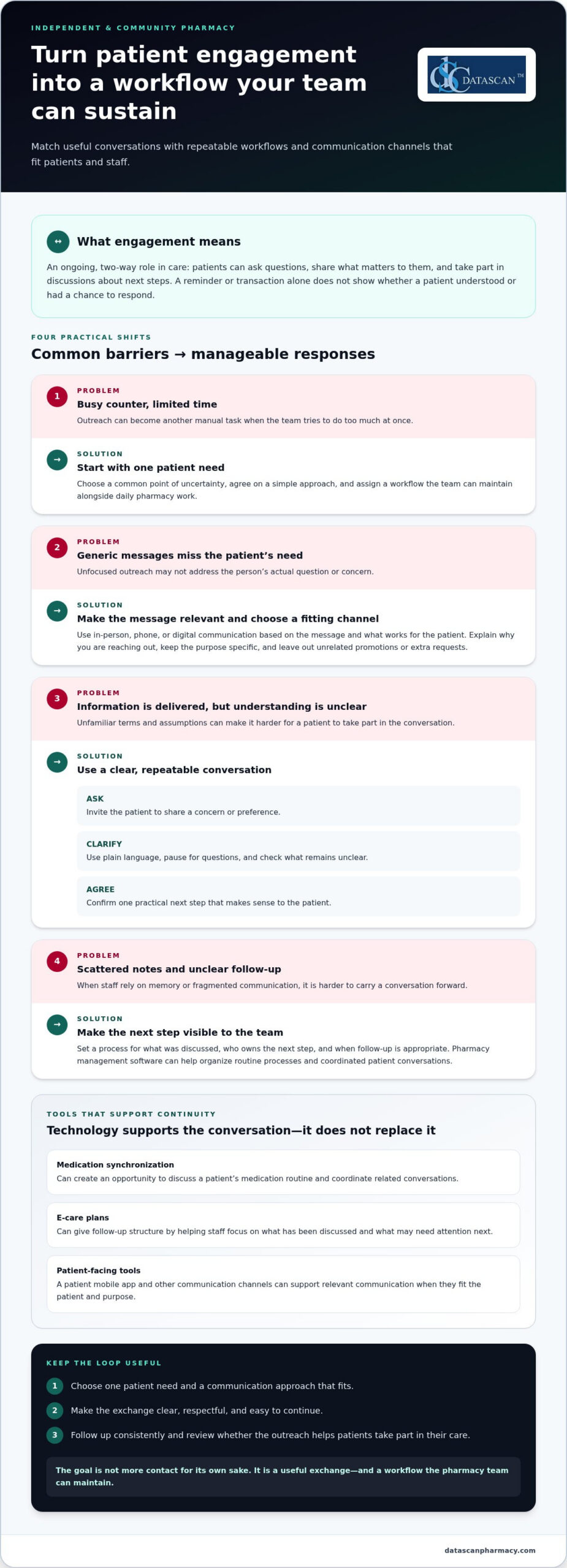
Patient engagement is an ongoing, two-way role in a person’s care. In a pharmacy, it means patients can ask questions, share what matters to them, and take part in discussions about next steps. A reminder or transaction can provide information, but it doesn’t show whether the patient understood it or had a chance to respond.
Meaningful participation depends on communication patients can understand and use. The Agency for Healthcare Research and Quality’s Health Literacy Universal Precautions Toolkit recommends making health information easier to understand and act on. Pharmacy teams can apply this by using plain language, inviting questions, and checking whether instructions are clear instead of assuming information has landed because it was delivered.
Engagement can make pharmacy interactions more responsive and understandable, but it doesn’t guarantee a clinical outcome. In independent and community pharmacies, trust and continuity matter to the day-to-day relationship. Patients should feel able to raise a concern, receive a clear answer, and know how to continue the conversation. That makes an interaction useful, not just efficient.
What does patient engagement look like at a community pharmacy?
It can happen during a brief interaction. A patient asks how to follow a prescription’s directions; a staff member listens, explains the relevant information in clear terms, and asks what questions remain. At a later visit, the patient may raise a related concern. Recognizing this as part of an ongoing conversation helps staff respond with context instead of treating every visit as an unrelated transaction. The goal is a clear exchange, not a longer conversation for its own sake.
What gets in the way of patient engagement?
Limited staff time, fragmented communication, and generic outreach can make interactions less relevant. Unfamiliar terms or unclear next steps can also create friction. These barriers don’t mean patients are unwilling to participate. They show where the pharmacy can make communication more accessible and coordinated.
Independent pharmacies need processes that fit the pace of daily operations. When staff have to reconstruct previous conversations from scattered notes or repeat manual coordination, continuity gets harder. Pharmacy management software can support organized workflows, while pharmacy staff provide the judgment and personal attention that make engagement meaningful.
How can a pharmacy build stronger patient engagement?
Build engagement around a patient’s immediate needs, then make the next interaction easy to continue. Start by identifying a common point of uncertainty, such as understanding prescription directions or coordinating a medication routine, and shape communication around it. This is more useful than launching several disconnected outreach tactics at once. To increase patient engagement in a pharmacy, make each interaction clear, respectful, and relevant to the person receiving it.
How can pharmacists make everyday conversations more engaging?
Open-ended questions give patients room to share what matters. Try, “What questions do you have about your medications?” or “What would make this easier to manage?” Explain information in plain language, pause for questions, and don’t assume silence means understanding. Before the conversation ends, agree on one clear next step, such as when the patient will follow up or what to do if another question comes up.
A short, repeatable conversation can help staff keep the exchange focused:
- Ask: Invite the patient to describe a concern or preference.
- Clarify: Explain the relevant information in familiar language and check what remains unclear.
- Agree: Confirm a practical next step that makes sense to the patient.
The aim isn’t to use a script word for word. It’s to make space for the patient’s perspective, even during a brief interaction. Respectful questions also help staff avoid sending information that doesn’t address the person’s actual concern.
How can personalized pharmacy services support ongoing engagement?
Medication synchronization can create an opportunity to discuss a patient’s medication routine and coordinate related conversations. E-care plans can provide structure for relevant follow-up, helping staff focus on what has been discussed and what may need attention next. Neither guarantees a particular result; both can support purposeful, continued communication when used in a way that fits the patient.
Keep outreach specific to its purpose. A message about a planned check-in should explain why you’re contacting the patient and give them a simple way to respond or ask for clarification. Avoid adding unrelated promotions or packing several requests into one message. Clear communication respects the patient’s time and helps staff keep follow-up focused.
Consistency also depends on whether the team can carry an interaction forward without relying on memory or scattered notes. A defined process can help staff know what was discussed, who owns the next step, and when follow-up is appropriate. Pharmacy workflow software can support organized processes and coordinated patient conversations.
To strengthen engagement without stretching the team, choose one patient need, agree on a shared approach, and refine it as staff learn what questions come up. Related pharmacy patient retention strategies can connect consistent, patient-centered interactions with the broader goal of maintaining lasting relationships.
Will patient engagement add work, or can technology make it manageable?
Patient engagement can add work if every reminder, follow-up, and patient question becomes a separate manual task. Technology can help organize repeatable steps and keep communication connected, but it can’t replace trust built through thoughtful conversation. For an independent pharmacy, the goal is to use digital tools where they fit and protect staff time for interactions that need human attention.
Different channels suit different needs. Choose based on the patient’s preference, the purpose of the contact, and whether a response or conversation is needed.
| Channel |
Patient fit and access |
Staff effort and continuity |
| In-person conversation |
Useful when a patient wants to ask questions directly or discuss a concern during a visit. |
Requires staff time in the moment; a clear process for documenting next steps can support continuity. |
| Phone outreach |
Offers direct interaction for questions that may need clarification or discussion. |
Takes staff time to place and manage calls; a consistent follow-up record helps the team stay coordinated. |
| Patient-facing digital tools |
Can offer another way to access pharmacy communication for patients who prefer digital channels. |
Can support routine touchpoints, while personal questions may still call for a staff conversation. |
Which engagement channel fits different patient needs?
Use in-person or phone contact when a patient’s question needs discussion, clarification, or a chance to explain preferences. A patient app may suit someone who prefers digital access for routine interactions. The MobileScripts patient app can be one option in a broader approach, not a replacement for staff contact. Match the channel to the interaction instead of assuming one method works for everyone.
How can pharmacy management software reduce disconnected work?
When staff rely on separate reminders, notes, and handoffs, it takes extra effort to see what has already happened and what needs attention. Pharmacy management software can support repeatable processes and help keep routine work organized. It doesn’t decide what a patient needs or provide empathy; pharmacy staff bring the judgment and personal communication. An organized system can help make that attention easier to sustain.
As you consider how to increase patient engagement in a pharmacy, identify which steps are routine and which need a personal response. Use technology to support consistency around routine work, then reserve staff attention for questions, preferences, and follow-up that benefit from direct interaction. Pharmacy management software can help connect pharmacy processes while the team keeps the patient relationship at the center.
How can a pharmacy put patient engagement into a sustainable workflow?
A sustainable patient engagement workflow gives each interaction a clear purpose, an owner, and a next step. Start with one recurring patient need, try a practical approach, and review whether the process is useful before expanding it. This keeps outreach from becoming a collection of disconnected tasks competing with daily pharmacy operations.
How should a pharmacy start an engagement workflow?
Ask the team to identify a recurring patient need that fits the pharmacy’s services. Choose a suitable communication approach and decide who will handle the next step. Keep the first workflow straightforward: staff should know what action to take and where to record its status. Review the process together and adjust it when a handoff or instruction creates friction.
- Choose a need. Select one recurring situation patients ask about or need help coordinating.
- Select an approach. Pick a communication channel and a clear purpose for the interaction.
- Assign ownership. Identify who initiates outreach, handles responses, and records follow-up.
- Follow up. Complete the agreed next step and note whether it happened or remains outstanding.
- Review and refine. Discuss what worked, where the process stalled, and what should change before continuing.
For example, if the team chooses a recurring need related to medication synchronization, define how staff will explain the service, who will respond to patient questions, and how agreed follow-up will be tracked. Start with that process instead of launching several initiatives at once. A manageable beginning gives the team room to learn without adding unnecessary coordination.
What should a pharmacy measure to review engagement?
Track measures the team can observe: whether planned outreach was completed, whether a patient responded, and whether agreed follow-up is still open or finished. These measures show where the workflow is moving or getting stuck; they aren’t proof of a clinical result. Pair them with staff feedback and, where appropriate, patient comments to understand whether the interaction felt clear and useful.
Keep the review focused. If outreach is often incomplete, examine whether ownership is clear or the steps are too cumbersome. If patients respond but still need the same clarification, reconsider the message or next step. Avoid setting an arbitrary target before the pharmacy understands its own workflow. The goal is practical improvement, not reporting that consumes the time the process is meant to protect.
Pharmacy management software and configurable workflows can help organize task ownership and follow-up details, reducing avoidable manual coordination. Pharmacy workflow software can support repeatable processes while staff remain responsible for personal judgment and patient communication. As you refine the process, ask whether each step makes the patient interaction clearer or simply adds work.
For support aligning pharmacy technology with your engagement workflow, connect with the Datascan team.
How can pharmacy management software support patient engagement?
Pharmacy management software can support consistent patient-facing workflows while helping independent pharmacy owners manage a demanding operation. That matters as PBM reimbursement pressures and reforms shape pharmacy finances. Technology can help organize routine work, but it can’t change a PBM contract or guarantee better reimbursement. Its practical value is reducing disconnected manual steps, giving owners and staff more time to focus on patient care and review business pressures.
What can Datascan tools contribute to patient-facing pharmacy workflows?
Datascan Pharmacy Management Software supports pharmacy operations, and its customizable workflow capabilities can help organize routine processes. Reducing avoidable coordination can give pharmacy owners more room to assess operational needs, including reimbursement pressures. The software doesn’t determine reimbursement terms or replace financial review. The team remains responsible for understanding its circumstances and deciding how to respond.
Patient-facing tools can support a pharmacy’s engagement approach. MobileScripts is a patient mobile app, and medication synchronization and e-care plans are supported features that can help structure patient interactions and follow-up. These tools don’t guarantee a particular patient response, clinical outcome, or financial result. They support pharmacy processes while staff provide the judgment and communication patients need.
For example, a pharmacy can use a consistent workflow to coordinate an engagement activity and organize follow-up, while staff handle patient questions and next steps. Owners can also use time spent less on manual coordination to review operational challenges, including PBM reimbursement concerns. Technology can support that work, but it doesn’t replace a careful review of pharmacy finances.
What is a practical next step for an independent pharmacy?
Choose one engagement workflow the team wants to make easier, then identify the manual handoffs or repeated tasks that slow it down. Consider how simplifying that process could give staff more time for patient communication and owners more capacity to focus on business priorities, including reimbursement pressures. A specific workflow makes it easier to discuss the pharmacy’s needs, staff capacity, and patient communication goals.
Datascan’s pharmacy management software and workflow tools support pharmacy operations, while the team remains at the center of patient relationships. Start a technology conversation with the work your pharmacy needs to manage, not an expectation that software alone will resolve PBM reimbursement challenges.
Discuss your pharmacy’s needs with Datascan.
Make your next engagement step manageable
Stronger patient engagement doesn’t require a sweeping change. Choose one interaction your team wants to make easier, then consider how workflows and tools can support it without taking the human element out of care. That focused first step gives your pharmacy a practical way to build on what already works.
Datascan is a family-owned company that has operated since 1981, with U.S.-based support for independent and retail pharmacies. If you’re considering how to increase patient engagement in a pharmacy, bring one workflow or patient communication goal into the conversation. A useful starting point is one that fits your team’s capacity and the ways your patients prefer to connect.
Talk with Datascan about patient engagement workflows and take the next step toward a process your team can sustain.
Frequently Asked Questions
What is the difference between patient engagement and patient satisfaction?
Patient satisfaction reflects how a patient evaluates an experience, while engagement describes their involvement in care-related conversations and decisions. Someone might be pleased with a quick, friendly visit without asking questions or discussing next steps. Engagement involves taking part, such as sharing a concern or confirming a plan. Pharmacies can gather patient feedback to understand the experience and consider whether interactions give people a meaningful opportunity to participate.
How can a small pharmacy improve patient engagement with limited staff?
A small pharmacy can focus its effort on a specific patient need instead of trying to contact everyone. For example, the team might identify a common question at prescription pickup and prepare a clear way to address it. Make the handoff visible so another staff member can continue if the person who started the conversation becomes busy. This keeps engagement connected to routine work rather than creating a separate outreach task for every concern.
Can a pharmacy app replace conversations with a pharmacist?
No. An app can provide a digital way to interact with the pharmacy, but it can’t replace a pharmacist’s professional judgment or a conversation tailored to a patient’s question. A routine request may suit a digital tool, while uncertainty about medication directions may need direct discussion. Make it clear how patients can reach the pharmacy team when they need help, and treat digital access as one part of patient communication.
How often should a pharmacy contact patients about their care?
There isn’t one contact schedule that fits every patient or purpose. Base timing on why the pharmacy is reaching out, any next step agreed with the patient, and their communication preferences. Before sending another message, consider whether it adds useful information or simply repeats an earlier contact. Asking patients which channel they prefer can help staff tailor future communication and avoid unnecessary outreach.
What should pharmacy staff do when a patient does not respond to outreach?
A lack of response doesn’t explain why a patient hasn’t replied. The message may have been missed, the channel may not suit them, or they may not need help at that time. Avoid repeated contact without a clear purpose. For routine outreach, staff can note the status and offer another way to connect during a later interaction. If the matter needs timely attention, follow the pharmacy’s established procedures for that situation.
How can a pharmacy tell whether its patient engagement efforts are useful?
Review more than the number of messages sent. Consider whether patients responded, whether staff completed the intended follow-up, and whether feedback suggests the communication was clear. For example, if patients continue to ask what action to take, the message may need revision. Review one engagement effort at a time and use staff observations alongside patient comments to decide what to change. Activity counts alone don’t show whether outreach was useful.
About the author: This FAQ was prepared by the Datascan Pharmacy Software editorial team, which focuses on pharmacy management software and tools for independent and retail pharmacies.
Article by
Sarah Callioras
Sarah Callioras is Vice President at Datascan Pharmacy Software, bringing nearly 25 years of experience across independent pharmacy operations and pharmacy technology. Since joining Datascan in 2016, she has played a key role in driving business growth, strengthening client relationships, and supporting independent pharmacies through innovative software solutions. With a strong background in pharmacy operations, business development, and strategic leadership, Sarah is passionate about helping independent pharmacies succeed in an evolving healthcare landscape.

Clinical services work best when their workflows fit the pharmacy’s day instead of adding another layer of manual tasks. Pharmacist clinical workflow tools help organize medication therapy management (MTM), documentation, and patient follow-up alongside daily pharmacy operations.
For independent pharmacists, dispensing, staffing, and reimbursement pressures can leave little time to coordinate care consistently. The goal is not simply to add software. It is to make patient-care tasks easier to see, assign, and complete within the pharmacy’s existing processes.
This article explains which clinical workflow steps technology can support, how to compare tools, and how pharmacy management software with customizable workflows can help bring clinical and operational tasks together.
About the author: Datascan Pharmacy Software is a family-owned pharmacy software company serving independent and retail pharmacies since 1981, with U.S.-based technical support.
Key Takeaways
- Separate clinical-care workflows from dispensing, inventory, and retail tasks, then identify where handoffs need attention.
- Use pharmacist clinical workflow tools to track care opportunities, assign next steps, and organize documentation without replacing clinical judgment.
- Compare tools by task visibility, documentation, follow-up, and how well they fit your pharmacy’s actual processes.
- Map the current process, identify points of friction, define requirements, then test and review a focused workflow change.
- Consider how pharmacy management software and customizable workflows can connect clinical tasks with broader pharmacy operations.
Pharmacist clinical workflow tools organize patient-care tasks, documentation, and follow-up. Pharmacy management software can also help connect this work with broader pharmacy operations. For independent pharmacies facing pressure on pharmacist time and reimbursement, organized records make it easier to review completed work and locate relevant information. Software does not determine payment or guarantee reimbursement.
Clinical workflows are distinct from dispensing, inventory, and front-end retail workflows, even when they interact. A pharmacy management system supports pharmacy operations broadly, while clinical workflows structure care activities such as medication reviews and follow-up. PBM reform discussions have also drawn attention to PBM practices and their effects on pharmacies. The Federal Trade Commission’s report on pharmacy benefit managers provides context for that scrutiny.
Which pharmacy tasks count as clinical workflow?
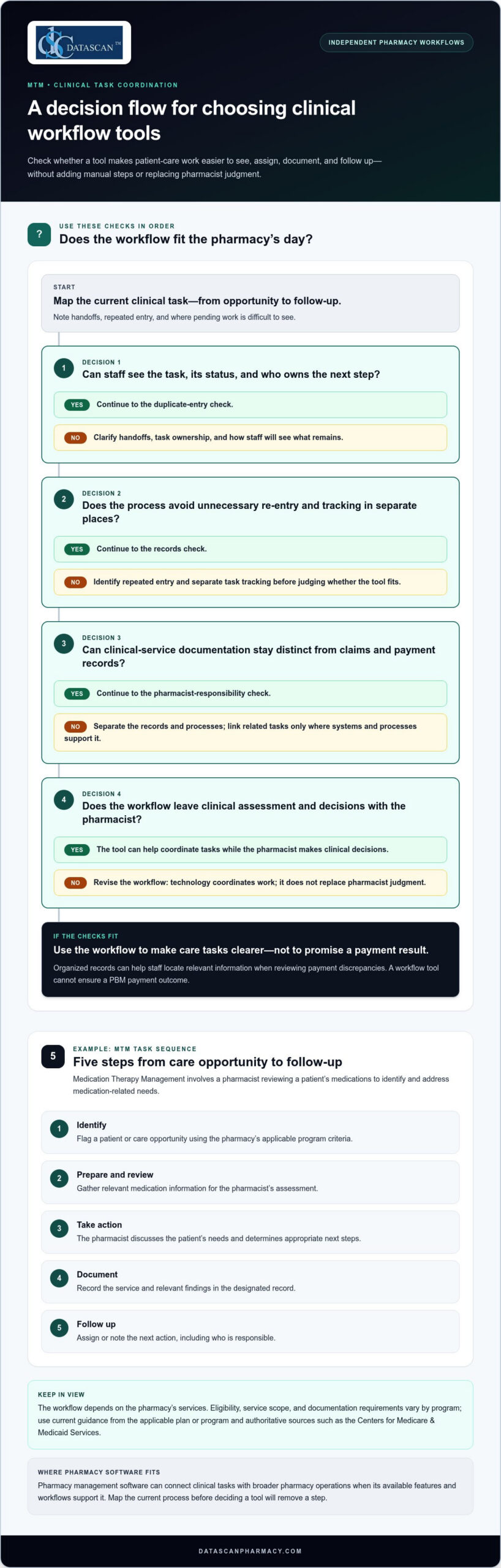
A clinical workflow can begin with identifying a patient-care opportunity and continue through preparation for a medication review, service documentation, and follow-up. The steps depend on the services your pharmacy provides. Make task ownership and status visible so staff can coordinate handoffs and see what remains. Keep clinical-service documentation distinct from claims and payment records, while linking related tasks where your systems and processes support it.
- Identify: Flag a care opportunity for attention.
- Review: Prepare relevant information for the pharmacist.
- Document: Record the service and relevant details.
- Coordinate: Assign the next action and its owner.
Technology can coordinate tasks, but the pharmacist remains responsible for clinical assessment and decisions. For reimbursement review, organized records can help staff locate relevant transactions or documentation when examining payment discrepancies. The information available depends on the pharmacy’s systems and workflow, and no workflow tool can ensure a PBM payment outcome.
How do MTM and e-care plans fit into the workflow?
Medication Therapy Management (MTM) is a pharmacist service that includes reviewing a patient’s medications to identify and address medication-related needs. Depending on the pharmacy’s services and applicable program requirements, the workflow may include preparation, review, documentation, care-plan updates, and follow-up. Medication synchronization and e-care plans are also useful activities to include when mapping patient-care tasks alongside routine operations. Define the steps around the services your pharmacy provides, then assess whether technology makes those steps clearer without requiring unnecessary entry or mixing clinical documentation with reimbursement reconciliation.
Clinical workflow tools make MTM tasks easier to see and coordinate, but they do not make clinical decisions for the pharmacist. Their value depends on how well they fit the pharmacy’s process. If staff must re-enter information or track tasks in separate places, the technology can add work instead of reducing it.
What are the main steps in an MTM workflow?
Medication Therapy Management (MTM) involves a pharmacist reviewing a patient’s medications to identify and address medication-related needs. A practical workflow might include these steps:
- Identify: Flag a patient or care opportunity using the pharmacy’s applicable program criteria.
- Prepare and review: Gather relevant medication information for the pharmacist’s assessment.
- Take action: The pharmacist discusses the patient’s needs and determines appropriate next steps.
- Document: Record the service and relevant findings in the designated record.
- Follow up: Assign or note the next action, including who is responsible.
Eligibility, service scope, and documentation requirements vary by program. Use current guidance from the applicable plan or program and authoritative sources, such as the Centers for Medicare & Medicaid Services, when defining your process.
Where can technology reduce workflow friction?
Look for repeated handoffs, follow-ups that are easy to overlook, and records staff must search for across separate systems. A visible task sequence can show what is pending, what has been documented, and where a handoff is needed. Pharmacy management software can reduce duplicate entry when its workflow and available features support using information across connected tasks. Map the current process before deciding that a tool will eliminate a step.
For independent pharmacies, pharmacy workflow software provides a configurable structure for organizing operational tasks. The aim is clearer coordination, with the pharmacist retaining responsibility for clinical assessment and decisions.
How should pharmacies discuss PBM-related clinical work?
Keep clinical-service documentation distinct from prescription claims adjudication and payment reconciliation. An MTM service record supports the pharmacy’s documentation process, but it does not establish that a PBM will pay a particular amount or reimburse the service. PBM reimbursement pressures make careful organization valuable. Pharmacist clinical workflow tools coordinate tasks, not reimbursement outcomes.
Review whether each step has a clear owner, whether information is entered more than once, and how the team sees pending follow-up. Make changes only where the software’s capabilities support them, then confirm that the revised process still meets the relevant program’s requirements.
Compare pharmacist clinical workflow tools against real tasks in your pharmacy, not the length of a feature list. Check whether staff can see pending work, record care activities, coordinate follow-up, adapt the process to your services, and avoid entering the same information in multiple places.
| What to compare |
What it means in practice |
| Workflow visibility |
Can staff tell which clinical tasks are pending, in progress, or ready for a handoff? |
| Documentation |
Can the team record the service and its next action consistently? |
| Follow-up |
Is it clear what needs to happen next and who is responsible? |
| Customization |
Can the workflow reflect the pharmacy’s actual services and division of work? |
| System fit |
Does clinical work connect sensibly with pharmacy operations, patient communication, and existing records, or does it create duplicate entry? |
Does the tool fit the pharmacy’s clinical services?
Start with services you provide or plan to organize, such as MTM, medication synchronization, and care-plan activities. Separate essential needs, such as recording a completed review or assigning follow-up, from optional functions. A tool should support your process without requiring staff to maintain a parallel workflow. For broader context on pharmacy management software, see Datascan’s pharmacy management software.
Can staff see and coordinate the work?
Trace a task from its starting point to the next action. Can the right team member identify what is waiting, understand their responsibility, and see whether follow-up remains open? Consider how the clinical process intersects with dispensing and patient communication, while keeping those workflows distinct where needed. Review the steps in the system itself rather than relying on a feature label to explain how they work.
What evidence should support a tool’s claims?
Evaluate the tool using a representative pharmacy workflow, such as identifying a care opportunity, documenting the pharmacist’s action, and recording follow-up. Check that claims about documentation or program requirements align with current authoritative guidance. Watch for repeated information entry and confirm that staff can follow the task sequence clearly.
Choose the tool that fits your pharmacy’s clinical workflow, not the one with the longest feature list. This keeps the comparison grounded in daily operations and your team’s needs.
How can a pharmacy map and improve its clinical workflow?
Map the clinical process your team follows before changing software or adding steps. A practical review shows where ownership is unclear, information is entered more than once, or follow-up stalls. Use those findings to focus pharmacist clinical workflow tools on real operational needs. Keep the plan workable for your staff and the time you can give it.
How do you map the current clinical process?
Choose one service, such as an MTM review or care-plan follow-up, and write down each step from identifying the patient-care task through completing the next action. Include handoffs between the pharmacist and other team members. Keep the map simple enough to reflect a normal workday, not just an ideal process.
- Record who starts the task and what prompts it.
- Note what information staff need and where they document it.
- Mark repeated entry, unclear ownership, and delayed next steps.
- Show how the team records completion or assigns follow-up.
Use only the information needed for the review, and follow your pharmacy’s procedures for protecting patient information. A workflow map should clarify the process without becoming an informal record containing unnecessary patient details.
How should a pharmacy test a workflow change?
Define the problem before selecting a solution. If follow-up tasks are often left unclear, for example, test a change that makes responsibility and status easier to track. Decide what you will observe in advance, such as whether each task has an owner and whether the next action is documented. Avoid arbitrary time-saving targets or assuming a change worked without pharmacy-specific evidence.
Get feedback from the staff who use the process, including team members managing dispensing alongside clinical services. If a new step creates extra entry or interrupts work at a busy point in the day, revise it. The goal is a process the team can follow consistently, not a more elaborate workflow diagram.
When should a pharmacy revisit its workflow?
Review the process when services, staffing, or operating needs change, or when recurring issues show that the current steps no longer fit. Pharmacy management software with customizable workflow capabilities can help align task sequences with the way your pharmacy works. Let the process guide the configuration, not the other way around. Keep this review focused on clinical tasks rather than broader software-conversion decisions.
If you’re ready to review how your pharmacy handles clinical tasks, discuss your pharmacy workflow with Datascan.
How can Datascan pharmacy management software support clinical workflows?
Datascan pharmacy management software includes customizable workflow capabilities that pharmacies can assess against their clinical services, staff responsibilities, and daily processes. Use those capabilities to consider whether a workflow can reflect how your team handles tasks. Software does not make clinical decisions or guarantee a particular result.
What should a pharmacy look for in customizable workflow?
Start with the process you mapped: what initiates a task, who handles each step, what needs documenting, and how follow-up is assigned. Then assess whether a workflow can be adapted to those needs without adding unnecessary steps or duplicate entry. A pharmacy providing MTM, medication synchronization, or care-plan services may have different coordination needs from a pharmacy offering a different mix of services.
Datascan offers pharmacy workflow software with customizable workflow capability. Use your pharmacy’s process as the reference point when considering how that capability fits your team’s work.
How does pharmacy management software fit clinical services?
Clinical tasks take place alongside dispensing and other pharmacy operations, so consider how a system fits into the broader management process. Datascan’s pharmacy management software serves independent and retail pharmacies. Medication synchronization and e-care plans are relevant activities to include in a workflow discussion. Map the steps your pharmacy needs for each activity, including documentation and follow-up, rather than assuming a particular sequence or outcome.
Compare the system with the criteria established earlier: whether staff can understand pending work, record necessary information, coordinate next steps, and avoid needless re-entry. Consider how the workflow fits available staff capacity. For independent pharmacy owners balancing dispensing, operations, and reimbursement pressures, a clear, practical process matters more than added complexity.
What is the next step for evaluating fit?
Bring a specific workflow challenge to the discussion, such as unclear task ownership, fragmented follow-up, or repeated documentation. Include the staff roles involved, the steps you want to support, and the information the team needs to record. A focused conversation makes it easier to assess how Datascan’s customizable workflow aligns with your pharmacy’s processes, without presuming a clinical or reimbursement result.
Talk with Datascan about your pharmacy’s workflow and the clinical tasks your team wants to organize.
Build a Clinical Workflow That Fits Your Pharmacy
Effective pharmacist clinical workflow tools make patient-care tasks easier to organize while keeping clinical judgment in the pharmacist’s hands. Start by mapping your current process, then compare tools by task visibility, documentation, follow-up, and fit with your pharmacy’s services and staffing.
For independent pharmacies balancing patient care with daily operations and PBM pressures, the right workflow supports coordination without promising reimbursement or adding unnecessary steps. Datascan pharmacy management software includes customizable workflow capabilities, which your team can assess against the processes it needs to manage. Datascan has been family-owned and operated since 1981, with U.S.-based technical support.
A focused conversation can clarify your workflow priorities and system-fit questions. Talk with Datascan about your pharmacy’s clinical workflow and the processes your team wants to support. Start with the way your pharmacy works today.
Frequently Asked Questions
What are pharmacist clinical workflow tools?
Pharmacist clinical workflow tools organize patient-care tasks, including identifying a care opportunity, preparing for a medication review, documenting the service, and coordinating follow-up. They are distinct from dispensing, inventory, and retail workflows, though pharmacy management software may support both clinical and operational work. These tools help staff coordinate tasks; pharmacists retain responsibility for clinical judgment. For a broader overview of MTM in Medicare, see Medicare’s description of Medication Therapy Management programs.
How can pharmacy software support medication therapy management?
Pharmacy software can organize the administrative steps around Medication Therapy Management (MTM), a medication review service for eligible Medicare Part D enrollees. A pharmacy might use a workflow to track preparation, document the review, and record follow-up. Program details and eligibility criteria can vary, so use current guidance. Medicare explains MTM program basics, while CMS provides program requirements for Part D sponsors.
Can workflow tools help independent pharmacies save pharmacist time?
Workflow tools can reduce avoidable effort when they make tasks visible and help prevent unnecessary duplicate entry. A clear process, for example, can show who owns a follow-up and whether documentation remains to be completed. The effect depends on the pharmacy’s process and the tool’s actual capabilities. Review the workflow with staff, identify repeated steps, and assess changes using your pharmacy’s own observations rather than assuming a particular time saving.
What should an independent pharmacy look for in clinical workflow software?
Look for support for your services and daily processes: visible pending tasks, consistent documentation, clear follow-up ownership, customization, and fit with broader pharmacy operations. Test the system using a representative task, such as moving from a care opportunity to a documented next action. Check whether staff must re-enter information or switch between disconnected processes. Prioritize a workflow your team can use, and verify program requirements against current CMS or payer guidance.
How do clinical workflows relate to PBM reimbursement?
Clinical workflows organize care tasks and service documentation. They do not determine prescription claims adjudication or guarantee PBM reimbursement. Keep clinical-service records distinct from claims processing and payment reconciliation. PBM contract and payment practices are separate from documenting patient care. The Federal Trade Commission’s report on pharmacy benefit managers provides context on PBM practices, but software cannot promise a payment amount or change contract terms.
Can pharmacy management software support e-care plans and medication synchronization?
Pharmacy management software can help organize workflows related to patient-care activities and routine pharmacy operations. Datascan identifies e-care plans and medication synchronization among its feature areas. The workflow should reflect the pharmacy’s services and operating process, including the tasks staff need to coordinate. For Medicare MTM, use current Medicare program information and applicable sponsor guidance rather than assuming one documentation process applies to every service.
How can a pharmacy tell whether a workflow tool is adding extra steps?
Trace a real task from start to finish and note each handoff, information entry, and staff action. Repeatedly entering the same details, tracking status elsewhere, or unclear responsibility for the next step can signal extra work. Ask staff where the process feels duplicated or confusing, then compare the actual workflow with the intended one. Review changes against applicable documentation procedures and program guidance, including current CMS guidance for Medicare Part D MTM where relevant.
Article by
Sarah Callioras
Sarah Callioras is Vice President at Datascan Pharmacy Software, bringing nearly 25 years of experience across independent pharmacy operations and pharmacy technology. Since joining Datascan in 2016, she has played a key role in driving business growth, strengthening client relationships, and supporting independent pharmacies through innovative software solutions. With a strong background in pharmacy operations, business development, and strategic leadership, Sarah is passionate about helping independent pharmacies succeed in an evolving healthcare landscape.