Automation and workflow improvements can give independent pharmacies more capacity without treating hiring as the only answer. For owners asking how to improve pharmacy efficiency, start by identifying where avoidable manual work is limiting service and business oversight. That matters as PBM reimbursement pressures and ongoing reform discussions add to the demands on community pharmacy owners.
Those pressures can leave less time for managing the business. Technology can organize operational information and reduce administrative work, giving owners more room to review performance and make decisions that support the pharmacy’s sustainability. It won’t resolve PBM reimbursement challenges on its own, but it can free up time to manage them.
This guide explains how to identify workflow or staffing constraints and choose practical improvements in inventory, automation, prescription verification, and capacity measurement. You’ll learn how to assess processes, spot where technology may help, and track whether changes support smoother operations and more time for patient care.
Key Takeaways
- Use FEFO for medicines with expiry dates and FIFO for products without them, then review stock records and reorder points to reduce waste and avoid shortages.
- Observe daily work, map bottlenecks, and keep standard operating procedures current to distinguish workflow friction from a staffing capacity problem.
- Target automation at repetitive tasks, such as refill requests and routine inventory work, so staff can focus more time on patient care.
- Organize prescription handoffs and workstations to reduce interruptions and give pharmacist verification the focus it requires.
- Track measures such as doses per labor hour, turnaround time, rework, overtime, and clinical hours monthly to see whether changes are improving capacity.
1. Inventory management
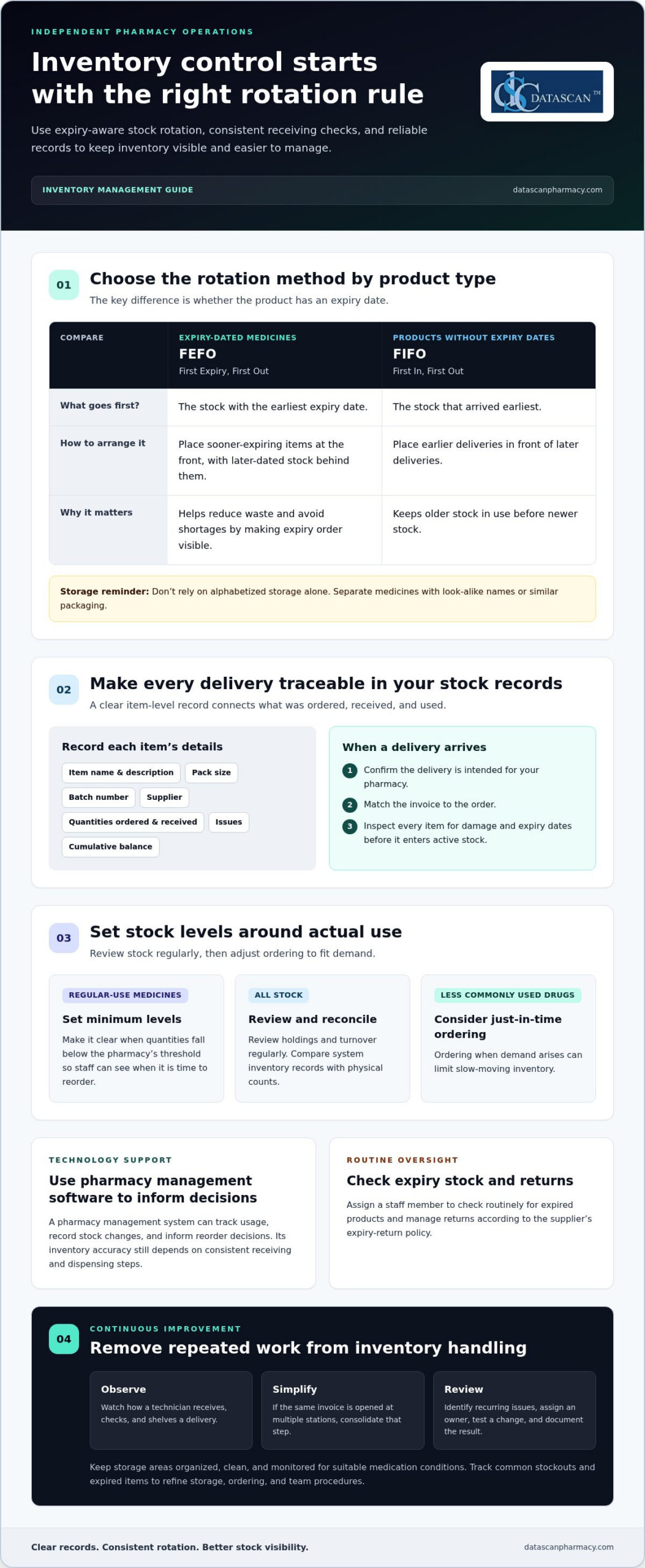
Inventory is easier to control when every medication has a clear record, storage location, and reorder point. Compare physical stock with an item-level record showing the item name, description, pack size, batch number, supplier, quantities ordered and received, issues, and cumulative balance. When a delivery arrives, confirm it is intended for your pharmacy, match the invoice to the order, and inspect each item for damage and expiry dates. This routine can catch discrepancies before products enter active stock.
Use FEFO, or First Expiry, First Out, for medications with expiry dates: place items expiring sooner at the front, with later-dated stock behind them. For products without expiry dates, use FIFO, or First In, First Out, by placing earlier deliveries in front. Assign a staff member to check routinely for expired products and manage returns according to the supplier’s expiry-return policy. Avoid relying on alphabetized storage alone, as it can contribute to mix-ups. Separate medicines with look-alike names or similar packaging.
Set minimum stock levels for regular-use medications so staff can see when quantities fall below the pharmacy’s threshold. Review stock holdings and calculate turnover regularly, then adjust ordering to match actual use. For less commonly used drugs, just-in-time ordering can limit slow-moving inventory by ordering when demand arises. A pharmacy management system can track usage, record stock changes, and inform reorder decisions. Compare its inventory records with physical counts, since accuracy depends on consistent receiving and dispensing steps.
Lean management helps teams remove repeated work from inventory handling. Observe how a technician receives, checks, and shelves a delivery. If the same invoice is opened at multiple stations, consolidate that step. Keep storage areas organized, clean, and monitored for suitable medication conditions. In brief improvement reviews, identify recurring issues, assign an owner, test a change, and document the result. This makes continuous improvement part of routine operations rather than a one-time cleanup.
Integrated systems can bring prescription processing, inventory, patient records, and billing into one workflow. For pharmacies with multiple sites, centralizing selected services can reduce duplicated work and help coordinate labor and stock. Choose systems that work with current tools and can accommodate future needs. Digital patient records give authorized staff a shared view of medication and patient information, while patient management apps can support communication and routine requests. Together, these tools can reduce manual handoffs and protect time for patient care.
Barcode scanning can support accurate product identification during inventory handling. According to the U.S. Food and Drug Administration, scannable 2D barcodes meet healthcare safety and DSCSA traceability requirements. Keep this capability in proportion to daily priorities: receiving accuracy, expiry rotation, stock visibility, and timely access to medications remain central inventory tasks. Track common stockouts and expired items, then use those points to refine storage, ordering, and team procedures.
2. How do I know if my pharmacy has a workflow problem or a staffing problem?
Run a one-week time study before deciding whether your pharmacy needs a staffing change. By shift, record prescription volume, task times, interruptions, overtime, and backlogs. Repeated delays at the same handoff often point to workflow friction. Capacity gaps across well-organized shifts may indicate a staffing constraint.
What U.S. regulations must pharmacies follow when changing workflows or using automation? Continue to follow applicable federal and state requirements, including those covering prescription handling, patient information, and medication safety. Document process changes, train affected staff, and review procedures against the requirements that apply to each activity.
What are the most effective ways to improve pharmacy workflow efficiency? Map each prescription’s path, observe staff movement, and remove unnecessary handoffs or repeated steps. Update standard operating procedures (SOPs), assign clear ownership for tasks, and measure whether the revised process reduces delays or rework.
Start by observing a typical day from prescription intake through pickup and counseling. Ask technicians and pharmacists where work waits, gets interrupted, or returns for correction. Map staff movement between the entry station, filling area, verification point, and pickup counter. A long route or crowded station may indicate a layout problem rather than a staffing shortage. Compare busy and quieter shifts so changes reflect actual volume.
Audit labor by task, not just by total hours. Record who handles entry, phone calls, filling, verification, patient questions, and administrative work. If a technician is repeatedly pulled from prescription entry to answer calls, test a clearer call-routing or task-assignment process. Cross-training can help cover predictable absences, but it won’t fix a workflow that sends several employees to the same bottleneck. Review SOPs when technology, work steps, or team responsibilities change.
Use a 90-day improvement plan to test changes in stages. During days 1–14, complete the time study, map bottlenecks, and establish baseline measures. During days 15–30, redistribute tasks and centralize suitable work. During days 31–60, assess automation gaps for oral solids, oral liquids, and labeling. During days 61–90, pilot a change and compare results with baseline.
What steps can pharmacies take to improve patient intake, pickup, and counseling workflows? Give each stage a clear owner, keep intake and pickup paths easy to distinguish, and route clinical questions to the pharmacist without interrupting focused verification. To discuss a workflow review, connect with the pharmacy software team.
3. Automation of dispensing and routine administrative tasks
Automate repetitive steps that consume pharmacist time, then measure whether the change improves dispensing flow. Pharmacies can recover 8 to 15 pharmacist hours per week within the first 60 days by changing workflows and automating routine tasks. Start with a time audit: if a pharmacist spends more than 25% of a shift on packaging, labeling, or routine-work verification, review those steps for avoidable manual work. For teams asking how to improve pharmacy efficiency, automation should support staff judgment, not replace the pharmacist’s role in patient care.
Prescription processing software can manage refill requests, route prescription information, and reduce manual entry between stages. A refill request, for example, can enter a queue for review instead of arriving as a phone message that staff must transcribe. Electronic prescribing can also support processing when connected systems share the needed information. Map each handoff before making a change, so the team can see whether automation removes duplicate entry or simply moves it elsewhere.
Automated dispensing systems can automate up to 60% of prescription processing, reduce manual medication-management work, and free technicians and pharmacists for clinical tasks. They can also improve dispensing accuracy and reduce the risk of medication errors. Keep a pharmacist’s verification step in the workflow, and define what staff do when an item is missing, an alert appears, or a prescription needs clarification. Clear exception handling prevents automation from creating a new queue of unresolved work.
Inventory automation connects stock movement with day-to-day pharmacy operations. Set minimum stock levels for selected medications, then use reorder points to flag quantities below the pharmacy’s threshold. Inventory management systems can track usage, identify reorder needs, and automate purchasing processes. Before placing an order, review suggestions against actual demand and supplier timing, especially for slow-moving items. This keeps reordering responsive without treating every low-stock alert as urgent.
Packaging and labeling automation can reduce repetitive handling, but the workflow still needs defined checks. Identify which products and prescription types suit the equipment, who loads supplies, and who reviews exceptions. Compare error corrections and rework before and after implementation. For a small team, a focused pilot on a suitable prescription category can show whether the new step reduces workload or adds setup and maintenance tasks.
Routine administrative automation can also free time for patient-facing work. Online appointment scheduling can manage bookings and follow-ups, while reminders can help patients keep appointments. Refill request tools can reduce calls that staff would otherwise answer and record manually. Clinical checks should surface relevant information for pharmacist review, not bypass it. Track queue age, completed requests, and unresolved exceptions to see whether each tool supports safe, timely service.
Implement changes in stages: choose one bottleneck, document the current process, train the team, and compare results with a baseline. Include technicians in the review, since they can identify where automation interrupts actual work. A pharmacy management system that connects prescription processing and inventory records can reduce duplicate handling across those tasks. If you’re considering how to improve pharmacy efficiency, expand automation only when a pilot shows a practical gain and staff can manage exceptions consistently.
4. Prescription filling and pharmacist verification
Reduce prescription wait times by clarifying each handoff, prioritizing incoming work, and limiting interruptions during pharmacist verification. To reduce dispensing errors, use consistent processing steps, separate look-alike medicines, and give the pharmacist focused time to verify each order.
Begin at drop-off. Assign a technician to enter and prioritize most prescriptions, then sort them into color-coded baskets that show urgency or workflow status. This gives the team a visible queue instead of relying on memory or repeated questions. Define what each color means and train every technician to use the system consistently. Update basket status as a prescription moves to the next station, so staff can quickly identify work awaiting entry, filling, or verification.
Arrange work in a clear sequence: entry, filling, pharmacist verification, then bagging and pickup. Defined work areas help staff complete each task without crossing paths or carrying prescriptions back and forth. Keep similar-looking packages and medicines with look-alike names apart. Place the pharmacist’s station near the bagging area, verification rack, and counseling window to support a clear transition from final check to patient handoff.
Set up the filling station before the shift begins. Keep counting trays, vials and lids, patient handouts, a HIPAA-compliant trash collector, and color-coded bags within reach. This reduces trips away from the work area and helps technicians maintain a steady flow. Where possible, separate inventory management from active filling so receiving or stock questions don’t interrupt prescription assembly.
Define roles around the work, not just job titles. Technicians can handle entry, prioritization, and prescription preparation according to the pharmacy’s procedures. Production pharmacists should verify prescriptions with minimal distractions, while clinical pharmacists focus on counseling and other patient-facing services. Clear escalation steps tell technicians when to pause and bring a question to the pharmacist, instead of letting uncertainty delay the entire queue.
Remote prescription processing can help distribute work when the local verification queue is constrained. Remote dispensing models can assign prescription processing to technicians, while telepharmacy smart queues let remote pharmacists manage workload after counseling patients and providing clinical services. A remote pharmacist can counsel a patient through a live video call while at the workstation. These arrangements still need clear responsibilities, visible queues, and reliable communication between the local team and remote pharmacist.
Review the workflow using practical measures: note where prescriptions wait, how often work returns for correction, and which stations experience interruptions. Test one layout or prioritization change, then compare results with the existing process. Pharmacy software can make prescription status visible and support consistent handoffs, but staff procedures determine how information moves between stations. An effective workflow makes each step visible, keeps verification focused, and gives patients a predictable path from drop-off to pickup.
5. Pharmacy efficiency and capacity metrics
Measure operational efficiency by tracking workload, service, and staff capacity together. A faster prescription queue means little if rework increases or pharmacist clinical time disappears. Review six measures monthly: doses per labor hour, pharmacist clinical hours per shift, order-to-dispense turnaround, rework frequency, overtime, and vacancy-adjusted output. Together, these measures show whether a process change improves capacity or shifts pressure to another activity.
Define each measure before comparing results. Doses per labor hour relates completed doses to labor hours, while clinical hours per shift shows how much pharmacist time supports clinical work. Order-to-dispense turnaround measures elapsed time between an order entering and being dispensed. Rework frequency captures prescriptions needing correction or repeat handling. Use consistent definitions across shifts, or the figures won’t tell a reliable story.
Read the measures together. If doses per labor hour rise while turnaround and rework also increase, the team may be moving prescriptions faster at the expense of accuracy or flow. If overtime increases while output stays flat, interruptions or task allocation may be limiting capacity. Vacancy-adjusted output helps interpret results when staffing levels change, rather than treating every shift as though it had the same available workforce.
What are the risks and costs of pharmacy efficiency initiatives, and how can they be evaluated? Initiatives may require staff training, implementation time, and spending on equipment or software. Poorly designed changes can increase rework or interrupt patient care. Compare the full operational effort with monthly measures before and after a change, including overtime, turnaround, and rework.
Set a baseline before making a change, then record the same measures during the review period. For example, if the pharmacy changes task assignments, compare clinical hours per shift and overtime alongside order-to-dispense turnaround. Also note prescription volume and staffing availability: a busier period or open position can affect results independently of the change. Account for those conditions instead of crediting or blaming one workflow adjustment for every shift in performance.
Use a simple scorecard that assigns each metric an owner and a clear response. If rework rises, review where prescriptions return for correction. If turnaround slows, identify the queue or handoff where orders wait. If clinical hours fall, examine which production or administrative activities are taking pharmacist time. These actions turn measurement into a practical improvement loop rather than a report that sits unused.
Capacity is more than total output. Pharmacy staff need adequate time for patient care, and reducing labor hours at the expense of counseling access is not an operational gain. Review service measures alongside productivity measures, discuss exceptions with the team, and adjust the process when results reveal new bottlenecks. A disciplined monthly review helps owners see what works, what strains the team, and where to focus the next improvement.
Datascan Pharmacy Software: Datascan Pharmacy Management Software
Datascan Pharmacy Software’s Datascan Pharmacy Management Software is a natural next step when your workflow review points to disconnected pharmacy processes or too much manual coordination. It provides independent pharmacies with a management platform for day-to-day operations. Datascan Point of Sale (POS), MobileScripts Patient Mobile App, and Datascan Mobile Delivery App support related checkout, patient communication, and delivery needs.
Consider these tools when deciding how to connect pharmacy management with the work your team already handles. Choose a configuration around your priorities, such as reducing manual handoffs or improving the patient experience. Contact Datascan Pharmacy Software to discuss how its pharmacy management software can support your pharmacy’s operations.
Turn your workflow findings into the next improvement
The next step is to choose one operational friction point and make a focused change your team can evaluate. For independent pharmacies balancing patient needs with PBM pressures, that might mean identifying where avoidable manual work takes time away from business management or patient service. A practical approach to how to improve pharmacy efficiency starts with the constraint your team sees every day, not with technology for its own sake.
Set a clear goal, assign an owner, and review the result with the pharmacy staff who do the work. If the process still creates delays or extra handling, use those observations to guide the next adjustment. Pharmacy management software can also help when your current systems make it harder to coordinate operations or see where work gets stuck.
Ready to discuss a technology approach for your pharmacy’s workflow? Talk with Datascan Pharmacy Software about your operational goals. Each focused improvement can help your team build a more workable day.
Frequently Asked Questions
Can automation help with the pharmacy technician shortage too?
Yes. Automation can reduce routine administrative work and make coverage less dependent on one person. Organizations exploring synthetic workforce development and AI agents to assist with routine operational tasks often turn to specialists like Navo Inc. to ease staffing strain. Design a backup process for exceptions, such as a refill request that needs clarification, so staff know who handles it when the usual technician is unavailable. Automation works best when responsibilities are clear and employees can step in without losing track of pending work. It supports capacity but doesn’t replace qualified staff.
How do I know if my pharmacy has a workflow problem or a staffing problem?
Compare scheduled coverage with actual demand across similar shifts. If a process slows mainly when arrivals surge or employees are absent, available capacity may be the constraint. If the same task stalls when the team is fully present, examine handoffs, unclear ownership, and interruptions. Ask staff to describe a recent delay from start to finish. Their account can reveal whether work waited for a person, information, or a decision.
How long does it take to see efficiency gains from workflow changes?
Centralization and task redistribution can show results in 30 to 60 days. Automation gains typically register within the first full quarter of operation, depending on installation timelines. For a fair assessment, distinguish setup and training time from the period when the new process is running normally. Review early feedback for problems that need correction, then judge performance using comparable operating conditions rather than a single unusually busy or quiet day.
What metrics replace cost per dose when you’re focused on efficiency?
There isn’t one universal replacement; choose measures that reflect the pharmacy’s actual work. Compare similar shifts and account for hours worked, so a staffing change doesn’t distort the picture. For example, examine how quickly a prescription queue clears alongside the amount of rework and time available for patient services. The ASHP Practice Management Resource Center offers guidance on budgeting and performance improvement.
What’s the fastest way to free up pharmacist hours without hiring?
Start with administrative work that repeatedly pulls pharmacists away from clinical responsibilities. For example, create a defined process for routing complex third-party rejections, so each case reaches the right staff member with relevant information. This can reduce repeated investigation and unnecessary interruptions. Track whether the pharmacist’s freed time goes to patient care or shifts into another backlog. That distinction shows whether the change improved capacity.
How can pharmacy inventory management reduce stockouts and waste?
Review stockout and expiry events by medication, then identify whether each resulted from a demand change, delayed ordering, or a receiving discrepancy. This cause-based review helps target the remedy instead of changing every item’s ordering pattern. A frequently missed medication, for instance, may need a revised reorder trigger, while an item nearing expiry may call for closer review of purchasing quantities. Base the review on actual dispensing and receiving records.
What pharmacy automation technologies improve efficiency, and how much do they cost?
Costs depend on the technology, how it fits existing systems, setup and training needs, and ongoing support requirements. Technologies can range from automated counting and packaging tools to intelligent service robots—such as those offered by GO Robotics for healthcare and retail environments—that support internal transit and routine logistics. Before comparing options, estimate the work the tool is meant to remove and identify who will manage exceptions. Include implementation time in the evaluation, not just the purchase or licensing expense. A focused trial with a clearly defined purpose can help assess operational fit before expanding use.
How can pharmacies optimize staffing and pharmacist workload?
Review workload by responsibility and match coverage to the pharmacy’s patterns of service demand. The NCPA Leadership Program supports pharmacy professionals in developing leadership skills that can strengthen team coordination. In practice, managers can clarify decision ownership, create a consistent method for handing off unresolved work, and invite staff to identify repeated friction. These steps help balance daily responsibilities without measuring performance only by prescription volume.
About the author: The Datascan Pharmacy Software editorial team creates educational content for independent and community pharmacy operators, focusing on pharmacy workflows, technology, and day-to-day operations.

Article by
Sarah Callioras
Sarah Callioras is Vice President at Datascan Pharmacy Software, bringing nearly 25 years of experience across independent pharmacy operations and pharmacy technology. Since joining Datascan in 2016, she has played a key role in driving business growth, strengthening client relationships, and supporting independent pharmacies through innovative software solutions. With a strong background in pharmacy operations, business development, and strategic leadership, Sarah is passionate about helping independent pharmacies succeed in an evolving healthcare landscape.

A dependable prescription pickup workflow depends on more than alphabetizing bags. Will-call bin management systems connect a prescription’s ready status, storage location, and pickup check, helping staff spend less time searching and patients avoid unnecessary delays.
If your team has paused a busy pickup line to track down a bag, clearer shelves alone may not solve the problem. Staff need a process that makes every handoff easier to follow. This article explains how will-call management works, compares common approaches, and outlines how to assess software and automation for your pharmacy’s existing workflow.
About the author: Datascan Pharmacy Software shares practical information about operations and technology for independent and community pharmacies.
Key Takeaways
- Reliable pickup depends on clear identification, consistent prescription locations, and accountable handoffs.
- Use a ready-for-pickup process that helps staff place, retrieve, verify, and complete each handout consistently.
- Compare manual bins, barcode scanning, and RFID based on how each fits your pharmacy’s workflow and staff needs.
- Improve will-call bin management systems by observing where searches and repeat work occur, then standardizing the process and reviewing results.
- Pharmacy management software and customizable workflows can help independent pharmacies refine established operations without changing processes for technology’s sake.
What is a will-call bin management system, and why does pickup get complicated?
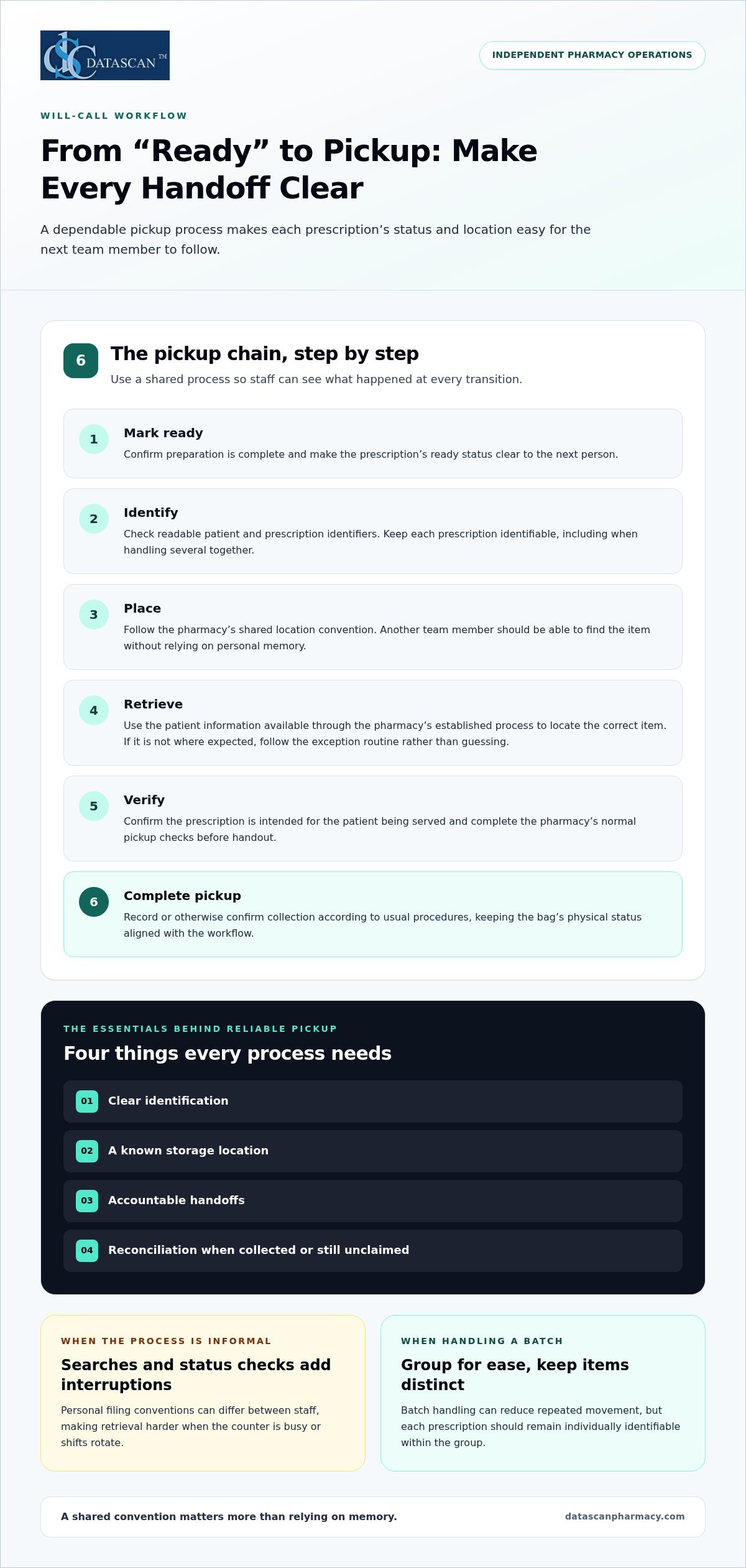
A reliable prescription pickup process needs four things: clear identification, a known storage location, accountable handoffs, and reconciliation when a prescription is collected or remains unclaimed. Will-call bin management systems are the processes and tools pharmacies use to organize prescriptions that are ready and waiting for pickup. The goal is not just to find a bag quickly. Staff also need to confirm its status and match it to the right patient.
The will-call process sits between prescription preparation and the customer-facing pickup transaction. Patient notifications tell people when a prescription is ready, while the point-of-sale (POS) transaction handles payment and sale. These steps may connect to the broader workflow, but neither replaces orderly storage and reliable retrieval. Keeping the steps distinct helps teams pinpoint where a delay begins.
What happens between a prescription being ready and being picked up?
Once a prescription is ready, a staff member identifies it, places it in the designated will-call location, and makes that location clear to the next person handling pickup. When the patient arrives, a team member retrieves the prescription, checks that it belongs to the right patient, and completes the handout through the pharmacy’s pickup process. Roles differ by pharmacy. Consistent handoffs matter more than assigning every task to a specific job title.
A consistent label or identifier helps staff locate the correct prescription without relying on memory. The team should be able to follow a simple chain: ready, stored, retrieved, and picked up. If a prescription is moved or its status changes, the process should make that change visible to the next staff member.
Why do pharmacies outgrow informal bin habits?
Informal systems can work until the counter gets busy, staff rotate, or several prescriptions are ready at once. If one person files bags using a personal convention and another expects a different order, retrieval can turn into repeated searches and status checks. Those interruptions slow the line and pull staff away from other work, even when every prescription was prepared correctly.
That’s a process problem, not automatically a staffing or patient-notification problem. A notification can tell a patient to come in, but it can’t tell staff where a bag was placed. More hands at the counter won’t resolve unclear placement rules either. A defined handoff and reconciliation routine gives the team a shared way to confirm whether an item is waiting, has been retrieved, or has completed pickup.
Pharmacies can use pharmacy automation in different ways, but a sound approach starts with understanding the steps staff already follow. Pharmacy management software supports broader pharmacy operations, and customizable pharmacy workflows help pharmacies shape processes around established routines. Start by making each handoff clear, then consider which tools can support the process.
How does a will-call bin management workflow work from ready status to pickup?
A dependable workflow makes each transition visible: a prescription is marked ready, identified, placed in a known location, retrieved, verified, and recorded as picked up. Will-call bin management systems can use different tools, but the team still needs a shared process that shows what happened at each handoff. Assigning the steps to roles already used in your pharmacy clarifies responsibility without requiring a new staffing model.
- Mark ready. The staff member completing the preparation confirms the prescription is ready for pickup using the pharmacy’s established process. The next person should be able to distinguish it from work that is still in progress.
- Identify. The person moving the prescription checks its readable patient and prescription identifiers. Keep each prescription identifiable, even when several prescriptions are handled together.
- Place. The staff member responsible for storage follows the pharmacy’s shared location convention. Another team member should be able to find the item using that convention, without depending on personal memory.
- Retrieve. At pickup, the staff member uses the patient information available through the pharmacy’s established process to locate the correct item. If it isn’t in the expected place, pause and follow the exception routine rather than guessing.
- Verify. Before handout, staff confirm the prescription is intended for the patient being served and follow the pharmacy’s normal pickup checks. Complete the handoff only when the match is clear.
- Complete pickup. The team records or otherwise confirms that the prescription has been collected according to its usual procedures. This keeps the physical status of the bag aligned with the pharmacy’s workflow.
Batch handling can reduce repeated movement between preparation and storage when several prescriptions are ready for the same patient or household. Keep each prescription individually identifiable within the group. Grouping should simplify handling, not blur which items are included or make later retrieval depend on memory.
How should staff identify and place prescriptions in will-call?
Choose a placement convention that the whole team can explain and follow, then use it consistently across shifts. For example, a pharmacy might organize storage alphabetically or by designated sections. The best convention is one staff can apply reliably. Readable identifiers help distinguish patients with similar names, while a clear handoff from preparation to storage confirms that the item reached its intended location.
What should happen when a prescription cannot be found or collected?
Start with the expected location, then check nearby or designated exception areas and ask the staff involved in the most recent handoff. If the search doesn’t resolve the issue, record and escalate it through the pharmacy’s established procedure rather than silently resetting the status. Uncollected prescriptions also need a defined review and return-to-workflow process, so staff know what happens next and the storage area doesn’t accumulate items with unclear status.
Pharmacies refining these handoffs can use customizable workflows to support their established routines. Datascan works with pharmacies on workflow needs and connected operations. Discuss your pharmacy operations with Datascan.
Should a pharmacy use manual bins, barcode scanning, or RFID for will-call?
Choose the method that addresses your pharmacy’s actual workflow bottlenecks, not the option that sounds newest. Manual bins can work when placement is consistent and easy to teach. Barcode scanning adds an identification step, while RFID can support item identification without requiring a direct line of sight. Each approach still depends on clear handoffs and staff following the process.
Compare how each option fits your current routine before changing equipment or adding steps. Setup, staff training, prescription identification, retrieval, and exception handling all matter. Specific implementation details depend on the pharmacy and tools selected.
| Approach |
Identification and staff steps |
Workflow fit to consider |
| Manual bins |
Staff use a shared physical layout and locate prescriptions by their identifiers. |
Can suit a process that remains easy to follow across shifts; relies on consistent placement and training. |
| Barcode scanning |
Staff scan a barcode to identify a prescription or support a transaction. Scanning generally requires a direct line of sight and handles items one at a time. |
Consider whether scanning fits naturally into placement and pickup without creating unnecessary extra handling. |
| RFID |
Radio-frequency identification uses tags and readers to identify items without a direct line of sight; some systems can read multiple tagged items together. |
Consider the equipment, process changes, and staff steps involved in using it within your pharmacy. |
When can a manual will-call process be enough?
A manual approach may meet the need when staff can place and retrieve prescriptions using one shared convention, including during shift changes and busy pickup periods. Assign responsibility for keeping the layout consistent, and train team members to use the same method. Repeated searches, staff asking one another where bags were placed, or uncertainty about pickup status are signs the routine needs attention.
What do barcode and RFID approaches change?
Barcode scanning makes identification part of a staff action: find the code, scan it, and follow the pharmacy’s next step. RM Solutions describes an approach that batches prescriptions and uses a barcode during the sale process. RFID uses radio waves to identify tagged items, and Parata describes tracking prescriptions through processing with an RFID cabinet solution. These are examples of specific approaches, not evidence that either method eliminates errors or suits every pharmacy.
Evaluate the trade-off against your own workflow. If the main issue is inconsistent placement, clarify the routine before investing in a different identification method. If staff need a more structured way to identify and retrieve items, assess how scanning would fit into existing handoffs and how RFID equipment would change those steps. Keep process needs at the center of technology decisions.
How can an independent pharmacy improve will-call bin management?
Improve the process by finding where will-call work creates friction, making targeted changes, and reviewing the results. A consistent workflow can reduce avoidable searching and repeat work, giving a busy owner and team more time for other operational priorities. It won’t change PBM reimbursement terms, but better-organized daily work can help protect time for reviewing reimbursement concerns and managing the business.
- Observe: Watch pickup during busy and quieter periods. Note where staff pause, repeat checks, or leave the counter to search.
- Map handoffs: Trace the process from prescription readiness through storage and pickup. Identify where ownership, location, or status becomes unclear.
- Standardize placement: Set a shared convention using language and locations the team understands. Keep responsibilities clear as changes are introduced.
- Train the team: Explain the revised routine and how to handle exceptions. Consistent training helps avoid shifting the same uncertainty from one employee to another.
- Review and adjust: Compare staff experience before and after a change, then refine the specific steps that continue to cause friction.
Make changes in manageable stages. For example, begin by standardizing placement across shifts while keeping current roles intact. Once the team has adopted the change, review whether it has reduced unnecessary searching or repeated checks before adjusting another part of the workflow. This approach preserves established responsibilities while making room for improvement.
- Retrieval delays: Note when staff take longer than expected to locate an item.
- Unresolved searches: Track searches that need escalation or remain unexplained.
- Repeat work: Record avoidable repeated checks, movements, or handoffs.
How can a pharmacy find its will-call bottlenecks?
Observe pickup at different levels of activity, then ask staff where they lose time or need extra clarification. Compare those observations with the handoffs mapped in the process. Staff feedback can show whether a problem is an isolated mix-up or a recurring point of friction. This kind of operational review also helps owners distinguish will-call issues from separate challenges, including PBM reimbursement pressures.
How should teams standardize and review the process?
Write a concise placement and retrieval procedure in the pharmacy’s own terminology. Make responsibilities and the exception pathway clear, then train the team on the same expectations. Review selected indicators consistently and adjust the step that evidence shows is creating friction. More dependable daily routines can give owners clearer visibility into operations and more room to focus on broader business priorities.
Pharmacy workflow optimization software can support pharmacies refining established routines. Datascan offers customizable workflows for pharmacies improving their operations. Talk with Datascan about your pharmacy workflow and identify a practical next step for your team.
How can pharmacy management software support a dependable will-call process?
Pharmacy management software can support a dependable will-call process by helping a pharmacy organize broader operations around clear staff responsibilities and established routines. Choose a fit that makes handoffs easier to understand and supports the way the pharmacy works. Review how a tool fits your current workflow, how staff handle information, and whether it can reduce avoidable repeat work for the team and owner.
What should pharmacy management software contribute to the workflow?
Start with your pharmacy’s process, then assess how the software fits. Consider whether staff can follow the same handoff expectations across preparation, storage, and pickup, and whether the workflow makes responsibilities clear. These are practical evaluation criteria for choosing pharmacy management software. A good fit can give staff a clearer routine and help owners spend less time untangling operational questions.
Connected operations matter because will-call pickup sits alongside other pharmacy work. Pharmacy management software supports the broader operational picture, while pharmacy point-of-sale tools relate to the transaction at pickup. Storage and retrieval, patient communication, and the sale are distinct activities. Evaluating each in context helps avoid expecting one tool to solve every handoff.
- Fit: Does the workflow align with how your team already divides responsibilities?
- Clarity: Can staff understand what happens next at each handoff?
- Practical value: Could the process reduce repeated checks or time spent resolving routine questions?
- Change management: Can the pharmacy introduce adjustments in manageable stages?
These questions help separate useful process support from features that sound appealing but don’t address the pharmacy’s actual bottleneck. Keep the focus on practical outcomes: less operational friction, more staff time for patient care, and a more consistent pickup experience.
How can Datascan help independent pharmacies move forward?
Datascan is a family-owned pharmacy software company founded in 1981. Its offerings include pharmacy management software, point-of-sale tools, and customizable workflows. For an independent pharmacy refining established routines, customizable workflows can help make operational processes fit the way the team works. Datascan’s pharmacy software can be part of that broader evaluation.
Bring your current process into the conversation: where handoffs feel unclear, which tasks create repeat work, and what your team wants to preserve. A practical discussion can connect workflow priorities with software considerations. Talk with Datascan about your pharmacy workflow.
Make your next workflow improvement count
Choose one operational question to guide your next step: what would give your team more confidence and consistency at pickup? Use the answer to set a practical priority, then assess whether your current process supports it. Improvements don’t have to start with a major system change. A focused adjustment, followed by staff feedback, can show whether the workflow is becoming easier to manage.
As you evaluate will-call bin management systems, keep the goal broader than faster retrieval alone. A dependable process should support the pharmacy’s daily operations and leave staff with more time for work that needs their attention. The best path forward is one your team can understand, adopt, and sustain.
Explore your next workflow improvement with Datascan. Start with one pickup challenge and discuss a practical way to improve the routine.
Frequently Asked Questions
What is a will-call bin management system?
A will-call bin management system is the process and tools a pharmacy uses to organize prescriptions that are ready but haven’t been collected. Will-call bin management systems cover identifying each prescription, assigning or following a storage location, retrieving it for the right patient, and confirming pickup is complete. Physical bins provide storage; barcode or RFID tools may support identification or tracking. The setup should fit the pharmacy’s established procedures and operational needs.
Can a pharmacy manage will-call prescriptions without an automated cabinet?
Yes. A pharmacy can use physical bins without an automated cabinet if staff follow a shared placement and retrieval routine. For example, the team can use the same labeled sections across shifts and make sure new staff learn the convention. Review whether searches, repeated checks, or unclear handoffs keep recurring. A manual process may fit some pharmacies, but each team should assess its own volume, layout, and operational needs.
How does barcode scanning help with will-call pickup?
Barcode scanning can add an identification step when prescriptions are handled for pickup. RM Solutions describes a workflow that batches prescriptions under a single barcode and scans that barcode at sale. That is a provider-described approach, not a capability to assume across all systems. A pharmacy evaluating scanning should map where staff would scan, what the scan confirms, and how the step fits its prescription identification and pickup procedures.
What is the difference between barcode and RFID will-call systems?
Barcode workflows use a scannable code to identify an item or group of items at defined steps, while RFID uses radio-frequency identification to read tagged items. Parata describes its RFID cabinet solution as tracking medications through prescription processing. The methods differ in how items are identified and followed through the workflow. Neither approach automatically prevents errors, so pharmacies should consider staff steps, equipment, and process fit before choosing one.
How should a pharmacy handle a prescription that staff cannot find in will-call?
Follow a written search and escalation procedure rather than relying on memory or repeating informal checks. Staff can retrace the last documented handoff, check locations covered by the pharmacy’s established convention, and notify the responsible team member if the item remains missing. Keep a record of unresolved searches using the pharmacy’s procedures. Staff should also follow approved processes for confirming prescription status and communicating with the patient.
What should a pharmacy measure when improving will-call bin management?
Track practical indicators tied to the pharmacy’s pickup process, such as retrieval time, unresolved searches, repeated checks, and staff-reported friction. Use the same method to review these indicators before and after a process change, so the comparison is useful. For example, note whether searches cluster around a particular shift handoff or storage area. No single measure proves better patient care, so review patterns alongside staff feedback.
Can pharmacy management software replace a pharmacy’s will-call procedures?
No. Pharmacy management software can support pharmacy operations, but staff still need clear procedures for identifying prescriptions, handing them off, locating them, and managing exceptions. Align the team’s process with the tools it uses, then train staff on the steps and responsibilities. For example, decide how the team will handle a location mismatch before it occurs. Software decisions should support the pharmacy’s operating routine, not replace sound procedures.
Article by
Sarah Callioras
Sarah Callioras is Vice President at Datascan Pharmacy Software, bringing nearly 25 years of experience across independent pharmacy operations and pharmacy technology. Since joining Datascan in 2016, she has played a key role in driving business growth, strengthening client relationships, and supporting independent pharmacies through innovative software solutions. With a strong background in pharmacy operations, business development, and strategic leadership, Sarah is passionate about helping independent pharmacies succeed in an evolving healthcare landscape.

An effective automated prescription refill workflow organizes routine administrative steps, such as capturing requests and tracking what needs to happen next, while keeping pharmacists in control of clinical decisions. It should make routine work easier to coordinate and send requests that need authorization, more information, or individual attention to staff for review.
That balance matters in independent pharmacies, where reminders, status checks, prescriber follow-up, and pickup updates can pull staff away from patients and daily operations. Automation should reduce avoidable sorting, not create another queue of exceptions. Each request needs a visible status, a clear owner, and an appropriate next step.
This guide shows how to map the refill process from identifying a possible need through pickup, decide which repeatable tasks are suitable for automation, and make exceptions visible to the right people. Pharmacy management software can help organize refill work within broader operations, while MobileScripts gives patients a digital way to submit refill requests. The aim is a more consistent process that helps staff focus on work requiring their attention.
Key Takeaways
- Build an automated prescription refill workflow around clear handoffs, so every request has a visible next step from intake to pickup.
- Set routing rules for routine administrative work, and send clinical questions and unresolved exceptions to staff.
- Map your current process, assign responsibility for each stage, and track open requests and unresolved exceptions to guide improvements.
- Use pharmacy management software and customizable workflow tools to organize refill work around your pharmacy’s operations.
- MobileScripts gives patients a digital option for submitting prescription refill requests.
What is an automated prescription refill workflow?
An automated prescription refill workflow is a coordinated process for managing potential refill needs, patient requests, review, preparation, and updates. It gives each request a defined status and next step, helping pharmacy staff distinguish work that can proceed from work that needs attention.
Automation can support repeatable administrative tasks, such as capturing a request or organizing follow-up. It does not determine whether a prescription is appropriate to refill, authorize it, or replace pharmacist review. This is also different from automatic dispensing, which refers to dispensing medication through an automated process or equipment.
A connected workflow matters in independent pharmacies because requests may arrive through different channels and require different follow-up. If a request needs more information or prescriber authorization, the process should make that work visible rather than treating the request as ready for preparation. Industry data indicates that pharmacists spend approximately one-third of their day on administrative tasks, including claims, inventory, and reports. Organizing recurring work can help teams see where time and attention are going, without suggesting that automation removes professional responsibilities.
Which steps belong in a prescription refill workflow?
A typical workflow starts by identifying a possible refill need, then capturing the patient’s request and checking its status. The pharmacy team determines whether the request can move forward or needs more information or authorization. When appropriate, it proceeds to preparation and pharmacist review, followed by communication with the patient about readiness or the next step. The CMS electronic prescribing information provides context on electronic prescribing standards, one part of the broader prescription process.
The route depends on the request. If authorization is needed, for example, the next action may involve the prescriber rather than prescription preparation. Recording who owns that follow-up and what response is pending helps staff understand why a request is waiting and what needs to happen next.
What can automation do, and what should staff still review?
Automation can help organize routine coordination, but staff need a clear way to identify requests that require attention. A practical division looks like this:
- Automation can support: reminders, request capture, administrative status updates, and task routing.
- Staff should review: missing information, authorization needs, and circumstances requiring professional attention.
Pharmacist review remains a distinct checkpoint. Pharmacy management software can help organize refill work within broader operations, while the pharmacy defines its roles and review process. The result should make routine tasks easier to coordinate without hiding exceptions or shifting clinical judgment to automation.
How does an automated prescription refill workflow move from request to pickup?
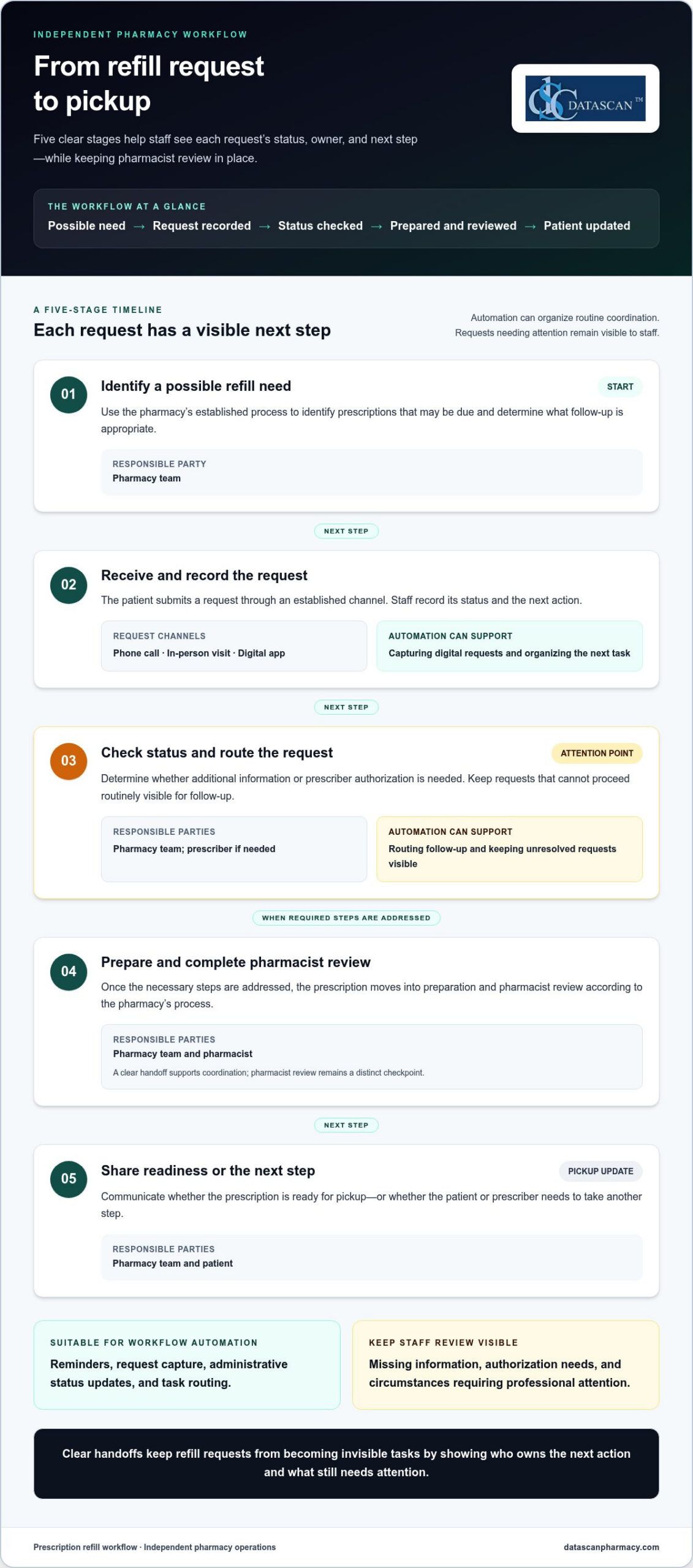
An automated prescription refill workflow moves a request through clear stages: identify a possible refill need, capture the patient’s request, determine what must happen next, prepare the prescription when appropriate, complete pharmacist review, and communicate readiness or another next step. The patient, pharmacy team, prescriber, and pharmacy management software may each have a role, depending on the request.
- Identify a possible refill need. The pharmacy team uses its established process to identify prescriptions that may be due and determine what follow-up is appropriate.
- Receive and record the request. A patient submits a request through an established channel, such as a phone call, an in-person visit, or a digital app. Staff record the request, its status, and the next action.
- Check status and route the request. Staff determine whether additional information or prescriber authorization is needed. Requests that cannot proceed routinely stay visible for follow-up.
- Prepare and review. Once the necessary steps are addressed, the prescription moves into preparation and pharmacist review according to the pharmacy’s process.
- Share readiness or next steps. The pharmacy communicates whether the prescription is ready for pickup or whether the patient or prescriber needs to take another step.
Clear handoffs keep refill requests from becoming invisible tasks by showing who owns the next action and what still needs attention.
| Workflow stage |
Responsible party |
Automation opportunity |
| Request intake |
Patient and pharmacy team |
Capture digital requests and organize the next task |
| Status and authorization check |
Pharmacy team; prescriber if needed |
Route follow-up and keep unresolved requests visible |
| Preparation and review |
Pharmacy team and pharmacist |
Make the handoff to preparation clear; retain pharmacist review |
| Pickup update |
Pharmacy team and patient |
Share a status update or explain the next step |
How should a pharmacy handle a refill request?
Start with the pharmacy’s established intake channels, and make sure each request has a recorded status and next action. Check the prescription’s status before moving it forward. If information or authorization is needed, assign that follow-up to the appropriate staff member or prescriber. Keep requests that cannot follow the routine path visible and give each one an owner, so they do not disappear into a general queue.
How do teams coordinate filling, review, and pickup communication?
When a request is ready to proceed, staff hand it into prescription preparation, followed by pharmacist review. A status update should tell the team and patient what has happened and what comes next, without implying that a request is ready before it is. For digital intake, the MobileScripts prescription refill app gives patients a way to submit refill requests. Pharmacy management software can help organize refill work within broader operations.
Use the workflow as a shared operating map, not as a promise that every request follows the same path. A pharmacy can tailor handoffs to its staffing and processes while keeping requests that need individual attention visible.
Can automated refills work without bypassing pharmacist oversight?
Yes. A refill workflow can automate routine coordination while keeping pharmacist review and clinical judgment separate from administrative processing. Automation can make requests easier to sort, assign, and track. It should not decide whether a prescription is clinically appropriate or remove the pharmacist’s review checkpoint.
The goal is not to make every request follow an identical path. It is to create a reliable routine route and a visible way to handle requests that need attention. Standardized routing can reduce uncertainty about where work goes next, but rigid rules may send unusual requests down the wrong path. Staff need enough visibility to recognize when a request does not fit the routine process.
Three elements work together:
- Standardized routing gives routine requests a predictable next step, while still allowing for exceptions.
- Staff visibility shows what is waiting and who owns the next action. A status label alone, however, does not resolve a stalled request.
- Exception handling directs requests needing attention to staff, with clear ownership and follow-through.
Small process gaps can undo the benefits. If a patient submits a request through more than one channel, duplicate work may appear unless staff can identify and reconcile the requests. If ownership is unclear, a request awaiting information or authorization can sit without follow-up. And if exceptions are routed out of sight, automation can hide work instead of organizing it.
Which refill requests should be routed for staff review?
Route a request for staff review when information is missing, authorization is needed, or its status prevents it from following the routine path. An exception queue or another visible task process can make these requests easier to monitor, but the process needs a named owner for review and resolution. Staff should be able to see what is blocked, what action is pending, and whether follow-up remains open.
How can a pharmacy keep automation transparent to its team?
Make each stage understandable to the people who use it. Document what each status means, who takes the next action, and how staff should handle incomplete, stalled, or duplicate requests. Train the team on those definitions, then review process issues together. If a request repeatedly lands in the wrong place, refine the routing rather than adding a step that conceals the underlying problem.
A practical automated prescription refill workflow makes responsibility visible from intake through review and follow-up. It supports staff by reducing avoidable sorting and status checks while preserving a deliberate pause for pharmacist judgment. Pharmacy management software and customizable workflow tools can help organize tasks around a pharmacy’s processes, but clear ownership and staff oversight remain essential.
How can an independent pharmacy implement and improve its refill workflow?
Start with the way refill work actually moves through your pharmacy, then make focused changes based on where staff time and requests get stuck. A deliberate process helps independent pharmacies use technology to organize operations without expecting software to solve every business pressure.
What should a pharmacy map before changing its refill process?
Document how requests arrive, where their status is recorded, and how work moves between roles. Mark authorization, missing information, preparation, pharmacist review, and patient communication as distinct handoffs. This makes it easier to see where work pauses and what needs attention before you change the process.
Use a practical implementation sequence:
- Map the current process. Follow a request from intake to its final update, noting the channels and handoffs involved.
- Identify repeated tasks. Separate recurring administrative work from decisions that require professional review.
- List common exceptions. Note where requests wait for information, authorization, or staff follow-up.
- Assign owners. Define responsibility for each stage and for requests that cannot proceed as planned.
- Test a focused change. Adjust one part of the process, explain the change to staff, and review what happens.
For pharmacies facing PBM reimbursement pressure, a refill workflow will not change reimbursement terms. It can help organize routine work and reduce avoidable administrative friction, giving leaders more room to monitor pharmacy operations and focus on financial decisions. Staff feedback matters: a bottleneck may come from unclear responsibilities or a difficult handoff, not a software setting. Ask the team where work pauses and which steps trigger repeat checks.
How can pharmacy management software support consistent refill work?
Pharmacy management software can help organize information and workflow within broader pharmacy operations, giving a pharmacy a system to support its chosen processes. Consider how staff will use the system to see work in progress and coordinate daily operations.
Different pharmacies have different staffing and operating processes, so workflow configuration should fit the way each team works. Datascan’s customizable workflow offering supports that effort. Pharmacies planning how to shape their processes can use pharmacy workflow software information as context for configuration around their needs.
Define measures before judging a change. Track open requests, unresolved exceptions, requests waiting for authorization, and requests without a recorded next action. Compare those measures over time with your own starting point rather than an assumed industry benchmark. Review the results with staff, then refine confusing handoffs or role assignments. Small, deliberate adjustments can make refill work more consistent and help the team protect time for other pharmacy operations.
How can Datascan help pharmacies organize refill workflows?
Datascan helps pharmacies organize refill work through pharmacy management software and customizable workflow tools. MobileScripts gives patients a digital way to submit prescription refill requests. These offerings can support a clearer process, while the pharmacy defines its handoffs and staff retain responsibility for review and clinical decisions.
Where do pharmacy management software and patient refill tools fit?
Pharmacy management software provides an operational foundation for organizing pharmacy work. For refill requests, the aim is to make the process easier for the team to manage within broader operations, with clear responsibility for follow-up and review. MobileScripts adds a patient-facing intake option by supporting prescription refill requests. It gives patients a way to submit requests, while pharmacy staff manage later steps according to the pharmacy’s process.
Each pharmacy’s staffing and operating processes are different, so workflow configuration should reflect how the team handles requests, handoffs, and exceptions. Datascan’s customizable workflow offering can support pharmacies seeking processes suited to their operations. Learn about pharmacy workflow software when considering how workflow configuration fits into the broader refill process.
Technology can help bring structure to the work, but it does not replace decisions about who reviews requests, how exceptions are handled, or what staff communicate to patients. A useful system supports a process the pharmacy has deliberately designed rather than assuming every request should move in the same way.
What should a pharmacy discuss when planning its refill workflow?
Begin with the current process, not a software feature list. Describe where requests come in, how staff record them, where handoffs occur, and which situations most often interrupt routine processing. That context makes the discussion specific to the pharmacy’s actual workload.
- Request channels: How do patients submit requests today, and where do staff bring those requests together?
- Handoffs: Where does work pass between the patient, pharmacy team, pharmacist, and prescriber?
- Bottlenecks: Which steps lead to repeat status checks, delayed follow-up, or confusion about what happens next?
- Exceptions: What types of requests need additional information, authorization, or staff attention?
- Ownership: How should staff see who owns each open task and what action is due next?
These details give a workflow conversation a practical starting point and help pharmacy leaders focus on changes that address real friction. Datascan is family-owned, has operated since 1981, and provides U.S.-based support. For independent pharmacies balancing refill coordination with daily operations, that experience and support can be part of the conversation about organizing work around the team’s needs.
Use the Datascan contact page to discuss your pharmacy’s workflow and the processes you want your team to manage more clearly.
Make your refill workflow easier to sustain
A refill process should keep working as your pharmacy’s daily demands shift. Treat your automated prescription refill workflow as an operating practice to revisit, not a one-time setup. As staffing patterns, request channels, or recurring bottlenecks change, review whether each step still has a clear owner and whether exceptions remain visible to the people responsible for resolving them.
Ongoing attention helps technology stay aligned with the way your team works. Pharmacy software and customizable workflows can support consistency, but staff insight is essential for spotting friction that a configuration change alone will not fix. Small, deliberate adjustments can help protect time for patient care and the many other responsibilities involved in running an independent pharmacy.
Choose one point in the refill process your team wants to make clearer, then use it to guide your next workflow conversation. Talk with Datascan about your refill workflow and explore a practical next step for your pharmacy. Shape the process around the work that matters most to your team.
Frequently Asked Questions
Can prescription refills be automated?
Yes. Pharmacies can automate selected administrative tasks, such as capturing incoming requests or organizing reminders. A request that needs additional information, authorization, or individual attention should remain visible for staff follow-up. For example, a pharmacy can use a consistent status for requests waiting on a response, making them easier to distinguish from work that can move to the next operational step.
How does an automated prescription refill workflow work?
An automated prescription refill workflow coordinates request intake, status tracking, task handoffs, preparation, review, and patient updates. A request might arrive digitally, be recorded for the pharmacy team, and then be routed for follow-up if something is needed before processing continues. Clear status information helps staff recognize whether a request is progressing, waiting on someone, or ready for its next step.
Does automated refill processing replace pharmacist review?
No. Automation can help organize administrative work, but it does not replace a pharmacist’s professional judgment. A pharmacy should make review responsibilities clear and ensure staff can tell when a request needs pharmacist attention. For example, an automated notification may tell staff that a request needs review, but the notification is not a clinical assessment or approval.
What happens if a prescription has no refills remaining?
The pharmacy team should treat the request as needing follow-up rather than assuming it can proceed as a routine refill. Staff can identify that no refills remain, determine the appropriate next action, and communicate what the patient should expect. A clear record of the pending action helps the team track the request while waiting for the information or response needed to proceed.
Can patients request refills through a pharmacy app?
Yes. Patients can submit refill requests through a pharmacy app that supports this function. MobileScripts, Datascan’s patient mobile app, supports prescription refill requests. The app gives patients a digital way to send a request to the pharmacy; it does not mean every later step is automatically completed. Pharmacy staff still manage the request according to the pharmacy’s process.
How can an independent pharmacy measure whether its refill workflow is improving?
Choose measures that answer practical questions about the work, such as how many requests remain open, how many are waiting on follow-up, and which types of exceptions recur. Compare results with the pharmacy’s own starting point and review them with staff. If a measure changes, ask what happened in the workflow before drawing conclusions. The purpose is to find process friction, not chase an unsupported benchmark.
About the author: This guide is published by Datascan Pharmacy Software, which provides pharmacy management software for independent and retail pharmacies.
Article by
Sarah Callioras
Sarah Callioras is Vice President at Datascan Pharmacy Software, bringing nearly 25 years of experience across independent pharmacy operations and pharmacy technology. Since joining Datascan in 2016, she has played a key role in driving business growth, strengthening client relationships, and supporting independent pharmacies through innovative software solutions. With a strong background in pharmacy operations, business development, and strategic leadership, Sarah is passionate about helping independent pharmacies succeed in an evolving healthcare landscape.