
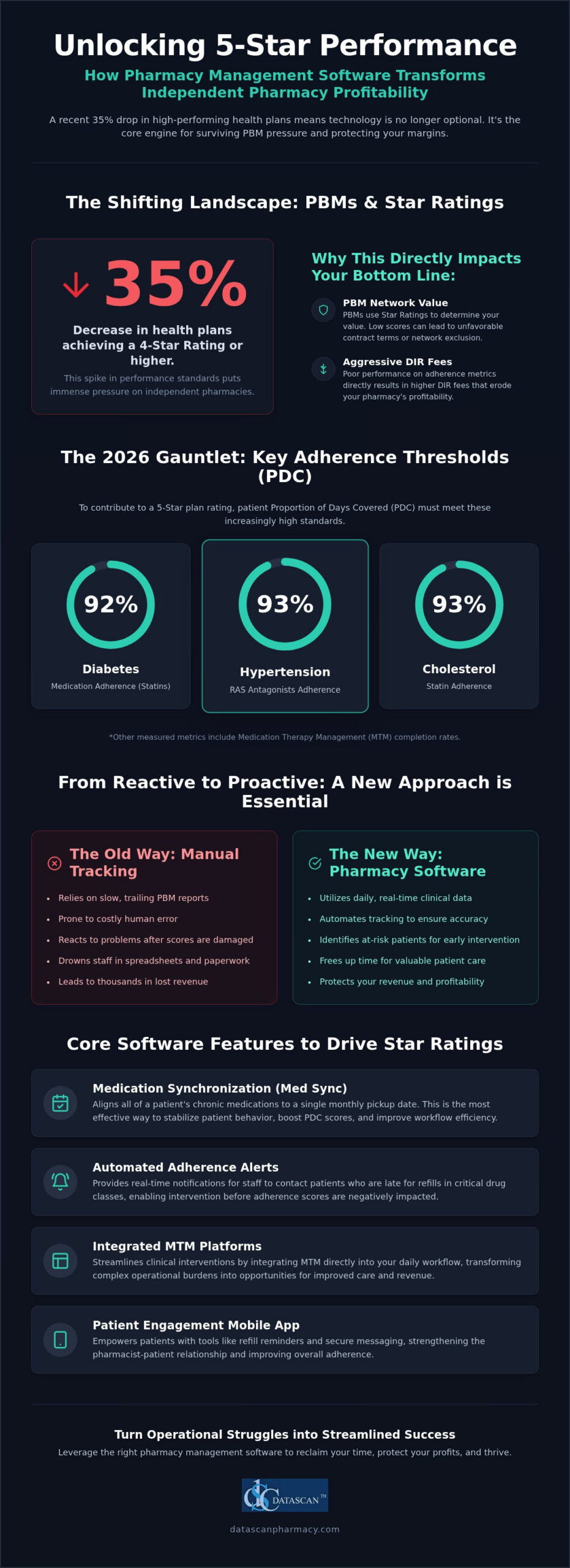
Did you know that after a recent spike in performance standards, there was a 35% decrease in health plans achieving a 4-Star Rating or better? For independent owners, this shift means the margin for error has vanished, making the right technology for improving star ratings your most critical asset. You can’t manually track every patient’s Proportion of Days Covered (PDC) while fighting complex PBM reimbursement models. To protect your bottom line, you need Datascan Pharmacy Management Software to automate clinical interventions and patient outreach before your scores slip.
We understand that the pressure of high DIR fees and the constant burden of paperwork can make you feel like you’re losing the “independent” in independent pharmacy. It’s frustrating to spend more time on spreadsheets than with the patients who rely on your care. This guide reveals how modern pharmacy software and tools like the MobileScripts Patient Mobile App directly influence Star Rating metrics to boost your performance and profitability. We’ll explore the specific 2026 adherence thresholds for diabetes and hypertension and show you how to reclaim your time through automated workflows that turn operational struggles into streamlined successes.
Key Takeaways
- Learn how technology for improving star ratings automates patient outreach and real-time tracking to identify care gaps before they impact your performance scores.
- Discover how medication synchronization and automated refill reminders within your pharmacy management software stabilize patient behavior to meet 2026 PDC thresholds.
- Streamline clinical interventions by integrating MTM platforms directly into your workflow, transforming complex operational burdens into streamlined successes.
- Empower your patients and strengthen the pharmacist-patient relationship through the MobileScripts Patient Mobile App and secure messaging tools.
- Understand the financial advantage of partnering with a family-owned software vendor that prioritizes independent pharmacy profitability and provides dedicated U.S.-based support.
How does technology improve pharmacy Star Ratings?
Technology for improving star ratings automates patient outreach, tracks medication adherence in real-time, and identifies gaps in care before they impact your performance scores. By 2026, your pharmacy management software isn’t just a dispensing tool; it’s the central hub for protecting your revenue. PBMs use these ratings to determine your value in their network. If your scores aren’t competitive, you’ll face aggressive DIR fees that eat into your margins. Because Star Ratings are primarily used to evaluate Medicare Part D plans, your performance directly influences the quality bonus payments those plans receive, making you a vital partner or a financial liability.
What metrics do Star Ratings actually measure?
Performance is largely driven by the “Triple-A” clinical metrics, which focus on medication adherence for diabetes, hypertension, and cholesterol. For the 2026 Star Ratings, the thresholds are higher than ever. To help a plan achieve a 5-star rating, your patients must maintain a Proportion of Days Covered (PDC) of at least 92% for diabetes and 93% for hypertension and cholesterol. Beyond adherence, CMS measures Medication Therapy Management (MTM) completion rates and Comprehensive Medication Reviews (CMR). While patient experience and access measures were reduced to a 2x weight for 2026, they still account for a significant portion of the overall score. Using Datascan Pharmacy Management Software allows you to monitor these specific clinical outcomes through a single, integrated dashboard.
Why is manual tracking no longer viable in 2026?
Relying on manual tracking or monthly PBM reports is a recipe for financial disaster. PBM performance windows are complex. Waiting for trailing data means you’re reacting to problems that have already damaged your score. Manual tracking is prone to human error, and even a handful of missed adherence interventions can result in thousands of dollars in lost revenue. You need a system that updates your clinical metrics daily. Modern technology identifies at-risk patients immediately, allowing your staff to intervene when it actually matters. By automating the identification of care gaps, you free up your team to focus on clinical care instead of drowning in spreadsheets. High-performing pharmacies use automation to stay ahead of PBM reimbursement changes and ensure their independence remains profitable.
Pharmacy management software directly increases patient medication adherence by automating the repetitive tasks that keep patients on track with their chronic therapies. When you implement Datascan Pharmacy Management Software, you’re not just filling bottles; you’re deploying a proactive clinical engine. This technology for improving star ratings identifies at-risk patients who are late for refills, allowing your staff to intervene before a missed dose impacts your performance metrics. According to the 2025 Medicare Advantage and Part D Star Ratings data, adherence measures remain a cornerstone of plan evaluation, making these automated tools essential for your survival against aggressive PBM reimbursement models.
How does Medication Synchronization drive scores?
Medication synchronization, or Med Sync, is the most effective way to stabilize patient behavior and secure your pharmacy’s financial health. By aligning all chronic medications to a single monthly pickup date, you eliminate the friction of multiple trips to the pharmacy, which is a major barrier to adherence. This consistency naturally increases the Proportion of Days Covered (PDC). For the 2026 rating cycle, achieving an 80% PDC or higher is the standard for success. Beyond clinical scores, Med Sync improves your internal workflow efficiency by allowing you to prepare prescriptions during slow periods. It also optimizes inventory management, ensuring you aren’t tying up capital in stock that sits on the shelf for weeks. It transforms a chaotic dispensing schedule into a predictable, high-performing operation that frees up your time for clinical care.
What are automated adherence alerts?
Automated adherence alerts act as a safety net for your most vulnerable patients. Your pharmacy software can generate real-time notifications for your staff to call patients who have fallen behind on high-weighted drug classes, such as those for diabetes, hypertension, and cholesterol. These text and email reminders keep the patient engaged with their therapy without requiring hours of manual phone calls from your technicians. You can customize these alerts to prioritize patients with the lowest PDC scores, ensuring your interventions have the maximum impact on your Star Ratings. Integrating barcode verification into this process ensures that every refill is accurate and safe, further protecting your pharmacy’s reputation for quality care. If you want to see how these tools can transform your daily operations, it might be time to reach out for a workflow assessment.
Which software features are most effective for improving Star Ratings?
The most effective software features for improving Star Ratings include automated MTM prompts, integrated e-care plans, and real-time performance dashboards that allow you to document clinical interventions without leaving your dispensing screen. By utilizing Pharmacy Workflow Optimization Software, you ensure that every technician and pharmacist is working toward the same performance goals during their standard shifts. Investing in the right technology for improving star ratings means choosing tools that turn clinical care into a billable, documented reality rather than a manual administrative burden.
To maximize your scores in 2026, your pharmacy management software should prioritize these high-impact features:
- Automated MTM triggers integrated with platforms like OutcomesMTM.
- Real-time PDC tracking for diabetes, hypertension, and cholesterol medications.
- Electronic Care Plan (e-care) documentation for audit-proof record keeping.
- Performance dashboards with goal-setting and PBM reimbursement alignment.
- Customizable clinical alerts that prompt staff for interventions at the point of sale.
How do I integrate MTM tasks into my daily dispensing workflow?
Managing Medication Therapy Management (MTM) tasks shouldn’t require your staff to log into multiple external portals or juggle separate spreadsheets. Your pharmacy software should serve as a bridge, surfacing Comprehensive Medication Review (CMR) and Targeted Medication Review (TMR) opportunities directly within the patient profile. This technology for improving star ratings ensures that when a pharmacist is already reviewing a patient’s record, they’re prompted to complete the necessary clinical documentation in one seamless motion. By documenting these interventions in real-time, you maintain the high completion rates PBMs demand while freeing up your time to focus on complex patient consultations instead of redundant data entry.
Which metrics should my pharmacy performance dashboard show?
A performance dashboard is only valuable if it provides actionable data that links directly to your bottom line. Your dashboard should visualize your current standing in the Triple-A adherence categories, comparing your actual PDC scores against the 2026 5-star thresholds of 92% and 93%. It’s critical to have a system that identifies underperforming categories instantly, allowing you to prioritize outreach efforts where they’ll have the greatest impact on your overall score. High-performing independent pharmacies use these dashboards to link clinical success to PBM reimbursement reports, providing a clear view of how improved adherence reduces DIR fees. This level of transparency empowers you to act as a champion for your business, ensuring your independence is backed by data-driven precision.
How do mobile patient apps influence Star Rating performance?
Mobile patient apps influence Star Rating performance by directly improving medication adherence and patient experience scores through streamlined communication and automated refill reminders. As PBMs increasingly scrutinize patient engagement, deploying a dedicated app is a vital piece of technology for improving star ratings. By putting the pharmacy in the patient’s pocket, you remove the barriers that lead to therapy gaps and poor clinical outcomes. This digital connection ensures your pharmacy remains the primary healthcare hub for your community, especially as you look toward promoting a new pharmacy mobile app to patients to drive long-term growth.
How does the MobileScripts Patient Mobile App drive results?
The MobileScripts Patient Mobile App empowers your patients to take ownership of their health by providing a transparent view of their entire medication profile. Within the app, patients can set custom dose reminders and receive push notifications when it’s time to request a refill. This functionality is critical for maintaining a high Proportion of Days Covered (PDC), as it prevents the “out-of-sight, out-of-mind” mentality that often leads to non-adherence. Because the app integrates directly with your pharmacy management software, refill requests are processed instantly, reducing the administrative burden on your staff and ensuring that patients never face a gap in their chronic therapy. Reducing friction in the refill process is one of the fastest ways to stabilize your performance metrics.
How does secure messaging build patient trust?
Trust is a measurable component of the Medicare Star Rating system, particularly within the Consumer Assessment of Healthcare Providers and Systems (CAHPS) surveys that measure patient experience. Using secure messaging with patients app features allows you to answer clinical questions in real-time, providing the personalized care that big-box competitors simply can’t match. This two-way communication builds a stronger relationship between the pharmacist and the patient, which translates into higher satisfaction scores and better retention. When patients feel supported and informed, they’re more likely to stick with their prescribed regimens and provide positive feedback during PBM-mandated surveys. To see how these tools can strengthen your patient relationships while protecting your bottom line, schedule a demo of our patient engagement suite.
How can the right pharmacy software vendor help you manage PBM reimbursements and Star Ratings?
The right pharmacy software vendor helps you manage PBM reimbursements by providing transparent data auditing tools and automated reporting that identifies underpaid claims. This strategic partnership ensures your technology for improving star ratings isn’t just a clinical tool but a financial defense system against unfair DIR fees. Choosing a family owned partner like Datascan ensures your specific operational needs aren’t ignored by a massive corporation. When you have a vendor that understands the pressures of the independent market, you gain access to innovative features designed specifically for your profitability and long term success.
A high quality vendor provides several key advantages for independent owners:
- Direct Advocacy: They act as a champion for the independent rather than answering to corporate shareholders.
- U.S. Based Support: You receive help from experts who understand the American regulatory and PBM landscape.
- Continuous Innovation: They frequently update features to combat evolving PBM reimbursement models.
How do I use my data to challenge unfair DIR fees and underpayments?
Independent pharmacies face a constant battle against complex PBM reimbursement models and unpredictable DIR fees. Your pharmacy management software should serve as a defensive shield, providing granular data that allows you to audit every claim for accuracy. By leveraging real-time performance data, you can identify discrepancies in how PBMs apply performance based fees and use that evidence to challenge unfair clawbacks. A vendor that focuses on independent pharmacy profitability will continuously update their system to keep pace with PBM reform, ensuring you have the reporting tools needed to negotiate better contract terms. This data driven approach is essential for any pharmacy patient retention strategies, as it ensures you remain financially viable enough to continue serving your community.
| Operational Area | Impact of Modern Pharmacy Software |
|---|---|
| PBM Auditing | Real-time identification of underpaid claims |
| DIR Fees | Lower fees through optimized performance scores |
| Staff Burnout | Reduced workload through automated clinical prompts |
| Patient Care | More face-to-face time for clinical consultations |
Can automated workflows really prevent pharmacist burnout?
One of the most significant benefits of sophisticated pharmacy software is its ability to reclaim your most valuable resource: time. Automating mundane tasks like refill reminders, inventory tracking, and clinical documentation allows you to step away from the computer and back to the counter. This shift is critical for preventing pharmacist burnout while maintaining the high standards required for 5 star performance. When your workflow is streamlined, you finally have the bandwidth to focus on PBM reform advocacy and high level business growth. U.S. based support from a family owned company means that when you do have questions about complex Star Rating data, you’re talking to experts who understand your business personally. Technology is the ultimate tool for the modern independent pharmacy champion, transforming operational struggles into a competitive advantage that protects your legacy and your bottom line.
Secure Your Pharmacy’s Financial Future in 2026
The strategic shift toward clinical outcomes in the 2026 CMS Star Ratings means your operational success is now inseparable from your digital capabilities. By automating medication adherence tracking and leveraging patient engagement tools like the MobileScripts Patient Mobile App, you protect your business from the revenue draining impact of poor performance scores. Implementing high performance technology for improving star ratings isn’t just about compliance; it’s about reclaiming your time and ensuring your independence remains profitable in a landscape dominated by PBM pressures.
Datascan has been a dedicated partner to independent pharmacies since 1981. As a family owned and operated company, we provide the built in Med Sync and MTM tools you need to excel, backed by industry leading U.S. based support. You don’t have to face complex reimbursement models alone when you have a visionary ally in your corner. Our pharmacy management software is designed to transform your operational burdens into streamlined successes.
See how Datascan Pharmacy Management Software can boost your Star Ratings today!
Your commitment to patient care is your greatest strength. Let our technology handle the paperwork so you can stay focused on the clinical care that your community deserves.
Frequently Asked Questions
How do Star Ratings affect independent pharmacy profitability?
Star Ratings directly impact independent pharmacy profitability by determining the level of DIR fees and quality bonus payments you receive. High performance scores lead to lower clawbacks and better reimbursement rates, while poor scores result in aggressive financial penalties. For independent owners, these ratings are often the difference between a healthy margin and a loss. Utilizing specialized pharmacy management software helps you monitor these metrics to protect your bottom line against PBM pressures.
What is the most important technology for improving medication adherence?
Medication synchronization is the most critical tool for improving medication adherence and stabilizing patient behavior. By aligning all chronic prescriptions to a single pickup date, you ensure patients have a consistent supply of medication, which naturally raises their Proportion of Days Covered. This technology for improving star ratings is built into Datascan systems to help you meet the 2026 PDC thresholds for diabetes and hypertension without increasing your staff’s manual workload.
Can my pharmacy management software help reduce DIR fees?
Yes, your pharmacy software reduces DIR fees by identifying clinical care gaps and adherence issues before they negatively impact your performance scores. Since many DIR fees are tied to Star Rating metrics, using automated alerts and real-time dashboards allows you to intervene with at-risk patients immediately. This proactive approach ensures you maintain the high scores required to qualify for lower fee categories or performance incentives offered by many PBM networks.
How often should I check my pharmacy’s Star Rating performance?
You should check your performance metrics daily to ensure you aren’t missing critical intervention windows for your patients. Waiting for monthly PBM reports means you’re reacting to old data that’s already damaged your scores. Modern pharmacy system software provides real-time business intelligence dashboards that visualize your standing against 2026 goals. Frequent monitoring allows you to prioritize outreach for high-weighted drug classes like cholesterol and diabetes medications before the performance window closes.
Does a patient mobile app really improve my Star Rating?
A patient mobile app significantly improves Star Ratings by reducing friction in the refill process and enhancing communication scores in patient surveys. Tools like the MobileScripts Patient Mobile App represent vital technology for improving star ratings by empowering patients with dose reminders. These easy refill requests directly increase medication adherence. Additionally, secure messaging features build the trust measured in CAHPS surveys, helping your pharmacy outperform competitors who lack a personalized digital touchpoint.
What should I look for in a pharmacy software vendor regarding Star Ratings?
Look for a vendor that offers integrated clinical tools, real-time data dashboards, and reliable U.S. based support. You need a partner that understands the specific pressures of independent pharmacies and continuously adds features to combat PBM reimbursement challenges. A family owned vendor like Datascan, which has been operating since 1981, provides the historical perspective and personal accountability required to build future proof solutions. Don’t use vendors that treat clinical performance as an afterthought.
Is medication synchronization difficult to implement with current pharmacy software?
Implementation’s straightforward when you use a system with a built in, customizable workflow designed for Med Sync. Modern pharmacy management software automates the identification of eligible patients and simplifies the alignment of refill dates. This technology allows your team to move away from chaotic, reactive filling to a predictable, organized schedule. By streamlining this process, you reduce staff burnout while simultaneously boosting the adherence scores that PBMs use to calculate your reimbursements.
How does MTM integration impact my pharmacy’s performance scores?
MTM integration boosts performance scores by prompting pharmacists to perform Comprehensive Medication Reviews during the standard dispensing process. Instead of logging into external portals, your pharmacy software should surface these clinical opportunities automatically. This seamless workflow ensures high completion rates for PBM mandated interventions. Documenting these services within your e-care plans not only improves your clinical standing but also creates opportunities for billing for professional services, further diversifying your revenue streams.
 Kevin Minassian is the President of Datascan Software. Under his leadership, the company rapidly expanded to provide pharmacy management software on a national level. Over the last 15+ years, he has ensured that Datascan has continuously evolved to offer innovative solutions for independent pharmacies while still offering world-class customer support. He is passionate about helping independent pharmacies to remain competitive, achieve success, and offer the very best service to their communities.