
Building a high-efficiency automated prescription refill workflow in 2026 requires a strategic integration between your pharmacy management software and a dedicated pharmacy app for prescription refills that handles patient requests in real-time. By centralizing these communications, you eliminate the manual data entry that leads to pharmacist burnout and reclaim the hours necessary to drive business growth. You didn’t spend years earning your degree to act as a data entry clerk while PBMs aggressively squeeze your margins through complex DIR fees. We understand that even with the latest PBM reforms, the operational burden on independent owners remains immense. This article will show you how to implement a workflow that essentially runs itself, allowing you to act as the clinical authority your community deserves. We will preview the specific steps to optimize your pharmacy software, implement medication synchronization, and automate patient notifications to ensure your business remains profitable and relevant in a rapidly evolving market.
Key Takeaways
- Discover how a software-driven automated refill workflow handles everything from requests to labeling, significantly reducing the manual labor that causes pharmacist burnout.
- Learn how to combat shrinking PBM reimbursements and lower DIR fees by leveraging medication synchronization and automated adherence reminders.
- Evaluate your pharmacy app for prescription refills to ensure it integrates directly with your pharmacy management software for real-time eligibility and insurance checks.
- Follow a proven five-step implementation plan to audit your current bottlenecks and transition into a stabilized, automated filling schedule.
- Reclaim your identity as a healthcare provider by automating data entry tasks, giving you the time needed to focus on high-margin clinical services and business expansion.
What is an automated prescription refill workflow?
An automated prescription refill workflow is a software-driven process that handles everything from the initial patient request to inventory checks and label printing without manual pharmacist intervention. By leveraging advanced pharmacy management software, this system automatically validates insurance eligibility and checks drug-to-drug interactions before the medication ever hits the tray. It transforms the traditional, reactive pharmacy model into a proactive machine that anticipates patient needs, ensures accuracy, and protects your bottom line from shrinking PBM reimbursements.
In a manual environment, your staff spends hours answering phone calls, deciphering voicemails, and manually typing data into the system. An automated workflow replaces these bottlenecks with digital triggers. When a patient uses a pharmacy app for prescription refills, the request bypasses the front counter and moves directly into the processing queue. This integration allows your workflow software to “auto-fill” medications based on established medication synchronization schedules. Instead of reacting to a line of frustrated patients, your team walks into a pharmacy where the day’s work is already organized and prioritized.
How does automation differ from traditional pharmacy systems?
Traditional systems rely on paper trails and patient-initiated calls, which often lead to transcription errors and workflow interruptions. Modern automation utilizes electronic prescribing standards to ensure that data flows seamlessly from the provider to your dispensing queue. When you implement a pharmacy app for prescription refills, patients receive real-time status updates on their smartphones, which eliminates the “Is it ready yet?” phone calls that plague busy shops. Safety is bolstered through integrated barcode verification, creating a closed-loop system where the software confirms the NDC and patient identity at every critical juncture.
Why is automation critical for independent pharmacies in 2026?
Independent owners are currently facing a “perfect storm” of labor shortages and predatory PBM practices. You can’t afford to pay a pharmacist to perform the tasks of a data entry clerk. Automation allows you to do more with fewer staff members by shifting chronic medication management to a synchronized schedule. This stabilized filling cycle reduces human error in high-pressure retail environments and ensures you have the right inventory on hand. Most importantly, it reclaims the time you need to provide high-margin clinical services, such as point-of-care testing or long-term care consulting. By letting the technology handle the repetitive mechanics of dispensing, you can finally focus on acting as a healthcare provider rather than a technician.
How does automated refill technology improve pharmacy efficiency?
Automated refill technology transforms pharmacy efficiency by eliminating the “wait time” bottleneck and ensuring prescriptions are staged and ready before the patient arrives. This proactive approach relies on a high-performing pharmacy app for prescription refills to capture patient intent early, allowing the backend system to process claims during off-peak hours. By shifting the workload, you don’t just save time; you optimize your entire operational flow to fight back against the shrinking margins imposed by PBMs.
Efficiency gains extend directly to your bottom line through improved inventory management and lower DIR fees. When your system predicts refill dates in advance, you can maintain leaner inventory levels, ordering only what you need for the upcoming week. This precision reduces the capital tied up on your shelves. Additionally, automated reminders sent through your pharmacy app for prescription refills significantly boost patient adherence. In the 2026 regulatory environment, maintaining high adherence is the most effective way to protect your Star Ratings and mitigate the impact of predatory DIR fee structures.
Can technology help overcome PBM reimbursement challenges?
Modern pharmacy management software provides the transparency needed to survive PBM pressures. By integrating automation into your billing workflow, the software can automatically flag low-margin or “under-water” claims before the labels are even printed. This allows you to address reimbursement issues in real-time rather than discovering losses weeks later during reconciliation. Automation also enables more granular tracking of PBM payments, ensuring that every cent owed to your independent pharmacy is accounted for and collected. Pairing this with dedicated pharmacy compliance reporting software gives you the documentation power to defeat PBM audit clawbacks before they strip away your hard-earned revenue.
How does med sync reduce the daily workload?
Medication synchronization is the engine behind a truly efficient pharmacy. Instead of handling ten different phone calls for ten different medications, you bundle a patient’s entire profile into a single monthly pickup. This moves your team from a reactive, “firefighting” mode to a methodical, proactive filling model. You can schedule your heavy filling days during times when foot traffic is low, ensuring your staff remains calm and focused. Implementing a Pharmacy Workflow Optimization Software strategy ensures that your team isn’t just busy, but productive. If you’re ready to see how these tools can transform your daily operations, you can speak with our team about a custom workflow audit.
How do I evaluate pharmacy management software for automated workflows?
To evaluate pharmacy management software for automated workflows, you must prioritize a system that offers a natively integrated mobile patient app and highly customizable dispensing stages. This ensures the technology adapts to your physical store layout rather than forcing you into a rigid, one-size-fits-all model that hinders efficiency. When you evaluate pharmacy management software, start by looking for a system that offers a truly integrated mobile experience for your patients. A standalone pharmacy app for prescription refills that isn’t natively tied to your database often creates data silos. These silos lead to synchronization errors and manual reconciliation tasks that defeat the purpose of automation. You need a solution that allows you to customize the workflow stages to match your store’s unique layout, from the initial intake to the final bagging. If your pharmacy software forces you into a rigid model, it’ll eventually become a bottleneck as your volume grows.
What are the must-have features for refill automation?
Refill automation isn’t just about processing a request; it’s about managing the entire patient lifecycle. Your pharmacy software must include integrated medication synchronization (Med Sync) modules that allow you to align multiple prescriptions into a single monthly event. This proactive approach is supported by automated text and email notifications that keep patients engaged without requiring a phone call from your staff. Utilizing a high-performance pharmacy app for prescription refills like the MobileScripts Rx Refill Application ensures that these requests flow directly into your queue, pre-validated and ready for filling. These features work together to reduce the chaos of “walk-in” refill requests that disrupt your staff’s concentration and lead to errors.
Why is vendor support as important as the software itself?
The strength of your pharmacy management software is only as good as the team standing behind it. In a high-pressure retail environment, hitting a technical snag can halt your entire operation. This is why prioritizing US-based support is vital. You don’t have time for long hold times or scripted responses from people who don’t understand the nuances of independent pharmacy. A family-owned vendor provides a level of accountability and industry perspective that large corporations simply can’t match. When evaluating pharmacy software vendors, look for a partner that treats your success as their own. They should offer the agility needed to adjust technical workflow parameters quickly as PBM pressures and market demands evolve, ensuring your technology remains a tool for growth rather than a burden.
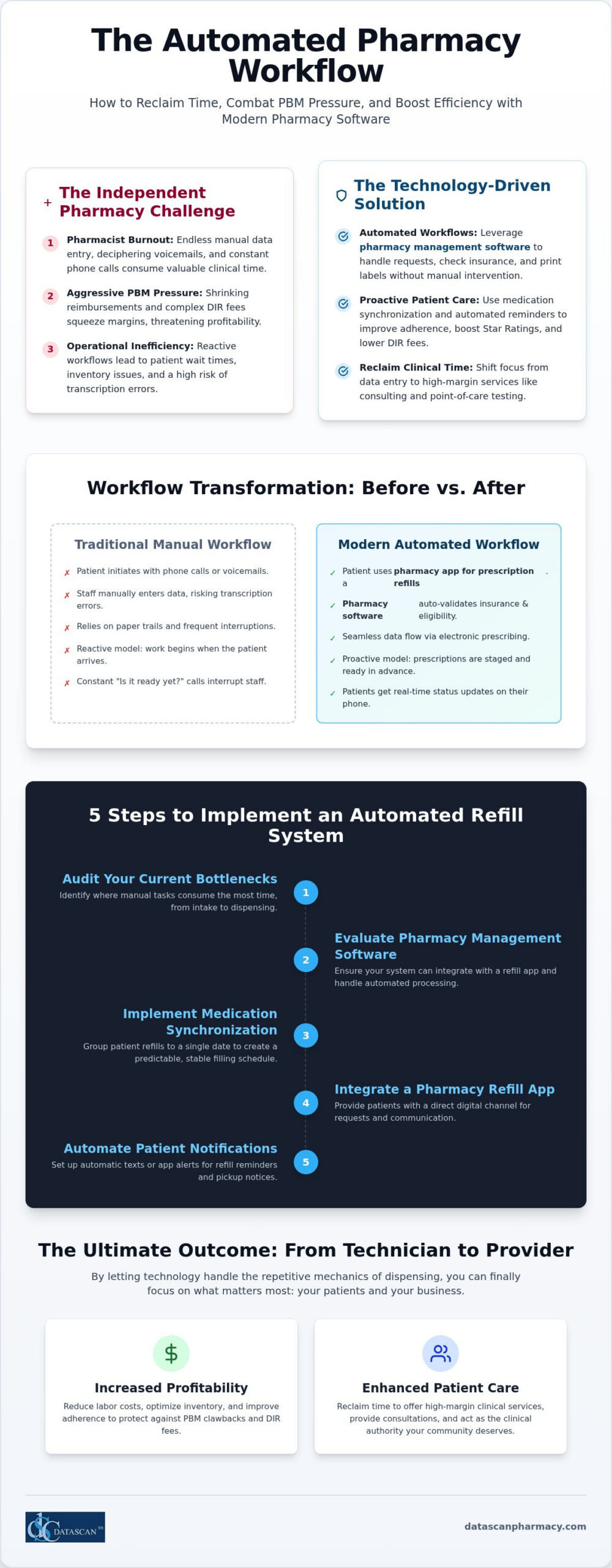
How to implement an automated refill system in 5 steps?
Implementing an automated refill system requires auditing your current manual bottlenecks, enrolling high-volume patients in medication synchronization, and deploying a native pharmacy app for prescription refills to capture requests digitally. By configuring your pharmacy management software to auto-populate the dispensing queue, you eliminate the friction of manual data entry and reclaim hours of staff time every week. This systematic transition ensures your pharmacy operates as a proactive healthcare hub rather than a reactive retail shop.
Step 1 & 2: Building the foundation for automation
The first step is identifying the “high-maintenance” 20% of your patient base that typically consumes 80% of your staff’s phone time. These are often chronic care patients with multiple prescriptions filled at different times throughout the month. Once identified, you must enroll these patients in a robust Med Sync program. When you talk to patients, focus on the convenience of a single monthly pickup and the peace of mind that comes with never running out of medication. This synchronization provides the predictable volume your pharmacy software needs to automate the “auto-fill” process effectively. For a deeper dive into streamlining these early stages, see our guide on automating pharmacy prescription intake.
Step 3, 4 & 5: Launching and refining the loop
Once your foundation is set, deploy a pharmacy app for prescription refills like MobileScripts to move patient communication away from the telephone. You can brand this app specifically for your pharmacy, giving your patients a modern, professional interface to manage their health. Configure your pharmacy management software to automatically move these app-based requests into the filling queue, where they can be checked for insurance eligibility and inventory availability without human intervention.
Safety remains the priority during this acceleration. Train your staff to utilize integrated barcode verification at the point of dispensing to maintain a closed-loop system that prevents errors. With the time saved from answering phones and typing in refills, your pharmacists can finally utilize clinical tools like Medication Therapy Management (MTM) to drive new revenue streams. This shift isn’t just about speed; it’s about repositioning your independent pharmacy as a high-value clinical provider in a competitive market. If you’re ready to transform your operational efficiency, schedule a workflow audit with our team today.
How can automation help me reclaim time to run my business?
Automation reclaims your time by shifting the operational burden from your staff to your pharmacy management software, allowing you to focus on high-level strategy rather than repetitive data entry. By deploying a pharmacy app for prescription refills, you stop the constant interruption of phone calls and start managing your pharmacy as a profitable healthcare enterprise. This transition is essential for survival in 2026, as it moves you away from the role of a technician and back into the role of an executive and healthcare provider.
Technology should work for the owner, not the other way around. When your pharmacy software handles the heavy lifting of insurance adjudication and inventory tracking, you finally have the mental space to negotiate better deals with your primary wholesaler. You can use these saved hours to analyze your gross profit and identify exactly which PBM contracts are costing you money. Additionally, automated systems create cleaner, more organized records, which significantly reduces the stress and preparation time required for board audits or PBM reconciliations. Implementing robust pharmacy compliance reporting software alongside your automated workflow ensures that this documentation is audit-ready at all times, protecting your margins from unexpected clawbacks.
Focusing on profitability and PBM reform
With the passage of the Consolidated Appropriations Act, 2026, the landscape of PBM compensation is shifting. More time in your day allows you to stay informed and advocate for PBM reform at the state level, ensuring your voice is heard as an independent owner. You can spend your afternoons reviewing dashboards to see where your pharmacy is losing money on low-margin reimbursements. Understanding your numbers is the only way to fight back against predatory practices. For a detailed breakdown of how to track these metrics, see our guide on calculating pharmacy gross profit.
The long-term value of a family-owned technology partner
The difference between a corporate vendor and a family-owned partner like Datascan is rooted in accountability. Large corporations often force you into a one-size-fits-all model, but a partner that understands the independent market will provide the flexibility you need to future-proof your business. We pride ourselves on being a visionary ally that helps you navigate the next decade of industry changes with US-based support and customizable tools. Don’t let manual workflows hold your business back from its full potential. You can schedule a demo of Datascan’s automated workflow tools today to see how we can help you reclaim your time and protect your margins.
Reclaim Your Future with Smarter Pharmacy Automation
The journey from a manual, reactive shop to a proactive healthcare hub depends on your ability to leverage the right technology. By integrating a high-performance pharmacy app for prescription refills with your core pharmacy management software, you eliminate the data entry bottlenecks that lead to staff burnout. This strategic shift doesn’t just save time; it provides the operational transparency needed to fight back against predatory PBM reimbursements and rising DIR fees.
Since 1981, our family-owned enterprise has stood as a visionary ally for independent owners. We understand that your success relies on 100% US-based technical support and pharmacy software that actually drives profitability. It’s time to stop acting as a technician and start acting as the executive your business requires. You can see how Datascan’s automated workflow reclaims your time and secures your pharmacy’s place in the 2026 market. The tools for transformation are ready when you are.
Frequently Asked Questions
Is automated prescription refill software safe for patients?
Automated systems actually improve patient safety by integrating barcode verification and real-time drug interaction checks into every dispensing stage. These digital safeguards eliminate the human fatigue and errors associated with manual data entry in high-pressure environments. By utilizing a closed-loop system within your pharmacy management software, you ensure every prescription matches the NDC and patient profile before a label is printed. This creates a more reliable and secure environment for your community.
How much time can a pharmacy owner really save with an automated workflow?
Pharmacy owners often reclaim several hours each day by automating their refill workflows. Instead of spending your morning answering repetitive phone calls or manually typing in refill requests, your staff can focus on high-margin clinical services. Automation handles the administrative heavy lifting, which essentially allows your pharmacy to run its daily dispensing tasks in the background. This newfound time is vital for analyzing gross profit and negotiating better wholesaler contracts to improve your bottom line.
Does automation require me to move my data to the cloud?
No, you don’t need to move your sensitive patient data to an external server to achieve full automation. Our system is designed to provide cutting-edge workflow capabilities without the risks associated with outside hosting. You maintain full control over your local database while still enjoying the benefits of a modern, automated refill system. This approach ensures your pharmacy remains fast, reliable, and secure without relying on a third-party connection for your core dispensing functions.
Can automated workflows help reduce PBM DIR fees?
Automated workflows are a powerful tool for reducing PBM DIR fees because they directly improve patient adherence. By using a pharmacy app for prescription refills to send automated reminders, you ensure patients pick up their chronic medications on time. Higher adherence rates lead to better Star Ratings and performance scores for your store. This proactive management helps protect your reimbursements and mitigates the financial impact of predatory PBM fee structures that penalize poor patient outcomes.
What happens if the insurance rejects an automated refill request?
If an insurance claim is rejected during the automated process, the system immediately flags the prescription and moves it into a manual review queue. This allows your staff to address the specific rejection reason, such as a prior authorization requirement or a refill too soon error, without disrupting the rest of the automated flow. Your pharmacy software ensures no claim is filled at a loss, protecting your margins while maintaining the speed of your daily operations.
Do I need a separate app for my patients to use automated refills?
You don’t need to manage a disconnected third-party tool; instead, you should use a natively integrated pharmacy app for prescription refills. A solution like MobileScripts connects directly to your database, allowing patients to request refills that populate your queue in real-time. This integration prevents data silos and ensures patient requests are accurately reflected in your workflow. It provides a seamless experience for your patients while significantly reducing the administrative burden on your pharmacy staff.
How does medication synchronization fit into an automated workflow?
Medication synchronization acts as the foundational engine for a truly automated workflow. By aligning all of a patient’s chronic medications to a single monthly pickup date, you create a predictable filling schedule. Your pharmacy management software can then auto-populate the queue for these synchronized patients, allowing you to fill prescriptions during off-peak hours. This proactive model eliminates the chaos of random walk-in requests and ensures your inventory is optimized for the specific needs of your patients.
Is it difficult to switch my current pharmacy software to an automated system?
Switching to an automated system is a streamlined process when you partner with an experienced vendor that understands independent pharmacy needs. We handle the complex data migration and training required to move your store from a manual environment to a modern workflow. Since our support is 100% US-based, you have direct access to experts who can troubleshoot technical adjustments quickly. This partnership ensures your transition is smooth and your business remains operational throughout the entire conversion.
 Kevin Minassian is the President of Datascan Software. Under his leadership, the company rapidly expanded to provide pharmacy management software on a national level. Over the last 15+ years, he has ensured that Datascan has continuously evolved to offer innovative solutions for independent pharmacies while still offering world-class customer support. He is passionate about helping independent pharmacies to remain competitive, achieve success, and offer the very best service to their communities.