
A dependable prescription pickup workflow depends on more than alphabetizing bags. Will-call bin management systems connect a prescription’s ready status, storage location, and pickup check, helping staff spend less time searching and patients avoid unnecessary delays.
If your team has paused a busy pickup line to track down a bag, clearer shelves alone may not solve the problem. Staff need a process that makes every handoff easier to follow. This article explains how will-call management works, compares common approaches, and outlines how to assess software and automation for your pharmacy’s existing workflow.
About the author: Datascan Pharmacy Software shares practical information about operations and technology for independent and community pharmacies.
Key Takeaways
- Reliable pickup depends on clear identification, consistent prescription locations, and accountable handoffs.
- Use a ready-for-pickup process that helps staff place, retrieve, verify, and complete each handout consistently.
- Compare manual bins, barcode scanning, and RFID based on how each fits your pharmacy’s workflow and staff needs.
- Improve will-call bin management systems by observing where searches and repeat work occur, then standardizing the process and reviewing results.
- Pharmacy management software and customizable workflows can help independent pharmacies refine established operations without changing processes for technology’s sake.
What is a will-call bin management system, and why does pickup get complicated?
A reliable prescription pickup process needs four things: clear identification, a known storage location, accountable handoffs, and reconciliation when a prescription is collected or remains unclaimed. Will-call bin management systems are the processes and tools pharmacies use to organize prescriptions that are ready and waiting for pickup. The goal is not just to find a bag quickly. Staff also need to confirm its status and match it to the right patient.
The will-call process sits between prescription preparation and the customer-facing pickup transaction. Patient notifications tell people when a prescription is ready, while the point-of-sale (POS) transaction handles payment and sale. These steps may connect to the broader workflow, but neither replaces orderly storage and reliable retrieval. Keeping the steps distinct helps teams pinpoint where a delay begins.
What happens between a prescription being ready and being picked up?
Once a prescription is ready, a staff member identifies it, places it in the designated will-call location, and makes that location clear to the next person handling pickup. When the patient arrives, a team member retrieves the prescription, checks that it belongs to the right patient, and completes the handout through the pharmacy’s pickup process. Roles differ by pharmacy. Consistent handoffs matter more than assigning every task to a specific job title.
A consistent label or identifier helps staff locate the correct prescription without relying on memory. The team should be able to follow a simple chain: ready, stored, retrieved, and picked up. If a prescription is moved or its status changes, the process should make that change visible to the next staff member.
Why do pharmacies outgrow informal bin habits?
Informal systems can work until the counter gets busy, staff rotate, or several prescriptions are ready at once. If one person files bags using a personal convention and another expects a different order, retrieval can turn into repeated searches and status checks. Those interruptions slow the line and pull staff away from other work, even when every prescription was prepared correctly.
That’s a process problem, not automatically a staffing or patient-notification problem. A notification can tell a patient to come in, but it can’t tell staff where a bag was placed. More hands at the counter won’t resolve unclear placement rules either. A defined handoff and reconciliation routine gives the team a shared way to confirm whether an item is waiting, has been retrieved, or has completed pickup.
Pharmacies can use pharmacy automation in different ways, but a sound approach starts with understanding the steps staff already follow. Pharmacy management software supports broader pharmacy operations, and customizable pharmacy workflows help pharmacies shape processes around established routines. Start by making each handoff clear, then consider which tools can support the process.
How does a will-call bin management workflow work from ready status to pickup?
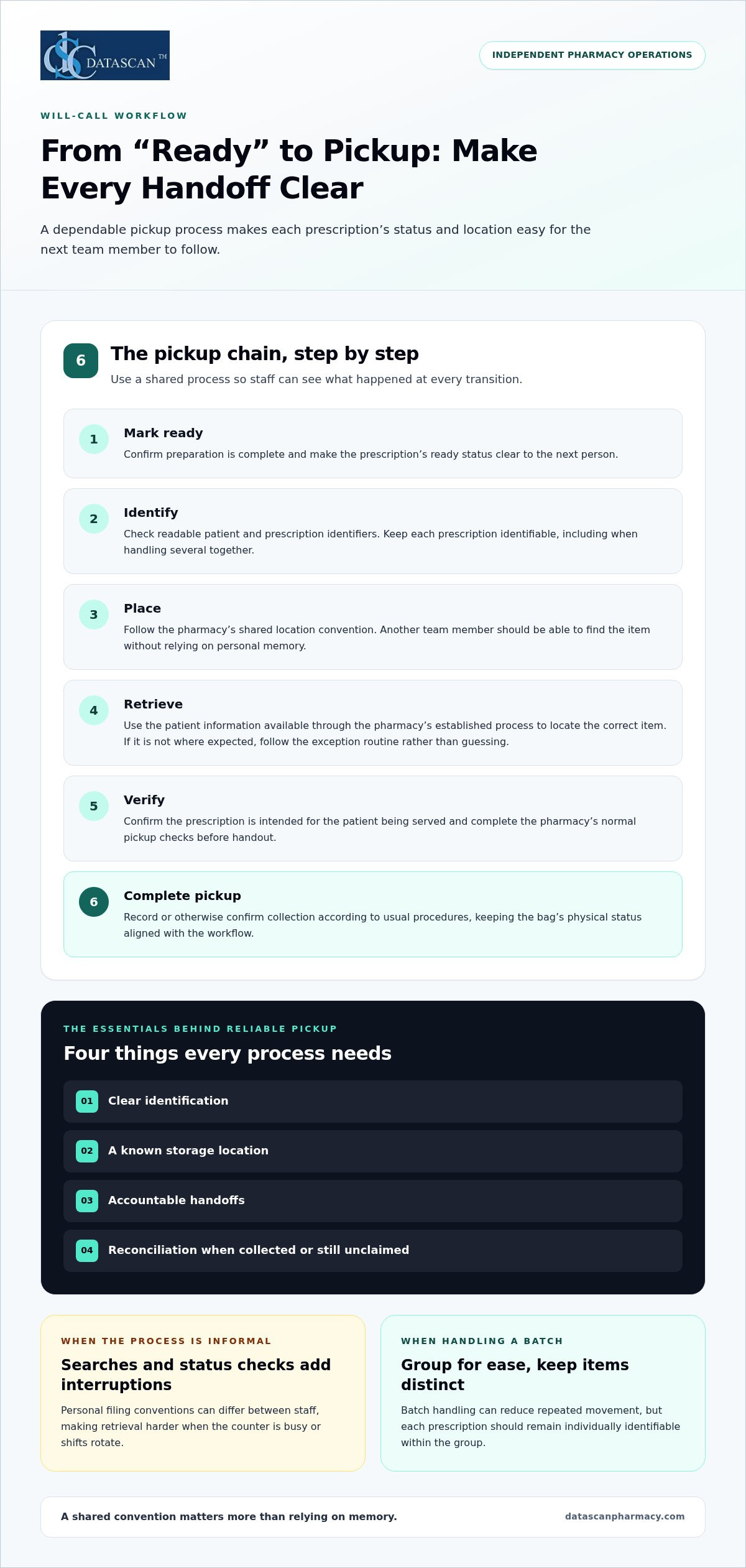
A dependable workflow makes each transition visible: a prescription is marked ready, identified, placed in a known location, retrieved, verified, and recorded as picked up. Will-call bin management systems can use different tools, but the team still needs a shared process that shows what happened at each handoff. Assigning the steps to roles already used in your pharmacy clarifies responsibility without requiring a new staffing model.
- Mark ready. The staff member completing the preparation confirms the prescription is ready for pickup using the pharmacy’s established process. The next person should be able to distinguish it from work that is still in progress.
- Identify. The person moving the prescription checks its readable patient and prescription identifiers. Keep each prescription identifiable, even when several prescriptions are handled together.
- Place. The staff member responsible for storage follows the pharmacy’s shared location convention. Another team member should be able to find the item using that convention, without depending on personal memory.
- Retrieve. At pickup, the staff member uses the patient information available through the pharmacy’s established process to locate the correct item. If it isn’t in the expected place, pause and follow the exception routine rather than guessing.
- Verify. Before handout, staff confirm the prescription is intended for the patient being served and follow the pharmacy’s normal pickup checks. Complete the handoff only when the match is clear.
- Complete pickup. The team records or otherwise confirms that the prescription has been collected according to its usual procedures. This keeps the physical status of the bag aligned with the pharmacy’s workflow.
Batch handling can reduce repeated movement between preparation and storage when several prescriptions are ready for the same patient or household. Keep each prescription individually identifiable within the group. Grouping should simplify handling, not blur which items are included or make later retrieval depend on memory.
How should staff identify and place prescriptions in will-call?
Choose a placement convention that the whole team can explain and follow, then use it consistently across shifts. For example, a pharmacy might organize storage alphabetically or by designated sections. The best convention is one staff can apply reliably. Readable identifiers help distinguish patients with similar names, while a clear handoff from preparation to storage confirms that the item reached its intended location.
What should happen when a prescription cannot be found or collected?
Start with the expected location, then check nearby or designated exception areas and ask the staff involved in the most recent handoff. If the search doesn’t resolve the issue, record and escalate it through the pharmacy’s established procedure rather than silently resetting the status. Uncollected prescriptions also need a defined review and return-to-workflow process, so staff know what happens next and the storage area doesn’t accumulate items with unclear status.
Pharmacies refining these handoffs can use customizable workflows to support their established routines. Datascan works with pharmacies on workflow needs and connected operations. Discuss your pharmacy operations with Datascan.
Should a pharmacy use manual bins, barcode scanning, or RFID for will-call?
Choose the method that addresses your pharmacy’s actual workflow bottlenecks, not the option that sounds newest. Manual bins can work when placement is consistent and easy to teach. Barcode scanning adds an identification step, while RFID can support item identification without requiring a direct line of sight. Each approach still depends on clear handoffs and staff following the process.
Compare how each option fits your current routine before changing equipment or adding steps. Setup, staff training, prescription identification, retrieval, and exception handling all matter. Specific implementation details depend on the pharmacy and tools selected.
| Approach | Identification and staff steps | Workflow fit to consider |
|---|---|---|
| Manual bins | Staff use a shared physical layout and locate prescriptions by their identifiers. | Can suit a process that remains easy to follow across shifts; relies on consistent placement and training. |
| Barcode scanning | Staff scan a barcode to identify a prescription or support a transaction. Scanning generally requires a direct line of sight and handles items one at a time. | Consider whether scanning fits naturally into placement and pickup without creating unnecessary extra handling. |
| RFID | Radio-frequency identification uses tags and readers to identify items without a direct line of sight; some systems can read multiple tagged items together. | Consider the equipment, process changes, and staff steps involved in using it within your pharmacy. |
When can a manual will-call process be enough?
A manual approach may meet the need when staff can place and retrieve prescriptions using one shared convention, including during shift changes and busy pickup periods. Assign responsibility for keeping the layout consistent, and train team members to use the same method. Repeated searches, staff asking one another where bags were placed, or uncertainty about pickup status are signs the routine needs attention.
What do barcode and RFID approaches change?
Barcode scanning makes identification part of a staff action: find the code, scan it, and follow the pharmacy’s next step. RM Solutions describes an approach that batches prescriptions and uses a barcode during the sale process. RFID uses radio waves to identify tagged items, and Parata describes tracking prescriptions through processing with an RFID cabinet solution. These are examples of specific approaches, not evidence that either method eliminates errors or suits every pharmacy.
Evaluate the trade-off against your own workflow. If the main issue is inconsistent placement, clarify the routine before investing in a different identification method. If staff need a more structured way to identify and retrieve items, assess how scanning would fit into existing handoffs and how RFID equipment would change those steps. Keep process needs at the center of technology decisions.
How can an independent pharmacy improve will-call bin management?
Improve the process by finding where will-call work creates friction, making targeted changes, and reviewing the results. A consistent workflow can reduce avoidable searching and repeat work, giving a busy owner and team more time for other operational priorities. It won’t change PBM reimbursement terms, but better-organized daily work can help protect time for reviewing reimbursement concerns and managing the business.
- Observe: Watch pickup during busy and quieter periods. Note where staff pause, repeat checks, or leave the counter to search.
- Map handoffs: Trace the process from prescription readiness through storage and pickup. Identify where ownership, location, or status becomes unclear.
- Standardize placement: Set a shared convention using language and locations the team understands. Keep responsibilities clear as changes are introduced.
- Train the team: Explain the revised routine and how to handle exceptions. Consistent training helps avoid shifting the same uncertainty from one employee to another.
- Review and adjust: Compare staff experience before and after a change, then refine the specific steps that continue to cause friction.
Make changes in manageable stages. For example, begin by standardizing placement across shifts while keeping current roles intact. Once the team has adopted the change, review whether it has reduced unnecessary searching or repeated checks before adjusting another part of the workflow. This approach preserves established responsibilities while making room for improvement.
- Retrieval delays: Note when staff take longer than expected to locate an item.
- Unresolved searches: Track searches that need escalation or remain unexplained.
- Repeat work: Record avoidable repeated checks, movements, or handoffs.
How can a pharmacy find its will-call bottlenecks?
Observe pickup at different levels of activity, then ask staff where they lose time or need extra clarification. Compare those observations with the handoffs mapped in the process. Staff feedback can show whether a problem is an isolated mix-up or a recurring point of friction. This kind of operational review also helps owners distinguish will-call issues from separate challenges, including PBM reimbursement pressures.
How should teams standardize and review the process?
Write a concise placement and retrieval procedure in the pharmacy’s own terminology. Make responsibilities and the exception pathway clear, then train the team on the same expectations. Review selected indicators consistently and adjust the step that evidence shows is creating friction. More dependable daily routines can give owners clearer visibility into operations and more room to focus on broader business priorities.
Pharmacy workflow optimization software can support pharmacies refining established routines. Datascan offers customizable workflows for pharmacies improving their operations. Talk with Datascan about your pharmacy workflow and identify a practical next step for your team.
How can pharmacy management software support a dependable will-call process?
Pharmacy management software can support a dependable will-call process by helping a pharmacy organize broader operations around clear staff responsibilities and established routines. Choose a fit that makes handoffs easier to understand and supports the way the pharmacy works. Review how a tool fits your current workflow, how staff handle information, and whether it can reduce avoidable repeat work for the team and owner.
What should pharmacy management software contribute to the workflow?
Start with your pharmacy’s process, then assess how the software fits. Consider whether staff can follow the same handoff expectations across preparation, storage, and pickup, and whether the workflow makes responsibilities clear. These are practical evaluation criteria for choosing pharmacy management software. A good fit can give staff a clearer routine and help owners spend less time untangling operational questions.
Connected operations matter because will-call pickup sits alongside other pharmacy work. Pharmacy management software supports the broader operational picture, while pharmacy point-of-sale tools relate to the transaction at pickup. Storage and retrieval, patient communication, and the sale are distinct activities. Evaluating each in context helps avoid expecting one tool to solve every handoff.
- Fit: Does the workflow align with how your team already divides responsibilities?
- Clarity: Can staff understand what happens next at each handoff?
- Practical value: Could the process reduce repeated checks or time spent resolving routine questions?
- Change management: Can the pharmacy introduce adjustments in manageable stages?
These questions help separate useful process support from features that sound appealing but don’t address the pharmacy’s actual bottleneck. Keep the focus on practical outcomes: less operational friction, more staff time for patient care, and a more consistent pickup experience.
How can Datascan help independent pharmacies move forward?
Datascan is a family-owned pharmacy software company founded in 1981. Its offerings include pharmacy management software, point-of-sale tools, and customizable workflows. For an independent pharmacy refining established routines, customizable workflows can help make operational processes fit the way the team works. Datascan’s pharmacy software can be part of that broader evaluation.
Bring your current process into the conversation: where handoffs feel unclear, which tasks create repeat work, and what your team wants to preserve. A practical discussion can connect workflow priorities with software considerations. Talk with Datascan about your pharmacy workflow.
Make your next workflow improvement count
Choose one operational question to guide your next step: what would give your team more confidence and consistency at pickup? Use the answer to set a practical priority, then assess whether your current process supports it. Improvements don’t have to start with a major system change. A focused adjustment, followed by staff feedback, can show whether the workflow is becoming easier to manage.
As you evaluate will-call bin management systems, keep the goal broader than faster retrieval alone. A dependable process should support the pharmacy’s daily operations and leave staff with more time for work that needs their attention. The best path forward is one your team can understand, adopt, and sustain.
Explore your next workflow improvement with Datascan. Start with one pickup challenge and discuss a practical way to improve the routine.
Frequently Asked Questions
What is a will-call bin management system?
A will-call bin management system is the process and tools a pharmacy uses to organize prescriptions that are ready but haven’t been collected. Will-call bin management systems cover identifying each prescription, assigning or following a storage location, retrieving it for the right patient, and confirming pickup is complete. Physical bins provide storage; barcode or RFID tools may support identification or tracking. The setup should fit the pharmacy’s established procedures and operational needs.
Can a pharmacy manage will-call prescriptions without an automated cabinet?
Yes. A pharmacy can use physical bins without an automated cabinet if staff follow a shared placement and retrieval routine. For example, the team can use the same labeled sections across shifts and make sure new staff learn the convention. Review whether searches, repeated checks, or unclear handoffs keep recurring. A manual process may fit some pharmacies, but each team should assess its own volume, layout, and operational needs.
How does barcode scanning help with will-call pickup?
Barcode scanning can add an identification step when prescriptions are handled for pickup. RM Solutions describes a workflow that batches prescriptions under a single barcode and scans that barcode at sale. That is a provider-described approach, not a capability to assume across all systems. A pharmacy evaluating scanning should map where staff would scan, what the scan confirms, and how the step fits its prescription identification and pickup procedures.
What is the difference between barcode and RFID will-call systems?
Barcode workflows use a scannable code to identify an item or group of items at defined steps, while RFID uses radio-frequency identification to read tagged items. Parata describes its RFID cabinet solution as tracking medications through prescription processing. The methods differ in how items are identified and followed through the workflow. Neither approach automatically prevents errors, so pharmacies should consider staff steps, equipment, and process fit before choosing one.
How should a pharmacy handle a prescription that staff cannot find in will-call?
Follow a written search and escalation procedure rather than relying on memory or repeating informal checks. Staff can retrace the last documented handoff, check locations covered by the pharmacy’s established convention, and notify the responsible team member if the item remains missing. Keep a record of unresolved searches using the pharmacy’s procedures. Staff should also follow approved processes for confirming prescription status and communicating with the patient.
What should a pharmacy measure when improving will-call bin management?
Track practical indicators tied to the pharmacy’s pickup process, such as retrieval time, unresolved searches, repeated checks, and staff-reported friction. Use the same method to review these indicators before and after a process change, so the comparison is useful. For example, note whether searches cluster around a particular shift handoff or storage area. No single measure proves better patient care, so review patterns alongside staff feedback.
Can pharmacy management software replace a pharmacy’s will-call procedures?
No. Pharmacy management software can support pharmacy operations, but staff still need clear procedures for identifying prescriptions, handing them off, locating them, and managing exceptions. Align the team’s process with the tools it uses, then train staff on the steps and responsibilities. For example, decide how the team will handle a location mismatch before it occurs. Software decisions should support the pharmacy’s operating routine, not replace sound procedures.
 Kevin Minassian is the President of Datascan Software. Under his leadership, the company rapidly expanded to provide pharmacy management software on a national level. Over the last 15+ years, he has ensured that Datascan has continuously evolved to offer innovative solutions for independent pharmacies while still offering world-class customer support. He is passionate about helping independent pharmacies to remain competitive, achieve success, and offer the very best service to their communities.