
Patient engagement shouldn’t become one more task your team can’t sustain. To understand how to increase patient engagement in a pharmacy, pair useful conversations with repeatable workflows and communication channels that fit patients and staff.
That can be difficult when the counter is busy, outreach time is limited, and generic messages don’t reflect what a patient needs. Engagement doesn’t mean contacting everyone the same way or adding manual steps. Pharmacy management software can help organize routine processes, while medication synchronization, e-care plans, and a patient mobile app can support relevant communication. Technology should make room for better pharmacist conversations, not replace them.
This guide explains how to build patient relationships around practical needs, choose channels your community will use, and create workflows your team can maintain alongside daily pharmacy work. It also covers how to assess whether outreach is useful, so engagement becomes part of patient care rather than another disconnected initiative.
Key Takeaways
- Build engagement around patient needs with clear, respectful conversations that invite questions and check understanding.
- Choose in-person, phone, or digital outreach based on the message and what works for each patient.
- Make engagement manageable by starting with one patient need and a simple, assigned workflow.
- Follow up consistently and review whether your outreach helps patients take part in their care.
- Use pharmacy management software, medication synchronization, e-care plans, and patient-facing tools to support consistent interactions without replacing personal care.
What does patient engagement mean in a pharmacy, and why does it matter?
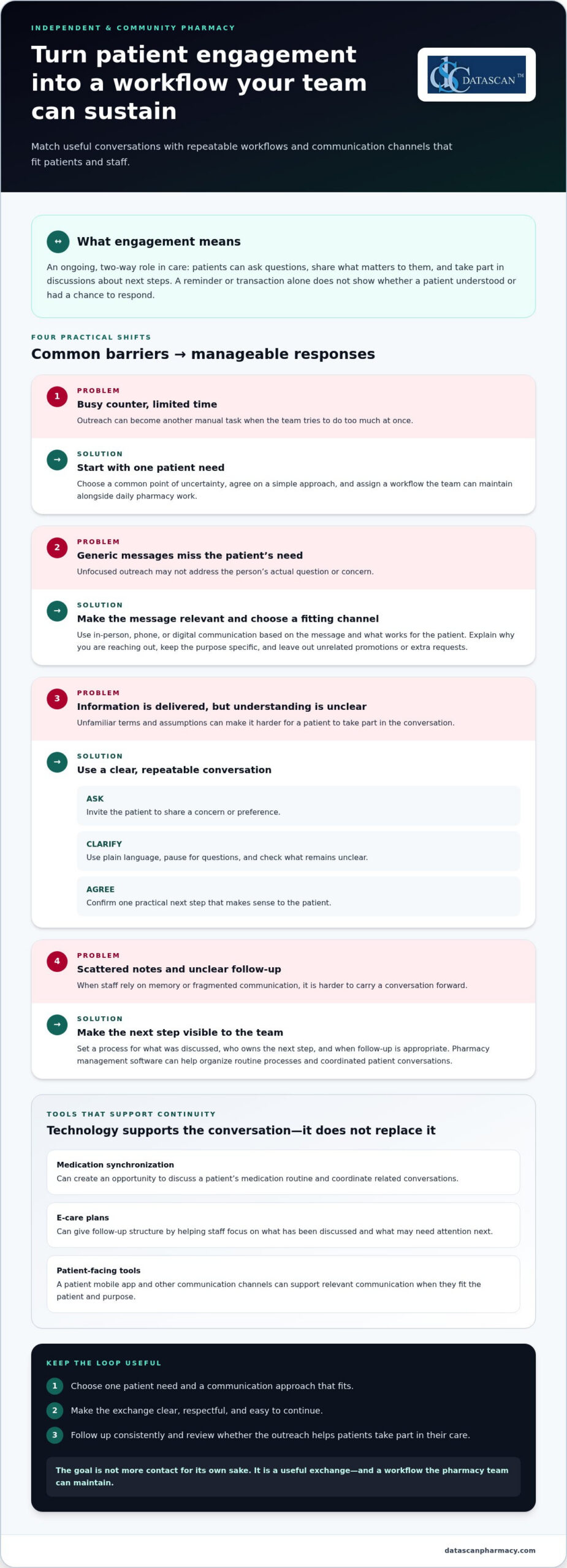
Patient engagement is an ongoing, two-way role in a person’s care. In a pharmacy, it means patients can ask questions, share what matters to them, and take part in discussions about next steps. A reminder or transaction can provide information, but it doesn’t show whether the patient understood it or had a chance to respond.
Meaningful participation depends on communication patients can understand and use. The Agency for Healthcare Research and Quality’s Health Literacy Universal Precautions Toolkit recommends making health information easier to understand and act on. Pharmacy teams can apply this by using plain language, inviting questions, and checking whether instructions are clear instead of assuming information has landed because it was delivered.
Engagement can make pharmacy interactions more responsive and understandable, but it doesn’t guarantee a clinical outcome. In independent and community pharmacies, trust and continuity matter to the day-to-day relationship. Patients should feel able to raise a concern, receive a clear answer, and know how to continue the conversation. That makes an interaction useful, not just efficient.
What does patient engagement look like at a community pharmacy?
It can happen during a brief interaction. A patient asks how to follow a prescription’s directions; a staff member listens, explains the relevant information in clear terms, and asks what questions remain. At a later visit, the patient may raise a related concern. Recognizing this as part of an ongoing conversation helps staff respond with context instead of treating every visit as an unrelated transaction. The goal is a clear exchange, not a longer conversation for its own sake.
What gets in the way of patient engagement?
Limited staff time, fragmented communication, and generic outreach can make interactions less relevant. Unfamiliar terms or unclear next steps can also create friction. These barriers don’t mean patients are unwilling to participate. They show where the pharmacy can make communication more accessible and coordinated.
Independent pharmacies need processes that fit the pace of daily operations. When staff have to reconstruct previous conversations from scattered notes or repeat manual coordination, continuity gets harder. Pharmacy management software can support organized workflows, while pharmacy staff provide the judgment and personal attention that make engagement meaningful.
How can a pharmacy build stronger patient engagement?
Build engagement around a patient’s immediate needs, then make the next interaction easy to continue. Start by identifying a common point of uncertainty, such as understanding prescription directions or coordinating a medication routine, and shape communication around it. This is more useful than launching several disconnected outreach tactics at once. To increase patient engagement in a pharmacy, make each interaction clear, respectful, and relevant to the person receiving it.
How can pharmacists make everyday conversations more engaging?
Open-ended questions give patients room to share what matters. Try, “What questions do you have about your medications?” or “What would make this easier to manage?” Explain information in plain language, pause for questions, and don’t assume silence means understanding. Before the conversation ends, agree on one clear next step, such as when the patient will follow up or what to do if another question comes up.
A short, repeatable conversation can help staff keep the exchange focused:
- Ask: Invite the patient to describe a concern or preference.
- Clarify: Explain the relevant information in familiar language and check what remains unclear.
- Agree: Confirm a practical next step that makes sense to the patient.
The aim isn’t to use a script word for word. It’s to make space for the patient’s perspective, even during a brief interaction. Respectful questions also help staff avoid sending information that doesn’t address the person’s actual concern.
How can personalized pharmacy services support ongoing engagement?
Medication synchronization can create an opportunity to discuss a patient’s medication routine and coordinate related conversations. E-care plans can provide structure for relevant follow-up, helping staff focus on what has been discussed and what may need attention next. Neither guarantees a particular result; both can support purposeful, continued communication when used in a way that fits the patient.
Keep outreach specific to its purpose. A message about a planned check-in should explain why you’re contacting the patient and give them a simple way to respond or ask for clarification. Avoid adding unrelated promotions or packing several requests into one message. Clear communication respects the patient’s time and helps staff keep follow-up focused.
Consistency also depends on whether the team can carry an interaction forward without relying on memory or scattered notes. A defined process can help staff know what was discussed, who owns the next step, and when follow-up is appropriate. Pharmacy workflow software can support organized processes and coordinated patient conversations.
To strengthen engagement without stretching the team, choose one patient need, agree on a shared approach, and refine it as staff learn what questions come up. Related pharmacy patient retention strategies can connect consistent, patient-centered interactions with the broader goal of maintaining lasting relationships.
Will patient engagement add work, or can technology make it manageable?
Patient engagement can add work if every reminder, follow-up, and patient question becomes a separate manual task. Technology can help organize repeatable steps and keep communication connected, but it can’t replace trust built through thoughtful conversation. For an independent pharmacy, the goal is to use digital tools where they fit and protect staff time for interactions that need human attention.
Different channels suit different needs. Choose based on the patient’s preference, the purpose of the contact, and whether a response or conversation is needed.
| Channel | Patient fit and access | Staff effort and continuity |
|---|---|---|
| In-person conversation | Useful when a patient wants to ask questions directly or discuss a concern during a visit. | Requires staff time in the moment; a clear process for documenting next steps can support continuity. |
| Phone outreach | Offers direct interaction for questions that may need clarification or discussion. | Takes staff time to place and manage calls; a consistent follow-up record helps the team stay coordinated. |
| Patient-facing digital tools | Can offer another way to access pharmacy communication for patients who prefer digital channels. | Can support routine touchpoints, while personal questions may still call for a staff conversation. |
Which engagement channel fits different patient needs?
Use in-person or phone contact when a patient’s question needs discussion, clarification, or a chance to explain preferences. A patient app may suit someone who prefers digital access for routine interactions. The MobileScripts patient app can be one option in a broader approach, not a replacement for staff contact. Match the channel to the interaction instead of assuming one method works for everyone.
How can pharmacy management software reduce disconnected work?
When staff rely on separate reminders, notes, and handoffs, it takes extra effort to see what has already happened and what needs attention. Pharmacy management software can support repeatable processes and help keep routine work organized. It doesn’t decide what a patient needs or provide empathy; pharmacy staff bring the judgment and personal communication. An organized system can help make that attention easier to sustain.
As you consider how to increase patient engagement in a pharmacy, identify which steps are routine and which need a personal response. Use technology to support consistency around routine work, then reserve staff attention for questions, preferences, and follow-up that benefit from direct interaction. Pharmacy management software can help connect pharmacy processes while the team keeps the patient relationship at the center.
How can a pharmacy put patient engagement into a sustainable workflow?
A sustainable patient engagement workflow gives each interaction a clear purpose, an owner, and a next step. Start with one recurring patient need, try a practical approach, and review whether the process is useful before expanding it. This keeps outreach from becoming a collection of disconnected tasks competing with daily pharmacy operations.
How should a pharmacy start an engagement workflow?
Ask the team to identify a recurring patient need that fits the pharmacy’s services. Choose a suitable communication approach and decide who will handle the next step. Keep the first workflow straightforward: staff should know what action to take and where to record its status. Review the process together and adjust it when a handoff or instruction creates friction.
- Choose a need. Select one recurring situation patients ask about or need help coordinating.
- Select an approach. Pick a communication channel and a clear purpose for the interaction.
- Assign ownership. Identify who initiates outreach, handles responses, and records follow-up.
- Follow up. Complete the agreed next step and note whether it happened or remains outstanding.
- Review and refine. Discuss what worked, where the process stalled, and what should change before continuing.
For example, if the team chooses a recurring need related to medication synchronization, define how staff will explain the service, who will respond to patient questions, and how agreed follow-up will be tracked. Start with that process instead of launching several initiatives at once. A manageable beginning gives the team room to learn without adding unnecessary coordination.
What should a pharmacy measure to review engagement?
Track measures the team can observe: whether planned outreach was completed, whether a patient responded, and whether agreed follow-up is still open or finished. These measures show where the workflow is moving or getting stuck; they aren’t proof of a clinical result. Pair them with staff feedback and, where appropriate, patient comments to understand whether the interaction felt clear and useful.
Keep the review focused. If outreach is often incomplete, examine whether ownership is clear or the steps are too cumbersome. If patients respond but still need the same clarification, reconsider the message or next step. Avoid setting an arbitrary target before the pharmacy understands its own workflow. The goal is practical improvement, not reporting that consumes the time the process is meant to protect.
Pharmacy management software and configurable workflows can help organize task ownership and follow-up details, reducing avoidable manual coordination. Pharmacy workflow software can support repeatable processes while staff remain responsible for personal judgment and patient communication. As you refine the process, ask whether each step makes the patient interaction clearer or simply adds work.
For support aligning pharmacy technology with your engagement workflow, connect with the Datascan team.
How can pharmacy management software support patient engagement?
Pharmacy management software can support consistent patient-facing workflows while helping independent pharmacy owners manage a demanding operation. That matters as PBM reimbursement pressures and reforms shape pharmacy finances. Technology can help organize routine work, but it can’t change a PBM contract or guarantee better reimbursement. Its practical value is reducing disconnected manual steps, giving owners and staff more time to focus on patient care and review business pressures.
What can Datascan tools contribute to patient-facing pharmacy workflows?
Datascan Pharmacy Management Software supports pharmacy operations, and its customizable workflow capabilities can help organize routine processes. Reducing avoidable coordination can give pharmacy owners more room to assess operational needs, including reimbursement pressures. The software doesn’t determine reimbursement terms or replace financial review. The team remains responsible for understanding its circumstances and deciding how to respond.
Patient-facing tools can support a pharmacy’s engagement approach. MobileScripts is a patient mobile app, and medication synchronization and e-care plans are supported features that can help structure patient interactions and follow-up. These tools don’t guarantee a particular patient response, clinical outcome, or financial result. They support pharmacy processes while staff provide the judgment and communication patients need.
For example, a pharmacy can use a consistent workflow to coordinate an engagement activity and organize follow-up, while staff handle patient questions and next steps. Owners can also use time spent less on manual coordination to review operational challenges, including PBM reimbursement concerns. Technology can support that work, but it doesn’t replace a careful review of pharmacy finances.
What is a practical next step for an independent pharmacy?
Choose one engagement workflow the team wants to make easier, then identify the manual handoffs or repeated tasks that slow it down. Consider how simplifying that process could give staff more time for patient communication and owners more capacity to focus on business priorities, including reimbursement pressures. A specific workflow makes it easier to discuss the pharmacy’s needs, staff capacity, and patient communication goals.
Datascan’s pharmacy management software and workflow tools support pharmacy operations, while the team remains at the center of patient relationships. Start a technology conversation with the work your pharmacy needs to manage, not an expectation that software alone will resolve PBM reimbursement challenges.
Discuss your pharmacy’s needs with Datascan.
Make your next engagement step manageable
Stronger patient engagement doesn’t require a sweeping change. Choose one interaction your team wants to make easier, then consider how workflows and tools can support it without taking the human element out of care. That focused first step gives your pharmacy a practical way to build on what already works.
Datascan is a family-owned company that has operated since 1981, with U.S.-based support for independent and retail pharmacies. If you’re considering how to increase patient engagement in a pharmacy, bring one workflow or patient communication goal into the conversation. A useful starting point is one that fits your team’s capacity and the ways your patients prefer to connect.
Talk with Datascan about patient engagement workflows and take the next step toward a process your team can sustain.
Frequently Asked Questions
What is the difference between patient engagement and patient satisfaction?
Patient satisfaction reflects how a patient evaluates an experience, while engagement describes their involvement in care-related conversations and decisions. Someone might be pleased with a quick, friendly visit without asking questions or discussing next steps. Engagement involves taking part, such as sharing a concern or confirming a plan. Pharmacies can gather patient feedback to understand the experience and consider whether interactions give people a meaningful opportunity to participate.
How can a small pharmacy improve patient engagement with limited staff?
A small pharmacy can focus its effort on a specific patient need instead of trying to contact everyone. For example, the team might identify a common question at prescription pickup and prepare a clear way to address it. Make the handoff visible so another staff member can continue if the person who started the conversation becomes busy. This keeps engagement connected to routine work rather than creating a separate outreach task for every concern.
Can a pharmacy app replace conversations with a pharmacist?
No. An app can provide a digital way to interact with the pharmacy, but it can’t replace a pharmacist’s professional judgment or a conversation tailored to a patient’s question. A routine request may suit a digital tool, while uncertainty about medication directions may need direct discussion. Make it clear how patients can reach the pharmacy team when they need help, and treat digital access as one part of patient communication.
How often should a pharmacy contact patients about their care?
There isn’t one contact schedule that fits every patient or purpose. Base timing on why the pharmacy is reaching out, any next step agreed with the patient, and their communication preferences. Before sending another message, consider whether it adds useful information or simply repeats an earlier contact. Asking patients which channel they prefer can help staff tailor future communication and avoid unnecessary outreach.
What should pharmacy staff do when a patient does not respond to outreach?
A lack of response doesn’t explain why a patient hasn’t replied. The message may have been missed, the channel may not suit them, or they may not need help at that time. Avoid repeated contact without a clear purpose. For routine outreach, staff can note the status and offer another way to connect during a later interaction. If the matter needs timely attention, follow the pharmacy’s established procedures for that situation.
How can a pharmacy tell whether its patient engagement efforts are useful?
Review more than the number of messages sent. Consider whether patients responded, whether staff completed the intended follow-up, and whether feedback suggests the communication was clear. For example, if patients continue to ask what action to take, the message may need revision. Review one engagement effort at a time and use staff observations alongside patient comments to decide what to change. Activity counts alone don’t show whether outreach was useful.
About the author: This FAQ was prepared by the Datascan Pharmacy Software editorial team, which focuses on pharmacy management software and tools for independent and retail pharmacies.
 Kevin Minassian is the President of Datascan Software. Under his leadership, the company rapidly expanded to provide pharmacy management software on a national level. Over the last 15+ years, he has ensured that Datascan has continuously evolved to offer innovative solutions for independent pharmacies while still offering world-class customer support. He is passionate about helping independent pharmacies to remain competitive, achieve success, and offer the very best service to their communities.