
A prescription can look profitable at the counter but lose money after a DIR fee is applied. DIR stands for Direct and Indirect Remuneration. Effective DIR fee mitigation strategies start with understanding how post-sale adjustments affect each prescription’s margin and your cash flow. Pharmacy benefit managers may recoup fees after the sale, making the final impact harder to see.
That uncertainty can make it difficult to identify which prescriptions, payers, or performance measures are affecting your bottom line. You need clear records to manage those effects.
This article explains how DIR fees are calculated and reconciled, why they can erode profits, and how to prioritize practical mitigation steps. You’ll also learn how prescription-level profitability analysis, cash-flow planning, performance monitoring, and clearer PBM terms can support more informed decisions for your pharmacy.
Key Takeaways
- Track adherence, generic utilization, and prescription-level margins to identify where performance adjustments may affect profitability.
- Build cash-flow forecasts that account for delayed fee recoupments, rather than relying only on the margin shown at the point of sale.
- Review fee statements and contract terms to understand how adjustments are calculated and which transactions they affect.
- Use clear performance data to prioritize operational changes and support more informed discussions about PBM terms.
- Pharmacy management software can help organize dispensing and business workflows, giving your team better visibility into pharmacy operations.
Mitigation strategies and prioritization
Effective DIR fee mitigation strategies begin with a focused review of the measures tied to your PBM contracts. Track adherence, generic utilization, and prescription-level profitability to see where performance and post-sale adjustments affect margins. Then rank opportunities by likely financial impact and by how much control your pharmacy has over each factor.
DIR fee arrangements vary by contract and performance measures, not simply by whether a pharmacy is independent, part of a chain, or specialty-focused. A chain may coordinate assessments across locations, while an independent pharmacy may review results locally. Specialty pharmacies should focus on measures relevant to their covered prescriptions and payer agreements.
Adherence and generic utilization are performance metrics that can affect DIR fees. Contract terms may also tie adjustments to other measures, so review the requirements for each payer relationship rather than assuming one score applies everywhere.
To improve quality scores, use adherence reports to identify patients who may need refill outreach, then coordinate follow-up through a consistent workflow. For example, review missed refills, address access barriers, and use medication synchronization to align refill timing. These steps support adherence monitoring, but results depend on the measures and patient population involved.
When challenging or appealing a fee, follow the dispute process and deadlines in the applicable contract. Keep statements, transaction records, performance reports, and correspondence together so each appeal links a specific adjustment to supporting evidence. Incomplete documentation or a missed deadline can weaken a dispute.
Prioritize work by separating controllable measures from contract terms or factors outside the pharmacy’s influence. A practical sequence is to identify the largest margin concerns, assign a staff owner, and review progress regularly. If a dedicated department handles quality or finance, connect its assessment to dispensing and patient outreach workflows.
- Compare adherence and generic utilization measures with the relevant payer terms.
- Use prescription-level margin reviews to identify where adjustments change profitability.
- Assign an owner to each improvement opportunity and track follow-up consistently.
- Organize appeal records around the specific transaction and contract process.
The Centers for Medicare & Medicaid Services explains that Medicare Part D originally used DIR to account for post-sale price adjustments. This context matters: a useful review connects performance activity, contract language, and the adjustment that appears later, rather than treating a single score as the whole explanation.
Independent pharmacies can analyze prescription-level profitability to identify drugs or payers that produce lower margins after adjustments. This helps focus reviews where post-sale changes have the greatest effect. Pharmacy-industry accountants can also help plan for DIR fees and monitor financial health, adding financial expertise to ongoing prioritization and follow-up.
Profit erosion and cash flow strain
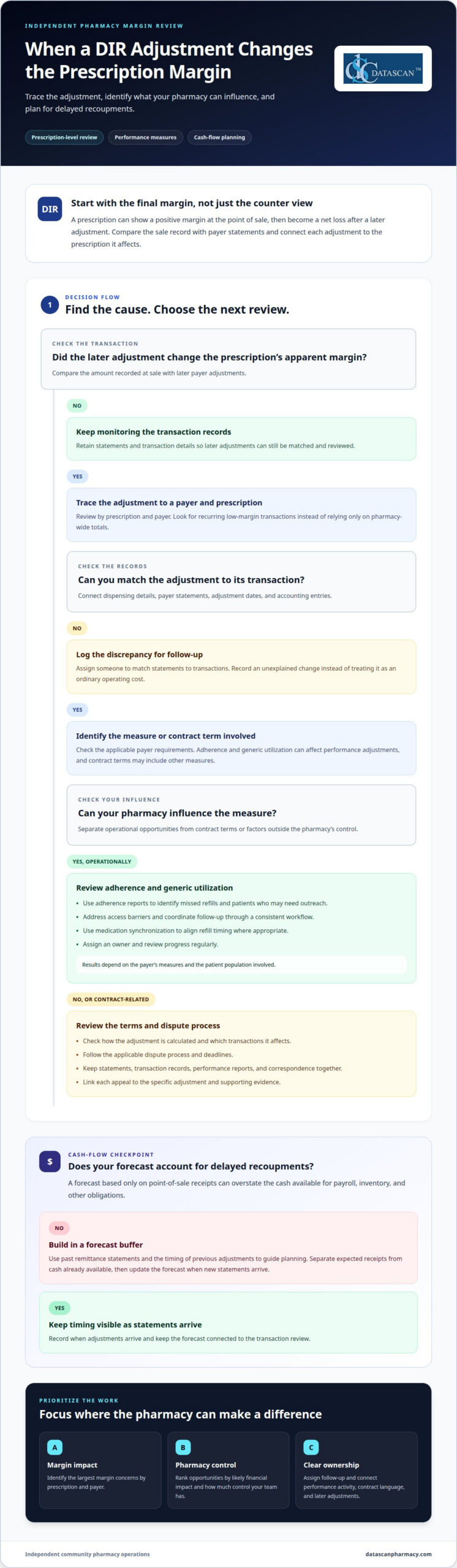
A prescription’s apparent margin can change after a DIR fee is applied. For example, a pharmacy may see a positive margin at the point of sale, then find that a later adjustment turns the transaction into a net loss. That gap makes prescription-level profitability harder to assess and means sales totals alone can give an incomplete view of financial performance.
DIR fees can strain cash flow as well as profit. A fee recouped after the sale may arrive after the pharmacy has paid suppliers and covered operating expenses. Because the final amount may not be visible during dispensing, a forecast based only on point-of-sale receipts can overstate the cash available for payroll, inventory, or other obligations.
Build a forecast buffer for future DIR fee clawbacks. Use past remittance statements and the timing of previous adjustments to guide planning, then separate expected receipts from cash already available. Update the forecast when new statements arrive. This gives owners a clearer view of upcoming pressure and helps them plan inventory purchases without treating uncertain reimbursement as spendable cash.
A practical review can connect each action to a financial signal:
- Separate gross and adjusted results. Compare the amount recorded at sale with later payer adjustments to see how reported margin changes.
- Review by prescription and payer. Look for recurring low-margin transactions rather than relying on a pharmacy-wide average.
- Mark timing in the forecast. Record when adjustments arrive, so cash planning reflects the delay between dispensing and recoupment.
- Assign follow-up. Give a staff member responsibility for matching statements to transactions and flagging unexplained changes.
Keep technical and financial records connected. A useful review links dispensing details, payer statements, adjustment dates, and accounting entries. When these records sit in separate workflows, staff may spend time reconciling totals without identifying which transactions caused the difference. A consistent process makes the next review more specific and helps distinguish timing issues from margin problems.
For example, if a payer adjustment appears in a later statement, trace it to the related transaction and note its effect in the forecast. If you cannot match the transaction, record the discrepancy for follow-up rather than treating the adjustment as an ordinary operating cost. Clear documentation also gives pharmacy leadership a stronger basis for discussing reimbursement patterns with financial advisers.
To discuss pharmacy cash-flow workflows, connect with the Datascan team.
DIR fee timing and transparency
Pharmacies may not know the amount of a DIR fee when a prescription is sold, making real-time profitability difficult to track. Owners can forecast and audit adjustments using payer statements, transaction records, contract terms, and performance data, then match each later adjustment to its source.
The delay creates a visibility gap. At the counter, the pharmacy sees the transaction’s initial reimbursement, not necessarily the final result after later adjustments. A statement may show a lump-sum deduction with limited detail about the prescriptions or measures behind it. A reliable audit therefore depends on preserving records that help trace the amount.
Build a record trail that links each adjustment to a payer, statement period, and relevant transaction. For example, when a remittance shows a deduction without prescription-level detail, compare it with available transaction and performance records. Note what matches and what remains unexplained. This separates documented adjustments from discrepancies that need follow-up.
Useful forecasting and audit sources include:
- Payer statements and remittances: Record the amount, posting date, and payer for each adjustment.
- Transaction-level records: Preserve prescription identifiers and reimbursement details that help connect later deductions to sales.
- Contract terms: Note the performance measures and adjustment methods that apply to each payer relationship.
- Performance reports: Keep adherence and generic utilization results alongside adjustment records to support trend review.
Use those records to create a recurring reconciliation process. First, group adjustments by payer and statement period. Next, match available transaction details and performance results. Then flag unexplained differences for review instead of blending them into routine expenses. A consistent process clarifies timing and helps refine cash forecasts.
Recent efforts aim to move DIR fees closer to the point of sale. This could make adjustments more visible when pharmacies evaluate a transaction, while also changing when cash leaves the business. Until the timing and reporting are clear for a specific payer arrangement, use actual remittance history to inform forecasts rather than assuming each sale reflects its final margin.
For example, a delayed lump-sum deduction can disrupt an inventory plan if the forecast treats the full earlier reimbursement as available cash. Treat a large unexplained adjustment as a potential cash-flow problem, not a routine entry. Trace its sources and assess the possible impact before changing purchasing decisions or interpreting a payer trend.
Owners can also assign responsibility for statement review, record retention, and follow-up. A named staff owner helps ensure each adjustment has a documented status, from matched to under review. That simple step turns scattered financial and technical records into an audit trail that can inform later discussions about fee calculations and transparency.
Negotiating clearer PBM terms
One approach is to move DIR adjustments closer to the point of sale, making their timing more visible while changing when reimbursement is affected. Other terms depend on the PBM contract, so compare the initial payment, later adjustments, and net reimbursement before evaluating an arrangement.
Start with the contract language for each payer relationship. Identify which performance measures apply, how adjustments are calculated, when they appear, and what transaction detail accompanies them. If an adjustment depends on performance, determine which measure drives it and how the pharmacy receives the result. Clear definitions make financial comparisons more useful.
Use a recent payer statement as a working example. Match its adjustment to the contract language and available performance information. Then list unresolved points, such as a lump-sum deduction without transaction-level detail. This gives a discussion with the PBM a specific focus instead of relying on a general request for greater transparency.
- Calculation method: Ask how the adjustment relates to contract terms or performance measures.
- Timing: Clarify whether the amount appears at the point of sale or through a later adjustment.
- Supporting detail: Request information that connects an adjustment with the affected transactions or measure.
- Review process: Identify how questions or disputes are submitted and what contract terms govern that process.
- Reimbursement comparison: Consider the initial payment and subsequent adjustments together, not as separate financial outcomes.
These points help determine whether clearer terms would change visibility, cash timing, or the amount ultimately retained. For example, an adjustment shown earlier may improve awareness during dispensing but still affect reimbursement. A contract that explains performance measures may help staff connect results with payment, even when the adjustment remains part of the arrangement.
Some payer or pharmacy network relationships may offer opportunities to seek clearer DIR terms. Those opportunities depend on the specific relationship and contract. Independent pharmacies can prepare by organizing statement examples, identifying unclear language, and explaining how missing details limit their ability to assess prescription profitability.
Keep the discussion tied to documented terms. If an explanation refers to adherence or generic utilization, ask how the measure is defined and where its result appears. If a payment statement groups adjustments, ask what details support reconciliation. Precise questions help determine whether contract language, reporting, or payment timing needs clarification.
Negotiation cannot replace contract review or transaction analysis. It can, however, make PBM reimbursement easier to interpret when the pharmacy understands which terms drive adjustments and how those terms affect its records.
How are pharmacy DIR fees calculated and reconciled?
DIR means Direct and Indirect Remuneration. According to the Centers for Medicare & Medicaid Services, Medicare Part D originally used DIR fees to account for post-sale price adjustments from manufacturers or pharmacies. Today, a pharmacy benefit manager may recoup fees after a prescription is filled and paid, with calculations shaped by contract terms, performance measures, or later adjustments.
There is no universal calculation that applies to every pharmacy. A PBM contract may define performance measures and adjustments, but pharmacies may receive limited detail about how a fee was determined or which prescriptions it affects. Fees may also appear as lump-sum deductions, making it harder to link a statement amount to individual transactions.
Reconciliation means comparing an adjustment with available payment and prescription records, then documenting how the pharmacy accounted for it. A practical review can follow this sequence:
- Identify the adjustment. Record the payer, statement date, amount, and any description provided.
- Review the applicable terms. Locate contract language describing adjustments, performance measures, or calculation methods.
- Match available records. Compare the statement with transaction details and related performance information.
- Document the result. Note which records support the adjustment and which questions remain unresolved.
For example, a statement may show one deduction without identifying the prescriptions behind it. Compare the statement period with available payer and dispensing records, then document any transaction matches. If the amount cannot be linked to supporting details, record that gap separately rather than assigning it to a specific prescription without evidence.
Keep the initial payment distinct from later adjustments. Recording each separately shows how reimbursement changed after the sale. It also gives accounting staff a traceable basis for comparing the original transaction with the later statement, while preserving the contract language and performance information used in the review.
A consistent reconciliation process can reveal whether a recurring adjustment relates to a known performance measure, a contract term, or an unclear statement entry. It does not replace the PBM’s calculation, but it helps pharmacy staff organize questions around specific records instead of relying on memory or broad estimates.
For a more organized review of pharmacy payment and transaction workflows, contact the Datascan team.
When reviewing these adjustments, retain the statement alongside the relevant contract terms and records. Pharmacies may receive little information about how DIR fees were calculated or which transactions they apply to. DIR fees are often deducted in lump sums with little advance notice.
A review log can distinguish details supplied by the statement from open questions, such as whether the amount can be matched to supporting transaction information. Keep the basis for each conclusion with the relevant records, and mark unverified links as unresolved. When new information becomes available, add it to the same review trail and note whether it changes the explanation. This keeps known details, gaps, and follow-up questions together, so staff can revisit a deduction without relying on memory or assuming a lump-sum amount identifies particular prescriptions.
Datascan Pharmacy Software
Datascan Pharmacy Software supports the day-to-day workflows behind stronger financial oversight. Its pharmacy management software and point-of-sale tools help organize dispensing and sales operations, giving your team a practical foundation for reviewing business activity alongside payer statements and contract records.
Consider Datascan when disconnected workflows make it harder to keep operational records organized while your team manages prescriptions, patient communication, and delivery. MobileScripts Patient Mobile App and Datascan Mobile Delivery App support additional pharmacy services as part of the broader workflow.
Datascan’s tools do not replace PBM contract review or determine how a fee was calculated. They can help support pharmacy operations while your team carries out that review. Contact Datascan Pharmacy Software to discuss your pharmacy’s workflow needs.
Make your next review more actionable
Your next step is to make fee review a repeatable management habit. Set a regular time to compare payer adjustments with operational and financial records, then use the findings to guide staff priorities and contract discussions. Consistent DIR fee mitigation strategies help your team make decisions based on documented patterns rather than isolated surprises.
Pharmacy management software can support workflows for dispensing and business operations, while your team remains responsible for reviewing PBM terms and payment records. Datascan’s Independence-First platform includes pharmacy management, point of sale, mobile, delivery, and workflow tools for independent community pharmacies.
You don’t have to solve every workflow challenge at once. Choose the next improvement that gives your team clearer information or a more consistent process, then build from there. Contact Datascan Pharmacy Software to discuss your pharmacy’s needs and take a practical next step toward stronger operations.
Frequently Asked Questions
What Are DIR Fees?
DIR fees are post-sale reimbursement adjustments, so the amount ultimately retained can differ from the amount first recorded. In bookkeeping, keep an adjustment separate from the original claim payment instead of treating the initial reimbursement as final. This distinction helps owners review payer-level results without confusing dispensing activity with later reconciliation.
What are DIR fees and how do they affect pharmacies?
DIR fees can change the final reimbursement a pharmacy retains after dispensing a prescription. For example, a pharmacy reviewing a payer statement may find an adjustment that changes how it categorizes a transaction in its financial records. This matters when owners assess payer relationships, set operational priorities, or decide which records need closer review. The effect depends on the adjustment and the terms of that payer relationship.
How can pharmacies negotiate DIR fee terms with pharmacy benefit managers?
Make discussions more specific by bringing examples of unclear adjustments and identifying the related contract language. A useful meeting agenda can ask how performance measures are defined, what statement details support an adjustment, and how contract changes are communicated. Questions tied to documented examples help focus the discussion on terms that affect interpretation, reconciliation, and reimbursement, rather than general complaints about fee transparency.
What contract clauses should pharmacies review to mitigate DIR fees?
Review clauses that define performance measures, calculation methods, adjustment timing, supporting statements, and dispute procedures. Look for language explaining how the PBM communicates changes and what records accompany a deduction. For example, a dispute clause may specify where to submit an appeal and which deadlines apply. Organizing these provisions into a reference sheet makes each relevant term easier to find during financial reviews.

Article by
Sarah Callioras
Sarah Callioras is Vice President at Datascan Pharmacy Software, bringing nearly 25 years of experience across independent pharmacy operations and pharmacy technology. Since joining Datascan in 2016, she has played a key role in driving business growth, strengthening client relationships, and supporting independent pharmacies through innovative software solutions. With a strong background in pharmacy operations, business development, and strategic leadership, Sarah is passionate about helping independent pharmacies succeed in an evolving healthcare landscape.
 Kevin Minassian is the President of Datascan Software. Under his leadership, the company rapidly expanded to provide pharmacy management software on a national level. Over the last 15+ years, he has ensured that Datascan has continuously evolved to offer innovative solutions for independent pharmacies while still offering world-class customer support. He is passionate about helping independent pharmacies to remain competitive, achieve success, and offer the very best service to their communities.