
Medication adherence is more than picking up a prescription: it means taking the medication on time, at the prescribed dose, and for the prescribed duration. Adherence management software helps pharmacy teams keep track of refill activity and identify patients who may need a reminder or personal outreach. The goal is to make follow-up easier to manage, not to replace the care team’s judgment.
Pharmacy teams know how quickly a delayed refill can get lost among claims, phone calls, and a busy counter. Adherence management software can bring relevant information into a clearer workflow, helping staff spot refill gaps, monitor adherence, and prioritize outreach. This gives the team a practical starting point for supporting patients.
This article explains what adherence means and how software can support reminders, pickup and claims tracking, adherence monitoring, and care team communication. It also covers which capabilities matter in a community pharmacy and how pharmacy management software can connect patient support with daily operations.
Key Takeaways
- Distinguish delayed prescription pickups from other adherence gaps so follow-up can address the right issue.
- Use refill and claims information to spot patterns that may otherwise be hard to see during a busy pharmacy day.
- Consider privacy and interoperability when evaluating how adherence tools fit into pharmacy workflows.
- Use adherence measures as signals for monitoring, then pair them with context from patient conversations.
- Organize outreach around patient needs so pharmacy teams can focus their time where support may help most.
How do pharmacy refill reminders and pickup tracking work?
Refill reminders help pharmacy teams identify prescriptions that need attention before a pickup is delayed. A useful workflow connects the prescription record, reminder timing, and pickup status so staff can see what action may be needed. For example, if a prepared prescription remains uncollected, the team can review its status and decide whether to follow up.
Electronic prescribing can bring a prescription into the pharmacy’s workflow. After processing, the pharmacy can use the refill schedule to organize future reminders. Staff can distinguish a prescription awaiting pickup from one that needs clarification or another response. That context helps avoid unnecessary outreach and keeps the next step visible.
Reminder channels may include voice messages, SMS, or app notifications. The right option depends on the patient’s communication preferences and the pharmacy’s workflow. A concise message could identify the pharmacy, say a refill is due, and explain how to respond. Avoid including sensitive medication details in messages that others might see.
Pickup tracking adds a useful checkpoint. If a patient usually collects a recurring prescription but misses the current pickup, staff can review the record and make a focused call. Several missed pickups may point to a broader barrier, such as transportation or difficulty managing multiple refills. A missed pickup is a prompt to follow up, not an explanation on its own.
Visual cues can make daily monitoring easier. A pharmacy dashboard might group prescriptions by status, such as due, prepared, or awaiting pickup. Staff can scan the list, select a delayed prescription, and document the response after contacting the patient. A clear status history also helps prevent another reminder after the prescription has been collected.
Reminder workflows are most useful when messages lead to a practical next step. A patient who says the medication is no longer prescribed needs a different response from someone who forgot to pick it up. Staff can record the reason, route questions to the appropriate pharmacy professional, and update the workflow based on the conversation. Patient education can clarify refill timing or how to ask for help.
For independent pharmacies, pharmacy management software can bring prescription and pickup information into the operational workflow. That makes it easier to review delayed pickups alongside daily pharmacy tasks and choose a relevant follow-up. The team can then use each reminder as a starting point for patient communication, rather than treating a message as the end of the process.
How do pharmacies use claims analysis and adherence tracking?
For U.S. healthcare providers, a useful platform connects pharmacy and medical claims data with relevant adherence measures and outreach workflows. The right fit depends on the care setting, available data, and the actions staff need to take.
Medication adherence management software costs depend on the platform’s scope, data sources, user access, implementation, and support. Pricing is provided after a quote request, with these factors shaping the proposal.
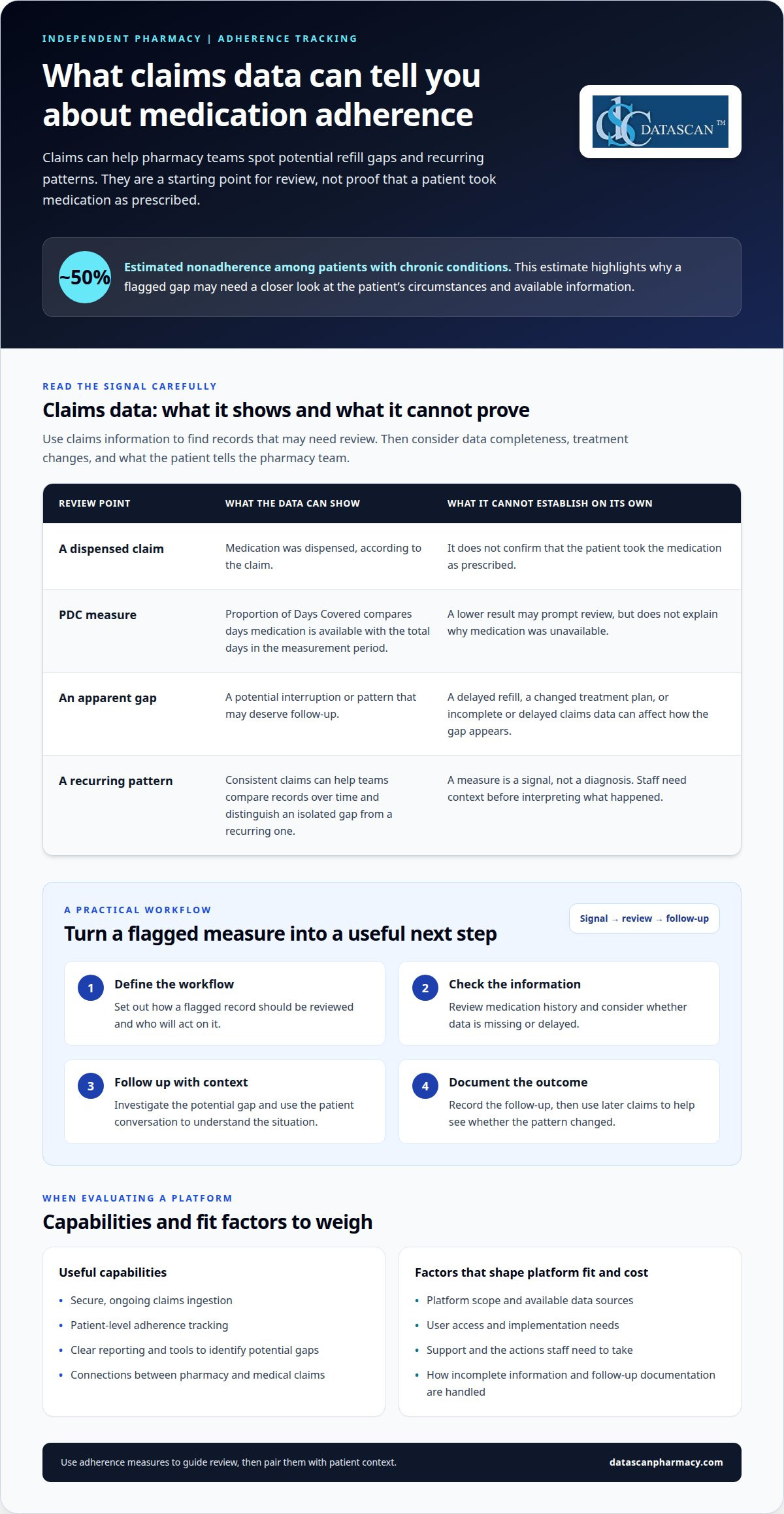
Useful features include secure, ongoing claims ingestion, patient-level tracking, clear reporting, and tools for identifying potential gaps. Proportion of Days Covered (PDC) compares the days a patient has medication available with the total days in the measurement period.
To choose and implement a platform, define the pharmacy workflow, identify claims sources, select relevant measures, and decide who will act on flagged records. Test how the platform handles incomplete information and how staff will document follow-up.
Claims analysis has limits: a claim can show that medication was dispensed, but it cannot confirm the patient took it as prescribed. Missing or delayed data can also affect an apparent adherence pattern, so staff need context before interpreting a gap.
Claims data can help teams see patterns across a patient population, but a measure is a signal, not a diagnosis. Approximately 50% of patients with chronic conditions are estimated not to adhere to prescribed medications. That estimate highlights why teams may need to investigate possible gaps and understand the barriers behind them.
PDC measures medication availability over a defined period. If a patient has medication available for fewer days than the measurement period, the result may prompt a review, but it does not explain the cause. A delayed refill, a changed treatment plan, or incomplete claims data can all affect the interpretation.
An integrated workflow can bring pharmacy and medical claims together for ongoing evaluation. Consistent, secure data ingestion supports comparisons over time. Reports can organize records by medication, period, or measure, helping staff distinguish an isolated gap from a recurring pattern.
Useful analysis links a flagged measure to a next step. A pharmacy team might review medication history, investigate a potential gap, and document the follow-up outcome. Later claims can help show whether the pattern changed. Discuss your pharmacy workflow when you’re ready to connect adherence tracking with daily operations.
For U.S. providers, a suitable platform securely combines pharmacy and medical claims, tracks patient-level adherence using measures such as PDC, and helps staff investigate and document follow-up on flagged gaps. The right fit depends on the care setting, available data, and team workflow.
How do HIPAA compliance and interoperability work?
Patient information moves through pharmacy, clinical, and hospital systems, making privacy and data exchange important considerations. Healthcare software teams should consider scalability, HIPAA compliance, and interoperability when designing medication adherence platforms. These factors affect how well tracking tools fit existing workflows and support responsible handling of sensitive patient information.
HIPAA compliance is not a software feature that guarantees an organization’s compliance on its own. A platform must fit the pharmacy’s policies, staff responsibilities, and information-handling practices. For example, a pharmacy should understand which employees can view adherence records and how those records move between systems. Clear procedures matter alongside appropriate platform safeguards.
Interoperability describes how systems exchange and use information. A hospital adherence platform may synchronize with electronic health records so medication information can connect with clinical records. For a community pharmacy, the practical question is whether the platform fits the systems already used for dispensing, patient communication, and care coordination. A disconnected tool can create duplicate entry and force staff to work across separate screens.
During evaluation, map the information needed for a specific task. A pharmacist reviewing a possible medication gap may need the prescribed medication, relevant dispensing information, and a way to record follow-up. Assess how the platform handles:
- Patient identity and medication details across connected systems.
- Updates when a prescription or treatment plan changes.
- Duplicate, incomplete, or conflicting records.
- Staff access and the steps for documenting outreach.
These checks can reveal workflow problems before rollout. If an electronic health record shows a changed prescription but an adherence dashboard displays the previous regimen, staff need a clear reconciliation process. Consistent field mapping and assigned responsibility for resolving mismatches help prevent outdated information from guiding outreach.
Scalability matters as a pharmacy adds users, locations, or adherence programs. A platform should support expected workflows without turning each expansion into a separate manual process. Test a representative scenario, such as reviewing a patient record, updating medication information, and documenting a care team action. This can reveal access, data exchange, and workflow gaps early.
Privacy and interoperability also shape the patient experience. Care teams should see information relevant to their roles, and the prescribed regimen should remain consistent across systems involved in care. Coordination relies on accurate records, defined processes, and staff who know how to respond when information does not match. Software supports this work but does not replace professional judgment or organizational responsibility.
Medication adherence software should integrate intervention and pharmacy platforms into the same workflow to streamline outreach addressing care gaps and reducing costs with carve-in pharmacy services.
Adherence monitoring and benchmarking
Medication adherence platforms vary in the measures they support, the clinical data they evaluate, and how they present trends. Compare whether a system can assess the Pharmacy Quality Alliance (PQA), Healthcare Effectiveness Data and Information Set (HEDIS), and Medicare Advantage (MA) Part C and D measures relevant to your program.
Evidence from monitoring studies shows associations between patient activity and clinical measures, but it doesn’t prove that software alone improves outcomes. In a study of 1,354 patients with type 2 diabetes, those who uploaded data about once a day were less likely to finish with HbA1c above 9%.
Benchmarking gives pharmacy teams a consistent way to interpret adherence data. Medication adherence studies commonly use an 80% benchmark for prescribed doses, and CMS sets an 80% goal for medication adherence. A benchmark can help identify patients or programs needing closer attention, but it should be read alongside the measure’s definition and the patient’s treatment context.
Measures also vary by program. A 2021 study of 823 Texas Medicaid patients with hypertension defined adherence as transmitting readings on at least 80% of days. That threshold describes the study’s remote monitoring measure, not a universal rule for every medication or clinical program. The distinction matters when teams compare results or set internal targets.
For a practical comparison, assess whether each platform can:
- Display measure definitions and the period used for each calculation.
- Break down results by medication, patient group, or clinical program.
- Show trends over time and help teams identify records needing review.
- Support follow-up documentation alongside monitoring results.
These functions can turn a score into a useful patient-care signal. For example, a clinical team could review a declining trend, check whether the treatment plan changed, and decide whether outreach is appropriate. The technology should make the reason for a flag clear rather than leave staff guessing.
Longitudinal data adds another important perspective. In a heart failure telemonitoring study, average patient adherence was 73.6% and declined by about 1.4% each month. That finding illustrates why a single snapshot can miss a gradual change. A monitoring program that displays trends can help teams notice the shift and respond with timely clinical review.
Use benchmarks carefully. Missed readings, medication changes, or data gaps may affect a result without explaining the underlying behavior. Monitoring is most useful when teams pair measure-based signals with clinical context, patient education, and documented follow-up. This makes adherence technology a support for patient care rather than treating a percentage as the whole story.
Care team outreach and adherence support
Care teams can use adherence management software to identify patients who may need support, prioritize outreach, and document what happens next. A rules engine can flag possible care gaps or quality measures, while risk stratification helps providers focus on patients whose medication use or therapy plans need attention.
Useful outreach starts with a signal and leads to a human response. For example, a patient might report a missed dose or side effect through an electronic channel, prompting a care team member to follow up. The conversation can uncover a practical barrier, clarify instructions, or identify a concern for clinical review. Software helps connect the report to the right workflow.
Risk-based worklists can organize patients by medication use, treatment plan, or identified care gap. This helps staff prioritize calls instead of treating every alert as equally urgent. A pharmacist might review a patient’s recent adherence trend, check the current therapy plan, and document whether the patient needs education, a care team referral, or other follow-up.
Outreach tools can support engagement through features such as:
- Real-time adherence trends and upcoming-dose information for patients and care teams.
- Caregiver access for family members or professionals involved in medication support.
- Alerts when a hospital patient misses a dose in a critical care unit.
- Daily reconciliation of patient information informed by outreach and reported outcomes.
These capabilities support different needs. A caregiver may help an older adult follow a medication routine, while a hospital nurse may need an alert about a missed dose. A pharmacy team can use a trend to guide a check-in, then record the patient’s response so later reporting reflects the intervention.
Outreach is harder when pharmacy and intervention platforms operate separately. Bringing them into the same workflow can help teams move from identifying a care gap to recording the action taken. Daily reconciliation informed by patient conversations can also help keep reported improvements and outcomes aligned with the information teams use.
Technology should support, not replace, professional judgment. A missed-dose alert does not explain why a dose was missed, and an upcoming-dose notification cannot resolve every patient concern. Staff need a clear path from each alert to the right person and a way to record the response. This keeps engagement connected to care instead of generating notifications without follow-through.
Patients can report side effects or missed doses to trigger human or AI follow-up, ensuring a meaningful response. Daily outreach-informed data reconciliation can also improve reporting of improvements and outcomes.
Want to connect adherence outreach with pharmacy operations? Talk with our team about your pharmacy workflow using Datascan Pharmacy Software.
Datascan Pharmacy Software
Datascan Pharmacy Software helps independent pharmacies connect medication support with daily operations through an Independence-First pharmacy software platform. Datascan Pharmacy Management Software, Datascan Point of Sale (POS), MobileScripts Patient Mobile App, and Datascan Mobile Delivery App support different parts of the workflow, from prescription management to patient communication and delivery.
For teams supporting adherence, built-in medication synchronization and e-care plans can help organize ongoing patient care. Pharmacy management software can also help coordinate refill processes and patient touchpoints within daily operations, rather than treating outreach as a separate task. Each pharmacy can configure its workflow around how its team serves patients.
If you’re considering how pharmacy technology can support your adherence workflow, contact Datascan Pharmacy Software to discuss your needs.
Build adherence support into your next workflow decision
Start by deciding how your pharmacy team wants to act on adherence information. Choose a workflow that matters to staff, such as identifying patients who need follow-up, then consider how pharmacy management software can support it without adding disconnected tasks. The right fit should reflect your team’s daily operations and the patient engagement you want to support.
Datascan Pharmacy Software offers an Independence-First platform that includes Datascan Pharmacy Management Software, Datascan Point of Sale (POS), MobileScripts Patient Mobile App, and Datascan Mobile Delivery App. Together, these tools support pharmacy operations and patient communication. Consider how they fit your approach to adherence management software and the workflows your team wants to strengthen.
Ready to discuss a practical next step for your pharmacy? Contact Datascan Pharmacy Software to talk through your pharmacy’s needs. You can build a workflow that gives your team a clearer path forward.
Frequently Asked Questions
How can custom software help with medication compliance?
Customizable workflows can help fit medication support into a pharmacy’s daily processes. For example, a team can organize refill follow-up and patient communication around its established steps instead of managing reminders separately. Medication synchronization and e-care plans can support consistent follow-through. Staff still need to review each patient’s circumstances, since a missed refill may reflect a treatment change or another barrier.
What is medication adherence management software and how does it work?
Medication adherence management software helps organize information and workflows that support patients taking medication as prescribed. It can bring together refill activity, patient communication, and adherence tracking so pharmacy staff can identify potential follow-up needs. For example, a team might review an adherence dashboard, contact a patient, and document the response. The software supports the process, while care decisions remain with qualified professionals.
How does medication adherence software integrate with EHRs, pharmacies, and remote patient monitoring systems?
Integration connects systems so relevant information can move between them, depending on available interfaces and data formats. A hospital adherence system may synchronize with an electronic health record, while pharmacy systems can contribute dispensing information. Remote monitoring data may provide another view of a patient’s care. Before implementation, teams define which records need to connect, how to handle mismatches, and who reviews incoming information.
How does medication adherence software protect patient data and comply with HIPAA?
Software can support privacy practices, but using a platform alone does not make an organization HIPAA compliant. Pharmacies need clear procedures for staff access, patient information handling, and responding to privacy concerns. During evaluation, examine how a system manages user permissions, stores and shares data, and supports the organization’s safeguards. Then train staff on those procedures, including how to avoid exposing patient details during calls or messages.
Which medication adherence software platforms are best for healthcare providers in the United States?
For U.S. providers, a suitable platform securely combines pharmacy and medical claims, tracks patient-level adherence using measures such as PDC, and helps staff investigate and document flagged gaps. The right fit depends on the care setting, available data, and team workflow.

Article by
Sarah Callioras
Sarah Callioras is Vice President at Datascan Pharmacy Software, bringing nearly 25 years of experience across independent pharmacy operations and pharmacy technology. Since joining Datascan in 2016, she has played a key role in driving business growth, strengthening client relationships, and supporting independent pharmacies through innovative software solutions. With a strong background in pharmacy operations, business development, and strategic leadership, Sarah is passionate about helping independent pharmacies succeed in an evolving healthcare landscape.
 Kevin Minassian is the President of Datascan Software. Under his leadership, the company rapidly expanded to provide pharmacy management software on a national level. Over the last 15+ years, he has ensured that Datascan has continuously evolved to offer innovative solutions for independent pharmacies while still offering world-class customer support. He is passionate about helping independent pharmacies to remain competitive, achieve success, and offer the very best service to their communities.