
The defining pharmacy technology trends for 2026 bring AI, digital health, and community-based care into everyday pharmacy operations. These tools are changing how teams organize work, support clinical services, and communicate with patients. The challenge is choosing technology that solves a real operational need and fits the way your pharmacy works.
Independent pharmacies balance patient care with dispensing, administrative demands, reimbursement pressures, and the daily decisions that keep the business moving. New tools can help, but adoption takes planning. Teams need to understand what a technology is designed to do, where staff judgment remains essential, and how it will fit existing processes.
This article looks at how pharmacies can assess AI, use digital health and telepharmacy, and make community-based care more accessible. It also covers practical adoption questions, from workflow fit to patient privacy. You’ll find guidance on where these developments may help, what to weigh before changing processes, and how pharmacy management software can support daily operations while keeping patient care at the center.
Key Takeaways
- See how AI can help pharmacies spot supply and reconciliation issues, while keeping pharmacists responsible for reviewing decisions.
- Learn practical ways to set boundaries for AI use, protect patient information, and fit new tools into existing workflows.
- Understand where AI can support clinical decision-making and why pharmacist judgment remains central to patient care.
- Explore how digital services, mobile access, and community-based care can make pharmacy support more convenient for patients.
- Find out how pharmacy management software, point-of-sale tools, patient apps, and delivery tools can support day-to-day operations.
How can AI improve pharmacy supply chains, reduce waste, and support medication reconciliation?
AI can analyze dispensing history, purchase orders, seasonal demand, and supplier lead times to flag likely shortages or excess stock. Streamlining supply chain data through EDI integration with ERP systems helps automate electronic order exchanges and prevent stock discrepancies. For example, a sudden rise in demand for a medication can prompt a review before the next order. That gives pharmacy teams time to adjust quantities and reduce expiry-related waste. AI forecasting is one of the pharmacy technology trends shaping operations in 2026.
For medication reconciliation, AI can compare a patient’s medication profile with lists from prescribers or care settings. It can flag possible duplicate therapies, conflicting strengths, or missing medications for pharmacist review. After discharge, for example, a comparison can help staff spot differences between the hospital list and the pharmacy record, then coordinate follow-up with the patient and care team.
Pharmacy technology also brings cybersecurity and privacy risks. Weak access controls, compromised accounts, or insecure integrations can expose sensitive medication information. Role-based permissions, secure authentication, and regular access reviews help restrict who can view or change patient records.
Medicare drug price negotiation adds another planning consideration. The Inflation Reduction Act established Medicare Maximum Fair Prices for selected high-cost drugs without generic or biosimilar alternatives, including Eliquis, Stelara, and Xarelto. These prices set a ceiling on what Medicare beneficiaries and Part D plans pay for covered drugs. Pharmacies should account for affected products and applicable payment terms when planning inventory and reimbursement.
According to the California Legislature, “Commencing January 1, 2026, a pharmacy benefit manager shall not conduct spread pricing in this state.” AI-supported reporting can help teams organize claim and reimbursement data, but it does not replace review of applicable rules. For Medicaid and 340B participation, pharmacy systems can help organize eligibility records, prescription details, and transaction documentation. Clear records support staff workflows and make exceptions easier to identify.
GLP-1 access adds pressure to inventory and patient-support workflows. The first oral Wegovy formulation entered the market in January 2026, adding another format for pharmacies to manage. Another pharmacy technology trend in 2026 is using tools to track demand, flag refill or supply issues, and organize patient communication. Staff still need clear processes for discussing coverage and affordability barriers.
- Use demand signals and supplier lead times to review orders before shortages or excess inventory develop.
- Route medication-list discrepancies to a pharmacist, then coordinate resolution with the patient and care team.
- Keep reimbursement, Medicaid, and 340B records organized so staff can review transactions and eligibility documentation.
How can pharmacies adopt and govern AI in their operations?
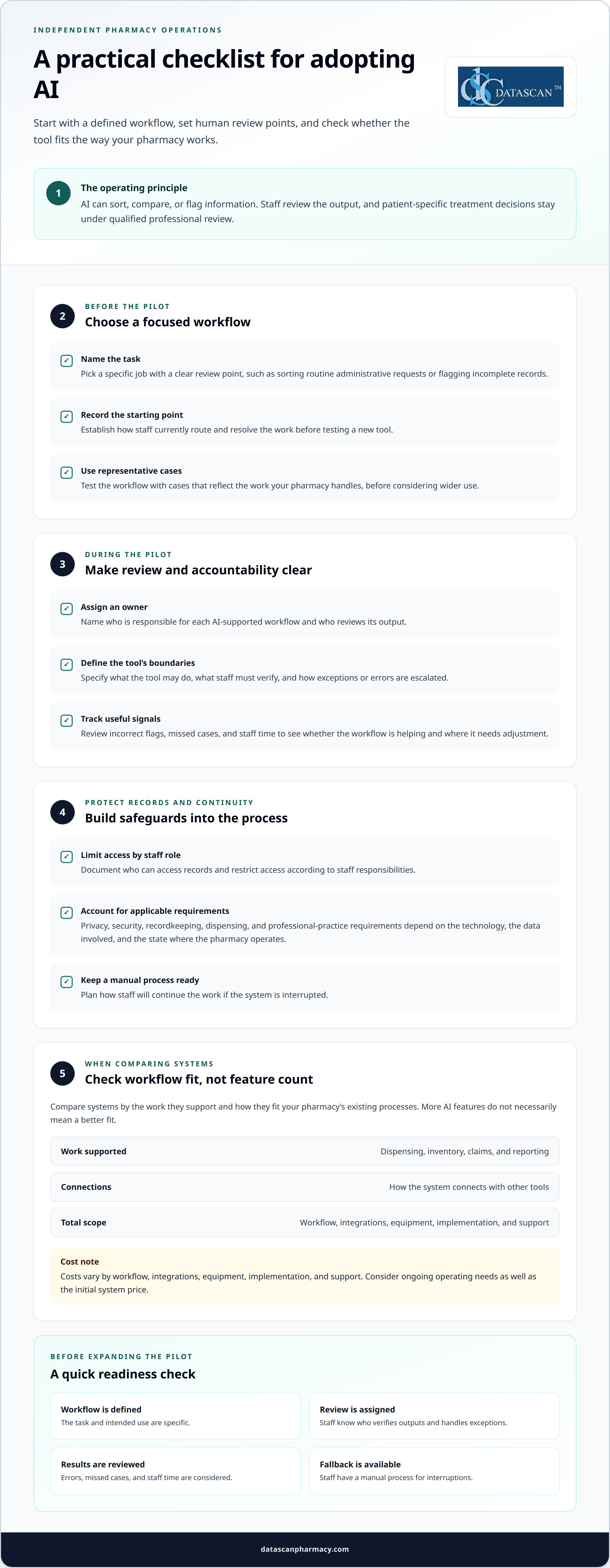
Pharmacies can adopt AI responsibly by starting with a defined workflow, assigning human oversight, and assessing whether the tool helps. A focused pilot, such as sorting routine administrative requests for staff review, can reveal workflow fit and data gaps before wider adoption. First, establish a baseline, such as how staff currently route and resolve those requests.
How do leading pharmacy technology platforms compare in 2026? Compare systems by the work they support, including dispensing, inventory, claims, reporting, and connections with other tools. A platform that fits current processes may serve a pharmacy better than one with more AI features but poor workflow fit. Evaluate how staff handle routine tasks and exceptions across a typical workday.
Real-world evidence for pharmacy AI remains limited and comes largely from pilot studies and guidance. Start with a task that has a clear review point, such as grouping administrative requests or flagging incomplete records. Track incorrect flags, missed cases, and staff time. Keep patient-specific treatment decisions under qualified professional review.
What federal and state regulations govern pharmacy technology in 2026? Requirements depend on the technology, data involved, and state where the pharmacy operates. Governance should account for applicable privacy, security, recordkeeping, dispensing, and professional-practice requirements. Document who reviews system outputs, who can access records, and how staff escalate errors.
Set an operating policy before expanding a pilot. Assign an owner to each AI workflow, define what the tool may do, and establish how staff review exceptions. For example, AI may sort incoming tasks while staff verify the information and decide what action to take. Revisit the policy when workflows or system functions change.
- Test a narrow workflow using representative cases.
- Limit patient-record access by staff role.
- Review errors and near misses, then revise procedures.
- Keep a manual process for system interruptions.
How much do pharmacy automation, AI, and software systems cost in 2026? Costs vary with the workflow, integrations, equipment, implementation, and support involved. Compare the full scope of each option, including ongoing operating needs, rather than judging by the initial system price alone.
What pharmacy automation and robotics technologies are emerging in 2026? Automated dispensing and robotics handle repetitive product movement, while AI can support task prioritization and exception review. Implementation studies associate pharmacy automation with improved operational efficiency and fewer dispensing errors, though evidence is moderate. Assess how a proposed system changes accuracy checks and staff responsibilities.
Measure adoption by how well the task is handled, not by the technology’s novelty. Check whether staff resolve flagged cases, whether exceptions are missed, and whether the process adds steps. A documented review cycle helps pharmacy teams refine procedures as operational needs change.
How can AI support clinical decision-making in pharmacies?
AI can support clinical decisions by organizing patient information and flagging patterns for pharmacist review. A system, for example, may surface a possible interaction, duplicate therapy, or refill gap. The pharmacist checks the record, considers the patient’s circumstances, and decides whether to contact the patient or prescriber.
Pharmacies use data analytics to identify patterns in medication histories, refill activity, and care gaps. These patterns can help staff prioritize outreach, such as following up when a patient’s refills have stopped. Pharmacogenomics may help tailor treatment to individual responses, but real-world data on pharmacy implementation remain limited.
Clinical decision support is most useful when it raises a specific question. A medication review, for instance, may show a new prescription alongside an existing therapy with a similar purpose. AI can flag the record, while the pharmacist checks the indication, dosage, allergies, and patient history before acting.
Context matters. A potential interaction alert may not tell the whole story if the patient’s medication list is incomplete or outdated. Staff can confirm current use with the patient, compare available records, and clarify discrepancies with the prescriber. That turns a software flag into a more meaningful clinical conversation.
- Use AI to sort medication records that need pharmacist attention.
- Review the source data before acting on a suggested risk or care gap.
- Record the pharmacist’s decision and any follow-up with the patient or prescriber.
AI can also help organize information for care coordination. If a patient has prescriptions from multiple clinicians, a system may bring relevant medication details together for review. The pharmacist can identify questions, support medication reconciliation, and share appropriate information with the care team.
Keep clinical accountability clear: AI output is decision support, not a diagnosis or treatment decision. A practical workflow assigns a pharmacist to review alerts, document the reasoning, and resolve cases that need prescriber input. This makes technology useful without replacing professional judgment in patient care.
How can pharmacies provide convenient digital and community-based care?
Pharmacies can pair accessible in-person services with digital options for refills, reminders, and care coordination. In the United States, 77% of patients report trusting their local pharmacist, and patients visit community pharmacists nearly two times as often as physicians. Convenience works best when patients can choose how to engage.
Start with everyday points of friction. A patient who can’t call during business hours may prefer to submit a refill request digitally; another may want to speak with pharmacy staff. Clear status updates and simple instructions help patients know what to expect. Digital access should support the pharmacy relationship, not replace personal assistance.
Community-based services can bring care closer to home. Seventy percent of U.S. adults believe pharmacists should provide more health services when primary care is unavailable. Pharmacies can offer vaccine conversations, medication support, and, where permitted, point-of-care testing. Some states allow pharmacists to test and treat strep or flu after documented positive test results.
CLIA waivers and point-of-care testing devices can support pharmacy-based testing. Pilots and observational studies indicate these services can improve prompt diagnosis and support treatment decisions, particularly for infectious diseases and minor acute conditions. Sourcing reliable testing kits and clinical products through medical supply distributors like omnimedsource.com helps pharmacies maintain steady inventory for these expanded services. EQUIPP reimburses pharmacies for blood pressure and A1C testing. Clear appointment steps, result communication, and follow-up help make these services easier to use.
- Offer digital refill requests alongside phone and in-person support.
- Use clear reminders so patients know when to arrive or follow up.
- Explain testing steps and how results connect to next care decisions.
Keep the human connection visible. Eighty percent of U.S. patients prefer in-person over digital-only care, while 65% of pharmacists are interested in technology that improves workflow and patient experience. A balanced approach lets patients use digital convenience while keeping pharmacist conversations available for questions and care needs.
Vaccine conversations have been part of pharmacy practice for twenty years. Pharmacies can make these discussions easier by pairing staff outreach with convenient scheduling and clear service information. The goal is practical: help patients access care in familiar community settings while giving the pharmacy team a manageable process for each service.
How are digital health and telepharmacy changing pharmacy care?
Digital health and telepharmacy can extend pharmacy access beyond a counter visit. Observational studies associate these services with fewer delays in medication review and better access to pharmaceutical care. Evidence for access benefits is stronger than evidence for clinical effectiveness or system-wide outcomes, which remains limited and context-dependent.
Telepharmacy connects patients with pharmacy services through remote communication. For example, a patient in an underserved area can discuss medication questions with a pharmacist without travelling to the pharmacy. A useful workflow explains how patients request support, how records are reviewed, and how the pharmacist documents follow-up.
Digital tools can make it easier to begin a medication review. A patient might submit a medication list before a consultation, then discuss discrepancies with the pharmacist by video or phone. The pharmacist can clarify current use, identify questions for the prescriber, and record the next step. Timely communication matters, especially when a review might otherwise be delayed.
Some programs also connect digital access with defined clinical services. One described program allows pharmacists to prescribe a limited supply of oral contraceptive medication after a pharmacy consultation. The consultation remains central: the pharmacist gathers relevant information, discusses the patient’s needs, and determines whether the service’s criteria are met.
- Offer a clear way to request a remote medication review.
- Collect relevant medication information before the appointment.
- Document the consultation, decisions, and planned follow-up.
- Give patients a direct route to in-person support when needed.
Integration requires attention. Limited data interoperability can make it difficult to assemble a complete medication history across healthcare settings. Regulations also vary, affecting how digital services operate from state to state. Pharmacies need workflows that account for local requirements and clarify who handles each step.
Cybersecurity and workflow fit matter, too. Remote consultations and digital records involve sensitive patient information, so pharmacies need controlled access and secure handling practices. A practical rollout starts with one service, such as remote medication reviews, then assesses scheduling, documentation, and follow-up before adding other digital care options.
Evidence strongly supports telepharmacy access benefits; clinical efficacy and system-level outcomes remain scarce and context-dependent. In the United States, 80% of patients prefer in-person over digital-only care. The review identifies regulatory variation, limited data interoperability, cybersecurity risks, and workflow integration as challenges.
How can Datascan Pharmacy Software support pharmacy operations?
Datascan Pharmacy Software provides an Independence-First platform for independent community pharmacies. Its integrated suite brings together pharmacy management software, point of sale, mobile tools, delivery, and workflow features. This can help pharmacies coordinate dispensing, patient engagement, checkout, and delivery operations without juggling separate systems.
Datascan Pharmacy Management Software supports the core management needs of a pharmacy. Medication synchronization and e-care plans are examples of features the company continues to add. A pharmacy looking to coordinate routine tasks and patient services can consider how management software fits its existing processes, staff responsibilities, and care priorities.
For pharmacies looking to support patient engagement through mobile access, Mobile Scripts offers a patient-facing app for iOS and Android. Patients can manage prescriptions and communicate with the pharmacy through the app, complementing direct conversations with staff. Its role depends on which pharmacy interactions patients need to access more easily.
In-store sales and delivery have distinct operational needs. Datascan Point of Sale handles checkout, front-end inventory, and signatures in a unified transaction experience. Datascan Delivery provides routing and delivery management tied to the pharmacy workflow and portal. Together, these tools support different parts of pharmacy operations.
- Consider pharmacy management software for coordinating core pharmacy operations.
- Consider MobileScripts Patient Mobile App when adding a patient-facing mobile channel.
- Consider Datascan Point of Sale (POS) for pharmacy point-of-sale activity.
- Consider Datascan Mobile Delivery App when organizing pharmacy delivery work.
Choose a next step by identifying the operational pressure you want to address. You may need to organize management tasks, improve patient engagement, or coordinate retail and delivery activity. Matching the platform’s components to that need keeps the decision grounded in daily work.
Pharmacy technology trends in 2026 point toward a mix of digital access and practical operational support. Datascan’s tools can help pharmacies consider these needs together, while keeping the focus on workflows that suit their teams and patients. The goal is a more organized operation with technology supporting, rather than replacing, personal pharmacy care.
Contact Datascan Pharmacy Software to discuss your pharmacy operations.
Frequently Asked Questions
What are the biggest pharmacy technology trends in 2026 in the United States?
The main priorities are workflow automation, AI-assisted operations, digital patient access, and expanded community pharmacy services. Policy and reimbursement shifts also influence technology decisions. For an independent pharmacy, connect each investment to a practical goal, such as reducing manual handoffs, improving prescription follow-up, or supporting a clinical service. That keeps technology planning focused on daily operations rather than novelty.
How are AI and machine learning being used in pharmacies in 2026?
Pharmacies are exploring AI for administrative support, pattern recognition, and decision support, while pharmacists retain responsibility for clinical judgment. For example, automated classification can group routine requests for staff review. Track errors and missed cases alongside staff time to assess whether a tool fits the workflow and where human review must remain part of the process.
How are telepharmacy and remote patient care changing in 2026?
Telepharmacy gives patients another way to access pharmacy services when an in-person conversation is difficult. Remote medication reviews can connect patients, pharmacists, and care teams around questions that need follow-up. Pharmacies should define how consultations are documented, how relevant information reaches the patient’s care team, and how patients can move from remote support to an in-person conversation when that better suits their needs.
What are the 2026 trends in pharmacy management systems and electronic prescribing?
Pharmacy management systems increasingly need to help staff handle the entire prescription workflow, including exceptions that need attention. Electronic prescriptions may arrive with incomplete details or changes requiring clarification. A useful system keeps those items visible, supports clear task ownership, and records how each issue is resolved. During a system review, map a prescription’s path from receipt through dispensing to identify where staff lose time or information.
What steps should an independent pharmacy take to adopt new technology in 2026?
Start by naming a specific operational problem, then involve the staff who handle it every day. Map the current process, define what a better result would look like, and test the technology on that task before expanding its use. For example, assess whether a new workflow makes prescription exceptions easier to assign and resolve. Use staff feedback to refine procedures and training.
How are pharmacy technology trends affecting medication safety, staffing, and patient access in 2026?
Technology can reduce repetitive work and help staff direct attention to exceptions, but its effect depends on workflow and human review. The American Society of Health-System Pharmacists reports pharmacy technician turnover in the United States is greater than 20%, with vacancy rates as high as 40%. Automation may support operational efficiency and pharmacist time for clinical roles, while clear patient communication remains essential.

Article by
Sarah Callioras
Sarah Callioras is Vice President at Datascan Pharmacy Software, bringing nearly 25 years of experience across independent pharmacy operations and pharmacy technology. Since joining Datascan in 2016, she has played a key role in driving business growth, strengthening client relationships, and supporting independent pharmacies through innovative software solutions. With a strong background in pharmacy operations, business development, and strategic leadership, Sarah is passionate about helping independent pharmacies succeed in an evolving healthcare landscape.
 Kevin Minassian is the President of Datascan Software. Under his leadership, the company rapidly expanded to provide pharmacy management software on a national level. Over the last 15+ years, he has ensured that Datascan has continuously evolved to offer innovative solutions for independent pharmacies while still offering world-class customer support. He is passionate about helping independent pharmacies to remain competitive, achieve success, and offer the very best service to their communities.