
A pharmacy data breach demands two tracks of action: contain the incident and assess who may have been affected, then review potential claims and response obligations. Knowing how to handle a pharmacy data breach starts with securing systems, preserving evidence, and determining whether protected health information or payment-card data was exposed. A breach alone doesn’t establish that every affected person has a compensation claim.
If you’re responsible for a pharmacy, the pressure is immediate: patient information, daily operations, and finances may all be at stake. How to handle a pharmacy data breach begins with documenting what happened and taking practical steps to limit further access.
This article explains what may shape a claim, what to include in an incident response and post-incident review, and which expenses can follow a breach. It also covers common vulnerabilities, including phishing, compromised credentials, system weaknesses, and vendor access, so you can identify possible risks and decide what to review.
Key Takeaways
- Assess a potential claim by identifying what information was exposed, who was affected, and what harm may have followed.
- Organize incident response around containing access, preserving records, and documenting decisions for a careful post-incident review.
- Plan for costs beyond immediate technical recovery, including investigation, notification, operations, and reputational effects.
- Review access controls, phishing risks, malware exposure, and vendor connections to spot common weak points.
- Understand how pharmacy management software can support daily workflows while keeping security and incident procedures part of your broader operations.
Can I Claim for a Pharmacy Data Breach?
Can a patient pursue a claim after a pharmacy data breach?
Possibly. A patient assessing a claim should identify what information was exposed and what harm followed. Keep breach notices, account alerts, related bills, and correspondence together, and note the date of each event. Exposure alone does not establish compensation. The connection between the incident, disclosed information, and documented harm helps establish the basis for a potential claim.
How do HIPAA compliance and cybersecurity safe harbor affect claims?
HIPAA, enacted in 1996, protects health information through its Privacy and Security Rules. The Security Rule appears at 45 C.F.R. §§164.302-164.318. HIPAA’s Safe Harbor Act requires OCR to consider cybersecurity practices implemented for at least 12 months before a breach when considering sanctions. Keep records that show which safeguards were in place and when.
According to the U.S. Department of Health and Human Services, Office for Civil Rights, the cited U.S. breach statistics covered breaches affecting 500 or more individuals.
What HIPAA notification deadlines and state laws apply?
Notification deadlines depend on applicable HIPAA requirements and state laws. Identify the affected patients’ states, the information involved, and when the incident was discovered, then compare those facts with each relevant rule. Track each recipient and deadline separately: one notice schedule may not cover every state or reporting route.
When must a pharmacy notify the FTC or payment card companies?
Determine whether FTC reporting requirements apply to the type of information and incident. If payment-card data was involved, review the pharmacy’s processor and card-network incident procedures. PCI-DSS covers payment-card data security, including breach prevention, detection, and response. Record which parties were notified, when notices were sent, and what information each received.
What should patient notifications and identity protection include?
A patient notice should explain what happened, the types of information involved, and steps patients can take to reduce risk. Provide a clear way to ask questions. If exposed details could enable identity misuse, consider offering free credit monitoring or identity protection, and explain its coverage and enrollment steps plainly.
How can patients complain, and what does PCI-DSS require?
Patients can submit a written complaint to the pharmacy and keep the complaint and response. The ICO is the United Kingdom’s data protection regulator, not the U.S. complaint route. The 30-day escalation guidance applies to complaints in the UK. In the United States, PCI-DSS applies to pharmacies that store, process, or transmit credit- or debit-card data.
How Should a Pharmacy Respond to a Security Incident?
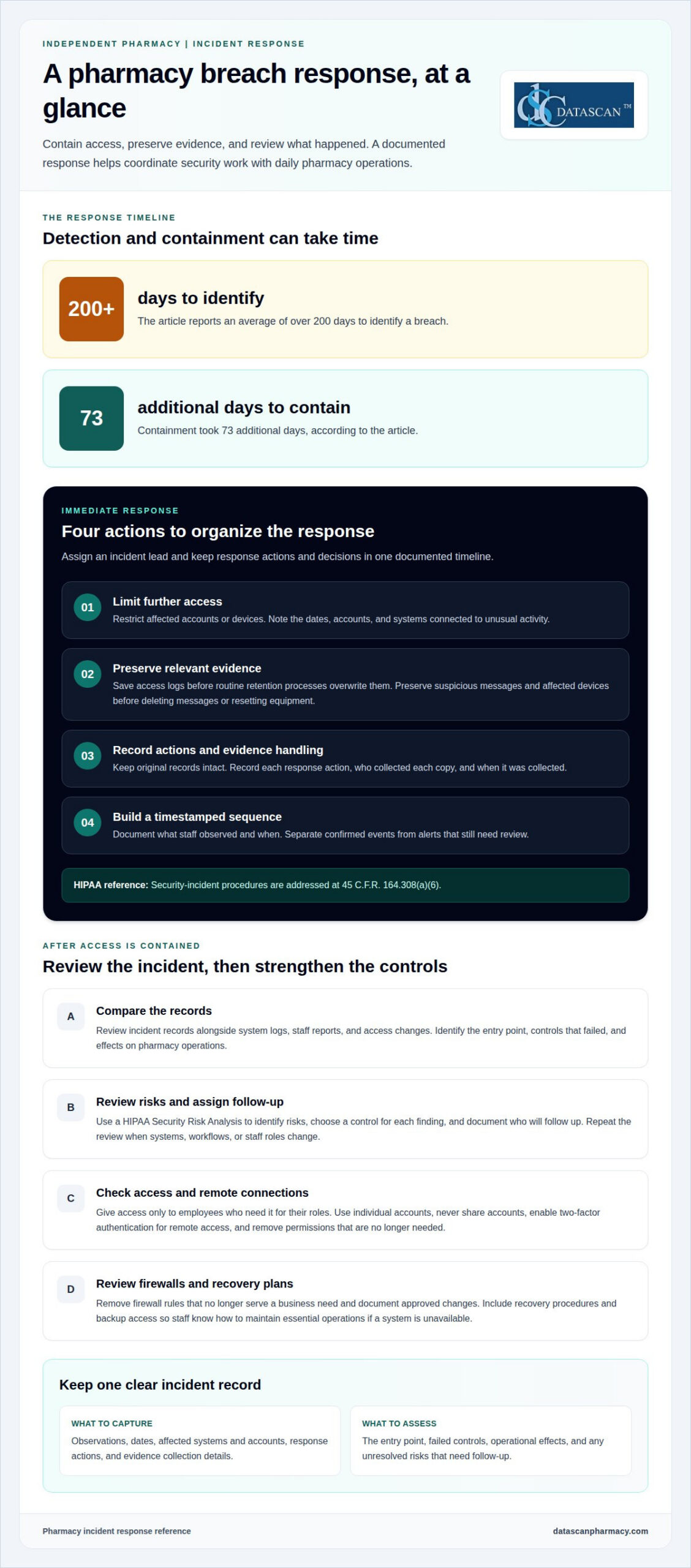
Knowing how to handle a pharmacy data breach starts with assigning an incident lead, containing affected access, and preserving evidence. Record what staff observed and when, then keep investigation decisions in a single timeline. A written plan clarifies responsibilities and helps coordinate technical work with patient care and daily operations.
How should a pharmacy contain a breach and preserve evidence?
Restrict access to affected accounts or devices, preserve relevant logs and messages, and record every response action. Investigate which systems and files were involved, then note the dates and accounts connected to unusual activity. HIPAA requires security-incident procedures under 45 C.F.R. 164.308(a)(6).
Keep original records intact. For example, save relevant access logs before routine retention processes overwrite them, and record who collected each copy. Preserve suspicious messages and affected devices before deleting messages or resetting equipment. A timestamped sequence helps distinguish confirmed events from alerts that need further review.
How can pharmacies prevent future breaches?
Use the HIPAA Security Risk Analysis to identify risks, assign a control to each finding, and document who will follow up. HIPAA also requires contingency planning under 45 C.F.R. 164.308(a)(7). Include recovery procedures and backup access so staff know how to maintain essential operations when a system becomes unavailable.
Repeat the review when pharmacy systems, workflows, or staff roles change. Record each risk, the safeguard selected, and who owns the follow-up. This makes it easier to assess whether controls still fit current operations and whether unresolved findings need attention.
How should pharmacies manage access, remote connections, and firewalls?
Give system access only to employees who need it for their roles, and never share accounts. Use two-factor authentication for remote access. Review permissions when duties change and remove access that is no longer needed. Individual accounts help link each login to the staff member responsible.
Review firewall settings as part of routine security work. Remove rules that no longer serve a business need and document approved changes. Monitor for unexpected logins or network activity as well, so the incident lead can investigate specific alerts rather than rely on informal reports.
What should a pharmacy review after an incident?
Compare incident records with system logs, staff reports, and access changes. Identify the entry point, controls that failed, and effects on pharmacy operations. An average of over 200 days to identify a breach and 73 additional days to contain one shows why review should include detection and escalation steps.
Only one in three organizations identified a breach using its own security team or tools. Review whether alerts reached the right staff, escalation steps were clear, and corrective actions remain open. Assign an owner to each action and record its completion in the pharmacy’s post-incident review.
What Is the Average Financial Cost of a Pharmacy Data Breach?
Which costs can follow a pharmacy data breach?
Costs may include forensic investigation, system recovery, patient notices, legal response, and interrupted operations. These figures describe different expense measures, so use them as context, not as a guaranteed bill.
That figure covers healthcare incidents broadly, not a typical independent pharmacy expense. A pharmacy’s actual financial impact depends on the systems affected, the information involved, recovery work, and the time needed to resume normal operations.
How can compromised credentials or insiders affect costs?
A breach’s entry point can affect the investigation and response workload. These figures describe broader breach patterns, not a pharmacy-specific bill.
For a pharmacy, investigators need to establish which account was involved, what it accessed, and whether its credentials reached other systems. That scope shapes the work needed to secure accounts and review activity. Track investigation expenses separately from recovery costs to show which response tasks drove each charge.
What penalties, lawsuits, and expenses should pharmacies assess?
After a breach, a pharmacy may face investigation and recovery expenses, regulatory sanctions, or lawsuits. Cost estimates do not set a fixed penalty or predict the outcome of a lawsuit. Assess documented response costs separately from potential claims, and connect each expense to the incident and response work.
- Record forensic investigation and system restoration expenses.
- Track patient notification and support costs.
- Document business interruptions and delayed pharmacy operations.
- Keep records of legal claims and regulatory responses.
A compromised payment system may require a card-related investigation alongside a review of patient information. Tie each expense to its cause and response step. This breakdown helps distinguish confirmed costs from potential exposure when pharmacy leaders assess the incident’s overall impact.
How Can Internet, Phishing, Malware, and Vendor Vulnerabilities Lead to a Pharmacy Data Breach?
Internet-connected pharmacy systems can expose sensitive information through phishing, malware, weak access points, or vendor connections. Knowing how to handle a pharmacy data breach also means understanding which pathways could expose records or disrupt operations. Review how staff access systems, which applications connect externally, and what third parties can reach.
How do internet and malware risks affect pharmacies?
Malware can disrupt pharmacy systems or expose information after a malicious file reaches a device. Treat unusual system behavior, unexpected encryption, or inaccessible files as warning signs that need prompt investigation.
Keep antivirus software active and update operating systems and pharmacy applications regularly. A 2020 federal alert warned of an increased and imminent cybercrime threat to healthcare providers. Updates help address known software weaknesses, while a documented process makes it easier to identify overdue systems.
How can phishing expose pharmacy information?
Phishing messages can trick staff into opening harmful attachments or sharing login details. Attacks against pharmacies and hospitals increased 189% from December 2020 to February 2021. Train employees to report suspicious messages, avoid unexpected email links, and use established channels to verify unusual requests.
Over 30% of breaches involved phishing or stolen or compromised credentials. If a message prompts a suspicious login, review account activity and determine whether that account accessed other systems.
How can vendors and connected systems create risk?
Vendors may connect to pharmacy networks to support payment systems or other services. Poorly controlled connections can create another route to pharmacy data. Limit access to necessary systems, review each vendor connection, and remove accounts when access is no longer required.
For PCI work, choose a vendor that is a qualified security assessor or approved scanning vendor and understands pharmacy operations. Keep an inventory of connected systems and access points. This record can help narrow an investigation involving a third-party service.
What practical steps can reduce these vulnerabilities?
A useful plan for how to handle a pharmacy data breach combines prevention with clear reporting procedures. Train staff to report suspicious activity, maintain antivirus protection, update applications, and use two-factor authentication for remote access. Individual accounts also make unusual activity easier to trace.
GenRx Pharmacy reported a ransomware incident involving 137,110 patients in September 2020. Use the case to review how staff would report a suspicious file and isolate an affected device. A short practice exercise can expose confusion about roles before a real incident occurs.
When Must a Pharmacy Report a Breach Under HIPAA, and to Whom?
Begin the reporting review when the pharmacy identifies a suspected exposure involving patient information. Document when the incident was discovered, what data may be involved, and who may be affected. Then compare the facts with HIPAA and applicable state requirements to determine recipients and deadlines.
How should a pharmacy determine whether HIPAA reporting applies?
First, establish whether the event involved protected health information and may qualify as a breach. Record the discovery date, systems involved, information at risk, and affected people. These facts help the pharmacy assess its reporting path under HIPAA and applicable state law.
Keep the analysis specific. For example, an employee’s misdirected message and an attacker’s access to a pharmacy server involve different circumstances. Preserve the message or access records, document the investigation, and explain how the pharmacy reached its conclusion.
Who may need to receive a breach report?
Build a recipient list based on the data and people affected. The review may include affected individuals, the U.S. Department of Health and Human Services, Office for Civil Rights, media, state authorities, and payment-card parties if card data was involved. Assess each applicable reporting route separately.
- Identify affected patients and their states of residence.
- Assess whether HHS OCR reporting applies.
- Review state reporting requirements for affected residents.
- Include media or payment-card parties when applicable.
How should a pharmacy manage deadlines and patient notices?
Create a deadline tracker based on the requirements that apply to the incident. Assign an owner to each notice, record its due date, and retain proof of submission. Do not treat one notification deadline as universal: HIPAA, state rules, and payment-card procedures can differ.
Patient notices should explain the incident, the types of information involved, and steps patients can take. Include a pharmacy contact route for questions. Keep a copy of each notice and record when it was sent.
What records should support the pharmacy’s reporting decision?
Maintain a single incident file with the discovery timeline, scope findings, affected groups, notification decisions, and copies of submitted reports. Record the responsible staff member and date for each action. This file helps the pharmacy explain its response to HHS OCR or state authorities.
How Can Datascan Pharmacy Software Help?
How can Datascan Pharmacy Software support a pharmacy after a breach?
Datascan Pharmacy Software helps independent pharmacies organize technology used in daily operations. Its pharmacy management software, point of sale, patient mobile app, and delivery app support different parts of pharmacy work. These tools can inform an operational review, but they do not replace cybersecurity controls or a breach response plan.
After an incident, a pharmacy may need to review how its systems fit together and which workflows depend on them. Datascan Pharmacy Management Software, Datascan Point of Sale (POS), MobileScripts Patient Mobile App, and Datascan Mobile Delivery App are parts of an integrated platform for independent pharmacies. Each supports a different role in pharmacy operations.
How can pharmacy management software fit into an operational review?
Map which systems support daily work, who uses them, and which processes depend on them. Pharmacy management software may be one part of that map. Documenting these relationships helps pharmacy leaders understand operational dependencies while security and technical teams handle investigation and safeguards.
- List the pharmacy systems involved in core workflows.
- Identify which roles use each system.
- Record operational processes that depend on those tools.
- Include POS, patient mobile, and delivery tools in the review.
This inventory can help leaders discuss system dependencies with their internal teams. It also keeps operational planning separate from technical breach investigation.
When should a pharmacy review its technology setup?
Review the setup when a breach reveals gaps in how systems support pharmacy operations or when workflows change. Consider whether pharmacy management, POS, patient mobile, and delivery tools still align with the pharmacy’s needs. Leave security reviews and regulatory decisions to the appropriate professionals.
A focused discussion should begin with the pharmacy’s workflow needs, current systems, and operational priorities. Datascan’s integrated platform includes pharmacy management, point of sale, patient mobile, and delivery applications, so the conversation can cover the broader setup rather than a single tool.
Technology can support pharmacy operations, but no software alone prevents every breach or fulfills every response obligation. Maintain documented security procedures, access controls, and incident reporting processes alongside the pharmacy’s operational systems.
If you’re reviewing your pharmacy’s technology setup, contact Datascan Pharmacy Software to discuss your pharmacy management needs.
Frequently Asked Questions
Can I Claim For A Pharmacy Data Breach?
Possibly. A patient may have grounds to pursue a claim if a pharmacy’s exposure caused identifiable harm, such as fraudulent account activity or documented expenses. Keep breach notices, relevant bills, account alerts, and correspondence together, noting when each event occurred. Exposure alone does not establish compensation. The connection between the incident, information disclosed, and resulting harm matters when assessing a potential claim.
Can I Complain To The Information Commissioner’s Office (ICO) If My Patient Data Has Been Exposed?
The ICO is the United Kingdom’s data protection regulator, so it generally isn’t the complaint body for a U.S.-only pharmacy incident. If your concern involves a U.S. pharmacy, send a dated written complaint to the pharmacy and retain its reply and breach notice. For a suspected HIPAA violation, you may also submit a complaint to HHS OCR. Include the pharmacy’s name, incident details, and relevant correspondence. Avoid sending unnecessary medical details.
What are the first steps a pharmacy should take after discovering a data breach?
Assign an incident lead and limit access to the affected account or device. Preserve relevant logs, suspicious emails, and timestamps before routine cleanup changes them. Ask staff to report what they observed without forwarding suspicious attachments or altering affected equipment. Keep an action log showing who took each step and when. This creates a reliable investigation timeline and helps staff coordinate response tasks.
How do pharmacies determine whether a HIPAA breach is reportable?
Review whether the incident involved protected health information, which records were exposed, who could access them, and what happened to the data. Document the evidence and the pharmacy’s reasoning, including steps taken to limit further disclosure. Then assess the applicable HIPAA reporting path and state requirements for affected residents. Base the decision on incident facts, not solely on a suspicious email or system alert.

Article by
Sarah Callioras
Sarah Callioras is Vice President at Datascan Pharmacy Software, bringing nearly 25 years of experience across independent pharmacy operations and pharmacy technology. Since joining Datascan in 2016, she has played a key role in driving business growth, strengthening client relationships, and supporting independent pharmacies through innovative software solutions. With a strong background in pharmacy operations, business development, and strategic leadership, Sarah is passionate about helping independent pharmacies succeed in an evolving healthcare landscape.
 Kevin Minassian is the President of Datascan Software. Under his leadership, the company rapidly expanded to provide pharmacy management software on a national level. Over the last 15+ years, he has ensured that Datascan has continuously evolved to offer innovative solutions for independent pharmacies while still offering world-class customer support. He is passionate about helping independent pharmacies to remain competitive, achieve success, and offer the very best service to their communities.