A single missing signature on a manual delivery log can result in the total recoupment of a high-dollar claim during a PBM audit; it’s a financial risk your independent pharmacy simply can’t afford in 2026. To secure your business, you must implement a system for HIPAA compliant delivery signature capture that links every prescription directly to an encrypted, time-stamped record within your pharmacy management software. This strategy ensures you aren’t just meeting privacy standards but are also building an ironclad defense against auditors who no longer accept basic delivery confirmations as proof of service.
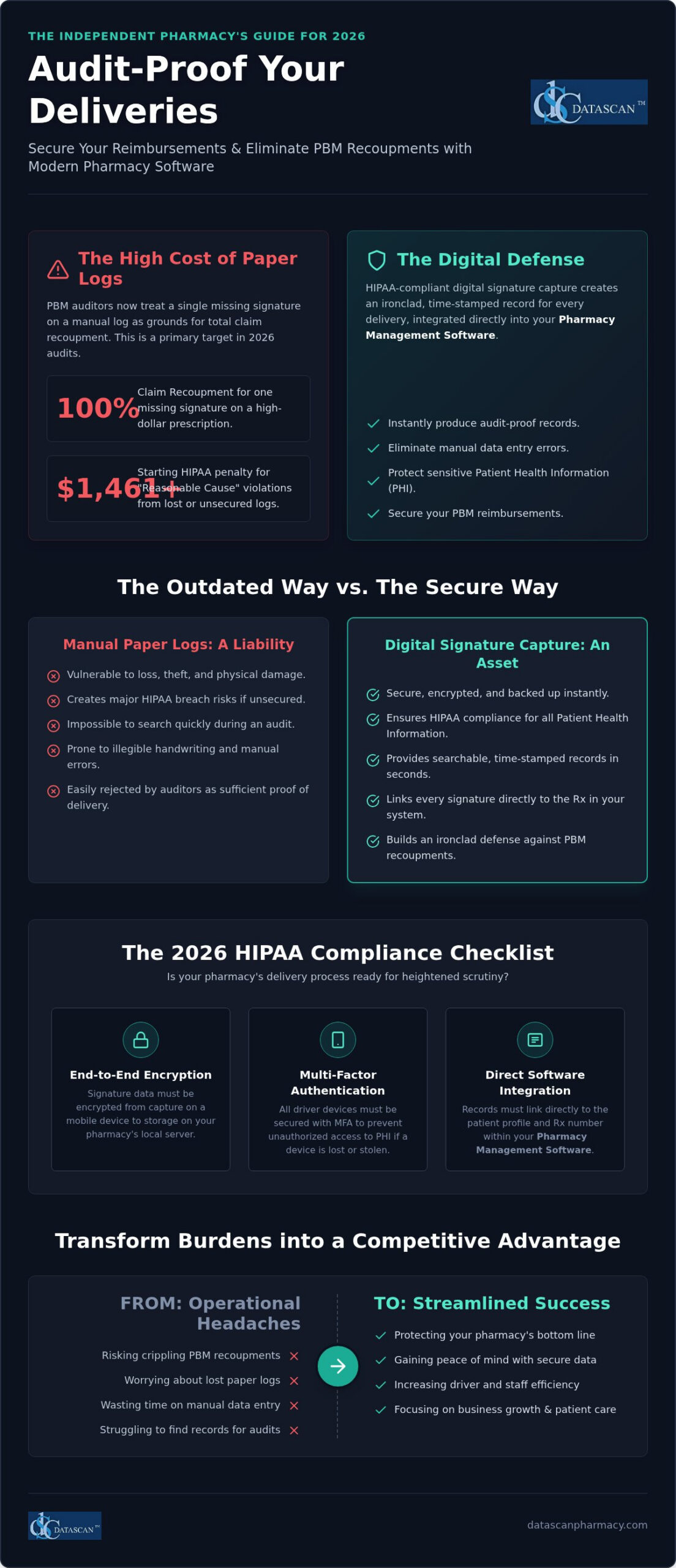
We know the pressure of maintaining profitability while managing a mobile workforce is intense, especially with 2026 HIPAA civil penalties for “Reasonable Cause” violations starting at $1,461 and climbing quickly. It’s frustrating when drivers lose paper logs or when you worry about a lost device compromising patient data. This article will show you how to transform these operational burdens into a streamlined, paperless success. You’ll learn how to implement a modern delivery system that improves driver efficiency and stores audit-proof records directly in your Pharmacy Software, giving you the freedom to focus on growth instead of administrative headaches.
Key Takeaways
- Protect your pharmacy from total claim recoupments by replacing vulnerable paper logs with an audit-proof digital signature system.
- Identify the mandatory 2026 requirements for HIPAA compliant delivery signature capture, including essential encryption standards for mobile devices.
- Streamline your daily operations by integrating secure delivery workflows directly into your Datascan Pharmacy Management Software.
- Increase driver efficiency and reduce administrative errors using a dedicated mobile delivery app designed specifically for independent pharmacies.
- Transform complex compliance burdens into a competitive advantage that secures your reimbursements and frees up valuable time for business growth.
What is HIPAA compliant delivery signature capture?
HIPAA compliant delivery signature capture is the process of securely recording a patient’s acknowledgment of receipt for prescriptions using encrypted digital tools that protect Protected Health Information (PHI). It’s a critical safeguard that replaces outdated paper logs with a verifiable, digital chain of custody. By using this technology, independent pharmacies ensure that every signature is inextricably linked to a specific Rx number and patient profile within their pharmacy management software. This creates an ironclad record that protects your reimbursements during aggressive PBM audits.
The transition from paper logs to digital mobile delivery applications isn’t just about convenience; it’s about survival in a landscape of increasing regulatory scrutiny. In 2026, a simple scribble on a clipboard is no longer enough to satisfy auditors. A truly compliant system requires end-to-end encryption during the transmission of the signature from the driver’s device back to the pharmacy’s local server. This ensures that the data remains protected according to the standards set by the Health Insurance Portability and Accountability Act (HIPAA). Without this level of security, your pharmacy is vulnerable to both HIPAA violations and PBM recoupments.
Why is digital signature capture better than paper logs?
Paper logs are a massive liability for any community pharmacy. If a driver leaves a clipboard in an unlocked vehicle or accidentally loses a log sheet, you’ve potentially triggered a major HIPAA breach. Beyond the security risks, paper is notoriously difficult to manage. Digital capture through a dedicated mobile delivery app allows for:
- Immediate, searchable records that can be produced instantly during an unannounced audit.
- Significant reduction in manual data entry errors that occur when staff try to transcribe messy handwriting.
- Protection against physical damage, such as water stains or tears, which can make paper logs unreadable and useless for defense.
What patient data is considered PHI during delivery?
It’s vital to remember that a delivery route contains a high volume of sensitive data. Patient names, home addresses, and prescription numbers are all classified as PHI. Even the signature itself is a legal acknowledgment that must be handled with the same security as a medical record. To meet 2026 standards, any device used by your drivers must be secured with multi-factor authentication (MFA). This prevents unauthorized access if a device is lost or stolen, ensuring that your pharmacy stays compliant while keeping patient data out of the wrong hands.
How does secure signature capture protect your pharmacy from PBM audits?
Secure signature capture is your primary defense against PBM auditors who treat a single missing signature as grounds for 100% recoupment of a claim’s ingredient cost and dispensing fee. In 2026, PBM audits have shifted focus from clinical accuracy to administrative technicalities, specifically targeting “missing proof of delivery” to claw back profits from independent pharmacies. Implementing a system for HIPAA compliant delivery signature capture ensures that every transaction is backed by ironclad, digital evidence that satisfies even the most aggressive auditor.
By integrating these tools directly into your pharmacy management software, you remove the “low-hanging fruit” that auditors typically exploit. When an auditor demands proof, you don’t need to dig through dusty boxes of paper logs; you can generate a comprehensive report in seconds. These digital records include the signature, a precise timestamp, and metadata that aligns with the HIPAA Security Rule, proving that your pharmacy maintains total control over patient data from the bench to the doorstep.
How does missing delivery documentation impact your pharmacy’s bottom line?
PBMs treat delivery records as a strict condition of payment, which means they use technical flaws in your documentation to justify taking thousands of dollars back. Digital timestamps and GPS coordinates provide vital secondary layers of proof that complement the patient’s signature, making it nearly impossible for an auditor to claim a medication wasn’t delivered. Our integrated pharmacy management software automates this defense by linking every delivery record to the original prescription transaction in real-time. A robust digital record should always include:
- The unique prescription (Rx) number.
- The date and exact time of the delivery.
- The name and signature of the recipient.
- GPS coordinates verified at the moment of capture.
Can technology help mitigate DIR fees and improve efficiency?
Streamlining your logistics isn’t just about audit protection; it’s about reclaiming your time and improving your pharmacy’s star ratings. When your delivery process is automated and paperless, your staff spends less time on manual data entry and more time on clinical services that drive profitability. Leveraging the right technology for improving star ratings alongside a secure delivery workflow gives independent pharmacies a powerful edge in competing with mail-order giants while protecting their reimbursements. If you’re ready to secure your workflow and stop audit losses, contact our team to see how we can help you optimize your business.
What is the HIPAA compliance checklist for pharmacy delivery software?
To achieve HIPAA compliant delivery signature capture in 2026, your system must include end-to-end encryption, unique driver credentials, and real-time integration with your central pharmacy database. Your delivery tool needs to function as a secure extension of your pharmacy management software, ensuring that patient data is never vulnerable to interception or unauthorized access. Use this checklist to evaluate your current or future delivery system:
- Encryption: Ensure AES-256 encryption is active for data at rest and in transit for all patient information handled on mobile devices.
- Automatic Syncing: Signatures must flow directly back to the patient profile without manual intervention, eliminating the risk of lost records or manual entry errors.
- Audit Trails: Every driver needs a distinct account to maintain a clear record of who handled which prescription and the exact time of the transaction.
- Remote Wipe: Your system must allow you to clear all sensitive data from a device instantly if it’s lost or stolen during a route.
Why is a Business Associate Agreement (BAA) necessary?
You can’t legally share patient data with a software vendor without a signed BAA in place. This document is a legal contract that binds the vendor to the same HIPAA privacy and security standards that you follow as a healthcare provider. Generic, non-healthcare e-sign tools often fail this compliance step because they refuse to sign these agreements, leaving your pharmacy liable for any potential breaches. As a dedicated partner to the independent community, Datascan provides the legal and technical framework required to keep your pharmacy compliant, ensuring your audit defense is built on a solid foundation.
What are the technical requirements for mobile delivery devices?
The hardware your drivers carry into the field must be as secure as the terminals inside your pharmacy. This starts with enforcing multi-factor authentication (MFA) for every login, which is a critical defense against modern hacking trends. Adhering to the Digital Signature Standard ensures that the signatures you capture are legally binding, tamper-evident, and verifiable during a PBM audit. Finally, data should never be stored locally on the device longer than necessary; once a delivery is confirmed and synced to your local server, the PHI should be purged from the mobile unit to minimize the risk of exposure.
How do you implement a secure mobile delivery workflow?
A secure mobile delivery workflow connects your pharmacy management system directly to the patient’s doorstep through an encrypted, verifiable chain of command. By integrating HIPAA compliant delivery signature capture into your workflow software, you ensure that every transaction is documented and stored without the risks associated with manual paper logs. This streamlined approach turns a complex logistical challenge into a repeatable, audit-ready process that protects your bottom line.
To implement this successfully, your pharmacy should follow these five essential steps:
- Step 1: Integrate your delivery module with your internal workflow software to ensure data flows seamlessly between the fill station and the driver’s device.
- Step 2: Assign prescriptions to specific routes and drivers within the system; this maintains a clear record of who is responsible for each medication at any given time.
- Step 3: Drivers use the mobile app to scan the package barcode at the doorstep, which confirms the driver is handing the correct medication to the correct patient.
- Step 4: Capture the digital signature and any required co-payments at the point of delivery, ensuring the system records the transaction as a completed, paid event in real-time.
- Step 5: The system performs an automatic upload of the signature record to the patient profile for permanent storage, making it instantly retrievable for future audits.
Training your delivery team for compliance
Your drivers are the face of your pharmacy and must be trained to handle PHI with the same care as your in-store technicians. They need to understand that they aren’t just delivering “packages”; they are handling legal documents and sensitive medical information. Best practices include verifying the recipient’s identity without announcing the medication name aloud and maintaining privacy during every interaction. If a patient is not home or refuses to sign, drivers must follow a secure re-delivery protocol that keeps the PHI protected within the delivery vehicle rather than leaving it on a porch or with a neighbor.
Optimizing routes to save time and fuel
Route optimization within your delivery app does more than just save on fuel costs. It gives pharmacy owners back their most valuable asset: time. By automating the delivery sequence, your drivers can complete more stops in less time, while real-time tracking allows your store staff to provide accurate updates to patients. This level of efficiency helps independent pharmacies compete with larger chains while maintaining the personal touch their communities expect. For a deeper dive into maximizing store-wide productivity, read our Pharmacy Workflow Optimization Guide. If you’re ready to secure your delivery operations, contact our support team today for a personalized demonstration.
How does Datascan’s mobile delivery app streamline your pharmacy operations?
Datascan’s mobile delivery app streamlines your workflow by providing a direct, secure bridge between your field drivers and your local pharmacy management system. This specialized tool allows independent pharmacies to achieve HIPAA compliant delivery signature capture while eliminating the friction of manual data entry and fragmented record-keeping. By automating the documentation process, you transform a high-risk operational burden into a streamlined success that protects your reimbursements.
Unlike one-size-fits-all corporate software, our solution is built specifically for the unique pressures of the independent pharmacy owner. We act as the “Champion of the Independent,” delivering technology that prioritizes your profitability by reducing labor costs and shielding you from aggressive PBM audit risks. If a driver encounters a technical hurdle during a late-afternoon route, our US-based support team ensures you get a real person on the phone immediately, not a generic chatbot or an outsourced help desk. This level of accountability is essential for maintaining a reliable delivery service that your community can trust.
Seamless integration with POS and management systems
Efficiency is born from deep integration, and our mobile app ensures that every signature captured in the field appears instantly within your Datascan Point of Sale system. There is no need for complex syncing or reliance on external servers; the app maintains a direct, secure connection to your pharmacy’s local server to keep your data under your own roof. This real-time visibility doesn’t just protect you during audits; it also forms a core part of effective pharmacy patient retention strategies by ensuring your staff can provide accurate, up-to-the-minute delivery status updates to your patients whenever they call.
Future-proofing your pharmacy with Datascan
With a history spanning more than 40 years, Datascan has evolved alongside the independent pharmacy industry, providing stable and innovative solutions that venture-backed corporations simply cannot match. As a family-owned vendor, we are directly accountable to your success, and our longevity proves our commitment to building future-proof tools that help you thrive despite shifting PBM demands. We invite you to see how our mobile delivery app can transform your operations and secure your reimbursements. Schedule a demo today to experience the power of a system designed for the way you actually do business.
Secure Your Pharmacy’s Future with Audit-Proof Delivery
Transitioning to a high-efficiency digital workflow is no longer optional for independent pharmacies facing aggressive PBM audits in 2026. By implementing HIPAA compliant delivery signature capture, you effectively eliminate the risk of total claim recoupments caused by missing or illegible paper logs. This technology doesn’t just protect your hard-earned revenue; it streamlines your entire mobile operation, freeing up your time to focus on patient care and clinical growth. You deserve a system that works as hard as you do to protect your bottom line.
Since 1981, Datascan has remained a family-owned and operated partner to community pharmacies across the country. Our mobile solutions provide direct integration with the Datascan Pharmacy Management System and offer industry-leading, US-based technical support to ensure your drivers always have the help they need. You have the power to overcome PBM challenges and build a more profitable, efficient business for your community. See how Datascan’s Mobile Delivery App can audit-proof your pharmacy and schedule a demo today!
Frequently Asked Questions
Is a digital signature as legally binding as a pen-and-paper signature?
Digital signatures are just as legally binding as traditional ink signatures thanks to the ESIGN Act and the Uniform Electronic Transactions Act. These digital records offer superior protection for your business because they create a tamper-evident record linked to a specific transaction. When integrated with your pharmacy software, these signatures provide a verifiable audit trail that manual logs cannot match. This ensures you meet federal standards while protecting your reimbursements from technical recoupments.
Does HIPAA require a signature for every single prescription delivery?
HIPAA requires a good faith effort to obtain an acknowledgment of receipt for the Notice of Privacy Practices. While the regulation is the foundation, PBM contracts are the primary reason you need a signature for every delivery. PBMs treat a signed delivery log as a strict condition of payment. If you do not have a signature stored in your pharmacy management software, auditors will often claw back the entire cost of the claim.
What happens if my delivery driver loses the mobile device containing patient signatures?
If a driver loses a device, you should immediately initiate a remote wipe through your security management tools. Because a secure mobile delivery app syncs data directly to your local pharmacy management software, the patient signatures are not lost. They are already safely stored on your local server. Multi-factor authentication prevents unauthorized users from accessing any PHI on the lost device, keeping your pharmacy compliant and your patient data protected.
Can I use a standard tablet for HIPAA compliant signature capture?
You can use a standard tablet, but it must be configured with specific safeguards to be compliant. This includes full-disk encryption, phishing-resistant multi-factor authentication, and a secure connection to your pharmacy system software. The hardware itself is just a tool; the compliance comes from the secure application and the administrative policies you implement. Generic tablets without these protections should never be used to handle sensitive patient information or capture signatures.
How long does a pharmacy need to keep delivery signature records for audits?
HIPAA mandates that pharmacies retain compliance-related documentation for at least six years. However, PBMs often have their own lookback periods that can extend beyond that timeframe. It is best practice to store your digital records indefinitely within your pharmacy management software. Since these records do not take up physical space like paper logs, keeping them for the long term is a low-cost way to ensure you are always ready for an audit.
Do PBMs accept digital signatures as proof of delivery?
PBMs absolutely accept digital signatures and often prefer them for their accuracy and metadata. A digital signature captured through a secure app includes a timestamp and GPS coordinates that provide a level of proof paper logs cannot offer. Using a digital system helps you overcome reimbursement challenges by providing the gold standard of proof that auditors look for in 2026, making your records much harder to dispute during a review.
What is the difference between an e-signature and a digital signature under HIPAA?
An e-signature is a general term for an electronic mark, while a digital signature is a specific, encrypted type of e-signature. For HIPAA compliant delivery signature capture, the system uses cryptographic keys to ensure the signature is authentic and has not been altered. This high level of security is what makes digital signatures acceptable for protecting sensitive healthcare data and satisfying the technical requirements of the HIPAA Security Rule.
How can I capture signatures if the patient is not at home during the delivery?
You should not leave the medication if a patient is not home; instead, the driver must return the prescription to the pharmacy. Leaving PHI on a porch is a significant security risk and fails to provide the proof of delivery required by PBMs. Your delivery app should allow the driver to mark the delivery as attempted and return the item to the pharmacy workflow, where it can be rescheduled for a time when the patient is available.
 Kevin Minassian is the President of Datascan Software. Under his leadership, the company rapidly expanded to provide pharmacy management software on a national level. Over the last 15+ years, he has ensured that Datascan has continuously evolved to offer innovative solutions for independent pharmacies while still offering world-class customer support. He is passionate about helping independent pharmacies to remain competitive, achieve success, and offer the very best service to their communities.