Chat with us, powered by LiveChat
The Best Pharmacy Software Since 1981
How Hard Is It to Learn Pharmacy Software? How Can I Train My Staff?

How Hard Is It to Learn Pharmacy Software? How Can I Train My Staff?

Two pharmacists learning how to use pharmacy software

Running an independent pharmacy today requires the right technology to keep things running smoothly. Pharmacy software has become an essential part of daily operations, handling everything from prescription processing and inventory management to billing, reporting, and patient communication. One of the first questions pharmacy owners and staff ask as they evaluate different pharmacy systems is, “How hard is it to learn the pharmacy software?”

The answer depends heavily on the pharmacy system you choose. Some pharmacy management software platforms are intuitive, simple to navigate, and quick to learn. Others are overly complex, with steep learning curves that frustrate users and lead to wasted time and inefficiency.

Let’s explore what makes pharmacy software easier or harder to learn, how long the typical learning curve takes, and the best ways to train your staff. We’ll also take a closer look at why Datascan Pharmacy Software is one of the easiest systems to adopt—making it the best pharmacy software choice for independent pharmacies that want powerful tools without the frustration of overly complicated pharmacy software solutions.

Why Ease of Learning Matters in Pharmacy Software

A pharmacy management system should be designed to make your staff’s jobs easier, not harder. If your pharmacy software is too complicated, employees will avoid using it to its full potential—or worse, they’ll make mistakes that impact your business and potentially harm a patient.

When technology is intuitive:

  • Staff are more likely to embrace it in their daily workflow.
  • Training new employees takes less time.
  • Errors are reduced, since staff feel confident navigating the system.
  • Efficiency improves, meaning more time for patient care and less time spent troubleshooting software.

If the learning curve is steep, your team may resist incorporating the pharmacy software into everyday tasks. In a busy pharmacy environment, you don’t have time for your system to slow you down. That’s why choosing software for pharmacies that is user-friendly is crucial.

How Hard Is It to Learn Pharmacy Software?

Not all systems are created equal. Some of the more complex pharmacy management systems require days or even weeks of training before staff can use them with confidence. These platforms often have cluttered screens, non-intuitive workflows, or rigid setups that don’t adapt well to your pharmacy’s unique needs.

Datascan, on the other hand, was built with usability in mind. Pharmacies have consistently praised it as one of the top pharmacy software systems for its balance of simplicity and technology.

  • Logical workflow: The system was built with independent pharmacy in mind. The flow is logical and intuitive.
  • Customizable options: While the software is simple to navigate, it also offers robust customization so you can adapt it to your pharmacy’s needs.
  • Short learning curve: On average, it takes just 1–2 hours for staff to learn the day-to-day functions needed to process prescriptions, handle refills, and manage patients.
  • Simple yet robust: Even though it’s easy to use, Datascan still offers all the advanced features you’d expect from the best pharmacy software—like reporting, inventory management, patient communication tools, and integration with third-party platforms.

The competition’s pharmacy systems often leaves staff needing multiple training sessions just to master the basics. In fact, some systems are so overwhelming that users never fully adopt all of the features, leaving valuable tools unused.

Training Your Pharmacy Staff

Even if your pharmacy management software is easy to use, proper training ensures your staff can get the most out of it. An organized training plan will boost confidence, minimize errors, and allow your pharmacy to maximize efficiency.  Training should be thorough and continual.  Datascan offers free live training to both new and existing pharmacies– something the competition often does not do.

1. Start With the Basics

When introducing new pharmacy software, focus first on the daily tasks your staff will use most frequently—such as prescription entry, processing refills, and patient profile management. Once staff are comfortable with these functions, you can introduce more advanced features.

2. Use Hands-On Training

The best way to learn pharmacy software is by doing. Allow staff to practice in a test environment, or walk them through real-life scenarios step by step. Hands-on training builds muscle memory and speeds up adoption.

3. Take Advantage of Vendor Support

Not all vendors provide the same level of training and support. Datascan stands out by offering free training for new clients as well as existing customers. Their training isn’t a one-time offering—whether you’re just getting started or adding new staff, you can always access training at no additional cost.

Beyond live training, Datascan also provides a library of training videos and how-to documents available on the client website. This means your team always has on-demand resources to reference whenever they need a refresher.

4. Provide Written Guides and Videos

Supplement hands-on learning with reference materials. While live training is always best, there’s no doubt that comprehensive how-to guides, or short video tutorials can help staff revisit features they may not use every day. With Datascan, much of this is already available in their client portal.

5. Encourage Ongoing Learning

As your pharmacy grows, your staff may need to use more advanced features of the software. Schedule refresher training sessions or Datascan’s Optimization Training to help learn more about new features you may benefit from implementing in your pharmacy.

Why Datascan Is the Easiest to Learn

When comparing pharmacy management software, Datascan stands out for its ease of use and straightforward training process. Here’s why independent pharmacies choose Datascan:

  • Fast onboarding: Most staff can begin using the software after just an hour or two of training.
  • Logical layout: The workflow is intuitive and logical. 
  • Customization: Pharmacies can set up the system to fit their exact needs without complicating daily use.
  • Free training: New clients and existing customers alike can take advantage of unlimited free training.
  • Training resources: Access to online training videos and how-to documents ensures ongoing support.
  • Responsive support: With U.S.-based support and lightning-fast response times, help is always just a call away.
  • Balance of simplicity and power: Unlike competitors that overwhelm users with unnecessary complexity, Datascan provides everything an independent pharmacy needs without overcomplicating the process.

This is why many consider Datascan to be the best pharmacy software for independent pharmacies that value both functionality and usability.

The Bottom Line

Learning pharmacy software doesn’t have to be difficult. The key is choosing a system that’s designed with usability in mind. A complex pharmacy management system can frustrate staff. 

With Datascan, the average staff member can master day-to-day functions in just 1–2 hours, making it one of the easiest and fastest systems to learn. Combine that with free training, an extensive library of videos and how-to documents, robust features, customizable options, and industry-leading support, and you have a pharmacy computer system that truly sets itself apart as the top pharmacy software for independent pharmacies.

By investing in a user-friendly pharmacy software and creating a structured training plan, you can ensure your staff feels confident and your pharmacy runs at peak efficiency.

Pharmacy Software Reliability – What Kind of Downtime Can I Expect?

Pharmacy Software Reliability – What Kind of Downtime Can I Expect?

A female pharmacist on the phone looks at a report on a computer screen

When running an independent pharmacy, reliability is not optional, it’s essential. Every prescription you fill, every patient you help, and every claim you transmit depends on your pharmacy software functioning seamlessly. 

Downtime doesn’t just cause frustration; it disrupts patient care, decreases efficiency, and costs your pharmacy money. That’s why choosing the best pharmacy software is about more than just features. It’s about selecting a system and a partner you can depend on.

Let’s explore what kind of downtime you can expect from different pharmacy management systems, the differences between cloud-based and on-premise solutions, and why Datascan Pharmacy Software solutions stand out with unparalleled reliability and industry-leading support.

Understanding Downtime in Pharmacy Software

Downtime occurs any time your pharmacy management system isn’t working properly. It can mean being completely locked out of your system, working around a problem or dealing with slow, lagging performance that prevents staff from working efficiently. Common causes of downtime include:

  • Internet outages – Cloud-based pharmacy systems rely entirely on the internet. If your pharmacy loses connection or the host system has issues, you may be stuck waiting until service is restored.
  • Server outages on the vendor’s side– Cloud pharmacy systems may experience server crashes, scheduled maintenance, or data center failures, leaving pharmacies unable to access their software.
  • Software bugs – New updates or untested changes can introduce bugs that take hours or days for the vendor to patch.
  • Slow support responses – Even a small issue can become a major downtime event if it takes time to get a support technician on the line, and worse if it takes hours or days for the pharmacy software systems vendor to fix the issue.
  • Hardware issues- printer problems, issues with the network, component failure within a PC can all cause downtime in your pharmacy.

When your pharmacy depends on fast service, these delays can cause disappointed and frustrated staff and patients.

Cloud vs. On-Premise Pharmacy Software

One of the most important factors in determining system reliability is whether your pharmacy runs on the cloud or is an on-premise solution.

Cloud-Based Pharmacy Software:

  • Requires a strong and consistent internet connection.
  • You still need a working network and operational computers to access the pharmacy system
  • If your internet is down, even briefly, your pharmacy is effectively offline.
  • Issues on the host side, such as server crashes or overload, can shut down multiple pharmacies at once.
  • Benefit of working from anywhere with ease
  • Automatic updates may introduce new bugs without warning.
  • Online support queues can leave you waiting while your staff sits idle.

On-Premise Pharmacy Software:

  • Runs locally on servers or computers inside your pharmacy, any issues related to your hardware or network could bring your business down.
  • Internet outages don’t bring your operations to a halt—you stay operational.
  • Updates are tested and implemented with a slow rollout.
  • Your pharmacy retains access to its own data without relying on a third party.
  • To work remotely, you must use either a VPN network, Microsoft remote desktop access, or a remote program to control a PC such as Logmein. 

Datascan offers among the most reliable pharmacy software systems. Datascan offers on-premise reliability that keeps your pharmacy running no matter what’s happening with your internet connection or external servers.  Additionally, Datascan support is second to none– with immediate access to the helpdesk to quickly troubleshoot any issues and keep your pharmacy computers systems up and running.

Datascan’s Track Record of Reliability

Pharmacy owners using Datascan Pharmacy Software consistently report little to no downtime thanks to a combination of factors:

  • Client on-premises software: With software installed locally, pharmacies are protected from the risks of internet failures or vendor server issues.
  • Proactive updates: Datascan thoroughly tests updates before release, reducing the chance of disruptive bugs, and no massive updates are rolled out automatically.  
  • Immediate support: Unlike many competitors, Datascan’s support team is known for answering calls in under 30 seconds. That means issues are resolved in real time instead of leaving your staff waiting hours or even days.
  • Experienced help desk: The majority of Datascan’s support team has been with the company for 10+ years, giving them unmatched knowledge of pharmacy workflows and technical challenges.

The Cost of Downtime with Other Vendors

Many pharmacies that switch to Datascan do so after struggling with competitors. Here’s why:

  • Support wait times: Some pharmacy systems vendors force pharmacies into long hold queues or require email tickets that can take days to resolve. That’s lost time your patients and staff can’t afford.
  • Unreliable bug fixes: When a pharmacy system pushes out an automatic update with an error, every pharmacy using the platform may be impacted until the vendor resolves it.

When compared, the difference in reliability is clear—the best pharmacy software isn’t just about features, it’s about uptime.

Why Independent Pharmacies Choose Datascan

Independent pharmacies operate on thin margins and can’t afford interruptions or downtime. With Datascan Pharmacy Software, pharmacies get peace of mind knowing they’ve chosen one of the top pharmacy software solutions in the industry. Key benefits include:

  • Unmatched reliability- Datascan’s top pharmacy software is dependable and helps you keep your pharmacy running smoothly.
  • Top-tier support – Rapid response times mean your staff gets real answers in under 30 seconds.
  • Industry experience – With decades of expertise, Datascan understands the unique challenges of independent pharmacies.

Long-term trust – Pharmacies that choose Datascan stay with Datascan. The company’s reputation for reliability and support keeps clients loyal.

What Kind of Downtime Can You Expect with Datascan?

The short answer: almost none.

Because Datascan’s pharmacy management system runs locally in your pharmacy and is backed by the fastest, most knowledgeable support team in the industry, your staff won’t experience the common downtimes that plague other pharmacy management systems. If a question or technical issue arises, you can count on real-time answers from a dedicated team that knows your system inside and out.

With Datascan, downtime doesn’t drag on for hours or days—it’s resolved almost immediately. This is why many independent pharmacies consider Datascan not just the best pharmacy software, but also the most reliable pharmacy software on the market.

Final Thoughts

When it comes to searching for the absolute best pharmacy software, reliability should be at the top of your priority list. Frequent disruptions, slow support responses, and unexpected bugs can cause severe downtime and cripple your operations.

Datascan Pharmacy Software systems offer the reliability, control, and support that independent pharmacies need to thrive. With on-premise stability, minimal downtime, and the fastest support in the industry, Datascan isn’t just a solution—it’s a partner in your pharmacy’s success.

For independent pharmacies that can’t afford to risk downtime, Datascan remains the clear choice for the top pharmacy software available today.

Top Features to look for in a Pharmacy Point of Sale System

Top Features to look for in a Pharmacy Point of Sale System

pharmacy software point of sale system

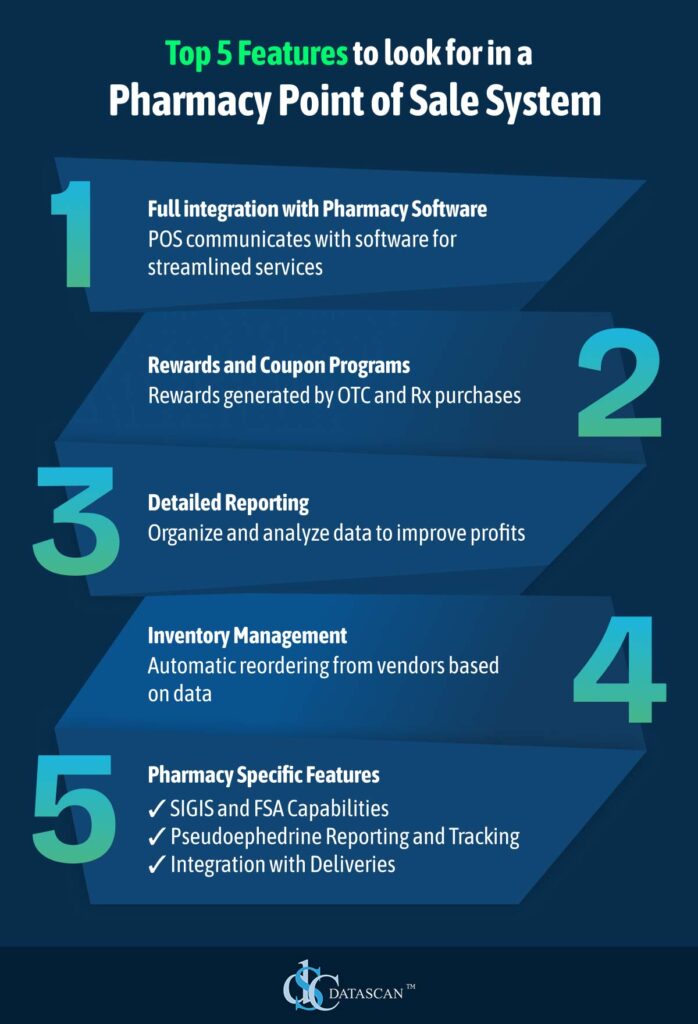
When searching for the best pharmacy point of sale software there are a few key features that are an absolute must have for every independent pharmacy.  Operating a small pharmacy or clinic today can be challenging, but the right technology synchronized together can make the world of a difference.  Ultimately, the ability to get a POS system for your pharmacy from the same vendor that supplies your pharmacy management software should ensure that both software packages are deeply integrated into each other.  It is also a benefit when any questions or issues arise that you can deal with one company that is responsible for both pharmacy software systems.  Make sure when you are shopping for your new pharmacy, or to replace your existing pharmacy system, that the features listed below are available from the vendor you choose to do business with.

1:  Full Integration with Pharmacy Software:

If your pharmacy software vendor is your POS provider, they will likely have a more robust integration between the two systems.  Essentially, the two software products need to speak to one another.  The POS system can grab the co-pays due from the pharmacy software to make certain of accuracy when checking customers out.  If a patient decides they do not want an RX and you need to return it, the pharmacy software needs to queue that prescription up to reverse it if it was sent to insurance.  Many pharmacies want to make sure prescriptions are verified before they are checked out and sold to a patient, and in Datascans pharmacy POS you can require verification be done before it can be sold at the cash register.  What if a patient is there to pickup a prescription, and there are still others in the store, possibly in other bags, or childrens medications waiting for pickup?  The POS can read from the pharmacy software and display a list of other RX’s in need of pickup.  Many states require that controlled substances are reported to the PMP once they have been delivered or picked up, so the pharmacy computer system can receive confirmation of date sold from the POS, and then report those scripts to the PMP with the proper data.  Both systems can also share data to help build out a series of reports to help owners better understand their business from sales and inventory perspectives.  The best retail pharmacy software will allow you to customize a rewards program in the pharmacy POS that will also allow you to grab data from the pharmacy management system, and give rewards for prescription sales as well as OTC.  These are just some of the important capabilities you should expect from your pharmacy POS and its integration with the pharmacy systems.

2:  Rewards and Coupon Programs:

Rewards programs have been around for decades.  The big chains offer them, it gives patients incentive to come back to the same store, make purchases, and get discounts in return for loyalty (which is why these are typically called ‘loyalty programs’).  Your pharmacy pos system must have a customizable rewards program.  One that you can choose milestones that offer different rewards, as well as the ability to choose how much each spending dollar means to you.  Datascan works with like to give more value to OTC dollars, while giving a bit less towards RX copay dollars.  They still count, just not as much, but add up over time to discounts and reewards that keeps their patients coming back.  Rewards can trigger anything from a coupon to be used at a later date, to an instant discount you display on the receipt and share with the customer at checkout.

pharmacists using software

3:  Detailed Reporting:

In order to build efficiencies into any business, you need data.  Knowing your areas of weakness (or areas that need improvement), knowing employee performance, profitability not just across the board but in specific areas of your independent pharmacy –these are all imperative to overall success.  The best pharmacy POS systems on the market, when properly ‘married to’ the best pharmacy systems on the market will allow you to dive into a wide range of reporting that are fully customizable.  Breaking down your OTC into categories and subcategories, looking over patient purchasing and identifying those that may be in the negative after RX losses to PBM’s coupled with little to no OTC sales will give you a detailed picture into areas of waste or weakness that you can turn around into more profits.  Remember that tying in data for a full picture from both the pharmacy point of sale and the pharmacy computer system is key to getting the big picture, not a partial one.

4:  Pharmacy specific features: 

There are many point of sale products on the market being used in independent pharmacies today that were not built FOR pharmacy, and may lack specific functionality to the industry.  Datascan made sure their pharmacy POS system was built from the ground up, to cover any and all unique requirements our industry has.

  • SIGIS and FSA capabilities: You may have patients that participate in health insurance plans that offer FSA/HSA spending cards.  In order for you to be able to accept these cards in the point of sale system, you will need to be registered with SIGIS, and be setup properly from your vendor within the software.  Without it, you are simply walking customers out your door and into your competitor down the block.
  • Pseudoephedrine reporting / tracking: There are laws that require you track, and in some cases report pseudoephedrine purchases.  These are tracked at checkout in the pharmacy point of sale system, and then tie into reporting from NPLEX within Datascans system.  If a customer attempts to purchase more than the law allows, the system will stop you.  When you sell items that contain pseudoephedrine in them, the software prompts and requires you to scan the ID/drivers license.
  • Integration with Deliveries: The best pharmacy pos systems on the market will also integrate with a delivery system, preferably from the same vendor. (again, they will have control of all potential issues start to finish).  Many independent community pharmacies are opting to offer delivery to local patients to set themselves apart from the chains.  We offer our own robust delivery system on both android and apple IOS, as well as support integration with a number of delivery systems / couriers around the country.  This allows you to manage, with ease, start to finish all deliveries, manage drivers, ensure copays or monies due are brought back to the pharmacy and placed in the register and so much more.

5:  Inventory Management:

Inventory is one of, if not the largest expense a community pharmacy has to invest in continually.  Ideally, you want inventory turning over, and not sitting stale on the shelves.  The ability to track historic sales and make decisions on replenishment based on that history is important to lower spending and keep those dollars in your accounts, not on your shelves.  Simplifying cost updates, inventory ordering and inventory level updates is all done via EDI, and electronic interchange with whole sale vendors.  You need the ability to either manual reorder (when needed), and set automatic reorder points so when you sell down to a certain number in inventory, it puts it on the next PO.  The system should shop for you across vendors for the same products, saving you money, and paying for itself!

If you take the time to choose the right pharmacy software vendor, that offers an integrated pharmacy point of sale system, and all of the features above (and more of course), you are on the right track. Now you just need to take advantage of the technology and features built into the software systems to get the most out of them.  The best pharmacy software companies on the market will offer their own pharmacy driven pos system that ties directly into their pharmacy management software, delivery applications, amongst many other technologies offered industry wide.  Used correctly, these products will more than pay for themselves and help you to build a more profitable pharmacy.

Pricing Pharmacy Software: Are There Hidden Costs?

Pricing Pharmacy Software: Are There Hidden Costs?

a pharmacist on the phone pricing pharmacy software
  • Not all pharmacy software includes the features that independent pharmacies need to succeed.
  • Implementing a new pharmacy software system can come with additional expenses.
  • Datascan offers an all-inclusive system with no hidden fees and award-winning support.

When independent pharmacy owners begin their search for the best pharmacy software, pricing is often one of the first questions that comes to mind. After all, your pharmacy software is hands-down the most important investment you’ll make in your business. But here’s the thing: not all vendors are upfront about what you’ll actually end up paying.

In fact, the world of pharmacy management software pricing can sometimes feel like navigating a maze. Many competitors lure in pharmacies with what appears to be a low monthly cost, only to tack on hidden fees later. The result? You may find yourself paying far more than you originally budgeted.  It’s important to understand exactly what you’re paying for and exactly what you’re getting.

At Datascan Pharmacy Software, transparency is key. Datascan has built a reputation as one of the top pharmacy software providers by offering clear, upfront, and honest pricing—without the nickel-and-diming practices that are all too common in the industry.

First, it’s important to break down the common costs of pharmacy management systems, where hidden fees often creep in, and how Datascan stands apart with transparent, all-inclusive pricing.

The True Costs of Pharmacy Software

Every pharmacy software system comes with a few standard costs. While they may vary by vendor, most pharmacies should expect the following:

1. Licensing Fees

This is the cost of obtaining the software license itself. Some vendors charge by the number of users and number of workstations, whereas Datascan includes an unlimited number of users and workstations.

2. Onboarding and Training

Pharmacy software is undoubtedly complex. Pharmacies need onboarding, setup, and staff training to ensure the system is used effectively. Some companies charge fees for training sessions or limit the number of hours included.  Datascan always includes initial training, as well as ongoing training for free.  This ensures that you and your staff are constantly up to date with new features, and have a comprehensive understanding of the pharmacy systems capabilities.

3. Data Conversion and On-site Training

If you’re switching from one pharmacy management software to another, the data conversion is often one of the biggest expenses. Moving prescription data, patient profiles, prescriber information, and inventory is handled with the help of a data conversion company– and isn’t always included. Some vendors upcharge conversions, which can cost your pharmacy thousands of dollars. Datascan, however, often offers pharmacies free data conversion, saving them significant upfront costs.

On-site training is often another exorbitant cost for a pharmacy.  Many pharmacy software vendors charge thousands of dollars to send staff on-site for only a few days.  Datacan staff come onsite typically Monday-Friday, and often includes the cost of on-site training for free, with minimal fees to cover travel-related costs for the staff.

4. Monthly Support and Maintenance

Every pharmacy software vendor charges a monthly service fee for support and ongoing system maintenance. This is expected, as pharmacy systems require continual updates to remain compliant with regulations and to integrate with third-party services such as Surescripts or pharmacy claims switching vendors.  This price varies from vendor to vendor and can range from affordable to astronomical.  

Datascan offers a ‘package price’ that includes not only your pharmacy software licences and maintenance, but many services that other vendors charge add-ons for, such as document management, or our patient-facing mobile application– they are included!

5. Transaction Fees

There are also transaction-based fees, such as electronic prescribing and insurance claims switching. While these are unavoidable in the industry, rates vary depending on the vendor.  It is important to understand these fees and be able to quantify your charges at the end of each month.  Datascan provides its clients with an easy-to-read breakdown and summary of charges each month for all costs related to the pharmacy management systems. 

Where the Hidden Fees Sneak In

Here’s where things get complicated– many vendors don’t include anything with their base pricing. Instead, they charge additional fees for features that should be standard in a pharmacy management system.

Often, you won’t even know about these hidden costs until you try to enable a feature. At that point, you’re locked in, and your “affordable” pharmacy software suddenly costs far more than expected.

Some of the most common hidden add-on costs include:

  • Patient Mobile Apps – An essential in today’s digital-first world, but some vendors charge extra, often in excess of $100 per month, to offer a mobile app for patients.
  • Delivery Applications – Many pharmacies rely on delivery, but delivery management tools are often sold as expensive add-ons.  These can cost your pharmacy upwards of $50+ per month.
  • Third-Party Data Feeds – Want to share data with a partner platform? Some vendors make you pay just to access your own data.
  • Document Management – Storing and managing scanned prescriptions, insurance cards, and other paperwork is crucial, yet many vendors add extra fees for this capability.
  • Faxing – Still widely used in pharmacy, fax integration is another common hidden fee.
  • Controlled Substance Reporting – Control reporting isn’t optional, yet some systems tack on fees for automated reporting. 
  • After-Hours Support – You may find yourself paying a premium to get help outside of standard business hours.
  • Compound capabilities – you may not offer compounded medications now, but if you decide to add it to your business model later, does the pharmacy system have this built in?
  • LTC / Nursing — again, something you may add in the future –but does the pharmacy software have it built in, and is it free of charge?

These “nickel and dime” fees add up quickly. What seemed like an affordable monthly rate can balloon into something significantly higher once all the must-have features are factored in.

Be Careful: PioneerRx’s “RX Usage Fee”

One example that stands out in the industry is PioneerRx. They charge an “RX usage fee” for every prescription picked up at the point of sale– every one– including cash prescriptions!

This fee may not sound significant at first, but when calculated out, and added to the switching cost, it comes to nearly 10 cents per prescription on insurance-based claims. This is an astoundingly high rate. Pharmacies often don’t realize how much this adds to their overall expenses until it’s too late.

This is why it’s so critical to ask detailed questions about pricing and request a side-by-side comparison. Datascan encourages pharmacies to bring competing quotes to the table so you can clearly see how the costs stack up—and where the hidden fees lie. Compare pharmacy systems vendors side by side, for price, customer satisfaction (online ratings), and technology.

Datascan’s Approach: Transparent Pricing with No Hidden Fees

Datascan has taken a very different approach to pricing.  As one of the best pharmacy software providers in the industry, Datascan believes that pharmacies deserve full visibility into what they’re paying for.

Here’s what sets Datascan apart:

  • All-Inclusive Base Pricing – Features that competitors charge extra for—like mobile apps, delivery tools, document management, faxing, and after-hours support—are included in Datascan’s base pricing.
  • Free Data Conversion (for many pharmacies) – Making the switch shouldn’t come with a giant cost. Datascan helps many pharmacies convert data at no cost.
  • Clear Monthly Support Fees – You know upfront what you’ll pay each month for pharmacy software support and maintenance, with no surprise charges.
  • No Usage-Based Nickel and Diming – Unlike competitors, Datascan doesn’t add fees for “RX Usage.”
  • Honest Comparisons – Datascan helps pharmacies review competitor quotes line by line so you can see exactly what you’re paying for.

Why Transparency Matters

Independent pharmacies are already struggling with shrinking reimbursement rates, DIR fees, and staffing challenges. The last thing an independent pharmacy needs is surprise costs from its pharmacy management software.

Transparent pricing not only protects your bottom line but also builds trust. When you know exactly what you’re paying for, you can budget more effectively and focus on what really matters: building a better and more profitable pharmacy.

Datascan’s approach to pricing reflects its larger philosophy: providing pharmacies with the tools, support, and service they need to succeed, without the games or hidden fees.  Datascan has been laser-focused on the success of independent pharmacy for over 4 decades.

Final Thoughts

When it comes to choosing the best pharmacy management software, price is about more than just an upfront number on paper. It’s about understanding the true costs—both upfront and ongoing—of the system you’re investing in.

Hidden fees for features like mobile apps, delivery tools, or even control reporting can significantly increase your total spend. 

Datascan stands out as one of the top pharmacy software providers because of its transparent pricing model, all-inclusive features, and commitment to helping independent pharmacies thrive. With no hidden fees and clear, upfront pricing, Datascan makes it easy for pharmacies to budget confidently and invest in a software system that truly delivers value.

If you’re evaluating software for pharmacies, take the time to ask the right questions about pricing. And most importantly, ask Datascan to help you compare—so you can be sure you’re not paying for hidden costs you never expected.

Should Independent Pharmacies Offer Durable Medical Equipment?

Should Independent Pharmacies Offer Durable Medical Equipment?

As more patients nationwide suffer from conditions like cancer and cardiac disorders and also look to manage care at home, the need for at-home “DME”, or Durable Medical Equipment, continues to rise. According to a study by Grand View Research, the market for Durable Medical Equipment was worth nearly $42 billion in 2016 and is expected to continue to grow. Independent pharmacies have a tremendous opportunity to create an additional profit center by offering Durable Medical Products to customers within their pharmacies. At Datascan, we constantly urge independent pharmacy owners to seek out non-PBM-centric revenue sources and build other streams of revenue into their business. Whether you’re considering Part B contracts or looking to merely sell DME without contracting, there is an undeniable demand for these types of products.

Many patients who are managing chronic conditions or rehabilitating after a surgery or injury need more than just prescriptions. The likelihood is if your patient is already filling prescriptions with your pharmacy, they’ll look to you for their non-prescription needs as well. Pharmacy patients rehabbing at home require much of the same equipment a typical facility uses. Products to assist those with limited mobility like walkers, canes, and wheelchairs are useful both in the home and while getting around outside. Patients may require toileting DME products like commodes or bed pans if they’re bed-bound, in addition to personal care products. Let’s also not forget about our senior patients who may suffer from limited mobility and can benefit from a variety of Durable Medical Equipment products as well. Providing DME products in your independent pharmacy also allows your pharmacists and staff to be much more involved and proactive in overall patient health and well-being.  As we all know by now, PBMs are forever ranking performance and looking for new ways to dig into your pharmacy’s profits. If we can better manage our patients’ overall health, we’ll essentially see better outcomes and eventually fewer claw backs.

For many pharmacies, the headaches of billing Durable Medical Equipment is not worth the time; and so they are opting to offer DME as a service for self-pay customers. Contracting with insurance companies to be able to accept and bill DME products is a lengthy process that does not always result in optimal reimbursements. Often times, DME claims are captured and later evaluated for actual pharmacy reimbursement. Many pharmacy owners find themselves underpaid or unpaid for items they thought were reimbursable. Because of these challenges, many pharmacies have opted not to offer Durable Medical Equipment at all. A large percentage of patients are paying out of pocket for items or handling insurance reimbursement themselves. Providing patients with DME products can still be a very profitable opportunity for community pharmacies.

Managing inventory is an important aspect of successfully selling Durable Medical Equipment in your pharmacy. Using the reporting and inventory tools within your Datascan Pharmacy Software and POS will help. Since many local, independent pharmacies struggle with space, stocking large-sized DME items is sometimes not practical. Datascan Point of Sale allows pharmacies to set inventory thresholds and even order directly through EDI with their wholesalers right out of the POS system. While stocking smaller items like canes, camwalkers, and incontinence DME products may be more practical, there still needs to be proper inventory management. Tracking purchase history and trends through the POS reporting can be incredibly helpful in determining proper inventory points for these types of items. In addition to inventory reports, Datascan’s Point of Sale also tracks patients and customers so you can keep record of which customers purchased certain products. Customer-specific data is useful when it comes time to special ordering items and supplies.

Certain DME products such as hospital-style medical beds or wheelchairs can be offered for rent to patients, and Datascan’s Point of Sale system has a built-in module to help you manage those rentals. Whether it’s daily, weekly, monthly, or any other time period, the system can help set up those rentals and the billing associated with them, as well as help you easily track who has all of these items.

Venturing out and making changes to your pharmacy business can be overwhelming — we get it! The days of prescription profits being enough to sustain a successful independent pharmacy have fallen by the wayside and we need to rely more and more on non-PBM-centric profit centers. Offering Durable Medical Equipment has proven successful for many independent pharmacies as the demand for home health equipment is on the rise. This is an ever-increasing market and with the help of the right Pharmacy Management Software, one that independent pharmacy owners can find huge profits in.

How Much Does Pharmacy Management Software Cost?

How Much Does Pharmacy Management Software Cost?

Pharmacist on a computer system

The Cost of Pharmacy Computer Systems and Software

Evaluating pharmacy software systems and figuring out how much to expect in overall costs can be complicated. Pharmacy systems vendors price differently, and virtually no two package their systems the same way. Pharmacy software systems have initial startup fees, monthly support fees, and transactional fees for switching and electronic prescribing. Some even offer money back through revenue-sharing programs. 

Let’s take a look at the types of fees you can expect.

Startup Pharmacy Software Costs

You can expect to pay upfront fees when opening a new pharmacy or converting your pharmacy system to another vendor. These are one-time charges and often include a software license for pharmacy software and point-of-sale software, training costs, any hardware or pharmacy computer system you may be purchasing, and pharmacy software conversion costs (if you have an existing system you need to switch over from). These costs vary from vendor to vendor and are often negotiable depending on contract lengths, startup store discounts, and prescription volume for existing independent pharmacies.

For a new startup pharmacy, you can expect a range of $2,500 and up depending on what software and hardware you need. Pharmacies looking to convert from their existing software may be eligible to pay next to nothing depending on volume and length of contract. When converting, assuming you can use existing hardware from your current pharmacy computer system (in most cases you can), you can expect to look at quotes including the conversion cost to migrate your data to the new pharmacy system, the cost of on-site training with their staff, and potentially a cost for the new pharmacy software. These quotes will vary by vendor and the deals they are offering.

Datascan is known to offer deep discounts to pharmacies looking to convert away from their current pharmacy software vendor.

Pharmacist on a computer

Monthly Fees

These are the base fees you can expect to pay monthly to cover the software maintenance and support both during and after business hours. These will also include the new features offered in many systems that are constantly being updated. The ‘maintenance’ factor has to do with constant changes within our industry. Pharmacy software systems are constantly in need of updating whether it be to keep up with the newest NCPDP standards set for processing claims, changes with the electronic prescribing standards, or even changes brought about by ASAP for the transmission of controlled substance prescriptions to your state PMP.

Add-On Costs for Pharmacy Software

Some vendors include features at no additional cost, while some will charge as add-ons for features such as document management, delivery software, patient mobile applications, controlled substance reporting, backup services, and more.  It is important to compare the true side-by-side costs figuring out what some vendors are including in their base fees vs what others are charging for. For example, Datascan does not charge for our mobile application for your patients, while some vendors can charge upwards of $100 or more a month for theirs!

Features you want may often not be included in standard pharmacy software packages and can very quickly add up. Datascan’s pharmacy software package is inclusively priced and includes features like document management, a patient mobile app, and controlled substance reporting for free. These features may significantly enhance the workflow of your pharmacy at no extra cost.

Transactional Fees

Transactional fees are variable pharmacy software costs that will change on a monthly basis. These are fees for switching, electronic prescribing, and text messaging, and all depend on volume. The pharmacy systems vendors are paying for these services, and therefore the pharmacy itself must pay for them as well.

Variable Fees

Variable fees include ‘switching’ and electronic prescribing transactions. Switching occurs when you send an insurance claim for a prescription for payment to the PBM or insurer. The ‘switch’ is what routes the claim. Pharmacy management software vendors are charged for this routing, and therefore, pharmacies are as well. 

Electronic prescribing is when a physician sends a pharmacy the prescription electronically directly into the pharmacy’s computer system (which is mandated in many states as the push to do away with paper prescription pads grows). Many refer to these transactions as “Surescripts” because that is the primary vendor that routes the Erx’s. Surescripts charges for these transactions, therefore, pharmacies pay for them as well. Both of these are variable because it all depends on the pharmacy’s volume. The greater the volume, the higher the cost of your pharmacy software.

Variations by System

The amount of variable fees is often different among each pharmacy software system vendor, but typically falls within a similar range. One vendor, PioneerRX, charges an RX completion fee, which is a charge for every prescription picked up, cash or third party, in your pharmacy. This is not a typical fee you’d find from most other pharmacy software vendors. Datascan’s pharmacy software system is among the best-priced when it comes to both base fees and transactional fees.

pharmacy computer system

Revenue Sharing

The best pharmacy software vendors offer a variety of revenue share programs designed to help keep your monthly pharmacy software costs down. Many vendors subscribe their clients to programs, but do not share their revenue streams. Data sharing programs such as IQVIA pay for independently owned retail pharmacies to submit HIPAA-compliant, deidentified prescribing data. Other revenue share programs like cash RX rebate programs, e-vouchers, and Carepoints all offer incentives for you and help reduce your monthly software charges.

Final Thoughts

As a pharmacy owner, you can expect to see a breakdown of different fees and costs for your pharmacy management software and computer system. There are one-time upfront fees for software licensing and training, and then there are monthly fees for software maintenance and support as well as transactional fees for switching and electronic prescribing.

Costs will vary depending on the vendor you choose, but you should never pay more for less. Datascan is the overall best-priced retail pharmacy software system on the market.

Get a Custom Cost Quote for Datascan

For a detailed price quote of Datascan Pharmacy Software, give us a call at (877) 222-RXRX, or contact us online. We’ll schedule a free demo and put together a software package that fits your needs and budget.