
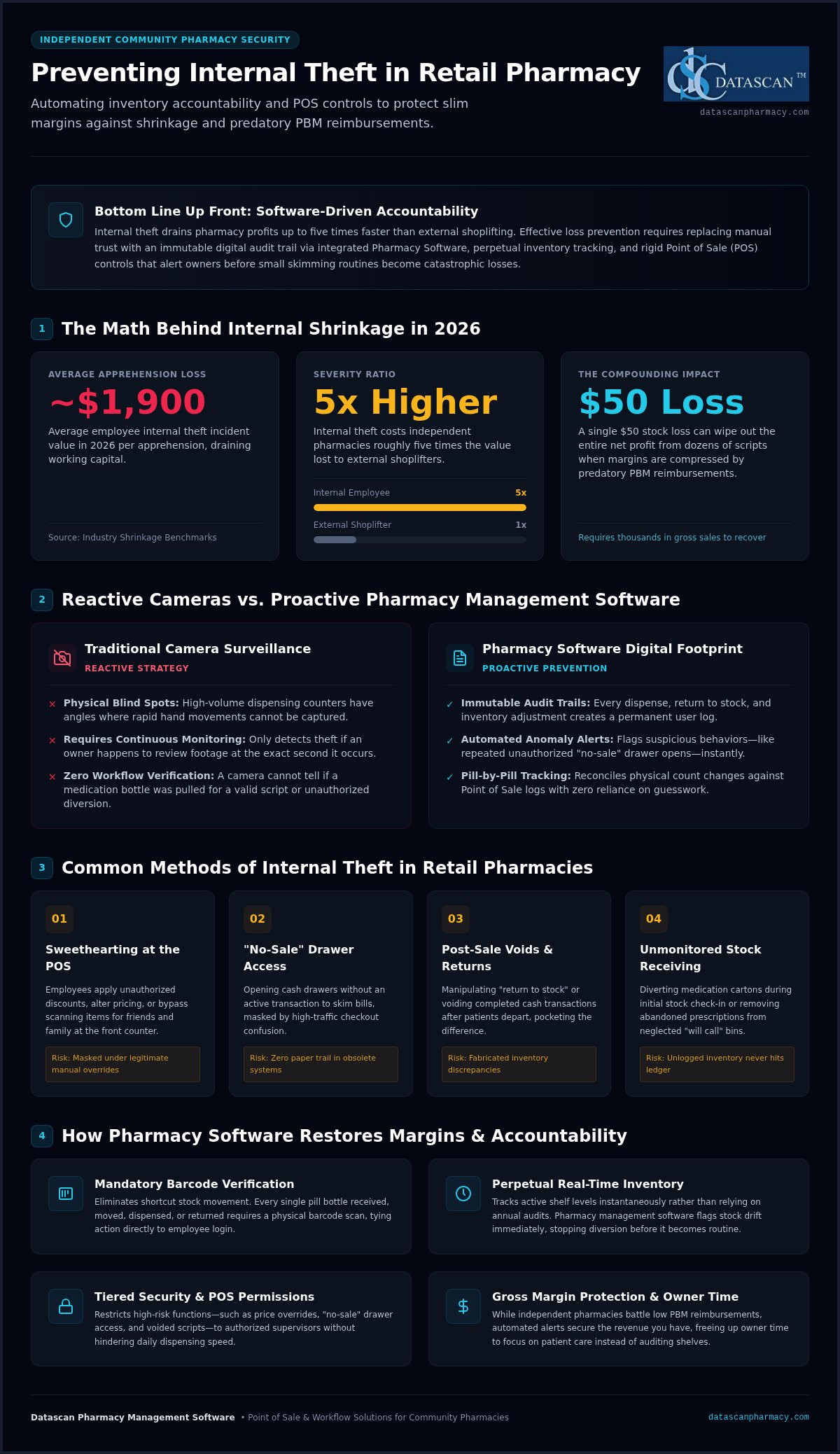
Did you know that internal employee theft incidents in 2026 average nearly $1,900 per apprehension, which is roughly five times the value lost to external shoplifters? Preventing internal theft in a pharmacy requires a strategic shift from emotional trust to automated accountability through integrated pharmacy management software and rigid POS controls. While you likely view your team as family, the reality of unexplained shrinkage in high-value inventory often points toward systemic gaps in your daily workflow. It’s an agonizing position to be in, especially when predatory PBM reimbursements are already squeezing your gross profit margins to the breaking point.
You’ll discover how to identify hidden shrinkage and secure your independent pharmacy using advanced Pharmacy Software that replaces manual oversight with precise, automated alerts. We will show you how to implement a clear system for monitoring transactions and reconciling POS data with actual stock levels. By the end of this guide, you’ll have a roadmap to eliminate hidden losses; moving your business from operational struggle to optimized efficiency while freeing up your time to focus on patient care rather than auditing shelves.
Key Takeaways
- Understand why internal theft is often invisible and how it drains your profitability up to five times faster than external shoplifting.
- Master the essential strategies for preventing internal theft in a pharmacy by replacing blind trust with automated software alerts and perpetual inventory tracking.
- Identify common vulnerabilities like “sweethearting” at the register and see how integrated pharmacy management software closes the gaps between the counter and the script.
- Learn to implement tiered security permissions that restrict unauthorized access to high-value inventory and sensitive POS functions without slowing down your workflow.
- Discover how securing your inventory serves as a critical defense for your gross profit margins against predatory PBM reimbursements.
What is internal pharmacy theft and how does it impact independent pharmacies?
Internal pharmacy theft is the unauthorized removal of medication, cash, or merchandise by employees, and it is best prevented through strict pharmacy software permissions and perpetual inventory tracking. While external shoplifting is often a visible, one-time event, internal shrinkage is a silent, ongoing drain on your bottom line. It often goes unnoticed because the culprits are trusted team members who understand your daily routines and security gaps. In an era where independent pharmacies are already battling predatory PBM reimbursements, losing inventory to drug diversion or register skimming can be the difference between staying open and closing your doors.
Effective preventing internal theft in a pharmacy requires moving beyond simple trust. Dishonest employees often use legitimate workflows to mask their actions, such as manipulating “return to stock” procedures or voiding sales after a customer leaves. This makes the theft invisible to the naked eye. Your pharmacy management software must serve as an immutable audit trail, tracking every pill and every penny with total precision. By creating a digital footprint for every action, you eliminate the “gray areas” where theft typically thrives.
The true cost of shrinkage in 2026
A $50 loss in inventory doesn’t just cost you $50. It wipes out the net profit of dozens of prescriptions. Because independent margins are so thin, you might need to generate thousands of dollars in new sales just to recover from a single instance of theft. This math is especially brutal when you consider the compounding effect of low PBM reimbursements. When you’re fighting for every cent, you cannot afford to have your gross profit cannibalized from within. Unmonitored front-end sales are a common vulnerability, as small, repetitive skimming incidents add up to significant annual losses. Utilizing an integrated Datascan Point of Sale (POS) ensures that every transaction is accounted for, protecting your cash flow while you focus on navigating PBM reform.
Why traditional security cameras are not enough
Security cameras have blind spots, particularly in high-volume dispensing areas where hands move faster than a lens can capture. Relying on video surveillance is a reactive strategy; it only works if you happen to be watching the footage at the exact right moment. A digital audit trail doesn’t blink. While a staff member might hide a bottle to avoid a camera, they can’t hide a dispense that wasn’t logged or a “no sale” that wasn’t authorized in the Pharmacy Software. Transitioning from reactive “catching” to proactive prevention means using your pharmacy computer system to flag suspicious activity before it becomes a pattern. Digital logs provide the transparency and accountability that physical hardware simply cannot match.
What are the most common methods of internal theft in a retail pharmacy?
Internal theft in retail pharmacies typically manifests through point-of-sale manipulation, inventory diversion during check-in, and exploiting unmonitored “will call” bins. Success in preventing internal theft in a pharmacy relies on closing these specific workflow loopholes with integrated software that requires barcode verification for every stock movement. If your current system allows for “shortcuts” or manual overrides without a digital paper trail, you’re essentially providing a roadmap for dishonest behavior.
Point of Sale (POS) manipulation
The “sweethearting” technique is one of the most pervasive threats at the front counter. This occurs when an employee gives unauthorized discounts or simply doesn’t scan items for friends and family. Without strict controls in your pharmacy point of sale, these losses are often buried under the guise of legitimate price overrides or employee benefits. Another red flag is the “no-sale” drawer opening. This trick allows staff to access the cash drawer without a transaction record, a move that modern systems should immediately flag for owner review. Similarly, voided transactions and post-sale edits are frequently used to mask cash skimming after a customer has already walked out the door with their receipt.
Inventory and “Will Call” loopholes
Medication diversion often begins the moment a wholesaler delivery arrives. If your check-in process isn’t digitized and verified tablet-by-tablet, it’s easy for high-value bottles to go “missing” before they ever reach the shelf. The “will call” bin represents another significant risk. When prescriptions sit for extended periods, they become targets for incremental theft. An employee might “pinch” a few pills from a bottle before processing a return to stock, assuming the discrepancy won’t be noticed. Because these losses involve controlled substances, they trigger strict DEA theft and loss reporting guidelines, which can lead to heavy fines if your records don’t match your physical counts. Utilizing a customizable workflow that forces barcode verification at every step is the only way to ensure total accountability. Implementing these tech-driven barriers is the most effective way of preventing internal theft in a pharmacy while protecting your hard-earned margins. If you suspect your current workflow has these gaps, it’s time to reach out for a security audit of your technology stack.
Myth vs. Reality: Why trusting your staff isn’t a substitute for pharmacy system security
Trusting your staff is a vital part of a healthy workplace culture, but it’s never a substitute for the objective security of preventing internal theft in a pharmacy through automated system controls. Professional theft is rarely a one-time heist; it’s usually an incremental, slow-moving process performed by those who know your system’s blind spots better than you do. Relying on “gut feelings” or personal relationships to manage inventory is a dangerous gamble in an industry where razor-thin margins can’t absorb even small losses.
Many independent owners fall into the trap of believing long-term tenure equals immunity to dishonesty. In reality, employees with years of experience are often the most capable of exploiting manual gaps because they’ve mastered every workaround. They don’t typically “grab and run”; they skim slowly, taking a few tablets here or a few dollars there. Without robust Pharmacy Software that forces accountability, these small variances are easily dismissed as rounding errors or wholesaler mishaps. Furthermore, the “chaos” of a disorganized back-end provides the perfect cover for these activities. A lack of integrated pharmacy workflow software creates the very environment that thieves thrive in, as it’s impossible to pin down where a discrepancy occurred.
The “Family-Owned” trap
Independent pharmacies pride themselves on a family-oriented culture, but this warmth becomes a liability if it leads to “blind trust.” While conducting thorough pre-employment screening through Elevated Background Checks helps ensure you hire trustworthy staff from the start, you still need systems in place to maintain professional accountability. “Trust but verify” isn’t just a slogan; it’s a survival strategy when battling underwater PBM reimbursements. In manual environments, “trusted” employees can easily manipulate paper logs or bypass unforced steps, knowing there’s no digital audit trail to challenge them. By the time you notice the shrinkage, the financial damage is often irreparable.
Standardizing safety to protect your team
Implementing clear, tech-driven protocols in your pharmacy management software removes the “temptation” factor entirely. Honest employees actually prefer systems that track their accuracy because it provides concrete, irrefutable proof of their integrity. When every transaction is verified and every pill is tracked through barcode verification, your team doesn’t have to worry about being blamed for unexplained shrinkage. This level of precision doesn’t just protect your bottom line; it also saves you the immense emotional stress of investigating a team you care about. By automating these checks, you’re preventing internal theft in a pharmacy while simultaneously freeing up your time to focus on clinical services and PBM reform.
How can you use pharmacy software to prevent internal theft?
Pharmacy owners can stop shrinkage by implementing tiered user permissions, setting automated transaction alerts, and utilizing perpetual inventory system for pharmacy tracking within their pharmacy management software. These digital controls create an immutable audit trail that makes it nearly impossible for internal theft to go undetected. While traditional security measures like cameras offer a visual record, your software provides the data-driven proof needed to identify and stop dishonest behavior before it cripples your bottom line.
Permission-based POS security
Restricting access is your first line of defense. By using your Pharmacy management software to assign specific roles, you ensure that only authorized personnel can perform high-risk actions. For example, “Price Override” and “Tax Exempt” buttons should be restricted to management only. This prevents the unauthorized discounting and price manipulation that often mask theft at the front counter. You can also configure the system to require dual-verification for dispensing high-value medications. Every time a cash drawer opens without a completed sale, the system must log a “Drawer Open” event. This allows you to review a precise list of every time the till was accessed without a transaction, removing the anonymity that thieves rely on.
Leveraging business intelligence dashboards
Data is a powerful ally in preventing internal theft in a pharmacy. Modern Pharmacy software provides business intelligence dashboards that highlight suspicious patterns in real-time. By calculating pharmacy gross profit regularly, you can spot downward margin trends that might indicate inventory skimming or cash register manipulation. You should look for “outlier” employees whose transaction patterns differ from the team. If one technician has ten times more voids or overrides than others, your system will flag this for immediate investigation. Reconciling inventory against wholesaler invoices automatically ensures that every bottle you pay for actually reaches your shelves. These automated alerts for voids, overrides, and controlled substance access turn your pharmacy computer system into a 24/7 security guard. If you’re ready to lock down your inventory and protect your margins, contact our team for a software demonstration today.
Why Datascan Pharmacy Management Software is the ultimate defense against shrinkage
Datascan provides an integrated ecosystem of Pharmacy management software and POS tools that eliminate security gaps by forcing compliance through customizable workflows. This system ensures every pill and penny is tracked with an immutable audit trail, making it the most effective solution for preventing internal theft in a pharmacy while protecting your gross profit from predatory PBM reimbursements. When your dispensing and sale processes are perfectly synced, the “invisible” losses that plague manual systems become impossible to hide.
The primary vulnerability in many pharmacies is a lack of communication between the filling counter and the register. With the Datascan Point of Sale, every transaction is tied directly to the prescription record, closing the loopholes that allow for “sweethearting” or unauthorized voids. Our customizable workflow allows you to mandate barcode verification at every stage of the process. This forces your staff to follow your specific security protocols, eliminating the shortcuts that often lead to diversion or cash skimming. By automating these barriers, you aren’t just catching theft; you’re preventing it from ever starting.
Built for independent pharmacy owners, by family owners
We’ve been family-owned since 1981, which means we understand the specific pressures you face as an independent owner. We know that with PBM reform still a work in progress, you don’t have the luxury of losing even 1% of your inventory to shrinkage. Our non-cloud, locally-hosted approach offers superior reliability and data control, ensuring your security systems stay active even if your internet connection wavers. Our US-based technical support team is always available to help you interpret security reports and configure alerts, giving you the tools of a large corporation with the personal touch of a private partner. This technology acts as a time-multiplier, freeing you from the burden of manual auditing so you can focus on clinical growth.
Take control of your pharmacy’s future
Securing your business shouldn’t feel like an uphill battle against your own team. By shifting from a culture of vulnerability to one of total operational control, you protect your honest employees and your bottom line simultaneously. The peace of mind that comes with a fully audited dispensing process allows you to lead with confidence, knowing your inventory is safe and your business is optimized for maximum profitability. Don’t let hidden shrinkage undermine your hard work. It’s time to see the difference that the right Pharmacy software can make for your community pharmacy. Schedule a demo of Datascan Pharmacy Management Software today.
Reclaim Your Profits with Total Operational Control
Internal theft shouldn’t be an inevitable cost of doing business. By implementing rigid workflows and tiered permissions, you transform your pharmacy management software into a 24/7 security partner. We’ve explored how professional theft exploits the gaps in manual systems, making integrated POS and Rx tracking essential for any independent owner fighting thin PBM margins. Preventing internal theft in a pharmacy is about more than just catching a culprit; it’s about building a culture of accountability that protects your honest staff and your hard-earned gross profit.
Since 1981, Datascan has been a family-owned ally for independent pharmacies, providing US-based expert support and the most comprehensive POS and Rx integration in the industry. It’s time to stop the invisible drain on your bottom line and focus on your business growth. Protect your pharmacy with Datascan Management Software today. You have the power to reclaim your time and your profits with a system built to support your independence.
Frequently Asked Questions
What is the most common sign of internal theft in a pharmacy?
Unexplained inventory shrinkage is the most frequent indicator that internal theft is occurring within your pharmacy. This often manifests as discrepancies between your physical stock and the records in your pharmacy management system, especially regarding high-value or controlled medications. You should also watch for patterns of excessive “no-sale” drawer openings or frequent voided transactions at the register. Monitoring these red flags through automated software alerts is the most effective way of identifying dishonest behavior early.
Can pharmacy software really track individual pill discrepancies?
Yes, modern pharmacy management software utilizes perpetual inventory system for pharmacy tracking to monitor every single tablet from the moment it is checked in from the wholesaler. By requiring barcode verification during the dispensing process, the system maintains a real-time count of your on-hand stock. This level of precision is essential for preventing internal theft in a pharmacy because it allows owners to pinpoint exactly when a discrepancy occurred and which staff member was logged into the station.
How often should I audit my POS transaction logs?
You should review high-risk transaction alerts daily and conduct a more comprehensive audit of your POS logs every week. Daily reviews should focus on immediate red flags like price overrides, tax-exempt sales, and cash drawer openings that aren’t tied to a completed transaction. Weekly audits help you identify broader trends or outlier behaviors among specific employees. Utilizing integrated business intelligence tools simplifies this process by highlighting suspicious patterns automatically, saving you hours of manual work.
Is it legal to use software to monitor employee sales patterns?
It is entirely legal and considered a standard industry practice to monitor employee transactions within your pharmacy management software for security and compliance purposes. Most employment agreements and pharmacy regulations allow for the tracking of transaction logs, login timestamps, and inventory adjustments to ensure patient safety and business integrity. These digital audit trails are necessary for meeting federal reporting requirements and protecting your gross profit. It’s always wise to outline these monitoring policies clearly in your employee handbook.
What should I do if my pharmacy management system flags a suspicious transaction?
You should immediately investigate the flagged event by reviewing the digital audit trail and comparing it against your staff schedule and security footage. Start by identifying the specific user ID associated with the transaction and look for a history of similar overrides or voids. If internal findings reveal extensive theft or employee fraud that requires outside expertise, check out Canadian Special Investigations to see how licensed investigators gather evidence in workplace cases. If the discrepancy involves controlled substances, you must follow mandatory DEA protocols for reporting significant losses within the required timeframe. Having US-based support can help you pull the detailed reports needed to verify the data before taking action.
How does perpetual inventory help prevent employee theft?
Perpetual inventory creates a continuous, real-time record of every stock movement, leaving no room for the “invisible” shrinkage that thieves rely on. When preventing internal theft in a pharmacy, this system forces accountability by requiring a digital footprint for every pill added or removed from your shelves. Since the software calculates the expected on-hand balance after every dispense, any shortage becomes immediately apparent during cycle counts, which discourages staff from attempting to divert medication or manipulate stock levels.
Will implementing strict software permissions slow down my pharmacy workflow?
While tiered permissions add a layer of verification, a high-quality pharmacy management system integrates these security checks seamlessly into your existing workflow. Forcing a manager’s authorization for high-risk actions like a price override only takes a few seconds but protects thousands of dollars in potential profit. Most independent pharmacy owners find that the time saved by avoiding manual inventory reconciliations and theft investigations far outweighs the minimal time spent on secure authorization steps during the day.
How much does internal theft typically cost an independent pharmacy?
Internal employee theft incidents in 2026 average nearly $1,900 per apprehension, which is roughly five times the cost of an average external shoplifting incident. For an independent pharmacy operating on thin margins, a single $2,000 loss can require $100,000 in new sales just to recover the lost profit. These financial drains are particularly dangerous when combined with low PBM reimbursements, making robust, software-driven security a critical requirement for maintaining your business’s solvency and long-term health.
 Kevin Minassian is the President of Datascan Software. Under his leadership, the company rapidly expanded to provide pharmacy management software on a national level. Over the last 15+ years, he has ensured that Datascan has continuously evolved to offer innovative solutions for independent pharmacies while still offering world-class customer support. He is passionate about helping independent pharmacies to remain competitive, achieve success, and offer the very best service to their communities.