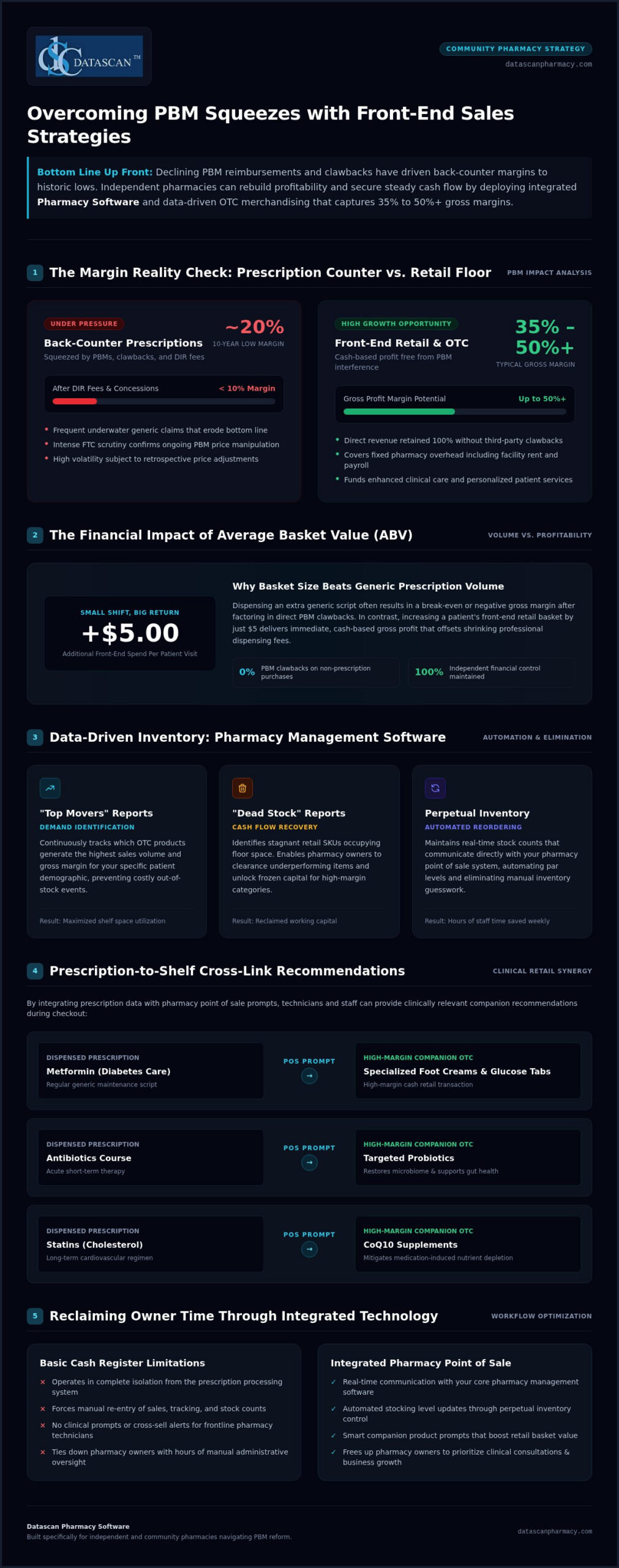
Did you know that while your prescription margins have bottomed out at a 10-year low of roughly 20%, your front-end retail items could be generating gross margins as high as 50% or more? It’s no secret that PBM reimbursements and upfront price concessions are squeezing the life out of independent pharmacies, leaving many owners wondering how to sustain their legacy in 2026. You’re likely feeling the weight of declining profits and high DIR fees that eat away at your hard-earned revenue every single day.
The good news is that you don’t have to be at the mercy of PBMs to thrive. By implementing data-driven front-end sales strategies for pharmacies, you can transform your retail floor into a high-margin revenue engine that offsets reimbursement cuts. This article will show you how to leverage your pharmacy management software and integrated pharmacy point of sale technology to automate inventory and boost gross profit per visit. We’ll preview the specific tools you need to reclaim your time and diversify your income streams, ensuring your independent pharmacy remains a cornerstone of your community for years to come.
Key Takeaways
- Offset declining PBM reimbursement rates by reclaiming high-margin retail profits that can reach gross margins of 50% or higher.
- Implement data-driven front-end sales strategies for pharmacies by using integrated software reports to identify “Top Movers” and cross-link patient needs with OTC products.
- Learn how to build a high-margin OTC department through a perpetual inventory system that sets automated stocking levels and eliminates costly “dead stock.”
- Discover the critical difference between a basic cash register and a sophisticated pharmacy point of sale system that communicates with your management software in real-time.
- Free up hours of administrative time each week by automating retail management tasks, allowing you to focus on patient consultations and business growth.
Why are front-end sales strategies vital for independent pharmacies in 2026?
Front-end sales strategies for pharmacies are the retail tactics used to maximize non-prescription revenue, providing a critical high-margin buffer against declining PBM reimbursements. In 2026, relying solely on prescription volume is a dangerous gamble. With average overall gross margins hitting 10-year lows of around 20% and PBMs like Caremark and Express Scripts under intense FTC scrutiny for squeezing independents, the front-end is no longer optional. While your back-counter margins often dip below 10% after DIR fees and clawbacks, your front-end retail items consistently deliver 35% to 50% gross margins. Shifting your focus ensures you aren’t just “counting pills” but building a sustainable business. High-margin retail profit allows you to invest in the clinical services patients actually need, turning a struggle for survival into a streamlined success.
How do PBM reimbursements impact your retail focus?
Shrinking reimbursements make every square foot of your floor space more valuable than ever. When PBMs slash your professional fees, your front-end revenue must step up to cover fixed overhead like rent and staffing. By utilizing robust pharmacy management software, you can identify which aisles are actually paying the bills. By refining your front-end sales strategies for pharmacies, you can effectively insulate your business from the volatility of the insurance market. This strategic shift transforms your store from a simple dispensing hub into a community health and retail destination. It empowers you to spend more time on clinical care because you’ve secured the financial foundation of the business through high-margin OTC sales. When your front-end is optimized, you don’t have to chase volume just to break even on underwater generic claims.
The financial benefit of the “basket size” mentality
Success in 2026 requires a focus on Average Basket Value (ABV). Increasing a patient’s spend by just $5 in the front-end is often more profitable than dispensing a generic prescription with a negative margin. To manage this effectively, you need a perpetual inventory system integrated into your Datascan Point of Sale. This technology ensures you never miss a sale due to out-of-stocks. Our advanced Pharmacy Software allows you to track these trends in real-time, helping you stock the products your specific patient demographic demands. You can learn more about how these numbers impact your bottom line in our guide on how to calculate pharmacy gross profit. Every additional OTC item in the basket is a cash-based transaction free from PBM interference. This isn’t just about selling more; it’s about reclaiming the independence that PBMs have spent decades trying to erode.
How can data from your pharmacy management software drive retail growth?
Your pharmacy management software is more than a prescription processor; it’s a goldmine of consumer insights that identifies exactly what your patients need before they even leave the store. By analyzing purchasing patterns, you can eliminate the guesswork that leads to “dead stock” and instead focus on high-margin items that actually move. Data-driven front-end sales strategies for pharmacies rely on “Top Movers” reports to ensure your best-selling items are always in stock while using “Dead Stock” reports to clear out underperforming inventory, immediately freeing up vital cash flow for more profitable ventures.
Mining your Rx data for OTC opportunities
The most effective way to boost your bottom line is to link what happens at the script counter to what’s available on your shelves. Cross-link reporting allows you to see exactly what your diabetic patients are buying, or more importantly, what they aren’t. For example, a patient picking up metformin is a prime candidate for specialized foot creams or glucose tabs. You can set up automated prompts within your Datascan Point of Sale to remind staff to suggest clinically relevant companion products, such as probiotics with antibiotics or CoQ10 with statins. As highlighted in a recent FTC report on pharmacy reimbursement pressures, the financial squeeze on independents makes these cash-based companion sales essential for survival. This approach ensures you’re buying what sells rather than just buying what you like, protecting your margins from the unpredictability of PBMs.
Leveraging patient apps for front-end awareness
Modern Pharmacy Software extends your reach far beyond the four walls of your building. By utilizing the MobileScripts patient app, you can push retail-only coupons and monthly “front-end specials” directly to a patient’s smartphone. When a patient opens the app to request a refill, it’s the perfect opportunity to drive “in-app” browsing of your OTC departments. You’re not just providing a convenience; you’re creating a digital storefront that keeps your retail offerings top-of-mind. This level of engagement turns a routine refill into a personalized shopping experience, driving foot traffic and increasing the average basket value. If you’re ready to see how these integrated reports can work in your specific store, you can reach out to our team for a personalized walkthrough of our system’s capabilities.
What are the most effective examples of pharmacy front-end sales strategies?
Effective front-end sales strategies for pharmacies focus on transforming your retail floor into a solution-oriented environment that prioritizes high-margin products over low-profit commodities. By grouping items by ailment rather than brand, you create “Problem-Solution” endcaps that guide patients toward complete care. A patient suffering from a cold doesn’t just need medicine; they need tissues, vitamin C, and sanitizing wipes. Placing these items together increases your average basket value without requiring extra effort from your staff. Implementing private label programs is another powerful tactic. These allow independent pharmacies to compete with big-box pricing while maintaining gross margins of 50% to 70%, effectively insulating your cash flow from PBM volatility. Additionally, understanding how shoppers navigate these displays is crucial, and utilizing people counting systems from providers like footfall.au helps retail businesses track store traffic patterns and optimize floor layouts.
Strategic impulse buy zones and niche health services further diversify your revenue. You should optimize your checkout line with low-cost, high-margin items like professional-grade lip balms or healthy snacks that appeal to waiting patients. For stores looking to specialize, incorporating Durable Medical Equipment (DME) or utilizing compounding solutions can attract a loyal patient base that specifically seeks out your expertise. These specialized services are often cash-based or have better reimbursement rates than traditional retail scripts, making them essential for a modern, profitable pharmacy model.
Optimizing the OTC aisle layout
Your retail layout must follow the “Eye-Level is Buy-Level” rule to ensure your most profitable products are the first things patients see. Use professional signage to educate patients on the clinical benefits of premium supplements, as many shoppers are willing to pay more for quality when they understand the value. To keep the retail experience fresh for your regulars, dedicate a small section to “New Products” and rotate it monthly. For more detailed merchandising frameworks, you can explore NCPA’s Front-End Overhaul strategies, which provide actionable tips for independent community pharmacies looking to revitalize their floor space.
Implementing a loyalty program that actually works
A successful loyalty program goes beyond simple points; it should offer tiered rewards that encourage consistent front-end spending. By using your pharmacy management software to track participation, you can identify your most valuable customers and offer them exclusive benefits. For instance, creating a “Gold Member” tier that provides a 5% discount on all OTC items has been shown to significantly increase total annual spend per patient. This automated approach, managed through your Pharmacy Software, rewards loyalty while providing you with the data needed to refine your marketing efforts. When your technology handles the tracking, you save time and ensure no patient is overlooked in your quest for retail growth.
How do you build a high-margin OTC department with a perpetual inventory system?
Building a high-margin OTC department requires moving away from guesswork and implementing a perpetual inventory system for pharmacy that tracks every item in real-time. This technology ensures your shelves stay stocked with high-demand products while preventing “dead stock” from tying up your working capital. By integrating your retail floor with your Pharmacy Software, you can automate your replenishment cycle and focus your energy on patient care. These front-end sales strategies for pharmacies are essential for maintaining a healthy cash flow in a market where every dollar of retail profit counts.
To establish a truly efficient system, follow these five critical steps:
- Step 1: Conduct a baseline inventory audit to clean up your pharmacy system software database, ensuring every SKU is accurately recorded.
- Step 2: Set minimum and maximum (Min/Max) stocking levels for every retail SKU based on historical sales data.
- Step 3: Enable automated ordering through your primary wholesaler so that your system triggers a purchase order the moment stock hits a minimum threshold.
- Step 4: Use barcode scanning for every transaction at your Datascan Point of Sale to maintain real-time accuracy and prevent manual entry errors.
- Step 5: Review “Shrinkage” reports weekly to identify discrepancies between your physical stock and your digital records.
The financial impact of perpetual inventory
Reducing “overstock” on slow-moving items can put thousands of dollars back into your bank account almost immediately. When your pharmacy management software alerts you to items that haven’t sold in 90 days, you can stop ordering them and repurpose that shelf space for higher-margin goods. This level of precision is also vital for retail compliance, particularly when managing FSA and HSA card processing for eligible OTC items. Manual inventory counts are the biggest time-waster for independent owners; automating this process through your POS saves hours of labor every week and eliminates the human error that leads to missed sales opportunities. To understand the full financial impact of implementing this approach, explore our comprehensive pharmacy perpetual inventory profitability guide for a detailed breakdown of how real-time stock accuracy translates directly to improved gross margins.
Preventing internal theft with smart POS security
A transparent, data-backed system is your best defense against preventing internal theft in a pharmacy and “sweethearting.” By using employee-specific logins, you can track every “No Sale,” “Voided” transaction, or price override in real-time. Your POS should be configured to set up alerts for suspicious front-end activity, ensuring that you’re notified of irregularities before they become a major financial drain. When your staff knows that every transaction is logged and audited within the Pharmacy Software, it creates a culture of accountability. This security doesn’t just protect your inventory; it protects your bottom line. If you’re ready to see how automated inventory can transform your store, you can contact our team for a personalized demonstration of our retail management tools.
Why is the right pharmacy point of sale system the key to retail success?
A true pharmacy POS system serves as the central nervous system of your retail operation, acting as the essential bridge between patient data and profitable transactions. Unlike a basic cash register that merely tallies totals, a sophisticated Datascan Point of Sale system integrates directly with your Pharmacy Software to ensure every retail decision is backed by real-time clinical and financial data. This integration is vital for independent pharmacies in 2026, as it allows for seamless inventory tracking, automated clinical prompts, and secure financial processing all within a single, unified platform. By choosing a system built specifically for the industry, you empower your staff to execute complex front-end sales strategies for pharmacies with total confidence.
When your POS “talks” to your pharmacy management software in real-time, you eliminate the manual entry errors that drain your time and profit. This synergy allows you to implement advanced retail tactics, such as automated loyalty rewards and targeted supplement recommendations, without adding to your staff’s administrative workload. Furthermore, the importance of US-based support cannot be overstated. When your retail system faces a technical hurdle during a busy holiday rush, you need immediate, expert assistance from a team that understands the unique pressures of the independent market. Reliable technology ensures your store remains operational and profitable, even during peak hours.
Streamlining the checkout experience
Speed and accuracy at the register are critical for maintaining patient satisfaction and protecting your margins. Integrated credit card processing speeds up your lines and significantly reduces the risk of manual entry errors that can lead to costly chargebacks. Your system should also capture digital signatures for HIPAA and delivery compliance directly at the point of sale, keeping you audit-ready without the burden of a paper trail. By leveraging workflow software, you can prevent bottlenecks at the register, ensuring that the transition from the script counter to the retail checkout is friction-free for every patient.
Extending the front-end with delivery and mobile tools
Your retail reach shouldn’t stop at your front door. By utilizing an electronic delivery system, your drivers can sell OTC items and capture secure payments right on the patient’s doorstep. This effectively transforms your delivery vehicle into a mobile storefront, allowing you to capture high-margin retail sales that might otherwise go to a big-box competitor. Additionally, offering Curbside Pickup for retail items via your patient app caters to the modern demand for convenience and speed. Technology doesn’t just manage your pharmacy; it actively grows it by meeting patients wherever they are. If you’re ready to modernize your retail operation, you can contact us today to see how our integrated solutions can drive your success.
Reclaim Your Pharmacy’s Independence and Profitability in 2026
The landscape for independent pharmacies is shifting rapidly, but the path to long-term success is clear. By prioritizing front-end sales strategies for pharmacies, you’re not just stocking shelves; you’re building a high-margin shield against declining PBM reimbursements. We’ve explored how leveraging integrated inventory management and real-time data allows you to reclaim hours of administrative time while maximizing every square foot of your retail space. It’s time to stop letting “dead stock” and inefficient manual counts drain your working capital.
Datascan has been family-owned since 1981, and we remain dedicated to providing the tools you need to thrive. Our integrated POS and pharmacy management software are backed by US-based technical support, ensuring you’re never alone in your quest for growth. You can transform your store into a streamlined, profit-driven destination that prioritizes both patient care and business health. See how Datascan POS can transform your front-end profitability today. We’re here to help you future-proof your legacy with precision and confidence.
Frequently Asked Questions
How can I increase front-end sales without hiring more staff?
What are the highest margin OTC categories for independent pharmacies?
Private label wellness products and professional grade supplements typically offer the highest margins, often reaching 50% to 70% gross profit. Unlike brand name commodities found in big box stores, these curated items allow you to leverage your clinical expertise to justify a premium price point. Other high margin categories include specialized wound care and durable medical equipment, which provide essential solutions for your local patient base while diversifying your non PBM revenue streams.
Does a pharmacy POS system really help with PBM reimbursements?
While a POS doesn’t change PBM contract rates, it acts as a critical financial shield by capturing the high margin cash revenue needed to offset reimbursement cuts. By using sophisticated front-end sales strategies for pharmacies, you can ensure that every patient visit contributes to your bottom line, even when prescription margins are underwater. The right system also provides the data needed to analyze which departments are effectively subsidizing your professional dispensing services.
How do I prevent internal theft in my pharmacy retail section?
Preventing internal theft requires a transparent system that tracks every retail action through employee specific logins. Your POS should provide detailed reports on No Sale instances, voided transactions, and price overrides to highlight suspicious patterns immediately. When your staff knows that the pharmacy management software logs every transaction and generates weekly shrinkage reports, it creates a culture of accountability that naturally discourages theft and sweethearting at the register. For a comprehensive breakdown of security protocols and common misconceptions, see our full guide on preventing internal theft in a pharmacy.
What is a perpetual inventory system and why does my pharmacy need one?
A perpetual inventory system is a continuous tracking method that updates your stock levels in real-time as items are scanned at the point of sale. Your pharmacy needs this to eliminate the manual labor of hand-counting and to prevent dead stock from tying up your cash. By setting automated min/max levels, your pharmacy system software ensures you never miss a high margin sale due to an out-of-stock item while keeping your inventory lean.
Can I sell front-end items through my pharmacy delivery service?
Yes, you can effectively extend your retail floor to the patient’s doorstep by utilizing a mobile delivery app. This technology allows your drivers to process OTC sales and capture secure payments remotely, turning every delivery into a potential retail transaction. Offering front-end items during the delivery process provides a high level of convenience for homebound patients while capturing revenue that would otherwise go to online retailers or big box chains.
How do I use my pharmacy software to find cross-selling opportunities?
The average gross profit margin for a pharmacy front-end typically ranges between 35% and 50%, which is significantly higher than the average prescription margin. Private label items and niche wellness categories can push these numbers even higher, sometimes exceeding 70%. In 2026, maintaining these healthy retail margins is essential for independent pharmacies to remain profitable and offset the financial pressure from PBM clawbacks and low reimbursement rates.
 Kevin Minassian is the President of Datascan Software. Under his leadership, the company rapidly expanded to provide pharmacy management software on a national level. Over the last 15+ years, he has ensured that Datascan has continuously evolved to offer innovative solutions for independent pharmacies while still offering world-class customer support. He is passionate about helping independent pharmacies to remain competitive, achieve success, and offer the very best service to their communities.