

How to Start an Independent Pharmacy: The Ultimate 2026 ChecklistAugust 20, 2026
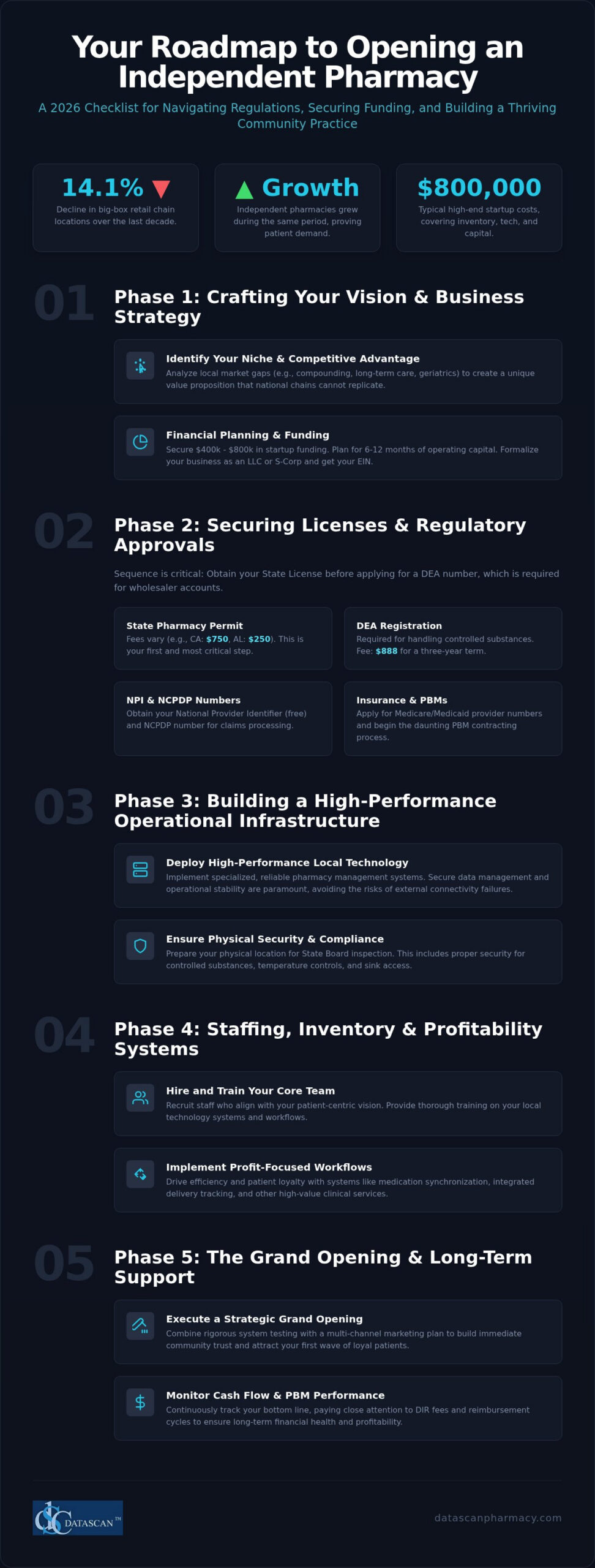
Did you know that while big-box retail chains saw a 14.1% decrease in locations over the last decade, independent pharmacies actually grew? This shift proves that patients value the personalized care only you can provide, though the path to opening your doors remains rigorous. You’re likely facing the dual pressure of $800,000 in startup costs and a complex web of DEA and state board regulations. It’s common to fear that inefficient workflows or opaque PBM practices will undermine your profitability before you’ve even established your footprint.
We created this how to start an independent pharmacy checklist to replace that uncertainty with a methodical, high-performance strategy for 2026. You’ll learn how to secure your NPI and DEA registrations, manage initial inventory, and deploy the specialized local technology required to drive retention and optimize your bottom line. This roadmap covers everything from financial planning to implementing integrated delivery and POS systems, ensuring you launch with the confidence of a seasoned industry leader. We’ll examine the critical steps to transform a complex operational vision into a thriving, community-centered reality.
Key Takeaways
- Identify a specialized community niche to establish a competitive advantage over large retail chains and maximize your pharmacy’s market impact.
- Streamline your path to compliance using a comprehensive how to start an independent pharmacy checklist to manage DEA registration, state permits, and NPI applications.
- Deploy high-performance local technology systems to ensure operational reliability and secure data management without the risks of external connectivity failures.
- Implement profit-focused workflows like medication synchronization and integrated delivery tracking to drive efficiency and long-term patient loyalty.
- Execute a strategic grand opening that combines rigorous system testing with a multi-channel marketing plan to build immediate community trust.
Phase 1: Crafting Your Vision and Business Strategy
Launching a successful business begins long before you fill your first prescription. Every item on your how to start an independent pharmacy checklist should be anchored in a clear, actionable vision that distinguishes you from the automated, impersonal nature of national chains. You aren’t just opening a store; you’re establishing a clinical hub. Gaining a deep understanding of the field of pharmacy and its evolving role in community health allows you to identify whether your strengths lie in traditional retail, long-term care (LTC), or specialized compounding solutions.
Conduct a rigorous market analysis to pinpoint where big-box retailers are failing your neighbors. Are wait times excessive? Is there a lack of pediatric flavoring or geriatric care coordination? Once you’ve identified these gaps, draft a formal business plan that outlines your financial projections and ROI targets. Engaging with specialized pharmacy accountants and legal advisors at this stage is non-negotiable. These experts understand the nuances of PBM audits and pharmacy-specific tax structures that generalists often overlook, giving you a competitive edge from day one.
Defining Your Competitive Advantage
Success in 2026 requires more than just being “local.” You must be better. Analyze the service gaps at local chains, such as their inability to provide personalized consultations or specialized medication packaging. If you decide that high-margin services like compounding will be a core offering, ensure your strategy reflects the unique equipment and regulatory needs of that niche. Your value proposition should be clear and punchy. A strong example is: “Our pharmacy provides high-touch, clinical interventions and specialized medication management that national chains simply cannot replicate.”
Financial Planning and Funding
The financial foundation of your startup must be resilient. Verified research indicates that startup costs for a new independent pharmacy in 2026 typically range from $400,000 to $800,000. This covers everything from initial inventory to high-performance local technology. Using a structured how to start an independent pharmacy checklist ensures you don’t overlook the 6 to 12 months of operating capital needed to weather initial reimbursement cycles. Explore loan options through pharmacy-specific lenders like Live Oak Bank, as they understand the industry’s unique cash flow. Finally, establish your business entity as an LLC or S-Corp and obtain your EIN to formalize your operational presence.
Phase 2: Securing Licenses, Permits, and Regulatory Approvals
Once you’ve moved past crafting your business plan, the focus shifts to the rigorous legal requirements of the industry. Securing a physical location is the catalyst for your regulatory filings. Your first priority is applying for a state pharmacy permit. These fees vary by jurisdiction; for instance, California requires $750 while Alabama charges $250. This step is a critical milestone on your how to start an independent pharmacy checklist because most subsequent approvals depend on it.
Next, register with the DEA to handle controlled substances. As of July 2026, the application fee is $888 for a three-year term. You must also obtain a National Provider Identifier (NPI) number. While the NPI application is free through the CMS NPPES system, it’s essential for all healthcare billing. Don’t forget your NCPDP number, which serves as your pharmacy’s unique fingerprint for electronic claims processing and wholesaler communications.
The Regulatory Paperwork Trail
Sequence is everything. You can’t open a wholesaler account without a DEA number, and you can’t get a DEA number without a state license. Prepare for a pre-opening inspection by your State Board. They’ll check for proper security, temperature controls, and sink access. During this time, secure professional liability and malpractice insurance. These policies protect your assets against the specific risks inherent in dispensing and clinical care.
PBM and Insurance Contracting
Navigating the PBM landscape is perhaps the most daunting task for a new owner. Ten major PBMs control over 90% of prescription volume. You’ll need to apply for Medicare and Medicaid provider numbers to serve a broad patient base. Be hyper-aware of DIR fees, which can significantly impact your initial cash flow. Many startups join a Pharmacy Services Administration Organization (PSAO) to gain collective bargaining power and streamline the enrollment process across multiple third-party payers. If you’re feeling overwhelmed by these legal hurdles, reaching out to industry experts for a consultation can provide the clarity you need to move forward.
Compliance with the Drug Supply Chain Security Act (DSCSA) is mandatory from day one. This federal mandate requires a robust track and trace system for all prescription drugs. Your operational infrastructure must be capable of receiving and storing electronic transaction data from your primary wholesaler. Failing to meet these standards can result in severe penalties and supply chain disruptions.
Phase 3: Building a High-Performance Operational Infrastructure
Transitioning from regulatory approvals to physical setup requires a shift in focus toward long term operational resilience. This resilience depends on both physical and digital security; to ensure your business network is protected from day one, check out ITS Canada Inc for comprehensive IT solutions. Selecting your site is about more than just square footage. You need a location with high visibility and accessible parking to ensure elderly or compromised patients can reach you without struggle. As you move through your how to start an independent pharmacy checklist, remember that your floor plan must prioritize clinical workflow over simple retail aesthetics. A poorly designed counter can add miles of unnecessary walking for your technicians, directly impacting your daily script capacity and employee burnout rates.
High volume independents can’t afford the latency or connectivity risks associated with remote, web-dependent hosting models. When the internet goes down in your neighborhood, your ability to dispense medication shouldn’t stop. Implementing pharmacy management software that utilizes high speed local databases ensures zero latency during prescription processing. This architecture provides you with 100% data ownership and the peace of mind that your pharmacy remains functional regardless of external service outages. Local server reliability is the bedrock of a predictable, high performance business that scales with your patient volume.
Optimizing Store Design and Layout
Your pharmacy’s interior should be a physical manifestation of your commitment to care. Design your counter for maximum efficiency, placing high move inventory within easy reach of the primary filling stations. You must also allocate dedicated space for private patient counseling and vaccination areas to meet the rising demand for clinical services. Security is equally paramount. Install high definition camera systems and a DEA compliant safe to protect your inventory and maintain compliance. To manage your front end effectively, explore integrated POS solutions that sync directly with your management system. This integration allows for seamless retail transactions and automated inventory tracking, ensuring you never miss a sale or run out of essential over the counter products. By following this how to start an independent pharmacy checklist, you’re building a foundation that supports both immediate profitability and future expansion.
Phase 4: Staffing, Inventory, and Profitability Systems
Your pharmacy’s success depends on the synergy between your people and your processes. While physical infrastructure was the focus in the previous phase, Phase 4 of your how to start an independent pharmacy checklist centers on the systems that drive recurring revenue and operational excellence. You aren’t just hiring employees; you’re building a clinical team. It’s vital to recruit a lead pharmacist and technicians who align with your community-first vision and understand the high-performance culture you’re establishing.
Simultaneously, you must establish a primary wholesaler relationship to secure your initial inventory. With over 350 branded medications seeing price increases in 2026, managing your margins through smart purchasing and inventory control is non-negotiable. Your staff must be trained to use your internal systems to track these shifts, ensuring your stock levels remain optimized without overextending your working capital.
Maximizing Profitability from Day One
Profitability isn’t accidental. It’s engineered through the right tools. By utilizing medication synchronization software, you can stabilize your monthly revenue and transform chaotic filling days into predictable, organized workflows. This proactive approach ensures patients never miss a dose, which directly improves adherence rates and your pharmacy’s performance scores. Additionally, implement e-care plans to document clinical services and interventions. This documentation is essential for participating in value-based payment models and proving your pharmacy’s impact on patient outcomes. Regularly analyze daily reports to monitor margins and inventory turns, ensuring your capital isn’t tied up in slow-moving stock.
Expanding Reach with Delivery and Mobile Tools
Modern patients demand convenience that rivals national big-box competitors. You can meet this need by offering a mobile refill app for easy, on-the-go ordering. This technology keeps your pharmacy in the palm of their hand and builds long-term loyalty. To expand your reach beyond the storefront, set up an electronic delivery system. This tool allows you to manage local logistics with precision, providing patients with real-time updates and secure bedside service. Train your staff on using mobile delivery apps to ensure every home visit is professional and documented. These systems aren’t just perks; they’re essential components of a 2026 how to start an independent pharmacy checklist designed for growth. Ready to equip your new pharmacy with the industry’s most reliable local technology? Schedule a demonstration today to see our systems in action.
Phase 5: The Grand Opening and Long-Term Support
The final phase of your how to start an independent pharmacy checklist focuses on the transition from a construction project to a living community resource. Before you host a high-profile grand opening, execute a soft opening for at least one week. This quiet period allows you to stress-test your internal workflows and ensure your local server technology handles real-world prescription volume without friction. It’s the time to identify any bottleneck in your filling process or any minor glitch in your POS hardware before the community arrives in mass. By the time your official grand opening event occurs, your team should move with the precision of a seasoned operation, projecting an image of assertive competence to every new patient.
Marketing Your Independent Brand
In 2026, a “build it and they will come” mentality is a recipe for struggle. You must launch a multi-channel marketing campaign that highlights your clinical superiority over the big-box chains. Start by claiming your Google Business Profile and building a professional website that clearly lists your specialized services, such as med-sync or delivery. Don’t neglect face-to-face outreach; visit local physician offices to discuss how your personalized care coordination can improve their patients’ health outcomes. Use social media to showcase the people behind the counter, emphasizing the personal touch and expertise that automated mail-order services can’t provide. This human connection is your strongest weapon against corporate competitors; to further enhance your brand’s local feel with custom wood-printed decor, you can learn more about creative ways to personalize your pharmacy’s interior.
Your journey doesn’t end on opening day; it evolves into a long-term quest for efficiency and growth. Success requires partnering with a technology provider that acts as a visionary ally rather than just a software vendor. Prioritize partners with a long history of family-owned independence who understand the specific pressures of the independent market. Ensure your support team is entirely US-based, providing you with experts who can resolve technical issues without the frustration of language barriers or time-zone delays. Relying on high-performance local architecture ensures that your pharmacy remains operational every second your doors are open, protecting your revenue from the unpredictability of external network failures. This technical reliability is the bedrock upon which you’ll build your reputation for consistency. Ready to build your pharmacy on a foundation of success? Contact our expert team today.
As you complete this how to start an independent pharmacy checklist, remember that your independence is your greatest asset. By combining high-performance local technology with a deep commitment to your neighbors, you aren’t just starting a business; you’re becoming a vital pillar of community health. Stay focused on the data, lean on your technology partners, and continue to refine your workflows to ensure long-term profitability in an ever-changing industry.
Building Your Legacy in Independent Pharmacy
Starting your own pharmacy is a bold commitment to your community’s health and your own professional independence. By following this how to start an independent pharmacy checklist, you’ve established a roadmap that balances regulatory precision with high-performance operational strategy. Success in the 2026 market demands more than just filling prescriptions; it requires a foundation of reliable local technology and clinical workflows that drive patient adherence. You’ve learned that the right infrastructure and a community-first team are the engines of long-term profitability.
You don’t have to navigate this complex journey alone. Partnering with a team that has been family-owned and operated since 1981 ensures you have the historical perspective and modern tools needed to compete with big-box retailers. With a 100% US-based support team that has served the industry for over four decades, we understand the specific pressures you face. It’s time to transform your vision into a profitable reality. Launch your pharmacy with the industry’s most reliable partner; contact Datascan today. Your community is waiting for the personalized care only an independent can provide.
Frequently Asked Questions
How much does it cost to start an independent pharmacy in 2026?
Starting an independent pharmacy in 2026 typically requires an investment between $400,000 and $800,000. These figures cover your initial inventory, facility fixtures, and high-performance local technology systems. Specialty pharmacies can see costs exceeding $1.5 million. You’ll also need to account for at least 6 to 12 months of operating capital to manage early cash flow while waiting for PBM reimbursements to stabilize.
How long does the process of opening a new pharmacy typically take?
The timeline for launching a new pharmacy generally spans 6 to 12 months. This period is heavily influenced by how quickly you secure a location and receive state board approvals. You must factor in lead times for wholesaler account setup and PBM contracting, which can take several months. Using a structured how to start an independent pharmacy checklist helps you manage these overlapping tasks efficiently to avoid unnecessary delays.
What licenses are required to open a pharmacy in the United States?
You must obtain several critical credentials before opening your doors. These include a pharmacy permit from your State Board of Pharmacy and a DEA registration for handling controlled substances. Additionally, you’ll need a National Provider Identifier (NPI) number and an NCPDP number for electronic claims. Some states may also require specific licenses for compounding or sterile processing if you plan to offer those specialized clinical services.
Can a non-pharmacist own an independent pharmacy?
Yes, non-pharmacists can own an independent pharmacy in most U.S. states, provided they employ a licensed Pharmacist in Charge (PIC) to oversee clinical operations. Ownership regulations vary by jurisdiction; you should consult your specific State Board of Pharmacy for local requirements. Regardless of your background, your success depends on building a team that shares your vision for community advocacy and clinical excellence.
How do I choose the best pharmacy management system for a startup?
Prioritize a system that offers high-performance local server reliability to ensure your business stays functional even during internet outages. You should look for a provider with a long history of supporting independents and a 100% US-based technical team. Ensure the software includes built-in profitability tools like medication synchronization and e-care plans. Avoid systems that force reliance on external connectivity, as zero-latency processing is vital for high-volume environments.
What is the most profitable service for an independent pharmacy to offer?
Clinical and wellness services, such as immunizations and medication therapy management, are currently among the most profitable offerings. Specialized niches like compounding or long-term care (LTC) services also provide higher margins compared to traditional retail dispensing. By diversifying your revenue streams, you reduce your reliance on fluctuating PBM reimbursement rates and establish your pharmacy as a vital community health destination.
How do I get a DEA number for my new pharmacy?
You apply for a DEA number by submitting DEA Form 224 through the official Diversion Control Division website. As of July 2026, the application fee for a new retail pharmacy registration is $888 for a three-year term. You cannot complete this step until you have secured your state pharmacy license. This registration is a mandatory component of your how to start an independent pharmacy checklist for handling controlled substances.
What is a PSAO and do I need one?
A Pharmacy Services Administration Organization (PSAO) acts as an intermediary that negotiates contracts with PBMs on behalf of independent pharmacies. While not legally required, most startups find them essential for gaining collective bargaining power and streamlining the complex third-party enrollment process. A PSAO helps you manage the administrative burden of contracting, allowing your team to focus on patient care and operational efficiency.