
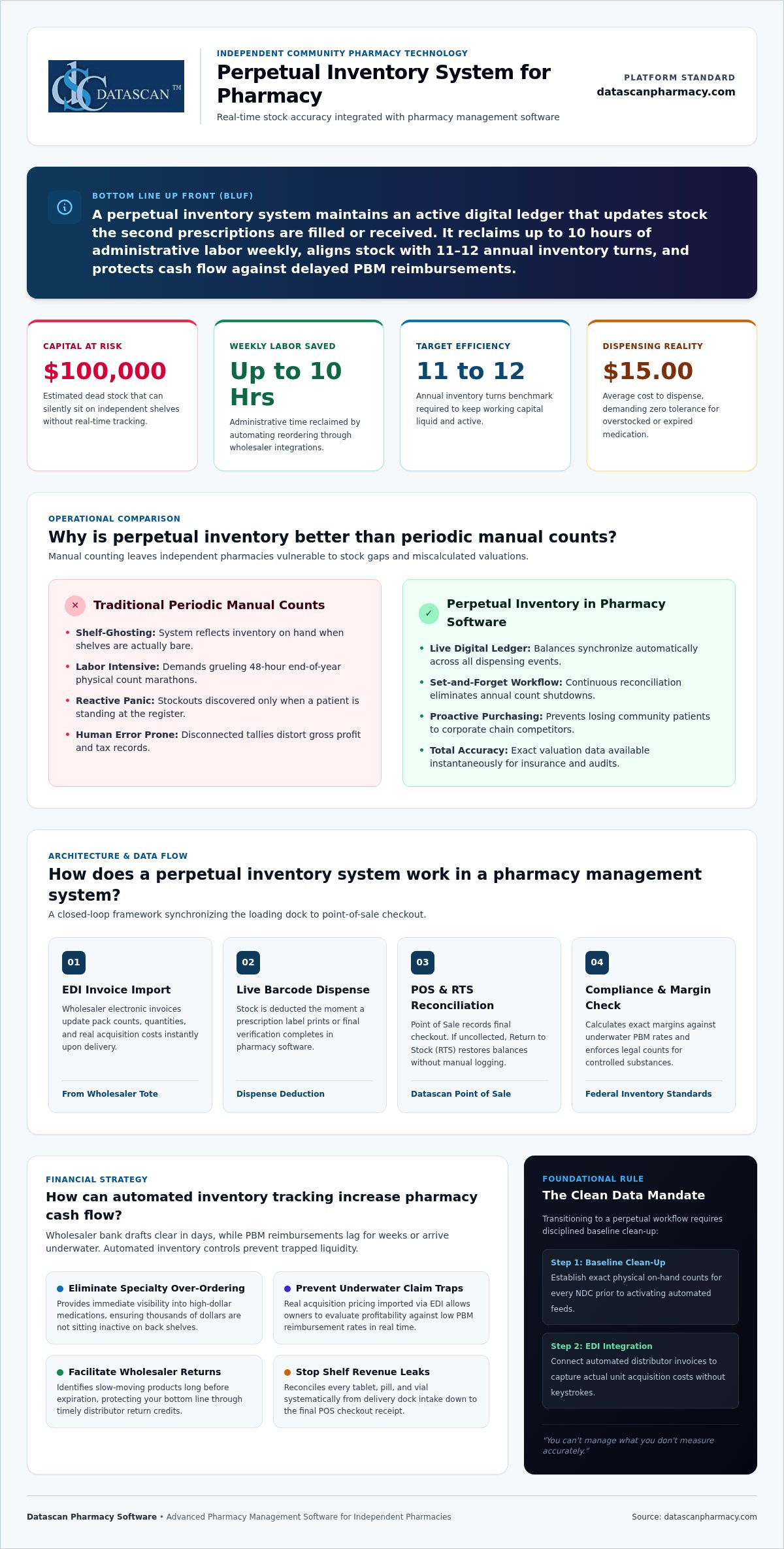
Could your pharmacy be hiding $100,000 in dead stock on its shelves right now? A perpetual inventory system for pharmacy solves this by providing real-time stock accuracy and automated reordering, which allows owners to reclaim up to 10 hours of weekly labor while boosting gross profit margins. By integrating these features into your pharmacy management software, you can align your inventory turns with the 11 to 12 annual benchmark. This ensures your capital isn’t trapped in slow-moving medications while wholesaler drafts clear faster than PBM reimbursements arrive.
We understand the burnout that comes from manual end-of-year inventory counts and the stress of seeing your hard-earned margins swallowed by predatory PBM fee models. You deserve a partner that champions your independence through smarter technology. This guide promises to show you how to transform your operations from reactive guesswork into a streamlined, profitable system. We’ll explore the essential steps to automate your workflow, reduce waste, and use your pharmacy software to fight back against the financial pressures of 2026.
Key Takeaways
- Discover how a perpetual inventory system for pharmacy eliminates the need for grueling manual counts by providing real-time accuracy across your entire stock.
- Learn to automate your ordering process through direct wholesaler integrations to reclaim up to 10 hours of administrative time every week.
- Master the strategy of inventory turns to ensure your cash flow isn’t trapped in slow-moving medications while waiting for PBM reimbursements.
- Identify how integrated pharmacy management software stops revenue leaks by reconciling every pill from the loading dock to the point of sale.
What is a perpetual inventory system for pharmacy?
A perpetual inventory system for pharmacy is a software-driven method that updates stock levels in real-time as prescriptions are dispensed and shipments are received. This continuous tracking ensures your on-hand balances are always current, allowing you to manage your largest expense with surgical precision without the need for periodic manual counts. By maintaining a live digital ledger, you gain immediate visibility into exactly what is sitting on your shelves at any given moment.
For the independent pharmacy owner, drug stock isn’t just medicine; it’s liquid capital. In an era where the average cost to dispense has risen to $15.00 and PBM reimbursements continue to lag, letting cash sit idle in overstocked medications is a direct threat to your solvency. A perpetual inventory system acts as the financial heartbeat of your business. It tracks every tablet and vial from the moment it leaves the wholesaler’s tote until it’s handed to the patient. This “always-on” nature means your pharmacy management software is constantly reconciling your physical shelf with your digital records, providing a level of financial clarity that manual systems simply cannot match.
How does it differ from traditional manual counting?
Traditional counting is a reactive nightmare that often results in “shelf-ghosting,” a situation where your system claims you have a drug in stock, but the shelf is actually bare. Manual counts are historically prone to human error and require massive labor investments that pull your staff away from patient care. By contrast, an automated system offers a “set it and forget it” workflow. You move away from the grueling 48-hour end-of-year counts and toward proactive stock management. This shift prevents the panic of realizing you’re out of a critical medication only when a patient is waiting, helping you maintain the high level of service that defines independent community pharmacies.
Why is real-time data critical for independent pharmacies?
Independent pharmacies must be leaner and faster than their corporate counterparts to survive PBM margin compression. Real-time data gives you immediate visibility into high-dollar specialty medications, ensuring you aren’t over-ordering products that tie up thousands of dollars in cash flow. This is especially vital as you aim for the industry benchmark of 11 to 12 inventory turns per year.
- Prevent Stockouts: Avoid losing patients to big-box chains because of inaccurate inventory levels.
- Financial Accuracy: Know the exact valuation of your inventory for tax and insurance purposes at any second.
- Waste Reduction: Identify slow-moving stock before it expires to facilitate wholesaler returns and protect your bottom line.
How does a perpetual inventory system work in a pharmacy management system?
A perpetual inventory system for pharmacy functions as a real-time digital ledger that synchronizes your physical stock with your software records through automated data feeds. It eliminates manual entry by using Electronic Data Interchange (EDI) to import wholesaler invoices and barcode scanning to track every dispense. This creates a closed-loop system where your on-hand balances are adjusted the second a drug enters or leaves your building.
When your daily order arrives, you simply scan the wholesaler invoice or import the EDI file. The pharmacy software automatically updates your quantities and acquisition costs. This ensures your gross profit calculations are based on what you actually paid, helping you identify underwater PBM reimbursements immediately. Stock is then deducted the moment a label is printed or when the transaction is finalized at the Datascan Point of Sale. If a patient doesn’t pick up a medication, the Return to Stock (RTS) function reverses that deduction, keeping your counts precise without manual logs. This level of detail is essential for meeting federal inventory requirements for controlled substances, where accuracy is a legal mandate.
What are the steps to implement a perpetual workflow?
Transitioning to an automated workflow requires a methodical approach to ensure your data remains “clean” from day one. You can’t manage what you don’t measure accurately. Follow these steps to get started:
- Baseline Count: Conduct a comprehensive clean-up phase to establish exact on-hand counts for every NDC in your pharmacy.
- Define PAR Levels: Set minimum and maximum “periodic automatic replenishment” (PAR) levels to trigger automated reordering when stock hits a specific threshold.
- System Integration: Ensure your pharmacy management software is fully synced with your POS to capture every depletion event.
How does barcode verification ensure inventory accuracy?
Barcode verification is the ultimate safeguard against “phantom inventory,” which is stock that exists in your system but isn’t actually on your shelf. By requiring a scan at the filling station, the software confirms the NDC and quantity match the prescription exactly. This prevents quantity errors that skew your financial reports and, more importantly, ensures patient safety. It creates an audit-ready environment where every pill is accounted for, protecting your pharmacy from PBM clawbacks and regulatory fines. If you’re ready to stop the manual guesswork, you can reach out to our team to see how these integrated tools work in a live environment.
Why is perpetual inventory better than periodic manual counts?
Perpetual inventory is superior to periodic counting because it provides a real-time valuation of your pharmacy’s largest asset while eliminating the grueling, 48-hour manual audits that lead to staff burnout. Unlike periodic counts that offer a “snapshot” of a single moment, a perpetual inventory system for pharmacy reflects the actual state of your shelves every second. This continuous accuracy is vital for tax reporting and insurance purposes, ensuring you aren’t overpaying premiums on inventory you don’t actually have. It also allows you to identify wholesaler short-ships or preventing internal theft in a pharmacy by flagging variances the moment they occur.
Relying on manual counts means you’re always working with outdated data. If a high-cost medication is stolen or lost on Monday, you might not realize it until the next scheduled count weeks or months later. With a live system, every pill is accounted for from the moment it’s received until it’s scanned at the point of sale. This creates a culture of accountability and precision that manual systems can’t replicate, protecting your bottom line from the “shrinkage” that often goes unnoticed in independent stores.
How much time can pharmacists save with automation?
Pharmacists often lose 5 to 10 hours every week to manual administrative burdens like shelf-scanning and order generation. By switching to automated par level triggers, you eliminate the need to “guess” what needs to be ordered. Your pharmacy software handles the replenishment logic for you, freeing up your time for higher-margin clinical services and Medication Therapy Management (MTM). Simplifying the “putting away the order” process also reduces staff stress, as the system already knows what’s in the tote, making reconciliation a matter of seconds rather than hours.
How does it reduce “dead stock” on your shelves?
Dead stock is essentially cash that’s been frozen on your shelves, and in 2026, no independent pharmacy can afford that. Research shows that roughly 10% of a retail pharmacy’s inventory value approaches expiration annually. Without proactive tracking, much of this becomes non-returnable, resulting in total financial write-offs. A perpetual system identifies medications that haven’t moved in 60 to 90 days, allowing you to return them for wholesaler credit before they expire. Moving toward an optimal turnover rate of 11 to 12 turns per year ensures your capital is working for you, not gathering dust in a bottle of slow-moving tablets.
How can automated inventory tracking increase pharmacy cash flow?
Automated inventory tracking increases cash flow by ensuring your most expensive assets, your medications, are turning over fast enough to cover wholesaler payments before PBM reimbursements arrive. By using a perpetual inventory system for pharmacy, you stop over-purchasing high-cost brands that sit idle, effectively “taking cash off the shelf” and putting it back into your operating account. This strategy is vital for maintaining an optimal turnover rate of 11 to 12 turns per year, which prevents your capital from being trapped in slow-moving stock.
Independent pharmacies currently face an economic paradox where sales grow while net profitability plummets due to underwater reimbursements and non-transparent fee models. A real-time system allows you to see your true acquisition cost via EDI feeds, which is a critical component for calculating pharmacy gross profit with precision. When you have immediate visibility into your margins, you can optimize your generic-to-brand mix to favor higher-margin items, protecting your business from the volatility of PBM clawbacks and DIR fee impacts.
Can inventory systems help overcome PBM reimbursement challenges?
Wholesaler payment cycles typically range from 7 to 14 days, while PBM claim remittances often take 14 to 30 days or longer. This timing gap creates a liquidity crunch that can sink an independent store. Automated tracking identifies underpaid claims by comparing the actual EDI invoice cost against the PBM remittance in real-time. This transparency lets you identify loss-leader drugs that are draining your resources. Better cash management also gives you the leverage to “buy right” from secondary wholesalers when prices are lower, further padding your bottom line. To see how real-time tracking can stabilize your bank balance, contact our team for a software walkthrough.
How does it help with front-end sales and retail profit?
Profitability isn’t limited to the back-end dispensing area. Your front-end retail space is a vital source of non-PBM revenue that isn’t subject to the same reimbursement delays. By using integrated pharmacy management software, you can track OTC trends and implement front-end sales strategies for pharmacies that drive higher basket totals. The system helps you identify which supplements or health products are moving, allowing for targeted patient engagement and cross-selling. This ensures your front end is just as optimized and profitable as your prescription department.
How does Datascan’s pharmacy software simplify inventory management?
Datascan simplifies inventory management by consolidating your dispensing, POS, and stock tracking into a single, cohesive ecosystem. This ensures that every pill counted at the filling station is instantly reflected at the register and in your reorder queue. As a family-owned company since 1981, we build our perpetual inventory system for pharmacy specifically to empower the independent owner who is fighting against corporate chains and PBM margin compression. We don’t just provide tools; we provide a financial defensive strategy that keeps your capital off the shelf and in your bank account.
Our pharmacy management software removes the technical friction often found in larger, generic vendor systems. We provide a customizable reporting suite that focuses on the metrics that actually matter for your bottom line: gross profit, inventory turns, and dead stock identification. By connecting your Datascan Point of Sale directly to your inventory ledger, we close the loop that often leads to revenue leaks. This integrated approach allows you to manage your business with precision, ensuring that your inventory investment is always optimized for maximum profitability.
What makes our US-based support different?
Independent pharmacy owners don’t have time to wait in a phone queue for a technician who doesn’t understand the nuances of their business. Our US-based support team provides direct access to experts who specialize in the specific pressures of community pharmacy. We handle the heavy lifting of wholesaler EDI setups and invoice mapping, ensuring your acquisition costs are accurate from the very first shipment. We also focus on training your staff to use our Workflow Software effectively, so your team can maintain stock accuracy without adding hours of manual labor to their daily shift.
Ready to take control of your pharmacy inventory?
We position ourselves as your Visionary Ally, offering the cutting-edge capabilities of a major corporation with the personal accountability of a family-run business. Transitioning from an error-prone manual count to a perpetual inventory system for pharmacy is the most impactful step you can take to reclaim your time in 2026. We help you navigate the implementation phase with minimal downtime, turning your complex operational burdens into streamlined successes. Request your personalized demo today to see how our technology can stop your revenue leaks and transform your pharmacy’s cash flow.
Secure Your Pharmacy’s Financial Future with Smarter Inventory
Implementing a perpetual inventory system for pharmacy is no longer just an operational upgrade; it’s a financial necessity in the face of 2026’s PBM pressures. By automating your stock levels and integrating your workflow with dedicated pharmacy management software, you reclaim thousands in “dead stock” capital and eliminate the burnout of manual counting. You’ve seen how real-time data allows you to turn inventory 11 to 12 times per year, ensuring your cash flow remains liquid even when reimbursements lag.
Datascan has been the champion of independent pharmacies since 1981, offering a 100% US-based support team and a fully integrated POS and inventory management ecosystem. We understand that your time is best spent with patients, not spreadsheets. It’s time to transform your pharmacy from a struggle for solvency into a streamlined, profitable success. Request a Datascan Demo to See Our Perpetual Inventory in Action and take the first step toward a more secure bottom line. Your independence is your greatest strength; let’s protect it together.
Frequently Asked Questions
How do I start a perpetual inventory system in my pharmacy?
Begin by conducting a thorough physical count to establish an accurate baseline, then configure your pharmacy software with EDI feeds from your wholesalers. This integration ensures every drug received is automatically added to your on-hand counts. Next, set your par levels for each NDC to allow the system to trigger automated reorders. This moves your team away from manual shelf-scanning and toward a proactive, software-driven workflow that saves hours every week.
Is a perpetual inventory system hard to maintain for a small staff?
No, it actually reduces the workload for small teams by automating the most time-consuming tasks like manual ordering and end-of-year audits. Once your par levels are established, the pharmacy management software handles the daily replenishment logic for you. Your staff simply needs to scan wholesaler invoices upon arrival and verify NDCs at the point of sale. This integrated approach frees up significant time, allowing a lean staff to focus on higher-margin clinical services.
Does perpetual inventory help with PBM audits and DIR fees?
Yes, it provides the precise, real-time documentation required to defend against PBM clawbacks and audit variances. By tracking every pill from receipt to dispense, you can prove exactly what was on your shelf at any given time. This transparency helps you identify underwater claims immediately by comparing acquisition costs from EDI feeds against reimbursements. While it doesn’t stop DIR fees directly, it gives you the data needed to optimize your drug mix and protect your margins.
What is the difference between perpetual and periodic inventory?
Perpetual inventory updates in real-time with every transaction, while periodic inventory relies on manual counts performed at set intervals. Periodic systems are often inaccurate because they only provide a snapshot that quickly becomes outdated as stock moves. A perpetual inventory system for pharmacy ensures your software records always match your physical shelf. This continuous accuracy allows you to manage your cash flow more effectively and identify shrinkage or wholesaler short-ships the moment they occur.
Can I track both Rx and OTC items in the same system?
Yes, Datascan’s integrated pharmacy management software and POS allow you to track both prescription medications and front-end OTC items in one loop. This unified approach provides a total view of your pharmacy’s profitability. You can set par levels for supplements and health products just as you do for Rx stock. Using POS data to track retail trends helps you identify high-margin front-end items, ensuring your retail space contributes significantly to your overall cash flow.
Do I need special hardware to run a perpetual inventory system?
You don’t need complex proprietary hardware; standard barcode scanners and a reliable local server are the primary requirements. Because Datascan is not cloud-based, your inventory data remains secure on your on-premise system, ensuring you can still process transactions and track stock even if your internet connection fluctuates. Most modern pharmacies already have the necessary scanners at the filling stations and the point of sale to facilitate the barcode verification needed for a perpetual workflow.
How does perpetual inventory improve my pharmacy gross profit?
It improves gross profit by maximizing your inventory turns and ensuring you aren’t overpaying for stock that sits idle on the shelf. When you turn your inventory 11 to 12 times per year, you’re effectively using your wholesaler’s money to fund your operations. The pharmacy management software also uses real-time EDI acquisition costs to help you identify and avoid loss-leader prescriptions. This data-driven approach is essential for overcoming the margin compression caused by predatory PBM reimbursement models.
Will this software help me identify expiring medications?
Yes, the pharmacy software identifies slow-moving medications that haven’t turned in 60 to 90 days, which are the items most likely to expire on your shelf. By flagging these NDCs early, the system allows you to return them for wholesaler credit while they are still within the return window. This proactive management prevents the 10% annual inventory shrinkage typically seen in stores that don’t use automated tracking, directly protecting your bottom line from unnecessary financial write-offs.
 Kevin Minassian is the President of Datascan Software. Under his leadership, the company rapidly expanded to provide pharmacy management software on a national level. Over the last 15+ years, he has ensured that Datascan has continuously evolved to offer innovative solutions for independent pharmacies while still offering world-class customer support. He is passionate about helping independent pharmacies to remain competitive, achieve success, and offer the very best service to their communities.