
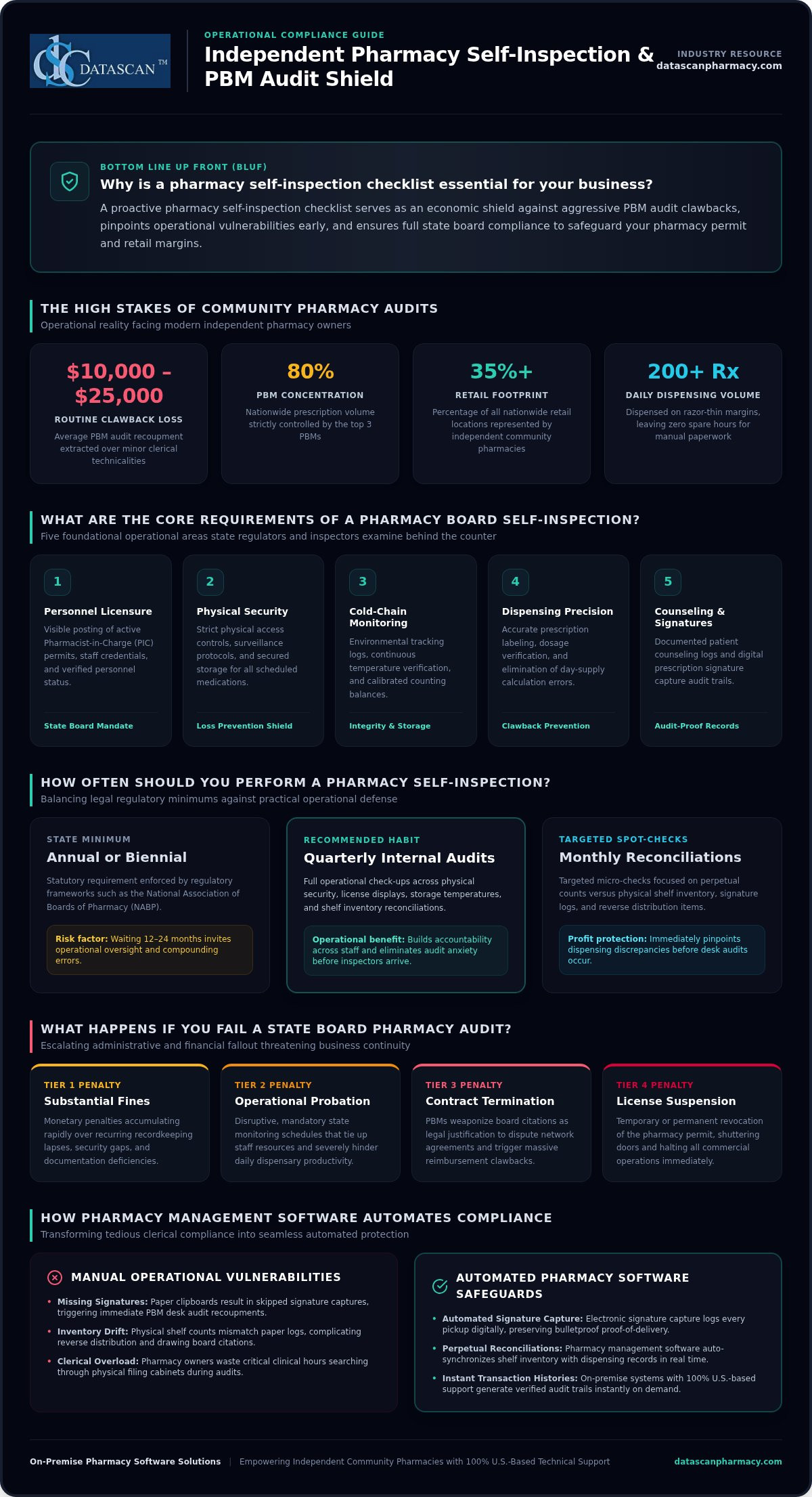
A comprehensive pharmacy self-inspection checklist isn’t just a routine regulatory formality. It’s your strongest operational shield against sudden license citations and aggressive PBM clawbacks, which routinely extract between $10,000 and $25,000 per audit over minor clerical technicalities. As an independent owner dispensing upwards of 200 prescriptions a day on razor-thin margins, you simply don’t have the spare hours to comb through endless regulatory paperwork or live in fear of an unexpected board inspection.
To keep your doors open and profitable, you need an exact roadmap that addresses precisely what state and federal inspectors look for before they arrive. This guide delivers a complete review of your compliance requirements, showing you how to safeguard your license, prevent recoupments, and eliminate audit anxiety. You’ll also learn how reliable pharmacy management software transforms manual inventory reconciliations and signature logging into automated workflows, freeing up valuable time so you can focus on patient care and business growth.
Key Takeaways
- Implementing a proactive pharmacy self-inspection checklist pinpoints operational vulnerabilities early, protecting your business against surprise citations and aggressive PBM clawbacks.
- Ensure full state board readiness by verifying active license postings, updating security protocols, and enforcing strict physical access controls for all scheduled medications.
- Streamline recordkeeping by reconciling physical shelf inventory with your perpetual counts to eliminate dispensing discrepancies and simplify reverse distribution.
- Establish a repeatable, low-stress audit routine by scheduling designated compliance hours and assigning checklist responsibilities to key staff members.
- Leverage robust pharmacy management software to automate prescription signature capture and report generation, keeping your records audit-ready while freeing up time for patient care.
Why is a pharmacy self-inspection checklist essential for my business?
A pharmacy self-inspection checklist is a proactive tool used to identify regulatory gaps before a Board of Pharmacy inspector does, protecting your license and bottom line. State regulators enforce strict legal requirements, but treating a self-audit purely as a compliance chore misses its true commercial value. For an independent pharmacy, regular operational self-inspections serve as an economic shield against aggressive pharmacy benefit managers (PBMs). With the top three PBMs controlling roughly 80% of nationwide prescription volume, post-dispense desk audits are routinely weaponized to claw back reimbursements over clerical technicalities like missing signatures or miscalculated day-supply entries. When you routinely audit your operations, you eliminate these vulnerabilities, protect your margins, and prevent dispensing errors before prescriptions leave the counter.
Independent community pharmacies represent over 35% of all retail locations across the country, yet corporate pressure continues to mount. Acting as your own champion means using disciplined self-audits to insulate your enterprise from external scrutiny. Regular operational checks catch workflow bottlenecks, protect clinical integrity, and help you preserve independence in a fiercely competitive market.
How often should I perform a pharmacy self-inspection?
Mandatory state filings establish the legal minimum, but your operational reality demands a tighter schedule. Many states, following regulatory frameworks promoted by the National Association of Boards of Pharmacy, require the Pharmacist-in-Charge to complete formal assessments annually or biennially. However, waiting twelve months between reviews invites oversight. Community pharmacies dispensing hundreds of prescriptions daily benefit significantly from quarterly internal check-ups and monthly spot-checks on high-risk operational areas. Establishing regular checkpoints builds accountability across your staff, turning complex regulations into daily operational habits.
What happens if I fail a state board pharmacy audit?
Failing an official inspection carries severe financial and administrative fallout. Regulatory agencies enforce escalating disciplinary actions that jeopardize your ability to operate:
- Substantial Fines: Monetary penalties accumulate rapidly for repeated recordkeeping lapses, missing physical security protocols, or compounding documentation gaps.
- Operational Probation: Put your business under disruptive, mandated monitoring schedules that drain staff productivity.
- License Suspension or Revocation: State boards can temporarily shutter your doors or strip your pharmacy permit entirely, instantly halting revenue.
- Contract Termination: PBMs frequently utilize official board citations as grounds to dispute in-network provider agreements, triggering massive reimbursement recoupments.
Surviving these audit crises requires complete technical readiness. Operating with proven on-premise pharmacy software supported by 100% U.S.-based technicians ensures your team can instantly generate required transaction histories, verify audit trails, and satisfy inspector inquiries with confidence.
What are the core requirements of a pharmacy board self-inspection?
The core requirements of a pharmacy board self-inspection focus on five critical operational areas: active personnel licensure display, physical security protocols, environmental cold-chain monitoring, prescription labeling precision, and documented patient counseling logs. State regulators do not just verify that you have policies in place; they inspect whether your daily operational records back them up. Standardized templates, such as the California State Board of Pharmacy self-assessment forms, illustrate how granular state reviews can be, demanding everything from the physical posting of your Pharmacist-in-Charge (PIC) permit to the calibration dates on your counting balances. Utilizing a robust, tech-enabled pharmacy self-inspection checklist ensures you systematically examine each compliance domain before an inspector steps behind your counter.
To avoid severe penalties, every independent pharmacy self-inspection checklist must rigorously cover these physical and operational standards:
- Prominent Licensure Postings: Pharmacy permits, DEA registrations, and current state licenses for all pharmacists and registered technicians must be clearly visible to the public.
- Physical Security and Controlled Access: Verify operational alarm systems, functional motion detectors, and restricted physical key or passcode access to Schedule II vaults.
- Environmental and Cold-Chain Controls: Maintain continuous digital temperature logs for refrigerators (36°F to 46°F) and freezers (-13°F to 14°F), alongside clean compounding areas and calibrated scales.
- Prescription Labeling and Counseling: Audit dispensed vials to confirm mandated warning labels, auxiliary instructions, expiration dates, and logged patient counseling offers.
Staying on top of these requirements can easily drain hours each week. Deploying reliable on-premise tools like Datascan Pharmacy Management Software simplifies reporting across every operational check, giving you centralized access to audit logs and system controls. If you want to streamline how your store handles compliance, you can always reach out to our U.S.-based team for personalized guidance.
What records must be included in my self-inspection?
Your documentation trail is the first thing a board inspector or PBM auditor investigates. Under 21 CFR § 1304.11, you must maintain a signed biennial controlled substance inventory on-site for at least two years, indicating whether counts took place at the open or close of business. Inspect your electronic DEA Form 222 tracking, verify that prescription records contain secure digital signatures, and review physical waste manifests to ensure full HIPAA compliance during document shredding.
How do I verify staff licensure and training compliance?
Failing to track employee qualifications can trigger immediate administrative citations. Review staff files to confirm that continuing education credits and board registrations are up to date for every technician and pharmacist on your schedule. You should also run monthly checks against the OIG and GSA exclusion lists to confirm clean billing credentials, while verifying that all personnel have documented their annual Fraud, Waste, and Abuse (FWA) training modules.
How do I inspect my pharmacy’s inventory and operational records?
Inspecting inventory and operational records requires matching your on-hand physical stock directly against system counts, reviewing wholesale purchase histories, and auditing third-party claim margins. By incorporating inventory audits into your regular pharmacy self-inspection checklist, you prevent DEA diversion flags while catching underpaid PBM claims that threaten your cash flow.
Start by clearing physical shelves of outdated stock. Pull products ninety days ahead of expiration, sequestering them in a secure holding area before transferring them to licensed reverse distributors for destruction. Concurrently, inspect your front-end regulatory logs. Verifying that your Datascan Point of Sale (POS) accurately records real-time pseudoephedrine purchase thresholds and archives customer signatures ensures full compliance with federal combat meth mandates. Aligning these internal checks with NABP Verified Pharmacy Program inspection standards provides a structured, repeatable framework that withstands rigorous scrutiny.
How do I audit my perpetual inventory for controlled substances?
Executing a controlled substance audit means comparing physical counts of Schedule II through V medications against perpetual logs recorded in your system. Regular variance tracking uncovers dispensing discrepancies early, stopping suspicious order monitoring (SOM) thresholds from choking off future wholesaler deliveries. Local, on-premise pharmacy software streamlines this routine by generating automated “zero-count” alerts and perpetual tracking reports, alerting staff immediately whenever a balance slips out of alignment.
Can self-inspections help identify PBM reimbursement errors?
Operational self-inspections do double duty by exposing predatory payer tactics. Auditing prescription billing logs against actual drug acquisition costs surfaces underwater claims where third-party payments fail to cover dispensing expenses. With the average cost to dispense hovering near $15 per fill, spot-checking claims through robust pharmacy management software lets you flag problematic adjudications, appeal below-cost payments, and protect operational margins. Evaluating claim profitability alongside inventory movement equips independent owners with the hard data necessary to fight unfair reimbursement cuts.
What are the steps to conduct a stress-free pharmacy self-audit?
Conducting a stress-free pharmacy self-audit requires transforming a massive compliance burden into an organized, five-step recurring process: scheduling dedicated evaluation windows, delegating responsibilities, generating digital validation reports, walking the floor, and executing rapid corrective plans. Treating internal reviews as an afterthought leads to rushed assessments and missed oversights. By utilizing a structured pharmacy self-inspection checklist alongside purposeful operational habits, independent owners protect their licenses without sacrificing hours of patient service.
Following these practical steps turns compliance into an achievable routine:
- Schedule a Dedicated Compliance Window: Set aside a specific two-hour block during low-volume mid-week mornings or after closing. Auditing while juggling phone calls and dispensing queues guarantees missed details.
- Assign Specific Sections to Key Staff: Distribute operational portions of your checklist to lead technicians or staff pharmacists. Give technicians ownership over cleanroom logs or refrigerator checks, fostering team-wide accountability.
- Pull Audit Reports via Local Workstations: Use your pharmacy workflow optimization software to extract real-time dispensing audit trails, user access records, and inventory variance logs rather than sorting through paper receipts.
- Execute a Physical “Mock Audit” Walkthrough: Walk your store through the eyes of an outside inspector. Verify that biohazard bins are secured, counting balances sit level, and patient-sensitive trash never lingers near public counters.
- Formalize an Immediate Corrective Action Plan: Log non-compliant items immediately and set strict resolution deadlines instead of letting minor problems linger.
If you need tools that streamline operational oversight and protect your bottom line, contact our team today to see a customized workflow demo.
What is the best way to document my findings?
Never rely on loose paperwork or scattered clipboards. Keep a physical “Master Compliance Binder” directly behind the counter alongside an organized local directory on your primary workstation. State board officials expect readily available proof. Ensure every completed checklist, temperature deviation log, and reconciliation report is signed and dated by the Pharmacist-in-Charge (PIC) to establish an airtight documentation trail during unexpected visits.
How do I create a corrective action plan?
A corrective action plan establishes clear accountability with measurable timelines. Assign a 24- to 48-hour resolution deadline for immediate regulatory risks, such as missing alarm tests or physical lock issues. Treat operational gaps as valuable coaching opportunities; retrain staff on system-guided dispensing checks rather than issuing reprimands, ensuring your team actively works to stop repeat mistakes.
How can pharmacy management software automate my compliance workflow?
Pharmacy management software automates your compliance workflow by converting manual verification tasks into enforceable, system-guided hard stops and instant audit reporting. Rather than relying on vulnerable paper binders, a robust on-premise system validates dispensing data in real time, automates state Prescription Monitoring Program (PMP) submissions, and archives required records automatically. Integrating these capabilities directly into your daily routine ensures that maintaining a pharmacy self-inspection checklist isn’t an exhausting after-hours chore, but a seamless operational standard.
Manual paperwork invites clerical oversights that corporate payers and regulatory boards routinely penalize. Modern pharmacy software eliminates these liabilities at the point of interaction. By deploying an integrated electronic delivery system, staff can capture digital signatures for HIPAA privacy notices, prescription pickups, and home deliveries directly on mobile devices. Every signature links immediately to the corresponding patient profile and transaction record, giving you an unalterable digital paper trail that neutralizes audit disputes before clawbacks occur.
How does workflow automation reduce compliance risks?
Workflow automation removes human error by enforcing digital checkpoints at every station. Built-in barcode verification requires technicians to scan stock bottles against prescription data, ensuring the exact National Drug Code (NDC) and dosage form match before dispensing. By integrating the core tenets of your pharmacy self-inspection checklist into daily software queues, your workstations prevent staff from skipping critical steps like patient counseling documentation, prescription origin verification, and required third-party override approvals.
Why is U.S.-based support critical for pharmacy software compliance?
Surviving a surprise inspection or PBM desk audit requires immediate answers, not endless hold times with overseas call centers. Datascan backs its technology with 100% U.S.-based support, connecting you directly to technicians who understand domestic pharmacy laws and board requirements. As an independent, family-owned business since 1981, Datascan understands that downtime during an audit threatens your livelihood. Having knowledgeable partners ready to help you generate historical logs or resolve technical hurdles ensures you never face regulators alone. Strengthening your software environment with multi-factor authentication for pharmacy software adds a critical layer of protection that safeguards your audit trails and patient data against unauthorized access.
Transform Your Compliance Strategy Into an Operational Shield
Treating your pharmacy self-inspection checklist as an ongoing operational strategy does more than satisfy state board inspectors. It safeguards your clinical independence, prevents costly payer clawbacks, and protects your bottom line. By replacing stressful manual paper tracking with structured internal audits and system-guided controls, compliance shifts from an overwhelming distraction into your strongest business defense.
You don’t have to tackle regulatory oversight alone. Datascan has stood as a dedicated partner to community pharmacies since 1981. As a family-owned technology provider, we design our pharmacy management software specifically for independent pharmacies, backing every feature with an expert, 100% U.S.-based support team that understands your daily operational pressures. Schedule a demo with Datascan today to streamline your compliance workflows and reclaim the valuable time you need to serve your patients and expand your business.
Frequently Asked Questions
Is a pharmacy self-inspection required by law in every state?
No, not every state board explicitly mandates a written self-inspection, but conducting one remains an industry standard nationwide. Benchmark jurisdictions require mandatory periodic self-audits or specific filings whenever the Pharmacist-in-Charge changes. Even where unmandated, operating with an internal pharmacy self-inspection checklist is vital. It prepares your team for unannounced state board visits and protects your business from punitive PBM desk audits.
Can I use digital signatures for my pharmacy self-inspection records?
Yes, most state regulatory bodies accept digital signatures as long as your system satisfies strict audit verification criteria. Your platform must capture secure timestamps and unalterable user credentials for the reviewing Pharmacist-in-Charge. Utilizing modern on-premise pharmacy management software ensures digital logs remain fully tamper-evident and immediately exportable whenever inspectors ask to see historical records.
How long should I keep my completed self-inspection checklists on file?
You should retain completed inspection records on-site for a minimum of three years, though DEA inventory mandates require at least two years of retention under federal law. Because major PBM audit lookbacks routinely examine records spanning 12 to 24 months, keeping your documentation readily accessible prevents retroactive clawbacks over historical clerical inquiries.
What are the most common citations found during pharmacy board audits?
The most frequent citations stem from missing biennial controlled substance inventories, unlogged refrigerator temperature excursions, and unposted staff licenses. Regulators also routinely cite facilities for outdated standard operating procedures, gaps in technician ratio tracking, and improper waste disposal. Catching these clerical oversights internally prevents formal reprimands on your public permit.
Does my pharmacy software need specific certifications for compliance?
Yes, your technology platform must meet rigorous regulatory standards, including DEA electronic prescriptions for controlled substances (EPCS) certification and automated state PMP reporting integration. Operating reliable, locally installed pharmacy software ensures strict compliance with state transaction limits, prevents unauthorized dispensing, and automatically archives digital audit trails required by oversight agencies.
How do I handle discrepancies found during my controlled substance inventory?
Address discrepancies immediately by recounting physical stock, reviewing recent electronic invoices, and auditing dispensing logs for unrecorded fills. If an unexplained variance constitutes a theft or significant loss, federal regulations mandate initial written notification to your local DEA Diversion Field Office within one business day, followed by an online DEA Form 106 submission within 15 calendar days.
Can a self-inspection checklist help me prepare for a PBM audit?
Yes, using a comprehensive pharmacy self-inspection checklist directly targets the non-clinical clerical flaws that PBM auditors exploit. Checking electronic signature capture logs, validating days-supply calculations, and confirming correct DAW codes shields your revenue against aggressive post-dispense clawbacks, preserving cash flow that corporate payers routinely attempt to recover.
What is the role of the Pharmacist-in-Charge (PIC) in the self-inspection process?
The Pharmacist-in-Charge bears ultimate legal accountability for verifying regulatory compliance and maintaining operational integrity across the facility. While the PIC can assign routine checklist tasks to senior technicians, they must personally review findings, validate controlled substance counts, sign required annual filings, and enforce corrective action plans whenever operational gaps appear.
 Kevin Minassian is the President of Datascan Software. Under his leadership, the company rapidly expanded to provide pharmacy management software on a national level. Over the last 15+ years, he has ensured that Datascan has continuously evolved to offer innovative solutions for independent pharmacies while still offering world-class customer support. He is passionate about helping independent pharmacies to remain competitive, achieve success, and offer the very best service to their communities.