
A PBM can meet its effective-rate guarantee even while your pharmacy loses money on an individual prescription. That is because the guarantee generally measures average reimbursement across a defined group of claims, not a minimum payment for each fill.
For independent pharmacies, understanding pharmacy effective rates means looking beyond a single claim or the rate shown in a contract. The calculation may involve reimbursement across a group of prescriptions, manufacturer rebates, brand effective rates, and PBM compensation. These moving parts can make it difficult to see whether the final figures reflect the economics of your pharmacy’s claims.
This article explains how pharmacy reimbursement and effective-rate guarantees work, why a portfolio average can hide unprofitable claims, and how brand drugs and manufacturer rebates fit into the picture. It also covers how PBM compensation shapes an arrangement and why contract terms matter when rates are reconciled. The aim is to clarify what an effective rate tells you, and what it does not.
Key Takeaways
- Separate what a payer spends from what the pharmacy receives to better understand where reimbursement differences arise.
- Look at rebate pass-through terms alongside list prices, since they can affect how drug concessions are allocated.
- Assess brand effective rates across the relevant claims and contract terms, not from a single prescription alone.
- Review how PBM compensation and reconciliation provisions shape the final reimbursement picture.
- See how pharmacy management software can help organize day-to-day operations and support a clearer view of pharmacy activity.
What is pharmacy reimbursement, and how do effective rate guarantees work?
Understanding pharmacy effective rates starts with distinguishing a claim payment from an overall contract guarantee. Pharmacy reimbursement is the amount paid to dispense a covered prescription. An effective-rate guarantee measures average reimbursement across a defined group of claims, rather than setting a minimum payment for each fill.
Spread Pricing and Pharmacy Payments
Spread pricing occurs when a pharmacy benefit manager (PBM) charges a payer more for a prescription than it reimburses the pharmacy, retaining the difference. The payer’s payment and the pharmacy’s reimbursement are distinct amounts. For example, a PBM could collect one amount from an employer plan and pay the pharmacy a lower amount for the same prescription. That gap affects how much of the pharmacy benefit reaches the dispensing pharmacy.
PBM Roles in Reimbursement
PBMs administer pharmacy benefits, process prescription claims, and negotiate drug-pricing arrangements with payers and pharmacies. Contract terms shape pharmacy reimbursement, payer payments, and whether the PBM retains a spread. A claim payment is not necessarily the payer’s total cost. Reviewing the contract alongside remittance details helps show how the amounts relate.
Reimbursement Rates and Dispensing Fees
A reimbursement rate applies to a claim or drug, a dispensing fee is a separate payment component, and an effective rate summarizes reimbursement across a group of claims. Guarantees are generally expressed as a discount off average wholesale price across eligible claims during a reconciliation period. A prescription can pay below acquisition cost even when the group average meets its guarantee. The average does not protect every claim.
Calculating Effective Rates from Claims
To calculate an effective rate, group eligible claims for the contract period, total the pharmacy reimbursement, and compare that amount with the contract’s pricing benchmark. The contract determines which claims and adjustments count. For a guarantee based on a discount off average wholesale price, compare aggregate reimbursement for the group with that benchmark, then assess the result against the guaranteed rate.
State and federal rules depend on the program and jurisdiction. Most states have laws requiring PBMs to provide maximum allowable cost transparency and appeal processes. The Centers for Medicare & Medicaid Services issued an informational bulletin on Medicaid managed-care spread-pricing reporting in May 2019. In 2020, the U.S. Supreme Court upheld state authority to regulate PBM reimbursement in Rutledge v. Pharmaceutical Care Management Association.
For Medicaid fee-for-service claims, the state’s applicable reimbursement methodology determines drug payment and any dispensing fee. For some generic drugs, the Affordable Care Act requires the HHS Secretary to set a Federal Upper Limit at no less than 175% of the weighted average of the most recently reported Average Manufacturer Price.
A fuller understanding of pharmacy effective rates includes recognizing that individual prescriptions can lose money even when a PBM meets its portfolio guarantee. Some contracts also allow recoupment when average reimbursement exceeds the guaranteed rate, so reconciliation terms can affect the pharmacy’s final payments.
How do manufacturer rebates and rebate pass-through affect drug prices?
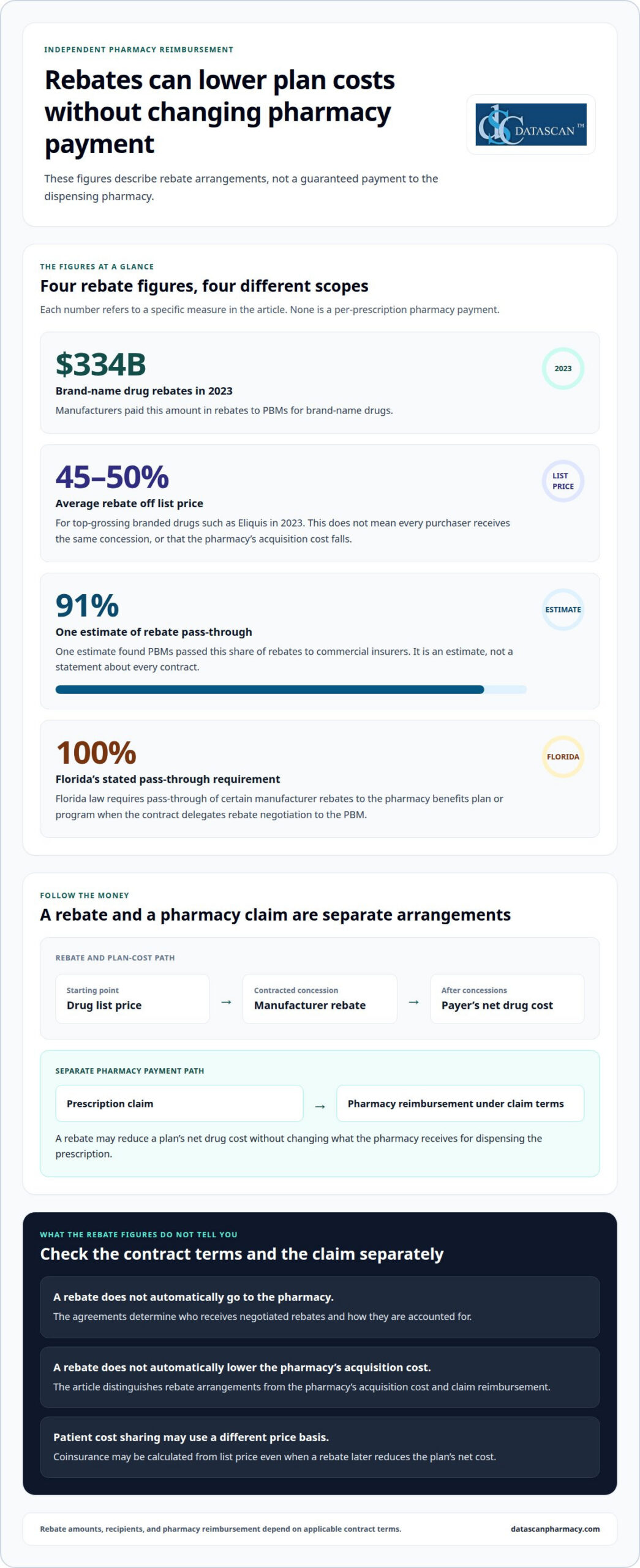
Manufacturer rebates are price concessions negotiated with pharmacy benefit managers (PBMs), often tied to a drug’s formulary placement. Their effect depends on the contract: a rebate may lower a payer’s net drug cost without changing what the pharmacy receives for dispensing a prescription.
Rebates and Price Concessions
A manufacturer rebate is a concession paid after a drug sale under terms negotiated with a PBM or payer. In 2023, manufacturers paid PBMs $334 billion in rebates for brand-name drugs. The amount and recipient depend on agreements, so a rebate does not automatically flow to an independent pharmacy or reduce its acquisition cost.
Rebate arrangements can reward preferred formulary placement, which affects which medications receive favorable coverage. A PBM may negotiate rebates for a health plan and account for them under its contract. For pharmacies, the distinction matters: rebates can affect plan economics while the dispensing pharmacy is reimbursed under separate claim terms.
Rebates, Discounts, and List Prices
A list price is the stated price before negotiated rebates or other concessions; a discount or rebate can reduce the payer’s net cost afterward. For top-grossing branded drugs such as Eliquis, manufacturer rebates averaged 45% to 50% off list price in 2023. That does not mean every purchaser receives the same concession or that the pharmacy pays less at acquisition.
Consider a covered medication with a list price and a negotiated rebate. The rebate may lower the plan’s net expense after the transaction, while a patient’s coinsurance may still be calculated from the list price. The patient could therefore pay more out of pocket than the plan’s eventual net cost suggests. Contract design determines how discounts reach the plan and whether they affect patient cost sharing.
Contract terms determine whether negotiated discounts and rebates reach the employer or payer or are retained by the PBM. One estimate found PBMs passed 91% of rebates to commercial insurers. Florida law requires a PBM to pass 100% of certain manufacturer rebates to the pharmacy benefits plan or program when the contract delegates rebate negotiation to the PBM.
For an independent pharmacy, the key distinction is where each concession goes. A rebate credited to an insurance plan may not improve the pharmacy’s payment for a prescription. Contracts define who receives rebates, when they are paid, and how they are treated. Spread pricing can create a separate difference between what the payer is charged and what the pharmacy receives. Reviewing these flows clarifies which party benefits from each negotiated discount.
How are brand effective rates determined?
A brand effective rate summarizes reimbursement for a defined group of brand-drug claims. The contract specifies which claims count, the pricing benchmark, and the reconciliation period. The resulting rate therefore depends on those terms, not on one standard formula that applies to every pharmacy.
There is no single typical pharmacy effective rate across the United States. A contract may set a brand-specific guarantee using a discount off average wholesale price, then compare aggregate reimbursement for the pharmacy’s eligible claims with that benchmark over the agreed period. Understanding pharmacy effective rates means reading the contract’s brand-claim definitions alongside its calculation method.
To assess a brand rate, separate eligible claims from those outside the contract’s measurement group. For example, a contract may define a group by brand status and other claim criteria, then compare the group’s reimbursement with its benchmark. A different definition changes which prescriptions affect the final result. The rate reflects both the payments and the contract’s rules for including claims.
A formulary can place brand medications in preferred and nonpreferred categories, while insurance coverage determines which products patients can access under their plans. These categories provide context when reviewing claim patterns, but the rate calculation follows the contract’s definition of eligible claims. Do not assume every brand prescription belongs in the same effective-rate group.
Spread pricing is another financial measure, but it does not by itself determine a brand effective rate. A PBM’s charge to a payer and its payment to a pharmacy are separate transaction amounts. The brand rate is calculated from the pharmacy payments and benchmark specified in the agreement. Keeping these measures separate helps interpret contract reports without treating payer spending as pharmacy reimbursement.
States may set different requirements for PBM payment arrangements, so applicable rules can affect how a pharmacy reviews a contract. For example, Florida law addresses certain payments to dispensing pharmacies or providers, including contracted professional dispensing fees. Understanding pharmacy effective rates still requires reading the relevant contract’s calculation terms, rather than assuming a rate applies uniformly across states.
When reviewing a brand effective rate, use a consistent process:
- Identify the contract’s eligible brand claims and pricing benchmark.
- Total actual reimbursement for those claims, applying contract-defined adjustments.
- Compare the result with the guarantee and review applicable reconciliation terms.
This comparison shows whether the rate follows the contract’s calculation while keeping individual claim performance visible. An aggregate result describes the measured group, not the economics of every prescription or the pharmacy’s overall profitability.
How do PBM compensation and effective-rate structures work?
Effective rates vary by pharmacy benefit manager (PBM), contract, claim group, benchmark, and reconciliation terms. A contract may use a portfolio average, so the resulting reimbursement rate reflects the claims included, not a guaranteed amount for every prescription.
PBM Compensation Structures
PBM compensation describes how pharmacy benefit managers earn revenue for administering pharmacy benefits and processing claims. Under spread pricing, a PBM may charge a payer more than it reimburses the pharmacy, retaining the difference. Under a Medicaid managed-care pass-through model, the PBM’s only contract revenue is an administrative fee. These structures affect how payer spending relates to pharmacy payments.
Manufacturers may also pay rebates tied to negotiated drug arrangements, while contracts determine how those funds are handled. Beginning January 1, 2028, Medicare Part D PBM compensation will be delinked from drug prices and rebates and based on a bona fide service fee. That change distinguishes payment for PBM services from drug-price-linked compensation.
Variation by PBM and Contract
Each PBM contract defines which claims enter an effective-rate calculation, the pricing benchmark, and the reconciliation period. One agreement might measure brand and generic claims separately; another may set different groups or terms. Those choices change the resulting average, even when pharmacies dispense similar prescriptions for patients with comparable coverage.
For example, a contract may express its guarantee as a discount off average wholesale price across eligible claims. If actual reimbursement falls short of the guaranteed average, the PBM may owe a true-up after the period. Some contracts instead allow recoupment when average reimbursement exceeds the guarantee. The written terms determine which outcome applies.
Fees and Rate Adjustments
Effective-rate calculations may account for reimbursement, contracted professional dispensing fees, and adjustments defined by the contract. The agreement specifies whether reversals, claim corrections, or reconciliation payments enter the calculation. When comparing a remittance with the final rate, distinguish claim-level payments from later adjustments.
That distinction matters because a dispensing fee may be included in a payment benchmark, but it is not the effective rate itself. Under Florida law, certain PBM payments to a dispensing pharmacy or provider must equal amounts the manager pays for the drugs, including any contracted professional dispensing fee. Florida also requires specified payments to pass through entirely without reconciliation offsets.
For an independent pharmacy, compare the contract’s calculation method with the claims and reconciliation statement. A portfolio average can mask losses on individual prescriptions, while a recoupment clause can reduce later payments. Reviewing both provisions clarifies how the PBM’s compensation model and reimbursement structure affect the pharmacy’s final revenue.
What fees and adjustments are included in pharmacy effective rates?
The contract’s calculation rules determine whether a pharmacy effective rate includes professional dispensing fees, claim corrections, or other adjustments. When reviewing a PBM statement, separate each item by category. Combining amounts that the agreement treats differently can produce a misleading comparison.
Start with the professional dispensing fee. A contract may include it in the amount compared with its pricing benchmark or report it separately from drug reimbursement. For example, if the agreement defines reimbursement as the drug payment plus a contracted dispensing fee, both components belong in the calculation. If it treats them separately, combining them would not follow the contract’s method.
Claim status also affects the calculation. A reversed prescription should not be treated like a completed, paid claim, and a corrected claim may replace an earlier record. The contract’s eligibility rules establish which transaction counts. This matters when a claim history shows an original submission, a reversal, and a replacement for the same prescription.
Keep these components distinct when reviewing the contract and payment records:
- Drug reimbursement: The payment assigned to an eligible prescription claim.
- Dispensing fee: A contracted professional fee, included or recorded separately as the agreement defines.
- Reversed claims: Transactions removed or excluded under the contract’s claim rules.
- Corrected claims: Replacement records handled according to the agreement’s eligibility terms.
Consider a group of brand prescriptions where the contract measures drug reimbursement against average wholesale price. If the contract includes dispensing fees in its reimbursement figure, the pharmacy’s comparison must treat them the same way. If fees are excluded from the benchmark calculation, including them would make the result inconsistent. Follow the wording that defines both reimbursement and eligible claims.
Keep manufacturer rebates and payer charges separate from pharmacy fees unless the effective-rate formula explicitly includes them. A rebate paid to a PBM is not automatically a dispensing fee or a payment recorded for the pharmacy’s prescription claim. Likewise, do not substitute a payer’s charge for the amount the pharmacy received.
For a clear review, match each claim record to its payment entry, identify reversals and corrected submissions, and classify dispensing fees according to the contract’s definition. Then compare like with like: eligible claims, consistent fee treatment, and the stated benchmark. This focused review can explain differences between the pharmacy’s calculation and the PBM’s statement without mixing unrelated transaction amounts.
How can Datascan Pharmacy Software help an independent pharmacy?
Datascan Pharmacy Software supports independent pharmacies with an integrated platform that includes pharmacy management software, point of sale, a patient app, and delivery tools. These systems help organize daily pharmacy operations, supporting teams as they review reimbursement activity alongside prescription filling and patient service.
Understanding effective-rate calculations still requires the terms of each PBM contract and its reconciliation details. Pharmacy technology does not set those terms or change a PBM’s calculation. It can support dispensing and payment-record workflows, giving pharmacy teams more visibility into their processes and helping them focus on contract questions.
Datascan Pharmacy Management Software supports pharmacy operations, while Datascan Point of Sale (POS) handles point-of-sale needs. Together, these offerings address separate parts of the pharmacy’s daily work. That can be useful when your team is balancing prescription processing, front-end transactions, and administrative responsibilities, without confusing those functions with PBM reimbursement rules.
Patient and delivery tools can also support service beyond the dispensing counter. MobileScripts Patient Mobile App gives patients a mobile channel for pharmacy interactions, while Datascan Delivery supports delivery routing and management tied to the pharmacy workflow. For a pharmacy managing multiple workflows, these tools help organize distinct activities without implying that rebates, claim rates, or reconciliation happen automatically.
- Use pharmacy management software to support pharmacy operations.
- Use Datascan Point of Sale (POS) for point-of-sale needs.
- Use MobileScripts Patient Mobile App to provide a patient mobile channel.
- Use Datascan Mobile Delivery App to support delivery operations.
Choose technology based on the operational challenges your pharmacy wants to address. If your main concern is an effective-rate dispute, the contract and PBM reconciliation remain central. If staff time is stretched across dispensing, checkout, patient interactions, and delivery coordination, pharmacy software can support those workflows while your team handles the financial review separately.
For an independent pharmacy, the practical next step is to match operational needs with the right tools, rather than expecting software to replace contract analysis. Datascan Pharmacy Software offers an Independence-First platform with pharmacy management software and integrated tools for independent pharmacy operations.
Contact Datascan Pharmacy Software to discuss your pharmacy’s needs.
Frequently Asked Questions
What is a pharmacy effective rate?
A pharmacy effective rate summarizes reimbursement across a contract-defined set of prescription claims. It shows how payments compare with the agreement’s pricing terms, but not the profit on every fill. For example, a pharmacy could have a favorable overall result while a particular medication still reimburses below its acquisition cost. Use the rate alongside claim-level results to understand both.
How is a pharmacy effective rate calculated?
Use the claims and payment records that qualify under the contract, then apply its stated benchmark and adjustments. A useful working review separates paid prescriptions, reversals, corrected claims, and later reconciliation entries before comparing totals. Keep brand and generic claims distinct if the agreement measures them separately. This helps explain why a pharmacy’s internal calculation may differ from a PBM statement, especially when the two use different claim groups.
How can pharmacies compare effective rates across PBM contracts?
Compare contracts using the same claim period and a consistent view of the pharmacy’s prescription mix. Review brand, generic, and specialty claims separately where the contract permits, then note how each agreement treats dispensing fees and later adjustments. A headline rate can mislead if one PBM includes different claims or uses another benchmark. A side-by-side comparison makes those differences visible before you assess the financial result.
What contract terms affect a pharmacy’s effective rate?
Terms that shape the result include the eligible-claim definition, pricing benchmark, measurement period, dispensing-fee treatment, and reconciliation method. Pay close attention to how the contract handles reversals, corrected claims, and payment adjustments after measurement. For example, a clause allowing recoupment can change the final amount even after initial reimbursement. Clear definitions matter because even a small difference in claim eligibility can alter the group being measured.
How can pharmacies negotiate or improve their effective rates?
Build negotiations around documented claim results, acquisition costs, and specific contract language rather than a single average. Identify prescriptions that repeatedly reimburse below acquisition cost, organize supporting invoices, and use the applicable appeal process. Ask for clear definitions of eligible claims, benchmarks, fees, and reconciliation adjustments in proposed terms. This gives the pharmacy a concrete basis for discussing reimbursement and identifying provisions that could reduce or obscure payment.
What are typical pharmacy effective rates in the United States?
There is no single typical pharmacy effective rate across the United States. Rates depend on contract terms, including eligible claims, the pricing benchmark, and the reconciliation period.

Article by
Sarah Callioras
Sarah Callioras is Vice President at Datascan Pharmacy Software, bringing nearly 25 years of experience across independent pharmacy operations and pharmacy technology. Since joining Datascan in 2016, she has played a key role in driving business growth, strengthening client relationships, and supporting independent pharmacies through innovative software solutions. With a strong background in pharmacy operations, business development, and strategic leadership, Sarah is passionate about helping independent pharmacies succeed in an evolving healthcare landscape.
 Kevin Minassian is the President of Datascan Software. Under his leadership, the company rapidly expanded to provide pharmacy management software on a national level. Over the last 15+ years, he has ensured that Datascan has continuously evolved to offer innovative solutions for independent pharmacies while still offering world-class customer support. He is passionate about helping independent pharmacies to remain competitive, achieve success, and offer the very best service to their communities.