
Clinical care can be a revenue stream, not just another task on a pharmacist’s schedule. Generating revenue from clinical pharmacy services means building offerings such as consultations, health classes, and immunizations into a clear workflow, then billing for them and tracking payments accurately. The opportunity depends on the services your pharmacy provides, payer requirements, and the time and resources needed to deliver care.
It’s reasonable to ask whether billing complexity and staff workload will outweigh the return. Connect clinical documentation, billing processes, and service costs so you can see what gets reimbursed and what contributes to profit. Gaps in documentation or follow-up can make revenue harder to collect.
This article explains how billing modifiers relate to clinical claims, where consultations, classes, and immunizations may create revenue opportunities, and which measures can help you assess growth and margins. Use this framework to evaluate each service, from care delivered to revenue collected, and decide what belongs in your pharmacy’s clinical offering.
What are the key takeaways about pharmacy clinical services?
- Understand how accurate documentation and appropriate billing workflows can help pharmacies capture revenue for clinical care.
- Explore how consultations, educational classes, and immunizations can contribute to a pharmacy’s service mix.
- Learn which revenue, reimbursement, and cost measures can help you assess growth and profit margins.
- See what to consider when evaluating Medicare billing pathways for pharmacist-provided clinical services.
- Find out how pharmacy management software can support smoother workflows and help free up time for patient care.
1. What billing modifiers apply to clinical pharmacy services?
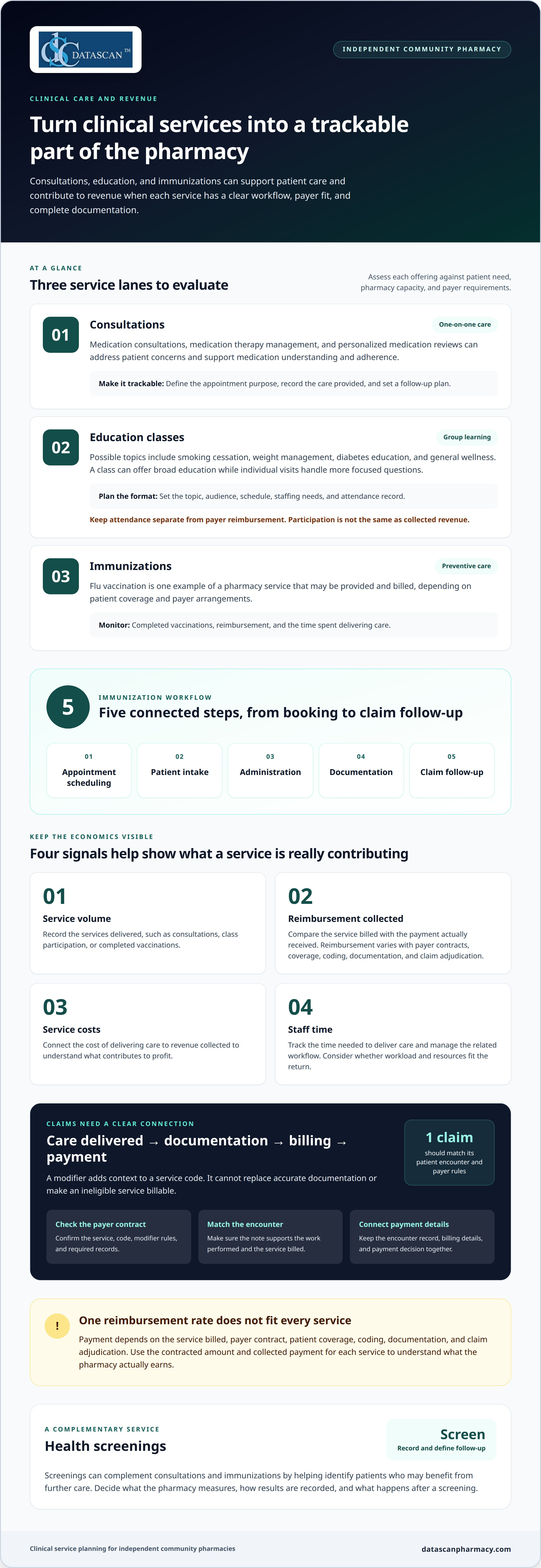
A billing modifier adds context to a service code, helping explain how a clinical service was delivered or billed. For a medication therapy management visit, the claim must connect the documented service, billing code, and any modifier accepted by the payer. A modifier cannot replace accurate documentation or make an otherwise ineligible service billable.
Start with the payer contract and identify the service, code, modifier rules, and required records. Then match each claim to the patient encounter. For example, the note should support the medication review performed and the service billed. Medical coding must align with clinical documentation, and requirements vary by state. A mismatched code or missing detail can lead to a denial, delayed payment, or audit questions.
State scope-of-practice rules and collaborative practice agreements shape which services a pharmacist may provide and under what authority. A billing workflow should reflect the pharmacist’s authorized role, the agreement’s limits, and the payer’s requirements. Aligning these elements connects patient care to a well-supported claim.
Incident-to billing depends on meeting the applicable payer criteria and documenting the care relationship and service delivered. Build the workflow around those criteria before submitting claims. Document the pharmacist’s role, the clinical work performed, and any required oversight. Clear records show how the service fits the billing arrangement.
There is no single typical reimbursement rate for medication therapy management or chronic care management. Payment depends on the service billed, payer contract, patient coverage, coding, documentation, and claim adjudication. Use the contracted amount and collected payment for each service to understand what the pharmacy actually earns.
To enroll, a pharmacy establishes a billing arrangement with an insurer and completes the payer’s credentialing process for the organization or individual pharmacists. Credentialing may be individual, organizational, or through a payer’s delegated model. Build enrollment into service planning, and track application requirements, payer decisions, and participation status.
Common denials include mismatched coding, incomplete notes, eligibility problems, or claims that do not meet payer criteria. Audit and fraud-and-abuse concerns can arise when claims lack support, duplicate services, or misrepresent what occurred. Keep the encounter record, billing details, and payment decision connected, and address errors through the payer’s established process.
Billing models can include direct insurer claims, payment through an eligible organization, or other contract-based arrangements. Each model changes who submits claims, tracks remittances, and follows up on unpaid balances. According to the Health Resources and Services Administration, the 340B Drug Pricing Program can offer savings when used compliantly and strategically. Treat those savings separately from clinical-service reimbursement when evaluating revenue.
2. How can my pharmacy earn revenue from consultations, classes, and immunizations?
Consultations, education, and immunizations can turn clinical expertise into services patients value and payers may reimburse. U.S. pharmacies receive reimbursement for services such as test-to-treat consultations, chronic disease management, and immunizations, subject to coverage and payer arrangements. Revenue depends on the service delivered, patient eligibility, payer rules, and complete documentation. A deliberate approach to generating revenue from clinical pharmacy services starts with offerings that match patient needs and pharmacy capacity.
A medication consultation can address a specific patient concern, such as understanding a new prescription or managing multiple medications. Medication therapy management and personalized medication reviews give pharmacists structured opportunities to identify concerns, explain medication use, and support adherence. Each appointment needs a defined purpose, an appropriate care record, and a follow-up plan. This structure connects the service to patient care and helps track reimbursement.
Classes can extend education beyond one-on-one visits. A pharmacy might offer smoking cessation, weight management, diabetes education, or general wellness sessions. For example, a diabetes class can explain medication routines and home monitoring, while individual consultations address questions needing more focused attention. Before launching a class, define its topic, audience, schedule, staffing needs, and attendance-recording method. Track participation separately from payer reimbursement, so interest in a class isn’t mistaken for collected revenue.
Immunizations can encourage repeat visits and support broader conversations about preventive care. A pharmacy can organize its process around appointment scheduling, patient intake, administration, documentation, and claim follow-up. Flu vaccinations are one example of a service pharmacies may provide and bill, depending on coverage and payer arrangements. A clear process helps staff manage each step and keeps the patient experience straightforward. It also lets pharmacy leaders monitor completed vaccinations, reimbursement, and time spent delivering care.
Health screenings can complement consultations and immunizations by helping identify patients who may benefit from further care. Define what the pharmacy measures, how results are recorded, and what happens after patients receive them. Pairing a screening with medication counseling can make the appointment more useful. Distinguish screening activity from any separate billable consultation, and follow payer terms for each service.
Technology can support scheduling, patient communication, and organized records, but it doesn’t replace clinical judgment or payer requirements. Choose a workflow that lets staff see the service offered, its completion status, and related follow-up. A point-of-sale system can support transactions around the pharmacy’s broader service offering. For pharmacies generating revenue from clinical pharmacy services, connecting service workflows with routine operations can make activity easier to track. To discuss how pharmacy operations can support patient-facing services, talk with the Datascan team.
3. How can I assess clinical-service revenue growth and profit margins?
Measure clinical-service performance using collected revenue, direct costs, and workload, not billed charges alone. Compare the same service across consistent periods, such as one quarter with the previous quarter. This shows whether growth reflects more completed visits, stronger collections, or a change in service mix.
Separate revenue by service, payer, and payment status. A diabetes consultation, medication therapy review, and screening may each require different staff time and follow-up. Track claims submitted, payments received, denials, and outstanding balances for each category. Compare those results with the service’s labor, supplies, and allocated operating costs. A strong revenue total can still mean a thin margin if delivery costs rise faster.
To estimate startup costs, list the resources needed before launch and the recurring costs of delivering the service, including staff time, training, supplies, space, and billing administration. Estimate staffing by mapping each step, from scheduling through documentation and follow-up. Profitability depends on collected revenue for completed services compared with direct and allocated costs.
Use a consistent calculation: subtract service costs from collected service revenue, then divide the result by collected revenue to assess the margin. Review both the dollar contribution and the margin. A service with lower revenue may still support growth if it uses existing capacity efficiently, while a busy service can strain staffing if appointments and follow-up take longer than planned.
Consider a pharmacy expanding medication therapy services. Compare revenue and direct labor for diabetes support with other clinical offerings, then assess whether more appointments fit staffing capacity. Review insurance contracts and reimbursement rates against the cost of providing each service. This can reveal how payment terms, claim follow-up, or service design affect the result.
- Growth: Compare clinical-service revenue across matching periods, and separate new visits from improved collections.
- Workload: Track time spent on appointments, documentation, billing, and follow-up for each service.
- Cash flow: Monitor accounts receivable and identify aging claims that need payment follow-up.
- Pharmacy activity: Compare prescription volume across daily, weekly, or monthly periods to understand wider operational changes.
Payment posting and claim follow-up can uncover missed collections without adding services. Match each remittance to its claim, investigate unpaid balances, and record the outcome of follow-up. Review aging accounts receivable alongside service-level revenue. This helps distinguish slow payment from a change in demand, while claim-level records can reveal processing gaps that a top-line revenue figure may hide.
Decide whether to expand after reviewing service-level results and staff capacity. A monthly dashboard can show collected revenue, direct costs, margin, appointment volume, and unpaid claims side by side. Use these measures to refine the service mix, protect patient care time, and identify billing or workflow changes that may improve financial performance.
4. How can clinical services generate revenue for a pharmacy?
Clinical services can generate revenue through payer reimbursement, contracted arrangements, or facility charges. The appropriate model depends on the service, the pharmacy’s role, and the applicable payer contract. Medication therapy management, chronic care management, transition-of-care programs, and certain immunizations may support billing, depending on state laws and payer contracts.
Build each service around a defined patient need. A transition-of-care program, for example, can focus on medication reconciliation after a patient leaves the hospital. A pharmacist can review the medication list, identify discrepancies, document interventions, and arrange follow-up. Each step supports continuity of care and provides a clear record of the work performed.
Medication therapy programs can address medication use across conditions, including diabetes. A structured service might include a medication review, patient discussion, documented recommendations, and a follow-up plan. Comprehensive documentation connects the clinical work to the claim and helps the pharmacy understand which services generate reimbursement. It also creates a consistent patient experience and supports patient satisfaction.
Care programs need more than a billable encounter. Staffing, clinical oversight, referral pathways, appointment processes, and follow-up all affect whether a service can operate consistently. One health system developed pharmacy-specific facility charge codes for pharmacist-managed clinics and standardized billing across its sites. It tracked both charges and actual reimbursement, giving its teams a way to evaluate collections.
The health system’s anticoagulation service was established to improve care and outcomes, not to generate institutional revenue. Patient volume later created revenue through facility charges. The example highlights an important distinction: clinical value should guide a program, while a defined billing process helps account for its financial contribution.
For each service, map the care pathway from referral or patient request through documentation and payment posting. Then identify the source of reimbursement and who handles each operational step. A useful review includes:
- Service scope: Define the patient need, pharmacist role, and care delivered.
- Billing model: Identify whether claims use a payer arrangement or an established facility charge.
- Documentation: Record the encounter, clinical actions, and follow-up in a consistent format.
- Program review: Compare charges with actual reimbursement and review patient feedback.
Continuous glucose monitoring is another clinical service pharmacies may assess within a broader care program. Consider how patient selection, pharmacist time, device-related workflow, documentation, and follow-up fit together. The service’s financial contribution depends on the applicable billing arrangement and the costs of delivering care.
Evaluate new programs before expanding them. Start with a patient-care objective, define the workflow, and identify the reimbursement route. Then track service delivery, documentation, and actual payment. This approach keeps clinical purpose connected to financial accountability.
5. Can pharmacists bill Medicare Part B or Medicare Part D for clinical services?
Medicare Part B and Part D are not interchangeable payment routes for pharmacist care. A pharmacist cannot assume every clinical encounter is billable under either benefit. The service, patient coverage, pharmacy’s billing arrangement, and applicable plan terms determine the route. Separate the clinical service from any prescription claim before estimating revenue.
Part B billing depends on whether the specific service and billing arrangement qualify for payment. Identify the service first, then map it to payer requirements and the submitting organization. For example, an immunization encounter and a medication consultation are distinct services, so their billing treatment should not be assumed to match. Keep records that clearly identify the care delivered and the related claim.
Part D covers prescription drug benefits, so distinguish a medication claim from a separate clinical encounter. A medication therapy discussion does not automatically become part of the drug claim simply because it concerns a prescription. Review the plan’s service terms and the pharmacy’s applicable arrangement to determine how the encounter is handled. Record service activity separately from dispensing activity.
A practical Medicare review can use a service-by-service worksheet. Include the service name, patient coverage, proposed billing route, responsible billing entity, required records, and claim result. For example, list a medication consultation separately from a dispensed prescription, then track whether the clinical service has its own payment pathway. This helps prevent expected clinical revenue from being counted as prescription reimbursement.
- Service: Describe the care delivered, not just the medication involved.
- Coverage route: Identify the Medicare benefit or plan arrangement relevant to that service.
- Billing responsibility: Record which eligible organization submits and follows the claim.
- Reconciliation: Compare the payer response with the service record and payment posting.
Medicare payment depends on the applicable benefit and billing arrangement, not simply on a pharmacist’s participation in patient care. Avoid projecting payment until the service’s billing route is established. A pharmacy can use claim outcomes to distinguish coverage questions from submission or recordkeeping problems, then update its process when plan terms or service workflows change.
Keep clinical service records and prescription transactions distinct, even when both relate to the same patient visit. This gives the pharmacy a clearer basis for reviewing payment and explaining the encounter. It also supports accurate financial reporting by preventing prescription revenue and clinical-service reimbursement from being combined without a clear record.
For help aligning pharmacy operations with clinical-service workflows, contact Datascan Pharmacy Software.
How Can Datascan Pharmacy Software Support Independent Pharmacies?
Datascan Pharmacy Software helps independent pharmacies organize daily operations while they build and evaluate clinical services. Datascan Pharmacy Management Software supports the broader pharmacy workflow, while Datascan Point of Sale (POS), MobileScripts Patient Mobile App, and Datascan Mobile Delivery App support other parts of pharmacy operations. As an Independence-First platform, Datascan brings dispensing, POS, mobile, delivery, and workflow together, helping teams manage operations and focus on patient care and service performance.
Use pharmacy management software as part of a practical plan: organize routine work, monitor service activity, and review revenue and costs using your pharmacy’s records. Datascan’s customizable workflow can help align day-to-day processes with how your pharmacy operates. It does not replace payer rules, clinical documentation, or billing decisions.
If you’re looking to streamline pharmacy operations as you assess clinical services, contact Datascan Pharmacy Software to discuss your needs.
What Is a Practical Next Step for Your Pharmacy?
Growth starts with a deliberate choice, not a longer list of services. Select one clinical offering that fits your patient community and current pharmacy capacity, then define how the team will deliver it, document the work, and review its financial performance. A focused pilot can reveal where the workflow needs adjustment before you expand the program.
Use those findings to decide what comes next: refine the service, improve the process, or plan a measured expansion. This makes generating revenue from clinical pharmacy services an operational goal connected to patient care, rather than a projection based only on billed activity. Keep clinical value and financial results in view together.
Datascan Pharmacy Software can help support the pharmacy operations behind that work. Contact Datascan Pharmacy Software today to discuss how its pharmacy management solutions may fit your goals. Your next step can be practical, focused, and built around the needs of your pharmacy.
What questions do pharmacy owners ask about clinical pharmacy services?
What clinical pharmacy services can generate revenue for a pharmacy?
Revenue-generating services can include medication therapy management, chronic disease support, immunizations, health screenings, and patient consultations. Educational programs, such as diabetes or smoking cessation classes, can also become part of a pharmacy’s service mix. To choose a starting point, consider the needs you see among patients, the pharmacist expertise available, and whether the team can provide follow-up. A service works best when its purpose and workflow are clearly defined.
How do clinical pharmacy services get reimbursed in the United States?
Pharmacies may receive payment through eligible insurance claims, contracts with health systems or employers, or direct patient payment. The route depends on the service, payer arrangements, patient coverage, and the pharmacy’s participation status. For example, an employer contract might define covered consultations for a specific employee group, while an insurer claim follows that plan’s billing process. Track each payment route separately to see which arrangements generate collected revenue.
Which CPT codes and billing rules apply to pharmacist-provided clinical services?
There isn’t one CPT code that applies to every pharmacist-provided service. The appropriate code and any modifier depend on the service performed, payer rules, documentation, and the pharmacist’s authorized role. A medication review and an immunization are different encounters, so don’t assume they share coding requirements. Build a service-specific coding reference from payer contracts and billing guidance, then update it when coverage terms or the pharmacy’s clinical workflow changes.
What documentation and compliance requirements apply to billing for clinical pharmacy services?
Keep a record connecting the patient encounter to the service billed. Include the service provided, relevant clinical findings, pharmacist actions, follow-up plan, and claim details. Retain payer responses and corrections so the pharmacy can explain how submitted claims relate to care delivered. For services under collaborative practice agreements, documentation should reflect the pharmacist’s role and the agreement’s scope. Consistent records help answer routine billing questions and support internal review.
How do direct-pay, employer, health-system, and payer contracts compare for pharmacy clinical services?
Direct-pay services let a pharmacy set a patient-facing service arrangement, while employer contracts define services for an employee group. Health-system agreements can connect pharmacy care with a broader care pathway, and payer contracts establish covered services and claim terms. Compare each model by who pays, how patients access care, what documentation is expected, and how payment is tracked. A written workflow for each arrangement helps staff keep billing processes separate.
What successful business models and case studies show revenue from clinical pharmacy services?
Examples include pharmacist-managed clinics, scheduled medication services, and clinical programs supported by standardized documentation. One pharmacy clinic increased its annual revenue by $125,000 after implementing documentation templates for cognitive services. That example highlights a practical business lever: make records consistent enough to support complete claims and reliable payment follow-up. When assessing a model, distinguish billed charges from collected revenue, then consider staffing and delivery costs before expanding it.

Article by
Sarah Callioras
Sarah Callioras is Vice President at Datascan Pharmacy Software, bringing nearly 25 years of experience across independent pharmacy operations and pharmacy technology. Since joining Datascan in 2016, she has played a key role in driving business growth, strengthening client relationships, and supporting independent pharmacies through innovative software solutions. With a strong background in pharmacy operations, business development, and strategic leadership, Sarah is passionate about helping independent pharmacies succeed in an evolving healthcare landscape.
 Kevin Minassian is the President of Datascan Software. Under his leadership, the company rapidly expanded to provide pharmacy management software on a national level. Over the last 15+ years, he has ensured that Datascan has continuously evolved to offer innovative solutions for independent pharmacies while still offering world-class customer support. He is passionate about helping independent pharmacies to remain competitive, achieve success, and offer the very best service to their communities.