
The Consolidated Appropriations Act of 2026 may have finally signed federal PBM reform into law, but for the independent pharmacist standing behind the counter today, those victories feel miles away. You are likely seeing record-high prescription volumes while your gross profits hit decade-long lows, leaving you with more work and less to show for it. When you’re evaluating pharmacy software vendors, you can’t afford to choose a mere utility provider that treats your business like a line item. You need a visionary ally that understands the financial squeeze of predatory reimbursements. The right pharmacy management software should be your strongest advocate, offering the tools you need to reclaim your time and protect your bottom line.
We know you’re tired of waiting on hold for outsourced support or discovering hidden costs buried in complex contracts. This 2026 guide is designed to cut through the noise and help you identify pharmacy software that prioritizes your operational freedom. You will discover how to find a partner that automates tedious reimbursement tracking and provides reliable, US-based support. We’ll explore the critical criteria for selecting a system that transforms your daily workflow from a struggle for survival into a streamlined, profitable success.
Key Takeaways
- Understand why your pharmacy management software is your most vital business partnership and how technology requirements have shifted in response to 2026 legislative changes.
- Learn why independent, family-owned vendors offer superior accountability and long-term stability compared to private equity-backed firms.
- Discover the essential technical features needed to automate PBM reimbursement tracking and protect your pharmacy’s shrinking profit margins.
- Simplify the process of evaluating pharmacy software vendors by using a weighted scorecard that prioritizes US-based support and reliable data migration.
- Master the art of the live demo to look beyond the sales pitch and find tools that truly free up your time for high-value patient care.
Defining the Stakes: Why Evaluating Pharmacy Software Vendors Matters in 2026
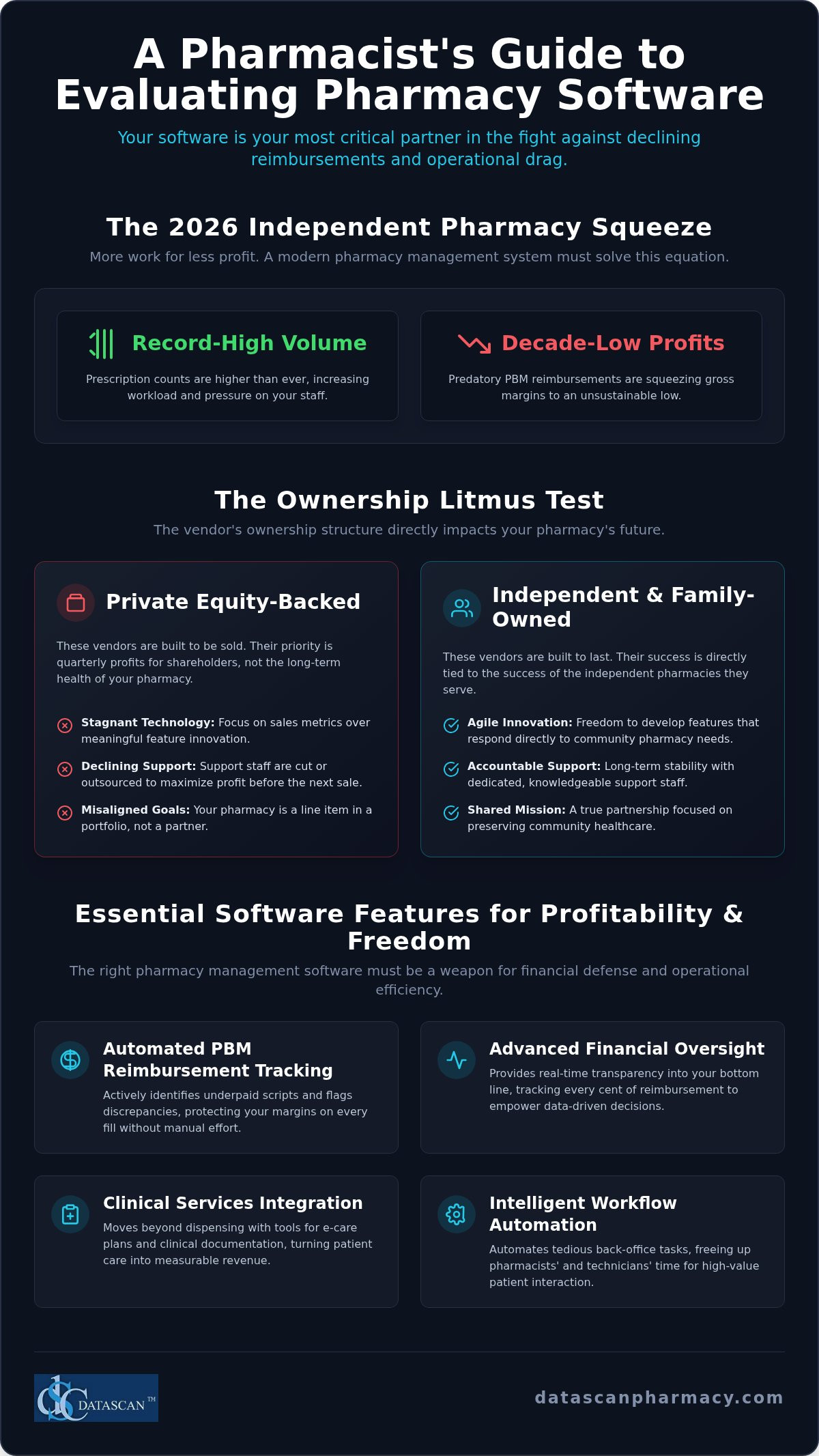
Your choice of technology isn’t just an IT decision. It’s the most critical business relationship you’ll ever form. As we move through 2026, the landscape for community pharmacies has shifted from simple prescription fulfillment to a complex battle for financial survival. When you’re evaluating pharmacy software vendors, you aren’t just buying a tool. You’re choosing an ally. A “utility vendor” might help you print a label, but a “strategic partner” provides the weaponry needed to fight back against declining PBM reimbursements and operational bloat.
This year serves as a pivotal turning point because the industry has reached a breaking point. While federal PBM reforms are finally on the horizon, the immediate reality remains a struggle with record-low gross profits despite increasing prescription volumes. A modern pharmacy management system must do more than just process claims. It must actively protect your margins by identifying underpaid scripts and automating the tedious back-office tasks that steal your time. The right pharmacy management software empowers you to transition from a passive participant in the healthcare system to a proactive, profitable provider.
The Shift from Dispensing to Clinical and Financial Profitability
Survival in 2026 requires a pivot toward clinical services and rigorous financial oversight. Your software must go beyond “lick, stick, and pour” to facilitate e-care plans and clinical documentation that turn patient care into measurable revenue. If a vendor focuses more on their own user-growth metrics than on your pharmacy’s gross profit, they’re a liability. You need integrated tools that prioritize your bottom line by tracking every cent of reimbursement in real time. This level of transparency is essential for overcoming the financial pressure exerted by PBMs and reclaiming your professional autonomy.
Avoiding the Corporate Consolidation Trap
The pharmacy technology market is currently plagued by corporate consolidation. Many vendors have sold out to private equity firms or large wholesalers, which often leads to a sharp decline in support quality and a focus on shareholder returns over feature innovation. When evaluating pharmacy software vendors, prioritize those that maintain their independence to ensure your voice remains heard. Partnering with an independently owned pharmacy software company ensures that your feedback actually matters. You deserve a partner whose success is directly tied to the success of independent pharmacies, not one that views your data as a commodity or treats your support calls as a nuisance to be outsourced.
The Ownership Litmus Test: Why Independent Pharmacies Need Independent Software
Don’t just look at the feature list; look at the boardroom. When you’re evaluating pharmacy software vendors, the most telling metric isn’t the number of lines of code. It’s the ownership structure. Corporate-owned vendors often operate with a looming exit strategy. They’re built to be sold. This creates a culture where quarterly profits for shareholders take precedence over the long-term operational health of your pharmacy. You need a partner whose roadmap is dictated by your needs, not by a private equity firm’s desire to “flip” a tech asset for a quick return.
Ownership directly influences how a company prioritizes its development cycle. An independent vendor has the freedom to innovate rapidly for community needs without waiting for approval from a distant corporate parent. This agility is vital in 2026, as PBM tactics shift faster than ever. When your software provider is an independent entity, they share your “underdog” perspective. They don’t view your pharmacy as a data point or a commodity. They view you as a partner in a shared mission to preserve community healthcare.
Private Equity vs. Family-Owned Stability
Private equity is about the “flip.” These firms buy software companies, lean out the support staff, and inflate growth metrics to attract the next buyer. This cycle leaves you with stagnant technology and a support team that doesn’t know your name. Contrast this with the stability of a family-owned vendor that has served the industry since 1981. A long-term vision allows for continuous investment in pharmacy management software that evolves alongside your business. Stability isn’t just about how long a company has existed; it’s about the consistency of its commitment to your niche.
Advocacy and the Personal Touch
Independence breeds advocacy. A vendor that isn’t beholden to a corporate parent or a wholesaler can speak freely about PBM reform and reimbursement transparency. They become a “Champion of the Independent,” building tools that specifically target underpaid claims because they understand your survival is their survival. This personal touch means you can reach leadership when it matters. It ensures your vendor adheres to the latest health information technology standards for interoperability without charging predatory “integration fees” just to keep their investors happy. If you’re ready to partner with a team that shares your values and understands your daily pressures, it’s time to start a conversation with us to see how we can support your growth.
Choosing an independent software provider ensures that your technology remains a tool for your success rather than a vehicle for someone else’s profit margin. When evaluating pharmacy software vendors, ask about their five-year plan. If that plan involves a merger or acquisition, your pharmacy’s future might be at risk. Secure your operations with a partner that is as committed to independence as you are.
Evaluating Technical Capabilities for PBM Reimbursement and Profitability
When you’re evaluating pharmacy software vendors, the technical specifications shouldn’t just be about processing speed; they must be about financial defense. In 2026, where PBMs continue to squeeze margins despite legislative promises, your Pharmacy Software needs to act as a real-time auditor. It’s about identifying revenue leaks before they become permanent losses. Solving the pharmacy technology puzzle means finding a system that prioritizes your gross profit over mere transaction volume. You need a platform that exposes the spread pricing and underpayments that often hide in plain sight.
Tools to Combat PBM Reimbursement Squeezes
Your Pharmacy management software must flag low-reimbursement claims the moment they are adjudicated. Don’t settle for retrospective reports that tell you how much money you lost weeks ago. You need integrated PBM reconciliation features that track every penny from the initial claim to the final payment. These tools allow independent pharmacies to overcome PBM-driven financial hurdles by providing the granular data needed to challenge underpaid claims or adjust purchasing strategies. Automating medication synchronization is another critical lever. It drives consistent monthly revenue and stabilizes cash flow, ensuring your pharmacy remains a viable healthcare hub in your community.
Workflow Automation for Time-Starved Owners
Time is your most valuable asset, yet most owners are buried in back-office tasks that don’t generate revenue. Implementing high-performance workflow software is the only way to reclaim hours for high-value patient care. Automation should handle the heavy lifting of the dispensing process, reducing the risk of human error and the constant threat of pharmacist burnout. When the system handles routine refills and doctor communications, you’re free to focus on clinical outcomes.
- Real-time margin tracking: Know your profit on every script at the point of adjudication.
- Automated inventory management: Prevent overstocking and reduce carrying costs with predictive ordering.
- Integrated patient engagement: Use technology to drive adherence without manual follow-up calls.
Every second saved by your technology is a second you can spend building patient relationships or exploring new clinical revenue streams. The efficiency of your dispensing process determines your ability to scale without adding expensive overhead. When you choose a partner that values your time, you’re investing in the longevity of your business. If your current system feels like a burden rather than a boost, it’s failing its most basic requirement.
The Service Difference: US-Based Support and the Migration Process
A high-performance system is only as effective as the team standing behind it. When you’re evaluating pharmacy software vendors, response time shouldn’t just be a bullet point on a sales sheet; it should be a binding promise. In the high-stakes environment of 2026, where every minute of downtime translates to lost revenue and frustrated patients, waiting hours for a callback from an offshore call center is unacceptable. You need immediate access to experts who understand the nuances of the American healthcare system and the specific pressures of independent pharmacy operations.
Offshore support often comes with hidden costs that aren’t visible in a contract. Language barriers and a lack of specialized US pharmacy knowledge can turn a simple technical question into a multi-day ordeal. When a vendor outsources their help desk, they’re distancing themselves from your daily struggles. True advocacy means providing a reliable, US-based support team that functions as an extension of your own staff, ensuring your Pharmacy management software remains an asset rather than a liability during peak hours.
The Value of US-Based Technical Support
Talking to a local expert who understands state-specific regulations and PBM complexities is non-negotiable for modern owners. Quality support reduces your daily stress levels and ensures operational continuity, allowing you to focus on patient outcomes rather than troubleshooting. We’ve seen how The Critical Role of US-Based Pharmacy Software Support can be the deciding factor in a pharmacy’s ability to navigate sudden industry shifts. Your vendor should be a partner you can call by name, not a ticket number in a global queue.
Ensuring a Stress-Free Pharmacy Software Conversion
The fear of a messy data migration keeps many pharmacists trapped in outdated systems. However, a structured conversion process can be seamless if your vendor prioritizes record integrity and data mapping. You should demand a clear roadmap that includes comprehensive training for your entire staff before the “go-live” date. To protect your business, always utilize a detailed Data Migration Checklist to ensure no patient records or insurance profiles are lost in transition.
- Data Integrity: Verify how historical prescription data and patient notes are preserved.
- Staff Training: Ensure your team is proficient with the new Pharmacy software workflow before switching.
- Post-Migration Support: Confirm that support staff are on standby during your first week of operation.
Don’t let the threat of a difficult migration stop you from upgrading your technology. If you’re ready to experience a transition backed by decades of experience and a team that actually cares about your success, contact our team today to discuss your custom migration plan. A smooth conversion is the first step toward reclaiming your time and securing your pharmacy’s future.
Final Selection Framework: Choosing the Best Pharmacy Software for Your Future
The final stage of evaluating pharmacy software vendors requires a cold, analytical look at the data you’ve gathered. You shouldn’t just rely on a gut feeling; instead, build a weighted scorecard that ranks each vendor on the pillars of independent success: ownership stability, PBM advocacy tools, and support quality. The best Pharmacy Software isn’t just a product you buy today. It’s a platform that evolves alongside your business to meet the challenges of 2026 and beyond. By quantifying these metrics, you can strip away the marketing gloss and see which partner truly aligns with your long-term profitability goals.
Transparency is the bedrock of a healthy partnership. As you finalize your decision, scrutinize the contract for hidden fees that often plague corporate-owned systems. Look for “integration fees” for wholesalers or “maintenance surcharges” that aren’t clearly defined. A champion of the independent will offer a straightforward agreement that reflects their commitment to your growth rather than their own quarterly dividends. Your Pharmacy management software should be an investment in your freedom, not a financial trap that limits your operational flexibility.
Critical Questions to Ask During Your Demo
The live demo is your opportunity to look beyond the sales pitch and test the software’s real-world utility. Ask about the frequency and cost of future software updates to ensure you won’t be hit with unexpected bills just to keep your system current. Inquire about deep integrations with your existing wholesalers and IVR systems; these connections are vital for maintaining a streamlined workflow. Finally, request references from other independent pharmacies currently using the system. Speaking with a peer who uses the tools daily will provide a level of honesty that no brochure can match.
Calculating Long-Term ROI Beyond the Initial Price
Don’t be blinded by a low entry price that hides a high total cost of ownership. When comparing systems, look at the projected ROI over a 5 to 10-year horizon. Factor in the revenue gains you’ll achieve from improved PBM tracking and the time you’ll reclaim through better workflow automation. For example, a system that identifies just a few underpaid claims per week can pay for itself in months. This analysis helps you understand the true value of a family-owned partner that prioritizes your retention over corporate expansion.
Securing your pharmacy’s future means choosing a partner that understands the high-stakes environment of 2026. When you’re evaluating pharmacy software vendors, remember that you’re choosing the foundation of your business. Select the vendor that offers the best balance of innovative technology, assertive PBM advocacy, and the personal accountability that only an independent company can provide. Your success is the ultimate metric of their performance.
Securing Your Pharmacy’s Legacy in an Evolving Market
The landscape of 2026 demands more than just a software provider; it requires a strategic alliance with a partner that understands the high-stakes reality of independent pharmacy. By prioritizing vendors with an “independent first” mindset, you ensure your technology remains a weapon against PBM pressure rather than a corporate liability. Throughout this guide, we’ve explored how the right pharmacy management software automates reimbursement tracking and provides the US-based support you need to eliminate operational bottlenecks.
When you’re evaluating pharmacy software vendors, remember that your choice defines your pharmacy’s trajectory for the next decade. Datascan has been family-owned and operated since 1981, delivering industry-leading support and built-in tools designed specifically for PBM reimbursement advocacy. Don’t settle for a vendor that views your business as a data point. It’s time to empower your team with technology that prioritizes your gross profit and operational freedom.
Discover how Datascan empowers independent pharmacies with innovative software solutions.
Your commitment to your community deserves a technology partner that is just as dedicated to your survival. Take the next step toward a more profitable, streamlined future today.
Frequently Asked Questions
What are the most important features to look for in a pharmacy management software vendor?
Look for tools that prioritize profitability and time management. Essential features include real-time PBM reimbursement auditing, automated medication synchronization, and integrated point-of-sale systems. When evaluating pharmacy software vendors, ensure the platform offers robust reporting that flags underpaid claims at the point of adjudication. It is also vital to select a vendor that provides localized, expert support rather than outsourced call centers. This combination ensures your operations stay efficient while your bottom line remains protected.
How long does the pharmacy software conversion process typically take?
The timeline for a pharmacy software conversion depends on the complexity of your data and the readiness of your team. Typically, the process involves several weeks of preparation, including data mapping and staff training, before the actual “go-live” date. A structured transition ensures that historical prescription records and patient profiles transfer accurately. Working with an experienced vendor that provides a dedicated conversion specialist can significantly minimize downtime and prevent operational disruptions during the switch.
Why should I avoid pharmacy software vendors owned by private equity firms?
Private equity-backed firms often operate with a focus on short-term quarterly gains and eventual exit strategies. This mindset can lead to reduced investment in customer support and stagnant feature development as they look to cut costs to satisfy shareholders. In contrast, family-owned companies maintain a long-term commitment to the industry. They prioritize the success of their clients because their own reputation is tied to the longevity of the independent pharmacies they serve.
Can modern pharmacy software really help me improve my PBM reimbursements?
Yes, advanced pharmacy management software is designed to audit claims in real time. These systems flag underpaid scripts at the point of adjudication, allowing you to address issues before they become permanent losses. By providing granular data on spread pricing and DIR fees, the right technology acts as your strongest advocate against PBM pressure. This level of financial transparency is essential for identifying revenue leaks and protecting your pharmacy’s shrinking margins in a competitive market.
Is US-based support actually better than offshore support for pharmacies?
US-based support is superior because it provides access to experts who understand the specific regulatory and insurance landscape of the American healthcare system. Offshore call centers often struggle with language barriers and a lack of specialized pharmacy knowledge, leading to longer resolution times. When a critical issue arises during peak hours, you need a partner who can communicate clearly and solve technical problems immediately without the frustration of waiting in a global queue.
What should I ask during a pharmacy software demo to ensure it fits my workflow?
During a demo, ask the vendor to show you the exact steps for processing a complex claim or managing a refill request. Inquire about the frequency of software updates and whether there are hidden costs for wholesaler integrations. It is also wise to ask for references from other independent pharmacies. This allows you to verify how the pharmacy system handles real-world pressures and whether the support team is as responsive as the sales pitch suggests.
How does pharmacy software help in reducing pharmacist burnout?
Technology reduces burnout by automating repetitive, time-consuming tasks like medication synchronization and patient refill reminders. When your pharmacy system software handles these routine operations, your staff can focus on high-value clinical services and patient interactions. Streamlined workflows eliminate the click-heavy administrative burdens that lead to mental fatigue. This allows you to run a more efficient business with a smaller, more focused team that isn’t overwhelmed by back-office manual labor.
What is the average cost of switching to a new pharmacy software system?
The cost of switching varies based on your specific needs, including the volume of data being migrated and the number of workstations required. Rather than just looking at the initial licensing fee, evaluate the total cost of ownership over several years. Consider the revenue gains from better PBM tracking and the time saved through automation. A pharmacy software partner that offers transparent pricing without hidden maintenance surcharges often provides the best long-term return on investment.
 Kevin Minassian is the President of Datascan Software. Under his leadership, the company rapidly expanded to provide pharmacy management software on a national level. Over the last 15+ years, he has ensured that Datascan has continuously evolved to offer innovative solutions for independent pharmacies while still offering world-class customer support. He is passionate about helping independent pharmacies to remain competitive, achieve success, and offer the very best service to their communities.