
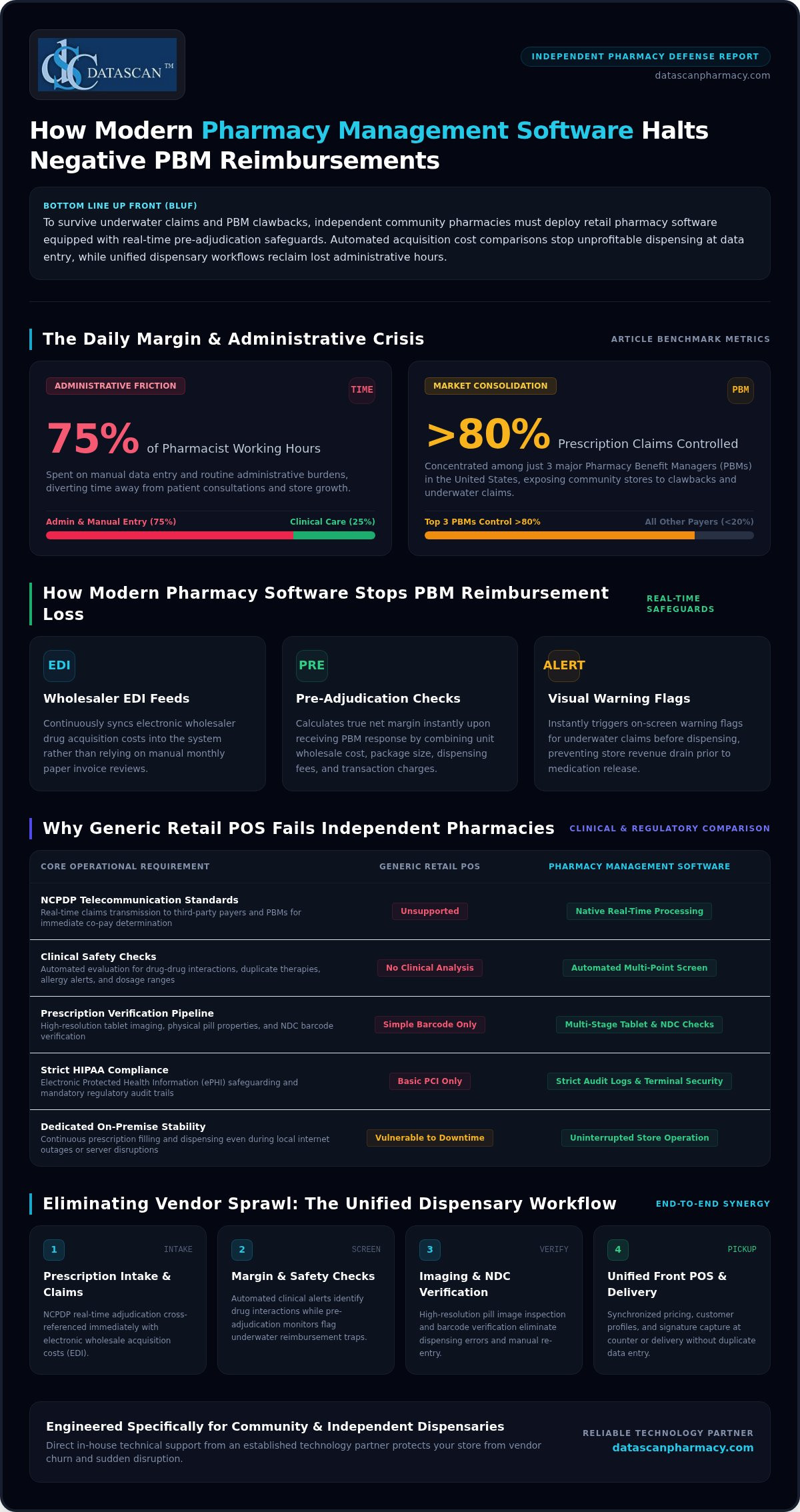
The best retail pharmacy software in 2026 must actively defend your profit margins, not just process claims. If you run an independent community pharmacy, you already know the daily frustration of underwater reimbursements, unexpected PBM clawbacks, and juggling separate vendors for dispensing and point-of-sale. Research shows that pharmacists spend up to 75% of their working hours on administrative tasks and manual data entry. That is valuable time stolen directly from patient consultations and business growth.
You deserve operational technology that works as your dedicated ally. In this guide, you will discover how modern pharmacy management software shields your prescription revenue with automated pre-adjudication safeguards, cuts dispensing bottlenecks with integrated verification tools, and eliminates vendor chaos. Here is our direct evaluation of the top pharmacy software solutions engineered to keep independent pharmacies profitable, efficient, and fully in control.
Key Takeaways
- Learn how real-time pre-adjudication safeguards in modern pharmacy management software flag underwater claims before dispensing, shielding store revenue against aggressive PBM clawbacks.
- Discover the essential features that separate modern retail pharmacy software from outdated legacy tools, including seamless integration between dispensary workflows, point-of-sale, and mobile communications.
- Explore how customizable verification workflows eliminate repetitive manual data entry, giving community pharmacy owners the operational freedom to focus on clinical care and business growth.
- Identify why choosing an established, family-owned technology partner with direct in-house technical support protects your dispensary from vendor churn and operational disruption.
What Is Retail Pharmacy Software and Why Does Your Dispensary Need It?
Retail pharmacy software is the operational engine of an independent dispensary, synchronizing prescription dispensing, real-time insurance billing, patient health profiles, and retail sales in a single system. It acts as an indispensable operational safeguard that prevents dangerous dispensing errors, shields store margins, and protects staff from administrative burnout. Because community dispensaries cannot afford downtime, dedicated on-premise stability ensures your staff continues filling prescriptions and serving patients without interruption, even during local internet outages or external server disruptions.
How Does Pharmacy Management Software Differ from General Retail POS?
Generic retail point-of-sale systems simply scan product barcodes, adjust inventory counts, and tally cash or card payments. They cannot navigate the clinical safety checks and regulatory requirements essential to community pharmacy practice. In contrast, a comprehensive Pharmacy management system manages complex, highly regulated clinical workflows that generic tools cannot touch:
- NCPDP Telecommunication Standards: Transmits real-time claims directly to third-party payers and pharmacy benefit managers (PBMs) for instant co-pay calculation and claim approval.
- Clinical Safety Checks: Automatically analyzes comprehensive patient records to flag drug-drug interactions, duplicate therapies, allergy alerts, and dosage ranges before filling.
- Prescription Verification: Integrates high-resolution tablet imaging, physical pill properties, and National Drug Code (NDC) barcode scanning across every dispensing stage.
- Strict HIPAA Compliance: Secures electronic protected health information (ePHI) across every terminal, preventing unauthorized access and maintaining strict audit logs.
Why Are Independent Pharmacies Moving Away from Fragmented Vendor Tools?
Running an independent pharmacy with fragmented, single-purpose software drains store resources. When your dispensing counter, front-end cash register, and patient messaging tools run on separate platforms, staff waste hours manually re-entering script numbers, patient details, and co-pays. This operational friction drives up overhead and exposes your pharmacy to costly verification mistakes.
Upgrading to unified pharmacy management software eliminates this vendor sprawl. By linking your dispensary directly to your front register and delivery operations, real-time retail pharmacy software synchronizes pricing, customer profiles, and prescription statuses instantly. Your team avoids double data entry, captures signatures cleanly at pickup, and gains the operational breathing room necessary to focus on high-value patient care.
How Does Pharmacy Management Software Combat Negative PBM Reimbursements?
Modern pharmacy management software acts as a direct financial shield against predatory pharmacy benefit manager (PBM) practices. With three major PBMs controlling more than 80% of prescription claims in the United States, independent dispensaries face aggressive audit penalties, unexpected post-fill adjustments, and underwater reimbursements on essential medications. Modern retail pharmacy software stops this cash drain by evaluating every claim against your true drug acquisition costs before a pill ever leaves the dispensary counter.
Instead of manually sorting through distributor invoices and remittance spreadsheets at the end of the month, automated software compares incoming electronic wholesaler acquisition costs (EDI feeds) against adjudicated co-pays and plan payments. If a claim reimburses below cost, the system immediately flags the transaction. This transparency is critical for calculating pharmacy gross profit accurately across every third-party payer contract.
How Can Prescribing Software Detect Underwater Claims Before Dispensing?
Pre-adjudication financial safeguards protect margins by stopping unprofitable fills in real time during intake and data entry:
- Real-Time Margin Safeguards: The system calculates true net margins by factoring in wholesale unit cost, package size, dispensing fees, and transaction fees instantly upon receiving the PBM response.
- Visual Warning Alerts: Bright on-screen visual banners alert pharmacy technicians immediately if an adjudication yields a negative margin, preventing the script from moving forward in the workflow.
- Clinical and Sourcing Interventions: With immediate notice, pharmacists can source alternative package sizes, evaluate secondary suppliers, or contact prescribers to switch to profitable therapeutic equivalents before dispensing the drug.
What Role Does Medication Synchronization Play in Cash Flow Predictability?
Managing prescription volume reactively leaves community dispensaries vulnerable to sudden wholesale price spikes and unpredictable reimbursement cycles. Integrated medication synchronization aligns multiple maintenance refills to a single, recurring monthly pickup date. Industry research highlights that leveraging AI and automation streamlines operational processes, and med-sync technology creates predictable weekly purchasing orders that prevent costly over-stocking.
Beyond smoothing out the dispensary workflow rhythm, synchronized patients consistently achieve higher proportion of days covered (PDC) scores. Maintaining superior adherence performance safeguards your store against punitive payer quality deductions and lowers the risk of targeted audit scrutiny. If your dispensary struggles with erratic payer adjustments, taking a moment to connect with a pharmacy software specialist can reveal how real-time claim auditing defends your bottom line.
What Core Features Should Independent Pharmacies Look for in a Pharmacy System?
The right retail pharmacy software must unite dispensary verification, financial reporting, clinical care documentation, and front-of-store sales within a single interface. Legacy systems that merely count pills and transmit basic claims leave community pharmacies vulnerable to audit fines, margin loss, and customer checkout delays.
When evaluating a new pharmacy system, compare basic legacy dispensers against a modern unified platform:
| Capability | Basic Legacy Dispensers | Modern All-in-One Pharmacy Software |
|---|---|---|
| Checkout Architecture | Standalone, unlinked third-party registers | Fully integrated point of sale with real-time script lookup |
| Clinical Services | Isolated paper notes or third-party portals | Integrated MTM logging, e-care plans, and immunization entry |
| Regulatory Tracking | Manual logs for pseudoephedrine (PSE) sales | Automated PSE tracking with digital signature capture |
| Card Compliance | Requires manual split-tenders at checkout | Certified SIGIS auto-routing for flexible spending accounts |
Why Is an Integrated Pharmacy Point-of-Sale System Essential for Retail Success?
Relying on an unlinked cash register invites dangerous dispensing errors and slows checkout lines. Utilizing an integrated platform like Datascan point of sale connects your front counter directly to active dispensary queues. Clerks scan prescription bag barcodes to confirm patient identities instantly, preventing wrongful releases and verifying co-pays on the fly.
Integrated POS terminals also handle complex retail regulations automatically. The system routes approved OTC items through certified SIGIS IIAS processing for hassle-free FSA and HSA spending, while real-time pseudoephedrine tracking records state-mandated limits without manual paper ledgers. For detailed optimization tactics, explore our resource on optimizing the pharmacy POS system for retail success.
How Do Patient Mobile Apps and Delivery Tools Expand Community Reach?
Community pharmacies succeed by providing personalized care that large retail chains and mail-order giants cannot match. Integrated tools expand this relationship beyond your brick-and-mortar storefront:
- Branded Mobile Refill Apps: Platforms like the MobileScripts patient mobile app empower customers to order refills, review med-sync schedules, and receive pickup alerts directly on their smartphones.
- Electronic Delivery Verification: Drivers equipped with the Datascan mobile delivery app record turn-by-turn route updates and collect HIPAA-compliant digital signatures right at the patient doorstep.
- Direct Patient Messaging: Two-way secure communications notify patients when scripts are ready, reducing will-call return-to-stock rates and building lasting community loyalty.
How Can Workflow Automation Software Free Up Valuable Time for Pharmacy Owners?
Customizable workflow automation frees independent pharmacy owners from the daily grind of manual paperwork, letting them redirect their energy toward clinical consultations and store revenue growth. When pharmacists spend up to 12 hours every week on manual data entry, their professional expertise is trapped behind a keyboard. Implementing specialized retail pharmacy software replaces chaotic paper bins with structured, rules-based queues that process scripts accurately with minimal technician intervention.
Effective retail pharmacy software divides dispensing into discrete operational stages: script intake, data entry, visual verification, dispensing, and final pharmacist sign-off. Implementing targeted workflow software allows stores to configure each checkpoint based on floor layout and staff credentials, eliminating counter bottlenecks. For actionable staffing models, review our guide on pharmacy workflow optimization software.
What Are the Critical Verification Checkpoints in a Modern Dispensing Workflow?
A structured workflow enforces patient safety and cuts verification liability through automated system checks:
- Hard-Stop Barcode NDC Verification: Technicians must scan the stock bottle barcode before counting. If the NDC does not match the adjudicated prescription, the software blocks the label from printing.
- High-Resolution Pill Imaging: The verification screen displays color photos of the front and back of the tablet, complete with physical imprint codes, so the checking pharmacist confirms contents at a glance.
- Dynamic Queue Routing: The engine automatically routes high-volume maintenance fills to secondary workstations or automated counting robots, keeping counter lanes open for acute, waiting patients.
How Does Automated Inventory Replenishment Prevent Overstock and Dead Shelves?
Uncontrolled inventory ties up thousands of dollars in operating cash on dispensary shelves. Intelligent stock automation links real-time dispensing directly to your primary drug wholesalers via electronic data feeds. Instead of requiring a technician to walk the aisles with a handheld scanner at closing, the system calculates reorder points based on rolling 30-day usage trends, seasonal demands, and minimum shelf targets.
Perpetual inventory management also tracks uncollected scripts in will-call. When a prescription reaches your store threshold without patient pickup, the system prompts a reverse claim and guides the technician to restock the medication. This immediate turnaround returns salable units to active stock before expiration, avoiding inventory write-offs. Ready to cut hours of busywork from your dispensary day? Schedule a practical workflow consultation to see automated dispensary queues in action.
Why Do Independent Pharmacies Choose Datascan Over Other Software Companies?
Datascan stands apart from corporate competitors because it combines four decades of family-owned independence with purpose-built technology designed specifically for community pharmacies. Unlike venture-backed vendors that force costly system migrations and prioritize outside shareholders, Datascan has supported independent community dispensaries across the United States continuously since 1981. Over twenty percent of client pharmacies have remained partnered with Datascan for more than 20 years, proving the value of long-term stability and client-driven development.
Every software update reflects direct feedback from working community pharmacists rather than corporate committee decisions. By delivering integrated tools for dispensing, point of sale, delivery management, and mobile refills, Datascan shields independent owners from vendor fragmentation while protecting local profitability. When you invest in retail pharmacy software, you need a dependable partner that treats your store as a priority, not an account number.
What Should Owners Expect During a Pharmacy Software Conversion?
Switching systems often feels daunting, but a structured transition plan eliminates downtime and preserves critical operational data:
- Complete Data Mapping: Experienced conversion specialists map your active patient files, historical prescription records, prescriber databases, and insurance profiles cleanly into the new environment.
- Parallel Validation Testing: Rigorous pre-launch audits verify script counts and balance sheets against your existing platform to ensure complete data integrity before going live.
- Role-Based Staff Training: Technicians and pharmacists complete interactive workflow training tailored to their daily duties, eliminating counter confusion on opening day.
How Does Dedicated US-Based Support Protect Daily Store Operations?
Dispensary issues require instant answers, not automated ticketing queues. When a processing snag stalls your fill queue or checkout counter, Datascan connects you directly to a dedicated, long-tenured technical support team located entirely in the United States. Without call center routing or offshore handoffs, experienced software specialists troubleshoot questions immediately, keeping your dispensing lines moving and maintaining steady patient service throughout the day.
Your community pharmacy deserves reliable technology backed by authentic, accessible accountability. Schedule a personalized demo with our pharmacy experts today to see how dedicated retail pharmacy software transforms daily operations, or connect with our team to upgrade your pharmacy system for lasting dispensary independence.
Equip Your Independent Pharmacy for Long-Term Growth
Independent community pharmacies cannot afford passive systems in an era of aggressive PBM clawbacks and tightening margins. Investing in modern retail pharmacy software gives your dispensary the pre-adjudication safeguards needed to stop underwater claims before they hurt cash flow, while unified point-of-sale and mobile tools eliminate administrative drag. When your dispensing workflow runs with rules-based precision, your pharmacists regain the daily bandwidth needed to deliver high-touch clinical care.
Datascan has proudly championed independent community pharmacies across the nation as a family-owned partner since 1981. With over 20% of client pharmacies partnered for more than 20 years and a responsive, US-based support team answering directly without call centers, you gain an enduring ally invested in your store’s independence. Protect your margins and simplify your dispensary operations today. Connect with the Datascan team today to request a live demo and discover what true operational efficiency can do for your business.
Frequently Asked Questions
What is the primary difference between retail pharmacy software and hospital pharmacy systems?
Retail pharmacy software focuses on outpatient dispensing, real-time third-party PBM claims adjudication, and customer-facing point of sale, whereas hospital systems manage inpatient electronic medication administration records (eMAR) and institutional bedside distribution. Community systems require direct NCPDP telecommunication standards, front-store inventory tracking, patient co-pay collections, and adherence tools. Inpatient systems integrate directly with hospital medical records to coordinate nursing administration schedules rather than processing retail prescription sales.
Can modern retail pharmacy management software help identify underpaid PBM insurance claims?
Yes, modern retail pharmacy software automatically audits claims against electronic wholesaler acquisition costs before dispensing to identify underpaid and underwater prescriptions. The software calculates your net margin by comparing adjudicated plan reimbursements against actual acquisition costs in real time. When a payer offers an underwater payment, visual alerts notify staff immediately, allowing pharmacists to review alternative package sizes, dispense generic equivalents, or reject negative claims before filling.
How difficult is it to migrate data when switching pharmacy software vendors?
Migrating to a new pharmacy system is straightforward when guided by an experienced vendor team executing structured data mapping and parallel testing protocols. Conversion specialists transfer historical dispensing records, patient profiles, active insurance plans, and prescriber files with minimal operational disruption. Pre-launch validation checks verify that prescription counts and balances match your legacy platform exactly, while structured staff training ensures technicians and pharmacists dispense smoothly from opening day.
Does retail pharmacy software include integrated point-of-sale and delivery tracking?
Leading all-in-one pharmacy software platforms include native point of sale (POS) and electronic delivery tracking directly inside the core dispensing system. Unifying front registers and mobile delivery tools eliminates expensive third-party vendor subscriptions. Clerks scan prescription barcodes to confirm patient identities at checkout, while delivery drivers capture electronic, HIPAA-compliant signatures on mobile devices curbside or at doorsteps, updating your store inventory and sales records instantly.
Why do independent pharmacies prefer on-premise pharmacy systems over cloud-based setups?
Independent pharmacies often rely on on-premise systems because local servers guarantee uninterrupted dispensing operations even during internet outages or external network failures. When outside web connections drop, an on-premise workstation keeps filling prescriptions, scanning barcodes, and serving walk-in patients without freezing. Store owners maintain physical custody of their operational database, avoiding remote server downtime, unexpected connection latency during peak hours, and third-party data center vulnerabilities.
How does barcode verification in retail pharmacy software reduce dispensing medication errors?
Barcode verification prevents dispensing mistakes by enforcing hard system stops whenever a scanned National Drug Code (NDC) does not match the prescription entry. During technician filling, the software requires a direct scan of the stock bottle. If the NDC, drug strength, or package size differs from the adjudicated order, the system halts the transaction before printing a label. This automated check eliminates wrong-drug errors and protects dispensary safety.
Can independent community retail pharmacies run medication synchronization through their dispensing software?
Modern pharmacy management software includes native medication synchronization modules to align all maintenance refills to a single monthly pickup date. Built-in med-sync dashboards track patient refill cycles, coordinate short fills for schedule alignment, and generate automated processing queues each month. This structured workflow eliminates sporadic prescription runs, smooths daily technician staffing requirements, improves patient adherence scores, and creates predictable wholesale inventory purchasing schedules.
 Kevin Minassian is the President of Datascan Software. Under his leadership, the company rapidly expanded to provide pharmacy management software on a national level. Over the last 15+ years, he has ensured that Datascan has continuously evolved to offer innovative solutions for independent pharmacies while still offering world-class customer support. He is passionate about helping independent pharmacies to remain competitive, achieve success, and offer the very best service to their communities.