In 2026, your retail pharmacy POS is no longer just a place to process transactions; it’s the primary clinical and financial safeguard standing between your independent business and total margin erosion. You’ve likely felt the crushing weight of shrinking reimbursements and those unpredictable DIR fees that eat into your bottom line before the patient even leaves the store. It’s a frustrating reality where inventory bloat and complex regulatory hurdles like DSCSA can make even a successful day feel like an uphill battle. We understand that as an independent pharmacist, you’re looking for more than just a tool; you’re looking for a partner that protects your legacy.
This checklist will reveal the critical features and compliance standards your hipaa compliant pharmacy pos system must meet to protect your margins and simplify patient care. By the end of this guide, you’ll know exactly how to achieve a streamlined checkout process and automated inventory management through a seamless integration between your POS and pharmacy management system. We’ll explore the essential technical requirements and real-time tracking capabilities that turn operational burdens into a modern, high-performance workflow built for the future of independent pharmacy.
Key Takeaways
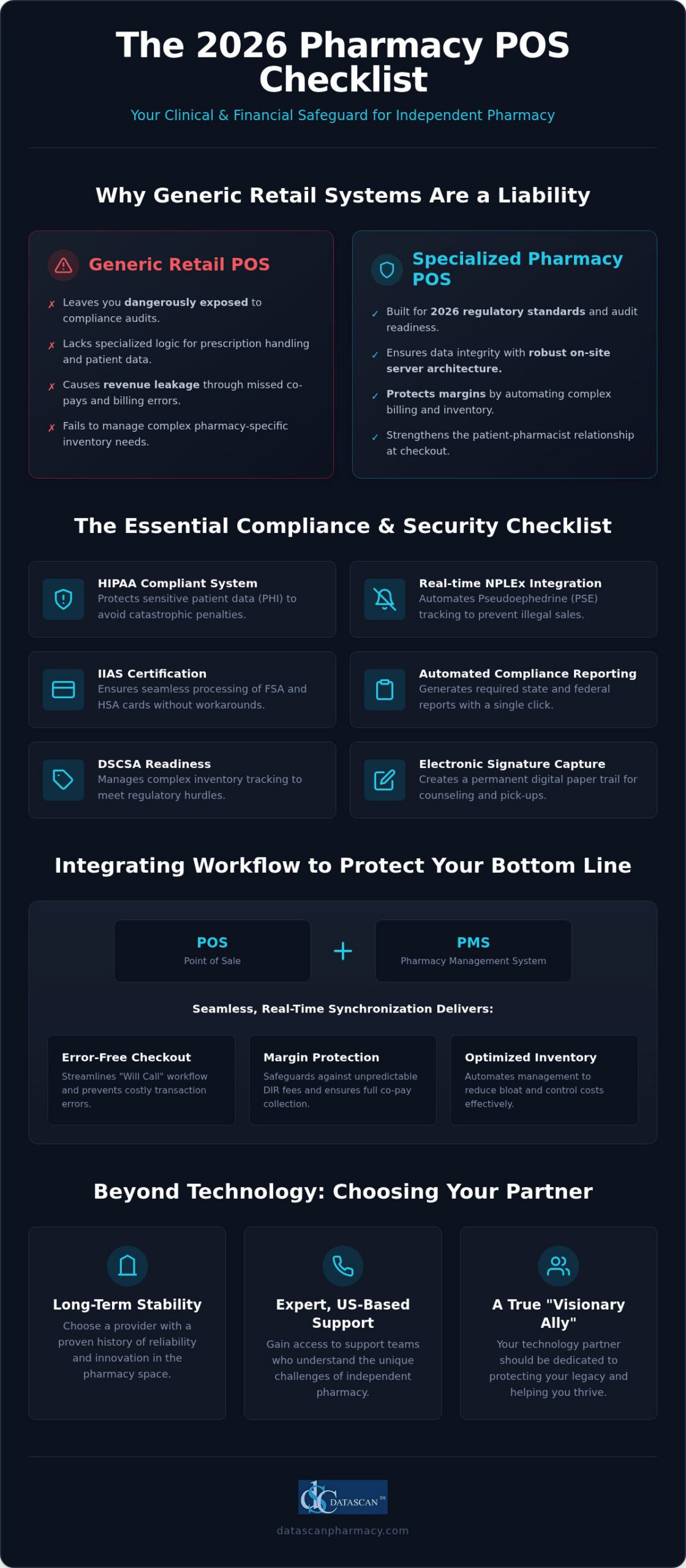
- Understand why generic retail systems leave you vulnerable to audits and why a specialized POS hub is mandatory for 2026 regulatory standards.
- Secure your patient data and maintain strict regulatory readiness by choosing a hipaa compliant pharmacy pos system that utilizes robust on-site server architecture.
- Streamline your “Will Call” workflow and prevent costly checkout errors through seamless synchronization between your POS and Datascan Pharmacy Management Software.
- Safeguard your margins against rising DIR fees by leveraging automated inventory management and specialized billing tools for compounding and 340B programs.
- Evaluate your technology partners based on long-term stability and the availability of expert, US-based support teams that understand the independent pharmacy landscape.
Beyond the Cash Register: Why Retail Pharmacies Need Specialized POS Technology
A retail pharmacy POS isn’t just a place to swipe cards; it’s the nerve center where clinical data, financial precision, and regulatory mandates converge. In 2026, the front counter has evolved into a high-acuity touchpoint. Patients now expect clinical consultations and specialized services right at the point of purchase, moving the pharmacy far beyond simple pill dispensing. Generic retail systems designed for coffee shops or boutiques leave independent pharmacies dangerously exposed to audits because they lack the specialized logic required for prescription handling. We believe your technology should act as a Visionary Ally, transforming these complex operational burdens into streamlined successes that protect your legacy.
Choosing a system built specifically for this niche industry is the only way to safeguard your margins against corporate consolidation. While big-box chains have massive IT budgets, independent pharmacies need a partner that understands their specific pressures. A specialized system doesn’t just record a sale. It validates the transaction against clinical records and ensures that every interaction strengthens the patient-pharmacist relationship. This level of specialization is what allows the “underdog” to not only survive but thrive in a competitive market. Furthermore, as you expand your digital footprint to attract new patients, staying informed on the foundational online growth strategies established by experts like 216digital ensures your pharmacy remains visible in an increasingly crowded local search environment.
The High Stakes of Pharmacy Compliance
Regulations don’t take a day off, and neither should your software. Every transaction involving a patient record must occur within a hipaa compliant pharmacy pos system to ensure data integrity and avoid the catastrophic penalties associated with data breaches. Specialized systems automate the heavy lifting by integrating directly with NPLEx for real-time Pseudoephedrine (PSE) tracking, which prevents illegal sales before they’re finalized. These tools also capture and store electronic signatures for counseling and prescription pick-ups, creating a permanent digital paper trail. This ensures that when auditors arrive, you have every necessary record at your fingertips, turning a high-stress event into a routine verification.
The Profitability Gap in Independent Pharmacy
Profitability in 2026 lives or dies at the checkout line. If your software doesn’t communicate fluently with your Pharmacy management system, you’re likely leaking revenue through missed co-pays and unbilled clinical services. By utilizing the Datascan Point of Sale, you close this gap through real-time synchronization that identifies billing opportunities and ensures every dollar owed is collected. The front-end is your primary area for margin growth this year. Your POS serves as the final line of defense against uncollected co-pays and lost inventory, ensuring that your hard work actually translates into bottom-line results.
The Essential Compliance & Security Checklist for Pharmacy POS Systems
Maintaining regulatory readiness in 2026 requires a shift from passive record-keeping to active, real-time data fortification. Your pharmacy isn’t just a retail storefront; it’s a healthcare facility handling highly sensitive protected health information (PHI). A hipaa compliant pharmacy pos system must act as your digital sentry, ensuring that every transaction meets the rigorous standards of federal law while protecting your business from the financial devastation of a data breach. Beyond simple encryption, your system needs to manage the complex interplay of Inventory Information Approval System (IIAS) requirements to ensure seamless processing of FSA and HSA cards, which helps you capture every possible sale without manual workarounds.
Mandatory Regulatory Integrations
Regulatory bodies don’t accept “system downtime” as an excuse for non-compliance. To stay ahead of audits, your checklist must include these non-negotiable features:
- Real-time NPLEx Integration: Automated tracking of Pseudoephedrine (PSE) sales ensures you never exceed legal limits and prevents illicit transactions before they are finalized.
- Automated Compliance Reporting: Your system should generate state and federal reports with a single click, removing the risk of human error during manual data entry.
- Secure Electronic Signature Capture: Capturing signatures for HIPAA acknowledgments and PMP requirements must be integrated directly into the checkout flow to ensure a complete audit trail.
Data Ownership and System Reliability
While many vendors push remote hosting models, we believe independent pharmacies deserve the stability of physical data ownership. A locally-hosted database provides zero-downtime reliability, ensuring your registers stay open even if your internet connection fails. This architecture is a cornerstone of meeting the HIPAA Security Rule, as it keeps your patient data within your four walls rather than on a distant server you don’t control. By utilizing the Datascan Point of Sale, you benefit from end-to-end encryption for credit card processing that functions without external dependencies, securing your finances and your patients’ trust simultaneously.
Internal security is just as vital as external protection. Robust user permission levels allow you to restrict access to sensitive financial data or inventory adjustments based on employee roles. This granular control is your best defense against internal shrinkage and accidental data exposure. If you’re ready to fortify your operations against the complexities of 2026, it’s time to reach out to our team for a personalized compliance assessment. Protecting your legacy starts with choosing a system that values your independence as much as you do.
Workflow Integration: Why Your POS and Pharmacy Management Software Must Speak
A POS system is only as powerful as its communication with your central Datascan Pharmacy Management Software. If these systems don’t share a single source of truth, you risk dispensing errors and wasted labor hours that your independent pharmacy simply can’t afford. A hipaa compliant pharmacy pos system ensures that patient profiles are updated instantly across your entire operation, eliminating the friction of manual data entry and protecting sensitive information. This real-time synchronization means that a change in a patient’s record at the pharmacy counter is reflected immediately at the register, maintaining the high standards required for HIPAA compliance in the pharmacy.
Safety remains the cornerstone of patient care, and barcode scanning at the register serves as your final line of defense. By scanning the prescription at the point of sale, the system verifies that the correct medication is being handed to the correct patient. This simple yet critical step prevents catastrophic dispensing errors that could damage your reputation and threaten your license. We believe your technology should empower your staff to work with total confidence, knowing the system is actively preventing mistakes before they happen. To see how integrated pharmacy pos software workflows can eliminate the gap between your front-end and back-end operations, explore our in-depth guide on mastering these systems in 2026.
The Will Call Management Checklist
Efficiency at the front counter starts with a robust Will Call workflow. Your POS should offer specialized features that go beyond simple transaction recording to optimize the patient experience. Use this checklist to evaluate your current system’s capabilities:
- Prescription Batching: The ability to link multiple prescriptions for the same patient under a single barcode for faster, more professional checkouts.
- Real-time Status Updates: Knowing exactly where a prescription is in the workflow—whether it’s filled, verified, or ready for pickup—directly from the register terminal.
- Automated Return to Stock: System-generated alerts for unclaimed prescriptions after a set period, ensuring your shelves stay clear and your inventory remains accurate.
Inventory Synchronization Best Practices
Profitability in 2026 relies on lean, precise inventory management that reacts to sales data in real time. Your POS should trigger automatic reordering from your wholesalers based on actual sales, preventing both stockouts and the “inventory bloat” that ties up your cash flow. A unified database for front-end and back-end items is essential for maintaining a clear picture of your pharmacy’s financial health. If you operate multiple locations, your system must provide multi-store inventory visibility, allowing you to transfer stock between sites and optimize your assets across the entire enterprise. This level of optimization turns your inventory from a liability into a competitive advantage.
Profitability Features: Protecting Margins and Retaining Patients
In 2026, protecting your independent pharmacy’s bottom line requires a strategic shift from simple sales to clinical profitability. A modern hipaa compliant pharmacy pos system does more than process payments; it serves as a sophisticated financial engine that handles complex compounding solutions and specialized billing tasks that generic systems ignore. By integrating these high-margin services directly into your checkout flow, you ensure that every custom medication is billed accurately and every clinical service is captured. This level of detail is vital for maintaining the financial health of your business while staying within the strict boundaries of healthcare regulations.
Pharmacists often struggle with shrinking reimbursements, but the right technology helps you fight back by turning every interaction into a value-added opportunity. Unlike big-box retailers, your loyalty programs should focus on clinical outcomes rather than just commercial volume. For example, your system can identify nutrient depletion, where certain medications strip the body of essential vitamins, and prompt staff to suggest supplements at the register. This approach doesn’t just increase your basket size; it improves patient outcomes and reinforces your role as a trusted advisor. Achieving this level of performance depends on having truly integrated pharmacy pos software that unifies your clinical and retail data into a single, actionable workflow.
The Margin Protection Checklist
To survive the current economic climate, you need visibility into every transaction. Your POS should provide these essential tools to keep your business lean and profitable:
- Real-time Margin Analysis: View profitability by product category to identify underperforming stock and optimize your front-end mix.
- DIR Fee Tracking: Automated estimation of DIR fees at the point of sale prevents end-of-quarter financial surprises.
- 340B Management Tools: Contract pharmacies need these tools to ensure compliance and maximize reimbursement without manual reconciliation.
Patient Retention and Engagement
Keeping patients loyal means meeting them where they are. Integration with a patient mobile app allows for seamless pick-up notifications that drive foot traffic back into your store. Additionally, managing delivery logistics via an electronic delivery system ensures that even your homebound patients receive top-tier service. A truly hipaa compliant pharmacy pos system also ensures that these retention efforts never compromise patient privacy. By offering customizable loyalty points that reward health-conscious purchases, you build a community of patients who value your expertise over a chain’s convenience. If you’re ready to see how these profitability features can transform your business, contact our team today for a personalized walkthrough.
Selecting Your Partner: Why Support and Longevity Matter in Pharmacy Tech
Choosing a technology partner in 2026 is one of the most consequential decisions you’ll make for your independent pharmacy. While a feature list provides a baseline, the true value of a hipaa compliant pharmacy pos system lies in the company standing behind it. In an era of aggressive corporate consolidation, many software vendors have become distant entities prioritizing shareholder returns over pharmacist success. Selecting a family-owned partner that has been operational since 1981 provides a level of stability and accountability that massive corporations simply can’t replicate. You aren’t just buying software; you’re securing a visionary ally dedicated to your long-term growth.
Immediate, expert assistance is non-negotiable when your registers are down or a compliance audit is underway. We’ve seen the frustration that occurs when pharmacies are forced to deal with offshore call centers that don’t understand the nuances of the US healthcare market. US-based support teams ensure that you’re speaking with experts who understand your specific pressures and can provide immediate troubleshooting. This support structure is why the Datascan Point of Sale remains the logical choice for independent owners who refuse to be treated like just another ticket number in a corporate queue.
Vendor Evaluation Checklist
Before signing any contract, you must look past the sales pitch to evaluate the vendor’s actual track record. Use these questions to separate the true partners from the mere providers:
- Market Longevity: How long has the company been serving the independent pharmacy market specifically? Look for decades of experience, not just years.
- Support Accessibility: Is the support team located in the US and available during your most critical pharmacy hours?
- Innovation History: Does the company have a documented history of consistent, innovative feature updates that respond to market trends?
The Implementation and Migration Process
A seamless transition is vital to ensuring your pharmacy doesn’t skip a beat during a system upgrade. You must demand a comprehensive data migration plan that guarantees no patient history or clinical record is lost in the move. High-touch training for your staff is equally important, as even the most powerful hipaa compliant pharmacy pos system is useless if your team doesn’t know how to leverage its full potential. Your partner should also provide a clear roadmap for future developments, such as e-care plans and enhanced clinical modules. This forward-thinking approach ensures that your technology remains a competitive advantage rather than a legacy burden, allowing you to focus on what matters most: your patients. To further support their wellness journey, you might suggest they check out BioNavs for personalized metabolic and longevity coaching.
The landscape of independent pharmacy in 2026 demands more than just endurance; it requires a proactive shift toward specialized technology that treats your front counter as a clinical hub. You’ve seen how a generic register isn’t enough to protect you from audits or shrinking margins. A true hipaa compliant pharmacy pos system must integrate deeply with your management software to automate compliance and capture every missed billing opportunity. This level of synchronization is what transforms a simple transaction into a safeguarded clinical interaction.
Choosing a partner is about more than a feature list; it’s about finding an ally that shares your values. At Datascan, we’ve been family-owned and operated since 1981, providing the specialized US-based support you need to navigate mission-critical operations with confidence. We’ve built our tools specifically for independent pharmacy success, ensuring you have the precision and speed to thrive against corporate competition. Don’t let outdated systems hold your business back. It’s time to Empower your independent pharmacy with Datascan POS solutions and take control of your financial future. Your legacy is worth protecting, and we’re here to help you lead the way.
Frequently Asked Questions
What is a retail pharmacy POS system?
It’s a specialized transaction hub that bridges the gap between retail sales and clinical pharmacy management. Unlike standard registers, it handles prescription pick-ups, pseudoephedrine tracking, and electronic signatures while maintaining health data security. It acts as the final clinical check before a patient leaves the store, ensuring that patient records and financial data remain synchronized and accurate within a single, secure environment that prioritizes patient safety.
Can I use a regular retail POS for my pharmacy?
No, using a generic retail system leaves your independent pharmacy vulnerable to massive compliance failures and audit penalties. Regular systems don’t have the specialized logic to track NPLEx data, manage “Will Call” bins, or capture required HIPAA signatures. A specialized hipaa compliant pharmacy pos system is mandatory because it understands the complex regulatory nuances of the healthcare industry, protecting your license and your bottom line from avoidable errors.
How does a pharmacy POS help with HIPAA compliance?
A pharmacy POS secures Protected Health Information (PHI) by using encrypted local databases and strictly controlled user access levels. It automates the capture of electronic signatures for privacy acknowledgments and keeps a permanent, auditable digital paper trail of every patient interaction. This ensures that your staff follows federal guidelines during every transaction, significantly reducing the risk of data breaches or accidental disclosures of sensitive patient medical history.
What is IIAS and why does my pharmacy need it?
IIAS stands for Inventory Information Approval System, a technical standard that allows your POS to automatically identify FSA and HSA eligible items. Without it, you can’t accept these health-related payment cards for over-the-counter products, which frustrates patients and leads to lost sales. Implementing IIAS ensures your pharmacy can process these transactions seamlessly, capturing revenue from patient healthcare spending accounts while meeting strict IRS requirements for substantiation at the register.
Does a pharmacy POS integrate with insurance billing?
Yes, a specialized POS system communicates directly with your pharmacy management software to pull the exact co-pay amounts determined during the adjudication process. This prevents manual entry errors at the register and ensures you collect the correct amount from the patient. It also helps track uncollected co-pays, acting as a financial safeguard that ensures your hard-earned insurance reimbursements aren’t undermined by losses at the point of sale.
How does inventory management work in a pharmacy POS?
Inventory management works through real-time synchronization between front-end sales and back-end stock levels. When an item is scanned at the register, the system immediately decrements your inventory and can trigger automatic reorders from wholesalers based on your custom par levels. This prevents both stockouts and inventory bloat, ensuring your cash flow isn’t tied up in stagnant products while keeping your most profitable items on the shelves for your patients.
Why is US-based support important for pharmacy software?
US-based support is critical because pharmacy operations are time-sensitive and governed by complex domestic regulations. When a register goes down or an auditor walks in, you don’t have time to explain US pharmacy law to an offshore call center. Having a team of experts who understand the American healthcare landscape ensures faster resolution times and higher accuracy, keeping your pharmacy operational and compliant during high-stakes situations where every second counts.
Can a POS system help reduce DIR fees?
While a POS cannot eliminate DIR fees entirely, it helps mitigate their impact by providing real-time tracking and estimation at the point of sale. By identifying high-DIR transactions and monitoring patient adherence through your hipaa compliant pharmacy pos system, you can make more informed decisions to protect your margins. This visibility allows you to adjust your business strategy and avoid the “clawback” surprises that often cripple independent pharmacy finances.
 Kevin Minassian is the President of Datascan Software. Under his leadership, the company rapidly expanded to provide pharmacy management software on a national level. Over the last 15+ years, he has ensured that Datascan has continuously evolved to offer innovative solutions for independent pharmacies while still offering world-class customer support. He is passionate about helping independent pharmacies to remain competitive, achieve success, and offer the very best service to their communities.