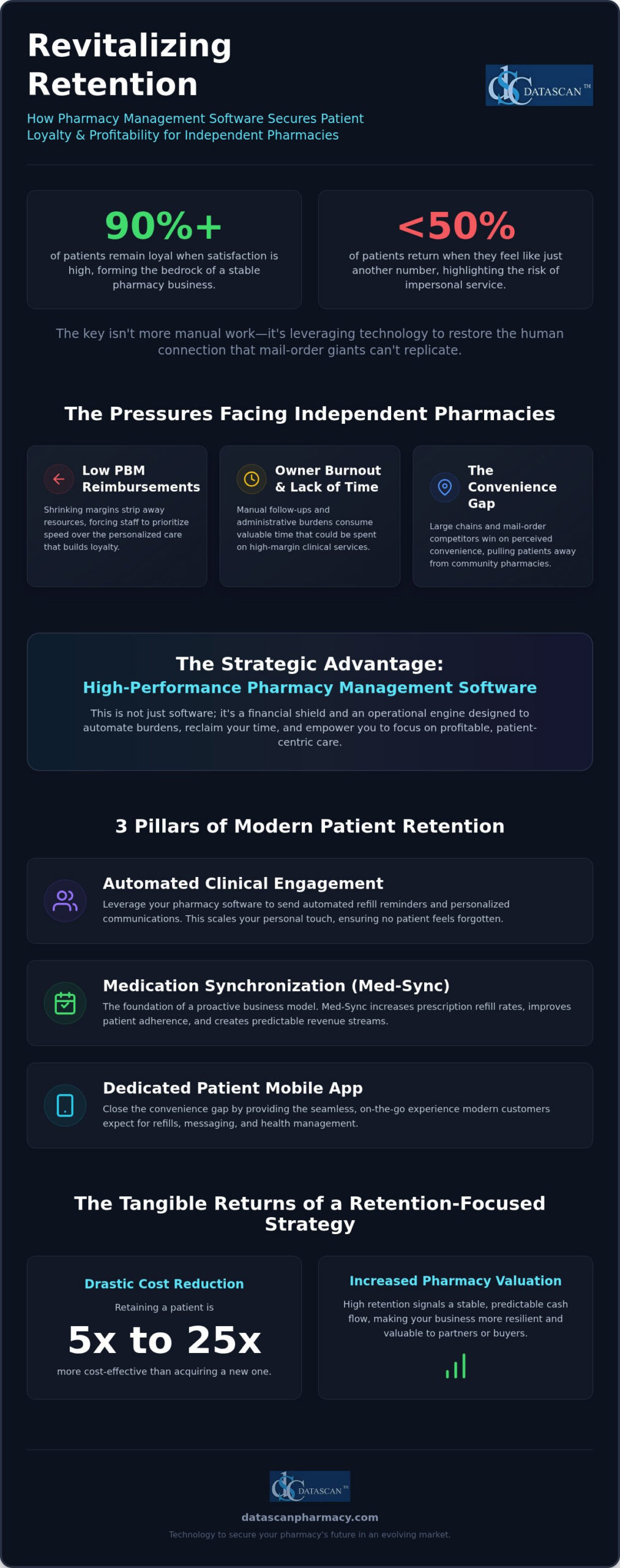
Did you know that over 90% of pharmacy patients will remain loyal when satisfaction is high, yet fewer than half return when they feel like just another number in a database? In 2026, successful pharmacy patient retention strategies aren’t about flashy marketing; they’re about using automation to restore the human connection that mail-order giants simply cannot replicate. You’ve likely felt the burnout of manual patient follow-ups while battling declining PBM reimbursements and the persistent financial pressure of DIR fees. It’s a frustrating cycle that often leaves far too little room for the personalized clinical care that defines your independent pharmacy’s mission.
We understand that as an independent owner, your time is your most valuable asset and your greatest competitive advantage. This guide will show you how to leverage high-performance pharmacy management software to stop patient churn and build a more resilient, profitable business. By integrating clinical engagement directly into your daily workflow, you’ll discover how the right pharmacy software can automate refills and free you to focus on high-margin services. We’re diving into the exact tools and tactics you need to transform operational burdens into streamlined successes and secure your pharmacy’s future in an evolving market.
Key Takeaways
Discover how to blend automated clinical engagement with digital convenience to build a loyal patient base that resists chain pharmacy competition.
Understand the financial impact of PBM reimbursements and DIR fees and how modern technology can help you reclaim time for profitable clinical services.
Master the latest pharmacy patient retention strategies by leveraging automated refill reminders and customizable workflows within your pharmacy software.
Learn why medication synchronization is the foundation of a proactive business model that increases prescription refill rates and improves patient outcomes.
Close the convenience gap with mail-order giants by utilizing a dedicated patient mobile app to provide the seamless, on-the-go experience modern customers expect.
What are the best pharmacy patient retention strategies for 2026?
Effective pharmacy patient retention strategies in 2026 prioritize a seamless blend of automated clinical care and digital convenience to secure long-term loyalty. While traditional customer service remains a staple of community pharmacy, modern retention is defined by your ability to keep patients engaged through every stage of their healthcare journey. Retention in this landscape isn’t just about a friendly greeting; it’s the continuous, tech-enabled relationship that ensures a patient chooses your counter over a mail-order package every single month.
Friendly faces aren’t enough to stop the bleed to mail-order giants and massive retail chains. These competitors win on perceived convenience, so you must win by combining your clinical expertise with advanced pharmacy management software. Technology-enabled clinical engagement allows you to scale your personal touch. It ensures no patient falls through the cracks because of a manual follow-up system that’s simply too slow to keep up with a busy pharmacy’s pace. By leveraging these tools, you transform your pharmacy from a pill dispensary into a proactive health hub.
Why is patient retention critical for independent pharmacies today?
Retaining a patient is significantly more cost-effective than acquiring a new one, often costing five to twenty-five times less based on standard industry data. Beyond immediate refill revenue, a loyal patient base directly increases your pharmacy’s valuation. High retention rates signal a stable and predictable cash flow to potential buyers or partners, making your business more resilient against market shifts. Most importantly, strong retention is the key to better patient adherence. When patients stay with your pharmacy, they’re more likely to follow their prescribed regimens, which improves health outcomes and reduces the risk of hospital readmissions in your community.
How has patient engagement evolved in the digital age?
The days of relying solely on walk-in traffic are over. Today’s patients expect multi-channel engagement that meets them where they are, whether that’s through a text message or a mobile app. Modern pharmacy management software bridges the communication gap by automating the outreach that once required hours of manual labor from your staff. This evolution has moved the industry toward patient-centric care models, where tools like workflow software enable the creation of e-care plans. These digital records allow you to document clinical interventions easily. They help you demonstrate your value to payers and transform a simple prescription fill into a comprehensive healthcare encounter that patients truly value.
How do PBM reimbursements and DIR fees impact patient retention?
Low PBM reimbursements and DIR fees directly sabotage pharmacy patient retention strategies by stripping away the financial resources needed to provide high-quality, personalized care. When your margins are squeezed, your staff is often forced to prioritize speed over clinical engagement; this leads to the very “impersonal” experience that drives patients toward competitors. While the 2024 shift to point-of-sale DIR fees provided more transparency, the resulting impact on cash flow remains a significant hurdle for independent pharmacies trying to maintain a loyal customer base in 2026.
Your pharmacy management software must act as a financial shield in this environment. By identifying which prescriptions are actually profitable and which are costing you money, you can pivot your focus toward clinical services that offer better returns. A superior Digital Experience Crucial for Pharmacies ensures that even when reimbursements are low, the value you provide through engagement keeps patients from switching to PBM-mandated mail-order programs. Retention isn’t just a goal; it’s a defense mechanism against aggressive PBM mandates that seek to pull patients away from community pharmacies.
Can technology help overcome PBM-related revenue loss?
High-performance pharmacy management software automates the reconciliation process, ensuring you claim every cent owed and reducing the risk of missed payments. Beyond simple claims, using data to pinpoint high-margin opportunities like specialized compounding or clinical consultations allows you to diversify your income. This shift helps you maintain the staffing levels necessary to keep patients coming back. For a deeper look at protecting your bottom line, learn how to calculate pharmacy gross profit to ensure your pricing and service mix are optimized for the current market.
Why PBM reform starts with building a loyal patient base
A large, dedicated patient base isn’t just a revenue stream; it’s leverage. When patients actively resist being funneled into mail-order because they value your local expertise, PBMs lose their absolute control over the market. To strengthen this position, you must use your workflow software to document clinical interventions meticulously. Proving your value to payers through data-driven outcomes is the most effective way to advocate for fair reimbursements. If you’re ready to see how a more efficient system can protect your profits, reach out to our team to learn more about our advocacy-focused technology.
How can pharmacy management software automate patient engagement?
Modern pharmacy management software transforms passive patient interactions into active engagement by automating routine communications and streamlining internal tasks. These automated systems are essential for pharmacy patient retention strategies because they ensure your pharmacy stays top-of-mind without requiring constant manual effort from your staff. By leveraging features like automated refill reminders, you can significantly reduce the “forgotten prescription” rate and keep your patients on their therapy schedules.
Safety and trust are the silent pillars of retention. Advanced pharmacy software utilizes barcode verification throughout the dispensing process to virtually eliminate errors. This precision builds a level of confidence that patients won’t find at high-volume chains where staff are often rushed. Furthermore, integrating workflow software into your daily operations frees up your technicians and pharmacists. Instead of being buried in paperwork or manual follow-ups, your team can spend more face-to-face time with patients, reinforcing the personal bond that defines independent pharmacy.
What workflow features drive the most loyalty?
Efficiency at the counter is a major driver of patient satisfaction. Your “Will Call” management system is a critical touchpoint; if a patient has to wait while staff hunts for a bag, trust erodes. Automated task management prevents these bottlenecks by ensuring prescriptions are ready and filed correctly before the patient arrives. For those offering specialized care, customizable workflow steps allow you to tailor the process for complex needs like compounding. This level of organization ensures that even the most intricate orders are handled with speed and precision, preventing the frustration of long wait times.
Using data to personalize the patient experience
Personalization is the biggest advantage you have over big-box competitors. Your pharmacy computer system tracks deep histories and preferences, allowing you to move beyond generic service. By analyzing this data, you can send targeted messaging based on specific health conditions, such as diabetic care tips or immunization reminders. Citing the importance of digital solutions in pharmacy, it’s clear that patients now expect a high-tech, high-touch experience. When you use data to anticipate a patient’s needs, you aren’t just a service provider; you’re a dedicated health partner, making it much harder for them to consider switching to a mail-order alternative. Expanding into cash-pay revenue streams, such as using pharmacy software for veterinary prescriptions, is another data-driven strategy that can diversify your income and reduce your dependence on PBM-controlled margins.
Why is medication synchronization the foundation of pharmacy loyalty?
Medication synchronization (med sync) is the most powerful tool for transforming your business from a reactive dispensary into a proactive healthcare destination. By aligning all of a patient’s maintenance medications to a single monthly pickup date, you create a structured “Appointment Based Model” (ABM) that significantly enhances pharmacy patient retention strategies. Instead of waiting for patients to realize they’re out of pills, your pharmacy software allows you to take the lead, ensuring they never miss a dose and stay tethered to your care long-term.
This shift to a proactive model does more than just improve adherence; it builds a predictable, recurring revenue stream that stabilizes your pharmacy’s financial health. When you know exactly which prescriptions are leaving the shelf and when, you can optimize your inventory and staffing levels with precision. This reliability is the cornerstone of loyalty. Patients value the peace of mind that comes from knowing their entire health regimen is managed by a single, competent professional who values their time as much as their health.
How to implement a successful med sync program
Launching a med sync program doesn’t have to be an operational burden if you follow a methodical approach. You can use your pharmacy management software to identify and enroll patients in three simple steps:
Identify: Run a report to find polypharmacy patients who are taking three or more maintenance medications.
Consult: During their next pickup, explain the convenience of a single monthly visit and the benefit of a comprehensive medication review.
Sync: Use your software to calculate “short fills” and align all prescriptions to a single anchor date.
The secret to long-term success is the monthly “sync call.” This brief check-in, performed a few days before the pickup date, is your best opportunity for relationship building. It’s a chance to ask about new symptoms, confirm upcoming refills, and remind the patient that you’re an active partner in their wellness journey, not just a retail clerk.
The efficiency gains of synchronized refills
Med sync is a massive win for pharmacy operations because it effectively eliminates “delivery fatigue.” Instead of sending a driver to the same house four times a month, you make one efficient trip. This level-loading of your daily prescription volume prevents the chaotic “Monday rush” and ensures your team isn’t overwhelmed by unpredictable workflows. By utilizing integrated workflow software, you can prep these orders during slower periods, freeing your staff for face-to-face clinical engagement when it matters most. If you’re ready to stabilize your workflow and secure your patient base, contact our team today to see how our synchronization tools can work for you.
How can a dedicated patient mobile app stop patients from switching to mail-order?
A dedicated patient mobile app eliminates the “convenience gap” that often drives customers toward mail-order giants by providing a seamless, digital-first experience. By offering chain-level technology, you ensure that your pharmacy patient retention strategies are backed by the modern accessibility patients now demand. This digital presence neutralizes the primary reason patients switch pharmacies while reinforcing your role as a trusted local provider who’s always within reach.
Independent pharmacies often struggle against the perceived ease of “set-it-and-forget-it” mail-order services. However, a mobile app like MobileScripts levels the playing field by offering a suite of features that prioritize the user’s time. Patients want more than just a place to pick up medication; they want easy refills, secure messaging, and real-time status updates at their fingertips. When you combine these features with electronic delivery tracking, you provide a seamless home experience that rivals any national competitor while maintaining your unique clinical expertise.
Winning the convenience battle with mobile refills
The “one-tap” refill process is a critical deterrent against patient churn. When a patient can request a refill in seconds from their smartphone, the friction of calling the pharmacy or driving over disappears. Push notifications play a vital role here as well. They’re significantly more effective than emails or phone calls, which often go ignored or end up in spam folders. These timely alerts keep patients engaged with their therapy and ensure they don’t forget their next dose. Additionally, providing access to digital health records through the app makes patients feel “anchored” to your pharmacy. Once their history and preferences are centralized in your digital ecosystem, the perceived cost of switching to a new provider becomes much higher. To maximize these benefits, learn the most effective methods for promoting a new pharmacy mobile app to patients so you can drive adoption and ensure your investment delivers real retention results.
Building trust through secure messaging
Building long-term loyalty requires more than just transactional efficiency; it requires accessible, reliable communication. HIPAA-compliant messaging within your app allows patients to ask quick clinical questions without the need for a phone call or an office visit. This digital access replicates the classic “hometown pharmacist” feel but delivers it in a way that fits a 2026 lifestyle. You aren’t just a faceless corporation; you’re a reachable healthcare partner. Patients are far less likely to leave a pharmacy where they have a direct, secure messaging with patients app solution that gives them a trusted line to their provider. This digital bond reinforces your pharmacy patient retention strategies by proving that high-tech solutions can actually enhance high-touch, personal care.
Future-Proof Your Pharmacy with Actionable Retention Tools
The independent pharmacy landscape is shifting, but you don’t have to face PBM pressures alone. Implementing robust pharmacy patient retention strategies requires a strategic combination of automated clinical engagement, proactive medication synchronization, and the digital convenience of a modern mobile app. By leveraging advanced pharmacy management software to streamline your workflow, you reclaim the time needed to focus on high-value patient care and protect your profitability from aggressive market mandates.
Datascan has stood as the champion of the independent for over 40 years. As a U.S.-based, family-owned partner, we’re consistently ranked among the top pharmacy systems for support and innovation. We understand your operational burdens and provide future-proof solutions that help you thrive in any market. See how Datascan Pharmacy Software empowers your independent pharmacy to win. You have the clinical expertise to lead your community; let us provide the technology to ensure your success remains permanent.
Frequently Asked Questions
How do I start a patient retention program with limited staff?
You can launch a retention program by automating your most time-consuming tasks through your pharmacy management software. Instead of relying on manual phone calls, use automated refill reminders and text alerts to keep patients engaged. This approach allows your limited staff to focus on high-value clinical interactions rather than administrative chores. Starting small with one or two automated features ensures you build a sustainable foundation without overwhelming your current team or resources.
What are the most common reasons patients leave independent pharmacies?
Patients typically leave independent pharmacies due to a perceived lack of convenience compared to mail-order giants or big-box chains. While they value your expertise, they often switch when they encounter friction in the refill process or lack digital tools like a mobile app. Additionally, aggressive steering tactics from PBMs can pull patients away. Combatting this requires a mix of seamless digital experiences and proactive clinical engagement to prove your unique value.
Can pharmacy software really help me compete with Amazon and big chains?
Yes, the right pharmacy software provides the same technological advantages as national chains while allowing you to maintain your personalized service. Tools like the MobileScripts patient app offer the “one-tap” convenience that modern consumers expect. By automating your back-end operations, you free up the time necessary to provide the deep, clinical care that faceless corporations cannot match. It effectively levels the playing field by closing the technology gap.
Is medication synchronization worth the effort for a small pharmacy?
Medication synchronization is one of the most effective pharmacy patient retention strategies regardless of your store’s size. It transforms your daily workflow from a reactive scramble into a predictable, manageable schedule. For a small pharmacy, this efficiency is vital because it maximizes your limited staff’s output. By aligning refills to a single date, you reduce delivery costs and create recurring touchpoints that solidify patient trust and improve long-term health outcomes.
How much does a patient mobile app cost for an independent pharmacy?
Costs for a patient mobile app typically involve a monthly usage fee that covers deployment, ongoing support, and regular updates. While specific pricing depends on your pharmacy’s volume and specific needs, these tools are designed to be an affordable investment for independent owners. The return on investment comes through reduced patient churn and higher refill rates. You should check with your vendor for a quote tailored to your specific operational scale.
How do I measure my pharmacy patient retention rate?
You can measure retention by tracking the percentage of patients who refill their maintenance medications at your pharmacy over a twelve-month period. Your pharmacy management software should provide reports that identify active versus inactive patients based on their last fill date. Monitoring your “churn rate,” or the number of patients who stop using your services, helps you identify exactly where your retention strategies need adjustment to protect your bottom line.
What role does the pharmacy POS play in patient loyalty?
Your pharmacy POS is the final opportunity to reinforce a positive patient experience and collect valuable data. An integrated system allows for quick, accurate transactions and supports loyalty programs or specialized discounts that keep patients coming back. It also tracks purchasing habits, which enables you to offer personalized recommendations. A smooth checkout process reduces frustration and ensures that the last interaction a patient has with your pharmacy is professional and efficient.
Can automated refill reminders actually improve my bottom line?
Automated reminders directly boost profitability by capturing refills that patients might otherwise forget or delay. When your pharmacy management software automatically notifies a patient that their medication is ready, it significantly reduces the rate of abandoned prescriptions in your will-call bin. These consistent touchpoints increase the total number of fills per patient each year. This steady volume helps offset the financial pressure caused by low PBM reimbursements and helps stabilize your pharmacy’s cash flow.
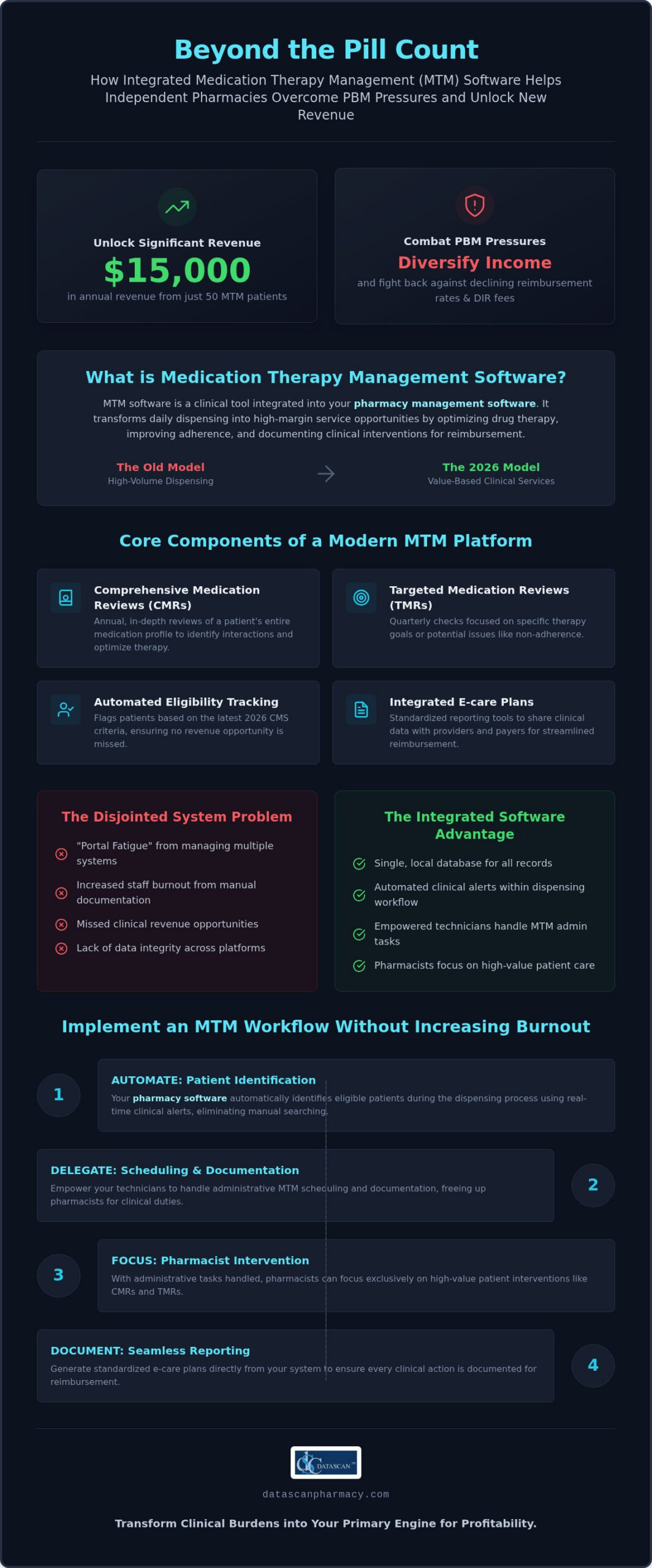
With an independent pharmacy generating up to $15,000 in annual revenue from just 50 MTM patients, medication therapy management software has become the primary engine for profitability in 2026. This technology streamlines clinical workflows by automating patient identification and integrating e-care plans directly into your pharmacy management software, effectively turning clinical burdens into efficient revenue streams. You’ve felt the weight of PBM reimbursement pressures and the burnout caused by manual documentation for far too long. It’s frustrating when your systems don’t talk to each other, leaving you to manage disjointed data while trying to care for your community.
Discover how modern medication therapy management software transforms these operational hurdles into profitable, automated workflows that protect your bottom line. We’ll explore how to use integrated tools to identify patients who meet the updated 2026 CMS eligibility criteria and how to sync clinical tasks with your dispensing routine. You’ll learn how to increase revenue from e-care plans while freeing up the time you need to actually run your business. This guide provides a clear roadmap for independent pharmacies to overcome PBM pressures and thrive through clinical innovation.
Key Takeaways
Combat PBM reimbursement pressures by diversifying revenue through clinical e-care plans that transform daily dispensing into high-margin service opportunities.
Optimize your workflow with medication therapy management software that integrates clinical tasks directly into your pharmacy software to eliminate the inefficiency of managing multiple disjointed portals.
Reduce staff burnout by automating the identification of eligible patients using the updated 2026 CMS criteria, ensuring no clinical revenue is left on the table.
Maintain complete data integrity and operational speed by choosing an integrated pharmacy management software solution that keeps dispensing and clinical records in a single, local database.
Empower your technicians to handle administrative MTM scheduling and documentation, which allows pharmacists to focus exclusively on high-value patient interventions.
Medication therapy management (MTM) software is a clinical tool used by pharmacists to optimize drug therapy, improve patient adherence, and document clinical interventions for reimbursement. As we move through 2026, the traditional model of high-volume dispensing is being replaced by a service-oriented clinical model that prioritizes patient outcomes over pill counts. Modern pharmacy management software now integrates these tools to automatically identify high-risk patients, helping you capture revenue that used to slip through the cracks. This transition isn’t just about clinical excellence; it’s about business survival. By utilizing Medication therapy management protocols, you can improve your Star Ratings and patient health outcomes while securing your pharmacy’s financial future.
Why is MTM software critical for independent pharmacies in 2026?
The landscape for independent owners has changed drastically with the shift from volume-based to value-based reimbursement models. You can’t rely on dispensing margins alone when PBMs continue to squeeze every cent out of your transactions. Clinical documentation provides the necessary proof to justify professional service fees, allowing you to fight back against reimbursement pressures. When your medication therapy management software generates real-time clinical alerts, it does more than just protect patient safety; it creates a documented trail of intervention that proves your value to the healthcare system. This data-driven approach is your best defense against arbitrary DIR fees and declining margins. It’s time to stop letting PBMs dictate your worth and start using your clinical expertise to drive profit.
What are the core components of an MTM platform?
A robust platform must go beyond basic alerts to provide a total solution for clinical care. Integrated clinical workflows ensure you aren’t jumping between disjointed systems to complete essential tasks. Core components include:
Comprehensive Medication Reviews (CMRs): Annual, in-depth reviews of a patient’s entire medication profile to identify drug interactions.
Targeted Medication Reviews (TMRs): Quarterly checks focused on specific therapy goals or potential issues like non-adherence.
Automated Eligibility Tracking: Systems that flag patients based on the latest 2026 CMS criteria, including those taking five or more chronic medications.
Integrated E-care Plans: Standardized reporting tools that allow you to share clinical data with other providers and payers easily.
Having these tools inside your pharmacy management software means your team can move from dispensing to clinical consultation without missing a beat. It’s about working smarter, not harder, to maximize the value of every patient interaction while building a sustainable, clinical-first business model.
What are the essential pharmacist clinical workflow tools for MTM?
Essential MTM workflow tools include automated medication synchronization, real-time clinical alerts within the dispensing queue, and integrated mobile outreach applications. These technologies allow independent pharmacies to fight PBM reimbursement pressures by maximizing clinical revenue through high-margin services without the need for additional staff. By embedding medication therapy management software directly into your daily operations, you transform clinical care from a secondary task into a primary profit center. High-performing pharmacies utilize these tools to ensure accuracy through integrated barcode verification and clinical check steps, ensuring that every intervention is documented and every opportunity for reimbursement is captured.
Effective pharmacy management software must serve as a total solution that eliminates the friction of disjointed systems. Relying on external portals often leads to “portal fatigue,” where valuable clinical opportunities are missed because the data isn’t visible during the fill process. Utilizing a mobile patient app further enhances this workflow by providing a secure channel for patient outreach and CMR scheduling. This digital connection reduces the time spent playing phone tag and allows your team to focus on delivering high-quality care that improves patient adherence and boosts your Star Ratings.
How do automated clinical alerts improve efficiency?
Automated clinical alerts function as actionable intelligence that appears exactly when you need it most. When your system flags a pending MTM opportunity “at-the-counter,” it identifies a prime moment for patient counseling that would otherwise be lost in the daily rush. This integration eliminates the need for pharmacists to log into multiple external websites just to check for eligibility. By catching CMRs and TMRs during the standard fill process, you reduce missed revenue and ensure your clinical documentation is as fast and precise as your dispensing. It’s about working smarter within your existing pharmacy software to capture every available clinical fee.
The importance of integrated medication synchronization
Medication synchronization serves as the foundation for any successful MTM program. By aligning a patient’s chronic medications to a single monthly pickup date, you create a predictable window for comprehensive clinical reviews. When these med sync tools are linked to your pharmacy workflow software, you gain superior inventory control and can plan your staffing needs with precision. This structured approach allows you to schedule MTM sessions when you know the patient will be in the store, turning a chaotic administrative burden into a repeatable, profitable clinical process. If you want to see how these features can transform your bottom line, reach out to our team for a closer look at our customizable clinical tools.
How does MTM software help independent pharmacies fight PBM reimbursement pressures?
Independent pharmacies use medication therapy management software to combat PBM reimbursement cuts by documenting value-based clinical services that generate non-dispensing revenue. This technology provides the clinical evidence and billing capabilities needed to offset predatory DIR fees and razor-thin dispensing margins. By shifting your focus from volume to high-value clinical interventions, you capture professional service fees that PBMs cannot easily claw back. High-performing pharmacy management software tracks your gross profit from clinical activities separately from dispensing, giving you a clear picture of where your business is actually growing. In a market where dispensing is often a race to the bottom, your clinical expertise is your most valuable, and most profitable, asset.
How can technology help overcome PBM underpayment?
Technology serves as your first line of defense against underpaid claims by identifying prescriptions that require clinical intervention or prior authorization before they impact your bottom line. As of January 2026, PBMs are prohibited from using spread pricing in many state Medicaid programs and California-regulated health plans. This shift toward pass-through pricing models makes clinical documentation even more vital. Your software should automate the documentation required for higher-tier reimbursement levels, ensuring you receive the maximum professional fee for every CMR or TMR you perform. Pairing your MTM tools with robust pharmacy compliance reporting software gives you the automated audit trail needed to defeat PBM clawbacks and protect every dollar you’ve earned. This business intelligence allows you to see which contracts are truly profitable and provides the data you need to drop those that consistently underpay for your services.
Building a ‘Clinical First’ business model
Transitioning your pharmacy from a “pill shop” to a local healthcare hub is the only way to remain sustainable in the current PBM landscape. Using MTM services allows you to build stronger, data-backed relationships with local physician networks by proving your role in improving patient outcomes. When you share e-care plans with prescribers, you demonstrate your value as a clinical partner rather than just a vendor. This shift creates a loyal patient base that values your expertise, which is essential for long-term retention. Learn how our pharmacy management software supports clinical growth by providing the tools you need to lead this transformation in your community. By prioritizing clinical care, you secure a revenue stream that is independent of PBM volatility and focused on the health of your patients.
How do you implement an MTM clinical workflow without increasing staff burnout?
Implementing a clinical workflow without increasing staff burnout requires delegating non-clinical tasks to technicians and using high-visibility dashboards to manage daily priorities. By leveraging medication therapy management software, you can automate the administrative heavy lifting that typically drains your team’s energy. Technicians can take the lead on scheduling, patient outreach, and basic data intake through integrated workflow tools, leaving pharmacists free to focus exclusively on high-value clinical interventions. This division of labor ensures that your pharmacy captures clinical revenue without overwhelming your staff or slowing down the dispensing queue. When your team sees their priorities at a glance on a “Bottom Line Up Front” dashboard, they spend less time searching for tasks and more time delivering profitable care.
Standardizing your documentation process is another critical step in protecting your staff from exhaustion. Modern pharmacy management software reduces the time spent on paperwork by using templates that auto-populate patient data into clinical reports. This efficiency is enhanced by mobile patient apps that eliminate the constant burden of phone tag. Instead of manually calling every eligible patient, your system can send automated reminders and secure messages, allowing patients to confirm appointments at their convenience. This digital outreach preserves your team’s mental bandwidth for the complex therapeutic reviews that drive your business forward. Pairing this approach with a dedicated pharmacy app for prescription refills further reduces manual data entry and frees your staff to concentrate on clinical priorities.
What are the best practices for MTM task management?
Successful MTM implementation often involves setting specific “clinical hours” or utilizing a rolling queue approach that fits your store’s natural rhythm. By using customizable workflow stages, you can track the progress of every CMR and TMR from identification to billing. It is vital to keep these tasks integrated within your primary pharmacy system rather than using separate logins. This unified approach prevents the cognitive load of switching between platforms and ensures that clinical opportunities are visible during every prescription fill. Optimize your team with advanced workflow software to ensure that every staff member knows exactly what needs to happen next in the clinical cycle.
Reducing the administrative burden of e-care plans
The transition to e-care plans doesn’t have to be a manual data entry nightmare. High-performing systems offer one-click submission of clinical interventions to national registries, ensuring your work is recognized and reimbursed quickly. Templates should do the majority of the work by pulling current medication lists and patient demographics directly from your database. This level of automation turns a potentially hour-long documentation task into a five-minute verification. If you’re ready to modernize your operations without burning out your best people, schedule a workflow consultation with our team today to see these tools in action.
Why choose an integrated pharmacy management system for MTM services?
Choosing an integrated pharmacy management system for MTM services is the most effective way to eliminate “portal fatigue” and maintain total data integrity across your clinical and dispensing workflows. When your medication therapy management software lives inside your primary database, you avoid the productivity drain of managing separate logins and disjointed patient records. This unified approach ensures that clinical checks happen in real-time during the prescription fill, allowing your team to identify revenue-generating opportunities without skipping a beat. For independent owners, this isn’t just a convenience; it’s a strategic necessity for protecting margins in a high-pressure PBM environment.
Working with a family-owned vendor like Datascan provides a level of accountability that massive corporations simply can’t match. Since 1981, we’ve served as a dedicated ally to the independent pharmacy, building tools that reflect the actual daily struggles of your business. Our US-based support team understands your workflow bottlenecks and resolves them quickly, ensuring your pharmacy management software remains an asset rather than a headache. You deserve a partner that treats your success as their own, offering the personal touch and specialized expertise needed to thrive in 2026.
Integrated vs. Standalone MTM: Which is better?
Integrated systems are superior because they prioritize operational speed and cost-efficiency over the fragmented approach of standalone portals. While standalone tools might offer basic functionality, they force your staff to duplicate data entry and manage multiple vendor contracts, which drives up your monthly overhead. An integrated solution offers a significantly shorter learning curve for your team because the clinical tools use the same interface they already use for dispensing. This synergy allows for more frequent clinical interventions, turning every patient interaction into a potential profit center while keeping your operational costs low.
Future-proofing your pharmacy for 2026 and beyond
Your pharmacy computer system must serve as the central brain of your operation to handle the evolving demands of clinical care and ongoing PBM reform. As reimbursement models shift further toward value-based outcomes, you need a vendor that rapidly adds innovative features to help you stay ahead of market trends. Choosing a local, non-SaaS solution ensures that your data remains secure and immediately accessible, providing the reliability you need to run a high-volume clinical hub without interruption. If you’re ready to secure your future and reclaim your time, request a demo of Datascan’s integrated MTM and pharmacy management solutions today to see how we empower the independent underdog.
Secure Your Pharmacy’s Clinical Future
The landscape of 2026 demands that independent pharmacies pivot from traditional dispensing to a clinical-first model to survive aggressive PBM reimbursement cuts. By implementing integrated medication therapy management software, you transition your business into a high-margin healthcare hub without the administrative headache of disjointed systems. You’ve seen how automated med sync and technician-led workflows protect your staff from burnout while capturing every clinical opportunity that meets the updated 2026 CMS eligibility criteria. This isn’t just about adding a feature; it’s about reclaiming your time and securing your bottom line.
Datascan has been a dedicated partner to the independent underdog since 1981. We provide 100% US-based support and innovative e-care plan integrations that keep your dispensing and clinical data in one secure, local database. This total solution approach ensures you never have to deal with the inefficiency of external portals again. You have the expertise to lead your community’s health, and we have the technology to make it profitable. Take the next step toward operational excellence and long-term sustainability. It’s time to transform your clinical burdens into streamlined successes.
How does MTM software improve pharmacy profitability?
MTM software improves pharmacy profitability by allowing you to bill for clinical services that are independent of traditional dispensing margins. By documenting Comprehensive Medication Reviews and Targeted Medication Reviews, you capture professional fees that directly offset the impact of PBM reimbursement cuts. This shift to a service-oriented model increases your gross profit while building a more loyal patient base, ensuring your independent pharmacy remains sustainable in a competitive market.
Can MTM software help reduce DIR fees?
Yes, medication therapy management software is a critical tool for reducing DIR fees by improving the performance metrics that PBMs use to calculate clawbacks. By utilizing integrated clinical alerts to boost medication adherence and identify drug therapy problems, you improve your pharmacy’s Star Ratings. Higher performance scores often lead to lower DIR fee categories, protecting your revenue from predatory PBM practices while simultaneously improving health outcomes for your community.
Do I need a separate software for MTM and dispensing?
You don’t need separate software; in fact, using an integrated pharmacy management system is much more efficient for your clinical workflow. Integrated systems eliminate “portal fatigue” by keeping all clinical and dispensing data in a single, local database. This allows your team to see MTM opportunities in real-time during the fill process without logging into external websites. A total solution approach ensures data integrity and saves your staff valuable time every day.
What is an e-care plan in pharmacy software?
An e-care plan is a standardized digital document used to record clinical interventions and share them with a patient’s broader healthcare team. Modern pharmacy software uses these plans to track medication changes, health goals, and patient outcomes in a format that payers recognize for reimbursement. By integrating e-care plans into your daily routine, you provide a professional level of care that justifies clinical fees and proves your value to local physician networks.
How much time does it take to implement MTM software?
Implementation time varies based on your current setup, but integrated clinical tools can typically be activated and ready for use within a few business days. The process involves configuring your workflow stages and training your staff on how to identify and document interventions. Because the tools are part of your existing pharmacy system, the learning curve is short, allowing your team to start capturing clinical revenue without a long transition period for your staff.
What are the CMS requirements for MTM programs in 2026?
As of January 2026, CMS has expanded MTM eligibility to include Medicare Part D patients taking five or more chronic medications, which is a decrease from the previous requirement of eight. Patients must also have at least one chronic condition and total medication costs exceeding $4,935 annually. Your medication therapy management software should automatically flag these eligible patients, ensuring you never miss an opportunity to provide a reimbursable Comprehensive Medication Review for your community.
Is US-based support important for pharmacy systems?
US-based support is vital because it ensures that the technicians helping you understand the specific regulatory and financial pressures of the domestic pharmacy market. When you face a workflow bottleneck or a clinical documentation issue, you need a partner who can provide immediate, expert assistance without language barriers or time zone delays. Datascan has provided this level of dedicated, family-oriented support since 1981, prioritizing the needs of independent pharmacy owners nationwide.
How does medication synchronization work with MTM?
Medication synchronization serves as the foundation for a successful MTM program by aligning a patient’s chronic prescriptions to a single monthly pickup date. This predictable schedule creates the perfect window for pharmacists to perform clinical reviews and consultations while the patient is already in the store. By linking med sync tools with your clinical workflow, you transform a chaotic administrative task into a repeatable and profitable clinical service that significantly improves patient adherence.
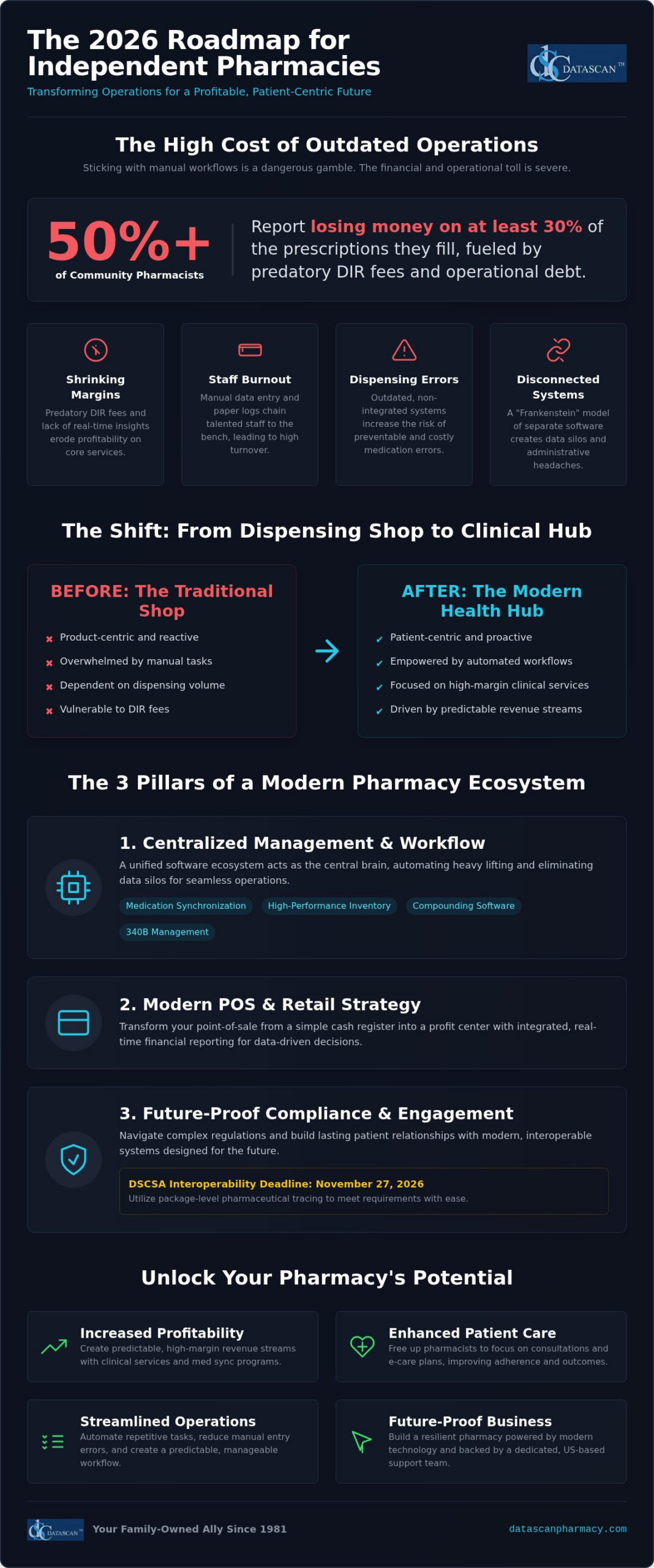
Did you know that over half of community pharmacists now lose money on at least 30% of the prescriptions they fill? It’s a staggering reality fueled by predatory DIR fees and the crushing weight of manual data entry that keeps your staff chained to the bench. You didn’t become a pharmacist to spend your day fighting disconnected systems or wrestling with paper logs. To survive and thrive, you must modernize pharmacy operations and pivot from a simple dispensing shop to a high-margin clinical health hub. At Datascan Pharmacy Software, we understand the pressure you’re under as an independent. As a family-owned ally since 1981, we’ve spent decades championing the underdog against corporate giants who want to see your margins disappear.
This 2026 roadmap reveals how to reclaim your time and profitability by leveraging a unified digital ecosystem. You’ll discover how to streamline workflows to free up your team for revenue-generating clinical services and med sync programs. We’ll explore the critical steps needed to meet the November 27, 2026, DSCSA interoperability deadline while maximizing patient retention through modern mobile engagement. By the end of this guide, you’ll have a clear strategy to transform your pharmacy from a manual operation into a streamlined, future-proof powerhouse.
Key Takeaways
Shift your business model from a product-centric shop to a clinical health hub to combat shrinking margins and DIR fees.
Implement a unified software ecosystem to modernize pharmacy operations, effectively removing the manual bottlenecks that cause staff burnout.
Leverage automated medication synchronization and clinical service tools to create predictable revenue streams and improve patient adherence.
Navigate the 2026 DSCSA requirements with ease by utilizing interoperable tracking systems that simplify package-level pharmaceutical tracing.
Build a future-proof business with a dedicated, US-based support team that prioritizes the unique needs of independent pharmacy owners.
Why Modernizing Pharmacy Operations is Essential in 2026
Modernization isn’t just a buzzword; it’s a survival strategy for the independent pharmacist. To modernize pharmacy operations effectively, you must integrate digital tools that automate the manual, repetitive tasks that drain your staff’s energy. Many pharmacies currently struggle with “operational debt,” a state where legacy, non-integrated systems force teams to work harder, not smarter. This friction prevents you from competing with large corporate chains that have deep pockets for tech. We’ve seen this cycle before since we started in 1981. It starts with a new regulation and ends with the chains pulling ahead while independents scramble to catch up. By choosing a unified software ecosystem, you transform these operational burdens into a distinct competitive advantage.
The Cost of Doing Nothing
Sticking with manual workflows is a dangerous gamble in 2026. When your team is bogged down by paper logs and disconnected databases, preventable dispensing errors become more likely. To mitigate these risks by digitizing physical records, you can explore Premium App Subscription Fees for professional mobile utilities that help transition your pharmacy to a paperless workflow. The financial toll is equally severe. Research from the NCPA Digest shows that more than half of community pharmacists report losing money on at least 30% of the prescriptions they fill. Without real-time insights into DIR fees and acquisition costs, your margins continue to shrink. This environment doesn’t just hurt your bottom line; it drives staff turnover. Talented technicians won’t stay in an environment where they feel like data entry clerks rather than healthcare professionals. You can’t afford to let your most valuable assets walk out the door because of outdated technology.
From Dispensing to Clinical Excellence
The future of pharmacy lies in clinical services, not just dispensing volume. Automation is the key that unlocks this transition. When your software handles the heavy lifting, your pharmacists can spend their time on e-care plans and patient consultations. This evolution aligns with the principles found in this Health Informatics Overview, which details how information technology improves patient safety and health outcomes. With tools like Datascan Pharmacy Management Software, you can easily implement med sync programs that drive adherence. In 2026, Medicare Part D beneficiaries face a $2,100 out-of-pocket maximum, making adherence and clinical guidance more critical than ever. Modernized operations empower you to lead your community’s health while securing your pharmacy’s financial future. You’re no longer just a pill dispenser; you’re a vital healthcare hub.
The Three Pillars of a Modern Digital Pharmacy Ecosystem
A truly modernized pharmacy isn’t just a collection of separate tools; it’s a living, breathing ecosystem where every component communicates in real time. To modernize pharmacy operations effectively, you must move away from the “Frankenstein” model of bolting together disconnected software from different vendors. This fragmented approach creates data silos, leading to synchronization errors and administrative headaches. A single-vendor ecosystem ensures that patient data flows seamlessly from the management system to the register and out to the patient’s mobile device. This level of integration preserves data integrity while providing you with a 360-degree view of your business health.
Centralized Management and Workflow
The Datascan Pharmacy Management Software acts as the central brain of your operation. It’s designed to automate the heavy lifting that usually eats up your staff’s time. Built-in medication synchronization software is a non-negotiable feature for 2026. It allows you to align refills and create a predictable, manageable workflow. High-performance inventory management tools prevent you from tying up capital in overstock while ensuring you never face a stockout on critical medications. For pharmacies offering specialized services, integrated Compounding Pharmacy Software and 340B Management Tools are essential. This level of sophisticated automation is highlighted in the Future of Pharmacy Automation, which emphasizes how digital integration directly improves medication safety and operational efficiency.
Modern POS and Retail Strategy
Your Datascan Point of Sale (POS) system should be viewed as a profit center rather than a simple cash register. Integrated POS software provides real-time financial reporting, giving you the clarity needed to make data-driven decisions about your front-end inventory. Customer loyalty programs built directly into the POS help you compete with the big chains by rewarding your most frequent shoppers. Additionally, local logistics have become a key differentiator for independents. By using the Datascan Mobile Delivery App, you can track every package from your store to the patient’s doorstep, ensuring accountability and professional service for your homebound patients.
Digital Patient Engagement
To stay relevant, you must meet patients where they spend their time: on their smartphones. MobileScripts facilitates instant refill requests, which significantly slashes the volume of time-consuming phone calls your staff handles daily. Secure, HIPAA-compliant messaging allows you to provide high-touch care without the security risks of standard SMS. These mobile tools also play a vital role in clinical care, allowing you to capture e-care plan data right at the point of care. If you’re ready to see how these integrated pillars can work for you, you can explore our full software suite and start building your digital foundation today.
Optimizing Clinical and Retail Workflows for Profitability
Profitability in 2026 requires more than just filling scripts; it demands a surgical focus on workflow optimization. To modernize pharmacy operations, you must leverage data to combat the shrinking margins caused by DIR fees and rising operational costs. Proactive adherence monitoring within your Datascan Pharmacy Management Software allows you to identify patients at risk of non-compliance, protecting your performance scores and your bottom line. This isn’t just about clinical care. It’s about financial defense. By using advanced reporting and analytics, you can pinpoint high-margin opportunities and eliminate the “operational debt” that comes from manual, unmonitored processes.
Mastering Medication Synchronization
Med Sync is the foundation of a predictable pharmacy day. By grouping a patient’s refills into a single monthly pickup, you eliminate the constant interruptions of reactive, daily fills. Our software automates the identification and synchronization process, which saves your staff hours of manual labor. This streamlined approach doesn’t just save time. It drives revenue. Pharmacies using automated med sync often see a measurable increase in annual prescription volume because patients stay on their therapies longer. You’re turning a chaotic workflow into a structured, high-volume engine that runs with minimal intervention.
Advanced Delivery Management
Logistics represent a significant overhead that many independents fail to track effectively. The Datascan Mobile Delivery App transforms this expense into a streamlined, professional service. Automated routing ensures your drivers take the most efficient paths, which reduces fuel costs and vehicle wear. Beyond the road, mobile tracking builds patient trust by providing real-time updates on their medication’s status. If you’re looking to expand your reach, bedside delivery software facilitates transitions of care by allowing you to deliver meds to patients before they even exit a hospital or clinic. This captures business that would otherwise go to a chain competitor.
Finally, don’t view the upcoming DSCSA requirements as just another regulatory hurdle. The November 27, 2026, deadline for small dispensers to implement package-level tracing is a firm mandate, but it also offers a hidden benefit. The interoperable systems required for compliance provide unprecedented inventory transparency. You’ll know exactly what’s on your shelves at all times, reducing waste and ensuring you never tie up capital in dead stock. You’re turning a mandatory compliance task into a powerful tool for inventory optimization and profit protection.
A Step-by-Step Transition Plan for Independent Pharmacies
Transitioning to a digital-first model isn’t an overnight task. It’s a methodical process that begins with an honest operational audit to identify your most restrictive bottlenecks. Are your technicians spending hours on the phone for refills? Is your pharmacist bogged down by manual inventory counts? Once you pinpoint these friction points, you can modernize pharmacy operations in logical, manageable phases. We recommend starting with your core management platform to stabilize your dispensing and clinical workflows. Once that foundation is secure, you can layer on integrated point of sale and mobile engagement tools to extend your reach directly to the patient’s smartphone.
Selecting the Right Partner
The software you choose is only as good as the team standing behind it. During a transition, US-based support is critical; you can’t afford to wait for a call back from a different time zone when your script queue is backing up. When evaluating providers, consider the difference between a venture-backed firm looking for an exit and a family-owned partner like Datascan Pharmacy Software that has been in the trenches since 1981. If you’re weighing your options against legacy systems, our WinRx software comparison reveals why agile, pharmacist-focused platforms are outpacing the industry’s biggest names in 2026. You need a partner that prioritizes data migration security to ensure your historical records remain accurate and accessible. A visionary ally doesn’t just sell you a license. They provide the historical perspective and personal accountability needed to build a future-proof business.
Training and Cultural Change
Your staff are the ones who will ultimately drive the success of your new ecosystem. To turn them into tech-savvy advocates, you must involve them in the process early and incentivize the adoption of new digital workflows. Instead of overwhelming the team, set realistic KPIs for the first 90 days. Focus on small, measurable wins like increasing med sync enrollment or reducing the volume of manual refill entries. Creating a feedback loop allows your technicians to suggest process improvements, making them feel like stakeholders rather than just employees. This cultural shift ensures that your investment in technology translates into actual operational efficiency and long-term profitability.
If you’re ready to move away from manual struggles and embrace a high-profit digital future, schedule a personalized demo to see our transition roadmap in action.
Choosing a Visionary Ally: The Datascan Advantage
Selecting the right technology partner is the single most important decision you’ll make as you modernize pharmacy operations. You need more than just a software vendor; you need a Visionary Ally who understands that your independence is your greatest strength. Since 1981, Datascan Pharmacy Software has operated as a family-owned enterprise, and that heritage defines our approach to personal accountability. Unlike venture-backed corporations focused on short-term gains, we measure our success by the longevity and profitability of our clients. Our US-based technical support team ensures that when you need assistance, you’re speaking with an expert who understands the urgency of your daily workflow.
The power of our ecosystem lies in its total integration. By combining our management platform, point of sale, MobileScripts, and delivery tools into a single suite, we eliminate the friction of data silos. This innovation-first mindset extends to specialized needs with our Compounding Pharmacy Software and 340B Management Tools. Datascan Pharmacy Software doesn’t just provide tools. We provide a roadmap for clinical and retail excellence. Our focus on DIR fee reduction and e-care plans ensures that your pharmacy remains a profitable pillar of your community.
Tailored Solutions for Independent Growth
We specifically design our features for the underdog. Because our system is built by pharmacy experts rather than just generic coders, every button and report serves a tangible business purpose. We know that independent pharmacies face unique pressures from PBMs and chains, so we build the tools you need to fight back and win. For independents evaluating their current platform, a thorough WinRx software comparison against Datascan makes clear why pharmacist-focused innovation consistently outperforms legacy corporate systems. A Visionary Ally is a partner that blends cutting-edge technical precision with the heart of a dedicated guide. This combination allows us to deliver the sophisticated capabilities of a large corporation with the personal touch of a family business.
Ready for the Future of Pharmacy
The regulatory environment of 2026 demands constant innovation. Whether it’s meeting the latest DSCSA tracing requirements or managing complex Medicare Part D changes, our platform evolves alongside the industry. When you choose Datascan Pharmacy Software, you’re joining a community of successful, modernized independent pharmacies that refuse to be left behind. Our continuous updates ensure you’re always ahead of the curve, turning regulatory hurdles into operational advantages. It’s time to stop struggling with manual processes and start building the high-profit digital powerhouse your community deserves.
The window to transition from a manual dispensing shop to a high-profit clinical health hub is narrowing as the 2026 regulatory deadlines approach. You’ve seen how the path to profitability lies in a unified digital ecosystem that eliminates data silos and streamlines staff workflows. By now, it’s clear that the shift toward clinical services and med sync isn’t just a trend; it’s the only sustainable way to combat shrinking margins and DIR fees. You have the clinical expertise to lead your community’s health, but you need the right tools to execute that vision without burning out your team.
It’s time to modernize pharmacy operations with a partner that has advocated for the underdog for over four decades. Since 1981, Datascan has remained a family-owned ally, providing a comprehensive integrated suite and reliable US-based support that large corporations simply can’t match. You don’t have to navigate these complex industry shifts alone.
How long does it take to modernize a pharmacy’s software system?
A full software transition typically takes 30 to 90 days depending on the complexity of your data migration and staff readiness. We prioritize a phased approach to ensure your team isn’t overwhelmed during the learning curve. Starting with core management software allows you to stabilize dispensing before adding advanced features like mobile apps. This methodical pace ensures data integrity while minimizing disruptions to your daily patient care and retail operations.
Will modernizing my operations actually help reduce DIR fees?
Yes, modernizing your operations directly impacts DIR fees by improving the performance metrics that PBMs use to calculate clawbacks. When you modernize pharmacy operations, you gain access to real-time adherence monitoring tools that identify non-compliant patients early. Improving Star Ratings through automated med sync and targeted outreach helps protect your margins from predatory retroactive fees. This proactive strategy turns clinical care into a financial defense mechanism for your business.
Is it better to buy pharmacy software from a large corporation or a family-owned business?
Choosing a family-owned partner provides a level of personal accountability and specialized industry knowledge that large corporations often lack. Datascan has been a champion of the independent pharmacist since 1981, offering the stability of a long-standing heritage. You get the benefit of US-based support and a software suite built by experts who understand your specific pressures. Venture-backed firms often prioritize shareholder exits over the long-term success of your pharmacy.
Can modern pharmacy software help with DSCSA compliance?
Modern pharmacy software is essential for meeting the enhanced DSCSA requirements that take full effect for small dispensers on November 27, 2026. These systems provide the electronic, interoperable tracing needed to track pharmaceutical products at the package level. Beyond simple compliance, these tools offer better inventory transparency. You’ll reduce waste and ensure that every item on your shelf is fully accounted for within a secure, digital chain of custody that protects your license.
How do patient mobile apps improve pharmacy profitability?
Patient mobile apps like MobileScripts increase profitability by automating the refill process and reducing the administrative burden on your staff. When patients request refills via their smartphones, your team spends less time on the phone and more time on high-margin clinical services. These tools also improve patient retention by offering a convenient, modern experience that rivals big-box competitors. Better engagement leads to higher adherence and more consistent prescription volume throughout the year.
What is the ROI of implementing medication synchronization software?
The return on investment for medication synchronization comes from increased prescription volume and significantly improved workflow efficiency. Patients enrolled in med sync programs are more likely to stay on their therapies, which can lead to a measurable increase in annual fills per patient. By grouping refills into a single monthly pickup, you also reduce the labor costs associated with multiple deliveries and chaotic, reactive filling schedules. It’s a proven strategy for building predictable revenue.
Do I need separate vendors for pharmacy management and POS systems?
It’s highly recommended to use a single-vendor ecosystem for both pharmacy management and point of sale to ensure data integrity. When you modernize pharmacy operations with an integrated suite, your financial reporting and patient records talk to each other in real time. This eliminates the errors and silos that occur when trying to bridge disconnected systems. A unified platform provides a clearer view of your business health while simplifying your technical support needs, much like how specialized ERP solutions like Flowgres help small businesses maintain tight control over their sales and budgets.
Mobile delivery tracking software reduces overhead by optimizing driver routes and providing real-time accountability for every package. Automated routing ensures that your delivery staff takes the most efficient paths, saving on fuel and vehicle maintenance costs. It also reduces the time spent handling patient inquiries about delivery status. By professionalizing your logistics, you can expand your service area and capture new business without a proportional increase in your administrative staffing costs.