A barcode helps prevent a prescription mismatch only when each scan connects the right patient, prescription, and medication. Barcode prescription verification software links these checks across prescription coding, label printing, workflow scanning, and pickup, helping pharmacy teams spot discrepancies before a prescription reaches the wrong person.
The details matter: patient ID cards and medication packages may use different barcode formats, and the pharmacy system must interpret scanned information correctly. A scanner alone cannot connect these steps. The software and workflow must match the data.
This article explains how patient and prescription labels are matched, how scanning can support verification at pickup, and what to consider when barcode data does not line up. It also covers how pharmacy management software and point-of-sale tools can fit into a connected workflow, so you can see where each check happens and what it contributes.
Key Takeaways
- See how a point-of-sale scan can help connect a prescription to the patient picking it up.
- Understand why barcode type matters when matching patient ID cards with prescription information.
- Learn how unique prescription codes can support identification throughout the pharmacy workflow.
- Recognize how label printing, readable barcodes, and scan checks fit together during verification.
- Explore how pharmacy management software and point-of-sale tools can support a connected verification workflow.
How does barcode verification work at the pharmacy point of sale?
At the pharmacy point of sale, barcode verification adds a scan-based checkpoint before a prescription leaves will-call. Staff scan the prescription identifier, review the returned record, and confirm the transaction before completing pickup. This check can reveal a mismatch between the selected prescription and the item being handed over. It supports, but does not replace, pharmacist review.
How do staff verify prescriptions and drugs?
Pharmacists verify prescriptions before they reach patients as part of the pharmacy’s error-prevention process. At pickup, staff can use a point-of-sale scan to help confirm that a prescription removed from a will-call bag is going to the intended patient. A scan is one checkpoint: staff still need to review the transaction and resolve any mismatch before completing the handoff.
What features make barcode systems usable?
U.S. pharmacy barcode functions may be built into pharmacy management or point-of-sale workflows. Compare systems by what information a scan retrieves, how clearly a mismatch appears, and whether staff can handle exceptions without losing the transaction. A 1D scanner can read prescription number barcodes, stock bottle barcodes, and standard UPC barcodes at the pharmacy point of sale.
FDA’s barcode rule at 21 CFR 201.25 requires most prescription drug products and certain over-the-counter drugs used in hospitals to carry the National Drug Code in a barcode. That rule concerns product barcodes, not every part of pharmacy dispensing.
How do pharmacies implement scanning and manage its limits?
A practical implementation starts by placing compatible scanners where staff review prescriptions, then testing the workflow with actual transactions. Staff scan, review the returned record, and resolve any mismatch before completing pickup. Set staff access according to assigned responsibilities, and train employees to handle unreadable codes, missing barcodes, and incorrect records.
Scanning can flag a discrepancy when the code and record do not match, but it cannot correct inaccurate information or compensate for a skipped scan. Usage figures describe adoption, not proof of error reduction, so claims about effectiveness should be limited to what a specific workflow checks. Common limitations include unreadable codes, incomplete records, and staff bypassing the scan.
For configurable packaging steps, a pharmacy workflow system can help organize how tasks move between staff roles. Choose a process that keeps scan results visible and gives staff a clear way to pause when a code fails. That makes the point-of-sale check part of a defined workflow, not an isolated scanner action.
How can a pharmacy match a patient to the correct prescription label?
A pharmacy can match a patient to a prescription label by connecting the patient’s record, the specific prescription, and the printed label. Staff first identify the patient, then select the prescription intended for pickup and compare the label details with that record. Keeping these checks distinct helps pinpoint a mismatch instead of treating the handoff as one general confirmation.
Patient identification starts with the information available at the counter, such as a patient ID card or the pharmacy’s established identification process. Scanning an ID card can help locate a patient record, but staff still need to select the right record carefully. If a patient has more than one profile or a similar name appears, resolve the ambiguity before selecting a prescription.
Next, staff connect the selected patient record to the prescription ready for pickup. A single patient may have several prescriptions waiting, so confirming the patient’s name alone does not identify which item is being dispensed. Staff should compare the prescription details in the selected record with the label attached to the bag.
A receipt or claim check can support this process by pointing staff to a transaction or the prescriptions associated with it. It is a reference, not proof of identity. For example, a family member may bring a receipt to collect an item, so staff still need to follow the pharmacy’s patient-identification process and match the prescription label to the appropriate record.
A clear matching sequence can separate each decision:
- Identify the patient using the pharmacy’s established process.
- Open the correct patient record and select the prescription intended for pickup.
- Compare the label’s patient and prescription information with the selected record.
- Use a receipt or claim check as supporting transaction information, when available.
- Pause and resolve any mismatch before handing over the prescription.
If the patient record is unclear, resolve the identity question before selecting an order. If the patient matches but the label details do not, the issue may be prescription selection or labeling. Separating these checkpoints clarifies the next action and reduces reliance on a receipt alone.
The goal is a traceable match between the person, the intended prescription, and its label. A scan can help retrieve information, but staff must review the result and address exceptions. That distinction matters at pickup, especially when one patient has several prescriptions ready or another person is collecting them.
How do unique prescription identification codes support verification?
A unique prescription identification code gives each prescription record a distinct reference within the pharmacy system. That reference helps staff and software distinguish one order from another, even when the same patient has several prescriptions in progress. The code is useful only if it remains connected to the correct record as the order moves through the pharmacy.
Think of the code as an index, not a summary of the prescription. It points to information stored in the system, such as the order’s current status and related workflow activity. Staff can use that reference to open the intended record rather than relying on a patient name or memory alone.
This distinction matters when a prescription changes during processing. If an order is corrected or put on hold, staff need to work from the current record, not an outdated printout or a different order for the same patient. The system should help show which record is active and whether the next workflow action can proceed.
- Record selection: the code helps distinguish one prescription from another.
- Workflow continuity: the same reference can connect processing steps to the intended order.
- Exception review: staff can investigate a record that is held, corrected, or otherwise not ready to proceed.
Unique identification also helps clarify where a mismatch begins. Opening the wrong record is different from selecting the right record when its information is outdated or incorrect. Keeping the code tied to its record gives the pharmacy a precise starting point for resolving the issue.
Pharmacy teams should consider how the system handles order changes. For example, a corrected prescription should lead staff to current information, while an earlier version should not be mistaken for the active one. Staff procedures should explain when to pause if the code leads to an unexpected status or record.
These identifiers support accurate record retrieval, but they do not validate every detail by themselves. Staff still need to review the information shown and follow the pharmacy’s dispensing process. The code’s role is narrower: it maintains a reliable connection between a prescription and its record, helping staff make the next decision using the intended order.
Barcode compatibility can also matter when a pharmacy uses scanned identifiers in its verification workflow. Pharmacies should ask barcode-software vendors whether their software handles both 10-digit and 12-digit NDC codes. Data Matrix, QR, and Aztec are 2D code symbologies used on personal ID cards. These formats provide context for considering how a system reads and connects an encoded identifier to the record being checked.
The prescription verification system description identifies U.S. Patent No. 5,845,255 as prior art and identifies U.S. Patent Publication No. 2006/0064326 as prior art. Under DSCSA, repackagers apply a product identifier encoded in a 2D data matrix that carries a serial number, lot number, and expiration date alongside the drug identifier. This places those package details alongside the drug identifier within the encoded product identifier, giving the verification workflow distinct information to handle.
How should pharmacies print and scan prescription labels?
Prescription labels support verification when the printed information is legible and the barcode connects to the intended record. A scan helps only if the code is readable and the system interprets it correctly. Printing and scanning are linked workflow steps, not separate tasks.
Before applying a label, staff should confirm that its patient and prescription details match the selected record. Keep the barcode clear, without folds, smudges, or overlaid stickers blocking it. If the label is damaged or its code will not scan, staff need a process to resolve the issue without treating a failed scan as a successful match.
Manufacturer barcodes and pharmacy label barcodes may represent different information. In particular, a pharmacy barcode system cannot directly match the pharmacy-label barcode with the manufacturer barcode when one includes leading zeros in the National Drug Code and the other does not. That formatting difference can interrupt a comparison even when staff selected the intended medication. Interpret scan results in context.
Label placement also affects product checks. Community pharmacies should ensure that wholesaler price labels do not obscure product barcodes or other vital label information. A clear stock-bottle barcode lets a scanner read the product identifier. If the code is covered, staff may need to pause and use the pharmacy’s exception procedure.
A practical print-and-scan workflow can include these checks:
- Print the prescription label from the selected prescription record.
- Review the printed patient and prescription information before applying the label.
- Scan the label barcode and confirm that the system retrieves the intended record.
- Scan the medication package barcode when the workflow calls for a product comparison.
- Resolve unreadable codes or mismatches before moving the prescription forward.
Testing matters when packages come from a new manufacturer or contain a new product. Community pharmacies should test those barcodes to confirm they are scannable and accurate. They also need procedures for products that arrive without a barcode or with one that cannot be scanned. Define a path for these exceptions rather than encouraging staff to bypass the check.
Reliable label scanning depends on the relationship between the printed code, the pharmacy record, and the product barcode. A readable label alone does not establish that the medication is correct. Barcode prescription verification software can support the comparison, but staff still need to review exceptions and follow the pharmacy’s dispensing workflow.
What does a prescription verification system include?
A pharmacy barcode verification setup needs compatible scanners, pharmacy management software, and a workflow that connects scans to prescription records. USB scanners connect to computers, while the scanner type must suit the barcode being read. The system then uses the scan to retrieve information for staff review.
The hardware captures barcode data; the software interprets it. A pharmacy may use a scanner at dispensing and another at pickup, depending on where staff need to compare records. For example, one workstation may scan a product package, while the register scans a prescription code during handoff. Each device needs to send readable data to the application.
The pharmacy management system provides the records behind each check. A prescription code can retrieve an order, while product information can be compared with the medication selected for that order. The software should show useful results, such as the record found or a mismatch requiring review. A scan helps only when staff can understand the result.
A system’s main components work together in this sequence:
- Scanner: captures the barcode from a prescription label, patient document, or medication package.
- Computer connection: sends scanned data to the pharmacy application, commonly through USB.
- Pharmacy software: looks up the corresponding record and presents information for comparison.
- Staff workflow: defines who reviews a match, handles an exception, and completes the next dispensing step.
Access controls are another part of the setup. Pharmacy staff should use individual accounts with permissions suited to their assigned work. For example, an employee handling pickup may need to view prescription status, while other functions may be limited to authorized roles. Clear access connects each system action to an appropriate staff responsibility.
Scanning hardware must fit the codes used at each workstation. A 1D scanner can handle common linear codes, while a 2D scanner reads two-dimensional formats. A scanner’s connection and compatibility with the pharmacy computer also matter. Test an actual label and package at the intended station, since successful scanning depends on the device, code, and software working together.
Software configuration shapes how checks fit into daily work. A pharmacy management system can organize prescription records and workflow steps, while staff procedures define what happens when a scan fails. The system architecture is not just hardware: it links data capture, record lookup, staff permissions, and exception handling into one usable process.
How can Datascan Pharmacy Software support prescription verification workflows?
Datascan Pharmacy Software helps independent pharmacies organize dispensing and pickup through pharmacy management software, point-of-sale tools, and customizable workflows. Its Independence-First platform brings pharmacy operations together, while each pharmacy can define a clear process from prescription preparation to handoff. Barcode verification still depends on compatible equipment and the pharmacy’s chosen scanning workflow.
Start with the work that needs coordination. For example, a pharmacy may want staff to follow consistent steps when preparing prescriptions, routing them for review, and moving them to pickup. Datascan Pharmacy Management Software and its customizable workflow help organize those operational steps around the pharmacy’s needs.
At the counter, Datascan Point of Sale (POS) supports the retail transaction portion of pickup. A pharmacy can consider how the point-of-sale process relates to its prescription handoff while keeping patient and prescription checks clear. The role of a barcode scan depends on the pharmacy’s scanner, system configuration, and procedures.
Useful planning questions include:
- Where in dispensing or pickup should staff perform each scan?
- Which prescription or product records should staff review after a scan?
- What should happen when a barcode is unreadable or a result needs review?
- Which staff roles handle preparation, review, and patient handoff?
These questions connect technology choices with everyday responsibilities. A pharmacy management system can provide an organized foundation for managing prescription activity, while a configurable workflow clarifies how tasks move between team members. Clear exception procedures matter too. If a package has no readable barcode, staff need a defined way to pause and resolve the issue.
Pharmacies with specialized dispensing processes can also consider how compounding pharmacy software fits their operations. The goal is to align the software and workflow with the pharmacy’s actual prescription processes, rather than treating barcode scanning as a standalone fix. Staff still need to review records and follow established dispensing procedures.
Datascan Pharmacy Software is a natural option when a pharmacy is reviewing how management software, point-of-sale activity, and team workflows fit together. Contact Datascan Pharmacy Software to discuss your pharmacy’s workflow needs.
Frequently Asked Questions
What is barcode prescription verification software and how does it work?
Barcode prescription verification software uses scanned codes to help pharmacy staff retrieve and compare prescription-related records. For example, a scan can bring up an order so staff can review its details before completing a dispensing step. The software supports the workflow, but staff still review the information and handle exceptions. It doesn’t independently establish that a prescription is clinically appropriate or replace professional judgment.
Can barcode verification software integrate with pharmacy management systems and e-prescribing platforms?
Yes, barcode verification can work alongside pharmacy management systems and e-prescribing platforms when their supported interfaces exchange the needed information. The pharmacy management system typically holds the prescription record used in verification, while e-prescribing transmits prescription details into the pharmacy’s workflow. Integration depends on how the systems connect and which data they share. A barcode process supplements those records; it does not replace the prescribing platform or pharmacy review.
Which barcode prescription verification systems are available in the United States?
Barcode verification functions may be built into pharmacy management software or point-of-sale workflows. A scanner alone does not perform the matching; the software and workflow connect the patient, prescription, and medication records.
How does barcode verification reduce dispensing errors, and what evidence supports its effectiveness?
At pickup, staff scan a prescription identifier, review the returned record, and resolve any mismatch before completing the handoff. This can flag a discrepancy before the prescription reaches the wrong person. Adoption figures show scanner use, but do not establish that scanning reduces errors.

Article by
Sarah Callioras
Sarah Callioras is Vice President at Datascan Pharmacy Software, bringing nearly 25 years of experience across independent pharmacy operations and pharmacy technology. Since joining Datascan in 2016, she has played a key role in driving business growth, strengthening client relationships, and supporting independent pharmacies through innovative software solutions. With a strong background in pharmacy operations, business development, and strategic leadership, Sarah is passionate about helping independent pharmacies succeed in an evolving healthcare landscape.

The safest prescription fill isn’t the fastest one. It’s the one that follows the same checks every time. To learn how to reduce prescription filling errors, verify the patient and prescription details, compare the written order with the computer record, and pause to clarify anything unclear. Consistent checks help catch mistakes before medication reaches the patient.
It’s easy to see why errors can happen: similar drug names, incorrect data entry, interruptions, and unclear instructions can disrupt a busy workflow. A reliable process gives each prescription focused attention, from identifying the medication and dose to checking the label and confirming the right patient at pickup. The FDA’s medication error resources offer further context on medication safety.
This article covers practical ways to strengthen checks in an independent or community pharmacy, from accurate data entry to clarification and repeatable workflows. These steps can help your team catch preventable errors while keeping daily operations moving. Author: Datascan Pharmacy Software, which provides pharmacy management solutions for independent and retail pharmacies.
Key Takeaways
- Separate medications with similar names and use clear shelf labels or visual alerts to make selection safer.
- Capture patient details and prescription directions accurately, then verify identity and allergy information.
- Compare the written order with the computer record, and pause to resolve anything that doesn’t match.
- Clarify illegible instructions and unfamiliar abbreviations with the prescriber instead of guessing.
- Standardize each team member’s role and the steps from filling through final handoff to help reduce distractions.
1. Preventing look-alike and sound-alike medication mix-ups
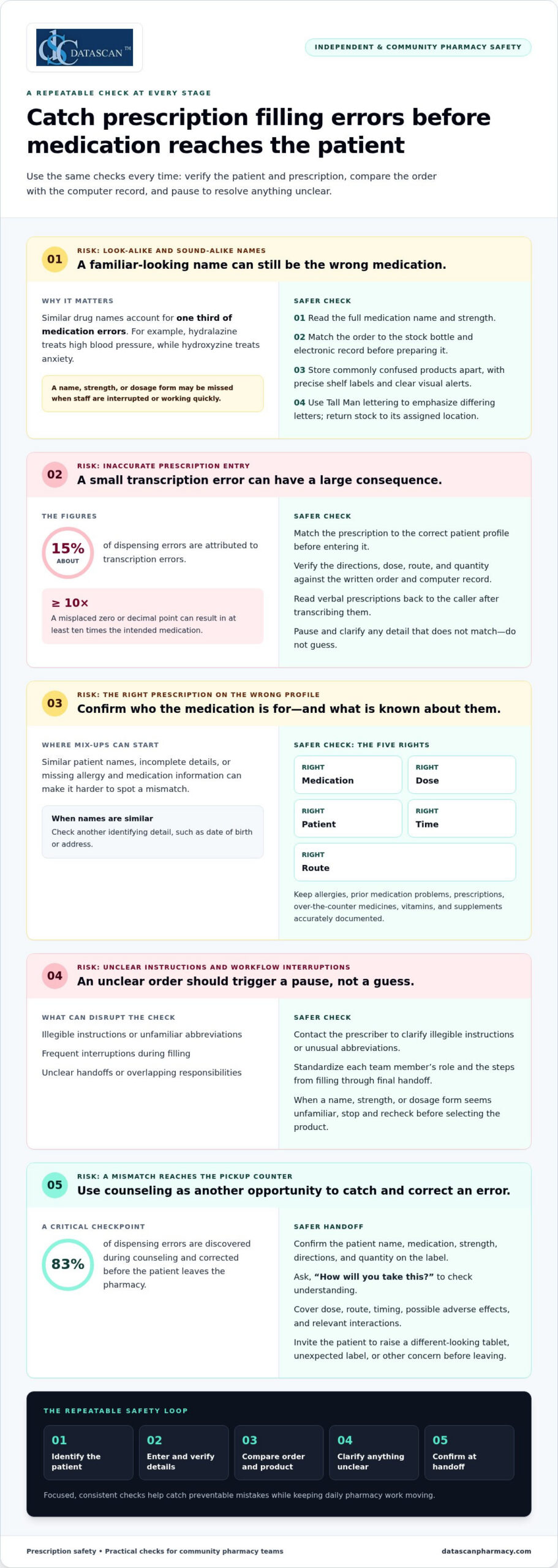
Common prescription filling errors include selecting the wrong medication or dose, entering an incorrect quantity, and dispensing to the wrong patient. Similar drug names, data-entry mistakes, unclear communication, and frequent interruptions can contribute. Similar drug names account for one third of medication errors, making name checks an essential part of dispensing.
Hydralazine treats high blood pressure, while hydroxyzine treats anxiety. Their similar names can make selection difficult, especially when staff are interrupted or working quickly. Compare the full drug name, strength, and dosage form on the prescription with the stock bottle and computer record. Don’t rely on the first few letters or a familiar-looking label.
Make look-alike and sound-alike medications easier to distinguish where products are selected. Store commonly confused products apart, use clear visual alerts, and label storage locations precisely. Tall Man lettering, which capitalizes part of a name, can highlight differences on stock bottles and electronic medication orders. Emphasize the differing letter patterns in similar names so staff notice them before selecting a product.
- Read the full medication name and strength on the order.
- Compare the product label with the electronic record before counting or preparing it.
- Return stock promptly to its assigned, clearly marked shelf location.
- Pause and recheck when a name, strength, or dosage form seems unfamiliar.
Patients can provide useful context during a medication check. Ask what prescriptions, over-the-counter medicines, vitamins, and supplements they take, and document known allergies or previous medication problems. This information helps the pharmacist assess potential interactions and spot an order that differs from the patient’s usual therapy. Encourage patients to share an up-to-date medication list with each doctor and pharmacist, especially when multiple prescribers are involved.
At pickup, invite the patient to check the medication and ask questions if its appearance differs from what they expected. Confirm who the prescription is for and explain how to take it. If the patient notices a different tablet or an unexpected label, that can prompt another check before they leave the pharmacy.
Dosage form matters, too. Long-acting medications shouldn’t be cut, crushed, or chewed unless a doctor or pharmacist says it’s appropriate, because the medicine may release too quickly. If a patient has trouble swallowing a tablet, recommend discussing a suitable formulation with a doctor or pharmacist rather than changing the medication independently. Each check addresses a different risk, but both depend on matching the product and instructions accurately.
2. Accurate prescription entry and patient identification
Accurate entry starts with matching the prescription to the correct patient profile. Confirm the patient’s identifying details before entering directions, dose, route, and quantity. Transcription errors account for about 15% of dispensing errors, and a misplaced zero or decimal point can result in at least 10 times the intended medication. Read verbal prescriptions back to the caller after transcribing them.
Use the five rights of medication safety as a final verification prompt: right medication, dose, patient, time, and route. Check the patient’s date of birth or address when names are similar. In hospital settings, the Joint Commission requires at least 2 patient identifiers when medications are administered. Accurate identification and current patient information help prevent medication errors, including an incorrect drug being dispensed.
Patients should check the prescription label before leaving the pharmacy. Confirm the patient name, medication, strength, directions, and quantity, then compare the label with what the prescriber said to expect. Ask the pharmacist to explain any mismatch, unfamiliar direction, or change in tablet appearance before taking the medication.
At pickup, invite patients to describe how they’ll take the medication. An open-ended question such as, “How will you take this?” can reveal confusion that a yes-or-no question may miss. Counseling should cover the dose, route, timing, possible adverse effects, and relevant interactions. About 83% of dispensing errors are discovered during counseling and corrected before the patient leaves the pharmacy.
- Ask about prescription medicines, over-the-counter drugs, vitamins, and supplements.
- Make sure allergies and prior medication problems are recorded accurately.
- Explain what to do if a dose is missed, using the prescription’s specific instructions.
To prevent errors during a transfer or refill, give the receiving pharmacy an up-to-date medication list and identify the exact prescription and prescriber. Confirm that the pharmacy has the current directions, strength, and allergy information. Once the refill is prepared, compare its label and appearance with the previous supply, and ask about unexpected changes.
If a patient discovers an incorrect fill, they should stop and contact the dispensing pharmacy promptly. Don’t take another dose until the pharmacist or prescriber explains what to do. If the medication has already been taken and concerning symptoms occur, seek urgent medical care.
In the United States, patients can report a suspected dispensing error to the pharmacy manager or owner and ask how to file a formal complaint. They can also contact their state pharmacy regulator for information about its complaint process. Keep the label, packaging, receipt, and prescription details available when describing the event.
3. Checking written prescriptions against computer records
Pharmacies prevent wrong-drug and wrong-dose errors by comparing the prescription with the computer record, verifying patient-specific details, and arranging an independent check. To understand how to reduce prescription filling errors, treat a mismatch as a reason to stop and investigate, not as a detail to correct from memory. Clarify concerns with the prescriber or patient as appropriate.
Use the original written order as the reference, not memory or a previous fill. Compare the patient, medication, strength, dosage form, directions, and quantity with the entered record. For example, if the prescription says one strength but the computer entry shows another, stop processing until the mismatch is resolved. Technicians and pharmacists should use the same comparison steps, even when a familiar prescription seems routine.
A second-person check can catch a mistake that self-checking may miss. When possible, have a pharmacist independently compare the written order, computer record, and prepared medication. The reviewer should inspect the original instructions rather than rely on the first person’s verbal summary. If the check is delayed, keep the prescription and product clearly associated, then complete verification before dispensing.
Dose review must account for the patient, not just the drug. Verify age- and weight-based doses, particularly for pediatric and geriatric patients. Compare the prescribed amount with the patient’s recorded age and weight, and check the units, frequency, and dosage form. A dose that looks unusual for a child’s weight or an older patient’s profile needs investigation before the medication is released.
Review the profile for other prescriptions that could create harmful interactions or duplicate therapy. Patients with multiple doctors may have prescriptions from clinicians who don’t know what another clinician ordered. Check the medication history and relevant alerts, then assess whether the current order fits the patient’s existing regimen. A possible interaction is a reason to investigate and communicate, not to make an unsupported change.
Use a consistent double-check sequence for each prescription:
- Match the written order to the correct patient record.
- Compare the drug, strength, dosage form, instructions, and quantity.
- Review age, weight, allergies, and medication history.
- Compare the prepared product and label with the verified order.
- Resolve discrepancies before dispensing.
Document clarifications in the pharmacy record so the final instructions reflect the prescriber’s response. If an order changes during a phone call, update the computer entry and compare it again with the clarified directions. This creates a clear record linking the original prescription, the correction, and the medication dispensed.
For teams considering how to reduce prescription filling errors, every unresolved order needs a clear next step. Set it aside, record the specific discrepancy, and involve another qualified team member before proceeding. Don’t repeat the same quick check or rely on memory to fill in missing information.
4. Clarifying illegible prescriptions and unusual abbreviations
If a prescription is illegible, incomplete, or open to more than one interpretation, pause dispensing and clarify it with the prescriber. Guessing at a medication, dosage, route, or frequency can turn a small uncertainty into an incorrect fill. A clear answer gives the pharmacist a reliable basis for preparing the prescription and counseling the patient.
Start by identifying exactly what is unclear. Is the drug name hard to read, or does the order omit a strength, dosage form, route, or frequency? If a written direction could indicate different amounts, don’t choose the most familiar interpretation. Mark the order for follow-up and keep it separate from prescriptions ready for filling.
Unusual abbreviations and puzzling symbols also need clarification. A shorthand term may seem routine to one staff member but mean something different to another. Don’t assume an abbreviation has the same meaning across prescribers or medication types. Ask the prescriber to state the intended instruction in plain language, then record that wording in the pharmacy system.
Use a consistent clarification process so the next step is clear to every team member:
- Identify the specific word, number, symbol, or direction that creates uncertainty.
- Contact the prescribing office and ask for the intended medication instructions.
- Read the clarified order back to confirm the drug, strength, dosage, route, and frequency.
- Document the response and update the prescription record before filling.
- Have the pharmacist review the resolved order before dispensing.
Missing details matter, too. If an order names a medication but omits a dosage or route, don’t fill the gap using a previous prescription. The patient’s current condition, treatment plan, and other medicines may differ. Ask the prescriber for the missing information, and document the clarification so the final label matches the authorized directions.
Check for conflicts between the order and the patient profile. For example, if a newly clarified medication conflicts with a recorded allergy or appears inconsistent with the patient’s existing instructions, bring the concern to the pharmacist. The pharmacist can assess the information and contact the prescriber when needed. This helps address potential risks without staff making unsupported changes.
Keep the patient informed while the team resolves uncertainty. Explain that the pharmacy needs a clear instruction before dispensing, and ask whether the patient has relevant context, such as a recent treatment change. Patient input can help identify what to ask, but it doesn’t replace prescriber clarification. Once the answer arrives, compare the updated record with the final label and directions. Documenting this handoff helps prevent an unresolved question from carrying into preparation or counseling.
5. Standardizing prescription-filling workflows
A repeatable workflow gives each prescription a defined path, even during a busy shift. Assign clear responsibilities for intake, data entry, preparation, pharmacist review, and handoff. When pharmacy technicians know which step they own, fewer tasks get lost between coworkers. A written process also makes it easier to identify where mistakes happened and improve the routine. Teams aiming to reduce prescription filling errors can start by mapping these handoffs.
Keep each patient’s prescriptions together and separate them from other work in progress. Return stock promptly after selecting a medication, and clear unused products from the filling area before starting another order. For example, finish preparing one patient’s prescription and attach its label before moving to the next. This reduces the chance of mixing products, labels, or instructions across orders.
Set up the physical workspace to support the process. Keep frequently used tools in consistent locations, remove clutter from the counting area, and ensure only the active prescription is on the immediate work surface. A standardized shelf layout helps staff return products to the correct location. If the pharmacy uses an automated pill-counting machine, include routine checks and maintenance in its workflow.
Use a clear sequence that staff can follow for every fill:
- Receive the prescription and route it to the assigned team member.
- Enter and prepare the order using the pharmacy’s established steps.
- Keep the product and patient label together during preparation.
- Complete pharmacist review before the prescription moves to pickup.
- Return stock and reset the work area before starting another order.
Define how staff should handle interruptions. If a phone call or patient question pauses a fill, leave the order in a marked, secure location and note the step completed. On returning, restart at the last verified point rather than relying on memory. An interactive voice response system can handle routine calls and refills, reducing interruptions during dispensing.
Workload management matters to accuracy. Pharmacy leaders can monitor queues, balance assignments, and provide breaks so fatigue and competing tasks don’t undermine focus. Build training into the workflow for new and existing staff, including pharmacy technicians, and review procedures when errors or near misses reveal a weak handoff. Report dispensing errors so the team can identify patterns and prevent similar problems.
A computer-supported workflow can make status and ownership easier to track, but staff still need clear steps for exceptions. Define who contacts the doctor when clarification is needed, who records the response, and who resumes the order. Reducing filling errors also means checking whether each stage has a clear owner and documented next step. A customizable pharmacy workflow can organize responsibilities around how the pharmacy operates. Consistency makes the process easier to follow, even when work shifts between team members.
Datascan Pharmacy Software: Datascan Pharmacy Management Software
Datascan Pharmacy Software provides Datascan Pharmacy Management Software for independent and community pharmacies. If your team is reviewing how prescriptions move from entry through verification and pickup, pharmacy management software can support that operational review. Map the steps staff follow, identify where handoffs or interruptions create friction, and assess whether your current system supports the way your pharmacy works.
Datascan also offers Datascan Point of Sale (POS), MobileScripts Patient Mobile App, and Datascan Mobile Delivery App. These tools support different parts of pharmacy operations, while prescription accuracy still depends on clear procedures and careful staff checks.
Contact Datascan Pharmacy Software or visit datascanpharmacy.com to learn more.
Make safer checks part of your next improvement
A practical answer to how to reduce prescription filling errors is to treat accuracy as an operating standard, not just a final inspection. Next, review how your pharmacy’s procedures and technology work together during a real shift. Which handoffs are hardest to manage? Where do staff need clearer steps to keep prescriptions moving without skipping verification?
Use those questions to guide a focused conversation with your team. A process that works on paper should also make sense at the counter, in the filling area, and during a busy pickup period. Aligning pharmacy management software with consistent procedures can help staff follow the workflow more easily.
If you’re considering how Datascan Pharmacy Software could support your pharmacy’s operations, contact Datascan Pharmacy Software to discuss your needs. Every deliberate improvement helps build a more dependable process for your team and patients.
Frequently Asked Questions
How can patients verify a prescription is filled correctly before leaving the pharmacy?
Ask the pharmacist to identify the medication’s active ingredient and explain whether the dispensed product matches the treatment your prescriber intended. If the packaging or manufacturer looks unfamiliar, ask whether that reflects a product change. Patients can also ask what to do if the medication’s appearance changes at a later refill. Resolve those questions before leaving, so you know whom to contact if the next supply differs.
How can pharmacists reduce dispensing errors during prescription processing?
Build safeguards into the order queue so duplicate requests, early refills, and incomplete prescriptions receive attention before moving forward. For example, if a refill request arrives while the same prescription is already being processed, flag it for review rather than treating it as a separate routine order. Clear status labels also help staff distinguish new, pending, and completed work without relying on memory during a busy period.
How can patients prevent errors with generic substitutions and look-alike medication names?
Ask the pharmacist to explain a substitution by its active ingredient, strength, and dosage form, then confirm whether the prescribed directions remain the same. Don’t switch products or adjust how you take them based only on packaging or tablet appearance. If a refill looks different, bring the container or a clear photo of the previous product to the pharmacy and ask the pharmacist to explain the difference.
How should patients use medication lists and patient portals to catch prescription discrepancies?
Use the portal as a comparison tool, not as the only record of current treatment. After a specialist visit, urgent-care appointment, or hospital stay, review the medication section for entries that may no longer reflect the plan you were given. Note which clinician prescribed each medicine and when the information changed. If portal details conflict with discharge papers or current instructions, ask the care team to reconcile the records before relying on an outdated entry.

Article by
Sarah Callioras
Sarah Callioras is Vice President at Datascan Pharmacy Software, bringing nearly 25 years of experience across independent pharmacy operations and pharmacy technology. Since joining Datascan in 2016, she has played a key role in driving business growth, strengthening client relationships, and supporting independent pharmacies through innovative software solutions. With a strong background in pharmacy operations, business development, and strategic leadership, Sarah is passionate about helping independent pharmacies succeed in an evolving healthcare landscape.