
AI in pharmacy can analyze operational and patient information to surface patterns, support medication-safety checks, and inform clinical decisions. How AI is used in pharmacy depends on the task: some systems assist with workflow, while others assess information for possible risks or care opportunities. Pharmacists review the results before they inform patient care.
For community pharmacies, the goal isn’t to add technology for its own sake. It’s to make busy workflows more manageable while keeping patient needs and professional judgment at the center. That balance matters: AI can help staff work with complex information, but its output depends on the quality of the data and how teams use it.
This article explains where AI can support pharmacy operations, medication safety, clinical decisions, and pharmacointelligence. You’ll also learn how bias, privacy, validation, and ongoing oversight shape safe use, helping you assess the technology’s value and limits.
Key Takeaways
- AI can help pharmacies analyze patient and operational data, support routine workflows, and surface patterns that may inform care.
- Use AI recommendations as decision support, with pharmacists reviewing clinical alerts and patient-specific suggestions.
- Assess data quality and privacy because incomplete or unrepresentative information can affect accuracy and fairness.
- Validate AI tools and monitor their performance over time to identify benefits and unintended effects.
- Pharmacointelligence can help reveal trends in patient needs, prescribing, and inventory that support earlier, more informed action.
How Is AI Being Used in Pharmacy Today?
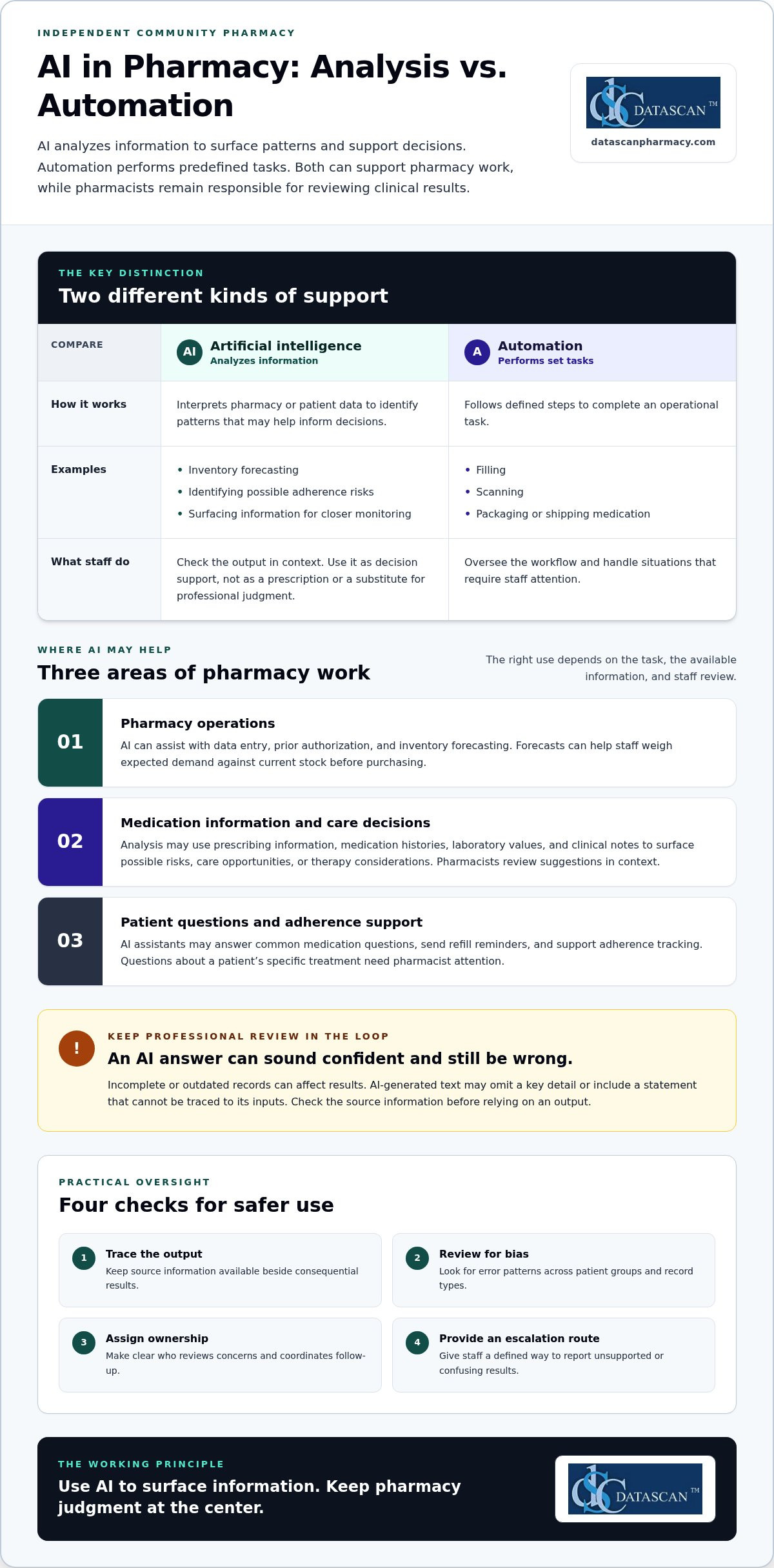
Understanding how AI is used in pharmacy starts with the difference between pattern analysis and routine automation. AI can interpret pharmacy or patient data to support decisions, while automation performs set tasks such as filling, scanning, packaging, or shipping medication.
Pharmacy Operations and Patient Care
AI in pharmacy operations means analyzing information to identify patterns that may help staff manage work and patient needs. Applications include assisting with data entry, prior authorization, and inventory forecasting. These uses matter when administrative tasks compete with time for patient care. For example, an inventory forecast can help staff weigh expected demand against current stock before making purchasing decisions.
There’s no single cost for an AI pharmacy system. Cost depends on the tool’s scope, data integration, and staff training; potential savings may come from reducing manual work and improving inventory decisions. To assess how AI could fit pharmacy workflows, start with a defined task, then train staff to review results and report errors.
Data Analysis and Medication Recommendations
AI can analyze prescribing information, medication histories, laboratory values, and clinical notes to support patient-specific recommendations. This may help identify adherence risks or patients who could need closer monitoring. In personalized medicine, a system can use available patient information to suggest therapy adjustments or highlight treatment considerations. Pharmacists review suggestions in context rather than treating an output as a prescription.
Prescribing analysis can also help identify patterns related to cost-effective medication use. Patient-monitoring information may point to opportunities to support people with long-term conditions. For instance, a pattern in monitoring data could prompt a pharmacist to consider whether a patient may benefit from follow-up. The quality and completeness of the information determine what the system can identify.
Patient Engagement and Medication Adherence
AI chatbots and phone assistants can answer common medication questions, send refill reminders, and support adherence tracking. Compared with software limited to preset responses, an AI assistant can respond to a wider range of common questions. It can help with routine information requests, while questions involving a patient’s specific treatment need pharmacist attention.
AI may also support telepharmacy, virtual consultations for minor ailments, and educational resources. Wearables and remote monitoring devices can provide information such as heart rate or glucose levels for review. Patient information must be protected from breaches and unauthorized access. Pharmacies using these tools need clear practices for handling sensitive records and deciding which messages require staff follow-up.
Accuracy, bias, and accountability
AI can produce an inaccurate answer that sounds confident, so pharmacy teams need to assess the result, not its tone. A generated summary may omit a key detail or connect unrelated information. For example, if a patient record contains an outdated entry, analysis based on that record may repeat the error. Staff should be able to trace an output back to the information used.
Bias can enter when data used to develop or operate a system leaves out relevant patient experiences. A model may then perform unevenly for groups poorly represented in that data. Review results across patient groups and information types instead of relying on a general impression of performance. If staff notice a pattern, such as repeated errors in one kind of record, document it for review.
Hallucinations create a different problem: a system may generate a plausible statement without support from its inputs. When reviewing an AI-written explanation, pharmacy staff should compare its claims with the underlying record. If the output introduces details that cannot be traced to source information, treat them as errors to report, not evidence that the system has found something new.
The UK Parliament Science, Innovation and Technology Committee’s interim report on AI governance describes 12 challenges, including data access, bias, liability, and privacy. Those concerns can overlap. For example, limited data access may affect what a system can assess, while unclear responsibility can delay action when its output is wrong.
Accountability works best when responsibilities are explicit before a tool enters a workflow. Identify who reviews its output, who receives error reports, and who can pause its use. Staff also need a way to preserve the original result and the information it relied on. That record helps the pharmacy determine whether an error came from incomplete data, a poor interpretation, or a mismatch between the tool and its task.
- Traceability: Keep the source information available beside consequential AI output.
- Bias review: Examine error reports for patterns across patient groups and record types.
- Clear ownership: Assign a role to review concerns and coordinate follow-up.
- Escalation: Give employees a defined route to report unsupported or confusing results.
These steps make accountability part of daily technology use. A pharmacy can discuss reported errors in routine workflow reviews, update staff instructions, and reassess whether the tool still fits its assigned task. Clear ownership also helps staff speak up when an answer seems wrong. The goal is practical oversight, with a clear path from questionable output to informed review.
Medication safety and clinical decision support
AI can support medication safety by bringing relevant prescription information to a pharmacist’s attention during review. It may flag a possible interaction, an allergy concern, or a dose that needs closer assessment. The value is not simply producing more alerts. A useful system gives staff enough context to decide what deserves attention before the prescription moves forward.
Consider a new prescription that triggers an interaction warning. The pharmacist can review the medications involved, check the patient profile, and assess whether the alert applies to the situation. A warning may identify a possible concern, but the patient’s full circumstances shape its significance. The system supports the check; the pharmacist makes the clinical assessment.
AI can also assist with dose review by comparing a proposed dose with available patient-specific information. For example, an alert may prompt staff to review relevant laboratory values or details in the medication record. If the necessary information is missing, the output cannot provide a complete picture. A clear prompt should help staff identify what to review, rather than obscure the reason for its recommendation.
Clinical decision support works best when it fits the pharmacy’s existing prescription review. Staff need to know what an alert means, what information it used, and who handles follow-up. If a prompt conflicts with the prescription or patient profile, pause the workflow and resolve the discrepancy before proceeding. That checkpoint keeps an automated suggestion from becoming an unchecked instruction.
- Interaction prompt: Review the medications involved and the patient’s current profile.
- Allergy warning: Compare the alert with recorded allergy details and the prescription.
- Dose review: Check the information behind the prompt, including relevant clinical details.
- Unclear output: Route it to pharmacist review before acting on the suggestion.
Alert quality matters during a busy shift. If staff encounter repeated prompts that don’t apply, they may struggle to distinguish a meaningful warning from routine noise. Pharmacy teams can review alert patterns, discuss confusing messages, and clarify what action each prompt requires. This helps keep attention on information that supports a meaningful safety check.
Pharmacist oversight remains important whenever AI informs a medication-related decision. A practical workflow preserves access to the original prescription and patient information, makes escalation straightforward, and leaves the clinical decision with the pharmacist. This allows AI to assist with review without displacing professional judgment in patient care.
Validation, safety, and ongoing monitoring
Validate an AI tool before use, then monitor its performance as pharmacy workflows and data change. Testing should reflect the tool’s intended task, the information it receives, and the decisions staff make based on its output. A successful demonstration alone does not establish that it will work reliably in daily pharmacy practice.
FDA-related requirements depend on an AI tool’s intended function and role in healthcare. Before adopting a tool for clinical use, identify what it does and how its output may affect patient care, then establish appropriate review and oversight for that use.
MHRA, FDA, and Health Canada developed ten guiding principles for Good Machine Learning Practice. These principles provide a framework for developing and evaluating machine-learning tools. For pharmacy teams, the practical focus is whether the system performs its stated task with relevant information and fits the staff’s established review process.
Start validation with realistic examples. If a tool flags medication risks, test it with representative records, including cases where relevant details are missing or ambiguous. Compare its output with the information available to qualified staff. Record missed issues, incorrect prompts, and results that need clarification. This review shows where the tool needs limits or additional human checks.
The Royal College of Pharmacy says AI tools should be validated and monitored over time to confirm benefits and mitigate unintended consequences. Monitoring should account for changes in data quality, workflow, and the tool’s outputs. For example, a change in how patient information is entered could affect a system that relies on it. Staff feedback can reveal such problems early.
Set review criteria before deployment so the team can recognize when performance needs attention. A pharmacy could track:
- Accuracy: Whether outputs match the information in the patient record.
- Relevance: Whether alerts help staff assess a real workflow concern.
- Usability: Whether staff can understand the output and its basis.
- Escalation: Whether employees know how to report errors or pause use.
Assign responsibility for reviewing those signals and updating staff guidance. If a tool begins producing unclear or inconsistent results, staff need a defined route to flag the issue and prevent unreviewed outputs from guiding care. Keep the system’s purpose narrow, document workflow changes, and repeat validation when its data or function changes. These practices make oversight an ongoing part of safe pharmacy operations, not a one-time approval step.
Pharmacy AI can analyze patient-specific information to provide tailored therapy recommendations and identify high-risk patients who may need closer monitoring or alternative treatment strategies. Pharmacy AI applications can also use patient-monitoring data to identify opportunities to improve outcomes for people with long-term conditions.
AI integrated with wearable technology and remote monitoring devices could help pharmacists track patient health data, including heart rate and glucose levels. Pharmacist oversight is important for patient safety when AI is used in pharmacy workflows.
AI and pharmacointelligence in pharmacy
Pharmacointelligence uses pharmacy and patient data to reveal patterns that can guide operational planning and community care. AI can help connect prescribing, monitoring, and inventory information, giving pharmacy teams a clearer view of needs that may be difficult to spot across separate records.
In practice, AI can analyze prescribing data to identify patterns in medication use and support reviews of cost-effective prescribing. Patient-monitoring data can also reveal opportunities to improve care for people with long-term conditions. For example, a pharmacy team could use recurring monitoring patterns to identify patients who may benefit from a conversation or closer follow-up.
AI may also help predict disease risks, supporting earlier community health interventions. A risk signal is a starting point for review, not a diagnosis. Its usefulness depends on the information available and whether the pattern is relevant to the individual. Pharmacists can use that signal to prioritize outreach, ask follow-up questions, and connect patients with appropriate care.
Operational data offers another practical perspective. AI can support data entry, prior authorization tasks, smart verification, and inventory forecasting. These applications address different workflow needs:
- Data entry: Identify information that may need organization or review.
- Prior authorization: Assist with administrative information handling.
- Smart verification: Surface details for staff to assess during a check.
- Inventory forecasting: Use demand patterns to inform stock planning.
Each output needs context. A forecast, for instance, can help staff consider expected demand, while purchasing decisions still depend on pharmacy operations and current circumstances. Connecting useful patterns to a defined workflow makes the information easier to act on.
Pharmacointelligence also extends to drug development. AI-assisted drug repurposing can allow a medication that failed for its original intended use in clinical trials to proceed directly to phase II trials for a new indication. This illustrates how pattern analysis may help identify a different research path, rather than simply repeating the original purpose.
For community pharmacies, the practical question is which data patterns can support better decisions today. Start with a clear use, such as inventory planning or identifying long-term-condition patients for follow-up. Define what information informs the result, who reviews it, and what action follows. That keeps intelligence tied to a real pharmacy workflow instead of producing insights without a next step. Discuss your pharmacy technology priorities and the workflows you want to strengthen.
Datascan Pharmacy Software: Datascan Pharmacy Management Software
Datascan Pharmacy Software offers the Datascan Pharmacy Management Software Suite for independent community pharmacies managing daily operations. If you’re assessing AI, a dependable pharmacy management platform can help organize core workflows while your team evaluates where new tools fit. Datascan also offers Datascan Point of Sale (POS), MobileScripts Patient Mobile App, and Datascan Mobile Delivery App.
These offerings support different parts of pharmacy operations, from management workflows to patient-facing services. They are not presented as AI decision tools. For pharmacies reviewing technology needs, pharmacy management software is a practical place to consider how existing workflows can support future operational changes.
Contact Datascan Pharmacy Software to discuss your pharmacy’s software needs, or visit datascanpharmacy.com.
Choose the Next Practical Step for Your Pharmacy
Understanding how AI is used in pharmacy can help you make deliberate technology decisions, but progress starts with the workflow your team needs to improve. Choose a practical priority, such as organizing daily operations or improving how patients connect with your pharmacy. Then assess how your current systems support that work and where staff oversight remains essential.
Datascan Pharmacy Software offers the Datascan Pharmacy Management Software Suite, Datascan Point of Sale (POS), and MobileScripts Patient Mobile App. These tools support pharmacy management, transactions, and patient engagement, giving your team options to consider as you plan its technology approach.
You don’t need to change every workflow at once. A focused conversation can help clarify which operational needs should come first and what role pharmacy software can play. Contact Datascan Pharmacy Software to discuss your pharmacy’s needs and take a confident next step.
Frequently Asked Questions
What are the main uses of AI in pharmacy?
AI can support pharmacy operations, patient communication, medication review, and analysis of prescribing or monitoring information. To assess an application, identify the decision it supports. For example, an inventory forecast helps staff plan stock, while an adherence prompt may help prioritize patient outreach. These are distinct uses, so evaluate each against its own workflow and intended result.
How do pharmacies use AI for medication dispensing and inventory management?
AI can analyze prescription and stock patterns to inform dispensing workflows and inventory planning, while dispensing automation performs physical tasks such as filling or packaging. For inventory, a forecasting tool can help staff compare anticipated demand with current stock before ordering. For dispensing, AI may surface information for review, but the pharmacist and pharmacy workflow remain responsible for the final check and release process.
How does AI support pharmacists in checking prescriptions and preventing medication errors?
AI can flag details that deserve a closer look, such as a possible interaction, allergy concern, or dose issue. A practical review begins by opening the relevant patient and prescription information, then checking what triggered the alert. The pharmacist can resolve discrepancies, document the decision through existing procedures, and report unclear prompts. This process helps distinguish a useful warning from an alert without relevant context.
What AI tools are used in pharmacy practice in the United States?
Pharmacy applications include clinical decision-support systems, inventory forecasting tools, patient communication assistants, and analytics that review prescribing or monitoring information. Some tools also assist with administrative work, such as data entry or prior authorization. These categories describe functions, not a single standard product. A pharmacy should match the tool to a specific operational or patient-care need and understand what information it uses.
What are the risks and limitations of AI in pharmacy, including privacy and bias?
AI can produce inaccurate recommendations, overlook relevant context, or perform unevenly when its data does not represent the patients affected. Patient records also require protection from unauthorized access. A pharmacy can reduce workflow risks by limiting access to sensitive information, reviewing outputs against source records, and providing a clear way to report errors. Staff should know which outputs require pharmacist review before anyone acts on them.
How accurate is AI compared with pharmacists for medication-related tasks?
Accuracy depends on the task, the information available, and how performance is assessed, so AI should not be assumed to be more accurate than pharmacists across medication-related work. To evaluate a tool, compare its results with pharmacist review using representative cases. Track missed issues, incorrect flags, and unclear outputs separately. This gives the pharmacy a practical view of where the system assists staff and where human judgment remains necessary.

Article by
Sarah Callioras
Sarah Callioras is Vice President at Datascan Pharmacy Software, bringing nearly 25 years of experience across independent pharmacy operations and pharmacy technology. Since joining Datascan in 2016, she has played a key role in driving business growth, strengthening client relationships, and supporting independent pharmacies through innovative software solutions. With a strong background in pharmacy operations, business development, and strategic leadership, Sarah is passionate about helping independent pharmacies succeed in an evolving healthcare landscape.
 Kevin Minassian is the President of Datascan Software. Under his leadership, the company rapidly expanded to provide pharmacy management software on a national level. Over the last 15+ years, he has ensured that Datascan has continuously evolved to offer innovative solutions for independent pharmacies while still offering world-class customer support. He is passionate about helping independent pharmacies to remain competitive, achieve success, and offer the very best service to their communities.