In 2021, 8.2% of U.S. adults aged 18 to 64 who were prescribed medication said they didn’t take it as prescribed because of cost, according to the CDC. Improving patient medication adherence rates starts with finding out what’s getting in the way, not assuming patients simply forgot. A reminder may help with forgetfulness, but it won’t address every barrier.
For independent pharmacies, pickup is just one moment in a patient’s care. A repeatable approach can help busy teams ask about barriers without blame and offer support that fits each patient’s needs.
This guide covers how to identify common barriers, choose practical support, and build follow-up into everyday pharmacy workflows. It also explains how to select useful measures and review your approach over time.
About the author: Datascan Pharmacy Software shares practical guidance for independent and community pharmacies on pharmacy operations and patient-care workflows.
Key Takeaways
Use open-ended questions to understand what makes taking medication difficult, without blaming patients.
Match support to the barrier. A reminder may help with forgetfulness, while other challenges need a different response.
Build improving patient medication adherence rates into a repeatable workflow with clear ownership and follow-up.
Compare counseling, regimen support, synchronization, and digital engagement in light of patient needs and staff capacity.
Use pharmacy management software to organize adherence-related work, then review appropriate measures to assess your process.
What does improving patient medication adherence rates actually involve?
Medication adherence means taking medication as prescribed. Improving it means understanding why doses are missed and responding to the reason. A number may flag a concern, but it can’t tell a pharmacy team whether a patient needs a simpler routine, clearer information, help with access, or another kind of support.
A practical definition: A clinical taxonomy by Vrijens and colleagues defines medication adherence as the process of taking medication as prescribed, including starting treatment, following the agreed plan, and stopping treatment. Persistence describes the time from starting a medication until it is stopped. These definitions help pharmacy teams describe different patterns without treating them as personal failings. The medication-adherence taxonomy provides the definitions.
Nonadherence can be intentional, such as choosing not to take a medicine because of concerns or unwanted effects, or unintentional, such as forgetting a dose or misunderstanding directions. Neither label is a judgment of the patient. It’s a starting point for understanding what happened and what might make the prescribed plan more manageable.
A single adherence rate has limits. It summarizes a pattern over a measurement period, but it doesn’t explain a person’s daily circumstances or show whether missed doses stem from one barrier or several. Use a measure to identify where follow-up may be useful, then talk with the patient before deciding what action fits.
Why do patients have difficulty taking medication as prescribed?
Adherence barriers can arise in four connected areas. A patient may face more than one at a time, so avoid assuming there’s a single cause:
Patient factors: Forgetfulness, competing demands, or difficulty fitting doses into a routine.
Provider factors: Communication gaps that leave directions or medication concerns unclear.
Treatment factors: A complex regimen that’s hard to manage consistently.
Health-system factors: Access challenges that make obtaining or continuing medication difficult.
These categories help organize questions, not assign fault. A patient who misses refills might be managing a complicated schedule, unclear instructions, an access problem, or a combination of factors.
Why should pharmacies focus on the reason behind a missed dose?
The same behavior can have different causes. A late refill might reflect forgetfulness, uncertainty about how to take a medicine, or difficulty accessing it. Ask, “What has made it hard to take this medication?” rather than, “Why aren’t you taking it?” The first invites context; the second can sound like blame. Listening helps the pharmacy team choose a relevant next step instead of guessing, while keeping the conversation focused on support.
How can a pharmacy identify a patient’s adherence barriers?
Use a brief, repeatable conversation to understand the patient’s experience before recommending a solution. A useful flow is invite, listen, clarify, agree, and document. It gives the team a consistent starting point while leaving room for each patient’s circumstances and clinical judgment.
Invite: Ask permission to discuss how the medication plan is going. “Would it be okay if we talked about how this medicine fits into your routine?”
Listen: Let the patient explain what’s working or difficult before offering a reminder or another solution.
Clarify: Ask follow-up questions to understand whether the issue is unclear instructions, a medication concern, a demanding routine, or difficulty obtaining the prescription.
Agree: Work with the patient on a practical next step that addresses the barrier they described.
Document: Record the patient’s concern and the agreed action in the appropriate pharmacy workflow, so follow-up has context.
What questions help uncover barriers without blaming patients?
Try neutral, open-ended prompts: “How do you usually fit your medicines into your day?” “What questions do you have about how to take this?” “Have you noticed anything about the medicine that concerns you?” “Has anything made it hard to obtain or pay for it?” Listen before suggesting an intervention. A knowledge gap may call for clearer counseling; a busy routine, medication concern, or access problem calls for a different response.
Clarify what the patient means before choosing a next step. If they’re unsure about directions, ask which part is confusing and use pharmacist judgment to address it. If the directions are clear but doses are hard to fit into the day, explore the routine. A concern about effects or treatment may require pharmacist assessment or coordination with the prescriber. Don’t assume a reminder will resolve every missed dose.
How should the pharmacy record and prioritize what it learns?
Keep notes concise and useful. When possible, record the barrier in the patient’s own words, the agreed next step, and whether follow-up or pharmacist review is needed. Prioritize concerns that require clinical judgment or coordination with the prescriber. Treat the record as a snapshot, not a complete adherence assessment. A patient’s needs or circumstances may change.
A consistent process helps teams carry what they learn into routine patient care. A customizable pharmacy workflow can provide a defined place for adherence-related tasks, so the next step is less likely to depend on one staff member’s memory. Barrier-first assessment makes improving patient medication adherence rates more individualized: understand the obstacle, agree on relevant support, and revisit the plan as appropriate. Discuss your workflow needs with Datascan.
Which medication adherence strategies should a pharmacy compare?
Choose adherence support based on the barrier the patient describes, not a one-size-fits-all program. Counseling, regimen support, medication synchronization, follow-up, and digital engagement can each play a role. Each option also needs a workable staff process and a clear reason for using it.
Counseling May address: Questions, concerns, or uncertainty about medication instructions. Workflow: Make time for a pharmacist conversation and determine whether the concern needs further clinical review.
Regimen support May address: Difficulty managing a complicated medication routine. Workflow: Review the regimen with the patient and identify a practical support approach within the pharmacy’s patient-care process.
Medication synchronization May address: Challenges coordinating prescription refill timing. Workflow: Review eligible prescriptions and coordinate timing through the pharmacy’s established synchronization process.
Follow-up May address: A barrier that needs another conversation or a check-in after an agreed action. Workflow: Assign responsibility and record the next step, so follow-up doesn’t rely on memory alone.
Digital engagement May address: A patient’s preference for a digital channel as part of pharmacy communication. Workflow: Offer a patient-facing tool as one support option, while keeping pharmacist communication available for questions that need personal attention.
This comparison organizes possible approaches; it doesn’t promise a particular result. The right fit depends on what the patient says, the care required, and what the team can consistently support. Avoid claiming an intervention improves adherence by a set amount unless you can cite current evidence and explain the study population and date.
When is personal counseling more useful than a reminder?
A reminder may suit a patient who understands the plan but has trouble fitting doses into a routine. It can’t explain unclear directions or resolve a concern about treatment. Those situations call for a conversation in which a pharmacist can understand the question and use clinical judgment. Treat reminders as one possible tool, not a universal solution or a substitute for listening.
How can synchronization and digital tools complement pharmacy care?
Medication synchronization is an option for coordinating prescription timing. It may fit when timing or refill coordination is part of the patient’s challenge, but it won’t address every barrier. E-care plans, patient-facing apps, and clinical technologies like remote patient monitoring software can complement pharmacy care as support channels; they don’t replace individualized assessment or pharmacist communication.
For patients who prefer a digital option, a patient medication refill app may provide another way to engage with the pharmacy. Ask whether the approach fits the identified need and can be incorporated into the team’s existing workflow. Matching the support to the barrier is central to improving patient medication adherence rates.
How can an independent pharmacy build a sustainable adherence workflow?
A sustainable workflow is simple enough for the team to repeat and specific enough to make the next step clear. Define a patient group, assign ownership, assess barriers, take an appropriate action, and review the work and selected measures. Build each step around existing dispensing or patient-care touchpoints rather than promising outreach the team can’t consistently deliver.
Select a patient group. Begin with a clearly defined group that fits your pharmacy’s care priorities and capacity. A focused start makes it easier to test and refine the process before expanding it.
Assign workflow ownership. Decide who identifies patients for follow-up, who handles outreach, and when a pharmacist should review a concern. Keep clinical decisions with the pharmacist.
Assess barriers. Use a routine pickup, refill, or patient-care interaction to ask what is making the medication plan difficult. Record the patient’s concern and any needed follow-up.
Act. Match the next step to the patient’s needs. Depending on the barrier and appropriate clinical judgment, this could mean counseling, regimen support, synchronization, or follow-up.
Review. Check whether the agreed task was completed and whether the selected measures are useful. Adjust the workflow if outreach is routinely missed or the data don’t answer the question you set.
Keep the first version manageable. For example, a team might flag a follow-up during refill processing, route questions requiring clinical judgment to the pharmacist, and review outstanding tasks during an existing team check-in. The best touchpoints depend on the pharmacy’s staffing and operations. The goal is to make adherence work visible without creating a separate, unsustainable process.
What should a pharmacy measure to understand progress?
Separate process measures from patient outcomes. For example, the number of planned outreach attempts completed shows whether the workflow is happening, not whether medication-taking behavior changed. Proportion of days covered (PDC) is a claims-based adherence measure that estimates the share of a measurement period in which a patient had medication available. It doesn’t confirm that doses were taken or explain why gaps occurred.
Before using PDC, define the medication, patient group, measurement period, and applicable exclusions. Follow current CMS or Pharmacy Quality Alliance specifications for the measure being used, and document the source and date. Avoid comparing results based on different populations or calculation rules, and don’t treat one figure as a complete assessment of an individual patient.
How can pharmacy software support a repeatable process?
Pharmacy management software can help organize appropriate tasks and patient information within the pharmacy’s workflow, while leaving assessment and clinical decisions to the care team. A pharmacy workflow optimization software approach can make ownership and next steps part of routine operations. Follow-up also helps keep the patient’s agreed plan connected across relevant pharmacy touchpoints.
For independent pharmacies shaping this process, discuss your pharmacy workflow needs. A practical, reviewable routine gives improving patient medication adherence rates a stronger foundation than reminders or outreach that aren’t tied to an identified need.
How can pharmacy management software support better adherence?
Pharmacy management software can help organize day-to-day work and give teams more room for patient care, but it can’t change PBM reimbursement terms or replace financial review. For independent pharmacies managing reimbursement pressure, PBM requirements, and limited staff time, technology is most useful when it supports reliable operations without overstating what the system can do.
What should an adherence-supporting pharmacy system help a team do?
Start with the work your pharmacy needs to coordinate. Define which tasks support patient care, who is responsible, and how each task fits existing operations. A clear workflow can reduce reliance on memory and help the team handle routine responsibilities consistently, while pharmacists retain responsibility for clinical decisions.
For example, medication synchronization and e-care plans can be part of a pharmacy’s broader patient-care approach. Datascan’s pharmacy management software supports pharmacy operations, while the pharmacy’s documented workflow determines how staff incorporate these capabilities into care. Technology can help teams organize their work; it should not be presented as a tool that changes PBM reimbursement or resolves claim disputes.
As you assess a system, consider whether it supports a workflow that makes these points clear:
Which adherence-related tasks the team has chosen to perform and who owns them.
What information staff need to carry out the next appropriate step.
When a patient conversation or pharmacist judgment is necessary.
How the team reviews outstanding work alongside other operational priorities.
Keep expectations practical. A defined process can help staff manage agreed tasks, but it doesn’t replace separate review of PBM contracts, reimbursement terms, or payment records.
How can pharmacies balance digital convenience with personal care?
Digital tools provide another engagement channel, but patients differ in preference, access, and comfort with technology. Datascan offers the MobileScripts Patient Mobile App as a patient-facing option, and its pharmacy management solutions include e-care plans. These tools can be part of a broader approach, but the pharmacy team still needs to decide when personal communication is appropriate.
A mobile channel may complement routine pharmacy interactions, while medication questions and concerns call for appropriate personal attention. Use the communication method that fits the patient and the pharmacy’s care process. An app or software feature doesn’t establish that a patient understands or follows a medication plan, and it shouldn’t be treated as a guaranteed adherence result.
Technology works best when it supports operational discipline and patient care without promising to solve reimbursement pressures on its own. If you’re considering how pharmacy management software can fit your pharmacy’s workflow and priorities, discuss your goals with Datascan.
Make your next adherence step achievable
Progress starts with a manageable commitment: choose one part of your pharmacy’s adherence workflow to strengthen, then give the team a clear way to carry it forward. You might clarify follow-up ownership, give patients a consistent way to share concerns, or review whether your process supports the care you want to provide. Improving patient medication adherence rates is ongoing work, and a practical workflow can help your team build on what it learns.
Datascan is a family-owned pharmacy software company founded in 1981, with U.S.-based support for independent pharmacies. The next step is to connect your patient-care priorities with workflows your team can sustain.
Is medication adherence the same as taking every dose perfectly?
No. Adherence isn’t a test of whether someone is a “good” or “bad” patient, and a missed dose alone doesn’t explain what happened. A patient may have misunderstood directions, faced an access problem, or had a concern about treatment. Ask about the specific situation, avoid drawing conclusions from one data point, and refer clinical questions to an appropriate healthcare professional.
Can a pharmacy improve adherence without adding a large new program?
Yes. Start with a narrow, manageable effort, such as asking patients in a chosen group whether they have questions during an existing pickup interaction. Decide who will handle those conversations and how the team will record the next step. After trying the process, review whether staff can complete it reliably and whether patients find it useful before considering an expansion.
How much can medication synchronization improve adherence?
There’s no single improvement amount that applies to every patient. Synchronization coordinates prescription timing, but a patient may still face treatment concerns, access difficulties, or other challenges that timing alone won’t address. For example, a patient managing several prescriptions may value coordinated refills, while another may need a pharmacist to discuss a concern first. Assess the individual situation, and avoid promising a specific result without relevant evidence.
What happens if a patient says they cannot afford a medication?
Take the concern seriously and respond without judgment. The pharmacist can discuss appropriate options within their professional role and coordinate with the prescriber when needed. Don’t assume synchronization or a digital reminder will solve an affordability barrier. Agree on a specific next step, record it according to pharmacy procedures, and make sure the team knows who is responsible for follow-up.
Is a patient app enough to improve medication adherence?
An app is best treated as one possible channel, not a complete solution. It may suit a patient who prefers digital engagement and can comfortably use the app’s available functions. Someone with questions about directions or concerns about treatment may need a direct conversation instead. Match the communication method to the patient’s preference and needs, and don’t assume app use alone changes medication-taking behavior.
How often should a pharmacy review its adherence workflow?
Set a review schedule that fits the pharmacy’s operations, then check whether assigned tasks are being completed and whether the process remains practical. For example, a team might review unresolved follow-ups during an existing operations meeting. Keep task-completion measures separate from patient outcome measures, protect patient information, and revise the workflow when staff capacity, patient needs, or care priorities change.
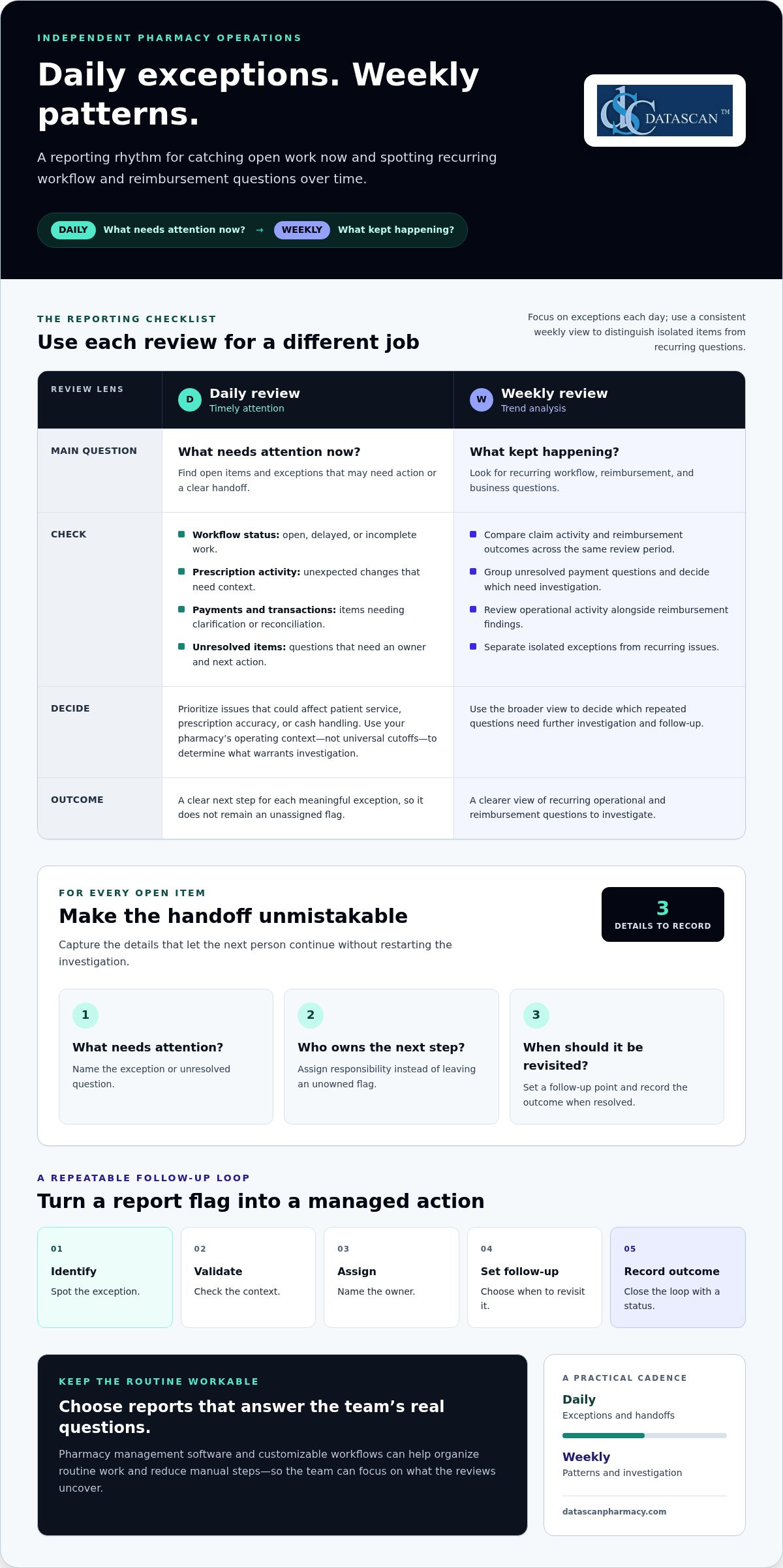
A useful pharmacy manager daily and weekly reporting checklist separates urgent exceptions from patterns that need a closer look. Review daily activity to decide what needs attention now, then use a weekly review to spot recurring workflow and reimbursement questions.
Reports can compete for time with dispensing, staffing, inventory, and patient needs. A focused routine helps prevent open items from getting lost and makes it easier to assess PBM reimbursement patterns without reviewing every figure every day.
This checklist covers daily workflow and transaction checks, weekly reimbursement and business reviews, and a straightforward way to assign follow-up. Pharmacy management software and customizable workflows can help organize routine work and reduce manual steps, giving independent pharmacy teams more time to act on what they find.
Author bio: Datascan Pharmacy Software provides pharmacy management software for independent and retail pharmacies.
Key Takeaways
Separate urgent daily exceptions from patterns that need a weekly review.
For every open item, record what needs attention, who owns the next step, and when it should be revisited.
Review claim activity, reimbursement outcomes, and unresolved payment questions weekly to identify recurring issues.
Use a consistent follow-up process: identify the exception, validate the context, assign responsibility, set a follow-up point, and record the outcome.
Use pharmacy management software and customizable workflows to support a repeatable reporting routine.
What should a pharmacy manager review in daily and weekly reports?
Review workflow exceptions and transaction questions daily, then use a weekly review to look for patterns in operations and reimbursement. A report is most useful when it answers a specific management question, such as which work items remain open or which payment questions need investigation.
Daily monitoring helps surface issues that may need timely action, while weekly analysis helps reveal whether they are recurring. Scanning every available figure each day can overwhelm a busy team. Inconsistent reviews, on the other hand, make it harder to track outstanding questions. Treat this cadence as a practical approach, then shape it around your pharmacy’s workflow and priorities.
A useful pharmacy manager daily and weekly reporting checklist distinguishes operational oversight from trend analysis. Ask, “What needs attention now?” during the daily review. During the weekly review, ask, “What kept happening, and what should we investigate?” A pharmacy management system helps structure pharmacy operations. Choose reports that answer the questions your team needs to resolve.
Which daily reports help a manager catch issues early?
Focus on exceptions rather than scanning every data point. Review open or delayed workflow items, prescription activity that needs context, and unresolved payment or transaction questions. For each item, decide whether it needs action, then record the next step so it is not left as an unassigned flag.
Workflow status: Find prescriptions or other work items that remain open, delayed, or incomplete.
Prescription activity: Review unexpected changes and determine whether they need follow-up.
Payments and transactions: Identify items that need clarification or reconciliation.
For each exception, record what needs attention, who owns the next step, and when it should be revisited. This gives the next person a clear handoff instead of an unassigned note.
What belongs in a weekly pharmacy review?
Use the weekly review to look beyond individual exceptions and assess patterns across a consistent period. Consider operational activity alongside reimbursement and business questions. CMS’s Medicare Part D rule effective January 1, 2024, requires nearly all pharmacy price concessions to be reflected in the negotiated price at the point of sale. Consistent attention to reimbursement outcomes and cash-flow signals is therefore a relevant management practice. The rule does not prescribe a particular review frequency.
Compare claim activity and reimbursement outcomes across the same review period.
Group unresolved payment questions and decide which need further investigation.
Review operational activity alongside those findings to identify recurring issues.
Weekly analysis complements daily oversight; it does not replace it. Use the broader view to distinguish isolated items from recurring questions and assign follow-up. Pharmacy management software can help organize routine work, while a pharmacy management software workflow can support a repeatable review process.
Which reports should pharmacy managers check every day?
Check the daily information that helps you address workflow exceptions, transaction discrepancies, and unresolved items before they carry into the next shift. Prioritize issues that could affect patient service, prescription accuracy, or cash handling instead of treating every figure as equally urgent.
A practical daily checklist can include:
Workflow exceptions: Find open, delayed, or incomplete work that needs review or staff follow-up.
Prescription activity: Look for activity that appears unusual in context and decide whether it needs attention.
Payment and transaction checks: Review transaction totals and exceptions as part of the pharmacy’s established closing process.
Unresolved items: Carry open questions forward with a named owner and a clear next action.
Use your pharmacy’s operating context to decide what warrants investigation. A delayed item during a busy period may call for a different response than work that remains unresolved after an expected handoff. Avoid universal cutoffs that ignore the way your team works. The pharmacy manager daily and weekly reporting checklist should help distinguish meaningful exceptions from normal variation.
How should a manager review daily workflow and prescription activity?
Scan open or delayed work, identify where tasks are accumulating, and decide what support or follow-up is needed. The goal is to understand the workflow, not assign blame. For example, if prescriptions are waiting at one stage, identify what is holding them up and who can move the work forward. Pharmacy workflow tools can help teams organize repeatable processes. For broader management context, the American Pharmacists Association’s pharmacy management resource offers a professional reference point.
For every exception, capture three details: what needs attention, who owns the follow-up, and what action comes next. Add a brief status or outcome when the issue is resolved. That record gives the next person enough context to continue without restarting the investigation.
What daily payment and transaction checks are useful?
Compare transaction totals and exceptions with the pharmacy’s established closing process. If something does not align, note the item, identify who will review it, and follow the process for resolving it. A pharmacy point-of-sale system can support this operational check, but a daily transaction review is not a full profitability or accounting analysis.
Keep the routine proportionate to the day’s needs. A focused review that flags service, accuracy, or cash-handling concerns is more useful than an exhaustive scan that leaves no time for follow-up. Pharmacy management software and consistent workflows can support a repeatable review, while the manager applies local controls and judgment.
How can weekly reporting reveal reimbursement and business patterns?
Weekly reporting helps managers determine whether claim activity, reimbursement outcomes, and unresolved payment questions are isolated or recurring. A useful review connects those patterns to a specific question and a clear next step.
Daily reviews surface exceptions that may need timely attention. Weekly analysis adds context: it can show whether similar questions keep coming up, whether an operational bottleneck is repeating, or whether a change deserves a closer look. The pharmacy manager daily and weekly reporting checklist works best when these reviews have distinct purposes.
Review focus
Daily monitoring
Weekly analysis
Claim activity
Flag an item that needs attention
Look for recurring changes or questions
Reimbursement outcomes
Record an exception for follow-up
Compare related information across a consistent period
Unresolved payment questions
Assign the next action
Check what remains open and whether similar issues recur
Operations
Address an immediate disruption
Identify repeated bottlenecks or shifts in activity
How should pharmacy managers review PBM reimbursement patterns?
Choose a consistent review period and compare relevant claim and reimbursement information using your pharmacy’s records. Group similar open questions to see whether they share a pattern. Document what needs investigation and assign someone to follow up. A recurring discrepancy is a reason to examine supporting records and the reconciliation process, not proof that a particular amount will be recovered.
Ground the review in the information available to your pharmacy. Differences can have different causes, so avoid applying a universal benchmark across payers and claims. Note the details needed for follow-up, track whether each question is resolved, and carry open items into the next review. This creates a clearer record for management decisions without overstating what the data shows.
Which business trends deserve weekly follow-up?
Look for recurring operational bottlenecks, shifts in prescription or claim activity, and payment questions that remain unresolved. One unusual result may reflect a one-off circumstance; a pattern across the review period deserves investigation. Check the context before deciding whether to adjust a process, gather more information, or keep monitoring.
For broader financial context, compare operational observations with the concepts covered in the published Calculating Pharmacy Gross Profit: 2026 Guide. The goal is not to turn a weekly report into a full accounting review. Identify which questions merit deeper analysis and assign a practical next step. Pharmacy management software can help organize routine activity for review, while consistent records make it easier to discuss reimbursement concerns and operational changes with the right team members.
How do you turn pharmacy reports into clear follow-up actions?
A report becomes useful when each exception leads to a decision, an owner, and a recorded outcome. Verify what happened, decide how soon it needs attention, and make the next step visible so the issue does not disappear into the day’s workload.
Use this sequence for each item that needs follow-up:
Identify the exception. Describe the specific workflow, transaction, or payment item that needs attention.
Validate the context. Check the underlying transaction or workflow record before drawing a conclusion. An exception is a prompt to investigate, not proof of an error.
Assign an owner. Name the person responsible for the next step so responsibility is clear.
Set the follow-up point. Decide when to review the issue again based on its impact and the information still needed.
Record the resolution. Note what you found and whether the item is resolved or needs further investigation.
What should a manager do when a report shows an exception?
Start with the source record and compare it with the relevant workflow or transaction context. If a payment question looks unusual, document what information needs to be reconciled before deciding what it means. Assign a team member to review or gather that information, set the next review point, and update the record when there is an answer. If the facts remain unclear, keep the item open with a defined next action.
Set timing according to potential impact rather than an invented universal threshold. An issue that could affect service, prescription accuracy, or cash handling may warrant same-day attention under the pharmacy’s own procedures. A recurring question without an immediate operational impact may fit the weekly review, where related items can be compared and further investigation considered. Let local controls and context guide the decision.
How can the team keep reporting manageable?
Reporting does not have to become a second workload. Use a short, repeatable checklist and capture only what moves an issue forward: what happened, who owns it, the next action, and the outcome. Match the review frequency to the decision. Address immediate exceptions promptly; assess broader patterns in the weekly review. Avoid reopening resolved items unless new information changes the picture.
Clear workflows make handoffs easier because team members can see what needs attention and what happens next. The published Pharmacy Workflow Optimization Software guide offers related workflow context, and pharmacy workflow software can help organize routine work consistently. Keep the pharmacy manager daily and weekly reporting checklist practical: review, assign, follow up, and close the loop.
For questions about how pharmacy technology can support clearer workflows and reporting routines, the Datascan team’s contact page provides a place to discuss your pharmacy’s needs.
How can pharmacy management software support a consistent reporting routine?
Pharmacy management software helps organize operational work and gives managers a more consistent basis for daily and weekly reviews. Its value comes from connecting routine information to a defined management question and follow-up process, not from reviewing every available data point.
A repeatable routine is easier to maintain when it fits the pharmacy’s dispensing and point-of-sale processes. For example, review workflow exceptions as part of an operational check, then assess reimbursement questions separately during the weekly review. Build the checklist around information your team can access and use reliably.
What should pharmacy managers look for in reporting workflows?
Start with the basics: Can the people who need the information access it? Does each review have a clear purpose? Is there a practical way to record who will follow up and what happens next? These questions help show whether the reporting routine supports decisions or simply adds another task to the workday.
Then consider how management software fits your current operations. The review process should work alongside dispensing and point-of-sale routines rather than creating disconnected steps. Pharmacy management software can organize operational work, while a customizable workflow can be shaped around the pharmacy’s needs. That flexibility matters because community pharmacies may have different handoffs and priorities.
Accessible information: Team members can find what they need for the review.
Clear purpose: Each review answers a specific operational or management question.
Defined follow-up: Exceptions have an owner and a next step.
Fit with existing routines: The process complements dispensing and point-of-sale work.
Technology can support consistency, but it does not replace management judgment. For PBM reimbursement monitoring, software can help organize routine pharmacy activity for review. Managers still need to examine relevant records, assess context, and decide which questions require follow-up. Focus on whether the information and workflow support the decisions your team needs to make.
How can managers take the next step?
Before discussing software, write down where the current routine breaks down. Note which daily issues are easy to miss, which weekly patterns are difficult to assess, and where follow-up ownership becomes unclear. Connect those gaps to the pharmacy’s broader workflow and reimbursement priorities. A short list of practical needs gives the conversation a clear starting point.
The pharmacy manager daily and weekly reporting checklist should remain useful as processes evolve. Datascan Pharmacy Software and customizable workflows help independent pharmacies organize routine work and reporting practices. The Datascan contact page is a place to discuss the workflow and reporting needs you have identified.
Make your reporting routine work for your pharmacy
A useful pharmacy manager daily and weekly reporting checklist should evolve with your team. As workflows, reimbursement questions, and management priorities change, revisit which information supports decisions and where follow-up gets stuck. This also helps you assess whether your pharmacy management software supports the routine your pharmacy needs.
Datascan is a family-owned company founded in 1981, with U.S.-based support. When planning a reporting cadence or refining existing workflows, bring your priorities and pain points into the discussion. A clear picture of what your team reviews, what it needs to follow up on, and what takes too much manual effort can guide the next step.
A pharmacy end-of-day report should give the manager enough information to close out the day and hand off anything that still needs attention. Include relevant workflow status, prescription activity, transaction totals or exceptions, and open questions with their current status. A pharmacy manager daily and weekly reporting checklist helps make closeout consistent. Adapt it to your pharmacy’s closing process and the information your team uses.
How often should a pharmacy manager review PBM reimbursements?
Review reimbursement information on a regular weekly cadence to spot recurring questions, and look at an individual item sooner if it needs timely operational follow-up. Keep the review period consistent and retain enough claim context to investigate differences. A weekly review helps organize follow-up, but it does not by itself establish why a reimbursement outcome occurred.
Can pharmacy management software help reduce manual reporting work?
Pharmacy management software can organize routine operational information and support consistent workflows, reducing repeated manual steps. Agree on where staff record an exception and how its status is maintained, rather than copying information into several places. Software can support the routine, but the team still needs to review findings and decide what to do.
What should a manager do when pharmacy reports do not match?
First, check that the reports cover the same date range and type of activity. Then compare the underlying records, such as transaction details or claim status, to identify where the difference appears. A mismatch does not prove an error; timing, report scope, or an unresolved item may explain it. Record what you checked, assign any remaining investigation, and keep the issue open until its status is clear.
Is a weekly pharmacy report the same as a financial statement?
No. A weekly pharmacy report is a management tool for reviewing selected operating activity and identifying questions that need attention. A financial statement serves a broader accounting purpose and follows the pharmacy’s accounting process. A weekly review may help managers decide what financial information to examine more closely, but it is not a substitute for formal financial records, reconciliation, or advice from the pharmacy’s accounting professional.
Who should be responsible for reviewing pharmacy reports?
A designated manager should own the review routine and make sure findings lead to appropriate follow-up. Team members who handle a particular workflow or transaction can provide context or investigate an assigned item, while the manager tracks outstanding questions and confirms their status. Define responsibility in a way that fits your pharmacy’s roles and access controls. Clear ownership prevents duplicate work and helps ensure important findings are not overlooked.
How can a small pharmacy keep reporting manageable?
Keep the routine focused on a small set of decisions the team needs to make regularly. Choose a consistent place to record open items, skip information that does not support a current decision, and fold checks into existing operating routines where practical. Start with the reports your pharmacy already uses, then adjust the cadence if issues are being missed or reviews take too much time. A simple process the team follows is more useful than an exhaustive checklist.
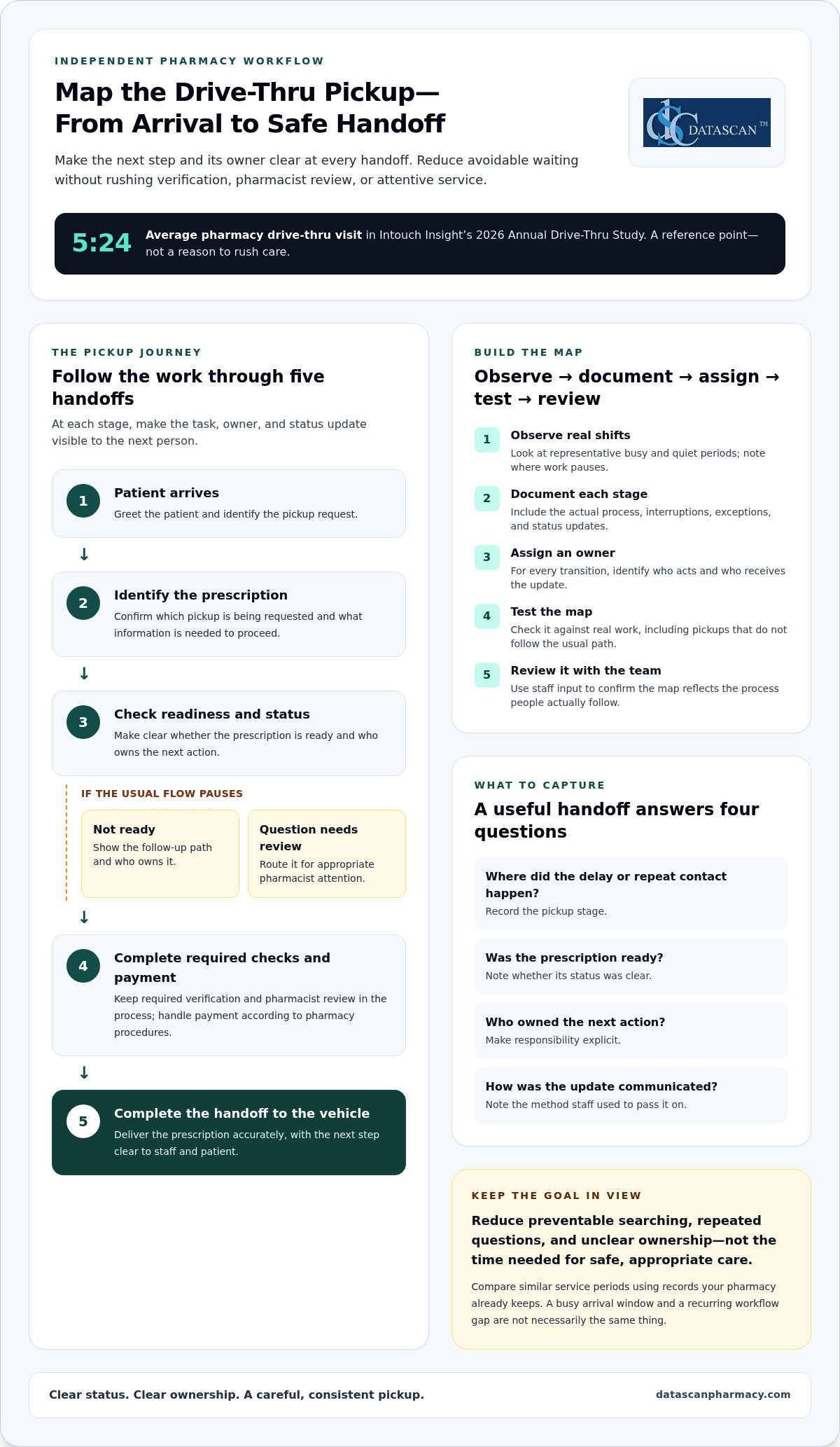
Drive-thru pharmacy workflow efficiency improves when staff can see what needs to happen next and who owns each handoff. The goal is not to rush every transaction. It is to reduce avoidable waiting while preserving careful, personal service. Intouch Insight’s 2026 Annual Drive-Thru Study puts the average pharmacy drive-thru visit at 5 minutes and 24 seconds, but speed matters only when patients still receive attentive service.
If staff repeatedly check prescription status, search for pickup information, or clarify who handles the next step, small delays can add up. Independent pharmacy owners already have plenty to manage, so finding bottlenecks should lead to practical changes, not another complicated project.
This guide explains how to map each handoff, identify avoidable waiting, and create a repeatable process from arrival through pickup. It also shows how to assess Pharmacy management software against your team’s actual responsibilities and workflow, including whether customizable workflow tools can support the way you work. The aim is a smoother drive-thru experience for patients and a more manageable process for staff, without treating speed as a substitute for care.
About the author: Datascan Pharmacy Software focuses on pharmacy technology and operational workflows for independent and retail pharmacies.
Key Takeaways
Trace the pickup journey from arrival to handoff to find delays caused by unclear status, ownership, or extra steps.
Map the process by observing, documenting, assigning responsibility, testing, and reviewing it with the team.
Compare workflow changes by their intended benefit, possible trade-offs, and the measures your team can track consistently.
Test one defined change, assign an owner, and explain the process to the staff it affects.
Assess Pharmacy management software against documented stages and staff responsibilities, including how customizable workflow fits your pickup process.
What slows down drive-thru pharmacy workflow efficiency?
Drive-thru pharmacy workflow efficiency depends on coordinated preparation, clear status communication, and reliable pickup handoffs. A delay may become visible at the window but begin earlier: a prescription is not ready, its status is unclear, or staff do not know who should take the next step.
Drive-thru workflow efficiency is the pharmacy’s ability to move a pickup from patient arrival to a safe, accurate handoff through coordinated tasks and clear status updates. Depending on the pharmacy’s procedures and the pickup, the process may include greeting the patient, identifying the pickup request, checking prescription status, completing required verification and pharmacist review, handling payment, and delivering the prescription to the vehicle.
Not every pause is avoidable. Verification, pharmacist review, and patient questions need the time required for safe and appropriate care. Focus instead on waiting caused by preventable searching, repeated questions, unclear ownership, or tasks that could have been handled before arrival. Pharmacy automation is one broad approach to organizing pharmacy tasks. The Pharmacy Automation overview provides context, but drive-thru handoffs still need to fit the pharmacy’s own process.
Where do drive-thru prescription pickup delays begin?
Look for where a pickup stops moving, not just how long the line is. A queue can grow because several patients arrive together. A processing bottleneck may occur when prescriptions are not ready. A communication bottleneck may show up when staff repeatedly ask whether an order is complete or who is handling it.
Observe the process and use records your pharmacy already keeps. Note when the queue grows, which pickup stages are still in progress, and where staff pause to find information or clarify responsibility. Compare similar service periods rather than relying on assumed industry benchmarks. This helps distinguish a busy arrival window from a recurring workflow gap.
Is the prescription ready when the patient arrives?
Can the staff member at the window identify its current status?
Does the next person know what action will move the pickup forward?
Which handoffs shape the patient pickup experience?
Follow each transition: intake to dispensing, dispensing to final checks, final checks to payment, and payment to vehicle-side service. At every stage, identify who owns the task, what status they communicate, and who receives the update. If ownership is unclear, two people may repeat work while another necessary step waits.
For example, a window staff member may need to confirm whether a prescription has cleared its final check. If that status has not been communicated, the staff member may leave the patient waiting while asking a colleague, even though the prescription is complete. A consistent handoff makes the next action clear without skipping verification or rushing pharmacist review.
How should a pharmacy map its drive-thru pickup workflow?
Map the pickup by observing what happens, documenting each stage, assigning responsibility, testing the map against real shifts, and reviewing it with the team. This gives staff a shared view of how information passes from one person to another, including what happens when a pickup does not follow the usual path.
Observe the work, document each step, assign an owner, test the map, and review it with the team. Keep the map practical. It should reflect the process staff actually follow, including interruptions and exceptions, rather than an idealized version. Record what the patient needs to know, what staff need to know, and how each update reaches the next person.
What should a drive-thru workflow map include?
Start with patient arrival and continue through prescription identification, readiness confirmation, payment, and completed handoff. At each transition, note the responsible role, the information needed to proceed, and the communication method staff use, such as a direct conversation or an available pharmacy system. Mark decision points where the request needs clarification or a question should be routed for appropriate review.
Show exceptions without letting them obscure the usual flow. For example, include a separate path for a prescription that is not ready and another for a question requiring pharmacist attention. These paths help staff see what to do next and who owns the follow-up, while preserving the pharmacy’s established verification and review steps.
How can pharmacy teams identify recurring bottlenecks?
Observe representative busy and quiet periods, then compare what changes and what stays the same. One shift may offer a useful clue, but it should not define the whole operation. Ask team members where they wait for information, repeat a contact, or feel unsure about who owns the next action. Their input can help distinguish recurring process friction from temporary demand or an unusual pickup.
Capture observations in a simple log. Detailed tracking that staff cannot maintain is less useful than consistent notes. Include:
The stage where a delay or repeat contact occurred.
Whether the prescription was ready and its status was clear.
Which role owned the next action and how it was communicated.
Whether the pickup was completed or needed follow-up.
Review the notes with the staff who handle each handoff. Confirm that the map reflects their actual responsibilities, then revise unclear steps before using it to assess changes. This groundwork also helps you decide whether pharmacy workflow software aligns with documented stages and responsibilities. A clear map is a practical starting point for improving drive-thru pharmacy workflow efficiency without asking staff to guess or skip necessary checks.
Which drive-thru workflow changes improve efficiency without sacrificing care?
The most useful changes address a specific point of friction, such as unclear role ownership, delayed status updates, disorganized queue handling, or a process staff manage outside their pharmacy system. Compare options against the process your team has documented. Judge drive-thru pharmacy workflow efficiency by both service flow and reliable, careful handoffs. Results depend on the pharmacy’s process and level of demand, so no change guarantees faster service.
Change
Intended benefit
Trade-off
Measure to review
Clarify role ownership
Reduce uncertainty about who takes the next action.
Responsibilities may need to flex during busy periods.
Repeat contacts and handoffs with unclear ownership.
Standardize status communication
Help staff share pickup status consistently.
A new communication step needs to fit existing work.
Time spent locating status or asking for updates.
Organize queue handling
Make the order and status of waiting pickups easier to follow.
Unexpected arrivals and exceptions can disrupt the sequence.
Waits, incomplete pickups, and queue interruptions.
Review workflow software support
Align system use with documented tasks and responsibilities.
Configuration will not resolve an unclear process by itself.
Manual workarounds and repeated data or status checks.
Should a pharmacy change the process or the software first?
Document the current process before deciding whether software configuration is needed. Start with low-disruption adjustments, such as clarifying ownership or agreeing on a consistent status update. If staff still rely on workarounds because the system does not align with the intended steps, consider a system-level change. Customizable pharmacy workflow software can support a defined process, but it should not be used to hide unclear responsibilities.
How can teams balance pickup speed with prescription accuracy?
Keep verification and appropriate pharmacist review visible in the workflow instead of treating them as obstacles to remove. Define how staff route questions that need pharmacist attention, and make sure routine handoffs do not bypass that path. A well-designed process supports the right review at the right stage while reducing avoidable searching and repeated questions.
Review service flow alongside signs of rework, such as repeated status checks, incomplete pickups, or handoffs that need correction. Treat privacy, prescription accuracy, and appropriate pharmacist involvement as non-negotiable when weighing a proposed change. If a faster step creates confusion or weakens a necessary check, revise the process rather than accepting that trade-off.
How can you test and improve drive-thru pharmacy workflow efficiency?
Test one clearly defined change against a consistent baseline, then review both the patient experience and the work required to complete each pickup. A small, measured pilot helps your team see whether a change reduces friction without creating new handoff problems or weakening necessary checks.
Start with measures staff can collect reliably using existing records or straightforward observations. Define what each measure means before comparing periods. For example, decide which events start and end an arrival-to-handoff measurement, and what counts as a repeat contact. Clear definitions make comparisons more useful and help prevent a busy shift from being mistaken for a process change.
Which measures can reveal drive-thru workflow friction?
Choose a small set that reflects both flow and completeness. Consider arrival-to-handoff time, repeat contacts, unresolved status questions, rework, and pickups that need follow-up. Record the same measures across comparable operating periods, and note unusual demand or exceptions that could affect interpretation. Without a comparable baseline and documented observation period, treat apparent improvement as an observation, not a proven result.
Arrival to handoff: Use the same start and end points each time.
Repeat contacts: Record when staff or patients need to ask again about status or next steps.
Rework and incomplete pickups: Note corrections, repeated actions, or cases that require follow-up.
Staff observations: Capture where the process felt unclear or required a workaround.
How should a pharmacy run a workflow pilot?
Choose one bottleneck the team can describe clearly, such as uncertainty about who communicates a status update. Assign an owner to explain the change, collect observations, and lead the review. Keep the adjustment limited so staff can distinguish its effects from other process changes, and explain what is changing before the pilot begins.
State the problem and the specific change being tested.
Tell affected staff what to do differently and who owns the next step.
Observe the process during the agreed review period and record exceptions.
Discuss results with staff, then continue, adjust, or stop the change.
Review more than timing. Ask whether patients received clear updates, handoffs were complete, staff knew who owned follow-up, and the change introduced extra steps elsewhere. If exceptions increased or staff needed frequent workarounds, revise the approach before expanding it. Do not assume a result will hold under every demand pattern. Record the conditions in which you observed it.
For broader process ideas, the Pharmacy Workflow Optimization Software: The 2026 Efficiency Guide can complement a local pilot. Pharmacy management software and workflow configuration should support the responsibilities your team has defined, not replace clear ownership. Datascan’s customizable pharmacy workflow is one option to assess against your documented process.
How can pharmacy management software support a better drive-thru workflow?
Pharmacy management software can support drive-thru pickup when its workflows align with the pharmacy’s documented stages, staff responsibilities, and patient-service priorities. Evaluate how the system fits the work your team already does rather than assuming software alone will resolve delays or improve drive-thru pharmacy workflow efficiency.
Use your workflow map as an evaluation tool. Follow a pickup through its stages and consider whether staff can access the prescription status information they need, understand who owns the next handoff, and complete payment within the pharmacy’s established process. Datascan Pharmacy Management Software includes customizable workflow capabilities, which can help align system configuration with a pharmacy’s way of working. The setup should support clear responsibilities, not create steps that staff must work around.
What should pharmacy management software support in a pickup workflow?
Assess the system against your actual pickup tasks. Consider prescription status visibility, defined staff handoffs, and whether point-of-sale steps fit the pharmacy’s existing process. Also plan how team members will learn the configured workflow and how you will review it after implementation. These considerations connect software decisions to day-to-day responsibilities rather than evaluating features in isolation.
For example, if the map shows staff often pausing to find out whether a prescription is ready, identify what information the relevant team members need and where they expect to find it. Then discuss how the system and staff process can support that need. Avoid assuming a particular display, alert, or drive-thru function exists unless it is part of the software being evaluated. A useful assessment ties each requirement to a real task and a clear owner.
Review point-of-sale steps just as practically. Consider where payment belongs in the pickup sequence, what information staff need at that stage, and how the process handles exceptions. Datascan Point of Sale is part of the broader set of tools pharmacies can consider alongside pharmacy management software. Review how the pieces fit your operation rather than treating a single feature as a substitute for a coherent workflow.
For a closer look at the broader system, explore Datascan Pharmacy Management Software. As you plan implementation, turn requirements into a straightforward pharmacy software implementation plan: identify the workflow being addressed, determine which staff responsibilities are affected, plan team training, and decide how to assess whether the configured process fits actual work. Keep the plan tied to your pharmacy’s own requirements.
How can independent pharmacies take the next step?
Bring your workflow map, recurring bottlenecks, and pilot observations to a software discussion. These materials connect system requirements to patient service and operational priorities, and help distinguish a configuration need from a process issue. Start with the handoff that most often causes confusion.
Treat drive-thru pharmacy workflow efficiency as an ongoing operational priority, not a one-time fix. As your team tests changes, record what you adjusted and what staff observed. That history can help you make future decisions with more confidence and keep the pickup process aligned with the way your pharmacy works.
If your next step involves technology, bring your documented workflow and priorities into the discussion. Datascan is a family-owned company that has supported independent and retail pharmacies across the United States since 1981, with pharmacy management software and customizable workflow capabilities. Focus on a practical fit for your operation, not change for its own sake.
Improving drive-thru pharmacy workflow efficiency starts with tracing a pickup from arrival to handoff, noting where work pauses, and testing one targeted adjustment at a time. Separate ready prescriptions from cases needing follow-up so different situations are not blended in the same comparison. Use the pharmacy’s own baseline across comparable periods, and keep identity checks, prescription verification, and pharmacist review intact. The aim is less friction, not a promised wait-time result.
What should a drive-thru pharmacy workflow include?
A useful drive-thru workflow covers patient arrival, request and prescription identification, readiness confirmation, payment, routing of questions that need attention, and completed handoff. Assign an owner to each transition and define the status information the next person needs. For example, identify a pickup as awaiting readiness confirmation rather than relying on memory or a second conversation. Adapt the sequence to the pharmacy’s roles, systems, and established operating procedures.
Can pharmacy software improve drive-thru workflow efficiency?
Yes. Pharmacy management software can support drive-thru work when its configuration reflects the pharmacy’s documented stages and staff roles. Assess whether staff can access needed information at the right point, whether handoffs make sense across roles, and how exceptions are handled. Software does not replace staff training, a clear process, or professional judgment. Test the fit with a representative pickup scenario to see whether the system supports the team’s actual workflow.
How should a pharmacy measure drive-thru efficiency?
Track a small, repeatable set of measures, such as arrival-to-handoff time, repeat contacts, unresolved status questions, and corrections or other rework. Define the start, end, and counting rules before collecting data, then compare similar operating periods against a baseline. Note factors such as unusual volume or exception cases so they do not distort interpretation. No single number describes the whole patient experience, so review measures alongside accurate handoffs and appropriate care.
How can a pharmacy handle prescriptions that are not ready at drive-thru pickup?
Create a separate path for a pickup that is not ready: confirm its current status, explain the next step to the patient, and assign a staff owner to follow through. Record what triggered the exception and whether the patient needed another contact, so the team can spot recurring causes. If the interaction raises a clinical question, route it through the pharmacy’s established process for pharmacist attention rather than improvising an answer.
What is the difference between drive-thru workflow efficiency and faster service?
Drive-thru workflow efficiency means coordinating a pickup with less avoidable friction. Faster service refers only to elapsed time. A shorter visit is not a success if the patient leaves without clear information, staff repeat work, or verification is rushed. Review how smoothly tasks move alongside handoff completeness and rework. This broader view helps the pharmacy improve operations without making speed the only measure that matters.
A dashboard won’t improve patient care on its own. Pharmacy data analytics for patient outcomes is useful when prescription and workflow information helps your team identify a follow-up opportunity and take a practical next step.
Independent pharmacy owners know that consistent care takes time, and operational reports don’t always show whether patients are getting the follow-up they need. Prescription and clinical information can also be scattered across daily work, leaving little time to look for patterns. Pharmacy management software can help organize information used in care workflows, making it easier for a busy team to review.
This article explains how to connect pharmacy data with patient-care questions, interpret findings carefully, and turn useful patterns into manageable actions. About the author: The Datascan Pharmacy Software team focuses on pharmacy management software and operational workflows for independent and retail pharmacies.
Key Takeaways
Connect a specific care question to measures your team can review and act on.
Compare dispensing and refill records, medication synchronization activity, care-plan documentation, and patient feedback, while considering the limits of each source.
Separate baseline, process, and patient-outcome measures so completed tasks aren’t mistaken for improved health.
Build a repeatable review cycle around actionable exceptions and your team’s capacity.
Use pharmacy management software and customizable workflows to organize review and follow-up, not as proof of clinical impact.
What does pharmacy data analytics for patient outcomes actually measure?
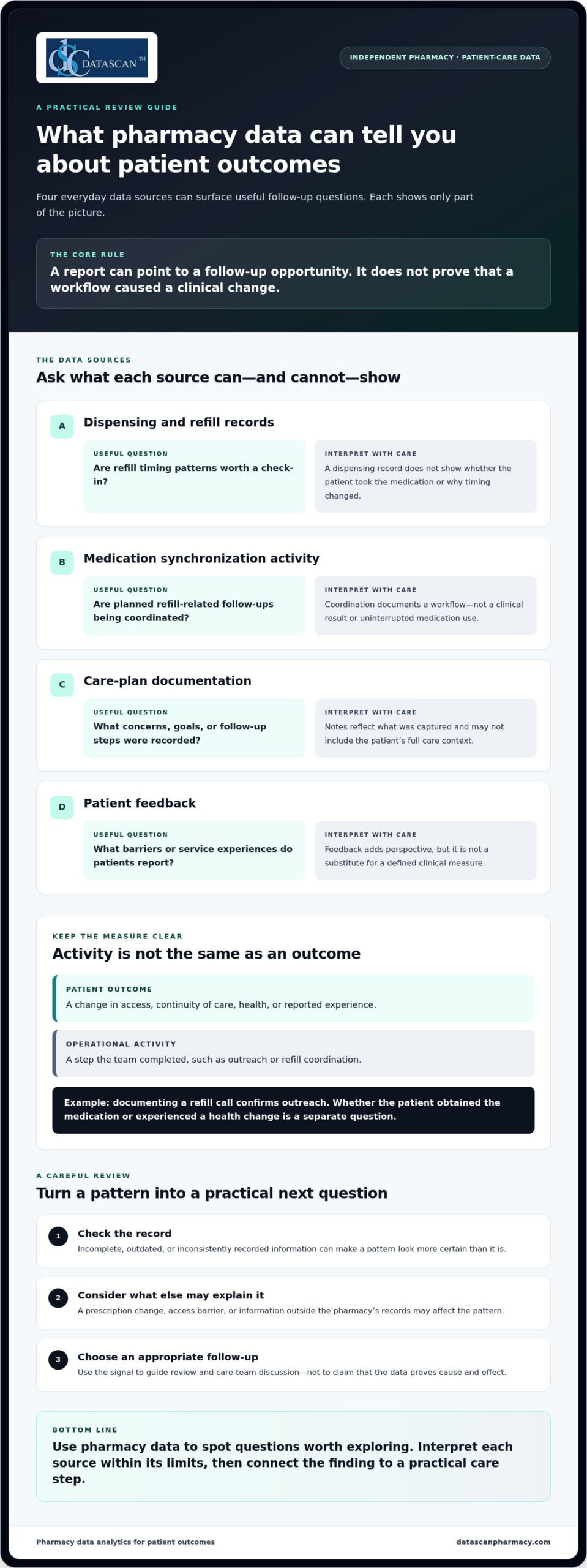
Pharmacy data analytics for patient outcomes connects information a pharmacy already handles to practical questions about care, follow-up, and patient experience. It can help an independent pharmacy identify where a patient may need attention. A report is a starting point for review, not proof that a particular service caused a clinical change.
Outcome measures describe a change in a patient’s health, medication access, continuity of care, or reported experience. Pharmacy activity measures describe work the team completed, such as outreach or refill coordination. Both can be useful, but an activity shouldn’t be presented as an outcome.
This work uses pharmacy information to support healthcare decisions. For clinical measures, consult the Pharmacy Quality Alliance’s measure resources and other appropriate clinical guidance to understand how a measure is defined and what it captures. Pharmacy management software can organize information used in established workflows, but a measure’s meaning depends on its definition, the information available, and the patient’s circumstances. A pharmacy management software system can support those workflows; it doesn’t independently prove cause and effect.
Which patient outcomes can a community pharmacy reasonably examine?
Start with areas the pharmacy can observe or document: whether a patient was able to obtain medication, whether refills appear consistent over time, whether planned follow-up took place, and how patients describe their experience. These indicators can flag a need for a closer look. Dispensing records alone, however, may not explain why a prescription wasn’t filled or whether a patient took the medication.
For clinical measures, use a validated definition and interpret results in the appropriate clinical context. Some long-term health outcomes depend on information outside the pharmacy’s view, so routine operational data may not show the full picture.
How are patient outcomes different from operational metrics?
An operational metric shows whether a step occurred. A patient-level measure asks whether something about the patient’s access, continuity, health, or experience changed. Operational indicators can point to useful follow-up opportunities, but completing a task doesn’t establish that the patient’s condition improved.
For example, a record that staff contacted a patient about a refill documents outreach. Whether the patient obtained the medication, continued treatment, or experienced a health change is a separate question that may require additional information and context.
Interpret findings cautiously. If patients who received follow-up show a different pattern later, that association can guide the team’s next question, but it doesn’t establish that follow-up caused the difference. Other factors may be involved, including a prescription change, access barriers, or information the pharmacy doesn’t hold.
For a useful review, label each measure as a patient outcome, a process measure, or a contextual indicator. This helps owners and staff discuss what the data shows, what it can’t show, and what follow-up may be appropriate, without mistaking a completed workflow step for better care.
What pharmacy data can help you understand patient outcomes?
Useful pharmacy data can come from routine dispensing, refill coordination, documented care-plan activity, and patient feedback. Together, these sources can help an independent pharmacy identify questions for follow-up, but each offers only part of the picture. Pharmacy data analytics for patient outcomes is most useful when the source, question, and limits of interpretation are clear.
Data quality affects how confidently a result can be interpreted. Incomplete, outdated, or inconsistently recorded information can make a pattern look more certain than it is. Before drawing conclusions, check what the record captures and what may be missing.
Data source
Possible question
Interpretation caveat
Dispensing and refill records
Are there refill timing patterns that may warrant a check-in?
A record shows dispensing activity, not whether the patient took the medication or why timing changed.
Medication synchronization activity
Are planned refill-related follow-ups being coordinated?
Coordination documents a workflow, not a clinical result or uninterrupted medication use.
Care-plan documentation
What concerns, goals, or follow-up steps were recorded?
Documentation reflects what was captured and may not include the patient’s full care context.
Patient feedback
What barriers or service experiences do patients report?
Feedback adds perspective, but isn’t a substitute for a defined clinical measure.
Can dispensing and refill patterns reveal follow-up needs?
They can point to a question worth asking, but they don’t establish adherence or health status. A refill later than expected might prompt staff to review the record or follow up. Timing can also reflect a prescription change, supply on hand, access issues, or a patient’s circumstances. Medication synchronization can help coordinate refill timing and related follow-up; the activity itself doesn’t prove that treatment continued.
How can care plans and patient feedback add context?
Care-plan notes can show what was discussed, what follow-up was planned, and whether a concern was documented alongside prescription information. Patient feedback can add another useful signal, such as a reported difficulty obtaining medication or understanding a process. Consider these sources together, while keeping feedback distinct from validated clinical measures and recognizing that documentation may not capture every interaction.
Information may be spread across systems or recorded differently by team members. First establish which records are available and how consistently they’re maintained. Access and use also depend on the pharmacy’s workflows and applicable requirements. Tie each measure to a defined question, then check whether the records contain the details needed to answer it.
For example, if the question is whether refill coordination is happening as intended, distinguish a record of planned contact from a patient-reported barrier or clinical measure. That separation helps avoid treating missing documentation as proof that care did or didn’t occur. A clear, manageable workflow can help the team capture follow-up consistently. Discuss pharmacy workflow needs in the context of your day-to-day processes.
How do you analyze pharmacy data without confusing activity with better outcomes?
Use a simple sequence: define a care question, choose a measure, check the data, interpret the pattern, and decide what action is appropriate. This keeps pharmacy data analytics for patient outcomes focused on decisions your team can make instead of reports without a clear purpose.
Define one question. Tie it to a specific care priority, such as whether a follow-up process is reaching the patients it is intended to reach.
Select a measure. Specify exactly what will be counted, for whom, and from which records.
Review data quality. Check whether records are complete, consistent, and relevant to the question.
Interpret the pattern. Compare like with like, and document changes in patients, prescriptions, or workflows that could affect the result.
Choose an action. Decide whether the finding calls for follow-up, a workflow adjustment, or more information before drawing a conclusion.
Keep three measure types distinct. A baseline measure describes the starting point for comparison. A process measure records an activity, such as a documented outreach attempt. A patient-outcome measure describes a defined patient-level result. A process measure may help explain how care was delivered, but it doesn’t substitute for an outcome measure.
Which measure should a pharmacy choose first?
Choose one care question that matters to the pharmacy and can be answered with information the team can reliably review. Define the measure in plain terms, including its data source and the population it describes. If staff can’t interpret the result or connect it to a reasonable next step, the indicator may add reporting work without helping care decisions.
How can you interpret trends responsibly?
Use consistent time periods and definitions when comparing results. Note missing records, changes in documentation, and workflow adjustments, since these can affect what appears in the data. For clinical measures, follow the measure’s published specification and appropriate clinical guidance rather than creating a local definition that looks similar but counts something different.
A before-and-after change alone cannot prove that a pharmacy action caused the difference. A trend may be associated with an intervention, but other explanations can include a change in patient mix, a therapy change, or incomplete records. The data can help identify a pattern, but it can’t isolate cause and effect by itself.
Consider a pharmacy reviewing a follow-up process over time. If documented contacts increase, that may show a change in recorded activity. It doesn’t establish that patients had better access or a different clinical result. Check whether the patient-level measure was defined and captured consistently, and whether other changes could explain the pattern.
When the meaning or clinical significance of a measure is unclear, avoid overinterpreting it. Consult an appropriate clinical expert or the authoritative source that defines the measure. Pharmacy software can help teams organize information within existing work, but careful definitions and sound judgment are what make the analysis useful.
How can an independent pharmacy turn analytics into patient-care action?
Turn analytics into action by building a small, repeatable review cycle around work your team already does. Choose a care question, review only the information needed to answer it, assign appropriate follow-up, and check whether the process is useful before expanding it. Pharmacy data analytics for patient outcomes should lead to a manageable decision, not another report competing with patient care.
A practical review cycle can look like this:
Select a priority. Choose a care process the pharmacy wants to understand, such as whether planned follow-up is reaching the intended patients.
Review actionable exceptions. Focus on records that may need attention rather than scanning every metric. Confirm the information before treating an exception as a care need.
Assign responsibility. Make clear who reviews the information, who handles appropriate follow-up, and where the action is documented.
Assess the workflow. Consider whether the review led to a useful next step and whether the team can sustain it with available capacity.
Keep documentation focused on the decision and action. Limit access to patient information according to appropriate team responsibilities and applicable privacy requirements. For practical ways to align review steps with daily pharmacy work, consider pharmacy workflow optimization.
How can you fit a data review into a busy pharmacy day?
Start with a small set of defined measures linked to existing care processes, then assign review and follow-up within the team’s current responsibilities. A brief, consistent review is more manageable than adding a reporting task with no clear owner. Before expanding, check whether the information led to a useful action and whether the process fits the pharmacy’s capacity.
Customizable workflows and pharmacy management software can help organize information around established responsibilities. Medication synchronization and e-care plans can support consistent follow-up processes, but they don’t guarantee clinical results. The pharmacy still needs a clear purpose for each review and a practical way to document the next step.
How can analytics support PBM-related patient-care decisions?
Keep reimbursement analysis separate from patient-outcome measurement. Reimbursement records can help the owner understand financial performance, while care measures address questions about patient access, follow-up, or experience. The two areas can overlap operationally because financial pressure may constrain the time or resources available for care activities, but assess that connection locally rather than assuming it.
For example, a reimbursement review may help identify a business concern, while a separate care review tracks whether planned follow-up is taking place. Keeping the questions distinct makes both analyses easier to interpret. Pharmacy software can support organized workflows, but it can’t establish that a reimbursement change caused a patient outcome or that an operational adjustment improved care.
Choose an analytics workflow that fits your team’s care priorities and daily responsibilities. Talk with Datascan about pharmacy workflow needs and how software can support a more manageable review process.
How can pharmacy management software support patient-outcome analytics?
Pharmacy management software can support patient-outcome analytics by organizing operational information within established pharmacy workflows, helping staff document care activity and identify records for review. It provides structure for the process, not a clinical conclusion. Pharmacists still interpret information, apply professional judgment, and decide what follow-up is appropriate.
For independent pharmacies, that distinction matters. A useful system should support the path from information to action without turning analytics into a separate administrative burden. Dispensing details, refill coordination, and documented care-plan activity may inform a review, while the pharmacy team determines what the information means for an individual patient. Data alone can’t establish that a workflow caused a particular outcome.
What should pharmacy management software contribute to an analytics process?
Look for practical support in three areas: organized information staff can use in their work, visibility into relevant workflow steps, and consistent documentation of follow-up. These features can help a team review its process more reliably. Software should assist the pharmacist’s judgment, not replace clinical expertise or turn an operational record into a clinical assessment.
Before adding a measure, connect it to a clear workflow question. Can the team locate the information needed for review? Is follow-up documented consistently? Does the result point to an action the team can take? If those links aren’t clear, adding more reports may create work without improving the decision process. A customizable workflow can help align review responsibilities and documentation with the pharmacy’s operations.
Datascan’s pharmacy management software is designed for independent and retail pharmacies. Its software suite includes medication synchronization and e-care plans, which can support organized refill coordination and consistent follow-up processes. These are workflow supports, not guarantees of improved adherence or other clinical outcomes.
How can Datascan help independent pharmacies connect insight with action?
Datascan provides pharmacy software for independent and retail pharmacies. Its customizable workflows can help align information review and follow-up with how a pharmacy team works, while medication synchronization and e-care plans support care processes. The pharmacy team remains responsible for interpreting information and choosing appropriate next steps.
Datascan is a family-owned company founded in 1981 and offers U.S.-based support. Its experience provides context for its focus on pharmacy operations, but software features don’t prove that a particular intervention produced a patient outcome. Keep measures clearly defined and use the system to support a careful review process.
When evaluating how software fits an analytics process, consider whether it can support the questions your team wants to answer, the information it needs to review, and the follow-up steps it can reasonably sustain. A conversation about your pharmacy’s workflows can help clarify what an organized process could look like. The goal is not more data for its own sake, but useful information that supports sound decisions and patient care.
Choose one patient-care question to act on
Your next step doesn’t need to be a large analytics project. Choose one patient-care question that matters to your pharmacy, decide what information would help answer it, and identify who can review the finding and determine a reasonable next step. A focused starting point keeps pharmacy data analytics for patient outcomes connected to real decisions instead of adding another task without a clear purpose.
As your approach develops, keep the process grounded in your team’s capacity. The right pharmacy management software should support how your pharmacy organizes information and follow-up, while leaving clinical interpretation and care decisions with your pharmacy professionals.
Can pharmacy data analytics prove that a pharmacy service improved patient health?
No. Pharmacy data analytics for patient outcomes can show changes or relationships in defined measures, but it can’t establish on its own that a service caused a health result. A measure may shift after a new follow-up process begins while other factors also change. Document what was introduced, check for competing explanations, and use appropriate clinical evidence before making claims about impact.
What patient outcomes can an independent pharmacy track?
The right measure depends on the care question and the information the pharmacy can reliably access. A pharmacy might select a defined measure related to medication access, continuity, or patient-reported experience, then specify which patients and records it covers. Use a validated definition where available, and state any limits clearly. A dispensing record alone, for example, can’t confirm how a patient used the medication.
How can pharmacy analytics help identify patients who may need follow-up?
Analytics can help surface records for review, such as a refill workflow that appears interrupted or a planned follow-up without documented completion. Treat these as prompts, not diagnoses. A staff member should verify the record, consider relevant context such as a changed prescription, and follow the pharmacy’s established process to decide whether outreach is appropriate. A flag should guide professional review, not automatically trigger a clinical conclusion.
What is the difference between a pharmacy process measure and a patient outcome?
A process measure records what the pharmacy team did, while a patient outcome describes a defined result for the patient. For instance, documenting that a medication review was completed measures an activity; a separately defined patient-level measure is needed to assess a result. Tracking both can help show whether a service was delivered and what happened afterward, but one measure shouldn’t substitute for the other.
Does pharmacy management software automatically improve patient outcomes?
No. Pharmacy management software can support organized records and repeatable workflows, but its presence doesn’t guarantee a clinical result. A system may help staff track a planned follow-up, while the pharmacy team still needs to assess the patient’s situation and determine an appropriate response. Evaluate software by how it supports a defined care process, not by assuming a feature itself improves health.
How can a pharmacy use analytics without adding too much staff workload?
Start with one question tied to a process the team already performs, and choose information that can be reviewed within existing responsibilities. Assign a clear owner to check exceptions and record the outcome of that review. If the information doesn’t lead to a decision or useful follow-up, simplify the measure or stop collecting it. Expand only after the initial process proves practical for the team.
How should a pharmacy protect patient information when reviewing analytics?
Use established pharmacy privacy and security procedures, limit access according to team roles, and review information only for an appropriate purpose. Before setting up a new report or review process, identify where its information comes from, who will see it, and how findings will be recorded. Requirements depend on the activity and applicable rules, so use current authoritative guidance and the pharmacy’s compliance resources for decisions about specific obligations.
A proof of delivery app for pharmacy should give staff a clear, retrievable record of delivery status and help them know when follow-up is needed. If it creates a disconnected record or duplicates existing work, it can add tasks instead of saving time.
That distinction matters when pharmacy teams are balancing patient service, daily operations, and pressure on reimbursements. Paper records and unclear delivery status can lead to avoidable follow-up. A tool that doesn’t fit your pharmacy’s workflow can leave staff managing yet another system.
This guide explains how to assess delivery documentation, workflow fit, and the way delivery tools work alongside pharmacy management software. You’ll find practical questions to use when comparing options and learn how Datascan’s pharmacy-focused delivery tools fit into the evaluation. Author bio: Datascan Pharmacy Software provides pharmacy management software and delivery tools for independent and retail pharmacies.
Key Takeaways
A proof of delivery app for pharmacy should document delivery status and help staff review it. It is not the same as route planning or patient communication.
Map each delivery step, from preparation to driver handoff and pharmacy follow-up, to identify where a tool fits your current process.
Compare workflow fit, status visibility, record access, staff usability, and how the app relates to your pharmacy management software.
Before adopting an app, define staff responsibilities, training needs, exception handling, and who needs access to delivery records.
Review how Datascan’s Mobile Delivery App and Electronic Delivery System fit into pharmacy delivery management.
What Does a Proof of Delivery App for Pharmacy Need to Prove?
A proof-of-delivery app records delivery completion and helps pharmacy staff review a delivery’s status. Its core purpose is to make the handoff easier to account for. Staff should be able to see whether a delivery is complete or needs follow-up without piecing together events from scattered notes, calls, or messages.
That purpose is narrower than general delivery logistics. Route planning helps determine where a driver goes; dispatch coordinates the work; patient communication shares updates. Delivery proof records the outcome of the handoff. A tool may combine some of these functions, but they aren’t interchangeable. A planned route doesn’t show that a delivery was completed, and a message to a patient doesn’t, by itself, establish the delivery outcome.
Use a practical test: can staff find a clear delivery status, understand what it means, and identify the next action when the status is unresolved? A useful process gives pharmacy staff and drivers a consistent handoff and gives the team a shared reference when questions arise. Pharmacy management software and delivery tools work best when they support the way the pharmacy already handles prescriptions and delivery work. Datascan’s Electronic Delivery System is part of its pharmacy delivery technology.
What counts as proof of delivery in a pharmacy?
Proof of delivery (POD) is a record showing that a delivery reached its intended completion point. The evidence included depends on the system and the pharmacy’s process, so don’t assume that every app captures the same information. For general background on the term and its electronic use, see Proof of delivery (POD).
Keep the meaning precise. A delivery confirmation concerns the delivery handoff. On its own, it doesn’t prove that a prescription was dispensed or that clinical counselling took place. Those are separate pharmacy activities. Define what “complete” means for each delivery workflow so staff record the right status without treating one event as evidence of another.
Why do independent pharmacies need delivery visibility?
When staff can’t tell whether a delivery is complete, a routine patient question can trigger several manual checks. Someone may need to find a paper note, call a driver, or ask a colleague what happened. A visible, retrievable delivery record gives the team a shared reference for follow-up and helps distinguish unresolved deliveries from completed ones.
Pharmacy proof of delivery is a retrievable record that shows whether a prescription delivery reached its defined completion point. For an independent pharmacy, that clarity can support a more organized handoff and make status checks easier to manage. It doesn’t replace route planning, dispensing records, or patient counselling.
How Does a Pharmacy Proof of Delivery App Fit the Delivery Workflow?
A pharmacy proof of delivery app fits between preparing an order for delivery and reviewing what happened after the driver handoff. It works best when staff know who prepares the delivery, who records its status, and who handles exceptions. Define those responsibilities first so the app supports the pharmacy’s process instead of creating a parallel set of tasks.
Think of the workflow as a chain of handoffs. The pharmacy identifies the delivery, assigns responsibility for the next step, records the status after the handoff, and uses that record to guide follow-up. The app can give staff a shared place to review delivery information, but the pharmacy still needs to decide who updates the record and acts on it. Software alone can’t resolve unclear ownership.
Where should delivery information enter the workflow?
Start before dispatch, when staff identify which order is going out and note any handling instructions relevant to that delivery. Prescription-processing details belong in the pharmacy’s established process. Delivery staff need a consistent reference that connects the prepared order to its delivery record. Using the same reference at preparation, handoff, and review makes it easier to match a record to the delivery later.
This is where the wider system matters. Pharmacy management software supports core pharmacy operations, while the delivery process needs to connect clearly to the work staff already do. Review how pharmacy management software fits into your operating process, then map delivery handoffs around your team’s actual responsibilities.
Prepare: Identify the delivery and the staff member responsible for preparing it.
Hand off: Make clear who takes responsibility for the delivery after it leaves the pharmacy.
Record: Follow the system process for recording the delivery status.
Review: Give pharmacy staff a defined way to find the record and decide whether follow-up is needed.
These steps define workflow ownership, not a promise that an app automates each task. During evaluation, check whether staff can use the app’s records without entering the same information in multiple places. The aim is a dependable handoff, not extra data entry for its own sake.
What should happen when delivery status needs follow-up?
Set an exception process before the team starts using a new tool. Staff should know how to identify a delivery with an unclear status, who reviews the available record, and who takes the next step. Define when an unresolved item moves from routine review to a designated supervisor or manager.
Keep reference details consistent across preparation, handoff, and review. If the pharmacy uses different labels or identifiers at each stage, staff may struggle to match a delivery record to the order they’re checking. A short written procedure can establish who records the status, how the team finds the record, and where to document the outcome of follow-up.
Delivery status records also serve a different purpose from supply-chain traceability. The FDA’s Drug Supply Chain Security Act (DSCSA) information addresses drug supply-chain security, not the pharmacy’s delivery workflow. To discuss how delivery tools fit into pharmacy operations, visit Datascan’s contact page.
Which Proof of Delivery App Features Matter Most to a Pharmacy?
The most useful features are those that support your delivery workflow and make delivery status and records easy for staff to review. Compare tools against real tasks, not the length of a feature list. A capability is valuable when it addresses an operational need without adding unnecessary steps.
Use this table to focus your evaluation:
Evaluation area
What to assess
Why it matters
Workflow fit
Can staff use the tool within the steps they already follow?
A natural fit can reduce workarounds and duplicate handling.
Delivery status visibility
Can staff find and understand the available status?
Clear status helps the team respond to questions and identify items needing review.
Record access
Can the appropriate staff locate delivery information when needed?
Accessible records can support organized follow-up and internal review.
Staff usability
Can pharmacy staff and drivers follow a repeatable process?
A usable process is easier to apply consistently.
System fit
How does the delivery tool relate to pharmacy management software and existing work?
A considered fit can limit disconnected steps.
How can I assess delivery records and visibility?
Evaluate the record from a staff member’s perspective. Can they locate a delivery, interpret its status, and review the available information efficiently? Ask to see a typical pharmacy delivery workflow in a product demonstration. Confirm specific capabilities rather than inferring them from labels. Timestamps, signatures, and location data are product-specific details to verify, not assume.
Retrievable delivery information may also help staff organize an internal review when a PBM reimbursement question involves delivery documentation. It can give the team relevant information to examine, but it doesn’t determine whether a claim qualifies for reimbursement or guarantee a particular result. Assess how easily staff can find the records they need, and keep documentation review within your pharmacy’s established process.
How do I judge usability and pharmacy system fit?
Test the process with the people who will use it: staff preparing deliveries, drivers handling them, and team members reviewing records. Look for a simple, repeatable sequence that doesn’t rely on undocumented steps. Evaluate delivery tools in the context of your actual pharmacy workflows and pharmacy management software.
A proof of delivery app for pharmacy should help staff complete necessary work with clear roles and usable records. Prioritize capabilities that address a known gap rather than adding features without an operational purpose. Assess delivery documentation separately from any specific PBM reimbursement or review criteria your pharmacy follows.
Can a Proof of Delivery App Improve Accountability Without Adding Staff Work?
Yes, if the app fits the responsibilities your team already has. A proof of delivery app for pharmacy can make delivery work easier to review, but unclear ownership or duplicate entry can add steps instead of reducing them. Before choosing a tool, test how it works for the people preparing deliveries, handling handoffs, and reviewing exceptions.
Clear delivery ownership gives staff a defined way to record, review, and act on delivery information. That can make it easier to handle status questions without repeatedly chasing updates. Accountability comes from a clear process, not from adding software alone.
What should a pharmacy test before choosing an app?
Walk through representative situations with the staff who will use the tool. Include a routine delivery, a failed handoff, and a patient or staff member asking for a status update. At each point, note who records the information, who can find it, and who decides what happens next. This reveals workflow gaps that a feature list may not show.
Staff roles: Identify who prepares a delivery, records its status, reviews unresolved items, and handles follow-up.
Training: Determine what drivers and pharmacy staff need to learn to complete their part consistently.
Exceptions: Agree on how the team handles a failed handoff, incomplete status, or record that needs clarification.
Record access: Establish which staff need to locate delivery information and how they’ll use it during follow-up.
Product capabilities: List open questions and verify specific functions instead of assuming they’re included based on a feature name.
Use the same scenarios to compare your current process with the proposed one. Note repeated entry, unclear handoffs, or steps that depend on informal messages. The aim isn’t to eliminate every staff action. It’s to see whether the app makes necessary work clearer without creating avoidable workarounds.
How can a pharmacy introduce delivery technology smoothly?
Begin with a written workflow that shows who owns each step and where staff turn when an exception occurs. Orient the team to that process before relying on the tool, then apply the same procedure consistently. Broader pharmacy workflow optimization can help show how delivery tasks fit into pharmacy operations.
After introducing the process, gather staff feedback on points that cause confusion or extra handling. Clarify responsibilities or steps as needed, and make sure the people responsible for follow-up can access the records they need. A small, repeatable process is more useful than a complicated workflow that only one team member understands.
Datascan’s pharmacy software and delivery tools are designed for pharmacy operations. Learn more about discussing your pharmacy’s delivery workflow on Datascan’s contact page.
How Can Datascan Support Pharmacy Delivery Management?
Datascan supports pharmacy delivery management with the Datascan Mobile Delivery App and Electronic Delivery System. These tools are designed for pharmacy operations. Evaluate their fit against your team’s real workflow: how deliveries are prepared, how responsibility is handed off, and how staff review delivery records. This helps you assess how delivery technology can complement pharmacy management software rather than become a disconnected task.
Where do Datascan’s delivery tools fit?
The Datascan Mobile Delivery App provides mobile delivery tracking, while the Electronic Delivery System offers electronic delivery tools. Pharmacies can evaluate these delivery-focused options alongside pharmacy management software. Focus on how the tools relate to your operation’s needs and the capabilities that matter to your delivery process.
As you assess records and workflow, consider how the Electronic Delivery System relates to the way your team handles delivery information. Compare the tools with your evaluation criteria: workflow fit, status visibility, record access, staff usability, and system fit. Focus on your pharmacy’s needs and distinguish demonstrated functions from assumptions based on a product name or feature label.
Delivery management is one part of the broader pharmacy operation. Pharmacy management software supports the wider environment in which staff prepare and manage pharmacy work, while delivery tools address delivery-related processes. Reviewing both together can help identify where a consistent workflow may support accountability and reduce unnecessary staff follow-up. Keep responsibilities clear for tasks your team still needs to perform.
What is the next step for evaluating fit?
Prepare a short outline of your current process before discussing options. Note the steps from delivery preparation through handoff and record review, identify the staff roles involved, and list common situations that require follow-up. Bring questions about how delivery records are accessed and which product capabilities matter to your operation. This keeps the discussion focused on your team’s needs rather than a generic feature checklist.
Datascan has served pharmacies since 1981 as a family-owned and operated company, and U.S.-based technical support is part of its offering. This is relevant context for independent and community pharmacies considering technology for day-to-day operations, including the time demands placed on owners and staff.
A proof of delivery app for pharmacy should be evaluated within the full delivery workflow, with clear roles and useful records at the center. Datascan’s pharmacy software and delivery tools offer a pharmacy-focused option to consider as you compare workflows. Bring your delivery steps, staff responsibilities, and key questions to the conversation.
Turn your evaluation into a clear picture of how delivery work should move through your pharmacy. Identify where staff need better visibility, which records they must be able to review, and what responsibilities belong to each team member. This gives you a practical basis for deciding whether a proof of delivery app for pharmacy will support your operation or add another task to manage.
Keep the goal focused: give your team a dependable way to understand delivery status and act on unresolved issues, while protecting time for the work only pharmacy staff can do. A thoughtful workflow discussion can connect delivery tools with the way your pharmacy already operates.
A proof of delivery app for pharmacy use records delivery outcomes for staff to review. It helps answer an operational question: what information is recorded about this handoff? On its own, it doesn’t establish that a prescription was dispensed correctly or that counselling occurred. Before selecting an app, define what your pharmacy considers a completed delivery and how staff will use the record during a patient inquiry or internal review.
How does a pharmacy proof of delivery app work?
A pharmacy delivery app gives staff and drivers a process for associating a delivery with its status and reviewing the available record. For example, if a patient calls about an order, staff can use the pharmacy’s chosen reference to locate the delivery information and determine whether further investigation is needed. The exact steps and captured details depend on the product, so build your workflow around demonstrated capabilities.
What should I look for in a pharmacy delivery app?
Look for a tool that addresses a specific need in your operation, such as finding a delivery record or clarifying who handles an unresolved status. Test common tasks with the people who will use the system: have a staff member locate a sample record, explain its status, and identify the next action. Verify specific evidence and functions rather than assuming they come with a feature label.
Can a proof of delivery app help reduce delivery follow-up work?
It can help staff answer some status questions using a retrievable record, but follow-up is still needed when information is missing or an exception requires investigation. Consider which delivery questions your team receives and what information staff need to resolve them. This gives you a practical way to assess whether a proposed process could make routine inquiries easier to handle, without assuming every follow-up will disappear.
Does a pharmacy delivery app need to integrate with pharmacy management software?
System fit depends on how your pharmacy handles delivery information. Determine whether staff can follow the workflow without unnecessary duplicate entry or confusing references. During evaluation, trace one delivery through the systems your team uses and note where information is created, reviewed, and retrieved. Assess the workflow and any direct integration claims against product-specific information.
How can a pharmacy introduce a delivery app without disrupting staff workflows?
Prepare staff before changing the routine: document the current process, explain who owns each delivery step, and show how the team will handle an exception. Use representative scenarios in orientation, such as a routine handoff and a delivery that needs follow-up. Invite staff to flag unclear steps, then refine the written procedure. A shared reference helps team members apply the process consistently across shifts.
Is a proof of delivery app the same as pharmacy route optimization software?
No. A proof of delivery app focuses on recording delivery outcomes and making available records reviewable. Route optimization software focuses on planning or organizing travel between stops. A product may offer both types of capability, but one doesn’t automatically mean the other is included. Decide whether your pharmacy needs delivery documentation, route planning, or both, then assess each capability against its operational purpose.