
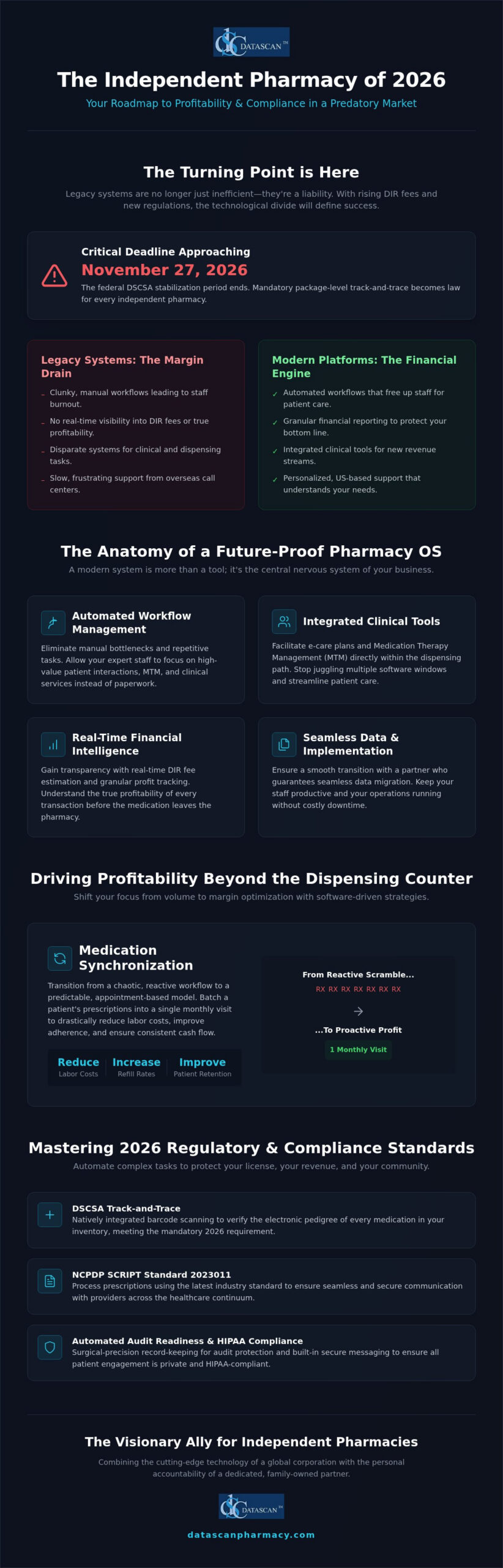
Your pharmacy is no longer just a place to fill prescriptions; it’s a financial engine that must be tuned for survival in a predatory market. By the time the federal DSCSA stabilization period concludes on November 27, 2026, the technological divide between thriving independents and struggling shops will be absolute. If you’re still battling pharmacy management software that feels like a relic of the nineties, you aren’t just losing time; you’re hemorrhaging margin.
We know the pressure of rising DIR fees and the exhaustion caused by clunky workflows that lead to staff burnout. It’s unacceptable to wait on hold for global call centers while your profitability hangs in the balance. You’ve worked too hard to let poor technical support or compliance complexity stall your growth. This guide promises to help you master modern operations by selecting a system that prioritizes your independence and long-term viability.
We’ll explore how to transform these burdens into streamlined successes through automated medication synchronization and transparent financial reporting. You’ll gain a clear roadmap for implementing tools that offer personalized, US-based support and high-precision dispensing. It’s time to stop surviving the industry’s shifts and start leading them with a platform built for the future. We don’t just want you to keep up; we want you to win.
Key Takeaways
- Modern pharmacy management software has evolved from a simple dispensing tool into a comprehensive financial engine designed to reclaim margins and combat PBM pressures.
- Discover why a “one-size-fits-all” corporate platform often fails independent pharmacies and why localized, US-based technical support is critical for operational uptime.
- Learn how to leverage clinical management features and automated medication synchronization to open new revenue streams beyond the traditional dispensing counter.
- Master the five essential phases of a software transition to ensure your data migration is seamless and your staff remains productive during the switch.
- See how a family-owned partner provides the cutting-edge technology of a global corporation with the personal accountability of a dedicated, visionary ally.
What is Pharmacy Management Software in 2026?
In 2026, your pharmacy management system is the central operating system that dictates every financial and clinical movement within your business. It’s no longer just a digital filing cabinet for scripts. Legacy dispensing systems were built for an era where volume was the only metric that mattered, but that world is gone. Today, the industry has pivoted toward a value-based care model. Modern pharmacy management software must act as a sophisticated clinical platform that captures patient outcomes while simultaneously defending your bottom line against predatory PBM tactics.
The Core Pillars of a Modern System
True operational excellence starts with modern pharmacy management software that offers automated workflow management to remove manual bottlenecks. This allows your staff to focus on high-value patient interactions instead of paperwork. A 2026-standard system integrates clinical tools directly into the dispensing path, facilitating e-care plans and medication therapy management (MTM) without requiring you to switch between disparate software windows. This level of control requires a partner who provides personalized, US-based support to resolve technical hurdles before they impact your workflow. Beyond clinical care, financial intelligence is the most critical pillar for the independent underdog. Your software must provide real-time DIR fee estimation and granular profit tracking. This transparency ensures you understand the true profitability of every transaction before the medication even leaves the pharmacy.
Regulatory Compliance Standards for 2026
Compliance isn’t just a hurdle; it’s a requirement for survival. The federal DSCSA stabilization period officially concludes on November 27, 2026, making package-level track-and-trace mandatory for every independent pharmacy in the nation. This mandate requires a system with native barcode scanning capabilities that verify the electronic pedigree of every medication in your inventory. Your software must also process prescriptions using the latest NCPDP SCRIPT standard 2023011 to ensure seamless communication with providers across the healthcare continuum.
Audit readiness is now simplified through automated record-keeping that tracks every change and communication with surgical precision. Your platform must also facilitate HIPAA-compliant secure messaging, ensuring that patient engagement remains private while meeting the modern expectation for instant, digital communication. By automating these complex regulatory tasks, you protect your license and your revenue while freeing your team to do what they do best: care for their community. This shift from manual tracking to automated compliance is the hallmark of a future-proof pharmacy operation.
Driving Profitability: Beyond the Dispensing Counter
Filling scripts at lightning speed is no longer the gold standard for success. While efficiency matters, it cannot single-handedly neutralize the relentless pressure of shrinking reimbursements and opaque DIR fees. Independent owners need a paradigm shift toward software-driven profitability. This means using your pharmacy management software as a surgical instrument to cut overhead and identify hidden revenue streams that corporate competitors often overlook. By shifting focus from volume to margin optimization, you can protect your business from the volatility of the retail market.
Medication Synchronization and Adherence
Medication synchronization is the cornerstone of a predictable business model. Instead of reacting to a chaotic stream of walk-ins and phone calls, you can transition to an appointment-based system. Adherence software allows you to batch a patient’s prescriptions into a single monthly visit, which drastically reduces labor costs and fulfillment time. It’s a powerful tool for retention; when patients stay adherent, your pharmacy sees a direct increase in refill rates and more consistent cash flow. This shift transforms your workflow from a reactive scramble into a methodical, high-margin operation.
Advanced Inventory and 340B Management
Inventory is often the largest drain on an independent pharmacy’s capital. Advanced tools within your pharmacy management software prevent you from tying up thousands of dollars in slow-moving stock that sits on the shelf. Through automated reordering and generic compliance monitoring, you ensure you’re always purchasing at the best price points to maximize wholesaler rebates. This precision prevents the common trap of overspending on inventory that doesn’t turn over quickly enough.
For pharmacies serving eligible populations, integrated 340B management tools offer a way to capture specialized revenue streams with total audit transparency. Maintaining inventory accuracy acts as a shield against wholesaler overspending, ensuring every dollar in your stock is working toward your bottom line. If you’re ready to see how these tools can transform your margins, you can explore the integrated solutions from Datascan designed specifically for the modern independent. Data-driven decision making isn’t just for the big chains; it’s the secret weapon for the independent underdog looking to thrive in 2026.
Choosing the Best Pharmacy Software: Independent vs. Chain Requirements
Corporate chains operate on a “one-size-fits-all” mandate that prioritizes standardization over store-level agility. For an independent owner, this approach is a recipe for operational stagnation. Your pharmacy management software shouldn’t just be a tool you use; it should be a partner that mirrors your business’s unique DNA. While legacy corporate vendors focus on high-volume automation for their own shareholders, independent pharmacy software is built to protect your specific margins and patient relationships. You need a system that adapts to you, not the other way around.
Evaluating a new system requires looking beyond the sticker price of a monthly subscription. Total Cost of Ownership (TCO) includes the long-term impact of hardware requirements, training time, and the devastating cost of downtime. A cheaper system often hides its true expense behind offshore support queues and rigid workflows that force you to hire more staff just to manage the software. True value lies in a platform that optimizes your existing labor and offers transparent pricing without hidden integration fees that bleed your budget dry.
The “fear of the switch” is the single biggest reason pharmacies stay trapped in failing systems. You worry about lost data, interrupted workflows, and staff frustration. Modern systems mitigate this risk through professional data migration experts who handle the heavy lifting behind the scenes. Transitioning to a superior platform is a strategic investment in your pharmacy’s future, not just a technical chore. When the migration is handled by specialists who understand the stakes, the “risk” of switching is far lower than the guaranteed cost of staying with an obsolete vendor.
The Independent Pharmacist Checklist
- DIR Fee Mitigation: Does the vendor provide the financial intelligence tools needed to track real-time profitability and reclaim margins?
- US-Based Support: Is the support team located in the United States and accessible via a direct phone line when you’re in the middle of a rush?
- Scalability: Can the pharmacy management software grow with you, whether you’re expanding your current footprint or opening a second location?
Chain Technology vs. Independent Flexibility
Enterprise systems are often burdened by “feature bloat”-hundreds of buttons you’ll never press that only serve to slow down your pharmacists at the bench. Independent pharmacies need flexibility to offer niche services like compounding or specialized 340B programs. Family-owned software providers offer a level of accountability that massive, private equity-backed corporations simply can’t match. They share your “independent” identity and prioritize the agility you need to outmaneuver the big-box competition. By choosing a visionary ally over a corporate vendor, you ensure your technology remains an asset rather than an anchor.
Implementing a New System Without Operational Downtime
Changing your pharmacy management software doesn’t have to feel like open-heart surgery on your business. Many owners cling to obsolete systems because they fear a weekend of lost scripts and frustrated patients. However, a structured implementation plan turns this perceived risk into a controlled, five-phase evolution. By partnering with professional data migration experts, you ensure that the transition is a catalyst for growth rather than a source of chaos. A successful switch follows a methodical path: discovery and hardware audit, data extraction, hybrid training, pilot testing, and the final go-live day.
Data Migration and Integrity
Accuracy is non-negotiable when moving sensitive healthcare data. Your patient profiles, insurance details, and prescription histories must land in the new system with surgical precision. This transition period is also the perfect opportunity for a clean-up phase. Use the switch to purge inactive files and outdated records, ensuring your new platform runs at peak performance from day one. Before the full cutover, your team should test the system with dummy data to verify that every field maps correctly to your new workflow. This verification step prevents the “data drift” that often plagues poorly managed migrations.
Staff Training and Change Management
Your team is the engine of your pharmacy, and their buy-in is critical for a smooth transition. To ensure they’re ready, identify super-users within your staff who grasp technology quickly and can lead their peers through the learning curve. We advocate for a hybrid training model that combines remote modules with on-site guidance to cover all learning styles. Use sandbox environments to let technicians practice filling scripts and processing insurance claims without affecting real inventory or patient records. This hands-on experience builds confidence before the first real patient walks through the door.
The first 30 days post-implementation are the most critical for long-term success. During this window, having access to personalized, US-based support is the difference between a minor hiccup and a major bottleneck. On go-live day, start early and follow a strict timeline to manage staff expectations and minimize patient wait times. If you’re ready to modernize your operations without the headache of downtime, following a proven pharmacy software implementation plan can help you reclaim your time and protect your margins throughout the conversion. Schedule a consultation with the implementation specialists at Datascan today. We don’t just provide software; we provide a roadmap to a more profitable, streamlined future.
Datascan: The Visionary Ally for Independent Pharmacies
Since 1981, Datascan Pharmacy Software has operated as the fierce champion of the independent pharmacy. We recognize that you aren’t just looking for another technical tool; you’re looking for a partner that shares your heritage and values. Our pharmacy management software delivers the sophisticated capabilities of a large corporation without sacrificing the personal accountability of a family-owned enterprise. This unique positioning allows us to offer cutting-edge tech with a personal touch, ensuring that you always have access to our specialized, US-based support team when it matters most. We don’t just sell software; we provide a future-proof foundation for the independent underdog.
The true power of our platform is found in the integrated Datascan Pharmacy Software ecosystem. By uniting your management system with Datascan Pharmacy Software Point of Sale (POS) and our suite of mobile applications, we eliminate the fragmentation that slows down your business. This total solution provides a seamless flow of data, allowing you to track profitability with precision while maintaining the agility needed to outpace big-box competition. It’s the logical conclusion for any owner seeking to transform operational burdens into streamlined successes.
The Integrated MobileScripts Advantage
Mobile Delivery and Routing Efficiency
Mastering local logistics is essential for modern pharmacy operations. The Datascan Pharmacy Software Mobile Delivery App allows you to optimize your routes in real-time, which directly lowers your fuel and labor costs. Beyond simple transportation, the app captures digital signatures and proof of delivery to ensure you remain fully compliant during audits. Much like how property inspectors use the PHOTO iD automated photo labeling app to maintain organized records, pharmacy delivery drivers can use integrated mobile tools to document successful drop-offs. This level of logistical control transforms your delivery service from an overhead expense into a competitive advantage. When you choose Datascan Pharmacy Software, you’re investing in a system that protects your margins at every turn. It’s time to reclaim your independence with a partner who actually understands the pressure of the independent pharmacy.
Reclaim Your Independence and Drive Maximum Profitability
The landscape of 2026 demands more than just endurance; it requires a strategic overhaul of your operational core. By prioritizing automated medication synchronization and package-level DSCSA compliance, you transform your pharmacy from a dispensing site into a high-margin clinical destination. Selecting the right pharmacy management software is the most critical decision you’ll make to defend your business against shrinking margins and corporate pressures. You don’t have to settle for the “one-size-fits-all” approach of legacy vendors who prioritize their shareholders over your success.
Since 1981, Datascan has stood as a family-owned partner dedicated to the independent underdog. With 100% US-based technical support and the integrated power of our MobileScripts patient application, we provide the tools you need to stay agile and profitable. It’s time to stop fighting clunky workflows and start empowering your team with technology built for your specific needs. Empower your independent pharmacy with Datascan’s all-in-one software suite and turn your operational burdens into streamlined successes. Your community relies on your expertise, and with the right visionary ally, your best years are still ahead.
Frequently Asked Questions
What is the average cost of pharmacy management software in 2026?
Monthly SaaS costs for independent pharmacies in 2026 typically range between $100 and $500. For robust systems requiring a one-time license, costs can span from $1,000 to $10,000 depending on the specific feature set. It’s vital to evaluate the total cost of ownership, including hardware and data migration, rather than just the initial monthly fee. This ensures your technology remains a profitable asset rather than a drain on your pharmacy’s capital.
How long does it take to switch pharmacy software systems?
A standard transition typically spans 30 to 60 days from the initial discovery phase to the final go-live day. This timeline allows for a meticulous hardware audit, secure data extraction, and comprehensive staff training. Rushing this process can lead to operational bottlenecks. Therefore, a methodical five-phase approach is recommended to ensure zero downtime. By following a structured roadmap, you can modernize your operations without interrupting patient care or script fulfillment.
Can my pharmacy management software help reduce DIR fees?
Yes, advanced pharmacy management software is designed to provide real-time DIR fee estimation and granular profit tracking. By identifying high-risk prescriptions and optimizing medication synchronization, the system helps you maintain higher performance scores which can mitigate fee clawbacks. This financial intelligence allows you to see the true profitability of a transaction before the medication leaves the pharmacy. It empowers you to make data-driven decisions that protect your pharmacy’s hard-earned margins.
Is cloud-based pharmacy software better than on-premise solutions?
The choice depends on your specific infrastructure and security needs. Cloud-based solutions offer easier remote access and lower upfront hardware costs, while on-premise systems provide maximum control over your data environment and operational speed during local internet outages. Many modern pharmacies prefer a hybrid approach that combines the reliability of a local server with the accessibility of mobile applications. Both models should prioritize HIPAA-compliant encryption and robust data backup to ensure total business continuity.
How does pharmacy software ensure DSCSA compliance?
Modern systems incorporate mandatory track and trace capabilities that electronically verify the pedigree of individual medication packages. With the federal stabilization period ending on November 27, 2026, your software must support package-level barcode scanning to comply with federal law. This automated record-keeping ensures audit readiness by tracking every movement within the drug supply chain. It removes the manual burden of compliance, allowing your staff to focus on clinical services and patient engagement instead of paperwork.
Does Datascan offer US-based technical support?
Yes, we provide 100% US-based technical support. This ensures your pharmacy never faces long delays with global call centers. Our support team is composed of industry experts who understand the specific pressures of independent pharmacy operations. This personal touch provides accountability and fast problem resolution. Large, private equity-backed firms simply cannot match this. You gain a dedicated visionary ally who is fiercely loyal to your success and available whenever you need assistance.
Can I manage multiple pharmacy locations with one system?
Absolutely, our pharmacy management software is built to scale from a single independent shop to a small regional chain. You can centralize your inventory management, financial reporting, and patient records across all locations for a unified view of your business health. This centralized control reduces administrative overhead and ensures consistent clinical standards across your entire footprint. It allows you to leverage the agility of an independent with the operational efficiency of a much larger enterprise.
What features should I look for in a pharmacy POS system?
Your pharmacy POS system must offer seamless integration with your management software to ensure real-time inventory updates and financial transparency. Critical features include integrated credit card processing, loyalty program management, and the ability to capture digital signatures for audit compliance. It should also support mobile delivery and curbside pickup to meet modern patient expectations. A robust POS system acts as the final link in your profitability chain, ensuring every transaction is captured accurately.
 Kevin Minassian is the President of Datascan Software. Under his leadership, the company rapidly expanded to provide pharmacy management software on a national level. Over the last 15+ years, he has ensured that Datascan has continuously evolved to offer innovative solutions for independent pharmacies while still offering world-class customer support. He is passionate about helping independent pharmacies to remain competitive, achieve success, and offer the very best service to their communities.