
What if the elimination of retroactive clawbacks actually made your pharmacy’s cash flow more volatile than before? While the 2024 CMS ruling moved price concessions to the point of sale, many independent owners in 2026 find that PBMs have simply traded one extraction method for another through aggressive audits and opaque reimbursement structures. Managing pharmacy DIR fees in this new environment requires moving beyond manual spreadsheets and embracing a data-driven defense. To protect your profitability, you must utilize high-performance pharmacy management software that offers real-time reconciliation and deep visibility into every claim.
We understand that you’re fighting a lopsided battle against PBMs while trying to keep your doors open. You deserve a predictable bottom line and the freedom to focus on patient care rather than chasing underpaid claims. In this article, you’ll learn how to master modern DIR reconciliation and leverage advanced Pharmacy Software to automate the financial tracking that used to take hours. We will break down the 2026 PBM reform landscape and provide a clear roadmap to higher gross profit margins through better data visibility and streamlined operations.
Key Takeaways
- Transition from retroactive tracking to real-time financial reconciliation to successfully navigate the 2026 PBM reimbursement environment.
- Learn why managing pharmacy DIR fees now depends on leveraging 835 electronic remittance advice (ERA) files to identify and contest underpaid claims instantly.
- Utilize advanced pharmacy management software to transform manual reconciliation into an automated background process that protects your bottom line.
- Boost your gross profit margins by optimizing Star Ratings and implementing medication synchronization to create predictable, stable cash flow.
- Discover how a dedicated technology partner empowers independent owners to reclaim their time and combat PBM transparency challenges with better data visibility.
What are pharmacy DIR fees in 2026?
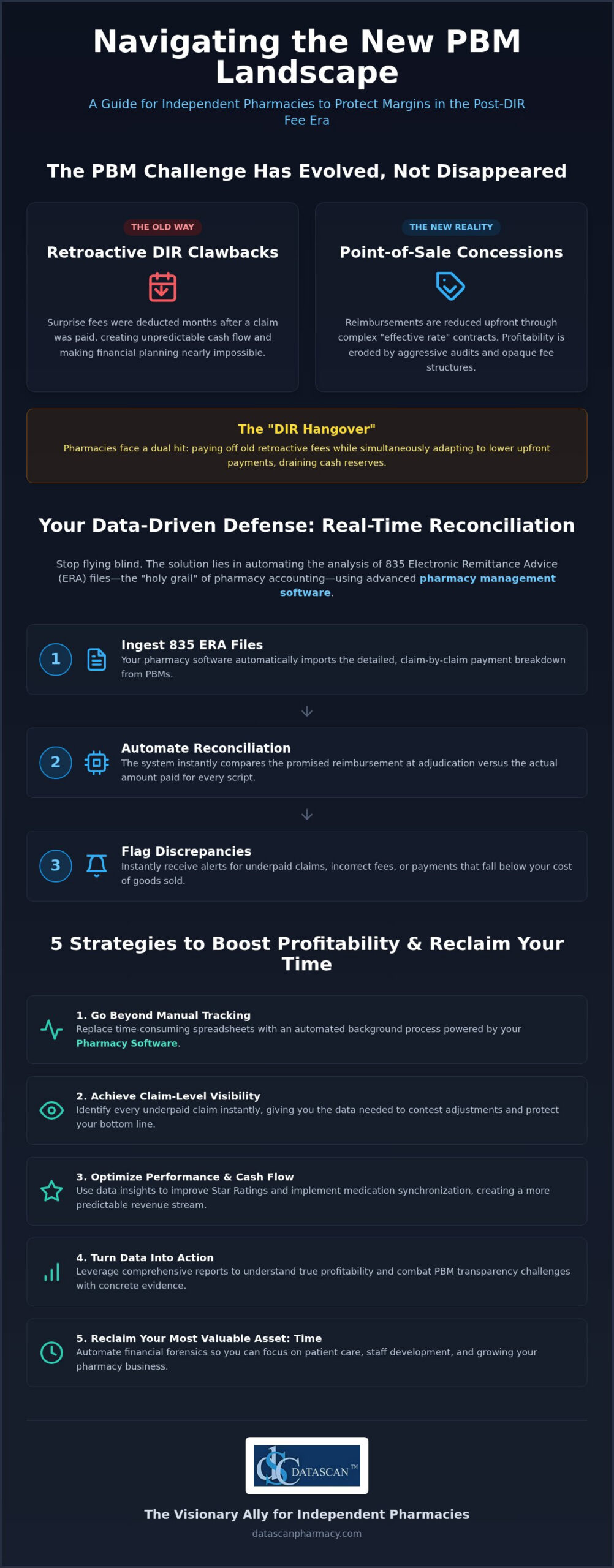
Managing pharmacy DIR fees requires moving from retroactive tracking to real-time financial reconciliation using advanced pharmacy management software. As of 2026, the mechanism of these fees has fundamentally shifted from the surprise retroactive “clawbacks” of previous decades to point-of-sale price concessions. While this transition was intended to provide transparency, it created a lower, less predictable reimbursement environment that continues to challenge independent margins. Today, DIR fees are essentially upfront discounts that PBMs deduct from your reimbursement before the payment even hits your ledger.
The industry is still grappling with the “DIR Hangover,” a period where pharmacies had to pay off residual retroactive fees from previous cycles while simultaneously adjusting to the lower net payments of the new point-of-sale model. This dual financial hit drained cash reserves and made revenue predictability nearly impossible for those without robust data tools. To understand the broader context of these entities, it’s helpful to review the history of Pharmacy Benefit Management and how their fee structures have evolved to prioritize corporate margins over community pharmacy sustainability.
How do DIR fees impact independent pharmacy gross profit?
The shift to point-of-sale transparency hasn’t solved the margin problem; it has simply moved the deduction to the start of the transaction. PBMs now utilize complex “effective rate” contracts, such as Generic Effective Rates (GER), to ensure their reimbursement targets are met. If your pharmacy’s performance doesn’t align with their arbitrary benchmarks, your reimbursement is adjusted downward. Tracking your true earnings is impossible if you aren’t accounting for these deductions at the claim level. For a detailed breakdown of how to navigate these numbers, consult our Calculating Pharmacy Gross Profit: 2026 Guide. High-performance pharmacy management software is essential to reveal these hidden costs that would otherwise stay buried in your PBM contracts.
Why is PBM reform taking so long?
Legislative efforts are finally gaining ground, but the implementation timeline remains a significant hurdle for independent owners. The Consolidated Appropriations Act of 2026 introduced major federal PBM reform, yet many of its most impactful provisions don’t take full effect for several more years. Additionally, while state-level PBM regulation is widespread and many jurisdictions have implemented new licensing deadlines throughout 2026, “transparency” in a contract doesn’t always translate to “fairness” in reimbursement. PBMs are adept at finding new avenues for revenue recovery, often replacing lost fee income with aggressive audit practices. Effectively managing pharmacy DIR fees means recognizing that you cannot wait for government intervention to save your margins; you must use technology to defend your profit today.
How to reconcile PBM payments to spot underpayments?
The most effective way to reconcile PBM payments is through the automated processing of 835 Electronic Remittance Advice (ERA) files within your pharmacy management software. These digital files act as the “holy grail” of pharmacy accounting; they provide a granular, claim-by-claim breakdown of what the PBM actually paid versus what was promised during initial adjudication. Without this level of detail, you’re essentially flying blind, unable to see where “effective rate” adjustments or undisclosed fees are eating your margins. Managing pharmacy DIR fees in 2026 requires this precise visibility to ensure your bank deposits match your ledger.
Identifying the gap between promised reimbursement and actual payment is critical because PBMs often use post-adjudication adjustments to recoup funds. When you import 835 files into your Pharmacy Software, the system automatically flags discrepancies. This allows you to spot claims that have fallen below your cost of goods sold (COGS) instantly. If you want a deeper look at how these mechanisms work, you can find DIR fees explained in industry white papers that highlight the shift from retroactive to point-of-sale concessions. By mastering this reconciliation, you transform your pharmacy from a passive recipient of payments into an active auditor of your own revenue.
What is the best way to track underpaid claims?
Tracking underpaid claims effectively requires a shift from manual spreadsheets to automated, claim-level alerts. High-performance Pharmacy Software allows you to set specific “negative margin” triggers. If a PBM pays less than the cost of the drug plus your required dispensing fee, the system should notify you immediately. This data visibility lets you identify patterns; perhaps a specific PBM is consistently underpaying on a particular therapeutic class. Generating audit-ready reports from these findings gives you the ammunition needed to contest unfair reimbursements or make informed decisions about dropping unprofitable contracts. To learn more about the tools available for this purpose, explore our comprehensive guide on software to identify underpaid pharmacy claims and how real-time adjudication can stop financial losses at the point of sale. If you’re ready to see how these tools work in practice, reach out to our team for a personalized walkthrough of our reconciliation features.
How often should a pharmacy reconcile its payments?
You should aim for daily or, at the very least, weekly reconciliation cycles to maintain a healthy cash flow. Waiting until the end of the month creates a “panic” scenario where you’re chasing hundreds of discrepancies all at once. Daily reconciliation, made possible by modern pharmacy management software, turns a massive chore into a five-minute background task. It ensures that you catch errors while the claims are still fresh, making it easier to resolve issues with the PBM or your PSAO. This consistency frees up your time, allowing you to move away from the back office and focus on growth-oriented tasks like clinical services or patient consultations.
How does pharmacy management software help manage DIR fees?
Pharmacy management software automates the financial oversight required to survive PBM reimbursement challenges by turning reconciliation into a background process. While earlier sections highlighted the need for data visibility, the practical reality is that you don’t have hours to spend on manual ledger entries. Modern pharmacy management software solves this by linking your dispensing data directly with electronic remittance advice. This automation ensures that managing pharmacy DIR fees isn’t a separate, exhausting task but a standard part of your daily digital workflow.
One of the most powerful tools in this fight is medication synchronization. By aligning patient refills, you create a predictable dispensing schedule that stabilizes cash flow and improves adherence metrics. These metrics are often used by PBMs to determine the performance component of Medicare Direct and Indirect Remuneration (DIR). When your system automates this process, you’re not just saving time; you’re actively defending your reimbursement rates and simplifying the burden of managing pharmacy DIR fees. Integrating your Pharmacy Software with your POS system also allows you to see the true net profit of every transaction, accounting for both the cost of goods and the PBM’s point-of-sale deductions. For a full breakdown of these tools, explore our Pharmacy Management Software Features.
Can workflow automation reduce operational costs?
Operational efficiency is your best defense against shrinking margins. Every minute your staff spends on redundant data entry or searching for paper records is a minute you’re paying for without a return. Implementing robust Workflow Software for Pharmacies allows your team to process prescriptions with surgical precision. This efficiency reduces the overhead costs that make PBM fees feel so burdensome. When your workflow is optimized, your staff can pivot toward high-value clinical services that provide revenue streams PBMs can’t easily touch, transforming your business model from volume-based to value-based.
Why is US-based support critical for software implementation?
Dealing with complex US financial regulations requires a technology partner that actually speaks the language of the independent pharmacist. Offshore support teams often lack a fundamental understanding of the PBM struggle or the nuances of state-level reform. At Datascan, our family-owned heritage means we have the independent “DNA” required to build future-proof solutions. We act as your Visionary Ally, providing US-based technical support that understands exactly why a reconciliation error or a negative margin claim is a crisis for your business. We don’t just sell software; we offer a partnership built on decades of advocacy for the community pharmacy.
What are the 5 best strategies for managing pharmacy DIR fees?
The most effective strategies for managing pharmacy DIR fees in 2026 focus on proactive data analysis and operational agility rather than passive acceptance of PBM terms. By implementing real-time claim monitoring, you can identify discrepancies immediately after adjudication, ensuring that underpayments don’t compound over months of unverified claims. Success in this area requires shifting your business model to prioritize high-margin services and utilizing Pharmacy management software that provides a clear window into your net profitability. Use these five tactics to protect your bottom line:
- Implement real-time claim monitoring: Use your Pharmacy Software to catch underpayments at the point of sale before they negatively impact your monthly cash flow.
- Maximize Star Ratings: Optimize patient adherence metrics to move your pharmacy into lower variable DIR fee tiers.
- Diversify revenue streams: Reduce your dependency on PBM-controlled prescriptions by expanding into compounding, high-margin OTC products, and clinical services.
- Audit PBM contracts annually: Work with a contract specialist to identify “effective rate” traps and hidden language that allows for aggressive post-adjudication audits.
- Prioritize profitability dashboards: Invest in a system that displays net profit after all anticipated fees, rather than just gross reimbursement. Pharmacy business intelligence dashboards can transform your raw prescription data into immediate, actionable insights that highlight underpaid claims and protect your bottom line.
Adopting these strategies transforms your pharmacy from a price-taker into a data-empowered business. If you’re tired of guessing your actual margins, contact our team to see how our profitability dashboards can give you back control over your finances.
How do Star Ratings affect your DIR fees?
Patient outcomes directly dictate the variable fee tiers applied by many PBMs; high performance in adherence often leads to lower concessions. Your pharmacy management software should serve as an early warning system, identifying “at-risk” patients who are falling behind on their medication schedules. By using the MobileScripts patient app, you can send automated reminders and drive the adherence levels necessary to maintain a high Star Rating. This proactive intervention ensures you aren’t penalized for patient behaviors that are within your power to influence through better technology.
Is diversifying into compounding worth the effort?
Compounding remains one of the most effective ways to bypass the “race to the bottom” of PBM reimbursements. These specialized prescriptions offer significantly higher margins and allow you to serve a niche market that isn’t solely dependent on insurance contracts. While compliance can be complex, utilizing Compounding Solutions for Pharmacies makes the process seamless. Integrated software handles the formulas, logs, and regulatory requirements, allowing you to focus on building a profitable service line that PBMs cannot easily claw back.
Why is Datascan the visionary ally for independent pharmacies?
Datascan is the visionary ally for independent pharmacies because we provide a locally hosted, high-performance ecosystem designed to neutralize PBM threats and maximize operational efficiency. Our Pharmacy management software isn’t just a dispensing tool; it’s a financial fortress built on over four decades of advocacy for the community pharmacist. We understand that managing pharmacy DIR fees is a matter of survival, which is why our technology is engineered to transform complex operational burdens into streamlined, profitable successes.
Since 1981, we’ve remained a family-owned enterprise, giving us a unique perspective on the independent “DNA” that corporate vendors simply can’t replicate. We’ve watched the industry evolve for decades and used that historical perspective to build future-proof solutions. Our total solution approach ensures that your Datascan Point of Sale, patient apps, and electronic delivery tools all work in harmony. This integration allows you to see the true net profit of your business in real time, accounting for every PBM deduction and operational cost without the need for manual spreadsheets. For independent owners looking to go further, our pharmacy business intelligence dashboards guide shows how to turn that real-time data into strategic decisions that protect your margins.
What makes Datascan different from ‘Big Tech’ pharmacy vendors?
While many competitors have pivoted toward rigid, corporate-driven models, Datascan remains fiercely loyal to the individual owner. We offer personalized, US-based technical support where you speak to a human who understands your workflow, rather than forcing you through an automated ticket system. Our commitment to innovation focuses on delivering tangible business results without the bloated corporate overhead. We empower you to reclaim your time and your profit by automating the technical burdens that often pull you away from your patients and your growth strategies.
How to get started with a stress-free software conversion?
Many owners stick with “good enough” systems because they fear the downtime of a data migration, but 2026 is the year to stop settling and start protecting your margins. Our conversion roadmap is purposeful and methodical, ensuring your patient records and financial data are moved with surgical precision. We provide a logical and organized training breakdown for your staff, so you can transition to our Pharmacy Software with total confidence. You don’t have to fight the PBMs alone. It’s time to Schedule a Demo with Datascan Today and experience the accountability and personal touch of a partner who is truly invested in your success.
Secure Your Margins in the New Era of PBM Reimbursement
The shift to point-of-sale concessions in 2026 has fundamentally changed the landscape, making real-time data visibility more critical than ever. Successfully managing pharmacy DIR fees requires a move away from manual tracking toward automated reconciliation that catches underpayments the moment they occur. By leveraging Pharmacy management software to maximize Star Ratings and diversifying into high-margin services like compounding, you can finally break the cycle of PBM dependency and stabilize your cash flow. Your expertise is needed at the patient counter, not buried in a back-office spreadsheet.
You don’t have to navigate these complex financial pressures alone. Datascan has been a fierce champion of the independent pharmacy since 1981, providing the sophisticated Pharmacy Software needed to transform operational burdens into streamlined successes. With our 100% US-based support and family-owned perspective, we offer the accountability and expertise your business deserves to thrive in a competitive market. Reclaim your pharmacy’s profitability with Datascan’s advanced management software. We are ready to help you build a more secure and profitable future for your community pharmacy today.
Frequently Asked Questions
How do I calculate the impact of DIR fees on my gross profit?
Subtract the total price concessions from your gross reimbursement to find your true net earnings. Since 2024, these fees are applied at the point of sale, but “effective rate” adjustments still create a gap between adjudicated prices and actual payments. Use your pharmacy software to compare initial claims with 835 electronic remittance advice. This data allows you to identify which plans are hurting your margins and adjust your contract strategies accordingly.
Can I appeal a DIR fee clawback from a PBM?
You can contest discrepancies if your reconciliation data shows an underpayment or an incorrect fee application. While traditional retroactive clawbacks were largely eliminated in 2024, PBMs now use aggressive audits to recoup funds. Success requires meticulous documentation and audit-ready reports from your pharmacy management system. Having clear data visibility allows you to challenge discrepancies through your PSAO or directly with the PBM’s appeals department to protect your revenue.
What is the difference between a DIR fee and a GER fee?
A DIR fee is a price concession applied to Medicare Part D claims, while a GER (Generic Effective Rate) is a contractual target for generic drug reimbursement. PBMs use GER to reconcile payments across all generic claims over a specific period. If your average reimbursement exceeds the agreed GER, the PBM recoups the difference. Both mechanisms require careful oversight within your pharmacy management software to ensure your net margins remain sustainable and predictable.
Does every pharmacy management software have PBM reconciliation tools?
No, many legacy systems lack the sophisticated tools needed for automated 835 ERA file reconciliation. Basic software might only show initial adjudication, leaving you to manually track actual payments. Advanced pharmacy management software, like the suite offered by Datascan, integrates these financial tools into your daily workflow. This automation is vital for managing pharmacy DIR fees and spotting negative margin claims without spending hours on manual data entry or spreadsheets.
How will PBM reform in 2026 change the way I manage my pharmacy?
The Consolidated Appropriations Act of 2026 mandates greater transparency, but many provisions, like the ban on spread pricing, won’t take full effect until 2028. In the meantime, managing pharmacy DIR fees requires focusing on upfront contract analysis and real-time claim monitoring. The focus has shifted from surviving surprise clawbacks to managing lower point-of-sale reimbursements. Successful owners are using technology to diversify revenue and protect their cash flow from ongoing PBM volatility.
Is it possible to eliminate DIR fees entirely by going ‘cash only’?
Going “cash only” eliminates PBM-related fees but also removes your access to the majority of patients who rely on insurance. A more balanced strategy involves using software to identify underpaid pharmacy claims to pinpoint and drop the most unprofitable plans while growing your cash-based services. Diversifying into compounding or high-margin OTC products reduces your dependency on PBM contracts without alienating your core patient base or sacrificing your essential community presence.
How do adherence apps like MobileScripts help lower my DIR fees?
Adherence apps improve your pharmacy’s Star Ratings, which directly influences the variable fee tiers set by many PBMs. High performance in patient adherence often leads to lower price concessions. By using the MobileScripts Patient Mobile App, you can send automated refill reminders and identify at-risk patients for intervention. This proactive approach ensures your performance metrics remain high, effectively reducing the percentage of reimbursement lost to performance-based deductions and protecting your bottom line.
What should I look for in a pharmacy software vendor when it comes to financial reporting?
Look for a vendor that provides real-time profitability dashboards and automated 835 reconciliation. Your system should display net profit after all anticipated fees rather than just gross reimbursement. US-based support is also critical for navigating complex financial regulations. A family-owned partner like Datascan understands the independent struggle and builds tools that prioritize your bottom line, helping you reclaim your time and your profit through better data visibility.
 Kevin Minassian is the President of Datascan Software. Under his leadership, the company rapidly expanded to provide pharmacy management software on a national level. Over the last 15+ years, he has ensured that Datascan has continuously evolved to offer innovative solutions for independent pharmacies while still offering world-class customer support. He is passionate about helping independent pharmacies to remain competitive, achieve success, and offer the very best service to their communities.