
Every time you dispense a prescription, you might be losing money before the patient even leaves the counter. The most effective software to identify underpaid pharmacy claims is a fully integrated pharmacy management system that performs real-time adjudication and profit analysis on every transaction. By catching reimbursements that fall below your acquisition cost at the point of sale, you stop the financial drain before it impacts your cash flow.
You’ve likely spent years watching PBMs squeeze your margins through complex clawbacks and opaque pricing models. Even with the Consolidated Appropriations Act of 2026 bringing much-needed reform to spread pricing, the burden of auditing every transaction still falls on your shoulders. This guide shows you how to leverage modern pharmacy management software to automate the identification of underpaid claims, reclaim lost revenue, and combat PBM pressures. We’ll break down how real-time data transparency improves your gross profit margins and frees you to spend more time on clinical services rather than fighting for every dollar.
Key Takeaways
- Learn why the most effective software to identify underpaid pharmacy claims is an integrated system that audits reimbursements in real-time during the dispensing process.
- Understand the impact of 2026 PBM regulations and why automated tools are necessary to navigate complex MAC pricing and hidden clawbacks.
- Discover how to use Business Intelligence dashboards to track long-term profit trends and catch “outlier” claims before they drain your revenue.
- Identify critical features like real-time margin alerts and automated 835 processing that eliminate the need for time-consuming manual audits.
- Explore how Datascan’s built-in profit protection tools provide detailed claim breakdowns to help independent pharmacies reclaim every dollar they’re owed.
What is the best software to identify underpaid pharmacy claims?
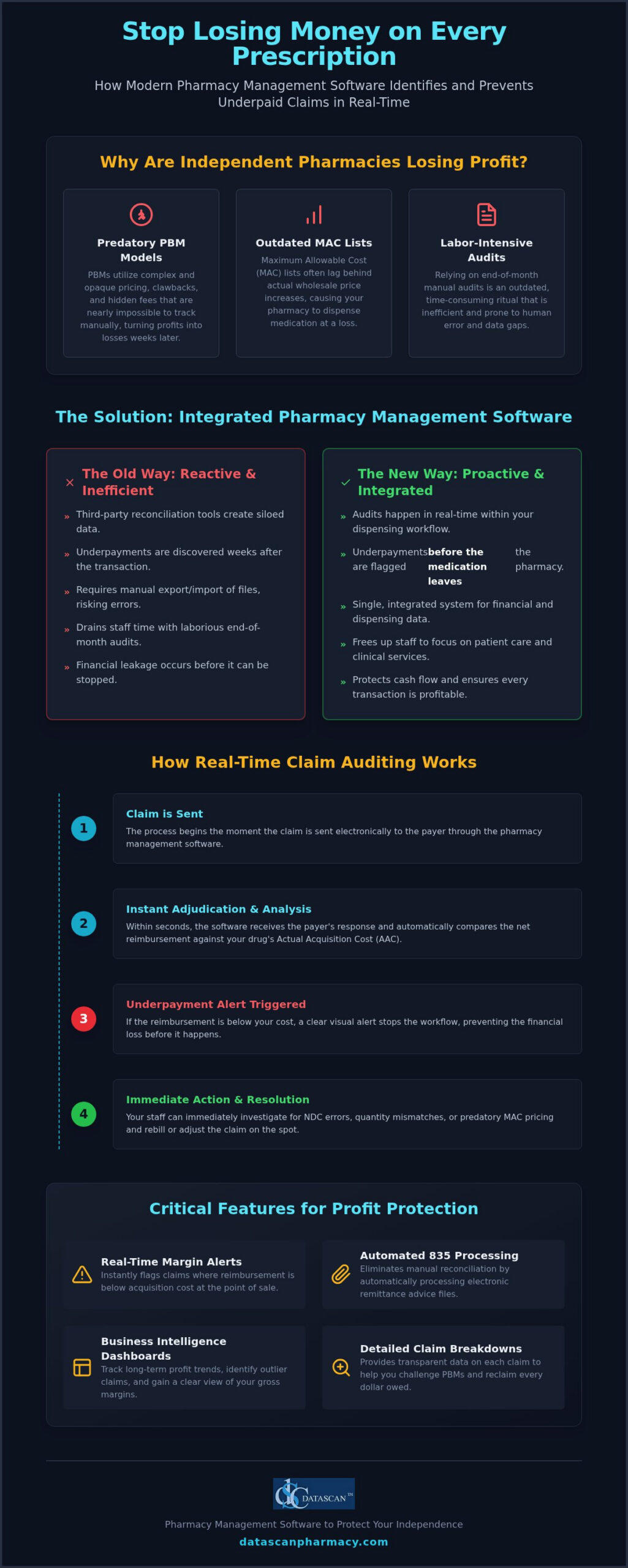
The most effective software to identify underpaid pharmacy claims is an integrated pharmacy management system that performs real-time reimbursement audits during the dispensing process. Instead of waiting weeks for a third-party report to tell you that you lost money, modern pharmacy management software flags these losses before the medication ever leaves your pharmacy. This proactive approach allows your staff to address discrepancies with Pharmacy Benefit Managers (PBMs) instantly, ensuring that every transaction contributes to your bottom line rather than draining it.
Your system should automatically compare the adjudicated reimbursement against your Actual Acquisition Cost (AAC) or Wholesale Acquisition Cost (WAC). If a claim falls below your cost, the software must trigger an immediate alert. This eliminates the outdated, labor-intensive ritual of manual end-of-month reconciliation. Independent pharmacies are currently under immense pressure from shrinking reimbursements. Relying on technology to handle these calculations isn’t just a convenience; it’s a survival strategy that protects your independence. You don’t have time to audit thousands of claims by hand; you need a system that acts as a 24/7 financial sentry.
How does real-time claim auditing work?
The process begins the moment you hit “send” on a claim. Within seconds, the software completes adjudication and receives a detailed response from the payer. High-quality software doesn’t just show you a “paid” status; it breaks down the response to compare the net reimbursement against your specific inventory costs. If the math doesn’t add up, a visual alert stops the workflow. This gives your team the chance to check for NDC errors, quantity mismatches, or predatory MAC pricing before the sale is finalized. This level of precision is vital because even a few dollars lost on high-volume generics can quickly snowball into thousands of dollars in annual revenue leakage.
Integrated software vs. third-party reconciliation tools
Many owners fall into the trap of paying for extra third-party reconciliation services, but these often create “siloed” data. When your auditing tools are separate from your dispensing platform, you’re forced to export and import files, which increases the risk of human error and data gaps. An integrated solution is more cost-effective and ensures that your financial data remains in one place. By using your primary pharmacy software to identify underpaid pharmacy claims, you streamline your operations and gain a clearer view of your actual gross profit margins without the headache of managing multiple vendors. Integration means that when a claim is flagged, the solution is right there in your existing workflow, allowing you to rebill or adjust the claim without switching programs.
Why are independent pharmacies losing money to underpaid claims?
Independent pharmacies are hemorrhaging profit because PBMs utilize predatory reimbursement models that are nearly impossible to track manually. Utilizing specialized software to identify underpaid pharmacy claims is the only definitive way to ensure you aren’t dispensing medication at a loss. While a claim might look “green” on your screen during adjudication, post-sale clawbacks and hidden fees often turn that perceived profit into a net loss weeks after the patient has left. Without a system that audits every penny in real-time, you’re essentially flying blind in a market designed to favor the largest corporate players.
The current pharmacy reimbursement crisis is fueled by a lack of transparency in Maximum Allowable Cost (MAC) lists. These lists often lag significantly behind the actual wholesale price increases you pay at the counter. When a PBM refuses to update these rates, your gross margin evaporates instantly. Modern pharmacy management software acts as your first line of defense, identifying these discrepancies before you finalize the sale. You need to fight back with the same level of technological precision that PBMs use to squeeze your margins.
The challenge of PBM reimbursement and reform in 2026
2026 represents a landmark year for transparency. The Consolidated Appropriations Act, 2026, signed into law on February 3, 2026, has already begun banning spread pricing in new PBM contracts executed after January 1. While this is a victory for the independent, PBMs are already shifting toward performance-based models that are even harder to audit without sophisticated tools. You must proactively focus on Managing Pharmacy DIR Fees by tracking every outlier claim that deviates from expected patterns. If you’re struggling to keep up with these rapid regulatory shifts, it might be time to connect with a team that understands your specific operational pressures.
Common reasons for pharmacy claim underpayments
Underpayments aren’t always the result of PBM malice; sometimes, they’re caused by simple data friction that your team is too busy to catch. Common issues include:
- Incorrect NDCs: Transmitting an NDC for a package size or manufacturer that doesn’t match your actual inventory cost.
- Stale MAC Pricing: Relying on reimbursement lists that haven’t been updated to reflect recent wholesale price spikes.
- Clinical Service Gaps: Failing to bill for the full scope of clinical services or dispensing fees that your contract allows.
By automating these checks, you eliminate the risk of human error and ensure that every claim is optimized for maximum legal reimbursement. This level of precision is exactly why pharmacies are increasingly adopting software to identify underpaid pharmacy claims as a core business function.
How does pharmacy management software find missing revenue?
Pharmacy management software finds missing revenue by automatically cross-referencing every adjudicated claim against your actual inventory costs and electronic payment files. By utilizing built-in software to identify underpaid pharmacy claims, you can spot “outlier” transactions that fall below your target margins without the need for expensive third-party add-ons. This integrated approach ensures that profit leaks are identified during the dispensing workflow, allowing you to stop losses before they impact your bank account.
To achieve high-level oversight, owners rely on pharmacy business intelligence dashboards that aggregate data across thousands of prescriptions. These tools don’t just show you what was filled; they highlight trends, such as specific payers who’ve recently lowered their MAC rates or specific NDCs that are consistently underpaid. When you have this data at your fingertips, you can make informed decisions about which contracts are worth keeping and which ones are actively hurting your business.
Automated reconciliation and 835 files
An 835 file is the electronic version of an Explanation of Benefits (EOB), and attempting to process these manually is a recipe for disaster. 835 reconciliation is the process of electronically verifying that the insurance payment matches the adjudicated amount. When your pharmacy management software handles this automatically, it matches electronic payments to the original claims with absolute precision. This automation saves your staff hours of tedious data entry and ensures that “clawbacks” or partial payments don’t go unnoticed. If a PBM tries to pay less than what was promised during the initial adjudication, your software flags the discrepancy immediately, allowing for rapid follow-up. Strengthening your pharmacy accounts receivable management process alongside automated 835 reconciliation is essential to closing the gap between what PBMs promise and what they actually deposit into your account.
Visualizing profit with pharmacy software dashboards
The true power of modern technology lies in its ability to turn raw data into actionable insights. Seeing your gross profit per script in a real-time workflow helps you understand the health of your pharmacy at a glance. By using these visual tools, you can quickly identify which payers are consistently underpaying your pharmacy and adjust your purchasing or billing strategies accordingly. Understanding these metrics is the first step toward Calculating Pharmacy Gross Profit accurately. Instead of guessing your margins at the end of the quarter, you’ll have a transparent, day-by-day view of your revenue, empowering you to reclaim every cent you’re owed by aggressive PBMs.
What features should you look for in a claims reconciliation tool?
The most critical features to look for in a claims reconciliation tool are real-time margin alerts and fully automated 835 processing. The best software to identify underpaid pharmacy claims must be integrated directly into your dispensing workflow to prevent financial losses before a patient leaves the counter. By investing in software to identify underpaid pharmacy claims that includes these core capabilities, you transform your pharmacy from a passive recipient of PBM terms into an active defender of its own revenue. Your system should provide:
- Real-time margin alerts: Immediate notifications that stop the workflow if a reimbursement falls below your acquisition cost.
- Automated 835 processing: Electronic matching of payments to original claims, eliminating manual entry and paper checks.
- Comprehensive reporting: The ability to export granular data for PBM audits or MAC appeals.
- U.S.-based support: Direct access to experts who understand the nuances of the American pharmacy landscape.
Why workflow integration is non-negotiable
Catching a bad claim after the patient has already walked out the door is a reactive strategy that costs you money every single day. By utilizing advanced workflow software, your team receives an immediate hard stop if a reimbursement is $0.00 or falls below your cost. This integration ensures that bad claims aren’t simply bagged and binned by technicians who are in a rush. When your integrated POS system is synced with your dispensing data, it acts as the final checkpoint. It verifies the “paid” status one last time at the register, preventing the financial leakage that occurs when staff accidentally override system warnings during the fill process.
The importance of U.S.-based pharmacy software support
Independent pharmacy owners don’t have time to waste on offshore call centers when thousands of dollars in reimbursement are on the line. You need a partner that acts as a Visionary Ally, offering support staff who can help you interpret complex PBM response codes and navigate the ever-changing regulatory environment. A family-owned vendor, like Datascan, brings a level of accountability and historical perspective that large corporations simply can’t match. They understand that every underpaid claim isn’t just a number on a spreadsheet; it’s a direct threat to your business’s survival. If your current vendor leaves you hanging when you need them most, it’s time to reach out to our team for a solution that prioritizes your profitability.
How can Datascan help reclaim your pharmacy’s underpaid claims?
Datascan provides the industry’s most robust software to identify underpaid pharmacy claims because our system treats profit protection as a core function rather than a secondary add-on. Unlike generic platforms designed for massive health systems, our pharmacy management software is engineered specifically for independent owners who must fight for every cent of reimbursement. Our technology provides a granular, real-time breakdown of every claim response, ensuring you see exactly what’s being paid, what’s being withheld, and where PBMs are attempting to squeeze your margins.
By automating the reconciliation process, you eliminate the need for manual spreadsheets and the constant stress of auditing paper checks. Our system acts as your Visionary Ally, identifying discrepancies the moment they occur. This proactive approach turns complex operational burdens into streamlined successes, allowing you to focus on growth rather than administrative damage control. We take pride in being the champion of the independent pharmacy, providing you with the same high-energy innovation that larger corporations use, but with the personal touch of a family-owned business that has been in the industry since 1981. Pairing our claims auditing tools with a robust approach to pharmacy accounts receivable management gives independent owners a complete financial defense strategy against the 21 to 45-day reimbursement delays that PBMs routinely impose.
Reclaiming your time to run your business
Automation isn’t just about money; it’s about giving you back the hours you currently spend on administrative tasks. When the system handles the heavy lifting of auditing every transaction, you gain the peace of mind to focus on high-value clinical services and patient care. Many independent pharmacies are switching to Datascan because they don’t have time to be full-time auditors. They need a system that works in the background to ensure margin control is maintained on every script. This shift from operational struggle to optimized efficiency is what allows community pharmacies to thrive in a competitive landscape.
Getting started with Datascan’s integrated solutions
Transitioning to a new system can feel daunting, but we’ve simplified the process to ensure your business doesn’t skip a beat. We offer a comprehensive pharmacy software implementation plan that serves as a clear roadmap for your team. This structured approach ensures that you can begin utilizing our software to identify underpaid pharmacy claims without disrupting your daily workflow. The best way to understand how these features will impact your bottom line is to see them in action. Schedule a demo today to witness how our real-time auditing and Business Intelligence tools can transform your pharmacy. Protect your pharmacy’s profitability with Datascan and take back control from predatory PBM practices.
Take Command of Your Pharmacy’s Profitability
Surviving the 2026 reimbursement landscape requires moving beyond manual audits and reactive reconciliation. The most effective way to stop revenue leakage is through real-time, integrated auditing that catches underpayments before the medication ever leaves the pharmacy. By implementing software to identify underpaid pharmacy claims, you transform your operation from a target for PBM clawbacks into a fortress of margin control. This proactive approach ensures that every transaction supports your business goals rather than draining your resources.
Datascan has been a family-owned and operated partner to independent pharmacies since 1981. We provide U.S.-based expert support and integrated real-time profit protection to ensure your business remains viable and competitive. You don’t have to fight PBM pressures alone when you have a visionary ally dedicated to your success. It’s time to stop the guesswork and start reclaiming the revenue you’ve earned through hard work and patient dedication.
Protect your pharmacy’s profitability with Datascan Pharmacy Software. Your commitment to community health deserves a bottom line that reflects your value. Let’s start protecting your revenue today.
Frequently Asked Questions
Can pharmacy software automatically identify claims paid below my cost?
Yes, high-quality pharmacy management software automatically identifies claims paid below cost by performing real-time margin analysis during the dispensing process. The system compares the adjudicated reimbursement from the PBM against your Actual Acquisition Cost (AAC) or Wholesale Acquisition Cost (WAC) stored in your inventory. This immediate feedback loop allows your staff to stop a transaction before it results in a loss, rather than waiting for a month-end report to discover missing revenue.
What is the difference between reconciliation and adjudication in pharmacy billing?
Adjudication is the real-time process where your pharmacy software sends a claim to a PBM and receives an instant response regarding coverage and reimbursement. Reconciliation happens later when your system matches the actual electronic payment, often delivered via an 835 remittance file, to that original adjudicated claim. Adjudication tells you what you’re promised, while reconciliation verifies that the PBM actually paid the full amount without hidden deductions or clawbacks.
How do I appeal a PBM underpayment using my software?
You can appeal a PBM underpayment by utilizing the comprehensive reporting features within your pharmacy system to generate proof of your acquisition costs. Modern software to identify underpaid pharmacy claims allows you to export specific “outlier” transactions where the reimbursement fell below your cost. You then submit this data, along with your wholesaler invoices, to the PBM’s MAC appeal department to request a price adjustment based on current market rates.
Do I need a separate third-party tool for claims reconciliation?
You don’t need a separate third-party tool if your primary pharmacy management software includes integrated reconciliation features. Integrated software to identify underpaid pharmacy claims is often superior because it eliminates “siloed” data and the need to manually export and import files between different platforms. Having your claims auditing built directly into your dispensing workflow reduces the chance of human error and ensures you have a single, accurate view of your pharmacy’s financial health.
How much time can automated claims software save a pharmacy owner?
Automated claims software can save a pharmacy owner several hours of administrative work every week. Instead of manually matching paper checks to prescriptions or auditing spreadsheets for underpaid generics, the system performs these tasks in the background. This allows you to focus on high-value clinical services and business growth. By automating the identification of underpaid claims, you reclaim your time while ensuring your margins are protected without constant manual oversight.
What happens if the PBM provides an incorrect MAC rate?
If a PBM provides an incorrect MAC rate, your pharmacy software will trigger a real-time margin alert during the adjudication phase. This notification stops the technician from finishing the fill until the discrepancy is reviewed. Since MAC lists often lag behind wholesale price spikes, catching these errors instantly is vital. You can then decide to rebill the claim, contact the PBM, or prepare a MAC appeal using the data captured by your system.
Can my pharmacy software track DIR fees and clawbacks?
Yes, sophisticated pharmacy management software tracks DIR fees and clawbacks by cross-referencing your adjudicated claims with the final electronic remittance advice (ERA). By monitoring the difference between the “promised” amount and the actual cash deposited, the software identifies post-sale adjustments that drain your profit. This level of transparency is essential for independent pharmacies to understand their true net profit per script and manage cash flow in an environment of aggressive PBM tactics.
Is U.S.-based support important for claims and billing issues?
U.S.-based support is critical because billing and reimbursement codes are specific to the American healthcare regulatory environment. When a claim doesn’t look right, you need an expert who understands PBM response codes and current legislative reforms like the Consolidated Appropriations Act of 2026. Offshore call centers often lack the historical perspective and local industry knowledge required to help independent pharmacy owners navigate complex financial discrepancies and protect their bottom line effectively.
 Kevin Minassian is the President of Datascan Software. Under his leadership, the company rapidly expanded to provide pharmacy management software on a national level. Over the last 15+ years, he has ensured that Datascan has continuously evolved to offer innovative solutions for independent pharmacies while still offering world-class customer support. He is passionate about helping independent pharmacies to remain competitive, achieve success, and offer the very best service to their communities.