
A pharmacy continuity plan should cover four areas: risk reduction, readiness, response, and recovery. A practical approach to creating a business continuity plan for a pharmacy starts by assessing the risks each location faces, then explains how staff will protect essential services, communicate during an outage, and restore operations. Each premises needs a current plan tailored to its services, people, and dependencies.
It’s easy to focus on dramatic events, but disruptions can also start with system failures, supply delays, or communication breakdowns. The plan should clarify what happens next, who takes action, and how patients will be kept informed.
This guide covers the main steps, from assessing threats and protecting information to coordinating with suppliers and other partners. You’ll also learn how to choose realistic continuity exercise scenarios, test your response, and update the plan when pharmacy operations change. The aim is a practical playbook, not a document left untouched on a shelf.
Key Takeaways
- Map recovery steps for pharmacy applications, networks, databases, servers, and telecommunications so staff know which systems to restore first.
- Build response and recovery procedures around realistic disruptions, clear staff roles, and patient communication.
- Protect pharmacy information with controlled access, secure backups, and practical data-restoration testing.
- Keep partner contacts and coordination steps easy to find, including procedures for suppliers and other essential services.
- Use business continuity standards, including ISO 22301:2019(F), cited by the International Organization for Standardization, to help structure and improve your plan.
What should a pharmacy business continuity plan contain?
Creating a business continuity plan for a pharmacy starts with assessing risks, ranking essential services, and defining recovery steps. The planning effort and costs depend on the premises, systems, backup power needs, data, and recovery objectives. After documenting responsibilities, system recovery, data protection, and staff actions, test the plan.
-
Assess business impact and set recovery objectives
List pharmacy activities, then assess how each could be affected by a disruption. Consider dispensing, prescription records, insurance claims, point of sale, refrigeration monitoring, and patient communications. For each activity, define the maximum tolerable interruption and recovery objective. These measures help prioritize threats instead of treating every application or task as equally urgent.
Connect each objective to its dependencies. Dispensing, for example, may rely on an application, database, server, network, and telecommunications. Record who is responsible for each dependency and what must be restored first. Avoid setting targets that overlook a failed connection or unavailable data source.
-
Prioritize services for recovery
Rank services by their effects on patient care and pharmacy operations. Identify which functions must continue during an outage, which can pause briefly, and which can resume later. A pharmacy might prioritize safe access to prescription information and dispensing workflows before restoring routine reporting.
Assign each service a recovery objective and connect it to the necessary systems and staff. Document a fallback for every high-priority function. Avoid a priority list that names services but leaves their dependencies or manual alternatives undefined.
-
Plan recovery for technology systems
Document the recovery sequence for applications, networks, databases, servers, and telecommunications. Name the person responsible for each action, the access they need, and the handoff to the next task. A pharmacy application cannot support staff if its database or network connection remains unavailable.
Plan how UPS units will support servers, network equipment, refrigeration monitors, and dispensing automation during power disruptions. Consider separate internet providers with automatic LTE or 5G failover. Record how staff will identify an outage, report it, and use an approved workaround.
-
Plan data backup and reconciliation
Use the 3-2-1 backup rule: keep three copies of data on two types of media, with one offsite or immutable copy. Encrypt backups and restrict access. Document where copies reside, who can restore them, and how staff will confirm recovered files are usable.
Test data restores quarterly and after major system changes. Include a process for reconciling work completed during an outage. Staff can record transactions handled manually, then compare those records with restored application data before normal processing resumes.
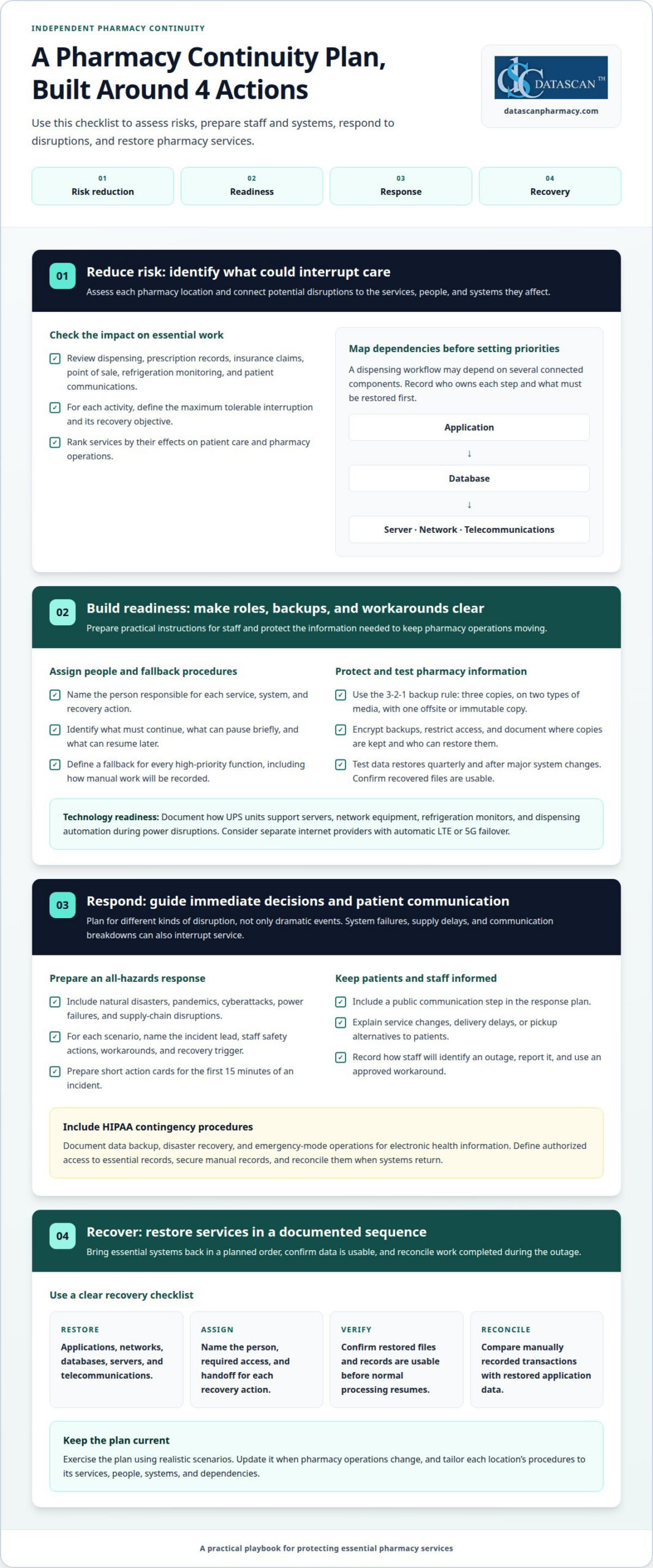
- Organize the plan around four actions: risk reduction, readiness, response, and recovery. Risk reduction addresses preventable threats; readiness assigns roles, supplies, and contact methods. Response guides immediate decisions, while recovery restores services and reconciles records. When creating a business continuity plan for a pharmacy, tailor each action to the premises, its services, people, and dependencies. Exercise the plan and update it when operations change.
Business continuity planning for disruptions
Build a disruption plan around an all-hazards response, HIPAA contingency planning, and safe temporary suspension. In the United States, include HIPAA Security contingency planning and identify applicable state pharmacy and emergency requirements for each location.
-
Plan for all-hazards disruptions
List the threats that could interrupt your pharmacy, then pair each with a response. Include natural disasters, pandemics, cyberattacks, power failures, and supply-chain disruptions. Avoid planning around just one dramatic event: a network outage can disrupt prescription processing as sharply as a severe storm.
For each scenario, name the incident lead, staff safety actions, workarounds, and recovery trigger. Prepare action cards for the first 15 minutes, when staff need short, clear instructions. Include employee well-being and a public communication step, such as telling patients about delivery delays or pickup alternatives.
-
Prepare HIPAA contingency plans
Document HIPAA Security contingency procedures for protecting and restoring electronic health information. Include data backup, disaster recovery, and emergency-mode operations, and assign a role to each procedure. State how authorized staff will access essential records if the usual system becomes unavailable.
Describe how to secure records during manual work and reconcile them after systems return. Restrict access to staff who need it, and keep a record of decisions made during the outage. Train employees during onboarding and annual refreshers so everyone knows where to find the procedures.
-
Plan for temporary suspension
Write a temporary suspension procedure for a site that cannot safely provide services. Name who decides to pause operations, who informs employees, and how patients receive clear instructions. Include a patient-facing message explaining the reason for closure, expected service changes, delivery delays, and alternative pickup arrangements.
Record how the pharmacy will protect prescription records, medications, and essential equipment while closed. Define reopening conditions, such as restored access, safe premises, and available staff. Keep a separate checklist for communicating the closure and resumption to relevant public and healthcare partners.
-
Identify applicable emergency requirements
Map federal and state requirements to each pharmacy location. Include HIPAA contingency planning, then identify the state pharmacy-board rules and emergency directives relevant to closure, patient records, and resuming service. Requirements can differ by jurisdiction, so do not apply one state’s procedures to every site.
Assign a plan owner to record the applicable authority, requirement, and notification route. Keep those details with the emergency contacts, and update them when a location or operating procedure changes. During a tabletop exercise, test who makes notifications and what information staff need to provide.
Cybersecurity and information governance
Protect pharmacy information by defining access, documenting incident steps, and planning for supplier outages. The October 2026 NCSC guidance for disruptive cyber attacks advises identifying critical services, involving suppliers, planning secure rebuilding, and testing workarounds.
-
Assess cybersecurity and information governance
Map the systems and information your pharmacy needs to keep operating. Include dispensing applications, prescription records, payment services, email, and network access. For each item, document its business owner, approved users, supplier, and recovery dependencies. This inventory helps identify which services an incident could affect first.
Set clear access and handling rules for each record type. For example, limit prescription information to staff who need it for their assigned duties. Document how staff should report suspected access, system changes, or missing data. Keep procedures in a secure, accessible location so the incident lead can find them when normal systems are disrupted.
Review the inventory when the pharmacy changes systems, suppliers, or workflows. A new payment terminal or email service can create a dependency the existing plan misses. Keep a dated update log, name the person responsible for each revision, and use the current copy in continuity exercises.
-
Prevent phishing disruptions
Train staff to pause before opening unexpected links or sharing credentials. Use pharmacy-specific examples, such as an email imitating a wholesaler invoice or a message requesting urgent prescription information. Tell employees how to report suspicious messages without forwarding sensitive patient details.
Document the response sequence: report the message, alert the designated incident lead, and preserve the email for review. Staff should not reply, open attachments, or enter passwords through message links. If someone has already interacted with a suspicious message, record what happened and which account or device may be affected.
Use onboarding and refresher sessions to practice the reporting route. A short exercise can ask staff to identify a false supplier request and explain whom they would notify. Keep the exercise focused on safe decisions, not blame. This encourages early reporting during a real disruption.
-
Plan for supplier and cyber disruptions
List the suppliers that support critical pharmacy operations, including technology, telecommunications, payment processing, and medication distribution. Record each supplier’s role, internal contact owner, and the service that depends on it. Identify alternatives for critical supplies, such as diversified wholesalers or a secondary courier.
For cyber incidents, define how the pharmacy will isolate affected systems, communicate with suppliers, and safely restore essential services. Include secure rebuilding steps and test workarounds before staff need them. For example, a paper process for recording transactions should explain how staff capture activity and reconcile it after recovery.
Ask each service owner to keep supplier details current and include key partners in exercises. Test scenarios where email is unavailable or a supplier cannot process orders. Record gaps, assign an owner to each corrective action, and update the continuity document after the exercise.
Partner coordination and emergency contacts
Keep partner contacts, emergency-mode procedures, and closure actions together in one accessible plan. During an outage, staff need to know whom to notify, which services can continue, and how patients will receive clear instructions.
- Build a contact directory for each pharmacy location. Include staff leads, nearby healthcare partners, utilities, suppliers, delivery services, technology providers, and local emergency management contacts. Record each contact’s role, preferred communication method, and an alternate route if the main channel fails. Assign a named staff owner to update the directory when people or partners change.
Set a notification order for incidents. For example, the incident lead can first confirm staff safety, then contact the affected supplier, and then share service changes with patients. Keep a short message template ready for delivery delays, temporary closure, or alternative pickup arrangements.
- Write emergency-mode procedures for staffing shortages, supply interruptions, and facility closures. Name who can pause operations, reassign available staff, contact a backup supplier, and communicate service changes. Include safe manual dispensing and verification steps, with an independent double-check for high-alert medications.
Identify which operations can continue with available staff and supplies, and which must stop. Keep a closure checklist covering site safety, securing records and medications, staff notification, patient messaging, and reopening decisions. Community Pharmacy England lists an emergency closure checklist for community pharmacies dated August 2022.
Use the checklist as a prompt, then adapt the actions to the pharmacy’s layout, services, and local contacts. During an exercise, have staff follow the closure sequence without relying on the manager’s memory.
- Document how staff will protect medication storage during a power outage. Use UPS units to support refrigeration monitors, and assign someone to record readings and outage actions. Define who decides whether affected stock remains usable, and keep it separate until that decision is made according to the pharmacy’s applicable procedures.
Include controlled substances, prescription records, and emergency dispensing in the written workflow. State who can access secured stock, how staff record each action, and how they preserve prescription information during system downtime. Require verification and reconciliation of manual records before normal processing resumes.
For emergency dispensing, identify the approved decision-maker, documentation process, and applicable jurisdictional procedures. Avoid improvising exceptions during a stressful incident.
- Map local emergency resources and reporting routes for each location. Record contacts for emergency management, fire response, utilities, public health, and relevant pharmacy authorities. Identify which situations require notification, who makes it, and what operational details staff should provide.
Keep the current contact sheet with the emergency closure checklist and staff call tree. Test both during an exercise, including a scenario where the pharmacy loses internet and telephone service. Provide an alternate communication method, then update the plan when a contact or reporting route changes.
Business continuity management standards
A business continuity standard gives pharmacy planning a repeatable structure, not a substitute for location-specific decisions. Use it to connect risks, recovery priorities, assigned actions, exercises, and review records.
- Use ISO 22301:2019(F) as a reference point. The International Organization for Standardization identifies it as the standard for business continuity management systems. Apply its management-system perspective to pharmacy operations, then tailor procedures to your premises, services, staff, and technology dependencies.
Do not treat a standard’s name as proof that your plan works. Your pharmacy still needs clear responsibilities, practical workarounds, and evidence that staff can follow them during a disruption.
- Set the plan’s scope before drafting procedures. List the pharmacy location, services, operating dependencies, and people included. For example, map how dispensing relies on staff, prescription information, a functioning network, and supplier access.
Record exclusions and interfaces, too. If a delivery partner, payment service, or external technology provider supports an essential activity, document the relationship and the contact owner. A defined scope prevents the plan from overlooking work that happens outside the pharmacy.
- Turn the risk assessment into controlled actions. For each disruption, document its possible effects, the service at risk, the response owner, and the recovery objective. Include scenarios such as a cyber incident, power loss, supplier interruption, or facility closure.
Connect each action to evidence. A completed exercise report, updated contact list, or restoration record shows what staff actually did. Keep the report concise enough for the pharmacy manager to identify open actions and assign an owner.
- Build a usable template around the decisions staff must make. Include activation criteria, role assignments, communication routes, workarounds, escalation steps, and recovery checks. Keep key instructions accessible if the pharmacy network or usual document system becomes unavailable.
Use consistent labels for versions, owners, and approval dates. Store an accessible copy with the emergency materials, and control who can change the master document. Staff should be able to find the current procedure without searching through old drafts.
- Test the management system through exercises and review. Choose a scenario that tests real dependencies, such as network failure during dispensing or a supplier outage affecting a critical item. Ask participants to follow the written actions instead of relying on memory.
After the exercise, record what worked, where the template caused confusion, and which actions need revision. Assign each correction to an owner and track it to completion. Update the plan after exercises, incidents, or material changes to premises, services, staff, systems, and suppliers.
Datascan Pharmacy Software
Datascan Pharmacy Software offers technology that can be incorporated into continuity planning. Map the systems your team relies on, the services they support, and the manual steps staff would use during an outage. Datascan Pharmacy Management Software and Datascan Point of Sale (POS) support core pharmacy and retail workflows, while MobileScripts Patient Mobile App and Datascan Mobile Delivery App support patient communication and delivery operations.
Consider these tools when documenting which workflows need attention during disruptions and how staff will resume them. A continuity plan still needs defined responsibilities, backups, recovery steps, and exercises tailored to your pharmacy. If you’re reviewing how your pharmacy systems fit into the plan, contact Datascan Pharmacy Software to discuss your needs.
Make Your Next Continuity Step Count
Creating a business continuity plan for a pharmacy gives your team a practical way to prepare for operational changes. Next, connect the plan to the systems staff use every day, then decide which workflows need review as your pharmacy evolves.
Datascan Pharmacy Software offers Datascan Pharmacy Management Software, Datascan Point of Sale (POS), and the MobileScripts Patient Mobile App. Consider how these tools fit into your pharmacy’s documented workflows and continuity priorities. A useful conversation starts with your goals, current processes, and the services your team needs to support.
When you’re ready to discuss how your pharmacy technology fits into your plans, contact Datascan Pharmacy Software. You can take the next step at a pace that works for your team.
Frequently Asked Questions
What scenarios should a pharmacy continuity exercise include?
Include scenarios that require staff to make decisions with incomplete information, such as a supplier delay coinciding with a sudden increase in patient demand. Add realistic developments during the exercise: a key manager is unavailable, a patient needs an urgent update, or an initial workaround fails. These changes reveal whether staff can adapt their judgment, not just follow a prepared script.
Why is that important?
A continuity exercise gives pharmacy staff a safe place to uncover practical friction before an actual emergency. For example, a staff member may know a procedure exists but not know where to find it during a busy shift. Discussing that gap after a simulation helps turn a general concern into a specific improvement, such as clearer instructions or a more workable handoff between shifts.
What should a pharmacy business continuity plan include?
Include a clear plan owner, approval process, version history, and instructions for accessing the current copy. Add decision points that tell staff when to escalate an issue rather than continue with an unsuitable workaround. For example, define who can pause a workflow if the available information is incomplete. These governance details help staff use the plan consistently, even when leadership is not immediately available.
How do pharmacies assess operational risks and prioritize critical services?
Compare each risk’s likelihood with its consequences for patient service, staff safety, and the pharmacy’s ability to operate. Then consider how quickly those consequences could escalate. A brief interruption to a nonessential administrative task may have a different effect from losing information needed for a patient’s prescription. Use these distinctions to rank risks and focus attention on the most serious exposures.
What pharmacy records, systems, and data need backup and recovery plans?
Beyond patient and transaction records, consider the information needed to rebuild system access and resume routine work. Examples include application configuration details, user access records, operating procedures, and current supplier contact information. Identify who can retrieve each item and how staff can tell whether it is current. This broader view helps prevent restoring data while overlooking the instructions or settings needed to use it.
How can pharmacies communicate with patients, prescribers, suppliers, and regulators during an interruption?
Make each message useful to its recipient: state which service is affected, what action is available, and when the pharmacy expects to share another update. For example, a patient notice can explain whether to wait for a callback or use an alternative pickup arrangement. Keep messages factual and avoid including sensitive patient details in broad communications. Record important conversations so the next shift can follow up.
How often should a pharmacy test and update its continuity plan?
Use changes and exercise findings to decide when a review is due, rather than relying only on a calendar reminder. A new service, a changed staff role, or a tabletop exercise that exposes confusion can each prompt a focused update. Track who owns each revision and tell affected employees what changed. A short briefing after an update helps prevent staff from relying on superseded instructions.

Article by
Sarah Callioras
Sarah Callioras is Vice President at Datascan Pharmacy Software, bringing nearly 25 years of experience across independent pharmacy operations and pharmacy technology. Since joining Datascan in 2016, she has played a key role in driving business growth, strengthening client relationships, and supporting independent pharmacies through innovative software solutions. With a strong background in pharmacy operations, business development, and strategic leadership, Sarah is passionate about helping independent pharmacies succeed in an evolving healthcare landscape.
 Kevin Minassian is the President of Datascan Software. Under his leadership, the company rapidly expanded to provide pharmacy management software on a national level. Over the last 15+ years, he has ensured that Datascan has continuously evolved to offer innovative solutions for independent pharmacies while still offering world-class customer support. He is passionate about helping independent pharmacies to remain competitive, achieve success, and offer the very best service to their communities.