

Pharmacy AR Management: 2026 Guide for Independent OwnersSeptember 4, 2026
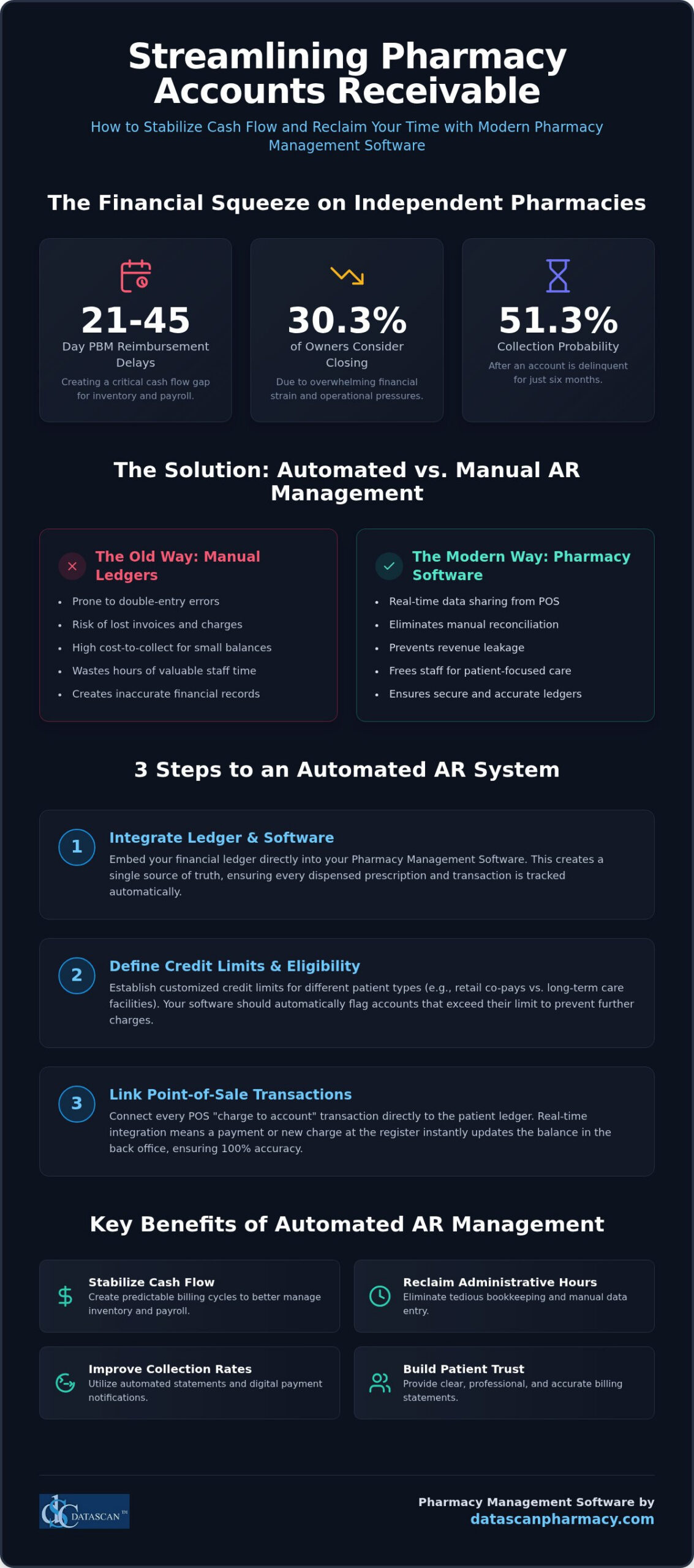
Effective pharmacy accounts receivable management is the most direct way to stabilize your cash flow and counteract the 21 to 45-day reimbursement delays typically forced by PBMs. By utilizing integrated pharmacy management software to automate your ledger, you can eliminate manual errors and reclaim the administrative hours previously spent on tedious bookkeeping. You’ve likely felt the pressure of managing a business where 30.3% of independent owners are considering closing due to financial strain, and it’s frustrating when the probability of collecting on a delinquent account drops to 51.3% after just six months. We understand that chasing small patient balances feels like a losing battle against your time and profitability.
This guide promises to give you the strategies and tools needed to transform your back office into a streamlined, automated engine for growth. We’ll preview how professional statement generation builds patient trust and how high-performance pharmacy software shares data in real-time to ensure your records are always accurate. By the end of this article, you’ll have a clear roadmap to modernizing your operations, automating your billing, and protecting your independent pharmacy’s bottom line.
Key Takeaways
- Master the fundamentals of pharmacy accounts receivable management to clearly distinguish between third-party insurance reimbursements and private-pay house accounts.
- Integrate your ledger directly within your pharmacy management software to ensure real-time data sharing between your POS and back-office systems.
- Stabilize your operational cash flow and protect your bottom line by automating billing cycles, which allows for more predictable inventory and payroll management.
- Improve collection rates and build patient trust by utilizing the MobileScripts patient app for instant balance notifications and convenient digital payment options.
- Reclaim hours of administrative time by leveraging customizable statement generation and a unified patient record system that eliminates redundant manual data entry.
What is pharmacy accounts receivable management?
Pharmacy accounts receivable (AR) management is the systematic tracking and collection of money owed to the pharmacy by patients, facilities, and third-party payers for prescriptions and services already provided. To fully grasp what is pharmacy accounts receivable management?, you have to distinguish between third-party AR, which covers insurance reimbursements, and private-pay house accounts. Independent pharmacies often rely on charge accounts for long-term care (LTC) and assisted living facility billing. In these settings, medications are dispensed throughout the month, but the facility or patient is billed in a single cycle. Your Pharmacy management software serves as the definitive financial record, ensuring that every dispensed prescription is accurately logged and eventually paid.
Why is AR management critical for independent pharmacies?
Cash flow is the lifeblood of your business, yet PBM reimbursement delays typically force you to wait 21 to 45 days for payment. This delay creates a gap that can jeopardize your ability to manage inventory or meet payroll obligations. Professionalizing your pharmacy accounts receivable management through your Pharmacy Software helps you bridge this gap by ensuring patient and facility payments are collected on time. Beyond daily operations, a well-managed AR system provides the financial transparency required during rigorous PBM audits. It also increases your business value, as clear financial ledgers are a top priority for potential buyers or lenders during a valuation.
Why should you choose automated tracking over manual ledgers?
The “shoebox of receipts” method is a dangerous relic that has no place in a modern pharmacy. Manual tracking leads to double-entry errors, lost invoices, and an incredibly high cost-to-collect for small balances. When you integrate your ledger with a Datascan Point of Sale system, the software handles the heavy lifting. Data shares in real-time, meaning a payment made at the register instantly updates the patient’s balance in the back office. This automation prevents revenue leakage and frees your staff from hours of tedious manual reconciliation. By moving away from manual ledgers, you ensure that your local-server system remains a secure, accurate, and efficient tool for protecting your pharmacy’s profitability.
How do you set up an automated pharmacy AR system?
Setting up an automated system requires integrating your financial ledger directly into your pharmacy management software to ensure every charge is tracked in real-time. This creates a closed-loop environment between your dispensing and point-of-sale workflows, eliminating the need for manual data entry and reducing the risk of human error. By shifting to an automated local-server model, you ensure that pharmacy accounts receivable management becomes a background process rather than a weekend-long chore.
How do you define credit limits and eligibility?
Risk management begins with establishing customized credit limits based on the specific needs of your patient base. Retail patients may only require small limits for occasional co-pays, whereas long-term care (LTC) facilities need larger caps tailored to their total bed count and monthly volume. Your pharmacy management software should automatically flag any account that exceeds its limit, allowing your staff to address the balance before more prescriptions are dispensed. Establishing clear due dates and standard 15-day or 30-day grace periods helps you maintain a predictable cash flow that isn’t dependent on unpredictable PBM reimbursement schedules.
How do you link point-of-sale transactions?
Every pharmacy POS transaction must feed directly into your patient ledger to maintain financial accuracy. When a patient or facility representative chooses to “charge to account,” your system should require a verified signature at the register to ensure you are audit-ready. This real-time integration means that the moment a prescription is picked up, the balance is updated across your entire network. Handling complex scenarios like partial payments or split-tender transactions becomes effortless when your POS and back-office pharmacy software share a single patient record, ensuring your daily books always balance without manual reconciliation.
How do you batch process monthly statements?
Batch processing transforms a tedious administrative burden into a one-click task. Instead of manually printing individual invoices, you can generate hundreds of professional, itemized statements simultaneously. These documents must include Rx numbers, dispense dates, and specific costs to build patient trust and minimize the time your staff spends answering questions about individual charges. Professional branding on these financial communications reinforces your identity as a sophisticated, reliable community healthcare provider. If you’re ready to see how these automated features can transform your back office, you can reach out for a demonstration of our integrated technology.
How does AR management improve independent pharmacy profitability?
Effective pharmacy accounts receivable management improves profitability by capturing every dollar owed, reducing bad debt expenses, and creating a predictable cash flow cycle that offsets PBM reimbursement delays. When you automate your ledger, you stop revenue leakage from uncollected co-pays and facility balances while gaining the financial clarity needed to understand how to calculate pharmacy gross profit accurately. This systematic approach ensures that your pharmacy isn’t just dispensing prescriptions, but actually collecting the revenue those prescriptions generate.
Proactive monitoring of aging reports is essential because the probability of collecting on a delinquent account drops to 51.3% after six months. By identifying past-due balances early through your Pharmacy Software, you can prevent them from becoming bad debt expenses that eat into your margins. Additionally, offering flexible payment options for front-end retail items through your house account system encourages higher basket sizes. Patients are more likely to pick up OTC essentials when they can bundle those purchases with their prescriptions and pay in a single, professional monthly cycle.
How does AR management help combat PBM reimbursement challenges?
PBMs often use reimbursement delays and complex fee structures to squeeze independent margins. Efficient AR tracking provides the granular data required for managing pharmacy DIR fees and identifying underpaid claims before the window for appeals closes. With integrated financial reporting, you can spot trends in insurer behavior and reimbursement lags. This data empowers you to negotiate better terms with wholesalers or local facilities based on hard financial performance rather than guesswork, protecting your bottom line from external volatility.
How does automation free up time for clinical services?
Administrative burnout is a major threat to independent owners who have too little time to run their businesses. By utilizing workflow software to automate the billing cycle, you remove the burden of manual debt collection from your staff. This shift allows your team to focus on high-value clinical services, such as MTM or immunizations, which diversify your revenue streams. Real-time data dashboards let you monitor the health of your accounts in minutes, ensuring you stay in control of your finances without spending your entire weekend on tedious bookkeeping.
What are the best practices for pharmacy billing and collections?
Best practices for pharmacy billing and collections center on maintaining a rigid statement schedule and offering frictionless payment options through integrated digital tools. By reviewing aging reports weekly and automating balance notifications, you can significantly reduce the time spent on manual outreach while keeping your cash flow consistent. This proactive approach ensures that pharmacy accounts receivable management remains an organized business process rather than a reactive crisis.
Consistency is the foundation of any successful financial workflow. You should establish a fixed “statement run” schedule, such as the 1st or 15th of every month, to train your patients and facilities to expect their bills. Offering multiple payment methods, including in-store, mail-in, and digital app payments, ensures that you remove every possible barrier to collection. Reviewing your aging reports weekly allows you to identify accounts that are 30, 60, or 90 days past due before they become uncollectible bad debt.
Leveraging technology for faster payments
Modern pharmacies use the MobileScripts patient app to send push notifications the moment a statement is ready for review. This feature allows patients to view their ledger balance in real-time on their own devices, which often leads to faster payments compared to traditional mail. For nursing homes or assisted living facilities, “card on file” features within your Pharmacy management software allow for recurring, automated payments that eliminate the need for monthly check-chasing and manual reconciliation.
Handling delinquent accounts professionally
Managing debt is a sensitive but necessary component of pharmacy accounts receivable management. Your system should be configured to send automated “friendly reminders” for accounts that are 15 days past due to prompt action without staff intervention. It’s equally important to train your staff on how to have respectful financial conversations, ensuring they can explain itemized charges clearly to build trust. When an account reaches a critical delinquency threshold, you must have a clear, firm policy for stopping credit to protect your pharmacy from further revenue leakage. If you’re ready to modernize your collection process with these integrated tools, schedule a personalized demo with our team today.
How can Datascan software streamline your accounts receivable?
Datascan Pharmacy Software streamlines your pharmacy accounts receivable management by integrating your dispensing and point-of-sale systems into a single, local-server environment that shares one patient record. This total integration ensures that every “charge to account” transaction at the register is instantly reflected in the back-office ledger without manual intervention. By maintaining your data on a secure local-server system, you protect your sensitive financial records and ensure 100% uptime for your business operations. Owners gain immediate visibility into their cash flow through robust tracking tools that provide professional-grade reporting without requiring specialized accounting expertise. Our pharmacy management software also includes customizable statement formats designed specifically for the unique needs of community pharmacies, ensuring your billing is professional and easy for patients to understand.
What features are built specifically for independent pharmacies?
Efficiency in the back office translates directly to better patient care and reduced administrative burnout. Datascan Pharmacy Software allows for one-click statement generation for your entire patient base or specialized billing cycles for nursing and assisted living facilities. When a patient attempts to charge a prescription, real-time credit limit flagging at the POS prevents your staff from extending credit to delinquent accounts. If a patient questions a charge, the detailed transaction history allows for instant resolution by showing the exact date, time, and itemized cost of every dispense. This level of transparency builds long-term trust with your community and reduces the time your staff spends on the phone resolving billing disputes.
Why does US-based expertise matter for your financial stability?
Partnering with a family-owned and operated company since 1981 provides a level of stability and advocacy that large corporations simply cannot match. We’ve spent decades as a “champion of the independent,” evolving our technology to meet the specific challenges of PBM reform and declining reimbursements. Our US-based technical support team doesn’t just fix software; they understand the operational pressures you face every day and offer a grounded, reliable warmth in their service. We prioritize the security of your local-server system, protecting your financial data and ensuring your pharmacy stays operational even if external network connections fail. We continuously release software updates driven by the real-world needs of our clients, ensuring your technology remains a future-proof asset for your business. This commitment to supportive partnership ensures that as the industry changes, your pharmacy has the tools needed to remain profitable and independent.
Take Control of Your Pharmacy’s Financial Future
Mastering pharmacy accounts receivable management is no longer just a back-office task; it’s a vital survival strategy for independent owners facing PBM volatility. By automating your ledger and integrating your POS with your dispensing software, you eliminate manual errors and stop revenue leakage before it impacts your bottom line. You’ve seen how professional statement generation and real-time credit flagging can reclaim hours of your administrative time while building deeper trust with your patients and facilities.
Datascan has been a dedicated partner to the independent community since 1981, offering seamless software integration and expert, US-based technical support. We’re here to ensure your technology works as hard as you do, providing the security of local-server systems and the precision of automated billing. Don’t let administrative burnout or reimbursement delays dictate your success. Streamline your pharmacy’s billing with Datascan’s integrated AR tools today. We’re proud to stand as your visionary ally in building a more profitable, future-proof pharmacy.
Frequently Asked Questions
Is it legal for independent pharmacies to charge interest on patient accounts?
Charging interest on past-due balances is generally legal provided you comply with state-specific usury laws and federal Truth in Lending Act requirements. You must clearly disclose your interest rates and late fee policies in a signed credit agreement before applying any charges to a patient’s ledger. Using an integrated pharmacy management software allows you to automate these calculations based on your specific terms, ensuring consistency and transparency while protecting your business from potential legal disputes.
How do I handle charge accounts for nursing homes or assisted living facilities?
Managing facility accounts requires a specialized workflow where medications are dispensed daily but billed in a single monthly cycle. By using the Datascan nursing and assisted living module, you can group individual patient charges under a single facility master account for streamlined oversight. This setup allows you to generate consolidated statements and track facility-wide balances efficiently. Integrated pharmacy accounts receivable management ensures that high-volume facility billing remains accurate and professional without overwhelming your staff with manual data entry.
What is the difference between third-party AR and patient house accounts?
Third-party AR represents money owed to the pharmacy by insurance companies or PBMs for adjudicated claims, whereas patient house accounts are private-pay balances owed directly by individuals or facilities. Third-party collections are often delayed by PBM reimbursement cycles, while house accounts are managed according to your internal credit policies. Distinguishing between these two within your pharmacy management software is critical for maintaining an accurate financial ledger and understanding your true cash flow position at any given time.
Can I manage my pharmacy accounts receivable without separate accounting software?
You don’t need separate accounting software for daily ledger tracking when using a fully integrated pharmacy system. Datascan’s local-server platform includes built-in AR tools that handle credit limits, statement generation, and payment posting directly within your existing workflow. This integration eliminates the need for double-entry and prevents errors between your dispensing data and your financial records. For high-level tax preparation, you can simply export your clean, organized data for your CPA or external accounting package.
How often should I send out pharmacy charge account statements?
Sending out statements on a consistent monthly schedule, typically the 1st or the 15th, is the industry best practice for maintaining predictable cash flow. Regular billing cycles train your patients and facilities to expect and prepare for their payments, which significantly reduces the number of delinquent accounts. Your software should allow you to automate this process, enabling one-click batch printing or digital notifications through the MobileScripts app to ensure your billing is always delivered on time.
What is an aging report and why is it important for my pharmacy?
An aging report is a financial document that categorizes your outstanding receivables by the length of time they have been unpaid, usually in 30, 60, and 90-day increments. This report is vital because it highlights which accounts are becoming high-risk, allowing you to take action before the probability of collection drops. Monitoring these reports weekly helps you identify trends in revenue leakage and ensures you are proactively protecting your pharmacy’s operational profitability and long-term stability.
How does integrated POS software prevent internal theft on charge accounts?
Integrated POS software prevents internal theft by requiring verified signatures for every “charge to account” transaction and creating a permanent, unalterable audit trail for every ledger adjustment. Because the POS and Rx software share a single patient record, employees cannot manipulate balances in one system without it being reflected in the other. Detailed transaction history and automated credit limit flagging ensure that every charge is legitimate and authorized, providing owners with the oversight needed to secure their assets.
Can I set different credit limits for retail patients versus facility accounts?
You can and should set different credit limits for retail patients versus facility accounts based on their specific risk profiles and purchase volumes. Retail patients may only need a small limit for occasional co-pays, while LTC facilities require much higher thresholds to accommodate monthly billing cycles for dozens of residents. Datascan allows you to customize these limits at the individual or facility level, ensuring that your financial management remains flexible enough to support growth while minimizing your total exposure.