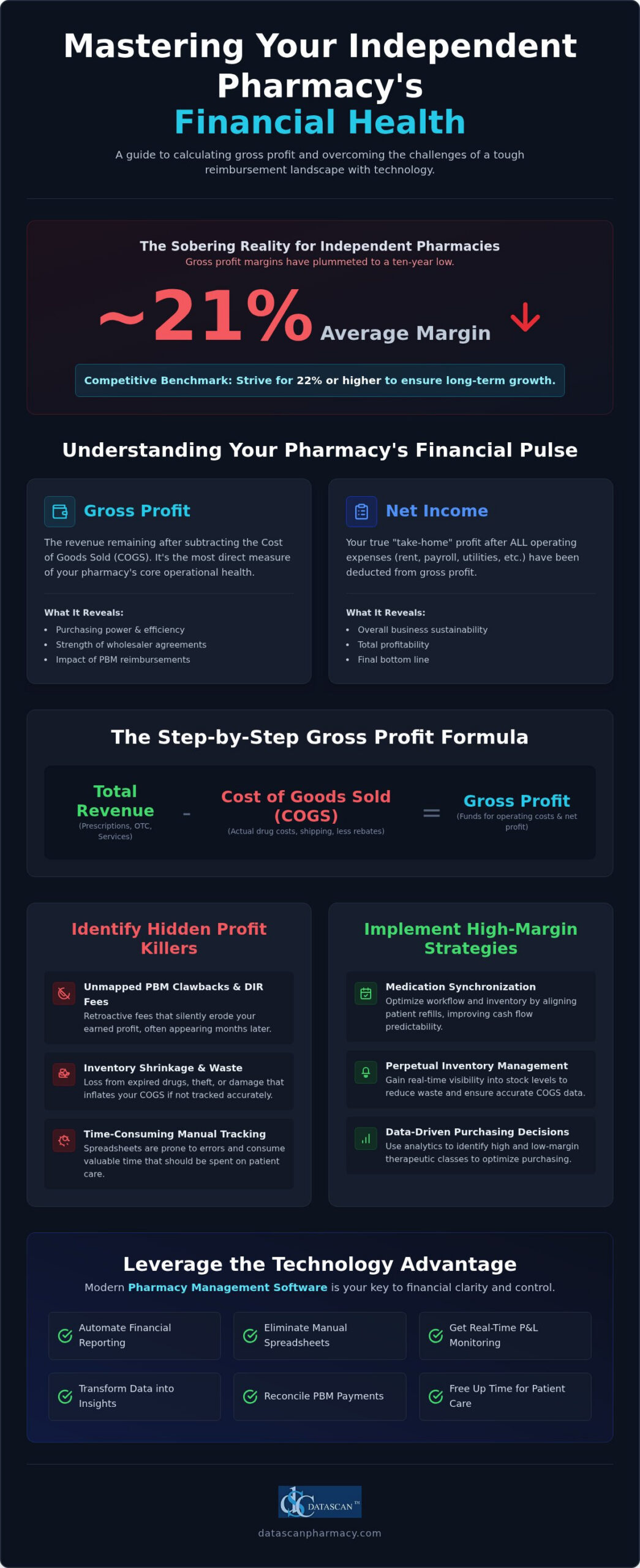
Did you know that in 2026, independent pharmacy gross profit margins have plummeted to a ten-year low of approximately 21%? It’s a sobering reality that reflects the tightening grip of PBM underpayments and the administrative burden of reconciling inventory costs. Mastering how to calculate pharmacy gross profit with precision is no longer optional; it’s a survival requirement for the modern owner. You likely feel the pressure of shrinking returns every time you review your books, wondering where the disconnect lies between your hard work and your bottom line. We understand that fighting for every cent against massive corporations is exhausting, especially when you’re trying to prioritize patient care.
This guide empowers you to take back control by mastering the essential formulas required to navigate the current reimbursement landscape. You’ll discover how the right pharmacy software can automate these complex calculations and free you from manual spreadsheet management. We’ll explore 2026 industry benchmarks, reveal where profit often leaks from your workflow, and show you how specialized pharmacy management software transforms financial tracking into a competitive advantage. It’s time to move beyond survival and start optimizing your independent pharmacy for long-term growth.
Key Takeaways
Master the fundamental distinction between gross profit and net income to ensure you are tracking the true operational health of your independent pharmacy.
Learn exactly how to calculate pharmacy gross profit by reconciling total revenue against your actual cost of goods sold while accounting for complex PBM clawbacks.
Identify the hidden “profit killers” in your workflow, such as unmapped DIR fees and inventory shrinkage, that often go unnoticed without real-time monitoring.
Discover how to utilize pharmacy management software to automate financial reporting and eliminate the time-consuming burden of manual spreadsheet tracking.
Implement high-margin strategies like medication synchronization and perpetual inventory management to optimize cash flow and protect your bottom line in a challenging reimbursement climate.
Understanding Pharmacy Gross Profit vs. Net Income
Success in the independent pharmacy space isn’t just about the volume of scripts crossing your counter; it’s about the precision of your margins. Many owners confuse high revenue with high performance, but without a clear grasp of What is Gross Profit, you’re essentially flying blind. Gross profit represents the revenue left over after you’ve subtracted your Cost of Goods Sold (COGS). It’s the most raw indicator of your purchasing power and dispensing efficiency. Net income, conversely, is your actual “take-home” profit after every single operational expense, including rent, payroll, and utilities, has been deducted.
Distinguishing between these two is vital. While net income tells you if your business is sustainable, gross profit tells you if your inventory management and PBM contracts are actually working for you. If you don’t know how to calculate pharmacy gross profit accurately, you might miss the fact that while your store is busy, your margins are being cannibalized by poor wholesaler terms or unfavorable PBM reimbursements. We believe independent owners deserve the same level of financial clarity as the big box chains, and that starts with isolating your COGS from your overhead.
Why Gross Profit is the Pulse of Your Independent Pharmacy
Think of gross profit as the early warning system for your business health. It directly reflects the strength of your purchasing agreements and your ability to manage high-cost specialty drugs versus generic alternatives. In an era where PBMs are aggressively shrinking margins, focusing solely on top-line revenue is a dangerous trap. By monitoring your GP regularly, you can identify which therapeutic classes are driving growth and which are costing you money to dispense. High-performing pharmacy management software makes this visibility possible, allowing you to pivot before a low-margin trend becomes a financial crisis. It’s about transforming raw data into a roadmap for better purchasing decisions that protect your bottom line.
Cost of Goods Sold (COGS) in the Pharmacy Context
Calculating your COGS is more than just looking at a wholesaler invoice. For a retail pharmacy, COGS includes the actual cost of prescriptions, over-the-counter inventory, and even the shipping fees associated with procurement. A common pitfall is failing to account for wholesaler rebates or off-invoice discounts, which can significantly skew your results. If your COGS is inflated, your profit reports will look grimmer than reality; if it’s underreported, you’ll face a nasty surprise at tax time. Accurate tracking requires a system that reconciles what you paid with what you actually sold. Understanding these nuances is the first step in learning how to calculate pharmacy gross profit like a seasoned financial expert rather than a distracted business owner. By mastering your COGS, you empower your pharmacy to thrive even when reimbursements are under fire.
The Step-by-Step Formula for Calculating Pharmacy Gross Profit
Execution begins with accurate data collection. To understand your financial standing, you must first aggregate two primary figures: your Total Sales Revenue and your Total Cost of Goods Sold (COGS) for a defined period. Revenue includes all income from prescriptions, clinical services, and front-end sales, while COGS encompasses the actual price paid for that inventory. Once you have these numbers, the basic equation is straightforward. Gross Profit = Total Revenue – COGS. This figure represents the dollars available to cover your operating expenses and, eventually, your net profit. Implementing robust pharmacy software is the most reliable way to ensure these figures are captured in real-time without manual errors.
While the dollar amount is important, it doesn’t tell the whole story of your operational efficiency. In 2026, the average gross profit margin for independent pharmacies has hit a decade low of approximately 21%. To remain competitive, you need to look at pharmacy profit margin benchmarks and strive for a margin of 22% or higher. Understanding how to calculate pharmacy gross profit allows you to see if your purchasing strategies are actually keeping pace with PBM reimbursement shifts. If your margin is dipping below these benchmarks, it’s a clear signal that your workflow or wholesaler agreements require immediate attention.
Calculating Gross Profit Margin Percentage
Converting your profit into a percentage is the most effective way to track performance over time. The math is simple: divide your Gross Profit by your Total Revenue, then multiply by 100. For example, if your pharmacy generated $1,000,000 in revenue with $790,000 in COGS, your gross profit is $210,000, resulting in a 21% margin. This percentage is far more useful than a flat dollar amount because it allows for objective year-over-year comparisons, regardless of fluctuating sales volumes. For retail success in 2026, independent pharmacies should target a gross margin of at least 22% to ensure long-term viability in a landscape defined by PBM volatility.
Markup vs. Margin: Don’t Confuse the Two
Relying on markup alone is a common trap that can hide serious profitability issues. Markup is the percentage added to the cost to reach a selling price, whereas margin is the percentage of the selling price that is profit. If you buy a product for $80 and sell it for $100, your markup is 25%, but your margin is only 20%. Confusing these two numbers often leads owners to believe they’re making more money than they actually are. To convert markup to margin, divide the markup by (1 + markup). Utilizing advanced pharmacy management software helps automate these conversions, ensuring your pricing strategies reflect actual profit goals. If you’re ready to see how your current margins stack up, reach out to our team for a personalized workflow assessment.
Factoring in PBM Reimbursements and DIR Fees
The basic math of revenue minus COGS is a starting point, but it doesn’t reflect the harsh reality of the modern reimbursement environment. If you’re only looking at the initial adjudication screen, you’re missing the hidden profit killers that PBMs bake into their contracts. Understanding how to calculate pharmacy gross profit in 2026 requires a “net-net” approach that accounts for the massive gap between what you’re promised and what actually hits your bank account. You must reconcile every PBM payment against your actual claims to identify underpaid scripts and reconcile your inventory costs with real-world revenue. Without this granular level of detail, your financial statements are merely an estimate rather than a reflection of your business health.
Effective reconciliation is the only way to expose where your margins are being cannibalized. Many independent owners find that their pharmacy management software is their strongest weapon in this fight, providing the data needed to challenge unfair clawbacks. By tracking your “net-net” profit, you move beyond the surface-level numbers and gain a true understanding of your operational viability. It’s about empowering your pharmacy to survive and thrive despite the predatory practices of middleman organizations.
Navigating the PBM Reimbursement Maze
Low reimbursement rates on generic drugs can decimate your gross profit margin if you aren’t paying close attention. The Consolidated Appropriations Act (CAA) of 2026, signed into law on February 3, 2026, marks a pivotal shift in PBM oversight by designating them as “covered service providers” under ERISA. This change subjects them to stricter compensation disclosure rules, but it hasn’t stopped the trend of aggressive underpayments. You need a system that identifies claims paid below cost in real-time, allowing you to flag and appeal these transactions immediately. Utilizing advanced workflow software helps you catch these discrepancies before they become a permanent drain on your resources.
DIR Fees: The Retroactive Profit Drain
DIR fees remain a significant challenge even with recent regulatory shifts. While 2024 changes moved many fees to the point of sale, the complexity of retroactive adjustments still forces pharmacies to estimate and set aside funds for potential clawbacks. The 2026 regulatory environment continues to evolve, making it essential to use pharmacy software that can forecast your true profit after all anticipated fees are deducted. For a comprehensive approach to managing pharmacy DIR fees in this new environment, you need a data-driven defense that goes beyond manual spreadsheets and embraces real-time reconciliation. This forecasting capability transforms your financial planning from guesswork into a precise science, ensuring you have the cash flow necessary to maintain operations. We believe that transparency is the key to independence, and your technology should provide a clear window into your future profitability.
Strategies to Improve Your Pharmacy’s Profit Margins
Knowing how to calculate pharmacy gross profit is only the first half of the battle; the second half is actively engineering those numbers to trend upward. In a climate where independent margins have hit a ten-year low, relying on volume alone is a failing strategy. You need to transform your workflow into a profit-generating engine. We believe that by leveraging specialized pharmacy management software, you can reclaim the time and capital currently lost to operational friction. It’s about empowering your team to focus on high-value tasks rather than manual data entry.
Implementing a perpetual inventory system is one of the most immediate ways to boost your bottom line. When your pharmacy software tracks every unit in real-time, it prevents the overstocking that traps your cash on the shelf. This capital can then be reinvested into higher-margin areas like compounding or clinical services. By using compounding pharmacy software, you can capture specialized prescription volume that is far less susceptible to PBM underpayments. These specialized services allow you to provide unique value to your community while protecting your business from the “race to the bottom” in generic reimbursement.
Inventory Management and Purchasing Efficiency
Purchasing efficiency is about more than just finding the lowest price; it’s about timing and precision. Overstocking doesn’t just tie up funds; it increases the risk of carrying dead stock that eventually expires and becomes a total loss. Your pharmacy management software should provide automated reports that flag slow-moving items before they become a liability. Additionally, utilizing secondary wholesalers for high-volume generics can significantly lower your COGS, provided you have the data to prove the savings. These small adjustments in purchasing strategy often yield the most significant improvements in your overall gross profit percentage without requiring a single new patient.
Revenue Diversification and Clinical Services
Diversifying your income is essential for long-term survival in the current market. Clinical services such as immunizations and Medication Therapy Management (MTM) offer significantly higher margins than standard dispensing because they aren’t as heavily impacted by PBM clawbacks. To support these services, you must streamline your standard workflow to free up your staff’s time. You can learn more about our electronic delivery system to see how optimizing your logistics improves patient retention and captures more front-end sales. A modern pharmacy software suite also integrates with patient-facing mobile apps to drive refill adherence and high-margin retail traffic. Pairing these tools with proven pharmacy patient retention strategies ensures that the patients you serve today remain loyal, high-value customers for years to come. If you’re ready to modernize your workflow and protect your margins, contact our team today for a custom technology consultation.
Leveraging Pharmacy Management Software to Automate Profit Tracking
Manual spreadsheets are a liability in the high-stakes environment of 2026. Relying on hand-entered data to track your margins is not just time-consuming; it’s a recipe for catastrophic oversight in a landscape where PBMs constantly shift the goalposts. When you move beyond the limitations of paper and generic digital tools, you gain the ability to see your pharmacy’s financial health with total clarity. We believe that modern pharmacy management software should serve as your most trusted financial advisor, providing the real-time insights you need to protect your independence. By automating the data collection process, you eliminate human error and ensure that your understanding of how to calculate pharmacy gross profit is based on actual bank deposits rather than optimistic estimates.
The true power of automation lies in the reconciliation process. Reclaiming lost revenue from PBMs is an impossible task for a human to manage script-by-script, but it’s a core competency of a high-performance pharmacy software system. When your dispensing data is fully integrated with your financial reporting, you can identify discrepancies immediately and take action. Integrating your pharmacy POS with your management system creates a total financial view, capturing every cent from both the pharmacy counter and the front-end retail section. This unified perspective is vital for identifying where profit is being lost in your daily workflow and where you can optimize for better returns. Independent owners who want to eliminate these administrative bottlenecks entirely should explore how pharmacy workflow optimization software can automate PBM compliance and restore profitability in 2026.
The Power of Integrated Business Intelligence
Business intelligence dashboards transform raw numbers into actionable strategies. Instead of digging through reports, you can visualize profit trends by day, week, or even specific therapeutic categories at a glance. This high-level visibility allows you to identify “red flag” prescriptions that are losing money instantly, giving you the chance to adjust your purchasing or clinical focus before the end of the month. Pharmacy business intelligence dashboards give independent owners the real-time visibility needed to stop PBM underpayments from silently draining their margins. You can discover the features of our pharmacy management software to see how these visual tools empower owners to make faster, smarter business decisions. It’s about having the pulse of your pharmacy right at your fingertips.
Choosing the Best Software for Retail Pharmacy Growth
Not all systems are created equal when it comes to safeguarding your bottom line. When evaluating technology, look for key features like integrated PBM reconciliation, automated medication synchronization, and robust, customizable reporting. We believe that U.S.-based support is vital for resolving the complex financial discrepancies that often arise with wholesaler and insurance billing. You need a partner who understands the local market and can offer immediate assistance when your margins are on the line. To ensure your front-end is performing as well as your back-end, you should explore our pharmacy POS system for a seamless, total-store financial tracking solution. Choosing the right technology is the most important investment you’ll make in your pharmacy’s future.
Future-Proof Your Pharmacy’s Financial Health
Mastering the mechanics of how to calculate pharmacy gross profit is the first step in reclaiming your store’s independence. In a 2026 market defined by shrinking margins and aggressive PBM clawbacks, you can’t afford to rely on manual spreadsheets or generic data. By integrating real-time PBM reconciliation and advanced business intelligence, you transform your financial statements into a strategic roadmap for growth.
Datascan has been family-owned and operated since 1981, standing as a dedicated ally to community pharmacies. Our pharmacy management software provides the precision you need with U.S.-based support and innovative features like med-sync and e-care plans included. You have the power to turn operational burdens into streamlined successes. It’s time to stop letting “hidden” profit killers drain your resources and start leveraging pharmacy software that works as hard as you do.
What is a good gross profit margin for an independent pharmacy in 2026?
A gross profit margin of 22% or higher is generally considered the benchmark for a healthy independent pharmacy in 2026. With the industry average hitting a 10-year low of approximately 21%, maintaining this threshold is essential for long-term sustainability. Achieving this requires a precise understanding of how to calculate pharmacy gross profit while proactively managing your inventory costs. Monitoring these benchmarks allows you to identify if your purchasing agreements are keeping pace with market shifts.
How do DIR fees affect the calculation of my pharmacy’s gross profit?
DIR fees and retroactive clawbacks act as hidden profit killers that directly reduce your “net-net” profitability. Even with regulatory shifts moving many fees to the point of sale, you must still account for adjustments that happen after the initial adjudication. If you don’t reconcile these fees against your monthly financial statements, your reported gross profit will be artificially inflated. Modern pharmacy management software is vital for forecasting these retroactive drains to ensure your cash flow remains stable. Learn more about managing pharmacy DIR fees with a data-driven 2026 strategy to protect your independent profitability.
Can pharmacy management software calculate gross profit automatically?
Yes, advanced pharmacy management software can automate this entire process by integrating your dispensing data with your cost of goods sold. Instead of manual spreadsheet entry, these systems provide real-time business intelligence dashboards that visualize your margins instantly. This automation allows you to see exactly where profit is being lost in your workflow. By utilizing integrated tools, you reclaim the time needed to focus on patient care while ensuring your financial data is always accurate.
What is the difference between gross profit and gross margin?
Gross profit is the raw dollar amount remaining after you subtract the total cost of goods sold from your total revenue. Gross margin, however, is that profit expressed as a percentage of your total revenue. While both metrics are important, gross margin is often the more useful figure for comparing your performance against industry benchmarks or tracking year-over-year efficiency. Knowing how to calculate pharmacy gross profit in both formats ensures you have a complete picture of your business.
How often should I calculate my pharmacy’s gross profit?
You should ideally monitor your gross profit in real-time or on a weekly basis using an integrated dashboard. Waiting until the end of the month to review your financials often means it’s too late to address PBM underpayments or inventory inefficiencies. Frequent tracking allows you to catch “red flag” prescriptions that are losing money immediately. Consistent oversight ensures that you can make data-driven decisions to protect your margins before they impact your pharmacy’s overall health.
How can I improve my pharmacy’s gross profit without raising prices?
You can improve your margins by optimizing inventory through a perpetual inventory system and expanding into high-margin clinical services like immunizations or compounding. Implementing medication synchronization also streamlines labor and improves adherence revenue without increasing your front-end prices. Utilizing pharmacy software to identify slow-moving “dead stock” helps reduce carrying costs and frees up vital cash flow. These strategies allow you to increase profitability by focusing on operational efficiency and revenue diversification rather than pricing.
What are the biggest expenses that impact pharmacy gross profit?
The primary expense impacting your gross profit is the Cost of Goods Sold (COGS), which includes the price of prescriptions and retail inventory. PBM-related costs, such as DIR fees and underpaid claims, also significantly reduce your real-world margins. It’s important to remember that operating expenses like rent, payroll, and utilities impact your net income but do not factor into the gross profit calculation. Focusing on reducing your COGS is the most direct way to improve your bottom line.
Is it better to track profit by individual prescription or by total store volume?
It is essential to track both to maintain a truly profitable operation. Total store volume provides a high-level view of your business health, but individual prescription tracking is the only way to identify specific claims paid below cost. High-performance pharmacy software allows you to flag these underpaid scripts in real-time, enabling you to appeal unfair reimbursements immediately. This granular approach ensures that no single transaction is cannibalizing the profits generated by your high-volume dispensing.
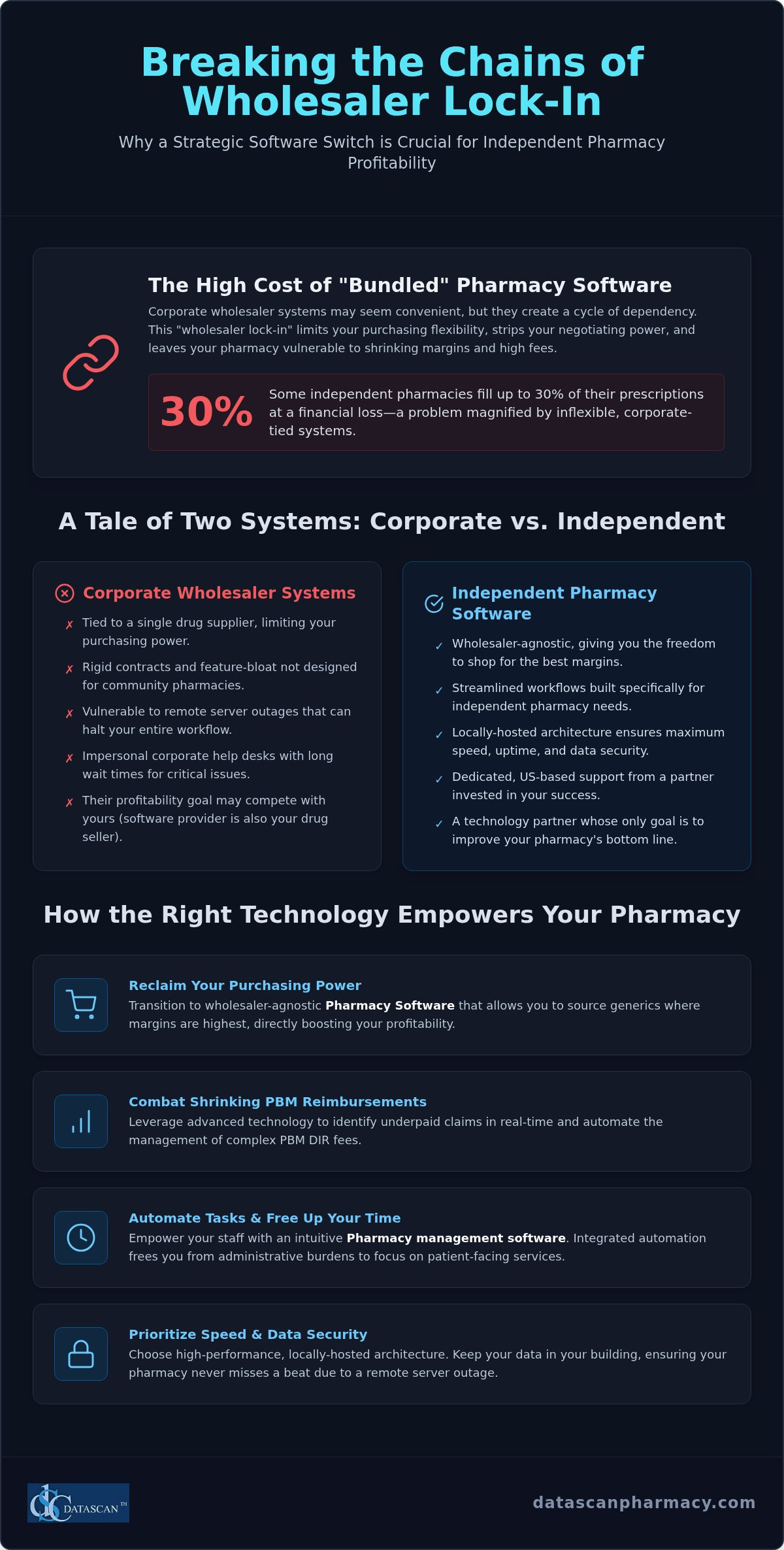
The “safe” choice of staying with a corporate wholesaler’s system might actually be the biggest risk to your pharmacy’s future in 2026. While these massive systems promise integration, they often create a cycle of wholesaler lock-in that limits your purchasing flexibility and leaves you vulnerable to high subscription fees. If you’re searching for the best McKesson pharmacy software alternative, you’re likely realizing that true independence requires a system built for your bottom line, not a corporate shareholder’s. You’re already fighting a battle where some independents fill 30% of prescriptions at a financial loss, so your pharmacy software must act as your strongest advocate rather than another monthly burden.
It’s frustrating to feel like a small fish in a corporate pond, especially when you’re facing the administrative weight of new PBM audit triggers and the complexities of the Consolidated Appropriations Act. We believe your pharmacy management software should protect your time rather than drain it. This article explores how switching to a dedicated, family-owned provider helps you bypass delayed corporate support, manage PBM reimbursements more effectively, and implement automation that frees you to focus on high-margin clinical services. Discover how the right technology can transform your operational struggles into streamlined, profitable success by decoupling your business from corporate constraints.
Key Takeaways
Reclaim your purchasing power by transitioning to wholesaler-agnostic pharmacy software that allows you to source generics where margins are highest.
Discover why high-performance, locally-hosted architecture is becoming the best McKesson pharmacy software alternative for owners who prioritize system speed and data security.
Streamline your transition with a structured conversion process that prioritizes data integrity and network optimization to ensure your pharmacy never misses a beat.
Leverage advanced technology to combat shrinking margins by identifying underpaid claims in real-time and automating the management of complex PBM DIR fees.
Empower your staff and free up your schedule for patient-facing services through integrated automation and dedicated US-based technical support.
Beyond Wholesaler Lock-in: Why Owners Seek a McKesson Alternative
Many independent pharmacy owners feel trapped by systems subsidized by their primary wholesaler. It looks like a great deal on the surface, but the hidden costs are often buried in your generic purchasing requirements. When your pharmacy management software is tied directly to your drug supplier, your negotiating power disappears. You aren’t just buying a tool; you’re signing away your ability to shop the market for better margins. Finding the best McKesson pharmacy software alternative is the first step toward breaking this cycle and reclaiming your pharmacy’s financial health in 2026.
The Limitations of EnterpriseRx for Small Pharmacies
EnterpriseRx is built for the scale of a corporate giant, but that complexity often translates to feature-bloat for a community pharmacy. Technicians shouldn’t have to click through ten screens to process a simple script. Rigid corporate contracts further strip away your business agility, making it difficult to pivot when market conditions change. Since these systems are often fully hosted, your local workflow is at the mercy of their remote servers. If their connection drops, your pharmacy stops. A locally-hosted system ensures you maintain control, keeping your data where it belongs: in your building. Corporate help desks often treat independent owners like a ticket number, leaving you waiting for days while your workflow suffers. You need a partner that offers accountability that a multi-billion dollar corporation simply cannot match.
Why Independence Matters in Pharmacy Management Software
True independence means choosing a vendor that doesn’t compete with you. When your software provider also sells pharmaceuticals, their primary goal isn’t always your profitability. Independent pharmacy software should empower you to use inventory cost-averaging to your advantage. By using a wholesaler-agnostic system, you can source generics from multiple secondary suppliers without technical friction. This flexibility is vital as you deal with every Pharmacy Benefit Manager (PBM) that tries to squeeze your reimbursements. You need a system that works for you, not your wholesaler.
2026 is the year to reclaim your data and your time. Waiting on a corporate help desk isn’t a viable business strategy. You need a “Visionary Ally” that understands the “underdog” mentality and provides the tools to fight back against shrinking margins. The best McKesson pharmacy software alternative isn’t just about changing the icons on your desktop. It’s about restoring your right to run your business on your own terms with technology that prioritizes your bottom line.
Best McKesson Pharmacy Software Alternative: A 2026 Comparison
Industry publications often claim that shifting to remote, off-site systems modernizes patient care, but many independent owners discover that these corporate models actually introduce latency and risk. When evaluating the best McKesson pharmacy software alternative, you must look beyond the marketing gloss of off-site tools and focus on system architecture that prioritizes uptime. A locally-managed Pharmacy management software provides the reliability your community depends on, ensuring that your dispensing workflow never stops because of a remote server outage. This stability is the foundation for driving revenue through clinical tools and medication synchronization rather than fighting your own technology.
Datascan vs. McKesson: Feature Breakdown
While EnterpriseRx focuses on centralized management for massive chains, our Pharmacy Management Software is built specifically for the high-touch environment of a community pharmacy. We prioritize dispensing workflows that require fewer clicks, allowing your technicians to process scripts with greater precision and speed. Unlike corporate systems that require expensive third-party add-ons, our suite includes fully integrated modules for compounding, 340B management, and nursing home services. This integration ensures that your data flows seamlessly between departments without the technical friction common in “bolted-on” software solutions. By keeping everything under one roof, you eliminate the hidden costs of multiple vendors and streamline your daily operations.
Switching from Computer-Rx or McKesson
Most owners decide to switch when they reach a breaking point with support fatigue or rising subscription fees that don’t reflect the value received. Switching from a legacy system or a corporate giant is a strategic move to reclaim your pharmacy’s identity. We have been family-owned and operated since 1981, providing a level of accountability and US-based support that large corporations simply cannot replicate. Implementing modern Workflow Software is the most effective way to reduce pharmacist burnout, as it automates the repetitive tasks that drain your energy. This transition isn’t just about new Pharmacy Software; it’s about partnering with an ally that understands the specific pressures of PBM reimbursements and staffing shortages. If you’re ready to see how a system designed for the independent underdog can transform your store, it might be time to schedule a personalized demo to explore your options.
Navigating the Pharmacy Software Conversion Process
The fear of a messy data migration often keeps pharmacy owners tethered to corporate systems that no longer serve them. We understand that your patient records and prescription history represent decades of hard work. Transitioning to the best McKesson pharmacy software alternative shouldn’t feel like a leap into the dark; it should be a methodical march toward operational freedom. Our process is designed to eliminate the anxiety of “go-live” day by focusing on precision and preparation long before the first script is filled on the new system.
A successful conversion follows five critical stages:
Step 1: Data extraction and pre-conversion cleanup. We scrub your existing data to ensure that only accurate, high-quality information enters your new system.
Step 2: Hardware evaluation and network optimization. We verify that your local infrastructure is primed for maximum speed and security.
Step 3: Staff training and workflow simulation. Your team practices in a risk-free environment to build confidence and proficiency.
Step 4: The go-live day. Our US-based support provides onsite or remote guidance to ensure a seamless transition.
Step 5: Post-conversion optimization and profit auditing. We help you use your new tools to identify underpaid claims and recover lost revenue immediately.
Ensuring Data Integrity During Migration
Corporate giants often make it difficult to export your own information, but we specialize in navigating these complex extractions. Protecting the continuity of care is our top priority. We align our migration standards with industry leaders like the Pharmacy Health Information Technology Collaborative to ensure interoperability and security. For a granular look at how we protect your pharmacy’s lifeblood, refer to our Pharmacy Software Data Migration Process for a full checklist.
Minimizing Downtime for Your Staff
A system is only as good as the people using it. We’ve developed an intuitive UI that mirrors the logic of a busy pharmacy, significantly reducing the learning curve for your technicians. Expert implementation support is non-negotiable because your pharmacy cannot afford to close its doors during a software switch. By following our Pharmacy Software Implementation Plan, you gain a clear roadmap that minimizes disruption to your daily workflow. This structured approach allows you to focus on patient care while we handle the technical heavy lifting, ensuring you reclaim your time and profitability without the typical headaches of a corporate transition.
Prioritizing Profitability: PBM Reimbursements and DIR Fees
Profitability in 2026 isn’t just about volume; it’s about precision. With some independent pharmacies reporting that they fill as many as 30% of prescriptions at a financial loss due to aggressive PBM practices, your Pharmacy management software must act as a financial watchdog. The best McKesson pharmacy software alternative doesn’t just process scripts. It provides real-time alerts when a claim is underpaid, allowing you to address the issue before the patient leaves the counter. By replacing generic data insights with profit-focused reporting, you can see exactly where your margins are being squeezed and take immediate corrective action.
Overcoming PBM Reimbursement Challenges
The landscape is shifting with the Consolidated Appropriations Act of 2026, which began banning spread pricing in new contracts on January 1, 2026. While this is a win for transparency, PBMs are responding with more aggressive audit triggers. You need Pharmacy Software that supports your advocacy by tracking gross profit at the point of dispensing. Our business intelligence dashboards transform raw data into actionable growth strategies, helping you navigate the transition as PBMs are forced to pass through 100% of rebates to plan sponsors. Instead of being blindsided by retroactive adjustments, you can use automated tools to manage and mitigate DIR fees, ensuring your bank account reflects your hard work. When evaluating pharmacy software vendors in this environment, it’s critical to prioritize platforms that offer proactive reimbursement tracking rather than reactive reporting.
Reclaiming Time for Community Pharmacy Owners
Technology should work for you, not the other way around. By automating mundane administrative tasks, you can finally shift your focus toward high-margin clinical services like Medication Therapy Management (MTM). Our MobileScripts patient mobile app significantly reduces phone call volume, freeing your technicians from the constant interruption of refill requests. This “Visionary Ally” approach saves hours of administrative labor every week, allowing you to engage more deeply with your patients. When your Point of Sale (POS) and dispensing systems are perfectly synced, you eliminate redundant data entry and reclaim your most valuable asset: your time. If you are ready to stop filling at a loss and start growing your bottom line, contact our team today to see our profit-recovery tools in action.
Why Datascan is the Logical Choice for Independent Pharmacies
Choosing the best McKesson pharmacy software alternative is a decision that defines your store’s trajectory for the next decade. While corporate entities prioritize shareholder returns and quarterly reports, we focus exclusively on the tools that keep independent pharmacies operational and profitable. We understand that you aren’t just looking for a vendor; you’re looking for a partner that shares your underdog spirit and provides the technical firepower to compete with massive retail chains. Our architecture provides the stability you need, while our continuous innovation cycle ensures you stay ahead of market trends without the drag of corporate bureaucracy.
The Human Element: US-Based Pharmacy Software Support
In a high-pressure environment, the last thing you need is a generic ticketing system that treats your emergency like a routine request. Calling a family-owned company means reaching experts who understand your workflow and share your values. We maintain a culture of accountability where every interaction is designed to solve problems, not just close tickets. This level of dedication is why many owners view us as their most reliable partner in an increasingly complex industry. You can read more on the Critical Role of US-Based Support to understand how localized expertise impacts your daily efficiency and peace of mind.
A Future-Proof Pharmacy Management System
As we navigate the shifts of 2026, from PBM transparency mandates to rising operational costs, your Pharmacy management software must be agile enough to adapt. We empower your pharmacy to thrive by providing advanced business intelligence and integrated tools that corporate systems often overlook. Our suite, including Compounding Pharmacy Software and the Datascan Mobile Delivery App, is designed to expand your revenue streams beyond traditional dispensing. This isn’t just about survival; it’s about building a future-proof enterprise that remains a pillar of your community.
The transition to a better system is the most impactful step you can take to reclaim your profitability and time. Don’t let corporate constraints dictate your success when a specialized solution is within reach. We invite you to schedule your Datascan demo today and see why we are the preferred choice for pharmacies reclaiming their independence. Our team is ready to show you how our Pharmacy Software can transform your operational burdens into streamlined successes.
Reclaim Your Independence and Profitability Today
The landscape for community pharmacies in 2026 demands more than just a dispensing tool; it requires a strategic partner that fights for your bottom line. By breaking free from wholesaler lock-in, you regain the flexibility to source generics at competitive prices and manage your inventory with total transparency. We’ve seen how specialized PBM reimbursement tools and automated workflow features can transform operational burdens into streamlined successes, allowing you to focus on high-margin clinical services. For owners searching for the best McKesson pharmacy software alternative, the logical path leads toward a system that prioritizes your store’s unique needs over corporate interests.
Datascan has been family-owned since 1981, providing the stability and heritage that corporate giants simply cannot match. Our 100% US-based support team understands the specific pressures you face, offering the personal accountability you deserve. You don’t have to settle for shrinking margins or delayed help desk tickets. It’s time to empower your pharmacy with technology that works as hard as you do. Discover the Datascan Difference: Schedule Your Demo and see how we can help you thrive in this evolving market. Your journey toward a more profitable and efficient future starts with a single conversation.
Frequently Asked Questions
What makes Datascan the best McKesson pharmacy software alternative?
Datascan stands out as the best McKesson pharmacy software alternative because it restores your independence from corporate wholesaler constraints. We offer a wholesaler-agnostic platform that prioritizes your store’s profitability rather than a corporate drug supplier’s bottom line. Our family-owned heritage since 1981 ensures you receive personalized, US-based support that understands the unique pressures of the independent underdog. You get a robust pharmacy software suite that includes integrated point-of-sale and clinical tools without corporate bureaucracy.
How difficult is the pharmacy software conversion from EnterpriseRx?
We’ve refined the pharmacy software conversion process into a methodical five-stage transition that prioritizes data integrity. While corporate giants often make data extraction difficult, our team specializes in navigating these complex migrations from systems like EnterpriseRx. We handle the heavy lifting of data cleanup and network optimization so your technicians stay focused on patients. With workflow simulations and onsite or remote go-live support, we ensure your pharmacy experiences minimal disruption during this essential upgrade.
Can Datascan help my pharmacy manage and reduce DIR fees?
Yes, our pharmacy management software acts as a financial watchdog by identifying underpaid claims and mitigating DIR fees in real-time. We provide profit-focused reporting that replaces generic data insights, allowing you to see exactly where PBMs are squeezing your margins. By tracking gross profit at the point of dispensing, you can address underpayments before the patient leaves. This proactive approach helps you reclaim revenue that often gets lost in the complexity of corporate systems.
Does Datascan offer US-based support for its pharmacy systems?
We provide a 100% US-based support team that shares your independent values and understands the urgency of your daily workflow. Unlike corporate help desks that treat you like a ticket number, our family-owned company offers direct accountability and expert guidance. When you call about your pharmacy systems, you speak with a professional who is dedicated to your success. This supportive partnership ensures that technical issues don’t stand in the way of providing excellent patient care.
Is Datascan compatible with all major wholesalers?
Our pharmacy software is completely wholesaler-agnostic, giving you the freedom to source generics from any supplier that offers the best margins. We believe independence is the key to survival in 2026, so we don’t lock you into rigid purchasing requirements. This flexibility allows you to use inventory cost-averaging to your advantage. By decoupling your software from your wholesaler, you reclaim the power to negotiate and shop the market for better pricing across the industry.
How does the cost of Datascan compare to corporate pharmacy software?
While corporate vendors often promise subsidized software, the hidden costs usually appear in restricted generic purchasing or high monthly subscription fees. Datascan provides a value-driven alternative that prioritizes your pharmacy’s long-term financial health. By using our pharmacy management software, you eliminate the indirect costs of wholesaler lock-in and gain tools that actively recover lost profits. The investment in a dedicated system often pays for itself through improved reimbursement tracking and reduced administrative labor.
What clinical features are included in Datascan pharmacy management software?
Our pharmacy management software includes a comprehensive suite of clinical tools designed to diversify your revenue streams. We offer integrated modules for medication synchronization, e-care plans, and MTM services that are less dependent on PBM reimbursements. You also gain access to specialized compounding and 340B management tools within the same platform. These features empower you to provide high-margin clinical care while our automation handles the repetitive tasks that typically cause pharmacist burnout and staffing stress.
Can I use my existing hardware when switching to Datascan?
We conduct a thorough hardware evaluation and network optimization as part of our implementation process to determine if your existing equipment is compatible. While we don’t sell hardware ourselves, we ensure your local infrastructure is primed for the speed and security our software requires. If your current machines meet the necessary specifications, we can often integrate them into your new pharmacy system. This approach helps minimize initial setup costs while ensuring your workflow remains fast and reliable.
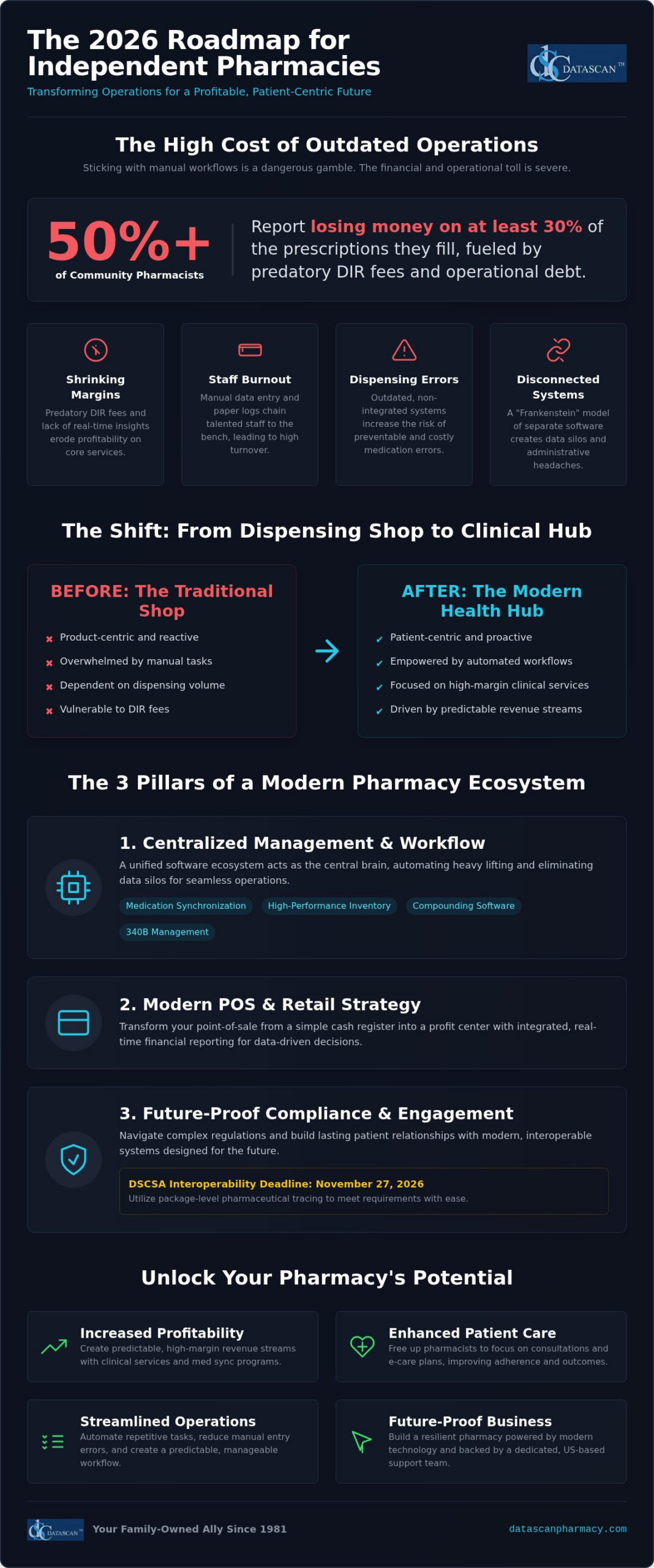
Did you know that over half of community pharmacists now lose money on at least 30% of the prescriptions they fill? It’s a staggering reality fueled by predatory DIR fees and the crushing weight of manual data entry that keeps your staff chained to the bench. You didn’t become a pharmacist to spend your day fighting disconnected systems or wrestling with paper logs. To survive and thrive, you must modernize pharmacy operations and pivot from a simple dispensing shop to a high-margin clinical health hub. At Datascan Pharmacy Software, we understand the pressure you’re under as an independent. As a family-owned ally since 1981, we’ve spent decades championing the underdog against corporate giants who want to see your margins disappear.
This 2026 roadmap reveals how to reclaim your time and profitability by leveraging a unified digital ecosystem. You’ll discover how to streamline workflows to free up your team for revenue-generating clinical services and med sync programs. We’ll explore the critical steps needed to meet the November 27, 2026, DSCSA interoperability deadline while maximizing patient retention through modern mobile engagement. By the end of this guide, you’ll have a clear strategy to transform your pharmacy from a manual operation into a streamlined, future-proof powerhouse.
Key Takeaways
Shift your business model from a product-centric shop to a clinical health hub to combat shrinking margins and DIR fees.
Implement a unified software ecosystem to modernize pharmacy operations, effectively removing the manual bottlenecks that cause staff burnout.
Leverage automated medication synchronization and clinical service tools to create predictable revenue streams and improve patient adherence.
Navigate the 2026 DSCSA requirements with ease by utilizing interoperable tracking systems that simplify package-level pharmaceutical tracing.
Build a future-proof business with a dedicated, US-based support team that prioritizes the unique needs of independent pharmacy owners.
Why Modernizing Pharmacy Operations is Essential in 2026
Modernization isn’t just a buzzword; it’s a survival strategy for the independent pharmacist. To modernize pharmacy operations effectively, you must integrate digital tools that automate the manual, repetitive tasks that drain your staff’s energy. Many pharmacies currently struggle with “operational debt,” a state where legacy, non-integrated systems force teams to work harder, not smarter. This friction prevents you from competing with large corporate chains that have deep pockets for tech. We’ve seen this cycle before since we started in 1981. It starts with a new regulation and ends with the chains pulling ahead while independents scramble to catch up. By choosing a unified software ecosystem, you transform these operational burdens into a distinct competitive advantage.
The Cost of Doing Nothing
Sticking with manual workflows is a dangerous gamble in 2026. When your team is bogged down by paper logs and disconnected databases, preventable dispensing errors become more likely. To mitigate these risks by digitizing physical records, you can explore Premium App Subscription Fees for professional mobile utilities that help transition your pharmacy to a paperless workflow. The financial toll is equally severe. Research from the NCPA Digest shows that more than half of community pharmacists report losing money on at least 30% of the prescriptions they fill. Without real-time insights into DIR fees and acquisition costs, your margins continue to shrink. This environment doesn’t just hurt your bottom line; it drives staff turnover. Talented technicians won’t stay in an environment where they feel like data entry clerks rather than healthcare professionals. You can’t afford to let your most valuable assets walk out the door because of outdated technology.
From Dispensing to Clinical Excellence
The future of pharmacy lies in clinical services, not just dispensing volume. Automation is the key that unlocks this transition. When your software handles the heavy lifting, your pharmacists can spend their time on e-care plans and patient consultations. This evolution aligns with the principles found in this Health Informatics Overview, which details how information technology improves patient safety and health outcomes. With tools like Datascan Pharmacy Management Software, you can easily implement med sync programs that drive adherence. In 2026, Medicare Part D beneficiaries face a $2,100 out-of-pocket maximum, making adherence and clinical guidance more critical than ever. Modernized operations empower you to lead your community’s health while securing your pharmacy’s financial future. You’re no longer just a pill dispenser; you’re a vital healthcare hub.
The Three Pillars of a Modern Digital Pharmacy Ecosystem
A truly modernized pharmacy isn’t just a collection of separate tools; it’s a living, breathing ecosystem where every component communicates in real time. To modernize pharmacy operations effectively, you must move away from the “Frankenstein” model of bolting together disconnected software from different vendors. This fragmented approach creates data silos, leading to synchronization errors and administrative headaches. A single-vendor ecosystem ensures that patient data flows seamlessly from the management system to the register and out to the patient’s mobile device. This level of integration preserves data integrity while providing you with a 360-degree view of your business health.
Centralized Management and Workflow
The Datascan Pharmacy Management Software acts as the central brain of your operation. It’s designed to automate the heavy lifting that usually eats up your staff’s time. Built-in medication synchronization software is a non-negotiable feature for 2026. It allows you to align refills and create a predictable, manageable workflow. High-performance inventory management tools prevent you from tying up capital in overstock while ensuring you never face a stockout on critical medications. For pharmacies offering specialized services, integrated Compounding Pharmacy Software and 340B Management Tools are essential. This level of sophisticated automation is highlighted in the Future of Pharmacy Automation, which emphasizes how digital integration directly improves medication safety and operational efficiency.
Modern POS and Retail Strategy
Your Datascan Point of Sale (POS) system should be viewed as a profit center rather than a simple cash register. Integrated POS software provides real-time financial reporting, giving you the clarity needed to make data-driven decisions about your front-end inventory. Customer loyalty programs built directly into the POS help you compete with the big chains by rewarding your most frequent shoppers. Additionally, local logistics have become a key differentiator for independents. By using the Datascan Mobile Delivery App, you can track every package from your store to the patient’s doorstep, ensuring accountability and professional service for your homebound patients.
Digital Patient Engagement
To stay relevant, you must meet patients where they spend their time: on their smartphones. MobileScripts facilitates instant refill requests, which significantly slashes the volume of time-consuming phone calls your staff handles daily. Secure, HIPAA-compliant messaging allows you to provide high-touch care without the security risks of standard SMS. These mobile tools also play a vital role in clinical care, allowing you to capture e-care plan data right at the point of care. If you’re ready to see how these integrated pillars can work for you, you can explore our full software suite and start building your digital foundation today.
Optimizing Clinical and Retail Workflows for Profitability
Profitability in 2026 requires more than just filling scripts; it demands a surgical focus on workflow optimization. To modernize pharmacy operations, you must leverage data to combat the shrinking margins caused by DIR fees and rising operational costs. Proactive adherence monitoring within your Datascan Pharmacy Management Software allows you to identify patients at risk of non-compliance, protecting your performance scores and your bottom line. This isn’t just about clinical care. It’s about financial defense. By using advanced reporting and analytics, you can pinpoint high-margin opportunities and eliminate the “operational debt” that comes from manual, unmonitored processes.
Mastering Medication Synchronization
Med Sync is the foundation of a predictable pharmacy day. By grouping a patient’s refills into a single monthly pickup, you eliminate the constant interruptions of reactive, daily fills. Our software automates the identification and synchronization process, which saves your staff hours of manual labor. This streamlined approach doesn’t just save time. It drives revenue. Pharmacies using automated med sync often see a measurable increase in annual prescription volume because patients stay on their therapies longer. You’re turning a chaotic workflow into a structured, high-volume engine that runs with minimal intervention.
Advanced Delivery Management
Logistics represent a significant overhead that many independents fail to track effectively. The Datascan Mobile Delivery App transforms this expense into a streamlined, professional service. Automated routing ensures your drivers take the most efficient paths, which reduces fuel costs and vehicle wear. Beyond the road, mobile tracking builds patient trust by providing real-time updates on their medication’s status. If you’re looking to expand your reach, bedside delivery software facilitates transitions of care by allowing you to deliver meds to patients before they even exit a hospital or clinic. This captures business that would otherwise go to a chain competitor.
Finally, don’t view the upcoming DSCSA requirements as just another regulatory hurdle. The November 27, 2026, deadline for small dispensers to implement package-level tracing is a firm mandate, but it also offers a hidden benefit. The interoperable systems required for compliance provide unprecedented inventory transparency. You’ll know exactly what’s on your shelves at all times, reducing waste and ensuring you never tie up capital in dead stock. You’re turning a mandatory compliance task into a powerful tool for inventory optimization and profit protection.
A Step-by-Step Transition Plan for Independent Pharmacies
Transitioning to a digital-first model isn’t an overnight task. It’s a methodical process that begins with an honest operational audit to identify your most restrictive bottlenecks. Are your technicians spending hours on the phone for refills? Is your pharmacist bogged down by manual inventory counts? Once you pinpoint these friction points, you can modernize pharmacy operations in logical, manageable phases. We recommend starting with your core management platform to stabilize your dispensing and clinical workflows. Once that foundation is secure, you can layer on integrated point of sale and mobile engagement tools to extend your reach directly to the patient’s smartphone.
Selecting the Right Partner
The software you choose is only as good as the team standing behind it. During a transition, US-based support is critical; you can’t afford to wait for a call back from a different time zone when your script queue is backing up. When evaluating providers, consider the difference between a venture-backed firm looking for an exit and a family-owned partner like Datascan Pharmacy Software that has been in the trenches since 1981. If you’re weighing your options against legacy systems, our WinRx software comparison reveals why agile, pharmacist-focused platforms are outpacing the industry’s biggest names in 2026. You need a partner that prioritizes data migration security to ensure your historical records remain accurate and accessible. A visionary ally doesn’t just sell you a license. They provide the historical perspective and personal accountability needed to build a future-proof business.
Training and Cultural Change
Your staff are the ones who will ultimately drive the success of your new ecosystem. To turn them into tech-savvy advocates, you must involve them in the process early and incentivize the adoption of new digital workflows. Instead of overwhelming the team, set realistic KPIs for the first 90 days. Focus on small, measurable wins like increasing med sync enrollment or reducing the volume of manual refill entries. Creating a feedback loop allows your technicians to suggest process improvements, making them feel like stakeholders rather than just employees. This cultural shift ensures that your investment in technology translates into actual operational efficiency and long-term profitability.
If you’re ready to move away from manual struggles and embrace a high-profit digital future, schedule a personalized demo to see our transition roadmap in action.
Choosing a Visionary Ally: The Datascan Advantage
Selecting the right technology partner is the single most important decision you’ll make as you modernize pharmacy operations. You need more than just a software vendor; you need a Visionary Ally who understands that your independence is your greatest strength. Since 1981, Datascan Pharmacy Software has operated as a family-owned enterprise, and that heritage defines our approach to personal accountability. Unlike venture-backed corporations focused on short-term gains, we measure our success by the longevity and profitability of our clients. Our US-based technical support team ensures that when you need assistance, you’re speaking with an expert who understands the urgency of your daily workflow.
The power of our ecosystem lies in its total integration. By combining our management platform, point of sale, MobileScripts, and delivery tools into a single suite, we eliminate the friction of data silos. This innovation-first mindset extends to specialized needs with our Compounding Pharmacy Software and 340B Management Tools. Datascan Pharmacy Software doesn’t just provide tools. We provide a roadmap for clinical and retail excellence. Our focus on DIR fee reduction and e-care plans ensures that your pharmacy remains a profitable pillar of your community.
Tailored Solutions for Independent Growth
We specifically design our features for the underdog. Because our system is built by pharmacy experts rather than just generic coders, every button and report serves a tangible business purpose. We know that independent pharmacies face unique pressures from PBMs and chains, so we build the tools you need to fight back and win. For independents evaluating their current platform, a thorough WinRx software comparison against Datascan makes clear why pharmacist-focused innovation consistently outperforms legacy corporate systems. A Visionary Ally is a partner that blends cutting-edge technical precision with the heart of a dedicated guide. This combination allows us to deliver the sophisticated capabilities of a large corporation with the personal touch of a family business.
Ready for the Future of Pharmacy
The regulatory environment of 2026 demands constant innovation. Whether it’s meeting the latest DSCSA tracing requirements or managing complex Medicare Part D changes, our platform evolves alongside the industry. When you choose Datascan Pharmacy Software, you’re joining a community of successful, modernized independent pharmacies that refuse to be left behind. Our continuous updates ensure you’re always ahead of the curve, turning regulatory hurdles into operational advantages. It’s time to stop struggling with manual processes and start building the high-profit digital powerhouse your community deserves.
The window to transition from a manual dispensing shop to a high-profit clinical health hub is narrowing as the 2026 regulatory deadlines approach. You’ve seen how the path to profitability lies in a unified digital ecosystem that eliminates data silos and streamlines staff workflows. By now, it’s clear that the shift toward clinical services and med sync isn’t just a trend; it’s the only sustainable way to combat shrinking margins and DIR fees. You have the clinical expertise to lead your community’s health, but you need the right tools to execute that vision without burning out your team.
It’s time to modernize pharmacy operations with a partner that has advocated for the underdog for over four decades. Since 1981, Datascan has remained a family-owned ally, providing a comprehensive integrated suite and reliable US-based support that large corporations simply can’t match. You don’t have to navigate these complex industry shifts alone.
How long does it take to modernize a pharmacy’s software system?
A full software transition typically takes 30 to 90 days depending on the complexity of your data migration and staff readiness. We prioritize a phased approach to ensure your team isn’t overwhelmed during the learning curve. Starting with core management software allows you to stabilize dispensing before adding advanced features like mobile apps. This methodical pace ensures data integrity while minimizing disruptions to your daily patient care and retail operations.
Will modernizing my operations actually help reduce DIR fees?
Yes, modernizing your operations directly impacts DIR fees by improving the performance metrics that PBMs use to calculate clawbacks. When you modernize pharmacy operations, you gain access to real-time adherence monitoring tools that identify non-compliant patients early. Improving Star Ratings through automated med sync and targeted outreach helps protect your margins from predatory retroactive fees. This proactive strategy turns clinical care into a financial defense mechanism for your business.
Is it better to buy pharmacy software from a large corporation or a family-owned business?
Choosing a family-owned partner provides a level of personal accountability and specialized industry knowledge that large corporations often lack. Datascan has been a champion of the independent pharmacist since 1981, offering the stability of a long-standing heritage. You get the benefit of US-based support and a software suite built by experts who understand your specific pressures. Venture-backed firms often prioritize shareholder exits over the long-term success of your pharmacy.
Can modern pharmacy software help with DSCSA compliance?
Modern pharmacy software is essential for meeting the enhanced DSCSA requirements that take full effect for small dispensers on November 27, 2026. These systems provide the electronic, interoperable tracing needed to track pharmaceutical products at the package level. Beyond simple compliance, these tools offer better inventory transparency. You’ll reduce waste and ensure that every item on your shelf is fully accounted for within a secure, digital chain of custody that protects your license.
How do patient mobile apps improve pharmacy profitability?
Patient mobile apps like MobileScripts increase profitability by automating the refill process and reducing the administrative burden on your staff. When patients request refills via their smartphones, your team spends less time on the phone and more time on high-margin clinical services. These tools also improve patient retention by offering a convenient, modern experience that rivals big-box competitors. Better engagement leads to higher adherence and more consistent prescription volume throughout the year.
What is the ROI of implementing medication synchronization software?
The return on investment for medication synchronization comes from increased prescription volume and significantly improved workflow efficiency. Patients enrolled in med sync programs are more likely to stay on their therapies, which can lead to a measurable increase in annual fills per patient. By grouping refills into a single monthly pickup, you also reduce the labor costs associated with multiple deliveries and chaotic, reactive filling schedules. It’s a proven strategy for building predictable revenue.
Do I need separate vendors for pharmacy management and POS systems?
It’s highly recommended to use a single-vendor ecosystem for both pharmacy management and point of sale to ensure data integrity. When you modernize pharmacy operations with an integrated suite, your financial reporting and patient records talk to each other in real time. This eliminates the errors and silos that occur when trying to bridge disconnected systems. A unified platform provides a clearer view of your business health while simplifying your technical support needs, much like how specialized ERP solutions like Flowgres help small businesses maintain tight control over their sales and budgets.
Mobile delivery tracking software reduces overhead by optimizing driver routes and providing real-time accountability for every package. Automated routing ensures that your delivery staff takes the most efficient paths, saving on fuel and vehicle maintenance costs. It also reduces the time spent handling patient inquiries about delivery status. By professionalizing your logistics, you can expand your service area and capture new business without a proportional increase in your administrative staffing costs.
Did you know that just ten pharmacy benefit managers now control over 90 percent of the total prescription claims volume in the United States? For the independent owner, this statistic represents more than just market share; it’s the direct source of the opaque DIR fees and shrinking margins that threaten your legacy every single day. You likely feel the mounting pressure of manual workflows and complex regulatory hurdles like the DSCSA compliance deadline on November 27, 2026, all while dealing with software vendors that treat your business like a line item on a corporate spreadsheet.
Selecting the right independent pharmacy software is no longer just an operational choice, but a strategic imperative to protect your autonomy. This guide provides a profit-first roadmap to help you mitigate predatory fees, automate complex clinical workflows, and reclaim your time through sophisticated automation. We will examine how modern platforms integrate medication synchronization with mobile delivery tools to drive patient retention and reduce overhead. You’ll also learn to identify a visionary ally that prioritizes your growth over their own acquisition potential, ensuring your technology remains as independent and resilient as your practice.
Key Takeaways
Discover how to transform your pharmacy into a high-margin clinical service center that effectively offsets shrinking PBM reimbursements.
Identify the essential workflow features in independent pharmacy software that minimize manual tasks and maximize the efficiency of your med-sync programs.
Learn why partnering with a family-owned vendor provides long-term stability so you don’t have to worry about the disruptions common when corporate software is sold.
Explore how digital tools like the MobileScripts Patient Mobile App and integrated delivery systems can automate patient engagement and secure your local market share.
Prepare for the 2026 DSCSA mandate by implementing software solutions that offer built-in compliance tools and e-care plan integration.
What is Independent Pharmacy Software and Why Does it Matter in 2026?
In its most fundamental form, a pharmacy management system serves as the digital backbone of a community pharmacy. However, independent pharmacy software in 2026 has evolved far beyond a simple tool for labeling bottles and submitting claims. It is now a sophisticated ecosystem designed to manage complex clinical workflows, secure regulatory compliance, and protect thin profit margins against aggressive PBM tactics. For the independent owner, this technology is the primary weapon used to level the playing field against national retail chains that possess massive corporate resources and predatory pricing models.
The Evolution of Pharmacy Management Systems
The industry has moved past the “fill and bill” era. Modern independent pharmacy software now prioritizes Medication Therapy Management (MTM) and the integration of e-care plans, which have become essential revenue drivers as dispensing margins tighten. A high-performance system utilizes a unified database that bridges the gap between your Point of Sale (POS) and prescription management. This connectivity ensures that every patient interaction is captured, allowing you to provide high-touch clinical services that chains simply cannot replicate at scale. By transforming into a clinical service center, your pharmacy creates a value proposition based on health outcomes rather than just commodity medication.
Financial Pressures Facing Independents Today
PBM mandates have fundamentally reshaped the technical requirements for staying profitable. It’s no longer enough to just dispense medication; you need software that provides real-time visibility into your financial health. DIR fee mitigation tools are now a critical component of the daily workflow, helping pharmacists identify and correct performance gaps before they result in massive clawbacks. Without these tools, you’re essentially flying blind in a market designed to squeeze your pharmacy’s autonomy.
Direct and Indirect Remuneration (DIR) fees are back-end adjustments collected by PBMs after the point of sale, which significantly reduce a pharmacy’s net profit and create unpredictable financial volatility in 2026. To manage such sudden cash flow interruptions, some independent owners investigate flexible funding sources; read more about short-term financial solutions that can help bridge the gap.
The regulatory environment is also shifting. With the DSCSA compliance deadline for small dispensers arriving on November 27, 2026, your software must be capable of handling complex track-and-trace requirements through automated barcode scanning. By automating these clinical and regulatory burdens, the right software transforms your pharmacy from a traditional dispensary into a comprehensive, future-proof health hub. This evolution ensures you can maintain your independence while providing the advanced care your community expects.
High-performance independent pharmacy software is defined by its ability to eliminate friction. Every extra click in the dispensing process represents a drain on your most expensive resource: staff time. By streamlining the workflow from intake to final verification, you allow your technicians to focus on patient-facing tasks that actually drive growth. This optimization must extend to specialized revenue streams. For instance, integrated 340B management tools allow you to tap into federal programs with automated compliance reporting, while specialized compounding software capabilities ensure you can handle complex formulations with the same precision as traditional prescriptions.
Inventory and POS Integration
Your Point of Sale (POS) must maintain a real-time dialogue with your management software to ensure financial accuracy. Analyzing 2023 technology trends reveals that pharmacies failing to integrate these systems often struggle with cash flow bottlenecks caused by overstocking. Modern systems use automated reordering logic based on actual dispensing data, ensuring you only pay for the inventory you need. This integration is also vital for DSCSA compliance; barcode scanning at the register provides a final layer of verification and ensures your track-and-trace documentation is airtight before the November 27, 2026 deadline.
Medication Synchronization and Adherence
Medication synchronization is the engine of predictable monthly revenue. A robust “Sync” program aligns all of a patient’s chronic medications to a single pick-up date, which significantly improves adherence and reduces the overhead of multiple deliveries. High-performance independent pharmacy software uses automated reminders to engage patients without requiring manual phone calls from your staff. These improvements in adherence directly impact your star ratings, which in turn protect your pharmacy from performance-based clawbacks and improve overall reimbursements. When your technology works as a unified force, you stop fighting your tools and start growing your business. If you’re looking for a partner that understands these operational nuances, explore how Datascan Pharmacy Management Software can transform your daily workflow.
Evaluating Vendors: Why Ownership Structure is a Strategic Asset
The technology you choose is only as stable as the company that builds it. In the high-stakes world of independent pharmacy software, the ownership structure of your vendor is a primary indicator of your future operational security. Many pharmacies fall into the “Venture Capital Trap,” where a startup or corporate-backed vendor prioritizes a lucrative exit strategy over long-term product development. When these companies are sold to competitors or private equity firms, the result is often a forced migration to an inferior platform, gutted support teams, or a sudden halt in innovation. You don’t just need a vendor; you need a visionary ally whose interests are perfectly aligned with your own survival.
Choosing a family-owned vendor with a 40-year track record provides a level of stability that “disruptor” startups cannot match. This longevity ensures that your software provider has seen the industry evolve through decades of regulatory shifts and is committed to staying independent. Furthermore, US-based support is not a luxury; it’s a necessity. When a system glitch occurs during your busiest hour, language and time-zone alignment ensure that troubleshooting is precise and immediate. By embracing digital health tools from a partner that understands the domestic landscape, you protect your pharmacy’s autonomy while gaining a competitive edge over corporate chains. If you’re currently evaluating legacy platforms, our detailed WinRx software comparison reveals how agile, pharmacist-focused systems are outpacing the industry’s biggest names in 2026.
The Support Experience: Beyond the Help Desk
Technical support should feel like a partnership, not a ticket number in a queue. You should evaluate vendors based on their response times and the actual pharmacy expertise of their technicians. A high-performance support team doesn’t just fix bugs; they help you optimize your workflow based on real-world feedback from other independent owners. This “pharmacist-centric” approach to updates ensures that the software evolves to meet the actual needs of the bench, rather than the whims of corporate shareholders who have never stepped behind a counter.
Long-term ROI vs. Initial Licensing Fees
Initial licensing fees are often a poor metric for the true value of independent pharmacy software. Low entry costs frequently hide a “nickel-and-diming” strategy involving transaction fees, mandatory hardware bundles, and expensive module add-ons for essential features like med-sync or e-care plans. When calculating the total cost of ownership (TCO) over a five-year period, the stability of a transparent pricing model far outweighs a cheap startup promotion. Family-owned vendors offer a legacy of commitment that venture-backed startups, often focused on short-term disruption before an acquisition, simply cannot provide.
Actionable Guidance: Transforming Operations with Digital Tools
Transformation isn’t just about switching your platform; it’s about utilizing the full suite of digital tools to reclaim your time and protect your bottom line. In 2026, the gap between thriving and struggling pharmacies is often defined by digital maturity. By following a structured implementation plan, you can turn your independent pharmacy software from a background utility into a proactive revenue engine that works while you sleep. This shift requires moving beyond basic dispensing and embracing tools that connect you directly to your patients’ pockets. This trend is visible across healthcare; for instance, many practices now utilize a dental post-treatment instruction library to provide patients with clear, accessible digital guidance after their appointments.
The MobileScripts Patient Mobile App serves as your pharmacy’s digital storefront, offering the 24/7 engagement that modern patients demand. This tool drastically reduces phone traffic by allowing patients to request refills and view their profile directly from their smartphone, freeing your staff for clinical consultations. Secure, HIPAA-compliant messaging features enable your team to communicate with patients without the friction of missed calls or unsecure SMS threads. When patients have instant access to their insurance information and prescription history, they feel more connected to your brand, which directly improves long-term retention and adherence rates.
Optimizing Local Delivery Logistics
Manual delivery logs are a significant liability in the current audit environment. Transitioning to the Datascan Mobile Delivery App provides real-time driver tracking and automated routing, which ensures your delivery service is as efficient as a national courier. By capturing electronic signatures at the front door, you create a digital trail that simplifies audit compliance and proves delivery with absolute certainty. This level of precision protects your margins from disputed claims while providing a professional experience that rivals any chain pharmacy. It’s a simple way to turn a logistical headache into a streamlined, high-tech service.
The third critical step is moving toward a completely paperless workflow for audit readiness. Storing documents digitally within your independent pharmacy software ensures that when an auditor asks for records, you aren’t digging through filing cabinets. Finally, you must utilize robust data reporting to identify low-margin prescriptions that are draining your resources. By focusing on high-value patients and clinical opportunities identified through your data, you can pivot your business model toward sustainable profitability. Ready to modernize your workflow? Learn how Datascan Pharmacy Management Software can digitize your entire operation today.
The Datascan Advantage: Building the Future of Independent Pharmacy
Choosing Datascan Pharmacy Management Software means you’re not just buying a license; you’re securing a partnership with a company that has championed the independent pharmacist since 1981. We’ve spent over 40 years perfecting a “best-of-both-worlds” experience that delivers the processing power of a large corporation alongside the accountability of a family-run enterprise. Our independent pharmacy software is engineered to transform your operational struggles into streamlined successes by prioritizing profitability and patient retention above all else.
Innovation at Datascan is proactive, not reactive. While other vendors scramble to meet regulatory deadlines at the last minute, we integrated e-care plans and DSCSA track-and-trace tools long before they became mandatory burdens. Our systems are built to handle the specific 2026 DSCSA requirements for barcode scanning, ensuring your pharmacy remains compliant and audit-ready without disrupting your daily workflow. This forward-thinking development is designed to protect your bottom line from predatory PBM tactics and shrinking margins, giving you the competitive advantage you need to thrive.
Why We Stay Independent
Our commitment to independence is your greatest strategic asset. In an industry where software vendors are frequently sold to competitors or private equity firms, Datascan remains firmly family-owned. This stability means you’ll never face the trauma of a forced migration or a sudden drop in support quality due to a corporate acquisition. We maintain the flexibility to innovate quickly, often releasing updates based directly on the feedback we receive from our clients. When you call our US-based technical support, you’re treated as a partner with a name, not just a ticket number in a database.
Join the Datascan Family
Transitioning to a new system shouldn’t be a source of anxiety. We’ve refined a seamless data migration process that ensures your patient profiles, insurance information, and prescription history move safely from your legacy system to our modern platform. We invite you to see exactly how our tools can revolutionize your pharmacy’s efficiency and financial health. Experience the Datascan difference with a free software demo. By scheduling a personalized walkthrough, you can explore our 340B management tools, Compounding Pharmacy Software, and mobile delivery apps in a real-world context tailored to your specific needs.
Secure Your Legacy with Future-Proof Pharmacy Technology
The landscape of 2026 demands more than just a software vendor; it requires a partner that understands the high stakes of your independence. We’ve explored how navigating complex DSCSA mandates and mitigating predatory DIR fees relies on technology built specifically for the bench. By prioritizing a family-owned ownership structure and leveraging a unified suite of management, POS, and mobile tools, you can transform operational burdens into streamlined successes. Selecting the right independent pharmacy software isn’t just about dispensing prescriptions. It’s about protecting your autonomy and ensuring your pharmacy remains the heart of your community for decades to come.
Datascan has been family-owned and operated since 1981, providing the stability you need in an era of corporate consolidation. Our award-winning, US-based technical support team is ready to help you implement the industry’s most comprehensive suite of management and patient engagement solutions. Don’t leave your pharmacy’s future to chance with a vendor that might sell out to a competitor. Schedule your personalized Datascan software demo today to see how we can optimize your profitability and workflow. Your legacy is worth protecting, and with the right tools, your best days are still ahead of you.
Frequently Asked Questions
What is the best pharmacy software for independent pharmacies?
The best pharmacy software is one that prioritizes your autonomy and profitability over corporate interests. Datascan Pharmacy Management Software stands out because it’s built by independents for independents. It offers a comprehensive suite including POS, mobile apps, and clinical tools that help you compete with national chains. By choosing a family-owned vendor, you ensure long-term stability and a system that evolves based on the actual needs of community pharmacists.
How does independent pharmacy software help with DIR fee mitigation?
High-performance independent pharmacy software provides real-time visibility into your financial performance to help you avoid back-end clawbacks. It automates medication synchronization and adherence tracking to improve your star ratings, which directly impacts your reimbursement levels. By flagging low-margin prescriptions and identifying adherence gaps within the daily workflow, the software empowers you to make proactive adjustments that protect your pharmacy’s bottom line from aggressive PBM tactics.
Is Datascan software HIPAA and DSCSA compliant?
Yes, Datascan is fully HIPAA and DSCSA compliant. Our system includes automated barcode scanning and track-and-trace features to meet the critical November 27, 2026 deadline for small dispensers. We prioritize data security through advanced encryption and multifactor authentication to ensure your patient information remains protected. This built-in compliance removes the manual burden of regulatory documentation, allowing you to focus on clinical service delivery and business growth.
Can I manage compounding and retail prescriptions in the same system?
You can seamlessly manage both compounding and retail prescriptions within the Datascan platform. Our Compounding Pharmacy Software is integrated directly into the core management system, eliminating the need for disparate databases or double entry. This allows you to handle complex formulations, track ingredients, and manage billing for specialized niche services alongside your traditional retail volume. It’s a unified solution designed to diversify your revenue streams efficiently.
What are the benefits of a patient mobile app like MobileScripts?
The MobileScripts Patient Mobile App serves as a 24/7 digital storefront that improves patient retention and reduces operational overhead. It allows patients to request refills, view their prescription history, and message your staff through a secure, HIPAA-compliant interface. By automating routine inquiries and refill requests, the app frees up your technicians to focus on higher-value tasks. This digital engagement tool ensures your independent pharmacy remains competitive in an increasingly mobile-first market.
How long does it take to switch to Datascan Pharmacy Management Software?
The transition process is designed to be as efficient and non-disruptive as possible for your team. While the exact timeline depends on your current system’s data complexity, our experienced migration specialists handle the heavy lifting of transferring patient and prescription history. We provide comprehensive training to ensure your staff is confident before you go live. This methodical approach minimizes downtime and ensures a smooth shift to a more profitable workflow.
Does Datascan offer US-based technical support?
Datascan provides award-winning, US-based technical support to ensure your pharmacy never faces a language or time-zone barrier during a crisis. Our support team consists of experts who understand the specific operational pressures of the domestic pharmacy industry. You’ll receive a personal touch that treats you as a partner rather than a ticket number. This commitment to domestic accountability is a core pillar of our identity as a family-owned, customer-centric company.
Can independent pharmacy software help manage 340B programs?
Effective independent pharmacy software includes integrated 340B Management Tools to help you tap into federal programs with minimal manual effort. Our system automates the tracking and reporting requirements necessary for 340B compliance, ensuring you capture every eligible claim without risking audit failures. This functionality allows you to diversify your revenue streams and support underserved populations while maintaining the high operational efficiency required to stay profitable in the modern healthcare landscape.
Your pharmacy is no longer just a place to fill prescriptions; it’s a financial engine that must be tuned for survival in a predatory market. By the time the federal DSCSA stabilization period concludes on November 27, 2026, the technological divide between thriving independents and struggling shops will be absolute. If you’re still battling pharmacy management software that feels like a relic of the nineties, you aren’t just losing time; you’re hemorrhaging margin.
We know the pressure of rising DIR fees and the exhaustion caused by clunky workflows that lead to staff burnout. It’s unacceptable to wait on hold for global call centers while your profitability hangs in the balance. You’ve worked too hard to let poor technical support or compliance complexity stall your growth. This guide promises to help you master modern operations by selecting a system that prioritizes your independence and long-term viability.
We’ll explore how to transform these burdens into streamlined successes through automated medication synchronization and transparent financial reporting. You’ll gain a clear roadmap for implementing tools that offer personalized, US-based support and high-precision dispensing. It’s time to stop surviving the industry’s shifts and start leading them with a platform built for the future. We don’t just want you to keep up; we want you to win.
Key Takeaways
Modern pharmacy management software has evolved from a simple dispensing tool into a comprehensive financial engine designed to reclaim margins and combat PBM pressures.
Discover why a “one-size-fits-all” corporate platform often fails independent pharmacies and why localized, US-based technical support is critical for operational uptime.
Learn how to leverage clinical management features and automated medication synchronization to open new revenue streams beyond the traditional dispensing counter.
Master the five essential phases of a software transition to ensure your data migration is seamless and your staff remains productive during the switch.
See how a family-owned partner provides the cutting-edge technology of a global corporation with the personal accountability of a dedicated, visionary ally.
In 2026, your pharmacy management system is the central operating system that dictates every financial and clinical movement within your business. It’s no longer just a digital filing cabinet for scripts. Legacy dispensing systems were built for an era where volume was the only metric that mattered, but that world is gone. Today, the industry has pivoted toward a value-based care model. Modern pharmacy management software must act as a sophisticated clinical platform that captures patient outcomes while simultaneously defending your bottom line against predatory PBM tactics.
The Core Pillars of a Modern System
True operational excellence starts with modern pharmacy management software that offers automated workflow management to remove manual bottlenecks. This allows your staff to focus on high-value patient interactions instead of paperwork. A 2026-standard system integrates clinical tools directly into the dispensing path, facilitating e-care plans and medication therapy management (MTM) without requiring you to switch between disparate software windows. This level of control requires a partner who provides personalized, US-based support to resolve technical hurdles before they impact your workflow. Beyond clinical care, financial intelligence is the most critical pillar for the independent underdog. Your software must provide real-time DIR fee estimation and granular profit tracking. This transparency ensures you understand the true profitability of every transaction before the medication even leaves the pharmacy.
Regulatory Compliance Standards for 2026
Compliance isn’t just a hurdle; it’s a requirement for survival. The federal DSCSA stabilization period officially concludes on November 27, 2026, making package-level track-and-trace mandatory for every independent pharmacy in the nation. This mandate requires a system with native barcode scanning capabilities that verify the electronic pedigree of every medication in your inventory. Your software must also process prescriptions using the latest NCPDP SCRIPT standard 2023011 to ensure seamless communication with providers across the healthcare continuum.
Audit readiness is now simplified through automated record-keeping that tracks every change and communication with surgical precision. Your platform must also facilitate HIPAA-compliant secure messaging, ensuring that patient engagement remains private while meeting the modern expectation for instant, digital communication. By automating these complex regulatory tasks, you protect your license and your revenue while freeing your team to do what they do best: care for their community. This shift from manual tracking to automated compliance is the hallmark of a future-proof pharmacy operation.
Driving Profitability: Beyond the Dispensing Counter
Filling scripts at lightning speed is no longer the gold standard for success. While efficiency matters, it cannot single-handedly neutralize the relentless pressure of shrinking reimbursements and opaque DIR fees. Independent owners need a paradigm shift toward software-driven profitability. This means using your pharmacy management software as a surgical instrument to cut overhead and identify hidden revenue streams that corporate competitors often overlook. By shifting focus from volume to margin optimization, you can protect your business from the volatility of the retail market.
Medication Synchronization and Adherence
Medication synchronization is the cornerstone of a predictable business model. Instead of reacting to a chaotic stream of walk-ins and phone calls, you can transition to an appointment-based system. Adherence software allows you to batch a patient’s prescriptions into a single monthly visit, which drastically reduces labor costs and fulfillment time. It’s a powerful tool for retention; when patients stay adherent, your pharmacy sees a direct increase in refill rates and more consistent cash flow. This shift transforms your workflow from a reactive scramble into a methodical, high-margin operation.
Advanced Inventory and 340B Management
Inventory is often the largest drain on an independent pharmacy’s capital. Advanced tools within your pharmacy management software prevent you from tying up thousands of dollars in slow-moving stock that sits on the shelf. Through automated reordering and generic compliance monitoring, you ensure you’re always purchasing at the best price points to maximize wholesaler rebates. This precision prevents the common trap of overspending on inventory that doesn’t turn over quickly enough.
For pharmacies serving eligible populations, integrated 340B management tools offer a way to capture specialized revenue streams with total audit transparency. Maintaining inventory accuracy acts as a shield against wholesaler overspending, ensuring every dollar in your stock is working toward your bottom line. If you’re ready to see how these tools can transform your margins, you can explore the integrated solutions from Datascan designed specifically for the modern independent. Data-driven decision making isn’t just for the big chains; it’s the secret weapon for the independent underdog looking to thrive in 2026.
Choosing the Best Pharmacy Software: Independent vs. Chain Requirements
Corporate chains operate on a “one-size-fits-all” mandate that prioritizes standardization over store-level agility. For an independent owner, this approach is a recipe for operational stagnation. Your pharmacy management software shouldn’t just be a tool you use; it should be a partner that mirrors your business’s unique DNA. While legacy corporate vendors focus on high-volume automation for their own shareholders, independent pharmacy software is built to protect your specific margins and patient relationships. You need a system that adapts to you, not the other way around.
Evaluating a new system requires looking beyond the sticker price of a monthly subscription. Total Cost of Ownership (TCO) includes the long-term impact of hardware requirements, training time, and the devastating cost of downtime. A cheaper system often hides its true expense behind offshore support queues and rigid workflows that force you to hire more staff just to manage the software. True value lies in a platform that optimizes your existing labor and offers transparent pricing without hidden integration fees that bleed your budget dry.
The “fear of the switch” is the single biggest reason pharmacies stay trapped in failing systems. You worry about lost data, interrupted workflows, and staff frustration. Modern systems mitigate this risk through professional data migration experts who handle the heavy lifting behind the scenes. Transitioning to a superior platform is a strategic investment in your pharmacy’s future, not just a technical chore. When the migration is handled by specialists who understand the stakes, the “risk” of switching is far lower than the guaranteed cost of staying with an obsolete vendor.
The Independent Pharmacist Checklist
DIR Fee Mitigation: Does the vendor provide the financial intelligence tools needed to track real-time profitability and reclaim margins?
US-Based Support: Is the support team located in the United States and accessible via a direct phone line when you’re in the middle of a rush?
Scalability: Can the pharmacy management software grow with you, whether you’re expanding your current footprint or opening a second location?
Chain Technology vs. Independent Flexibility
Enterprise systems are often burdened by “feature bloat”-hundreds of buttons you’ll never press that only serve to slow down your pharmacists at the bench. Independent pharmacies need flexibility to offer niche services like compounding or specialized 340B programs. Family-owned software providers offer a level of accountability that massive, private equity-backed corporations simply can’t match. They share your “independent” identity and prioritize the agility you need to outmaneuver the big-box competition. By choosing a visionary ally over a corporate vendor, you ensure your technology remains an asset rather than an anchor.
Implementing a New System Without Operational Downtime
Changing your pharmacy management software doesn’t have to feel like open-heart surgery on your business. Many owners cling to obsolete systems because they fear a weekend of lost scripts and frustrated patients. However, a structured implementation plan turns this perceived risk into a controlled, five-phase evolution. By partnering with professional data migration experts, you ensure that the transition is a catalyst for growth rather than a source of chaos. A successful switch follows a methodical path: discovery and hardware audit, data extraction, hybrid training, pilot testing, and the final go-live day.
Data Migration and Integrity
Accuracy is non-negotiable when moving sensitive healthcare data. Your patient profiles, insurance details, and prescription histories must land in the new system with surgical precision. This transition period is also the perfect opportunity for a clean-up phase. Use the switch to purge inactive files and outdated records, ensuring your new platform runs at peak performance from day one. Before the full cutover, your team should test the system with dummy data to verify that every field maps correctly to your new workflow. This verification step prevents the “data drift” that often plagues poorly managed migrations.
Staff Training and Change Management
Your team is the engine of your pharmacy, and their buy-in is critical for a smooth transition. To ensure they’re ready, identify super-users within your staff who grasp technology quickly and can lead their peers through the learning curve. We advocate for a hybrid training model that combines remote modules with on-site guidance to cover all learning styles. Use sandbox environments to let technicians practice filling scripts and processing insurance claims without affecting real inventory or patient records. This hands-on experience builds confidence before the first real patient walks through the door.
The first 30 days post-implementation are the most critical for long-term success. During this window, having access to personalized, US-based support is the difference between a minor hiccup and a major bottleneck. On go-live day, start early and follow a strict timeline to manage staff expectations and minimize patient wait times. If you’re ready to modernize your operations without the headache of downtime, following a proven pharmacy software implementation plan can help you reclaim your time and protect your margins throughout the conversion. Schedule a consultation with the implementation specialists at Datascan today. We don’t just provide software; we provide a roadmap to a more profitable, streamlined future.
Datascan: The Visionary Ally for Independent Pharmacies
Since 1981, Datascan Pharmacy Software has operated as the fierce champion of the independent pharmacy. We recognize that you aren’t just looking for another technical tool; you’re looking for a partner that shares your heritage and values. Our pharmacy management software delivers the sophisticated capabilities of a large corporation without sacrificing the personal accountability of a family-owned enterprise. This unique positioning allows us to offer cutting-edge tech with a personal touch, ensuring that you always have access to our specialized, US-based support team when it matters most. We don’t just sell software; we provide a future-proof foundation for the independent underdog.
The true power of our platform is found in the integrated Datascan Pharmacy Software ecosystem. By uniting your management system with Datascan Pharmacy Software Point of Sale (POS) and our suite of mobile applications, we eliminate the fragmentation that slows down your business. This total solution provides a seamless flow of data, allowing you to track profitability with precision while maintaining the agility needed to outpace big-box competition. It’s the logical conclusion for any owner seeking to transform operational burdens into streamlined successes.
The Integrated MobileScripts Advantage
Mobile Delivery and Routing Efficiency
Mastering local logistics is essential for modern pharmacy operations. The Datascan Pharmacy Software Mobile Delivery App allows you to optimize your routes in real-time, which directly lowers your fuel and labor costs. Beyond simple transportation, the app captures digital signatures and proof of delivery to ensure you remain fully compliant during audits. Much like how property inspectors use the PHOTO iD automated photo labeling app to maintain organized records, pharmacy delivery drivers can use integrated mobile tools to document successful drop-offs. This level of logistical control transforms your delivery service from an overhead expense into a competitive advantage. When you choose Datascan Pharmacy Software, you’re investing in a system that protects your margins at every turn. It’s time to reclaim your independence with a partner who actually understands the pressure of the independent pharmacy.
Reclaim Your Independence and Drive Maximum Profitability
The landscape of 2026 demands more than just endurance; it requires a strategic overhaul of your operational core. By prioritizing automated medication synchronization and package-level DSCSA compliance, you transform your pharmacy from a dispensing site into a high-margin clinical destination. Selecting the right pharmacy management software is the most critical decision you’ll make to defend your business against shrinking margins and corporate pressures. You don’t have to settle for the “one-size-fits-all” approach of legacy vendors who prioritize their shareholders over your success.
Since 1981, Datascan has stood as a family-owned partner dedicated to the independent underdog. With 100% US-based technical support and the integrated power of our MobileScripts patient application, we provide the tools you need to stay agile and profitable. It’s time to stop fighting clunky workflows and start empowering your team with technology built for your specific needs. Empower your independent pharmacy with Datascan’s all-in-one software suite and turn your operational burdens into streamlined successes. Your community relies on your expertise, and with the right visionary ally, your best years are still ahead.
Frequently Asked Questions
What is the average cost of pharmacy management software in 2026?
Monthly SaaS costs for independent pharmacies in 2026 typically range between $100 and $500. For robust systems requiring a one-time license, costs can span from $1,000 to $10,000 depending on the specific feature set. It’s vital to evaluate the total cost of ownership, including hardware and data migration, rather than just the initial monthly fee. This ensures your technology remains a profitable asset rather than a drain on your pharmacy’s capital.
How long does it take to switch pharmacy software systems?
A standard transition typically spans 30 to 60 days from the initial discovery phase to the final go-live day. This timeline allows for a meticulous hardware audit, secure data extraction, and comprehensive staff training. Rushing this process can lead to operational bottlenecks. Therefore, a methodical five-phase approach is recommended to ensure zero downtime. By following a structured roadmap, you can modernize your operations without interrupting patient care or script fulfillment.
Can my pharmacy management software help reduce DIR fees?
Yes, advanced pharmacy management software is designed to provide real-time DIR fee estimation and granular profit tracking. By identifying high-risk prescriptions and optimizing medication synchronization, the system helps you maintain higher performance scores which can mitigate fee clawbacks. This financial intelligence allows you to see the true profitability of a transaction before the medication leaves the pharmacy. It empowers you to make data-driven decisions that protect your pharmacy’s hard-earned margins.
Is cloud-based pharmacy software better than on-premise solutions?
The choice depends on your specific infrastructure and security needs. Cloud-based solutions offer easier remote access and lower upfront hardware costs, while on-premise systems provide maximum control over your data environment and operational speed during local internet outages. Many modern pharmacies prefer a hybrid approach that combines the reliability of a local server with the accessibility of mobile applications. Both models should prioritize HIPAA-compliant encryption and robust data backup to ensure total business continuity.
How does pharmacy software ensure DSCSA compliance?
Modern systems incorporate mandatory track and trace capabilities that electronically verify the pedigree of individual medication packages. With the federal stabilization period ending on November 27, 2026, your software must support package-level barcode scanning to comply with federal law. This automated record-keeping ensures audit readiness by tracking every movement within the drug supply chain. It removes the manual burden of compliance, allowing your staff to focus on clinical services and patient engagement instead of paperwork.
Does Datascan offer US-based technical support?
Yes, we provide 100% US-based technical support. This ensures your pharmacy never faces long delays with global call centers. Our support team is composed of industry experts who understand the specific pressures of independent pharmacy operations. This personal touch provides accountability and fast problem resolution. Large, private equity-backed firms simply cannot match this. You gain a dedicated visionary ally who is fiercely loyal to your success and available whenever you need assistance.
Can I manage multiple pharmacy locations with one system?
Absolutely, our pharmacy management software is built to scale from a single independent shop to a small regional chain. You can centralize your inventory management, financial reporting, and patient records across all locations for a unified view of your business health. This centralized control reduces administrative overhead and ensures consistent clinical standards across your entire footprint. It allows you to leverage the agility of an independent with the operational efficiency of a much larger enterprise.
What features should I look for in a pharmacy POS system?
Your pharmacy POS system must offer seamless integration with your management software to ensure real-time inventory updates and financial transparency. Critical features include integrated credit card processing, loyalty program management, and the ability to capture digital signatures for audit compliance. It should also support mobile delivery and curbside pickup to meet modern patient expectations. A robust POS system acts as the final link in your profitability chain, ensuring every transaction is captured accurately.