
Stocking too much ties up cash; stocking too little can leave patients waiting. Predictive analytics in pharmacy management uses historical and current data, such as sales patterns and seasonal demand, to forecast which medications a pharmacy may need and support better inventory decisions. It helps teams plan ahead, but it doesn’t replace their judgment.
The practical goal is to keep needed medications available without letting excess stock expire on the shelf. Demand can shift with the season, patient needs, and dispensing patterns, so past sales alone may not tell the whole story.
This guide explains how predictive analytics can inform pharmacy inventory planning, which data can shape a forecast, and how forecasts can guide replenishment and help reduce waste. It also covers why models need to be checked against actual results and how pharmacy management software can support better-informed stock planning.
Key Takeaways
- See how historical dispensing patterns and seasonal shifts can help anticipate inventory needs before they become stock problems.
- Learn how better stock planning can support medication availability while helping limit excess and expired inventory.
- Understand why forecasts need to be compared with actual demand and refined as conditions change.
- Explore how demand insights can help pharmacies plan workflows and focus staff time where it is needed.
- Consider the factors that shape the cost of predictive analytics software and how pharmacy management software can support inventory decisions.
What Is Predictive Analytics for Pharma Inventory?
Predictive analytics uses historical, operational, and environmental data to estimate future medication demand and inform stock decisions. Traditional forecasting often extends past sales patterns; predictive methods can weigh several signals. Pharmacies can start by selecting reliable data and comparing forecasts with actual dispensing.
How Does Historical Data Support Business Intelligence?
Healthcare predictive analytics applies patterns in historical pharmaceutical data to estimate future demand and inform business decisions. Business intelligence organizes sales, utilization, and inventory records so teams can see which products move, when trends shift, and where stock levels diverge from use. For example, comparing seasonal medicine sales with prior periods can help distinguish a recurring pattern from a one-time change in demand.
Forecasts become more useful when they combine dispensing history with relevant clinical, operational, and environmental signals. Seasonal disease patterns may affect medicine demand, while patient admissions or changes in utilization can reveal shifts that sales history alone misses. The goal is not to predict every individual need, but to give pharmacy teams a clearer view of likely demand and potential supply-chain pressure.
Data analysis also supports clinical-trial recruitment. Researchers can compare historical pharmaceutical data with factors associated with site health to identify trial locations that better fit recruitment needs. Analysis of trial data, health records, and eligibility criteria can also help identify potential participants. These applications differ from community pharmacy inventory planning, but both depend on well-organized data and relevant patterns.
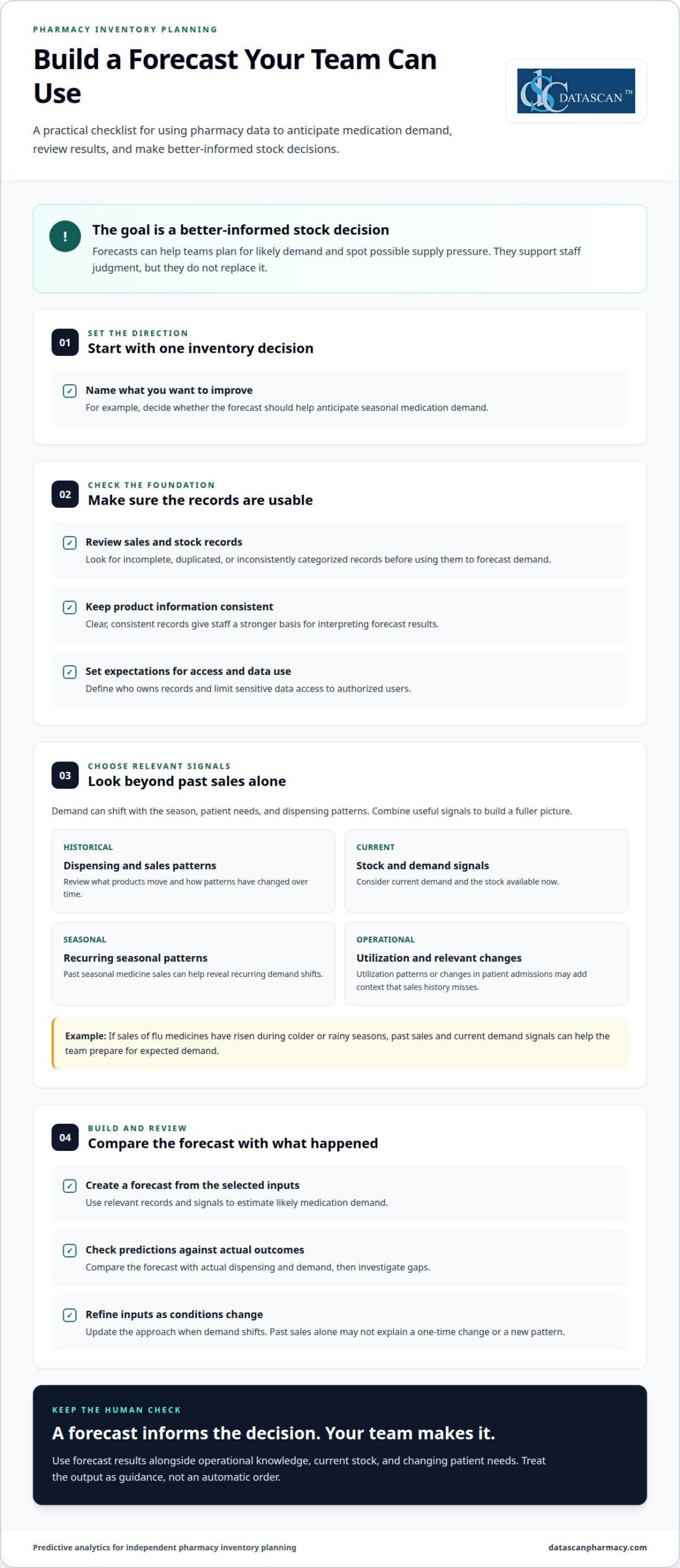
Data governance sets expectations for data quality, access, and use. Pharmacy teams need clear ownership of records, consistent product information, and access controls that limit sensitive data to authorized users. Incomplete, duplicated, or inconsistently categorized records can produce misleading forecasts. Defining data consistently and reviewing inputs gives staff a stronger basis for interpreting model outputs.
Cybersecurity matters because pharmacy inventory and health records can be sensitive. A data breach may expose information or disrupt access to systems used in daily operations. Security practices for predictive analytics include access controls, encryption for data in transit and at rest, and regular security audits. These safeguards help protect information while supporting the data quality needed for useful business intelligence.
How Do Forecasting Methods Differ, and What Shapes Software Costs?
Traditional pharmacy forecasting often relies on past sales, reorder rules, and staff experience. Predictive analytics can combine these signals with seasonal trends and other relevant data, which matters when demand changes for reasons simple averages cannot capture. Software costs depend on the system’s scope, data connections, analytics functions, and support needs; pricing is provided after a quote request.
To implement predictive analytics, first identify the inventory decision you want to improve, such as anticipating seasonal demand. Review sales and stock records for consistency, select relevant data inputs, and build a forecast. Compare predictions with actual outcomes, investigate gaps, and refine the model as demand changes. Staff should consider results alongside their operational knowledge, rather than treating a forecast as an automatic decision.
How does predictive analytics support patient treatment and medication availability?
Medication availability affects whether a patient can begin or continue a planned treatment. Predictive analytics can help pharmacies anticipate demand changes, while health records and utilization patterns can give care teams more context for coordinating medication needs. A forecast supports planning; it does not make clinical decisions or replace a clinician’s judgment.
Seasonal patterns offer a practical example. Sales of flu medicines may rise as temperatures drop or rainy seasons begin, so pharmacies can use past sales and current demand signals to prepare inventory. A forecast can highlight products that may need closer attention, helping teams prepare for expected demand. Staff still need to consider current stock and changing patient needs.
Inventory data can also support treatment coordination. When inventory systems connect with electronic medical or health records, healthcare professionals can better anticipate medication needs and coordinate care. That connection may help identify a potential supply issue before it interferes with a treatment plan. Keeping medication information and availability visible to relevant teams can also support efforts to reduce treatment errors.
Personalized medicine brings a different kind of data into treatment planning. Predictive analysis can use genetic information to help identify medication choices associated with minimal side effects for a patient. It can also identify patient subgroups more likely to respond positively to a particular drug. These insights can inform targeted treatment discussions, but they do not replace clinical assessment.
Patient monitoring adds another signal. Healthcare teams can combine electronic health records with wearable-device data to identify people at higher risk of developing a condition and consider preventive interventions. Changes in a person’s recorded health measures over time may prompt closer follow-up. Providers can also monitor treatment effectiveness and adjust therapy plans based on patient response.
These uses connect individual care with broader medication planning. Data analysis may reveal relationships among disease states, drug therapies, missed appointments, service use, and readmissions. A pharmacy or health system can use these patterns to consider where medication availability needs closer coordination. Each signal has limits: incomplete records or changing patient circumstances can make a forecast less useful, so teams should interpret predictions alongside current clinical information.
Clinical-trial recruitment offers another example of targeted analysis. Researchers can compare health records with eligibility criteria to identify potential participants who may fit a study. That differs from deciding what a community pharmacy should stock, but both applications depend on relevant, well-organized data. For medication availability, the practical value is clearer planning around anticipated needs, with patient care remaining the priority.
How do pharmacies forecast pharmaceutical inventory demand?
Pharmacy demand forecasting estimates which medications may be needed and when, using sales, inventory, and supply-chain signals. Predictive models can combine past use with current stock, supplier performance, lead times, transportation data, patient admissions, and seasonal fluctuations. This broader view helps pharmacy teams plan ahead, spot possible shortages, and respond before a projected gap affects dispensing.
Each input answers a different planning question. Sales and utilization records show what moved previously; inventory levels show what remains. Supplier performance and lead times help estimate when replenishment could arrive, while transportation data may signal shipment delays. Patient admissions and seasonal patterns add demand context. Together, these inputs can help distinguish a temporary sales spike from a shift that may change purchasing needs.
A forecasting model can estimate demand over a defined period, then be compared with actual dispensing. One proposed pharmaceutical inventory model predicted the quantity of drugs to stock for the next six weeks and reported a Root Mean Squared Error (RMSE) of 5.5. That figure describes the study model’s reported error measure, not a universal accuracy target for every pharmacy or medication.
For a pharmacy, forecast quality depends on the item and the data behind it. A fast-moving medication with stable demand may show a different pattern from a product with irregular use. If sales records omit relevant changes, the model may misread demand. Reviewing forecasts against actual stock movement helps teams find gaps and refine assumptions as conditions change.
Forecasts become useful in daily operations when they connect to clear inventory decisions. A system can project when stock may fall below a set threshold and trigger a purchase order. Prescriptive tools can also recommend reorder quantities. Before placing an order, staff can weigh the recommendation against current inventory, supplier lead times, and the medication’s expiration date.
- Inventory levels: Show how much stock is available for dispensing.
- Lead times and supplier performance: Help estimate replenishment timing.
- Transportation data: Can flag shipment delays that affect expected arrival.
- Utilization and seasonality: Reveal shifts in demand patterns.
Forecasts can support supply-chain planning beyond a single reorder. When a model detects rising demand or a possible shortage, teams can review purchasing plans and consider how to allocate available stock. Health system pharmacies may use utilization trends to inform procurement patterns, formulary decisions, and budgets. For community pharmacies, the same principle applies: connect demand signals to timely decisions, then compare the outcome with what actually happened.
Machine-learning models can process new data and adjust forecasts over time, but they still need review. Compare expected demand with dispensing and replenishment results, look for recurring forecast errors, and update the model when demand patterns or supply conditions shift. This feedback loop turns historical and current data into a more useful planning tool.
How can predictive analytics improve pharmacy staffing, workflow, and patient adherence?
Predictive analytics can help pharmacy teams anticipate workload, organize daily tasks, and identify patients who may need follow-up. By examining expected activity, staffing patterns, missed appointments, and medication use, a pharmacy can make more informed workflow decisions. The forecast supports planning, while staff use their knowledge to respond to each patient’s needs.
Staffing pressure often changes with expected demand. Healthcare predictive analytics can identify departments at greater risk of staffing shortages, while inventory systems can help staff schedule around anticipated clinic activity. If records point to increased activity during a seasonal period, for example, managers can review task coverage and workflow priorities ahead of time. Better alignment can help prevent treatment delays.
Workflow data can show where routine tasks compete for staff attention. A pharmacy can compare expected prescription volume with actual activity, then review which steps create bottlenecks. If prescription processing rises alongside incoming patient requests, managers can adjust task assignments or refine the workflow. Predictive insights will not eliminate every busy period, but they can help teams plan around patterns instead of reacting only after queues build.
Patient adherence involves more than medication availability. Predictive analysis can help identify relationships among drug therapies, missed appointments, medical-service use, and readmission rates. For example, missed appointments combined with changes in service use may signal a need for closer follow-up. These patterns can help care teams prioritize outreach rather than treating every case alike.
- Staffing: Compare expected activity with available coverage.
- Workflow: Identify repeated bottlenecks in dispensing and patient-service tasks.
- Adherence support: Use missed appointments and utilization patterns to guide follow-up priorities.
- Care coordination: Connect relevant inventory and health information to reduce treatment delays.
Follow-up can be more targeted when teams combine risk signals with patient context. Predictive analytics can flag patients whose risk factors suggest a high probability of readmission, helping staff identify people for follow-up care resources. In pharmacy workflows, this may help coordinate medication-related support with broader care plans. A signal can guide attention, but it does not explain why a patient missed treatment or determine which intervention is appropriate.
Use predictions as a planning aid, then compare them with actual workflow and patient outcomes. If expected activity differs from dispensing volume, appointment patterns, or staffing needs, review the inputs and adjust the approach. This feedback helps keep staffing plans, workflow priorities, and adherence outreach connected to what is happening in the pharmacy.
What are the costs of predictive analytics software for pharmacies?
Predictive analytics software costs depend on a pharmacy’s goals, data readiness, system connections, and required capabilities. Inventory forecasting has different needs from a project combining demand analysis with broader business intelligence. Pricing depends on project scope and is provided after a quote request. Key cost factors include integrations, data preparation, training, and ongoing support.
Start by defining the decision the software should improve. A pharmacy focused on seasonal purchasing may need sales history, inventory records, and replenishment information. A broader analytics project may require additional data sources and reporting workflows. A precise use case keeps the evaluation grounded in pharmacy operations rather than a long feature list.
Next, assess the data and systems involved. Inconsistent product records or gaps in dispensing history may need to be addressed before analysis becomes useful. Connections between inventory, point-of-sale, and pharmacy management systems can also affect implementation scope. If a pharmacy wants a unified view of sales and stock, it needs to understand how those records will be matched and maintained.
Compare the capabilities that directly support the intended work:
- Forecasting: Can the software analyze relevant sales and stock patterns?
- Replenishment: Can teams use projections to inform reorder decisions?
- Reporting: Can staff understand why demand estimates change?
- Data connections: Can the system use the records needed for the pharmacy’s goals?
Allow for staff time, too. A system that produces forecasts but requires repeated manual data cleanup may shift work rather than reduce it. Ask how data is prepared, who reviews outputs, and what training staff need to interpret reports. For an independent pharmacy, fitting analytics into existing dispensing and purchasing routines matters as much as the forecast itself.
Evaluate value through operational outcomes, not a promised savings figure. Track whether forecasts help staff identify excess inventory, respond to changing demand, or make purchasing decisions with better context. Compare these outcomes with the time spent maintaining data and reviewing results. A forecast that teams cannot use consistently may add complexity without improving decisions.
Before requesting a quote, document the pharmacy’s forecasting goals, data sources, required integrations, and support needs. This scope gives the discussion a practical starting point and helps distinguish essential functions from optional ones. Use the same requirements to compare implementation effort and ongoing work, not just initial software capabilities.
Datascan Pharmacy Software: Datascan Pharmacy Management Software
Datascan Pharmacy Software offers the Datascan Pharmacy Management Software Suite for pharmacies organizing their daily operations. Predictive forecasts can inform stock decisions, while pharmacy management software supports the workflows where those decisions are made. The software is not a predictive model, but it can form part of a broader effort to make pharmacy processes more manageable.
Consider Datascan when your pharmacy is reviewing its management software and wants workflows tailored to its needs. Datascan Point of Sale (POS), MobileScripts Patient Mobile App, and Datascan Mobile Delivery App are additional options for supporting transactions, patient engagement, and delivery workflows.
To discuss software for your independent pharmacy, contact Datascan Pharmacy Software or visit datascanpharmacy.com.
Turn Better Forecasts Into a Practical Plan
Make the next step a clear operating decision: choose one inventory question, identify who will review the forecast, and decide how the team will act on its findings. Starting with a focused question helps staff assess whether predictive analytics in pharmacy management fits their daily priorities without adding complexity for its own sake.
Pharmacy management software can help organize the workflows around inventory decisions. The Datascan Pharmacy Management Software Suite, Datascan Point of Sale (POS), and MobileScripts Patient Mobile App support pharmacy management, transactions, and patient engagement as part of an integrated, Independence-First platform.
Bring your priorities and workflow questions into the conversation. Contact Datascan Pharmacy Software to discuss how its pharmacy technology may fit your operations. A thoughtful next step can start with one practical question and build from there.
Frequently Asked Questions
What is predictive analytics in pharmacy management?
Predictive analytics in pharmacy management uses data patterns to estimate what may happen next and inform operational decisions. A pharmacy, for example, could compare past dispensing activity with current inventory to anticipate replenishment needs. The forecast is a planning input, not an instruction to dispense or a substitute for professional judgment. Its usefulness depends on relevant records and staff understanding how to interpret the results.
What pharmacy management problems can predictive analytics address?
Predictive analytics can help pharmacy teams examine recurring issues such as unbalanced inventory, potential stockouts, avoidable expired stock, and workflow bottlenecks. A manager could look for products that repeatedly go unused or compare expected prescription activity with actual workload. Patient follow-up patterns may also help teams prioritize outreach. These insights focus attention on specific operating decisions rather than treating every product or task alike.
How do pharmacies use predictive analytics to forecast medication demand and inventory needs?
Pharmacies can use dispensing history, current stock, and replenishment records to estimate future needs. A practical approach is to group medications by demand pattern, compare each group’s forecast with actual use, and investigate meaningful differences. A seasonal product may call for a different plan from one with steady use. Teams can then use the analysis to inform purchasing and check whether stock levels match demand.
What data and technology do pharmacies need for predictive analytics?
Useful analysis starts with consistent records for products, dispensing activity, inventory, and replenishment. Pharmacy management software can help organize operational data, while other systems may provide relevant information such as patient activity or supplier performance. Before relying on a forecast, teams need clear product-record definitions and a way to compare outputs with actual outcomes. Control access carefully, especially when records include sensitive patient information.
What measurable benefits and ROI have pharmacies reported from predictive analytics?
There is no single ROI figure that applies to every pharmacy. To evaluate value, establish a baseline for expired stock, purchasing patterns, and staff time spent reviewing inventory. Then track those measures after using forecasts to guide decisions. For example, compare stock write-offs and how often staff respond to unexpected demand. This gives owners a practical way to assess whether the approach supports their operating goals.
What privacy, security, and regulatory rules apply to pharmacy analytics in the United States?
Pharmacy analytics should account for applicable privacy, security, and supply-chain requirements based on the data and workflows involved. Protect sensitive records with access controls, encryption in transit and at rest, and regular security audits. The Drug Supply Chain Security Act is relevant to pharmaceutical inventory and supply-chain compliance, but it is distinct from general forecasting. Data governance helps define who may use records and for what operational purpose.
What risks and limitations should pharmacies consider when using predictive analytics?
Forecasts can mislead when records are incomplete, product categories change, or demand shifts beyond historical patterns. Results may also be difficult for staff to interpret. Pharmacies can reduce these risks by comparing predictions with actual dispensing, correcting data problems, and assigning staff to review unusual recommendations. Use analytics to inform decisions, not to automate clinical judgments or treat past patterns as guarantees of future demand.

Article by
Sarah Callioras
Sarah Callioras is Vice President at Datascan Pharmacy Software, bringing nearly 25 years of experience across independent pharmacy operations and pharmacy technology. Since joining Datascan in 2016, she has played a key role in driving business growth, strengthening client relationships, and supporting independent pharmacies through innovative software solutions. With a strong background in pharmacy operations, business development, and strategic leadership, Sarah is passionate about helping independent pharmacies succeed in an evolving healthcare landscape.
 Kevin Minassian is the President of Datascan Software. Under his leadership, the company rapidly expanded to provide pharmacy management software on a national level. Over the last 15+ years, he has ensured that Datascan has continuously evolved to offer innovative solutions for independent pharmacies while still offering world-class customer support. He is passionate about helping independent pharmacies to remain competitive, achieve success, and offer the very best service to their communities.