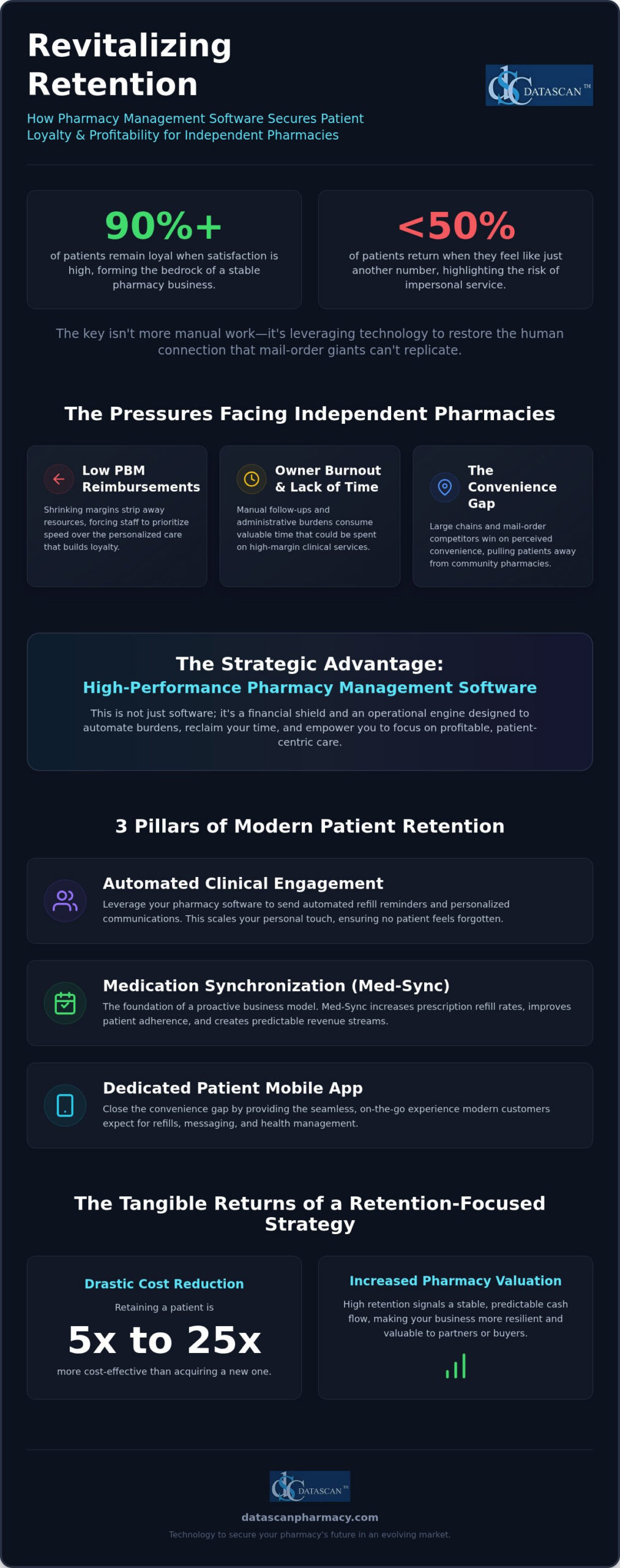
Did you know that over 90% of pharmacy patients will remain loyal when satisfaction is high, yet fewer than half return when they feel like just another number in a database? In 2026, successful pharmacy patient retention strategies aren’t about flashy marketing; they’re about using automation to restore the human connection that mail-order giants simply cannot replicate. You’ve likely felt the burnout of manual patient follow-ups while battling declining PBM reimbursements and the persistent financial pressure of DIR fees. It’s a frustrating cycle that often leaves far too little room for the personalized clinical care that defines your independent pharmacy’s mission.
We understand that as an independent owner, your time is your most valuable asset and your greatest competitive advantage. This guide will show you how to leverage high-performance pharmacy management software to stop patient churn and build a more resilient, profitable business. By integrating clinical engagement directly into your daily workflow, you’ll discover how the right pharmacy software can automate refills and free you to focus on high-margin services. We’re diving into the exact tools and tactics you need to transform operational burdens into streamlined successes and secure your pharmacy’s future in an evolving market.
Key Takeaways
Discover how to blend automated clinical engagement with digital convenience to build a loyal patient base that resists chain pharmacy competition.
Understand the financial impact of PBM reimbursements and DIR fees and how modern technology can help you reclaim time for profitable clinical services.
Master the latest pharmacy patient retention strategies by leveraging automated refill reminders and customizable workflows within your pharmacy software.
Learn why medication synchronization is the foundation of a proactive business model that increases prescription refill rates and improves patient outcomes.
Close the convenience gap with mail-order giants by utilizing a dedicated patient mobile app to provide the seamless, on-the-go experience modern customers expect.
What are the best pharmacy patient retention strategies for 2026?
Effective pharmacy patient retention strategies in 2026 prioritize a seamless blend of automated clinical care and digital convenience to secure long-term loyalty. While traditional customer service remains a staple of community pharmacy, modern retention is defined by your ability to keep patients engaged through every stage of their healthcare journey. Retention in this landscape isn’t just about a friendly greeting; it’s the continuous, tech-enabled relationship that ensures a patient chooses your counter over a mail-order package every single month.
Friendly faces aren’t enough to stop the bleed to mail-order giants and massive retail chains. These competitors win on perceived convenience, so you must win by combining your clinical expertise with advanced pharmacy management software. Technology-enabled clinical engagement allows you to scale your personal touch. It ensures no patient falls through the cracks because of a manual follow-up system that’s simply too slow to keep up with a busy pharmacy’s pace. By leveraging these tools, you transform your pharmacy from a pill dispensary into a proactive health hub.
Why is patient retention critical for independent pharmacies today?
Retaining a patient is significantly more cost-effective than acquiring a new one, often costing five to twenty-five times less based on standard industry data. Beyond immediate refill revenue, a loyal patient base directly increases your pharmacy’s valuation. High retention rates signal a stable and predictable cash flow to potential buyers or partners, making your business more resilient against market shifts. Most importantly, strong retention is the key to better patient adherence. When patients stay with your pharmacy, they’re more likely to follow their prescribed regimens, which improves health outcomes and reduces the risk of hospital readmissions in your community.
How has patient engagement evolved in the digital age?
The days of relying solely on walk-in traffic are over. Today’s patients expect multi-channel engagement that meets them where they are, whether that’s through a text message or a mobile app. Modern pharmacy management software bridges the communication gap by automating the outreach that once required hours of manual labor from your staff. This evolution has moved the industry toward patient-centric care models, where tools like workflow software enable the creation of e-care plans. These digital records allow you to document clinical interventions easily. They help you demonstrate your value to payers and transform a simple prescription fill into a comprehensive healthcare encounter that patients truly value.
How do PBM reimbursements and DIR fees impact patient retention?
Low PBM reimbursements and DIR fees directly sabotage pharmacy patient retention strategies by stripping away the financial resources needed to provide high-quality, personalized care. When your margins are squeezed, your staff is often forced to prioritize speed over clinical engagement; this leads to the very “impersonal” experience that drives patients toward competitors. While the 2024 shift to point-of-sale DIR fees provided more transparency, the resulting impact on cash flow remains a significant hurdle for independent pharmacies trying to maintain a loyal customer base in 2026.
Your pharmacy management software must act as a financial shield in this environment. By identifying which prescriptions are actually profitable and which are costing you money, you can pivot your focus toward clinical services that offer better returns. A superior Digital Experience Crucial for Pharmacies ensures that even when reimbursements are low, the value you provide through engagement keeps patients from switching to PBM-mandated mail-order programs. Retention isn’t just a goal; it’s a defense mechanism against aggressive PBM mandates that seek to pull patients away from community pharmacies.
Can technology help overcome PBM-related revenue loss?
High-performance pharmacy management software automates the reconciliation process, ensuring you claim every cent owed and reducing the risk of missed payments. Beyond simple claims, using data to pinpoint high-margin opportunities like specialized compounding or clinical consultations allows you to diversify your income. This shift helps you maintain the staffing levels necessary to keep patients coming back. For a deeper look at protecting your bottom line, learn how to calculate pharmacy gross profit to ensure your pricing and service mix are optimized for the current market.
Why PBM reform starts with building a loyal patient base
A large, dedicated patient base isn’t just a revenue stream; it’s leverage. When patients actively resist being funneled into mail-order because they value your local expertise, PBMs lose their absolute control over the market. To strengthen this position, you must use your workflow software to document clinical interventions meticulously. Proving your value to payers through data-driven outcomes is the most effective way to advocate for fair reimbursements. If you’re ready to see how a more efficient system can protect your profits, reach out to our team to learn more about our advocacy-focused technology.
How can pharmacy management software automate patient engagement?
Modern pharmacy management software transforms passive patient interactions into active engagement by automating routine communications and streamlining internal tasks. These automated systems are essential for pharmacy patient retention strategies because they ensure your pharmacy stays top-of-mind without requiring constant manual effort from your staff. By leveraging features like automated refill reminders, you can significantly reduce the “forgotten prescription” rate and keep your patients on their therapy schedules.
Safety and trust are the silent pillars of retention. Advanced pharmacy software utilizes barcode verification throughout the dispensing process to virtually eliminate errors. This precision builds a level of confidence that patients won’t find at high-volume chains where staff are often rushed. Furthermore, integrating workflow software into your daily operations frees up your technicians and pharmacists. Instead of being buried in paperwork or manual follow-ups, your team can spend more face-to-face time with patients, reinforcing the personal bond that defines independent pharmacy.
What workflow features drive the most loyalty?
Efficiency at the counter is a major driver of patient satisfaction. Your “Will Call” management system is a critical touchpoint; if a patient has to wait while staff hunts for a bag, trust erodes. Automated task management prevents these bottlenecks by ensuring prescriptions are ready and filed correctly before the patient arrives. For those offering specialized care, customizable workflow steps allow you to tailor the process for complex needs like compounding. This level of organization ensures that even the most intricate orders are handled with speed and precision, preventing the frustration of long wait times.
Using data to personalize the patient experience
Personalization is the biggest advantage you have over big-box competitors. Your pharmacy computer system tracks deep histories and preferences, allowing you to move beyond generic service. By analyzing this data, you can send targeted messaging based on specific health conditions, such as diabetic care tips or immunization reminders. Citing the importance of digital solutions in pharmacy, it’s clear that patients now expect a high-tech, high-touch experience. When you use data to anticipate a patient’s needs, you aren’t just a service provider; you’re a dedicated health partner, making it much harder for them to consider switching to a mail-order alternative. Expanding into cash-pay revenue streams, such as using pharmacy software for veterinary prescriptions, is another data-driven strategy that can diversify your income and reduce your dependence on PBM-controlled margins.
Why is medication synchronization the foundation of pharmacy loyalty?
Medication synchronization (med sync) is the most powerful tool for transforming your business from a reactive dispensary into a proactive healthcare destination. By aligning all of a patient’s maintenance medications to a single monthly pickup date, you create a structured “Appointment Based Model” (ABM) that significantly enhances pharmacy patient retention strategies. Instead of waiting for patients to realize they’re out of pills, your pharmacy software allows you to take the lead, ensuring they never miss a dose and stay tethered to your care long-term.
This shift to a proactive model does more than just improve adherence; it builds a predictable, recurring revenue stream that stabilizes your pharmacy’s financial health. When you know exactly which prescriptions are leaving the shelf and when, you can optimize your inventory and staffing levels with precision. This reliability is the cornerstone of loyalty. Patients value the peace of mind that comes from knowing their entire health regimen is managed by a single, competent professional who values their time as much as their health.
How to implement a successful med sync program
Launching a med sync program doesn’t have to be an operational burden if you follow a methodical approach. You can use your pharmacy management software to identify and enroll patients in three simple steps:
Identify: Run a report to find polypharmacy patients who are taking three or more maintenance medications.
Consult: During their next pickup, explain the convenience of a single monthly visit and the benefit of a comprehensive medication review.
Sync: Use your software to calculate “short fills” and align all prescriptions to a single anchor date.
The secret to long-term success is the monthly “sync call.” This brief check-in, performed a few days before the pickup date, is your best opportunity for relationship building. It’s a chance to ask about new symptoms, confirm upcoming refills, and remind the patient that you’re an active partner in their wellness journey, not just a retail clerk.
The efficiency gains of synchronized refills
Med sync is a massive win for pharmacy operations because it effectively eliminates “delivery fatigue.” Instead of sending a driver to the same house four times a month, you make one efficient trip. This level-loading of your daily prescription volume prevents the chaotic “Monday rush” and ensures your team isn’t overwhelmed by unpredictable workflows. By utilizing integrated workflow software, you can prep these orders during slower periods, freeing your staff for face-to-face clinical engagement when it matters most. If you’re ready to stabilize your workflow and secure your patient base, contact our team today to see how our synchronization tools can work for you.
How can a dedicated patient mobile app stop patients from switching to mail-order?
A dedicated patient mobile app eliminates the “convenience gap” that often drives customers toward mail-order giants by providing a seamless, digital-first experience. By offering chain-level technology, you ensure that your pharmacy patient retention strategies are backed by the modern accessibility patients now demand. This digital presence neutralizes the primary reason patients switch pharmacies while reinforcing your role as a trusted local provider who’s always within reach.
Independent pharmacies often struggle against the perceived ease of “set-it-and-forget-it” mail-order services. However, a mobile app like MobileScripts levels the playing field by offering a suite of features that prioritize the user’s time. Patients want more than just a place to pick up medication; they want easy refills, secure messaging, and real-time status updates at their fingertips. When you combine these features with electronic delivery tracking, you provide a seamless home experience that rivals any national competitor while maintaining your unique clinical expertise.
Winning the convenience battle with mobile refills
The “one-tap” refill process is a critical deterrent against patient churn. When a patient can request a refill in seconds from their smartphone, the friction of calling the pharmacy or driving over disappears. Push notifications play a vital role here as well. They’re significantly more effective than emails or phone calls, which often go ignored or end up in spam folders. These timely alerts keep patients engaged with their therapy and ensure they don’t forget their next dose. Additionally, providing access to digital health records through the app makes patients feel “anchored” to your pharmacy. Once their history and preferences are centralized in your digital ecosystem, the perceived cost of switching to a new provider becomes much higher. To maximize these benefits, learn the most effective methods for promoting a new pharmacy mobile app to patients so you can drive adoption and ensure your investment delivers real retention results.
Building trust through secure messaging
Building long-term loyalty requires more than just transactional efficiency; it requires accessible, reliable communication. HIPAA-compliant messaging within your app allows patients to ask quick clinical questions without the need for a phone call or an office visit. This digital access replicates the classic “hometown pharmacist” feel but delivers it in a way that fits a 2026 lifestyle. You aren’t just a faceless corporation; you’re a reachable healthcare partner. Patients are far less likely to leave a pharmacy where they have a direct, secure messaging with patients app solution that gives them a trusted line to their provider. This digital bond reinforces your pharmacy patient retention strategies by proving that high-tech solutions can actually enhance high-touch, personal care.
Future-Proof Your Pharmacy with Actionable Retention Tools
The independent pharmacy landscape is shifting, but you don’t have to face PBM pressures alone. Implementing robust pharmacy patient retention strategies requires a strategic combination of automated clinical engagement, proactive medication synchronization, and the digital convenience of a modern mobile app. By leveraging advanced pharmacy management software to streamline your workflow, you reclaim the time needed to focus on high-value patient care and protect your profitability from aggressive market mandates.
Datascan has stood as the champion of the independent for over 40 years. As a U.S.-based, family-owned partner, we’re consistently ranked among the top pharmacy systems for support and innovation. We understand your operational burdens and provide future-proof solutions that help you thrive in any market. See how Datascan Pharmacy Software empowers your independent pharmacy to win. You have the clinical expertise to lead your community; let us provide the technology to ensure your success remains permanent.
Frequently Asked Questions
How do I start a patient retention program with limited staff?
You can launch a retention program by automating your most time-consuming tasks through your pharmacy management software. Instead of relying on manual phone calls, use automated refill reminders and text alerts to keep patients engaged. This approach allows your limited staff to focus on high-value clinical interactions rather than administrative chores. Starting small with one or two automated features ensures you build a sustainable foundation without overwhelming your current team or resources.
What are the most common reasons patients leave independent pharmacies?
Patients typically leave independent pharmacies due to a perceived lack of convenience compared to mail-order giants or big-box chains. While they value your expertise, they often switch when they encounter friction in the refill process or lack digital tools like a mobile app. Additionally, aggressive steering tactics from PBMs can pull patients away. Combatting this requires a mix of seamless digital experiences and proactive clinical engagement to prove your unique value.
Can pharmacy software really help me compete with Amazon and big chains?
Yes, the right pharmacy software provides the same technological advantages as national chains while allowing you to maintain your personalized service. Tools like the MobileScripts patient app offer the “one-tap” convenience that modern consumers expect. By automating your back-end operations, you free up the time necessary to provide the deep, clinical care that faceless corporations cannot match. It effectively levels the playing field by closing the technology gap.
Is medication synchronization worth the effort for a small pharmacy?
Medication synchronization is one of the most effective pharmacy patient retention strategies regardless of your store’s size. It transforms your daily workflow from a reactive scramble into a predictable, manageable schedule. For a small pharmacy, this efficiency is vital because it maximizes your limited staff’s output. By aligning refills to a single date, you reduce delivery costs and create recurring touchpoints that solidify patient trust and improve long-term health outcomes.
How much does a patient mobile app cost for an independent pharmacy?
Costs for a patient mobile app typically involve a monthly usage fee that covers deployment, ongoing support, and regular updates. While specific pricing depends on your pharmacy’s volume and specific needs, these tools are designed to be an affordable investment for independent owners. The return on investment comes through reduced patient churn and higher refill rates. You should check with your vendor for a quote tailored to your specific operational scale.
How do I measure my pharmacy patient retention rate?
You can measure retention by tracking the percentage of patients who refill their maintenance medications at your pharmacy over a twelve-month period. Your pharmacy management software should provide reports that identify active versus inactive patients based on their last fill date. Monitoring your “churn rate,” or the number of patients who stop using your services, helps you identify exactly where your retention strategies need adjustment to protect your bottom line.
What role does the pharmacy POS play in patient loyalty?
Your pharmacy POS is the final opportunity to reinforce a positive patient experience and collect valuable data. An integrated system allows for quick, accurate transactions and supports loyalty programs or specialized discounts that keep patients coming back. It also tracks purchasing habits, which enables you to offer personalized recommendations. A smooth checkout process reduces frustration and ensures that the last interaction a patient has with your pharmacy is professional and efficient.
Can automated refill reminders actually improve my bottom line?
Automated reminders directly boost profitability by capturing refills that patients might otherwise forget or delay. When your pharmacy management software automatically notifies a patient that their medication is ready, it significantly reduces the rate of abandoned prescriptions in your will-call bin. These consistent touchpoints increase the total number of fills per patient each year. This steady volume helps offset the financial pressure caused by low PBM reimbursements and helps stabilize your pharmacy’s cash flow.
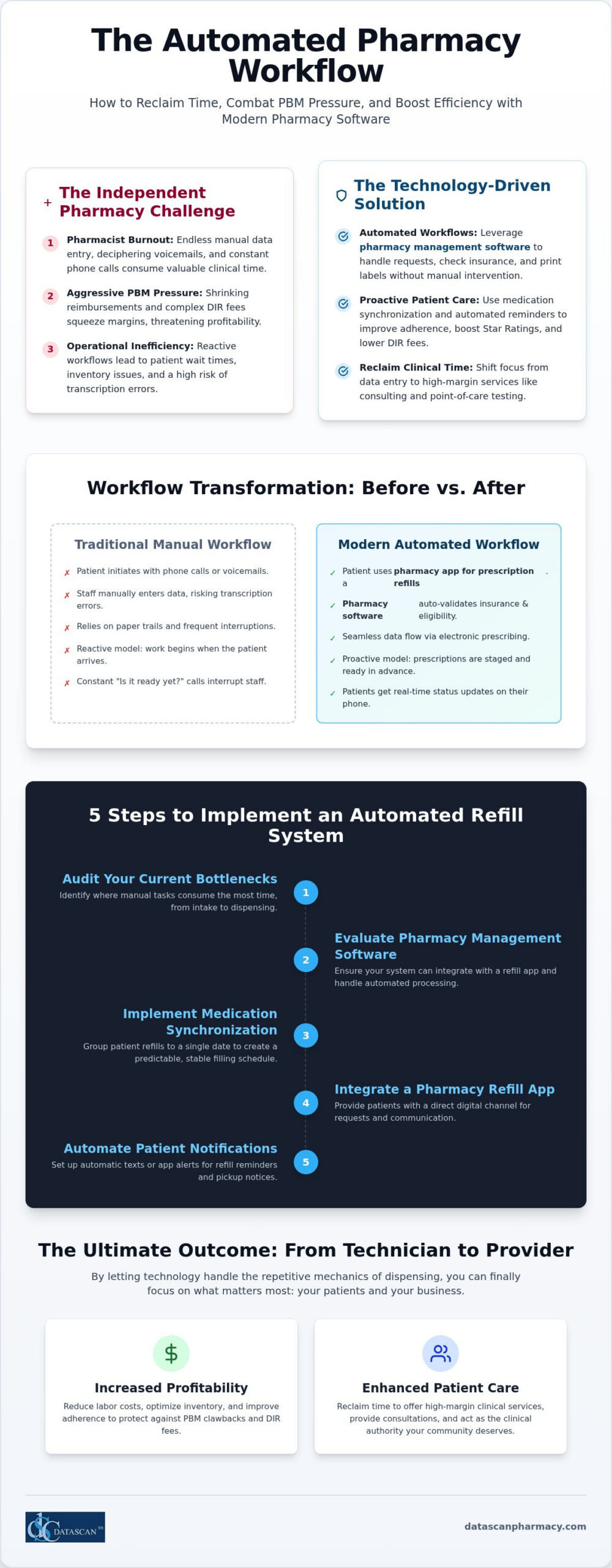
Building a high-efficiency automated prescription refill workflow in 2026 requires a strategic integration between your pharmacy management software and a dedicated pharmacy app for prescription refills that handles patient requests in real-time. By centralizing these communications, you eliminate the manual data entry that leads to pharmacist burnout and reclaim the hours necessary to drive business growth. You didn’t spend years earning your degree to act as a data entry clerk while PBMs aggressively squeeze your margins through complex DIR fees. We understand that even with the latest PBM reforms, the operational burden on independent owners remains immense. This article will show you how to implement a workflow that essentially runs itself, allowing you to act as the clinical authority your community deserves. We will preview the specific steps to optimize your pharmacy software, implement medication synchronization, and automate patient notifications to ensure your business remains profitable and relevant in a rapidly evolving market.
Key Takeaways
Discover how a software-driven automated refill workflow handles everything from requests to labeling, significantly reducing the manual labor that causes pharmacist burnout.
Learn how to combat shrinking PBM reimbursements and lower DIR fees by leveraging medication synchronization and automated adherence reminders.
Evaluate your pharmacy app for prescription refills to ensure it integrates directly with your pharmacy management software for real-time eligibility and insurance checks.
Follow a proven five-step implementation plan to audit your current bottlenecks and transition into a stabilized, automated filling schedule.
Reclaim your identity as a healthcare provider by automating data entry tasks, giving you the time needed to focus on high-margin clinical services and business expansion.
What is an automated prescription refill workflow?
An automated prescription refill workflow is a software-driven process that handles everything from the initial patient request to inventory checks and label printing without manual pharmacist intervention. By leveraging advanced pharmacy management software, this system automatically validates insurance eligibility and checks drug-to-drug interactions before the medication ever hits the tray. It transforms the traditional, reactive pharmacy model into a proactive machine that anticipates patient needs, ensures accuracy, and protects your bottom line from shrinking PBM reimbursements.
In a manual environment, your staff spends hours answering phone calls, deciphering voicemails, and manually typing data into the system. An automated workflow replaces these bottlenecks with digital triggers. When a patient uses a pharmacy app for prescription refills, the request bypasses the front counter and moves directly into the processing queue. This integration allows your workflow software to “auto-fill” medications based on established medication synchronization schedules. Instead of reacting to a line of frustrated patients, your team walks into a pharmacy where the day’s work is already organized and prioritized.
How does automation differ from traditional pharmacy systems?
Traditional systems rely on paper trails and patient-initiated calls, which often lead to transcription errors and workflow interruptions. Modern automation utilizes electronic prescribing standards to ensure that data flows seamlessly from the provider to your dispensing queue. When you implement a pharmacy app for prescription refills, patients receive real-time status updates on their smartphones, which eliminates the “Is it ready yet?” phone calls that plague busy shops. Safety is bolstered through integrated barcode verification, creating a closed-loop system where the software confirms the NDC and patient identity at every critical juncture.
Why is automation critical for independent pharmacies in 2026?
Independent owners are currently facing a “perfect storm” of labor shortages and predatory PBM practices. You can’t afford to pay a pharmacist to perform the tasks of a data entry clerk. Automation allows you to do more with fewer staff members by shifting chronic medication management to a synchronized schedule. This stabilized filling cycle reduces human error in high-pressure retail environments and ensures you have the right inventory on hand. Most importantly, it reclaims the time you need to provide high-margin clinical services, such as point-of-care testing or long-term care consulting. By letting the technology handle the repetitive mechanics of dispensing, you can finally focus on acting as a healthcare provider rather than a technician.
How does automated refill technology improve pharmacy efficiency?
Automated refill technology transforms pharmacy efficiency by eliminating the “wait time” bottleneck and ensuring prescriptions are staged and ready before the patient arrives. This proactive approach relies on a high-performing pharmacy app for prescription refills to capture patient intent early, allowing the backend system to process claims during off-peak hours. By shifting the workload, you don’t just save time; you optimize your entire operational flow to fight back against the shrinking margins imposed by PBMs.
Efficiency gains extend directly to your bottom line through improved inventory management and lower DIR fees. When your system predicts refill dates in advance, you can maintain leaner inventory levels, ordering only what you need for the upcoming week. This precision reduces the capital tied up on your shelves. Additionally, automated reminders sent through your pharmacy app for prescription refills significantly boost patient adherence. In the 2026 regulatory environment, maintaining high adherence is the most effective way to protect your Star Ratings and mitigate the impact of predatory DIR fee structures.
Can technology help overcome PBM reimbursement challenges?
Modern pharmacy management software provides the transparency needed to survive PBM pressures. By integrating automation into your billing workflow, the software can automatically flag low-margin or “under-water” claims before the labels are even printed. This allows you to address reimbursement issues in real-time rather than discovering losses weeks later during reconciliation. Automation also enables more granular tracking of PBM payments, ensuring that every cent owed to your independent pharmacy is accounted for and collected. Pairing this with dedicated pharmacy compliance reporting software gives you the documentation power to defeat PBM audit clawbacks before they strip away your hard-earned revenue.
How does med sync reduce the daily workload?
Medication synchronization is the engine behind a truly efficient pharmacy. Instead of handling ten different phone calls for ten different medications, you bundle a patient’s entire profile into a single monthly pickup. This moves your team from a reactive, “firefighting” mode to a methodical, proactive filling model. You can schedule your heavy filling days during times when foot traffic is low, ensuring your staff remains calm and focused. Implementing a Pharmacy Workflow Optimization Software strategy ensures that your team isn’t just busy, but productive. If you’re ready to see how these tools can transform your daily operations, you can speak with our team about a custom workflow audit.
How do I evaluate pharmacy management software for automated workflows?
To evaluate pharmacy management software for automated workflows, you must prioritize a system that offers a natively integrated mobile patient app and highly customizable dispensing stages. This ensures the technology adapts to your physical store layout rather than forcing you into a rigid, one-size-fits-all model that hinders efficiency. When you evaluate pharmacy management software, start by looking for a system that offers a truly integrated mobile experience for your patients. A standalone pharmacy app for prescription refills that isn’t natively tied to your database often creates data silos. These silos lead to synchronization errors and manual reconciliation tasks that defeat the purpose of automation. You need a solution that allows you to customize the workflow stages to match your store’s unique layout, from the initial intake to the final bagging. If your pharmacy software forces you into a rigid model, it’ll eventually become a bottleneck as your volume grows.
What are the must-have features for refill automation?
Refill automation isn’t just about processing a request; it’s about managing the entire patient lifecycle. Your pharmacy software must include integrated medication synchronization (Med Sync) modules that allow you to align multiple prescriptions into a single monthly event. This proactive approach is supported by automated text and email notifications that keep patients engaged without requiring a phone call from your staff. Utilizing a high-performance pharmacy app for prescription refills like the MobileScripts Rx Refill Application ensures that these requests flow directly into your queue, pre-validated and ready for filling. These features work together to reduce the chaos of “walk-in” refill requests that disrupt your staff’s concentration and lead to errors.
Why is vendor support as important as the software itself?
The strength of your pharmacy management software is only as good as the team standing behind it. In a high-pressure retail environment, hitting a technical snag can halt your entire operation. This is why prioritizing US-based support is vital. You don’t have time for long hold times or scripted responses from people who don’t understand the nuances of independent pharmacy. A family-owned vendor provides a level of accountability and industry perspective that large corporations simply can’t match. When evaluating pharmacy software vendors, look for a partner that treats your success as their own. They should offer the agility needed to adjust technical workflow parameters quickly as PBM pressures and market demands evolve, ensuring your technology remains a tool for growth rather than a burden.
How to implement an automated refill system in 5 steps?
Implementing an automated refill system requires auditing your current manual bottlenecks, enrolling high-volume patients in medication synchronization, and deploying a native pharmacy app for prescription refills to capture requests digitally. By configuring your pharmacy management software to auto-populate the dispensing queue, you eliminate the friction of manual data entry and reclaim hours of staff time every week. This systematic transition ensures your pharmacy operates as a proactive healthcare hub rather than a reactive retail shop.
Step 1 & 2: Building the foundation for automation
The first step is identifying the “high-maintenance” 20% of your patient base that typically consumes 80% of your staff’s phone time. These are often chronic care patients with multiple prescriptions filled at different times throughout the month. Once identified, you must enroll these patients in a robust Med Sync program. When you talk to patients, focus on the convenience of a single monthly pickup and the peace of mind that comes with never running out of medication. This synchronization provides the predictable volume your pharmacy software needs to automate the “auto-fill” process effectively. For a deeper dive into streamlining these early stages, see our guide on automating pharmacy prescription intake.
Step 3, 4 & 5: Launching and refining the loop
Once your foundation is set, deploy a pharmacy app for prescription refills like MobileScripts to move patient communication away from the telephone. You can brand this app specifically for your pharmacy, giving your patients a modern, professional interface to manage their health. Configure your pharmacy management software to automatically move these app-based requests into the filling queue, where they can be checked for insurance eligibility and inventory availability without human intervention.
Safety remains the priority during this acceleration. Train your staff to utilize integrated barcode verification at the point of dispensing to maintain a closed-loop system that prevents errors. With the time saved from answering phones and typing in refills, your pharmacists can finally utilize clinical tools like Medication Therapy Management (MTM) to drive new revenue streams. This shift isn’t just about speed; it’s about repositioning your independent pharmacy as a high-value clinical provider in a competitive market. If you’re ready to transform your operational efficiency, schedule a workflow audit with our team today.
How can automation help me reclaim time to run my business?
Automation reclaims your time by shifting the operational burden from your staff to your pharmacy management software, allowing you to focus on high-level strategy rather than repetitive data entry. By deploying a pharmacy app for prescription refills, you stop the constant interruption of phone calls and start managing your pharmacy as a profitable healthcare enterprise. This transition is essential for survival in 2026, as it moves you away from the role of a technician and back into the role of an executive and healthcare provider.
Technology should work for the owner, not the other way around. When your pharmacy software handles the heavy lifting of insurance adjudication and inventory tracking, you finally have the mental space to negotiate better deals with your primary wholesaler. You can use these saved hours to analyze your gross profit and identify exactly which PBM contracts are costing you money. Additionally, automated systems create cleaner, more organized records, which significantly reduces the stress and preparation time required for board audits or PBM reconciliations. Implementing robust pharmacy compliance reporting software alongside your automated workflow ensures that this documentation is audit-ready at all times, protecting your margins from unexpected clawbacks.
Focusing on profitability and PBM reform
With the passage of the Consolidated Appropriations Act, 2026, the landscape of PBM compensation is shifting. More time in your day allows you to stay informed and advocate for PBM reform at the state level, ensuring your voice is heard as an independent owner. You can spend your afternoons reviewing dashboards to see where your pharmacy is losing money on low-margin reimbursements. Understanding your numbers is the only way to fight back against predatory practices. For a detailed breakdown of how to track these metrics, see our guide on calculating pharmacy gross profit.
The long-term value of a family-owned technology partner
The difference between a corporate vendor and a family-owned partner like Datascan is rooted in accountability. Large corporations often force you into a one-size-fits-all model, but a partner that understands the independent market will provide the flexibility you need to future-proof your business. We pride ourselves on being a visionary ally that helps you navigate the next decade of industry changes with US-based support and customizable tools. Don’t let manual workflows hold your business back from its full potential. You can schedule a demo of Datascan’s automated workflow tools today to see how we can help you reclaim your time and protect your margins.
Reclaim Your Future with Smarter Pharmacy Automation
The journey from a manual, reactive shop to a proactive healthcare hub depends on your ability to leverage the right technology. By integrating a high-performance pharmacy app for prescription refills with your core pharmacy management software, you eliminate the data entry bottlenecks that lead to staff burnout. This strategic shift doesn’t just save time; it provides the operational transparency needed to fight back against predatory PBM reimbursements and rising DIR fees.
Since 1981, our family-owned enterprise has stood as a visionary ally for independent owners. We understand that your success relies on 100% US-based technical support and pharmacy software that actually drives profitability. It’s time to stop acting as a technician and start acting as the executive your business requires. You can see how Datascan’s automated workflow reclaims your time and secures your pharmacy’s place in the 2026 market. The tools for transformation are ready when you are.
Frequently Asked Questions
Is automated prescription refill software safe for patients?
Automated systems actually improve patient safety by integrating barcode verification and real-time drug interaction checks into every dispensing stage. These digital safeguards eliminate the human fatigue and errors associated with manual data entry in high-pressure environments. By utilizing a closed-loop system within your pharmacy management software, you ensure every prescription matches the NDC and patient profile before a label is printed. This creates a more reliable and secure environment for your community.
How much time can a pharmacy owner really save with an automated workflow?
Pharmacy owners often reclaim several hours each day by automating their refill workflows. Instead of spending your morning answering repetitive phone calls or manually typing in refill requests, your staff can focus on high-margin clinical services. Automation handles the administrative heavy lifting, which essentially allows your pharmacy to run its daily dispensing tasks in the background. This newfound time is vital for analyzing gross profit and negotiating better wholesaler contracts to improve your bottom line.
Does automation require me to move my data to the cloud?
No, you don’t need to move your sensitive patient data to an external server to achieve full automation. Our system is designed to provide cutting-edge workflow capabilities without the risks associated with outside hosting. You maintain full control over your local database while still enjoying the benefits of a modern, automated refill system. This approach ensures your pharmacy remains fast, reliable, and secure without relying on a third-party connection for your core dispensing functions.
Can automated workflows help reduce PBM DIR fees?
Automated workflows are a powerful tool for reducing PBM DIR fees because they directly improve patient adherence. By using a pharmacy app for prescription refills to send automated reminders, you ensure patients pick up their chronic medications on time. Higher adherence rates lead to better Star Ratings and performance scores for your store. This proactive management helps protect your reimbursements and mitigates the financial impact of predatory PBM fee structures that penalize poor patient outcomes.
What happens if the insurance rejects an automated refill request?
If an insurance claim is rejected during the automated process, the system immediately flags the prescription and moves it into a manual review queue. This allows your staff to address the specific rejection reason, such as a prior authorization requirement or a refill too soon error, without disrupting the rest of the automated flow. Your pharmacy software ensures no claim is filled at a loss, protecting your margins while maintaining the speed of your daily operations.
Do I need a separate app for my patients to use automated refills?
You don’t need to manage a disconnected third-party tool; instead, you should use a natively integrated pharmacy app for prescription refills. A solution like MobileScripts connects directly to your database, allowing patients to request refills that populate your queue in real-time. This integration prevents data silos and ensures patient requests are accurately reflected in your workflow. It provides a seamless experience for your patients while significantly reducing the administrative burden on your pharmacy staff.
How does medication synchronization fit into an automated workflow?
Medication synchronization acts as the foundational engine for a truly automated workflow. By aligning all of a patient’s chronic medications to a single monthly pickup date, you create a predictable filling schedule. Your pharmacy management software can then auto-populate the queue for these synchronized patients, allowing you to fill prescriptions during off-peak hours. This proactive model eliminates the chaos of random walk-in requests and ensures your inventory is optimized for the specific needs of your patients.
Is it difficult to switch my current pharmacy software to an automated system?
Switching to an automated system is a streamlined process when you partner with an experienced vendor that understands independent pharmacy needs. We handle the complex data migration and training required to move your store from a manual environment to a modern workflow. Since our support is 100% US-based, you have direct access to experts who can troubleshoot technical adjustments quickly. This partnership ensures your transition is smooth and your business remains operational throughout the entire conversion.
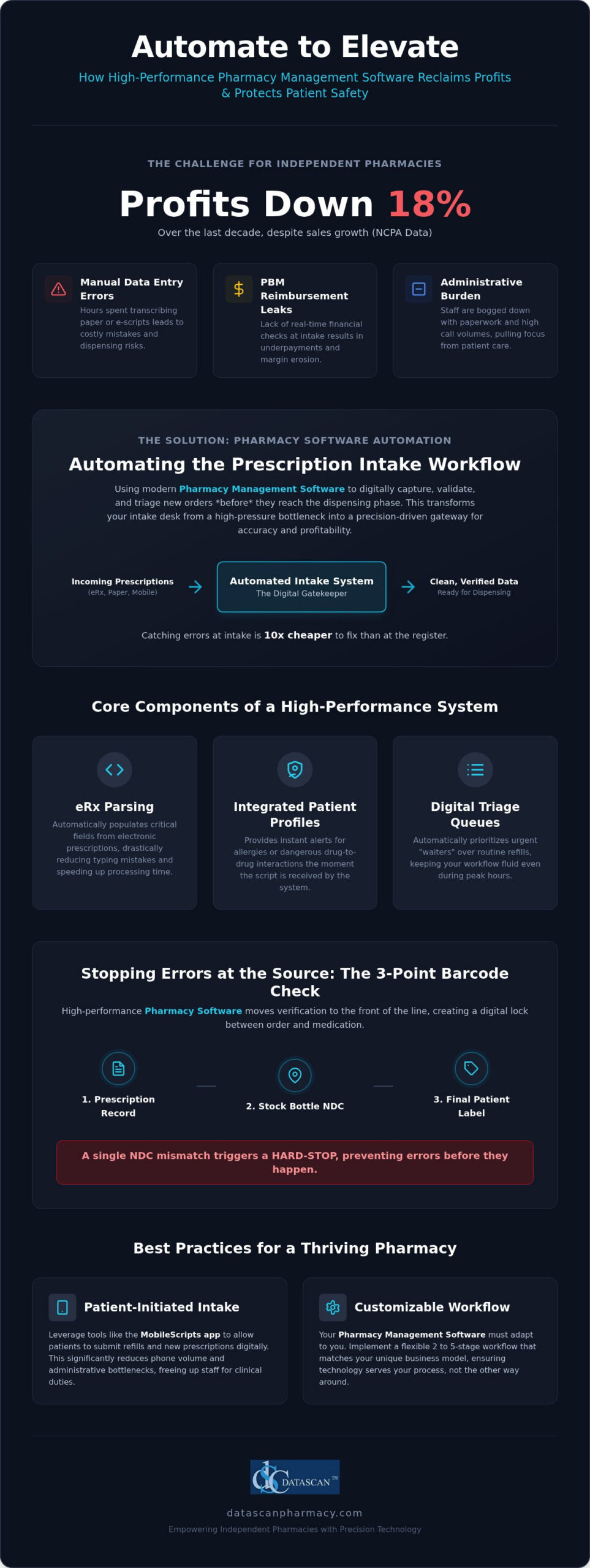
Did you know that while independent pharmacy sales have grown, actual profits plummeted by 18% over the last decade according to NCPA data? Automating prescription intake workflow is the most effective way to reverse this trend by stopping manual errors and PBM revenue leaks at the front door. By leveraging high-performance pharmacy management software, you can transform a high-pressure intake desk into a precision-driven gateway that protects your margins. This strategic shift isn’t just about technology; it’s about reclaiming your role as a clinical provider rather than an administrative clerk.
It’s exhausting to watch your staff drown in repetitive paperwork while the fear of dispensing errors during peak hours keeps you up at night. You believe your pharmacy should be a place for patient care, not a battleground for PBM administrative burdens. This guide promises to show you exactly how to streamline your intake process to eliminate errors and boost your bottom line. We’ll explore how customizable workflows and integrated mobile tools can free up your time for MTM services and clinical consultations, ensuring your business thrives in the 2026 landscape.
Key Takeaways
Discover how automating prescription intake workflow uses advanced pharmacy software to digitally capture and triage orders, eliminating the risks associated with manual data entry.
Learn why a 3-point barcode verification process at the intake stage is your best defense against dispensing errors before they reach the filling station.
Find out how to stop PBM reimbursement leaks by performing real-time financial checks at the start of your workflow using modern pharmacy management software.
See how patient-initiated intake tools like the MobileScripts app can significantly reduce phone volume and administrative bottlenecks.
Understand the importance of a customizable 2 to 5-stage workflow that allows your pharmacy software to adapt to your unique business model.
What is automating prescription intake workflow in a modern pharmacy?
Automating the prescription intake workflow is the process of using pharmacy management software to digitally capture, validate, and triage new orders before they reach the dispensing phase. It serves as the definitive foundation for a secure and profitable pharmacy operation. In the past, technicians spent hours manually transcribing data from paper or messy e-scripts, a process ripe for human error. Today, modern Pharmacy Automation technology acts as a sophisticated gatekeeper. By intelligently parsing incoming orders, the software filters out the administrative clutter of free-text notes and incomplete data that often causes bottlenecks. This ensures that your staff only interacts with clean, verified information, allowing them to focus on clinical patient care rather than tedious data entry.
Why is the intake stage the most critical part of the pharmacy workflow?
The intake stage is the single most important point in your pharmacy because it dictates the accuracy of everything that follows. Industry data suggests that errors caught during intake are 10x cheaper to fix than those identified at the register. When data is clean from the start, you eliminate the time-wasting cycle of insurance rejections and frustrated patients. Clean intake data also streamlines downstream tasks like automated delivery routing and PBM reimbursement tracking, which are vital for maintaining your margins. For a comprehensive look at how this impacts your entire business, see our guide on Pharmacy Workflow Optimization Software: The 2026 Efficiency Guide.
What are the components of an automated intake system?
An effective system relies on several integrated features within your Pharmacy Software to maintain high standards of precision. A high-performance system typically includes:
eRx Parsing: This feature auto-populates critical fields from electronic prescriptions, which drastically reduces the risk of typing mistakes and speeds up processing time.
Integrated Patient Profiles: These provide instant alerts for allergies or dangerous drug-to-drug interactions the moment the script is received into the system.
Digital Triage Queues: These help your team manage the “rush” by automatically prioritizing urgent “waiters” over routine refills, keeping your workflow fluid even during peak hours.
This level of organization ensures your independent pharmacy operates with the same technical prowess as the largest chains. By utilizing advanced pharmacy management software, you don’t just fill scripts faster; you build a more resilient business that is protected against the common pitfalls of manual processing.
How does barcode verification in dispensing process improve intake accuracy?
Barcode verification improves intake accuracy by creating a digital lock between the physician’s order and the physical medication pulled from your shelf. By integrating this technology into your automating prescription intake workflow, you ensure that “wrong drug” errors are stopped at the source rather than relying on a final check to catch mistakes. This proactive approach uses your pharmacy software to validate every movement, protecting your patients and reducing your liability.
Most legacy systems treat barcode scanning as a final safety net. However, high-performance Pharmacy management software shifts this verification to the front of the line. It utilizes a rigorous 3-point check that validates the prescription record, the manufacturer’s stock bottle, and the final patient label in real-time. If there is even a single digit mismatch in the NDC (National Drug Code), the system triggers a hard-stop. This prevents the technician from proceeding until the discrepancy is resolved. It stops errors early. This level of precision ensures that human fatigue or distractions don’t lead to a dangerous dispensing error during peak hours.
The step-by-step barcode verification workflow
A streamlined digital workflow replaces manual guesswork with a repeatable, high-velocity process. Your team should follow these three essential steps:
Step 1: Scan the incoming hard copy or the digital e-prescription record to lock in the required NDC within the system.
Step 2: Scan the manufacturer’s NDC barcode on the stock bottle during the pull to verify the physical product matches the digital order.
Step 3: Scan the final printed patient label before bagging to confirm the right medication is in the right container for the right patient.
Why manual verification is no longer sufficient in 2026
Human eyes are naturally susceptible to “look-alike, sound-alike” (LASA) drug errors. This is especially true when volume is high. A study published by the National Center for Biotechnology Information (NCBI) found that adopting automated barcode verification systems can reduce medication dispensing error rates from 3.87 to 0 per 100,000 dispensations. Manual checks aren’t enough. By removing the guesswork, you build a culture of safety that protects your pharmacy’s reputation.
Beyond safety, this level of automation is a major time saver. Some industry professionals report that barcode scanning at the intake level reduces manual verification time by up to 40% by eliminating the need for repetitive visual data re-checks. This allows your team to move through the queue with much higher velocity. If you are ready to modernize your safety protocols, reach out to our team to see how our software can safeguard your practice.
How can intake automation help independent pharmacies fight low PBM reimbursements?
Intake automation protects your margins by performing real-time financial audits on every prescription before it enters the filling process. By identifying underpaid claims with advanced pharmacy software, you stop financial losses at the point of entry rather than discovering them weeks later in a reconciliation report. This proactive approach is essential for survival in an era where PBM reimbursement cuts continue to eat into your bottom line.
Independent pharmacies are under siege. Data from the NCPA shows that while sales have increased, profits fell by 18% over the last decade. A major hidden cost in this equation is the labor spent processing prescriptions that result in a net loss. When you implement an automating prescription intake workflow, your system acts as a financial watchdog. It performs a “pre-edit” on every claim, flagging those where the reimbursement doesn’t cover the acquisition cost plus the cost to dispense. This allows you to address the issue immediately. Instead of wasting resources on loss-making scripts, your staff can pivot to high-margin clinical services like compounding or Medication Therapy Management (MTM) powered by integrated medication therapy management software.
Identifying underpaid claims before the label prints
Modern Pharmacy management software doesn’t just process orders; it analyzes them for profitability. The system can flag estimated DIR fees and low-reimbursement scripts at the intake stage. This gives your pharmacists the opportunity to suggest therapeutic alternatives that offer better margins while still meeting the patient’s clinical needs. By catching these issues before the label prints, you save on the costs of vials, labels, and, most importantly, your staff’s time. It’s about working smarter to ensure every dispensed medication contributes to your pharmacy’s financial health.
Automating the Prior Authorization (PA) process
Nothing kills pharmacy efficiency like the “PA bottleneck.” When a script requires prior authorization, patients often abandon the medication due to delays, which directly impacts your retention rates. Intake automation software detects the need for a PA instantly and can automatically initiate contact with the prescribing physician. Integrated doctor portals speed up this communication, ensuring the PA is handled quickly and documented accurately. This keeps the automating prescription intake workflow moving and ensures you don’t lose the sale to a PBM-owned mail-order competitor. By automating these administrative hurdles, you reclaim the time needed to run your business and care for your patients.
What are the best practices for automating your pharmacy workflow in 2026?
Success in automating prescription intake workflow starts with a comprehensive needs assessment to pinpoint exactly where your team loses the most time. Whether your pharmacy is struggling with high phone call volumes or long queues at the drop-off window, your software should be configured to target those specific friction points. Datascan offers customizable workflow options ranging from 2 to 5 stages, allowing you to build a process that mirrors your physical layout. By implementing this multi-stage verification, you can separate intake, filling, and clinical review into distinct, manageable steps. This structure allows you to train staff on an “Exception-Based Workflow” where they only intervene when the software flags a clinical or financial discrepancy, significantly increasing your overall throughput and reducing pharmacist burnout.
Moving patients to digital intake channels
The most efficient way to handle intake is to let the patient initiate the process. By encouraging your community to use the MobileScripts patient app, you move refill requests away from the telephone and directly into your Pharmacy management software. This digital transition reduces data entry errors because the patient’s own input populates the request. Additionally, you should prioritize Medication Synchronization (Med Sync). This practice bundles a patient’s intake tasks into one predictable monthly event, which helps you manage staff levels and reclaim time for high-value clinical services like those enabled by medication therapy management software that automates patient identification and e-care plan documentation. To take this further, learn how to pair these tools with a dedicated pharmacy app for prescription refills that handles patient requests in real-time and eliminates the manual data entry that leads to pharmacist burnout.
Setting up a ‘Paperless’ intake station
Eliminating physical clutter is a hallmark of a modern, efficient pharmacy. You should utilize high-speed scanners to digitize any paper prescriptions or hard copies the moment they arrive at the counter. This ensures that every document is instantly part of a secure, digital record that is easy to audit. Integrating an Electronic Delivery System and Signature Capture further streamlines this by removing the need for paper logs. These digital trails are essential for defending against PBM audits and ensuring your business remains compliant without sacrificing speed. If you want to see how these tools fit your specific business model, contact our team today to explore our customizable workflow options.
Why is a customizable pharmacy management system critical for your business?
A customizable pharmacy management system is critical because it ensures that your technology adapts to your specific physical layout and staffing levels rather than forcing your team into a rigid, one-size-fits-all process. Automating prescription intake workflow effectively requires this granular flexibility to maximize efficiency without creating new bottlenecks. By utilizing Pharmacy management software that offers adaptable configurations, you can build a defensive barrier against PBM reimbursement cuts while maintaining the high-energy environment of a growing community pharmacy. Unlike many modern systems, Datascan provides a locally hosted solution that ensures uninterrupted intake during internet outages, providing a level of reliability that off-site systems simply cannot match.
Every pharmacy has a unique “DNA” that dictates how scripts should flow from the drop-off window to the final bag. Our Datascan customizable workflow allows you to choose between 2, 3, 4, or 5-stage setups. This means you can design a process that mirrors your staff count and daily script volume. If you are running a high-volume location, a more complex stage setup provides the necessary checks and balances to prevent errors. Conversely, a smaller shop might benefit from a leaner approach. This adaptability ensures that your Pharmacy Software remains a tool for growth rather than an operational hurdle.
Tailoring the workflow to your staff’s expertise
The ability to scale your workflow is essential as your business evolves. A 2-stage workflow serves a small-staffed rural pharmacy perfectly by keeping the process fast and direct. As your volume grows, you can transition to a 5-stage workflow, which provides the rigorous check-and-balance system needed for high-volume retail locations. Our software allows you to “toggle” specific features on or off, giving you the power to refine your automating prescription intake workflow without needing to overhaul your entire system. This empowers your technicians to work at the top of their licenses while the software handles the heavy lifting of data validation.
The Datascan difference: Family-owned advocacy
We believe that independent pharmacies deserve an ally that understands their specific financial pressures. Unlike the generic call centers of larger vendors, Datascan provides US-based, award-winning technical support delivered by experts who know your business by name. We are fiercely loyal to our client base and remain a visionary ally in the fight for PBM reform and fair reimbursements. Our commitment to your profitability is woven into every feature we build, from real-time financial audits to patient-centric mobile tools. Don’t settle for a rigid system that limits your potential. Schedule a demo of Datascan’s customizable workflow software today and take the first step toward a more efficient, profitable future.
Take Control of Your Pharmacy’s Future
Success in 2026 requires more than just filling prescriptions; it demands a strategic defense against shrinking margins and administrative burnout. By automating prescription intake workflow, you transform your front-end operations into a high-precision filter that catches errors and stops underpaid PBM claims before they impact your bottom line. We’ve explored how customizable 2 to 5-stage workflows and integrated mobile tools empower your team to focus on clinical services that drive growth. This isn’t just about speed; it’s about building a resilient business that isn’t vulnerable to internet outages or generic support centers.
Datascan has been family-owned and operated since 1981, providing independent pharmacies with the visionary tools they need to thrive. Our award-winning US-based technical support is here to ensure your software works for you, not the other way around. With no cloud-based downtime risks, you can trust that your intake process remains uninterrupted even when the unexpected happens. It’s time to reclaim your time and protect your profits. Streamline your pharmacy today with Datascan’s customizable workflow software.
Frequently Asked Questions
How does automating prescription intake reduce dispensing errors?
It eliminates manual data entry risks by using eRx parsing and digital validation. By capturing clean data early, you prevent downstream errors that occur when technicians misread paper scripts. Using high-performance pharmacy management software ensures every order is triaged and checked against integrated patient profiles for interactions. This proactive approach stops mistakes before they reach the filling station, protecting patients and reducing your liability during peak hours.
Can automated pharmacy software help me identify underpaid PBM claims?
Yes, modern pharmacy software performs real-time financial audits during the intake process to flag claims that fall below your acquisition cost. It identifies estimated DIR fees and low reimbursements immediately, allowing your staff to address financial losses before the label prints. This advocacy tool is essential for independent pharmacies fighting PBM reform issues. By automating the pre-edit process, you protect your margins and ensure every dispensed script contributes to your bottom line.
Do I need expensive robots to automate my pharmacy workflow?
No, true automation is driven by your pharmacy management software, not just physical robotics. While robots handle the end-stage filling, automating prescription intake workflow focuses on the digital capture and triage of orders. You can achieve significant efficiency gains through software features like barcode verification, digital triage queues, and patient apps. These tools streamline your business without the massive floor space or capital investment required for high-cost mechanical dispensing hardware.
What is the difference between a 3-stage and 5-stage pharmacy workflow?
The difference lies in the number of verification checkpoints your prescriptions pass through before reaching the patient. A 3-stage setup typically covers intake, filling, and a final check, which is ideal for smaller pharmacies. A 5-stage workflow adds granular steps like clinical review and secondary verification, providing the rigorous oversight needed for high-volume retail locations. Datascan offers these customizable options so you can adapt your software to match your specific staffing levels and volume.
Is automated pharmacy software hard for staff to learn?
Modern pharmacy management software is designed with intuitive interfaces that mirror the natural flow of a community pharmacy. While any new system requires a transition period, an exception-based workflow actually simplifies daily tasks by only requiring staff intervention when the software flags a problem. This reduces the cognitive load on your team and prevents burnout. US-based technical support and professional training ensure your staff becomes proficient quickly, turning complex operations into streamlined successes.
How does barcode verification work during the intake process?
Barcode verification works by creating a digital link between the physician’s order and the physical stock bottle pulled from your shelf. During intake, the software locks in the required NDC from the eRx. When a technician pulls a medication, they must scan the manufacturer barcode to ensure an exact match. If there is a discrepancy, the pharmacy system triggers a hard-stop, preventing the error from moving forward to the filling or labeling stage.
Why is US-based support important for pharmacy management systems?
US-based support is critical because it connects you with experts who understand the specific regulatory and PBM pressures of the American healthcare market. When you encounter a technical issue or a billing bottleneck, you need a partner who can provide immediate, professional assistance without language barriers or time zone delays. Datascan is family-owned and operated, offering award-winning support that acts as a visionary ally for independent pharmacy owners who need reliable, expert guidance.
Can I automate the intake of veterinary or compounding prescriptions?
Yes, specialized pharmacy software includes modules specifically designed to handle the unique requirements of compounding and veterinary orders. These systems automate the intake of complex formulas and pet-specific data, ensuring that dosing and ingredient lists are captured accurately from the start. By digitizing these specialized scripts, you reduce the manual paperwork involved in specialty pharmacy services and free up your time to focus on high-margin clinical patient care.
Did you know that just ten pharmacy benefit managers now control over 90 percent of the total prescription claims volume in the United States? For the independent owner, this statistic represents more than just market share; it’s the direct source of the opaque DIR fees and shrinking margins that threaten your legacy every single day. You likely feel the mounting pressure of manual workflows and complex regulatory hurdles like the DSCSA compliance deadline on November 27, 2026, all while dealing with software vendors that treat your business like a line item on a corporate spreadsheet.
Selecting the right independent pharmacy software is no longer just an operational choice, but a strategic imperative to protect your autonomy. This guide provides a profit-first roadmap to help you mitigate predatory fees, automate complex clinical workflows, and reclaim your time through sophisticated automation. We will examine how modern platforms integrate medication synchronization with mobile delivery tools to drive patient retention and reduce overhead. You’ll also learn to identify a visionary ally that prioritizes your growth over their own acquisition potential, ensuring your technology remains as independent and resilient as your practice.
Key Takeaways
Discover how to transform your pharmacy into a high-margin clinical service center that effectively offsets shrinking PBM reimbursements.
Identify the essential workflow features in independent pharmacy software that minimize manual tasks and maximize the efficiency of your med-sync programs.
Learn why partnering with a family-owned vendor provides long-term stability so you don’t have to worry about the disruptions common when corporate software is sold.
Explore how digital tools like the MobileScripts Patient Mobile App and integrated delivery systems can automate patient engagement and secure your local market share.
Prepare for the 2026 DSCSA mandate by implementing software solutions that offer built-in compliance tools and e-care plan integration.
What is Independent Pharmacy Software and Why Does it Matter in 2026?
In its most fundamental form, a pharmacy management system serves as the digital backbone of a community pharmacy. However, independent pharmacy software in 2026 has evolved far beyond a simple tool for labeling bottles and submitting claims. It is now a sophisticated ecosystem designed to manage complex clinical workflows, secure regulatory compliance, and protect thin profit margins against aggressive PBM tactics. For the independent owner, this technology is the primary weapon used to level the playing field against national retail chains that possess massive corporate resources and predatory pricing models.
The Evolution of Pharmacy Management Systems
The industry has moved past the “fill and bill” era. Modern independent pharmacy software now prioritizes Medication Therapy Management (MTM) and the integration of e-care plans, which have become essential revenue drivers as dispensing margins tighten. A high-performance system utilizes a unified database that bridges the gap between your Point of Sale (POS) and prescription management. This connectivity ensures that every patient interaction is captured, allowing you to provide high-touch clinical services that chains simply cannot replicate at scale. By transforming into a clinical service center, your pharmacy creates a value proposition based on health outcomes rather than just commodity medication.
Financial Pressures Facing Independents Today
PBM mandates have fundamentally reshaped the technical requirements for staying profitable. It’s no longer enough to just dispense medication; you need software that provides real-time visibility into your financial health. DIR fee mitigation tools are now a critical component of the daily workflow, helping pharmacists identify and correct performance gaps before they result in massive clawbacks. Without these tools, you’re essentially flying blind in a market designed to squeeze your pharmacy’s autonomy.
Direct and Indirect Remuneration (DIR) fees are back-end adjustments collected by PBMs after the point of sale, which significantly reduce a pharmacy’s net profit and create unpredictable financial volatility in 2026. To manage such sudden cash flow interruptions, some independent owners investigate flexible funding sources; read more about short-term financial solutions that can help bridge the gap.
The regulatory environment is also shifting. With the DSCSA compliance deadline for small dispensers arriving on November 27, 2026, your software must be capable of handling complex track-and-trace requirements through automated barcode scanning. By automating these clinical and regulatory burdens, the right software transforms your pharmacy from a traditional dispensary into a comprehensive, future-proof health hub. This evolution ensures you can maintain your independence while providing the advanced care your community expects.
High-performance independent pharmacy software is defined by its ability to eliminate friction. Every extra click in the dispensing process represents a drain on your most expensive resource: staff time. By streamlining the workflow from intake to final verification, you allow your technicians to focus on patient-facing tasks that actually drive growth. This optimization must extend to specialized revenue streams. For instance, integrated 340B management tools allow you to tap into federal programs with automated compliance reporting, while specialized compounding software capabilities ensure you can handle complex formulations with the same precision as traditional prescriptions.
Inventory and POS Integration
Your Point of Sale (POS) must maintain a real-time dialogue with your management software to ensure financial accuracy. Analyzing 2023 technology trends reveals that pharmacies failing to integrate these systems often struggle with cash flow bottlenecks caused by overstocking. Modern systems use automated reordering logic based on actual dispensing data, ensuring you only pay for the inventory you need. This integration is also vital for DSCSA compliance; barcode scanning at the register provides a final layer of verification and ensures your track-and-trace documentation is airtight before the November 27, 2026 deadline.
Medication Synchronization and Adherence
Medication synchronization is the engine of predictable monthly revenue. A robust “Sync” program aligns all of a patient’s chronic medications to a single pick-up date, which significantly improves adherence and reduces the overhead of multiple deliveries. High-performance independent pharmacy software uses automated reminders to engage patients without requiring manual phone calls from your staff. These improvements in adherence directly impact your star ratings, which in turn protect your pharmacy from performance-based clawbacks and improve overall reimbursements. When your technology works as a unified force, you stop fighting your tools and start growing your business. If you’re looking for a partner that understands these operational nuances, explore how Datascan Pharmacy Management Software can transform your daily workflow.
Evaluating Vendors: Why Ownership Structure is a Strategic Asset
The technology you choose is only as stable as the company that builds it. In the high-stakes world of independent pharmacy software, the ownership structure of your vendor is a primary indicator of your future operational security. Many pharmacies fall into the “Venture Capital Trap,” where a startup or corporate-backed vendor prioritizes a lucrative exit strategy over long-term product development. When these companies are sold to competitors or private equity firms, the result is often a forced migration to an inferior platform, gutted support teams, or a sudden halt in innovation. You don’t just need a vendor; you need a visionary ally whose interests are perfectly aligned with your own survival.
Choosing a family-owned vendor with a 40-year track record provides a level of stability that “disruptor” startups cannot match. This longevity ensures that your software provider has seen the industry evolve through decades of regulatory shifts and is committed to staying independent. Furthermore, US-based support is not a luxury; it’s a necessity. When a system glitch occurs during your busiest hour, language and time-zone alignment ensure that troubleshooting is precise and immediate. By embracing digital health tools from a partner that understands the domestic landscape, you protect your pharmacy’s autonomy while gaining a competitive edge over corporate chains. If you’re currently evaluating legacy platforms, our detailed WinRx software comparison reveals how agile, pharmacist-focused systems are outpacing the industry’s biggest names in 2026.
The Support Experience: Beyond the Help Desk
Technical support should feel like a partnership, not a ticket number in a queue. You should evaluate vendors based on their response times and the actual pharmacy expertise of their technicians. A high-performance support team doesn’t just fix bugs; they help you optimize your workflow based on real-world feedback from other independent owners. This “pharmacist-centric” approach to updates ensures that the software evolves to meet the actual needs of the bench, rather than the whims of corporate shareholders who have never stepped behind a counter.
Long-term ROI vs. Initial Licensing Fees
Initial licensing fees are often a poor metric for the true value of independent pharmacy software. Low entry costs frequently hide a “nickel-and-diming” strategy involving transaction fees, mandatory hardware bundles, and expensive module add-ons for essential features like med-sync or e-care plans. When calculating the total cost of ownership (TCO) over a five-year period, the stability of a transparent pricing model far outweighs a cheap startup promotion. Family-owned vendors offer a legacy of commitment that venture-backed startups, often focused on short-term disruption before an acquisition, simply cannot provide.
Actionable Guidance: Transforming Operations with Digital Tools
Transformation isn’t just about switching your platform; it’s about utilizing the full suite of digital tools to reclaim your time and protect your bottom line. In 2026, the gap between thriving and struggling pharmacies is often defined by digital maturity. By following a structured implementation plan, you can turn your independent pharmacy software from a background utility into a proactive revenue engine that works while you sleep. This shift requires moving beyond basic dispensing and embracing tools that connect you directly to your patients’ pockets. This trend is visible across healthcare; for instance, many practices now utilize a dental post-treatment instruction library to provide patients with clear, accessible digital guidance after their appointments.
The MobileScripts Patient Mobile App serves as your pharmacy’s digital storefront, offering the 24/7 engagement that modern patients demand. This tool drastically reduces phone traffic by allowing patients to request refills and view their profile directly from their smartphone, freeing your staff for clinical consultations. Secure, HIPAA-compliant messaging features enable your team to communicate with patients without the friction of missed calls or unsecure SMS threads. When patients have instant access to their insurance information and prescription history, they feel more connected to your brand, which directly improves long-term retention and adherence rates.
Optimizing Local Delivery Logistics
Manual delivery logs are a significant liability in the current audit environment. Transitioning to the Datascan Mobile Delivery App provides real-time driver tracking and automated routing, which ensures your delivery service is as efficient as a national courier. By capturing electronic signatures at the front door, you create a digital trail that simplifies audit compliance and proves delivery with absolute certainty. This level of precision protects your margins from disputed claims while providing a professional experience that rivals any chain pharmacy. It’s a simple way to turn a logistical headache into a streamlined, high-tech service.
The third critical step is moving toward a completely paperless workflow for audit readiness. Storing documents digitally within your independent pharmacy software ensures that when an auditor asks for records, you aren’t digging through filing cabinets. Finally, you must utilize robust data reporting to identify low-margin prescriptions that are draining your resources. By focusing on high-value patients and clinical opportunities identified through your data, you can pivot your business model toward sustainable profitability. Ready to modernize your workflow? Learn how Datascan Pharmacy Management Software can digitize your entire operation today.
The Datascan Advantage: Building the Future of Independent Pharmacy
Choosing Datascan Pharmacy Management Software means you’re not just buying a license; you’re securing a partnership with a company that has championed the independent pharmacist since 1981. We’ve spent over 40 years perfecting a “best-of-both-worlds” experience that delivers the processing power of a large corporation alongside the accountability of a family-run enterprise. Our independent pharmacy software is engineered to transform your operational struggles into streamlined successes by prioritizing profitability and patient retention above all else.
Innovation at Datascan is proactive, not reactive. While other vendors scramble to meet regulatory deadlines at the last minute, we integrated e-care plans and DSCSA track-and-trace tools long before they became mandatory burdens. Our systems are built to handle the specific 2026 DSCSA requirements for barcode scanning, ensuring your pharmacy remains compliant and audit-ready without disrupting your daily workflow. This forward-thinking development is designed to protect your bottom line from predatory PBM tactics and shrinking margins, giving you the competitive advantage you need to thrive.
Why We Stay Independent
Our commitment to independence is your greatest strategic asset. In an industry where software vendors are frequently sold to competitors or private equity firms, Datascan remains firmly family-owned. This stability means you’ll never face the trauma of a forced migration or a sudden drop in support quality due to a corporate acquisition. We maintain the flexibility to innovate quickly, often releasing updates based directly on the feedback we receive from our clients. When you call our US-based technical support, you’re treated as a partner with a name, not just a ticket number in a database.
Join the Datascan Family
Transitioning to a new system shouldn’t be a source of anxiety. We’ve refined a seamless data migration process that ensures your patient profiles, insurance information, and prescription history move safely from your legacy system to our modern platform. We invite you to see exactly how our tools can revolutionize your pharmacy’s efficiency and financial health. Experience the Datascan difference with a free software demo. By scheduling a personalized walkthrough, you can explore our 340B management tools, Compounding Pharmacy Software, and mobile delivery apps in a real-world context tailored to your specific needs.
Secure Your Legacy with Future-Proof Pharmacy Technology
The landscape of 2026 demands more than just a software vendor; it requires a partner that understands the high stakes of your independence. We’ve explored how navigating complex DSCSA mandates and mitigating predatory DIR fees relies on technology built specifically for the bench. By prioritizing a family-owned ownership structure and leveraging a unified suite of management, POS, and mobile tools, you can transform operational burdens into streamlined successes. Selecting the right independent pharmacy software isn’t just about dispensing prescriptions. It’s about protecting your autonomy and ensuring your pharmacy remains the heart of your community for decades to come.
Datascan has been family-owned and operated since 1981, providing the stability you need in an era of corporate consolidation. Our award-winning, US-based technical support team is ready to help you implement the industry’s most comprehensive suite of management and patient engagement solutions. Don’t leave your pharmacy’s future to chance with a vendor that might sell out to a competitor. Schedule your personalized Datascan software demo today to see how we can optimize your profitability and workflow. Your legacy is worth protecting, and with the right tools, your best days are still ahead of you.
Frequently Asked Questions
What is the best pharmacy software for independent pharmacies?
The best pharmacy software is one that prioritizes your autonomy and profitability over corporate interests. Datascan Pharmacy Management Software stands out because it’s built by independents for independents. It offers a comprehensive suite including POS, mobile apps, and clinical tools that help you compete with national chains. By choosing a family-owned vendor, you ensure long-term stability and a system that evolves based on the actual needs of community pharmacists.
How does independent pharmacy software help with DIR fee mitigation?
High-performance independent pharmacy software provides real-time visibility into your financial performance to help you avoid back-end clawbacks. It automates medication synchronization and adherence tracking to improve your star ratings, which directly impacts your reimbursement levels. By flagging low-margin prescriptions and identifying adherence gaps within the daily workflow, the software empowers you to make proactive adjustments that protect your pharmacy’s bottom line from aggressive PBM tactics.
Is Datascan software HIPAA and DSCSA compliant?
Yes, Datascan is fully HIPAA and DSCSA compliant. Our system includes automated barcode scanning and track-and-trace features to meet the critical November 27, 2026 deadline for small dispensers. We prioritize data security through advanced encryption and multifactor authentication to ensure your patient information remains protected. This built-in compliance removes the manual burden of regulatory documentation, allowing you to focus on clinical service delivery and business growth.
Can I manage compounding and retail prescriptions in the same system?
You can seamlessly manage both compounding and retail prescriptions within the Datascan platform. Our Compounding Pharmacy Software is integrated directly into the core management system, eliminating the need for disparate databases or double entry. This allows you to handle complex formulations, track ingredients, and manage billing for specialized niche services alongside your traditional retail volume. It’s a unified solution designed to diversify your revenue streams efficiently.
What are the benefits of a patient mobile app like MobileScripts?
The MobileScripts Patient Mobile App serves as a 24/7 digital storefront that improves patient retention and reduces operational overhead. It allows patients to request refills, view their prescription history, and message your staff through a secure, HIPAA-compliant interface. By automating routine inquiries and refill requests, the app frees up your technicians to focus on higher-value tasks. This digital engagement tool ensures your independent pharmacy remains competitive in an increasingly mobile-first market.
How long does it take to switch to Datascan Pharmacy Management Software?
The transition process is designed to be as efficient and non-disruptive as possible for your team. While the exact timeline depends on your current system’s data complexity, our experienced migration specialists handle the heavy lifting of transferring patient and prescription history. We provide comprehensive training to ensure your staff is confident before you go live. This methodical approach minimizes downtime and ensures a smooth shift to a more profitable workflow.
Does Datascan offer US-based technical support?
Datascan provides award-winning, US-based technical support to ensure your pharmacy never faces a language or time-zone barrier during a crisis. Our support team consists of experts who understand the specific operational pressures of the domestic pharmacy industry. You’ll receive a personal touch that treats you as a partner rather than a ticket number. This commitment to domestic accountability is a core pillar of our identity as a family-owned, customer-centric company.
Can independent pharmacy software help manage 340B programs?
Effective independent pharmacy software includes integrated 340B Management Tools to help you tap into federal programs with minimal manual effort. Our system automates the tracking and reporting requirements necessary for 340B compliance, ensuring you capture every eligible claim without risking audit failures. This functionality allows you to diversify your revenue streams and support underserved populations while maintaining the high operational efficiency required to stay profitable in the modern healthcare landscape.