
Pharmacist burnout isn’t solved by asking an already stretched team to move faster. Reducing pharmacist burnout with technology starts with taking repetitive administrative work off the team’s plate, from tracking PBM reimbursements and DIR fees to managing manual dispensing steps. The 2025 Workforce Wellbeing Survey found that 87% of pharmacy respondents were at high risk of burnout, underscoring the need for practical relief in independent pharmacies.
If claim issues, paperwork, and workflow bottlenecks keep interrupting your day, you’re not alone. These demands take time away from patient care and running a profitable business. Pharmacy management software can organize reimbursement tracking and support customized workflows, while pharmacy software can reduce avoidable manual tasks and help daily operations run more smoothly.
This guide explains how to use technology to ease administrative strain, get a clearer view of reimbursement challenges, and give your team more time to focus on patients. You’ll also learn how Datascan’s pharmacy management software and customizable workflows can support a more efficient operation and help independent pharmacy owners protect their margins and work-life balance.
Key Takeaways
- Reducing pharmacist burnout with technology starts by identifying repetitive tasks that pharmacy management software can simplify or automate.
- Medication synchronization and customizable workflows can help make daily operations more organized and less reactive.
- Use reimbursement tracking tools to review PBM payments, investigate underpaid claims, and understand their effect on cash flow.
- Introduce new technology in manageable steps, starting with the workflow pressure your pharmacy most needs to address.
- A pharmacy software partner experienced in serving independent pharmacies can provide support tailored to workflow needs.
How can technology reduce pharmacist burnout in 2026?
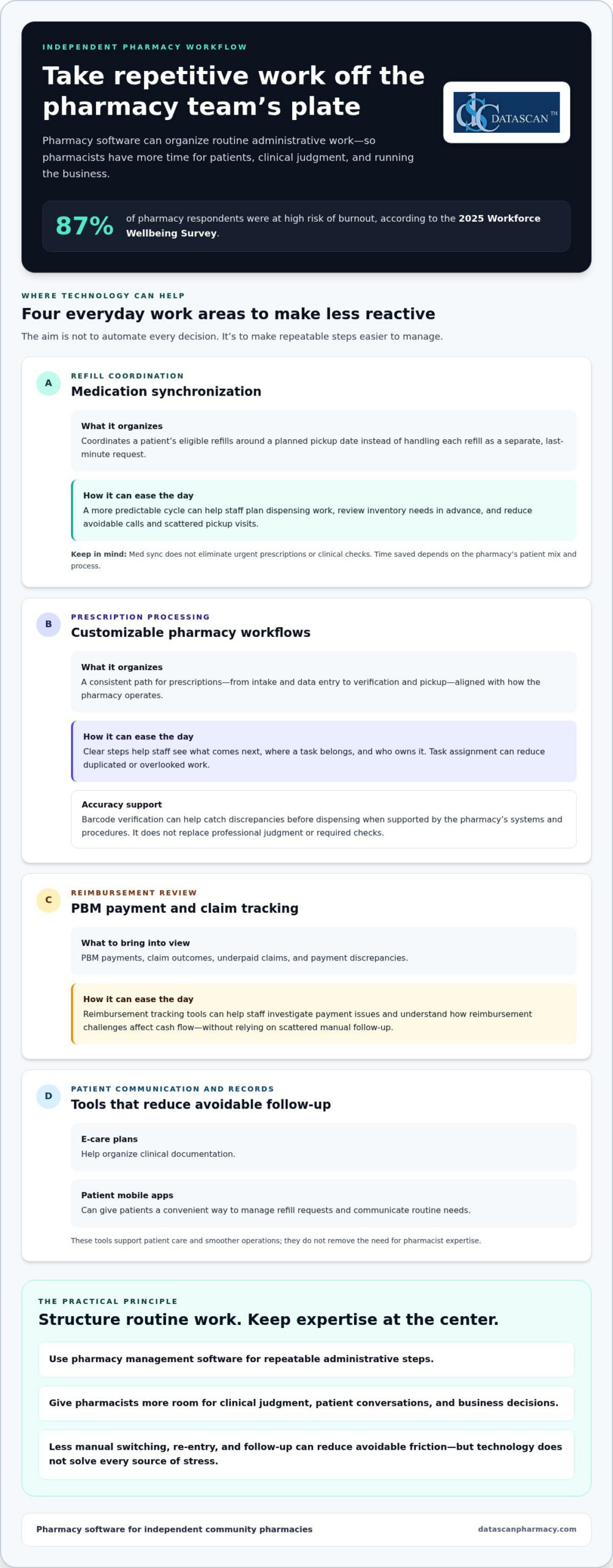
Technology can reduce pharmacist burnout by streamlining repetitive administrative work, including prescription processing, inventory tasks, and PBM reimbursement tracking. Less manual follow-up and data entry can leave pharmacists more time for patient care and decisions that require their expertise.
The pressure is real. The 2025 Workforce Wellbeing Survey found that 87% of pharmacy respondents were at high risk of burnout. For independent pharmacies, frequent interruptions and financial uncertainty can make routine tasks feel relentless. Better operational efficiency won’t address every source of stress, but reducing avoidable friction can give the team more control over its day.
What are the main causes of pharmacist fatigue today?
Some of the biggest time drains are easy to overlook: re-entering information, checking claim status, handling dispensing clarifications, and switching between systems to answer routine questions. Each task may be small on its own, but repeated interruptions break concentration and make it harder to keep work moving accurately.
PBM reimbursement uncertainty adds another layer of strain. Reviewing claim outcomes and investigating payment discrepancies takes staff time away from patients and business management. Manual entry can also lead to mistakes that need correction. It isn’t the only source of technical errors, but reducing unnecessary rekeying can remove one avoidable point of friction.
How does modern pharmacy software provide immediate relief?
Pharmacy management software brings operational information and workflows together, helping a team spend less time switching tasks and searching for details. Depending on the system and its configuration, automation can support repeatable steps in prescription processing, inventory management, and claims workflows. Pharmacy automation covers technologies designed to handle medication-related processes, showing how routine work can be structured to rely less on manual effort.
Centralized workflows can also ease the mental load. Rather than keeping every pending task in mind, staff can follow a consistent process to see what needs attention and move work forward. Datascan’s pharmacy management software is designed for independent pharmacies and includes customizable workflows that can fit the way a pharmacy operates. U.S.-based support gives pharmacy teams a knowledgeable point of contact for technical questions.
In 2026, the practical goal isn’t to automate every decision. It’s to use pharmacy software for repeatable administrative steps so pharmacists can focus on clinical judgment, patient conversations, and running the business. That makes reducing pharmacist burnout with technology an operational priority, not just a technology project.
Which pharmacy software features automate the most time-consuming tasks?
The most useful pharmacy software features reduce repetitive work across refill coordination, prescription processing, patient communication, and clinical documentation. Medication synchronization can make refill timing more predictable, while customizable workflows help staff follow a process that fits the pharmacy’s needs.
These tools can support patient care as well as smoother operations. The National Consensus Conference on Pharmacist Well-Being recommends workflow and technology solutions that make patient-centered care more efficient and help decrease pharmacist burden. For independent pharmacies, reducing pharmacist burnout with technology means choosing features that remove friction from work the team already does.
How does medication synchronization save hours every week?
Medication synchronization, or med sync, coordinates a patient’s eligible refills around a planned pickup date. Instead of handling each refill as a separate, last-minute request, the pharmacy can prepare for a more organized cycle and communicate with patients ahead of time. This can make workload easier to anticipate and help reduce avoidable calls and scattered pickup visits. The time saved depends on the pharmacy’s patient mix and process.
Upcoming refill schedules can also help the team plan dispensing work and review inventory needs in advance. Med sync doesn’t eliminate urgent prescriptions or clinical checks, but it can make routine refills less reactive and help smooth busy periods.
Can customizable workflows really improve pharmacy efficiency?
Yes. A customizable workflow can reflect how prescriptions move through a specific pharmacy, from intake and data entry to verification and pickup. Clear, consistent steps help staff understand what comes next and where each task belongs. Datascan’s customizable pharmacy workflow software lets independent pharmacies align software processes with their operational needs.
Barcode verification and task assignment can also be useful workflow approaches when supported by a pharmacy’s systems and procedures. Verification steps can help staff catch discrepancies before dispensing, while clear task ownership reduces the chance that work is duplicated or overlooked. These tools support accuracy, but they don’t replace professional judgment or required checks.
Other features can reduce follow-up work. E-care plans help organize clinical documentation, while patient mobile apps can give patients a convenient way to manage refill requests and communicate routine needs. When these functions are part of a coordinated pharmacy management software workflow, staff can spend less time chasing information and more time assisting patients. Explore Datascan’s workflow software to see how customized processes can fit day-to-day pharmacy operations.
How does technology help pharmacists manage PBM reimbursements and DIR fees?
Pharmacy management software helps independent pharmacies organize claim and reimbursement information so staff can spot payment discrepancies, track trends, and spend less time on manual reconciliation. It won’t determine whether a PBM payment is correct or guarantee a successful dispute, but clear records make it easier to identify claims that need review and understand how reimbursement issues affect cash flow.
When reducing pharmacist burnout with technology, the financial workflow matters as much as the dispensing workflow. Switching repeatedly between claim details, payment records, and spreadsheets adds administrative work and makes it harder to see patterns. A consistent process can help owners review reimbursement performance without relying on memory or scattered notes.
How can you identify underpaid claims automatically?
Start by comparing claim-level payment information with the reimbursement you expected under the applicable terms. Pharmacy management software can organize reimbursement data, and Datascan provides tools for PBM reimbursement tracking. Where available, reports or alerts can flag claims that appear below cost or differ from expected amounts, giving the team a starting point for investigation instead of requiring a manual review of every claim.
Reviewing results alongside acquisition costs and other relevant expenses also gives owners a clearer view of prescription-level gross profit. Consistent calculations support better business decisions, but they depend on accurate, complete inputs.
What role does data play in PBM reform advocacy?
Well-organized records can help turn individual payment concerns into a clearer view of recurring patterns. Pharmacy owners can review reimbursement trends, DIR fee information, and claim documentation to understand financial pressures on the business and support conversations with PBMs or policymakers. Digital records can also make audit preparation more orderly by keeping relevant claim information easier to retrieve. They don’t guarantee an audit outcome, but consistent recordkeeping can reduce last-minute searching.
- Track: Review reimbursement and fee data regularly instead of waiting until bookkeeping becomes urgent.
- Compare: Identify claims that appear inconsistent with expected reimbursement and document details for follow-up.
- Retain: Keep relevant claim records organized so staff can retrieve them when questions or audits arise.
Technology can also reduce operational strain beyond reimbursement work. An Agency for Healthcare Research and Quality summary reports that robotic dispensing improves staff satisfaction in the study it discusses, illustrating how automation may support efficiency and the work environment. For independent pharmacies, a practical next step is to make reimbursement data easier to review and act on with pharmacy software tools that fit the team’s processes.
What are the best strategies for implementing technology without adding more stress?
Introduce pharmacy technology in manageable phases. Start with a high-friction task and give staff time to learn the new process before adding another change. A clear purpose, practical training, and dependable support can make implementation a workflow improvement rather than another burden. This step-by-step approach makes reducing pharmacist burnout with technology more achievable for an independent pharmacy.
Start with a short implementation plan:
- Choose one pain point: Identify a recurring task, such as handling refill requests or coordinating delivery.
- Explain the benefit: Show staff how the change is intended to reduce interruptions or repetitive work.
- Train with real tasks: Let team members practice the workflow they’ll use during a normal shift.
- Review and adjust: Gather staff feedback, resolve snags, and decide what to introduce next.
Prioritize tools that address a visible source of workload. For example, the MobileScripts patient mobile app gives patients a way to request prescription refills through a mobile app, which can reduce reliance on phone calls for that task. Make sure staff understand how requests enter the pharmacy’s routine and who handles them.
How do you choose a pharmacy software vendor that supports your team?
Look for a partner that understands independent pharmacy operations and provides support your staff can use. Datascan is family-owned and has served pharmacies since 1981, with long-term U.S.-based support. During a pharmacy software conversion, plan how existing workflows will map to the new system, how staff will learn their roles, and how questions will be handled during the transition. Set clear internal points of contact so staff know where to raise issues.
Training should explain why the change is happening, not just which buttons to click. When staff understand how a tool fits their daily work, they can give useful feedback and build confidence using it.
How can mobile apps reduce the burden on your front-end staff?
Mobile refill requests can move routine requests into a structured process, freeing front-end staff to focus on in-person service and calls that need personal attention. Automated texts or push notifications may also reduce status-check calls when a pharmacy’s systems support those functions and the communication process is configured appropriately. Set expectations with patients about which requests the app handles and how the pharmacy follows up.
Delivery tools can help organize off-site patient needs by keeping delivery-related tasks within a defined workflow. Introduce these tools one at a time, monitor how they affect the team’s day, and refine the process before expanding their use. This keeps technology focused on practical relief, not change for its own sake.
Why is a family-owned pharmacy software vendor the best partner for reducing staff stress?
A family-owned pharmacy software vendor can offer a personal, accountable relationship alongside tools built for independent pharmacy operations. That matters because technology should fit the realities of your business, including how your team works, which reimbursement details you need to track, and the support you rely on when questions arise. Reducing pharmacist burnout with technology is easier when the system fits the pressures community pharmacies face.
Datascan has been family-owned since 1981 and provides long-term U.S.-based support. Its pharmacy management software is designed for independent pharmacies, with customizable workflows and tools that support PBM reimbursement tracking. Together, these capabilities can help owners address operational friction and the time-consuming work of understanding pharmacy finances.
What makes Datascan different from large corporate vendors?
Independent pharmacies need a technology partner that recognizes their business priorities, not just prescription volume. Datascan focuses on independent pharmacy operations with pharmacy management software that brings pharmacy workflows and business tools into the operational picture. U.S.-based support gives pharmacy teams a knowledgeable resource for system questions, while a family-owned approach emphasizes personal accountability and a lasting relationship.
Software can’t remove every source of stress or guarantee profitability. It can help owners organize workflows, track reimbursement information, and make better-informed decisions about how staff time is used. Those capabilities support a pharmacy’s work to serve patients while managing the business behind that care.
How do you get started with a less stressful pharmacy management system?
Begin with the problems that interrupt your team most often. Identify a workflow bottleneck, a recurring administrative task, or a reimbursement process that takes too much manual review. Then map how the task moves through the pharmacy, who handles each step, and what a better process should accomplish. This gives your team a practical basis for evaluating software and planning a transition.
- Set priorities: Choose the first workflow to improve rather than changing every process at once.
- Involve staff: Ask the people doing the work where delays, duplicate steps, or unclear handoffs occur.
- Plan training: Give staff time to learn the updated process and raise questions.
- Review the results: Check whether the change reduces friction before introducing another adjustment.
A good partnership connects technology decisions to the pharmacy’s actual needs. With a clear implementation plan, staff input, and support grounded in independent pharmacy operations, pharmacy software can become a practical tool for building a more manageable workday.
Give Your Pharmacy Team More Room to Thrive
Reducing pharmacist burnout with technology starts with practical changes: streamline repetitive workflows, make PBM reimbursement information easier to review, and introduce new tools in manageable steps. The right pharmacy management software can give staff more time while giving owners a clearer view of operations and profitability.
Technology works best when it fits the people using it. Datascan has been family-owned and operated since 1981, with long-term U.S.-based support and tools for independent pharmacies, including pharmacy management software, point-of-sale, mobile patient apps, and delivery tools. That combination gives pharmacy owners a knowledgeable partner as they improve workflows and reduce administrative strain.
You don’t have to overhaul every process at once. Start with one pressure point, involve your team, and build from there. Schedule a demo to explore Datascan Pharmacy Software for your workflow and see how the right tools can support a more efficient pharmacy. A less stressful workday is a practical goal, and your team can take the first step toward it.
Frequently Asked Questions
How does pharmacy management software specifically reduce daily stress?
Pharmacy management software can reduce daily stress by organizing routine tasks and limiting repeated manual steps. Depending on its features and configuration, it may support prescription processing, inventory tasks, refill coordination, and reimbursement tracking in a more consistent workflow. That can mean fewer interruptions to search for information or re-enter details. Reducing pharmacist burnout with technology works best when tools address specific pressure points without adding unnecessary steps.
Can automation help my pharmacy survive low PBM reimbursements?
Automation can’t change a PBM’s reimbursement terms or guarantee that a pharmacy will overcome low payments. It can help owners review claim and payment information, identify possible discrepancies, and keep reimbursement records organized for follow-up. Pharmacy management software with PBM reimbursement tracking can make it easier to see patterns and understand their effect on the business. Use those insights alongside accurate cost and financial records to guide decisions.
Is it difficult to switch to a new pharmacy software system?
A pharmacy software conversion takes planning, but a phased approach can make the transition more manageable. Identify essential workflows, involve staff who use them every day, and schedule time for training and questions. Before the transition, clarify how information and processes will be handled, what staff need to learn, and where they can get support. Introducing changes in stages helps the team adjust without trying to learn everything at once.
Do I need expensive hardware to reduce pharmacist burnout?
Not necessarily. Start by identifying whether the biggest time drain comes from software workflows, manual processes, or equipment needs. Pharmacy management software can support efficiencies such as organizing tasks and tracking reimbursements, but hardware requirements depend on the system and the pharmacy’s setup. Don’t assume buying new equipment is the first step. Define the workflow problem you want to solve, then determine what tools are needed to address it.
How does medication synchronization software work to save time?
Medication synchronization coordinates eligible prescription refills around a planned schedule for each patient. Instead of processing every routine refill as a separate, last-minute request, the pharmacy can prepare for upcoming fills and communicate with patients ahead of time. Pharmacy management software can help staff organize this work and anticipate routine dispensing needs. The process can make workloads more predictable, though urgent prescriptions and clinical checks still require attention as they arise.
What should I look for in a pharmacy software vendor to ensure long-term support?
Look for a vendor with experience serving independent pharmacies, clear support channels, and software that can accommodate your workflows. Consider how staff get help with technical questions and how feedback about daily operations informs improvements. Datascan Pharmacy Software is family-owned and operated since 1981, with long-term U.S.-based support. A continuing relationship with a knowledgeable support team can help your pharmacy address questions as its operational needs evolve.
Can technology help with pharmacy staff retention?
Technology can support staff retention by reducing avoidable administrative friction and making routine work more manageable, but it can’t guarantee that employees will stay. Consider tools that address frustrations your team identifies, such as repeated data entry, scattered workflows, or frequent refill-status calls. Involve staff in choosing what to improve and review whether the change helps. A more workable day can contribute to a supportive workplace alongside other retention efforts.
About the author: Datascan Pharmacy Software is a family-owned pharmacy management software provider founded in 1981. The company supports independent and retail pharmacies with pharmacy management software, point-of-sale tools, patient mobile apps, and delivery tools.
 Kevin Minassian is the President of Datascan Software. Under his leadership, the company rapidly expanded to provide pharmacy management software on a national level. Over the last 15+ years, he has ensured that Datascan has continuously evolved to offer innovative solutions for independent pharmacies while still offering world-class customer support. He is passionate about helping independent pharmacies to remain competitive, achieve success, and offer the very best service to their communities.