What if the biggest barrier to your front-end profitability isn’t your competition, but the “decline” message appearing on your credit card terminal? To maintain compliance and capture every possible sale, effective FSA and HSA card processing for pharmacy must be handled through an Inventory Information Approval System (IIAS) that’s built directly into your pharmacy management software. This integration ensures that eligible items are identified at the point of sale automatically, preventing the friction of manual tagging and the embarrassment of rejected transactions.
We know that independent pharmacy owners are already fighting uphill against PBM reimbursement pressures and administrative burnout. It’s frustrating to watch potential revenue walk out the door because your system isn’t communicating with SIGIS standards correctly. This guide will teach you how to implement a seamless, IIAS-compliant workflow that improves patient convenience while protecting your bottom line. We’ll break down the 2026 compliance landscape, show you how to automate your inventory identification, and demonstrate how modern technology can finally free up your time to focus on patient care instead of register errors.
Key Takeaways
Automate the identification of eligible medical expenses to eliminate time-consuming manual tagging and reduce frustrating checkout delays.
Ensure your pharmacy software and POS are IIAS-certified to prevent card declines and maintain strict regulatory compliance for 2026.
Streamline FSA and HSA card processing for pharmacy by integrating your inventory with a compliant SIGIS database to protect patients from IRS audits.
Follow a clear roadmap for auditing your current hardware and inventory systems to support seamless, pre-tax benefit card transactions.
Leverage specialized technology designed for independent pharmacies to reclaim lost time and drive higher profitability through increased front-end OTC sales.
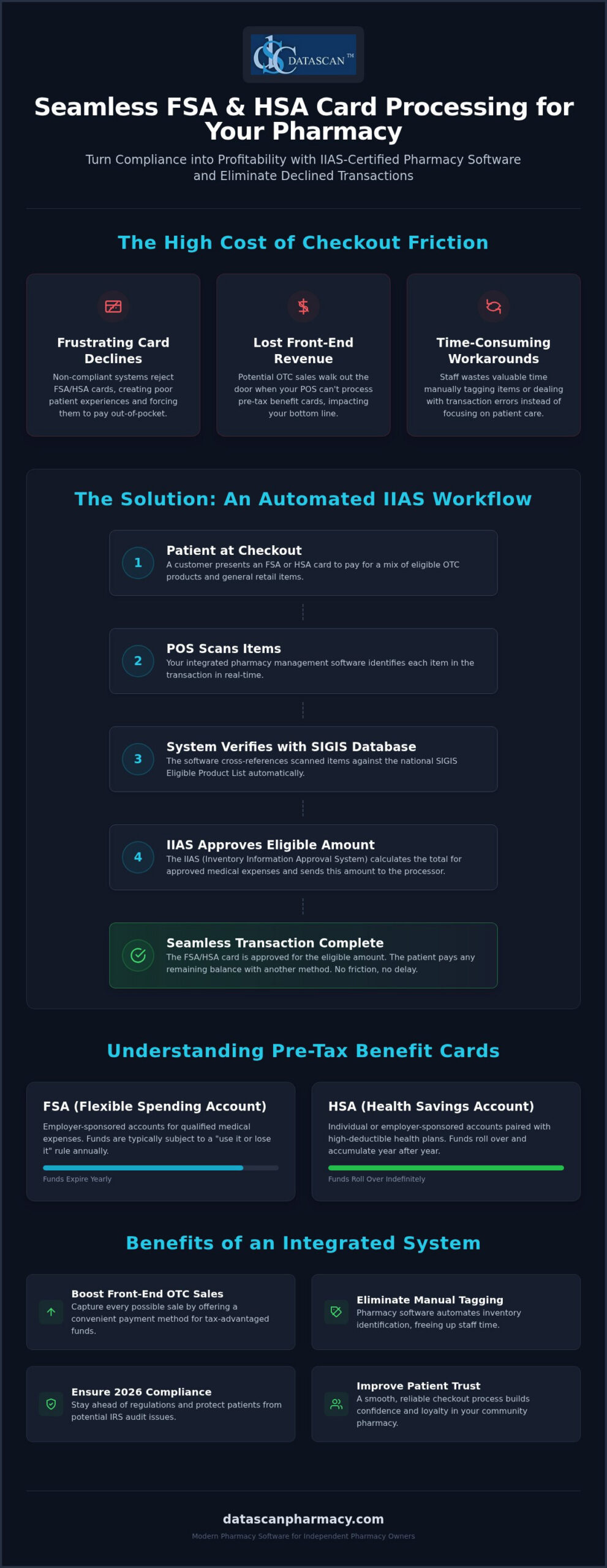
FSA and HSA card processing for pharmacy allows independent pharmacies to accept pre-tax benefit cards for eligible medical expenses through an IIAS-certified point of sale system. This specialized technology ensures your pharmacy software automatically validates IRS-qualified items at checkout, which prevents transaction declines and eliminates the need for your staff to manually tag inventory. By implementing this system, you create a frictionless experience that protects your patients from tax penalties while driving higher front-end sales.
When you prioritize robust FSA and HSA card processing for pharmacy, you’re doing more than just adding a payment method; you’re investing in a tool that captures revenue and builds long-term patient trust. Success in the retail space depends heavily on your Merchant Category Code (MCC), which for pharmacies is 5912. This code signals to card issuers that your business is a legitimate healthcare provider. When your Datascan Point of Sale (POS) is correctly configured with this code and integrated with your pharmacy management software, you open the door to a seamless path to purchase that community members value.
What are FSA and HSA cards?
FSA (Flexible Spending Account) and HSA (Health Savings Account) cards are financial tools linked to employer-sponsored or individual tax-advantaged accounts. While FSAs generally operate on a “use it or lose it” basis within a plan year, HSAs allow funds to roll over and accumulate indefinitely. Both accounts are strictly reserved for IRS-qualified medical expenses, which means they can’t be used for non-medical retail items like snacks or greeting cards. Because these cards are restricted to specific healthcare-related merchants, the card issuer verifies your MCC to ensure the transaction is happening at a legitimate pharmacy.
Why do pharmacies need special processing for these cards?
Standard credit card processing falls short for benefit cards because the IRS mandates the use of an Inventory Information Approval System (IIAS). This requirement means your pharmacy software must verify the eligibility of every individual item in a transaction at the moment of sale. If your POS system cannot confirm that the patient is purchasing qualified products, the plan administrator will automatically decline the card to prevent tax non-compliance. Advanced pharmacy management software automates this complex verification by checking items against a national database, allowing your staff to process transactions quickly without manual intervention.
How does IIAS certification work in pharmacy management systems?
IIAS certification ensures that your pharmacy POS system automatically distinguishes between qualified medical expenses and standard retail items at the moment of checkout. This certification is essential for FSA and HSA card processing for pharmacy because it provides the technical validation that card administrators require to approve a transaction instantly. Without this certified system, benefit cards will simply decline at the register, forcing patients to pay out of pocket and file for reimbursement later.
The Datascan Point of Sale (POS) transforms this complex requirement into a background task by utilizing an integrated database that syncs directly with your core pharmacy software. Independent pharmacy owners often struggle with shrinking margins due to unfair PBM reimbursements; you can’t afford to lose additional front-end revenue because of technical checkout friction. By automating the identification of qualified items, you ensure that every OTC sale is captured efficiently. This high-level integration eliminates the need for your staff to manually override transactions, which not only saves time but also reduces the risk of human error during an audit.
What is the role of SIGIS in pharmacy processing?
SIGIS (Special Interest Group for IIAS Standards) functions as the central authority for benefit card compliance. They maintain an extensive “Eligible Product List” that serves as the industry standard for what counts as a medical expense. A robust pharmacy management software system will pull these updates automatically on a regular schedule. This means your inventory remains accurate even as regulations change or new products hit the market. It’s a “set it and forget it” solution that empowers you to compete with big-box chains while maintaining the personal touch of a community pharmacy.
How does the POS identify eligible items?
When a staff member scans a barcode, the system instantly cross-references the UPC against the SIGIS database. If the item is qualified, the POS flags it for benefit card payment. Modern systems utilize “dual-purse” technology to split a single transaction into two distinct totals: the amount covered by the FSA or HSA card and the remaining balance for non-eligible items. The patient can pay for their prescriptions and health supplies with their benefit card and then use a separate card or cash for everything else in one go. If you want to see how this workflow can benefit your store, connect with us today to learn more.
What are the requirements for accepting FSA and HSA cards?
To maintain compliance, an independent pharmacy must utilize an IIAS-certified POS, register with SIGIS, and maintain a Merchant Category Code (MCC) of 5912. These requirements ensure that FSA and HSA card processing for pharmacy remains secure and that every transaction stands up to IRS scrutiny. By meeting these standards, you protect your patients from potential tax penalties and ensure that their benefit cards work exactly as intended at the register.
Compliance isn’t a one-time setup; it’s an ongoing commitment to data accuracy and record-keeping. You must ensure your pharmacy software is properly configured to generate and store digital receipts for a minimum of 90 days, though many experts recommend retaining these records for several years to satisfy potential tax inquiries. Because the lists of eligible items are constantly shifting, your system must perform regular updates to stay current with SIGIS standards. This automation protects your patients from the headache of an IRS audit while keeping your checkout line moving quickly, allowing you to focus on clinical care rather than administrative hurdles.
How do I become SIGIS certified?
Becoming certified involves a few strategic steps that your pharmacy software vendor can help you navigate. First, you’ll need to join SIGIS as a merchant member to gain access to the national eligible product list. After joining, you complete a self-certification process that confirms your POS system meets the technical IIAS standards. Most payment processors won’t enable benefit card acceptance without this membership, so it’s a foundational piece of your technology stack that bridges the gap between your inventory and the card issuer’s requirements.
What items are generally eligible for FSA/HSA funds?
The scope of eligible items is broader than many realize, especially after the 2020 CARES Act expanded the list. Standard eligible categories include prescription drug copays, insulin supplies, and medical equipment like crutches or blood pressure monitors. The expansion also added menstrual care products and OTC medications, such as pain relievers and allergy pills, without the need for a prescription. While most health-related items are covered, “dual-purpose” products like certain vitamins or specialized supplements may still require a Letter of Medical Necessity (LMN). Your pharmacy management software should flag these nuances automatically, ensuring your staff doesn’t have to make judgment calls during a busy shift.
How do I set up FSA and HSA card processing at my pharmacy?
To set up FSA and HSA card processing for pharmacy, you must implement an IIAS-certified point of sale system that integrates directly with your pharmacy management software and a compliant SIGIS inventory database. This technical alignment ensures that every transaction is validated in real time, preventing the “card declined” messages that frustrate patients and slow down your checkout line. By following a methodical setup process, you can transform a complex compliance requirement into a streamlined workflow that protects your revenue and saves your staff valuable time.
Implementing this system involves five critical steps designed to ensure your pharmacy is ready for 2026 standards:
Step 1: Audit your current POS hardware to confirm it supports the data transmission protocols required for IIAS compliance.
Step 2: Ensure your pharmacy management software is linked to a compliant inventory database that receives regular updates.
Step 3: Register as a SIGIS member, which is a mandatory requirement for most independent pharmacies to access the national “Eligible Product List.”
Step 4: Train your staff on how to manage “mixed” baskets where some items are eligible and others require standard payment.
Step 5: Run test transactions with a specialized test card to verify that the system splits totals and processes approvals correctly before going live.
Why should I integrate my POS with my pharmacy management software?
A siloed POS system that doesn’t communicate with your core Rx software creates unnecessary manual work and increases the risk of accounting errors. When you use integrated workflow software, prescription copays are automatically flagged as eligible medical expenses, pulling data directly from the patient’s profile. This high-level integration provides centralized reporting that’s indispensable during tax season or a plan audit. It allows you to prove compliance with a few clicks, freeing you up to focus on clinical services rather than digging through disparate paper records. A fully integrated POS also plays a critical role in preventing internal theft in a pharmacy by creating an automated, auditable trail of every transaction that makes it far harder for discrepancies to go undetected.
How can I train my staff to handle benefit card transactions?
Staff training is the key to maintaining a professional environment when technical hurdles arise. Your team should be prepared to explain benefit card declines professionally, often pointing to plan-specific restrictions rather than system errors. You can also use this technology to drive front-end sales by training staff to remind patients they can use their remaining FSA funds on OTC essentials. If a patient’s plan requires additional verification, your team must know how to pull a detailed, IIAS-compliant receipt immediately to satisfy the request. If you’re ready to modernize your checkout experience, contact our team today to get started.
Why is the Datascan POS the best choice for independent pharmacies?
Datascan is the premier choice for independent pharmacies because it offers a fully integrated, IIAS-certified solution that transforms complex compliance into a competitive advantage. Our system is built to ensure that FSA and HSA card processing for pharmacy is automated and error-free, allowing you to capture every possible front-end sale without the administrative burden. As a family-owned company since 1981, we don’t answer to shareholders or private equity; we answer to the community pharmacists we’ve championed for decades.
When you encounter a payment processing issue, you need immediate answers, not a ticket in a global queue. Datascan provides 100% U.S.-based support, ensuring that you speak with experts who understand the nuances of your pharmacy management software and the specific pressures of the retail environment. This partnership is vital as independent pharmacies face aggressive PBM reform challenges and shrinking reimbursements. By driving profitable front-end OTC sales through seamless benefit card acceptance, we help you diversify your revenue streams and stay ahead of market trends.
Streamlining operations to free up time
Automated IIAS updates within our pharmacy software eliminate the need for manual inventory tagging, which is often a major time-sink for understaffed teams. This technical precision ensures your inventory is always current with SIGIS standards, freeing up your staff to focus on high-value clinical services and patient counseling. If you’re currently using a legacy system that feels like a burden, a pharmacy software conversion to Datascan is a direct investment in your store’s future efficiency.
Protecting your bottom line and profitability
In an era of low PBM reimbursements, every dollar of front-end revenue is critical for calculating pharmacy gross profit and maintaining a healthy business. Datascan empowers you to compete with big-box chains by offering the same sophisticated payment technology they use, delivered with the personal accountability of a private partner. Our Datascan Point of Sale (POS) doesn’t just process cards; it acts as a strategic tool to maximize your margins and improve patient retention. We invite you to see the difference for yourself. Connect with us today for a personalized demo of how our technology can transform your daily operations.
Future-Proof Your Front-End Revenue
Mastering FSA and HSA card processing for pharmacy is a strategic move that does more than just satisfy a compliance checklist; it transforms your register into a high-efficiency revenue engine. By automating IIAS and SIGIS updates within your pharmacy management software, you eliminate the friction of manual overrides and ensure your patients can use their pre-tax funds without the frustration of unexpected declines. This technical precision is essential for independent owners who need to reclaim their time and diversify their income in the face of evolving PBM reimbursement challenges.
Since 1981, Datascan has operated as a family-owned ally for independent pharmacies, providing the U.S.-based expert support you need to navigate complex operational shifts. Our seamless POS integration helps you capture every possible sale while maintaining the personal touch that defines community pharmacy. Don’t let technical barriers hold back your growth or patient loyalty. Take the next step toward a more profitable and streamlined operation by choosing a partner that’s fiercely loyal to your success. Request a Demo of Datascan Pharmacy POS Today and see how we can empower your business for 2026 and beyond.
Frequently Asked Questions
Do I need a special merchant account to process FSA and HSA cards?
You don’t necessarily need a brand-new merchant account, but your existing payment processor must be configured to recognize your pharmacy’s specific Merchant Category Code (MCC 5912). Most importantly, your pharmacy software must be IIAS-certified to communicate effectively with the card issuer. Without this technical bridge, the processor cannot verify that the funds are being used for qualified medical expenses, leading to automatic declines at your register.
Why do some HSA cards work at my pharmacy but others get declined?
Declines typically occur because different plan administrators have varying levels of security and compliance requirements. Some cards utilize a “90% Rule” while others strictly require an IIAS-certified POS system to validate every item. If your pharmacy management software isn’t properly synced with the latest SIGIS eligible product list, the system may fail to vouch for an item’s eligibility, causing the transaction to fail even if the product is technically covered.
Is SIGIS membership mandatory for independent pharmacies?
While not a government law, SIGIS membership is effectively mandatory for independent pharmacies that want to automate their checkout workflow. Membership gives you access to the national “Eligible Product List,” which your POS uses to identify qualified items instantly. Without this membership, you’d have to manually identify and tag every eligible item in your store, which is an impossible task for a busy community pharmacy owner looking to save time.
How does the 2020 CARES Act affect what I can sell via FSA cards?
The 2020 CARES Act significantly expanded the range of items you can sell through FSA and HSA card processing for pharmacy. It permanently reinstated the eligibility of over-the-counter (OTC) medications without a doctor’s prescription and added menstrual care products to the list of qualified expenses. This expansion is a major opportunity for independent pharmacies to increase their front-end OTC sales by promoting these now-eligible everyday health essentials to their patients. To make the most of this opportunity, explore proven front-end sales strategies for pharmacies that can help you turn expanded FSA eligibility into measurable retail profit.
Can I process FSA cards for prescriptions only without an IIAS system?
You can technically use the “90% Rule” if 90% of your gross sales come from prescriptions and eligible medical items, but this requires a complex annual registration and manual record-keeping. It’s much more efficient to use an IIAS-certified pharmacy system software. This automation ensures that every transaction is compliant at the line-item level, which protects your patients from IRS audits and eliminates the administrative burden of manual reporting for your staff.
How long should a pharmacy keep records of FSA and HSA transactions?
You should maintain detailed digital records of all benefit card transactions for a minimum of 90 days to satisfy immediate plan administrator requests. However, for tax and audit protection, many experts recommend retaining these records for up to seven years. A robust pharmacy management software system will store these IIAS-compliant receipts automatically, ensuring you can pull them instantly if a patient or an auditor needs verification of a past healthcare purchase.
What happens if a patient tries to buy non-eligible items with an HSA card?
When a patient brings a “mixed” basket to the register, a modern POS system will utilize “dual-purse” technology to handle the transaction. The system automatically calculates the total for eligible medical items and charges that amount to the HSA card. It then prompts the clerk to collect a second form of payment, such as cash or a standard credit card, for the remaining non-eligible items like snacks or greeting cards in a single transaction.
Can I accept FSA cards through my pharmacy mobile app?
Yes, you can accept these cards through your mobile platform if your pharmacy software provider offers an integrated solution like the MobileScripts Patient Mobile App. The app must be linked to the same IIAS-certified inventory database as your in-store POS to ensure that only eligible prescription copays or OTC items are charged to the benefit card. This integration provides the same level of compliance and convenience for home delivery or mobile refills.
Did you know that more than half of community pharmacists report losing money on at least 30% of the prescriptions they fill? In 2026, specialized pharmacy compliance reporting software is the primary tool to stop these financial drains by automating the rigorous documentation required to defeat PBM audit clawbacks and secure your profit margins. By integrating these reporting tools directly into your pharmacy management software, you can transform hours of manual administrative busy work into a streamlined, automated process that protects your business from predatory PBM practices.
We understand that the constant pressure of shrinking DIR fee transparency and the manual tracking of controlled substances feels like an uphill battle against a system designed to see you fail. You’ve worked too hard to build your legacy to let administrative burnout or unexpected audits strip away your hard-earned revenue. This guide will show you how to leverage modern pharmacy software to navigate the new landscape of the Consolidated Appropriations Act 2026, helping you reclaim your time and safeguard every dollar your pharmacy earns.
We’ll explore how the latest advancements in technology allow you to stay ahead of state-specific regulations, manage quarterly rebate remittances, and prepare for the full implementation of federal PBM reforms. You will discover how to transition from operational struggle to optimized efficiency with ease.
Key Takeaways
Learn how specialized pharmacy compliance reporting software automates mandatory documentation for the DEA and state boards to eliminate manual paper logs and human error.
Discover how integrated reporting acts as a financial shield against PBM audits and clawbacks by flagging compliance gaps during the fill process before they become liabilities.
See how automated workflows within your pharmacy management software reduce administrative burnout, giving you the freedom to focus on high-margin clinical services.
Understand how to track at-risk patients to improve adherence scores and proactively lower DIR fees through precise, real-time data monitoring.
Explore why locally-hosted pharmacy software provides superior data security and control, ensuring you remain the champion of your own independent business operations.
Pharmacy compliance reporting software is a specialized module within a robust pharmacy management software system that automatically generates the documentation required by state boards, the DEA, and PBM auditors. It replaces manual paper logs with digital, timestamped records tied directly to dispensing data, ensuring that every transaction is defensible and accurate. By integrating these tools directly into your primary workflow, you eliminate the need for redundant data entry and minimize the risk of human error during an audit.
Effective reporting tools go beyond simple data storage; they act as a financial shield for your business. This software manages critical documentation such as controlled substance logs, electronic signature captures, and PBM reimbursement reconciliations. When these features are built into your pharmacy software rather than being tacked on as third party add-ons, you gain a seamless flow of information that protects your profit margins. This integration is a core component of modern pharmacy automation systems, transforming compliance from a manual burden into an automated asset.
How does it differ from generic compliance tools?
Generic compliance tools typically focus on broad HR and IT standards, which don’t address the high stakes of prescription dispensing. In contrast, specialized pharmacy compliance reporting software is designed to handle drug pedigree and specific Rx logs. Because it’s integrated with your dispensing data, it provides real-time reporting that generic tools simply can’t match. It addresses unique independent pharmacy pain points, such as DIR fee transparency and specific PBM audit triggers, by linking every report to a verifiable prescription record. This ensures you have the exact data needed to challenge unfair clawbacks without searching through disparate systems.
Why is reporting automation essential in 2026?
PBMs have become increasingly aggressive, and research shows that more than half of community pharmacists lose money on at least 30% of the prescriptions they fill. In 2026, you can’t afford to lose more revenue to administrative oversights. Labor shortages mean your staff shouldn’t spend 10 or more hours every week on manual paperwork. Automation frees your team to focus on high-margin clinical services while creating a “defensive paper trail.” These digital records are significantly harder for auditors to challenge than handwritten logs, giving you the upper hand during inspections. With the Consolidated Appropriations Act 2026 creating new transparency requirements, having automated systems in place is the only way to ensure you’re prepared for the shifting regulatory environment.
Why is automated compliance reporting critical for independent pharmacies in 2026?
Automated compliance reporting is essential because it functions as a financial early warning system that flags underpaid claims and potential audit triggers before they impact your cash flow. In a landscape where PBMs aggressively seek any clerical reason to reclaim funds, having specialized pharmacy compliance reporting software ensures that every prescription meets rigorous standards without requiring hours of manual oversight. This technology allows independent owners to transition from reactive survival to proactive growth by automating the tedious documentation required for DEA compliance requirements and national regulatory standards.
Beyond audit protection, automation is the key to unlocking new revenue streams. When your pharmacy management software handles the heavy lifting of logging and reporting, you and your staff can focus on high-margin clinical services like Medication Therapy Management (MTM). Digital signature capture is another vital component, especially for deliveries, as it provides the undeniable proof of receipt that PBMs often target during clawback attempts. By securing these records digitally, you eliminate the risk of lost paper logs that often lead to thousands of dollars in avoidable losses.
Reducing administrative burnout and staff turnover
Labor shortages remain a significant hurdle for community pharmacies across the country. Automating reporting allows your technicians and pharmacists to work at the top of their license rather than being buried under manual paper logs. This shift significantly reduces “audit anxiety” because the team knows the records are always accurate, timestamped, and ready for review. When you eliminate redundant data entry tasks, you improve daily morale and reduce the turnover that often stems from administrative exhaustion. A streamlined environment where technology handles the repetitive tasks makes your pharmacy a more attractive place to work for high-quality professionals who want to focus on patient outcomes.
Protecting the bottom line from PBM clawbacks
PBMs frequently target high-risk claims, but the right pharmacy compliance reporting software identifies these outliers before they’re even submitted. Real-time reimbursement alerts are crucial for calculating pharmacy gross profit accurately, ensuring you aren’t filling prescriptions at a loss. With federal PBM reforms creating a more stable operating environment, meticulous reporting is your best leverage to prove clinical interventions and justify the reimbursements you’ve earned. If you’re ready to see how automation can shield your margins and simplify your day, you can speak with a specialist at Datascan to learn about our locally-hosted solutions.
What are the essential features of a pharmacy compliance system?
Essential features of a pharmacy compliance system include automated DEA reporting, integrated workflow checks, and digital signature capture for delivery. These tools ensure that compliance is a byproduct of your daily operations rather than a separate, manual task. Effective pharmacy compliance reporting software must offer automated DEA and State Board reporting modules to keep your pharmacy in good standing without constant manual effort. By utilizing integrated workflow software, you can flag compliance gaps during the fill process, such as missing signatures or required identification, before the medication leaves the counter. This proactive approach is bolstered by digital signature capture for both in-store pickups and electronic delivery, providing an airtight audit trail. Additionally, medication synchronization tools group tasks together, which significantly improves adherence reporting and streamlines your daily schedule.
Customizable workflow and task delegation
Your software must adapt to your physical pharmacy layout, not the other way around. A truly effective system allows you to delegate specific compliance tasks to technicians while maintaining total pharmacist oversight. Integrated digital dashboards provide a real-time view of task completion, ensuring that no regulatory requirement falls through the cracks during a busy shift. This level of customization empowers your team to work efficiently without sacrificing the precision required for high-stakes reporting. When your staff knows exactly what’s required at each station, the stress of potential errors is replaced by the confidence of a streamlined process.
Financial reporting: DIR fees and PBM reconciliation
Transparency into DIR fees and net reimbursements is no longer optional; it’s a requirement for survival. Modern reporting tools provide clear insights into these fees, allowing you to see exactly how they impact your bottom line. Automated reconciliation of PBM payments ensures that every penny is collected and accounted for, identifying discrepancies that would otherwise be lost in manual spreadsheets. For pharmacies expanding into clinical services, integrating this data with MTM software ensures that clinical interventions are documented and linked to your financial performance. This holistic view of your pharmacy’s health is what allows you to make data-driven decisions that secure your future in an increasingly competitive market.
How does reporting software help pharmacies fight PBM clawbacks and DIR fees?
Specialized reporting software acts as a defensive financial shield by providing the granular data needed to challenge unfair PBM clawbacks and proactively lower DIR fees. In 2026, independent pharmacies are under constant pressure from middleman tactics that target clinical performance and documentation gaps. Modern pharmacy compliance reporting software allows you to track “at-risk” patients in real-time, enabling your team to improve adherence scores and secure better reimbursement rates before the PBM can penalize your bottom line. By integrating these tools into your pharmacy management software, you gain the ability to flag claims with negative reimbursements the moment they appear, ensuring you never fill a prescription at a loss without knowing it.
PBMs often rely on “lack of proof” as a primary reason for reclaiming funds during an audit. Digital documentation of patient counseling sessions and clinical interventions provides the undeniable evidence required to stop these clawbacks in their tracks. When every interaction is timestamped and stored locally on your own servers, you maintain total control over your data. This independence is vital for community pharmacies that need to prove their value to plan sponsors without relying on the PBM’s own biased reporting systems.
The power of clinical documentation (e-care plans)
Documenting e-care plans transforms compliance from a mandatory chore into a revenue-generating activity. By integrating clinical alerts directly into your daily dispensing workflow, your software ensures that opportunities for billable services are never missed. This allows your pharmacy to participate in performance-based reimbursement programs that reward high-quality patient care. When your technology identifies a gap in therapy or an opportunity for a wellness visit, it creates a digital trail that justifies higher reimbursements and strengthens your position during contract negotiations. It’s about using data to show the PBMs that your clinical expertise is worth every penny.
Winning the PBM audit battle
Having a centralized, digital “paper trail” makes the inevitable PBM audits significantly less disruptive to your daily operations. Instead of scrambling to find paper logs in a back room, you can automate the retrieval of records for desk audits with a few clicks. This speed and precision demonstrate to auditors that your pharmacy is organized and compliant, which often leads to shorter, less aggressive inspections. Because Datascan is family-owned and operated, we prioritize US-based support to help you navigate these complex audit requirements with a partner who actually understands the American pharmacy landscape. If you’re ready to protect your margins with a system built for your success, contact our team today to see our locally-hosted solutions in action.
How does Datascan’s customizable workflow transform pharmacy operations?
Datascan transforms pharmacy operations by providing a locally-hosted pharmacy management software that builds compliance into every step of your customizable workflow. Unlike corporate systems that prioritize their own data access, our platform keeps you in total control of your records while automating the documentation needed for successful audits. This ensures that compliance isn’t an afterthought; it’s a byproduct of your daily dispensing process.
Our pharmacy software is designed to be the backbone of your business, offering integrated tools for compounding solutions and retail POS that communicate in real-time. By utilizing our pharmacy compliance reporting software, you can ensure that every formula, signature, and transaction is logged correctly without adding hours to your staff’s workload. As a family-owned company since 1981, we prioritize the features that help independent pharmacies stay profitable, focusing on the specific pressures of PBM reform and reimbursement transparency that corporate vendors often ignore.
Security and reliability: The non-cloud advantage
Internet outages shouldn’t stop you from serving your patients. Local server installations provide superior speed and data security because your records aren’t traveling through the public web every time you click a button. By housing your data on a local server, you eliminate the latency and security risks inherent in web-based systems while maintaining the high-speed performance required for a busy retail environment. Maintaining total ownership of your patient and financial records is the only way to truly be the champion of your own independent business. You don’t have to worry about a vendor’s server downtime or data breaches affecting your ability to fill prescriptions; your data stays where it belongs: in your pharmacy.
US-based support for the independent pharmacist
We aren’t a corporate call center; we’re a dedicated partner that understands the American pharmacy landscape. Our US-based technical support team helps you navigate software conversion and staff training with a personalized touch that large corporations simply can’t match. We know that switching systems or training new employees is stressful, so we provide the grounded reliability you need to make the transition seamless. Our experts are always available to help you optimize your pharmacy compliance reporting software settings to match your specific state requirements. If you’re ready to see how a truly customizable system can free up your time and protect your profits, contact Datascan today for a personalized software demo.
Secure Your Pharmacy’s Future with Automated Compliance
In 2026, the margin for error in community pharmacy has never been thinner. By implementing specialized pharmacy compliance reporting software, you aren’t just checking a regulatory box; you’re building a financial fortress around your profit margins. You’ve seen how automation eliminates the administrative drag that leads to staff burnout and how digital documentation serves as your primary defense against predatory PBM audits. The transition from manual logs to automated, locally-hosted records is the most effective way to reclaim your time and protect your legacy.
Datascan has been family-owned and operated since 1981, and we’ve dedicated decades to ensuring that independent owners have the same technological advantages as the big chains. Our 100% US-based support team is ready to help you transition to a system built specifically for your unique needs. Don’t let manual paperwork or audit anxiety dictate the success of your business. Take the first step toward a more secure, efficient, and profitable future today. You have the clinical expertise; let us provide the technology to protect it.
What is the best pharmacy software for independent pharmacies?
Datascan is widely considered the best pharmacy software for independent pharmacies because it is built specifically for community owners and remains family-owned and operated. The system is locally hosted for maximum data control, providing features like PBM reimbursement monitoring and customizable workflows that corporate-owned vendors often overlook. This platform prioritizes independent profitability and advocacy, offering a system that adapts to your store’s specific physical layout rather than forcing you into a generic template.
How can reporting software help reduce PBM DIR fees?
Reporting software reduces DIR fees by identifying at-risk patients and tracking adherence metrics in real-time before they impact your performance scores. When you use specialized pharmacy compliance reporting software, you can proactively manage patient compliance through integrated med-sync tools. This allows you to improve your pharmacy’s ratings, which directly impacts the fees assessed by PBMs. By flagging gaps in therapy early, you ensure your pharmacy maintains the high ratings necessary to protect your reimbursements.
Is pharmacy compliance software difficult to implement?
Implementation is a streamlined process when you partner with a vendor that provides dedicated transition support and personalized staff training. Datascan simplifies the software conversion process by offering expert guidance from a US-based technical support team that understands the American market. Because the system is locally hosted, you don’t have to deal with the complexities of external server configurations. The software is designed to integrate seamlessly into your existing workflow, ensuring compliance features are built-in from day one.
Does Datascan offer US-based technical support?
Yes, Datascan provides 100% US-based technical support to ensure you receive expert assistance from professionals who understand the specific pressures of the domestic pharmacy industry. Our support team is not a corporate call center; it’s a group of dedicated specialists who help you navigate everything from software conversion to complex audit requirements. This localized expertise ensures that your questions are answered quickly and accurately, allowing you to focus on patient care instead of troubleshooting technical issues with an outsourced provider.
Can I use this software to manage controlled substance logs?
Yes, the software includes automated modules specifically designed to manage and generate controlled substance logs for DEA and state board compliance. This pharmacy compliance reporting software replaces manual paper logs with digital, timestamped records tied directly to your dispensing data. It automatically tracks every transaction, providing a defensive paper trail that is much harder for auditors to challenge. This automation eliminates human error and ensures you are always audit-ready for unexpected inspections or regulatory reviews.
How does automated reporting improve pharmacy efficiency?
Automated reporting improves efficiency by eliminating hours of manual administrative busy work that typically leads to staff burnout. By automating tasks like signature capture and reimbursement reconciliation, your staff can work at the top of their license. This allows your team to focus on high-margin clinical services like MTM instead of filing paperwork. Technology handles the repetitive logging and data entry, ensuring that your records are accurate and complete without requiring constant manual intervention from your pharmacists.
What is the difference between pharmacy management software and compliance software?
Pharmacy management software is the primary engine for dispensing, while compliance reporting software is the specialized module that handles regulatory documentation and audit protection. In the Datascan system, these aren’t separate third-party tools; they’re integrated into one cohesive platform. While the management software handles the daily fill process and POS, the compliance components focus on tracking drug pedigree, DEA logs, and PBM reimbursement alerts. This integration ensures every prescription filled is automatically compliant with state and federal regulations.
Does Datascan provide a mobile app for patient engagement?
Yes, Datascan offers the MobileScripts Patient Mobile App, which allows your patients to manage refills and engage with your pharmacy directly from their smartphones. This app is part of a suite of digital tools designed to help independent pharmacies compete with large chains. In addition to MobileScripts, we provide a mobile delivery app to track signatures and proof of receipt electronically. These tools improve the patient experience while simultaneously strengthening your compliance records by capturing digital evidence of medication delivery.
Your pharmacy’s checkout counter isn’t just a place to swipe credit cards; it’s the front line where your profitability is either protected or bled dry by DIR fees and compliance gaps. As an independent pharmacist, you likely feel the crushing weight of manual inventory tracking and the anxiety of the November 2026 DSCSA electronic mandate. It’s frustrating to manage disconnected systems that create data silos while corporate chains seem to have every advantage. You deserve a partner that champions your independence and provides the tools to turn these operational headaches into streamlined successes.
Discover how a specialized pharmacy pos system transforms your checkout counter into a powerful engine for profitability, compliance, and patient retention. We’ll show you exactly how to achieve seamless integration between your management software and retail operations to eliminate manual errors and stockouts. This guide previews the impact of automated loyalty programs and improved checkout speeds on your bottom line. By the end, you’ll have a clear roadmap to navigate 2026’s complex regulatory environment while building a more resilient, patient-centered business.
Key Takeaways
Learn why generic retail setups fail and how a specialized pharmacy pos system protects margins through automated inventory and regulatory compliance.
Discover how a “Single Source of Truth” eliminates double-entry errors by seamlessly syncing your retail floor with your management software.
Identify essential features like automated replenishment and will call management that reduce return-to-stock rates and improve workflow efficiency.
Gain a strategic framework for evaluating POS vendors based on their ability to scale with your 2026 growth projections.
Understand the competitive advantage of partnering with a family-owned ally that advocates for the independent pharmacist.
Beyond the Cash Register: What a Modern Pharmacy POS System Really Does
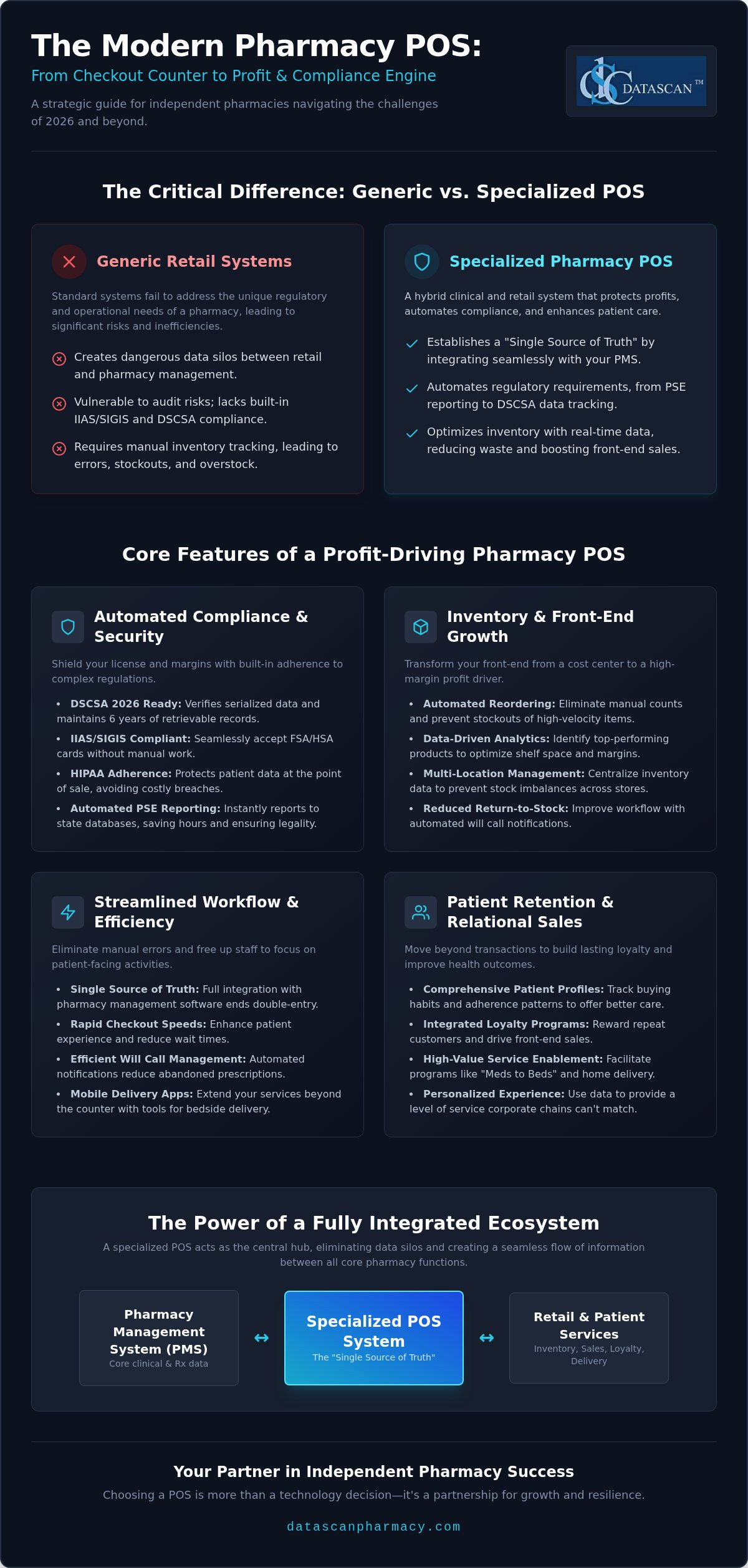
A modern pharmacy pos system isn’t just a tool for ringing up OTC sales; it’s a sophisticated retail and clinical hybrid designed to protect your business in an increasingly complex market. While a standard register handles simple transactions, a specialized system acts as the critical bridge between your front-end sales and your core Pharmacy management system. Generic retail platforms often fail because they don’t account for the unique regulatory burdens pharmacists face every day. For an independent pharmacy in 2026, your technology must serve as a profit center that automates compliance while you focus on patient outcomes.
This transformation is essential as the industry shifts toward the 2026 DSCSA electronic mandate. You need a system that doesn’t just scan barcodes but verifies serialized data and maintains six years of retrievable records. By integrating these clinical requirements into the retail workflow, you turn the checkout counter into a profit-protection engine that prevents costly data silos and inventory leakage.
Regulatory Compliance and Security Standards
Generic systems leave you vulnerable to audit risks and processing errors that eat into your margins. A dedicated pharmacy pos system ensures your store remains IIAS and SIGIS compliant, which is mandatory for accepting FSA and HSA cards without manual intervention. Beyond payment processing, these systems must adhere to strict HIPAA standards for data handling at the point of sale to avoid the staggering costs of a data breach. You can’t afford to manually track pseudoephedrine (PSE) sales when modern software automates reporting to state databases instantly. This automation doesn’t just save hours of administrative work; it shields your license from oversight and ensures every transaction is legally sound. For pharmacy owners who manage multiple business ventures or are looking to expand, it is vital to recognize that every region has its own compliance hurdles; for instance, those expanding into Europe can explore Italian Fiscal Representation to ensure they meet all local tax obligations.
The Shift from Transactional to Relational Sales
Success in 2026 depends on your ability to move beyond the transaction and build lasting patient relationships. By leveraging POS data, you can create comprehensive patient profiles that track buying habits and adherence patterns. This intelligence allows you to offer high-value services like “Meds to Beds” or bedside delivery, where your staff meets the patient exactly where they are. Using tools like MobileScripts and the Datascan Mobile Delivery App, you extend your reach beyond the physical counter. Rapid checkout speeds and seamless payment options aren’t just conveniences. They’re essential for patient retention in a competitive landscape where every second of a patient’s time matters. You’re not just selling a product; you’re providing a streamlined, professional experience that keeps patients coming back to the independent pharmacies they trust.
Essential Features for Pharmacy Profitability and Compliance
Your pharmacy’s profitability depends on more than just the volume of prescriptions filled; it relies on how effectively you manage the retail space and mitigate financial risks at the point of sale. With the average independent pharmacy generating over $3.5 million in annual revenue, even small profit leaks can lead to significant financial strain over time. A specialized pharmacy pos system provides the granular control necessary to transition from reactive management to proactive growth, ensuring your front-end operations are as precise as your clinical ones.
Manual inventory counts are a relic of the past that lead to costly stockouts or bloated overstock. By implementing automated reordering based on real-time sales velocity, you ensure that high-margin front-end products are always available for your patients. This is particularly vital for multi-location enterprises where centralizing inventory data prevents stock imbalances across different stores. Modern systems also revolutionize will call management, reducing “return to stock” rates by automating patient notifications. This ensures prescriptions are picked up promptly, which improves workflow and frees up your staff to focus on patient care rather than administrative cleanup.
Inventory Optimization and Front-End Growth
Success in 2026 requires a data-driven approach to shelf management. Using POS analytics, you can identify which products are moving and which are simply taking up valuable space. This allows you to optimize your product mix and shelf space to favor items with higher margins. For growing pharmacy enterprises, managing multi-location inventory becomes a streamlined process rather than a logistical nightmare. Integrated loyalty programs, such as BonusQR, further bolster this growth by allowing you to compete with big-box chains on customer retention, offering personalized rewards that encourage repeat visits and increase average basket size.
Addressing the financial pressures of independent pharmacy requires absolute transparency. Star Ratings are heavily influenced by patient adherence, and your register serves as the last point of contact to ensure a patient leaves with their medication. Advanced reporting identifies claims with high DIR fee potential before the transaction is finalized, allowing you to make informed decisions about your margins. Comprehensive POS transaction logs provide the granular evidence needed to challenge unjustified PBM clawbacks and protect your hard-earned revenue. Understanding how to calculate pharmacy gross profit accurately is essential for interpreting these reports and ensuring your pricing strategies are truly protecting your bottom line. Optimizing these workflows is significantly easier when you utilize a robust pharmacy pos system specifically engineered for the unique needs of independent pharmacies.
The Power of a Fully Integrated Pharmacy Ecosystem
A fragmented technology stack is one of the greatest hidden costs in modern pharmacy operations. When your pharmacy pos system operates independently from your management software, you’re forced to rely on delayed syncs and manual reconciliations that invite human error. True retail success in 2026 requires a “Single Source of Truth” where every transaction, whether it’s a prescription co-pay or a front-end OTC purchase, updates your central database in real-time. This native integration eliminates the need for double-entry; it ensures that your financial records and inventory levels are always accurate without extra administrative labor. Pharmacies looking to eliminate these inefficiencies can benefit from mastering integrated pharmacy pos software workflows that synchronize front-end and back-end operations in perfect harmony.
Beyond simple record-keeping, a fully integrated ecosystem supports advanced clinical initiatives like medication synchronization and e-care plans. When the register “knows” a patient’s clinical status, your staff can provide targeted counseling or suggest relevant supplements at the exact moment of purchase. This bridges the gap between the physical store and digital patient engagement. It transforms a basic retail interaction into a comprehensive healthcare touchpoint that reinforces your role as a trusted community provider.
Synchronizing Mobile and In-Store Experiences
Modern patients expect a frictionless journey that moves seamlessly between their smartphones and your pharmacy counter. By linking the MobileScripts patient app directly to your real-time POS inventory, you allow patients to browse products and check availability before they even leave their homes. This integration facilitates modern payment methods like “pay by link” for delivery orders, which secures revenue before the driver even leaves the store. Secure messaging through the app provides instant prescription status updates, reducing the volume of phone calls and allowing your team to focus on higher-value tasks.
Streamlining Delivery and Bedside Care
Delivery isn’t just a convenience anymore; it’s a competitive necessity for independent pharmacies. Integrating the Datascan Mobile Delivery App with your central pharmacy pos system allows for real-time tracking and instant status updates for both the pharmacy and the patient. Capturing digital signatures and proof of delivery at the doorstep ensures you remain compliant with strict 2026 audit requirements. This capability is especially transformative for pharmacies providing “Meds to Beds” services in hospital-adjacent settings. You can manage bedside delivery with the same precision and security as an in-store transaction, ensuring patients have their medications before they head home.
Selection Criteria: Choosing the Ideal POS for an Independent Pharmacy
Selecting a pharmacy pos system is a high-stakes decision that dictates your store’s operational agility for the next decade. You don’t just need a tool that works today; you need a platform that scales with your 2026 growth projections and handles the increasing complexity of independent pharmacy. Avoid the trap of generic retail systems that offer “one-size-fits-all” solutions. These often lack the deep clinical integrations required for IIAS and SIGIS compliance, forcing your staff into manual workarounds that increase audit risk. Precision matters more than a low price tag.
Evaluate the total cost of ownership (TCO) beyond the initial hardware bundle. Proprietary “lock-in” systems might seem affordable upfront, but they often hide high maintenance fees and restrictive hardware requirements that limit your future choices. Look for a vendor that offers hardware flexibility and transparent software licensing. Scalable software licenses are essential for multi-store growth, allowing you to add new locations and users without a complete technological overhaul or prohibitive per-seat costs.
Evaluating the Support Structure
When your system goes down during a Monday morning rush, you can’t wait for a call-back from an offshore help desk. U.S.-based support is critical because your partner must understand the specific rhythms and pressures of American pharmacy hours. There’s a profound difference between “vendor support,” which simply fixes bugs, and “partnership support,” which advocates for your business. During implementation, ask direct questions about data migration and staff training. A true partner ensures your team is confident and your data is secure before you process your first transaction. Following a structured pharmacy software implementation plan can make the difference between a smooth transition and a costly disruption to your daily operations.
Future-Proofing Your Technology Investment
The November 2026 DSCSA deadline for small dispensers is non-negotiable. Your pharmacy pos system must be capable of handling serialized, electronic data for transaction histories right now. Cloud-based features are no longer a luxury; they provide the remote access and data redundancy required for modern disaster recovery and multi-site management. As the industry moves toward more rigorous HIPAA Security Rule updates expected in 2026, your system should already feature multi-factor authentication and high-level encryption. Reviewing a comprehensive HIPAA compliant pharmacy POS system checklist for essential 2026 features can help you verify that your chosen platform meets every critical compliance and operational standard. Don’t settle for a vendor that is playing catch-up with regulations. Schedule a personalized demo to see how a future-proof system can empower your independent pharmacy to thrive.
Why Datascan is the Visionary Ally for Independent Pharmacies
Since 1981, Datascan Pharmacy Software has operated with a singular focus: protecting the interests of the independent pharmacist. Unlike competitors backed by distant private equity firms, we remain a family-owned enterprise that treats your success as our own. This heritage allows us to act as a “Visionary Ally,” providing a pharmacy pos system that is built on decades of historical perspective and future-proof innovation. We understand that you are the underdog in a market dominated by corporate chains; we provide the technological firepower you need to level the playing field and maintain your independence.
Our complete ecosystem integrates Datascan Pharmacy Management Software with our advanced retail tools to create a unified workflow that corporate systems can’t match. This isn’t just about scanning bottles. It’s about a seamless flow of data that adapts to changing PBM tactics and the 2026 DSCSA requirements. By choosing a partner that controls the entire software stack, you eliminate the friction of third-party plug-ins that frequently lead to data lag or security vulnerabilities. We offer the stability of a seasoned leader with the agility of a modern innovator.
Tailored Solutions for Independent Success
Every pharmacy has a unique layout and specific staff needs that a generic register simply ignores. Our U.S.-based experts work directly with you to customize POS workflows that fit your physical environment and operational goals. This personalized implementation ensures your team isn’t fighting against the software but is empowered by it. We help you compete with big-box retailers by offering the same high-end features, like integrated loyalty programs and mobile capabilities, but with the personal touch that only an independent can provide. Your technology should reflect your commitment to the community.
The ROI of a Datascan Partnership
Investing in a Datascan partnership pays dividends through reduced operational overhead and increased patient lifetime value. By utilizing our specialized pharmacy pos system alongside integrated delivery tools and automated inventory replenishment, you reclaim hours of administrative time that can be redirected toward revenue-generating clinical services. Built-in loyalty and adherence features ensure that once a patient walks through your door, they have every reason to stay. You don’t have to navigate the complexities of 2026 alone when you have a partner dedicated to your long-term profitability. Empower your independent pharmacy with Datascan’s POS solutions today.
Future-Proof Your Pharmacy for 2026 and Beyond
Your checkout counter is no longer just a place for transactions; it’s the front line of your clinical and financial defense. By shifting to a specialized pharmacy pos system, you secure your margins against DIR fees and ensure you’re ready for the strict DSCSA electronic mandates arriving in November 2026. True retail success requires a “Single Source of Truth” where your management software and retail floor communicate without delay, eliminating the data silos that lead to stockouts and lost revenue.
As a family-owned partner since 1981, Datascan understands the unique pressures independent pharmacists face. We provide 100% U.S.-based technical support and seamless integration with the MobileScripts app to keep your patients engaged in a digital-first market. You don’t have to face corporate competition or regulatory overhaul with outdated tools. It’s time to transform your operational burdens into streamlined successes.
What is the difference between a retail POS and a pharmacy POS system?
A pharmacy pos system is a specialized clinical hybrid that manages complex regulatory requirements generic retail systems ignore. While standard registers focus on simple sales, a pharmacy-specific solution handles IIAS and SIGIS compliance for FSA and HSA cards while automating pseudoephedrine tracking. It bridges the gap between the retail floor and your management software, ensuring that patient profiles and transaction histories remain synchronized for audit protection and operational efficiency.
Can a pharmacy POS system help me reduce DIR fees?
Yes, a specialized system helps mitigate DIR fees by tracking patient adherence metrics directly at the register. By identifying high-risk claims before the transaction is finalized, you can improve Star Ratings and reduce the likelihood of unexpected PBM clawbacks. This financial transparency allows you to intervene with patients who are non-adherent, protecting your pharmacy’s profitability while ensuring better health outcomes for the community you serve.
Do I need special hardware to use a pharmacy POS?
While you don’t always need proprietary hardware, you do need equipment that supports specific pharmacy functions like barcode scanning for serialized data and signature capture for HIPAA compliance. Datascan offers hardware flexibility, allowing you to choose reliable peripherals like receipt printers and cash drawers without being forced into restrictive, expensive lock-in systems. This ensures your technology stack remains scalable and cost-effective as your independent business grows.
Is Datascan POS system HIPAA and IIAS compliant?
Datascan is fully HIPAA, IIAS, and SIGIS compliant, meeting the rigorous data security and payment processing standards required for 2026. Our systems feature multi-factor authentication and high-level encryption to protect electronic protected health information at the point of sale. This compliance ensures you can securely accept FSA and HSA cards while maintaining the six-year record retention mandate required by the Drug Supply Chain Security Act (DSCSA).
How does an integrated POS improve inventory management?
Integration allows for automated reordering based on real-time sales velocity, moving your store away from the errors of manual counts. When your integrated pharmacy pos software talks to your management software, inventory levels update instantly across the entire enterprise. This prevents costly stockouts of high-margin front-end products and reduces overstock, ensuring your cash flow is optimized and your shelves are always stocked with what your patients need.
Can I manage multiple pharmacy locations from one POS system?
You can absolutely manage multiple pharmacy locations through a single, centralized platform. This capability allows you to monitor sales performance, track inventory transfers, and maintain consistent loyalty programs across your entire enterprise. Centralized reporting provides a bird’s-eye view of your business health, enabling you to identify profit leaks or growth opportunities in specific stores without having to be physically present at every counter.
What kind of support should I expect during a POS system transition?
During a transition, you should expect a dedicated partnership that includes comprehensive data migration and staff training. Datascan provides 100% U.S.-based technical support to ensure your team is fully equipped to use the new system during high-traffic hours. This supportive approach minimizes downtime and operational friction, allowing your pharmacy to maintain its focus on patient care while upgrading to more powerful, future-proof technology that champions your independence. Reviewing a detailed pharmacy software implementation plan before you begin can help you set realistic timelines and avoid common pitfalls during the conversion process.
Does the POS system integrate with patient mobile apps for refills?
Our system integrates seamlessly with the MobileScripts patient app, allowing for real-time refill requests and payment processing. Patients can manage their prescriptions, receive status updates, and even use “pay by link” features for delivery orders directly from their smartphones. This digital engagement bridges the gap between your physical store and your patients’ daily lives, driving retention and competing effectively with the convenience offered by national chains.