Could your pharmacy be hiding $100,000 in dead stock on its shelves right now? A perpetual inventory system for pharmacy solves this by providing real-time stock accuracy and automated reordering, which allows owners to reclaim up to 10 hours of weekly labor while boosting gross profit margins. By integrating these features into your pharmacy management software, you can align your inventory turns with the 11 to 12 annual benchmark. This ensures your capital isn’t trapped in slow-moving medications while wholesaler drafts clear faster than PBM reimbursements arrive.
We understand the burnout that comes from manual end-of-year inventory counts and the stress of seeing your hard-earned margins swallowed by predatory PBM fee models. You deserve a partner that champions your independence through smarter technology. This guide promises to show you how to transform your operations from reactive guesswork into a streamlined, profitable system. We’ll explore the essential steps to automate your workflow, reduce waste, and use your pharmacy software to fight back against the financial pressures of 2026.
Key Takeaways
Discover how a perpetual inventory system for pharmacy eliminates the need for grueling manual counts by providing real-time accuracy across your entire stock.
Learn to automate your ordering process through direct wholesaler integrations to reclaim up to 10 hours of administrative time every week.
Master the strategy of inventory turns to ensure your cash flow isn’t trapped in slow-moving medications while waiting for PBM reimbursements.
Identify how integrated pharmacy management software stops revenue leaks by reconciling every pill from the loading dock to the point of sale.
What is a perpetual inventory system for pharmacy?
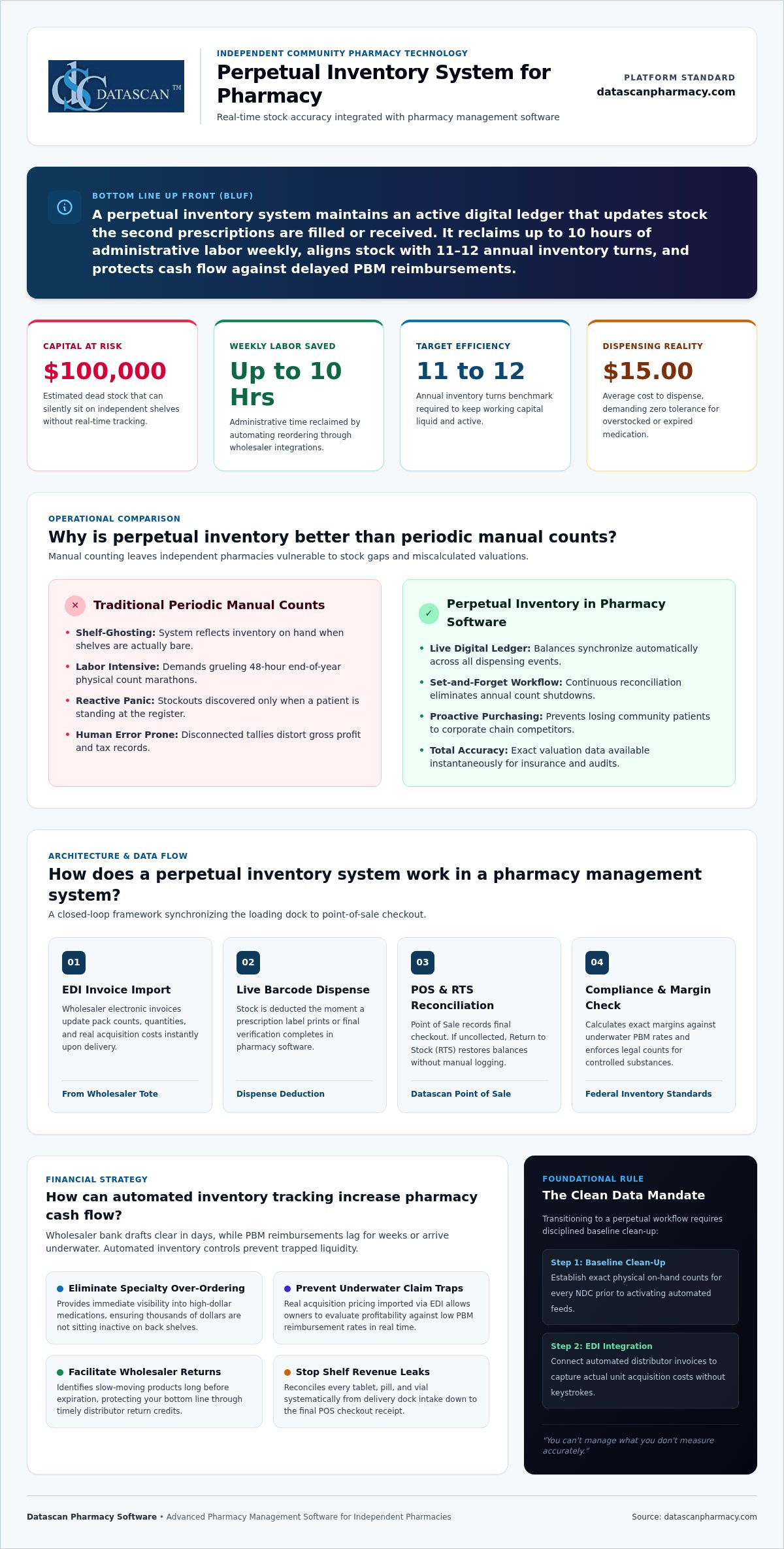
A perpetual inventory system for pharmacy is a software-driven method that updates stock levels in real-time as prescriptions are dispensed and shipments are received. This continuous tracking ensures your on-hand balances are always current, allowing you to manage your largest expense with surgical precision without the need for periodic manual counts. By maintaining a live digital ledger, you gain immediate visibility into exactly what is sitting on your shelves at any given moment.
For the independent pharmacy owner, drug stock isn’t just medicine; it’s liquid capital. In an era where the average cost to dispense has risen to $15.00 and PBM reimbursements continue to lag, letting cash sit idle in overstocked medications is a direct threat to your solvency. A perpetual inventory system acts as the financial heartbeat of your business. It tracks every tablet and vial from the moment it leaves the wholesaler’s tote until it’s handed to the patient. This “always-on” nature means your pharmacy management software is constantly reconciling your physical shelf with your digital records, providing a level of financial clarity that manual systems simply cannot match.
How does it differ from traditional manual counting?
Traditional counting is a reactive nightmare that often results in “shelf-ghosting,” a situation where your system claims you have a drug in stock, but the shelf is actually bare. Manual counts are historically prone to human error and require massive labor investments that pull your staff away from patient care. By contrast, an automated system offers a “set it and forget it” workflow. You move away from the grueling 48-hour end-of-year counts and toward proactive stock management. This shift prevents the panic of realizing you’re out of a critical medication only when a patient is waiting, helping you maintain the high level of service that defines independent community pharmacies.
Why is real-time data critical for independent pharmacies?
Independent pharmacies must be leaner and faster than their corporate counterparts to survive PBM margin compression. Real-time data gives you immediate visibility into high-dollar specialty medications, ensuring you aren’t over-ordering products that tie up thousands of dollars in cash flow. This is especially vital as you aim for the industry benchmark of 11 to 12 inventory turns per year.
Prevent Stockouts: Avoid losing patients to big-box chains because of inaccurate inventory levels.
Financial Accuracy: Know the exact valuation of your inventory for tax and insurance purposes at any second.
Waste Reduction: Identify slow-moving stock before it expires to facilitate wholesaler returns and protect your bottom line.
How does a perpetual inventory system work in a pharmacy management system?
A perpetual inventory system for pharmacy functions as a real-time digital ledger that synchronizes your physical stock with your software records through automated data feeds. It eliminates manual entry by using Electronic Data Interchange (EDI) to import wholesaler invoices and barcode scanning to track every dispense. This creates a closed-loop system where your on-hand balances are adjusted the second a drug enters or leaves your building.
When your daily order arrives, you simply scan the wholesaler invoice or import the EDI file. The pharmacy software automatically updates your quantities and acquisition costs. This ensures your gross profit calculations are based on what you actually paid, helping you identify underwater PBM reimbursements immediately. Stock is then deducted the moment a label is printed or when the transaction is finalized at the Datascan Point of Sale. If a patient doesn’t pick up a medication, the Return to Stock (RTS) function reverses that deduction, keeping your counts precise without manual logs. This level of detail is essential for meeting federal inventory requirements for controlled substances, where accuracy is a legal mandate.
What are the steps to implement a perpetual workflow?
Transitioning to an automated workflow requires a methodical approach to ensure your data remains “clean” from day one. You can’t manage what you don’t measure accurately. Follow these steps to get started:
Baseline Count: Conduct a comprehensive clean-up phase to establish exact on-hand counts for every NDC in your pharmacy.
Define PAR Levels: Set minimum and maximum “periodic automatic replenishment” (PAR) levels to trigger automated reordering when stock hits a specific threshold.
System Integration: Ensure your pharmacy management software is fully synced with your POS to capture every depletion event.
How does barcode verification ensure inventory accuracy?
Barcode verification is the ultimate safeguard against “phantom inventory,” which is stock that exists in your system but isn’t actually on your shelf. By requiring a scan at the filling station, the software confirms the NDC and quantity match the prescription exactly. This prevents quantity errors that skew your financial reports and, more importantly, ensures patient safety. It creates an audit-ready environment where every pill is accounted for, protecting your pharmacy from PBM clawbacks and regulatory fines. If you’re ready to stop the manual guesswork, you can reach out to our team to see how these integrated tools work in a live environment.
Why is perpetual inventory better than periodic manual counts?
Perpetual inventory is superior to periodic counting because it provides a real-time valuation of your pharmacy’s largest asset while eliminating the grueling, 48-hour manual audits that lead to staff burnout. Unlike periodic counts that offer a “snapshot” of a single moment, a perpetual inventory system for pharmacy reflects the actual state of your shelves every second. This continuous accuracy is vital for tax reporting and insurance purposes, ensuring you aren’t overpaying premiums on inventory you don’t actually have. It also allows you to identify wholesaler short-ships or preventing internal theft in a pharmacy by flagging variances the moment they occur.
Relying on manual counts means you’re always working with outdated data. If a high-cost medication is stolen or lost on Monday, you might not realize it until the next scheduled count weeks or months later. With a live system, every pill is accounted for from the moment it’s received until it’s scanned at the point of sale. This creates a culture of accountability and precision that manual systems can’t replicate, protecting your bottom line from the “shrinkage” that often goes unnoticed in independent stores.
How much time can pharmacists save with automation?
Pharmacists often lose 5 to 10 hours every week to manual administrative burdens like shelf-scanning and order generation. By switching to automated par level triggers, you eliminate the need to “guess” what needs to be ordered. Your pharmacy software handles the replenishment logic for you, freeing up your time for higher-margin clinical services and Medication Therapy Management (MTM). Simplifying the “putting away the order” process also reduces staff stress, as the system already knows what’s in the tote, making reconciliation a matter of seconds rather than hours.
How does it reduce “dead stock” on your shelves?
Dead stock is essentially cash that’s been frozen on your shelves, and in 2026, no independent pharmacy can afford that. Research shows that roughly 10% of a retail pharmacy’s inventory value approaches expiration annually. Without proactive tracking, much of this becomes non-returnable, resulting in total financial write-offs. A perpetual system identifies medications that haven’t moved in 60 to 90 days, allowing you to return them for wholesaler credit before they expire. Moving toward an optimal turnover rate of 11 to 12 turns per year ensures your capital is working for you, not gathering dust in a bottle of slow-moving tablets.
How can automated inventory tracking increase pharmacy cash flow?
Automated inventory tracking increases cash flow by ensuring your most expensive assets, your medications, are turning over fast enough to cover wholesaler payments before PBM reimbursements arrive. By using a perpetual inventory system for pharmacy, you stop over-purchasing high-cost brands that sit idle, effectively “taking cash off the shelf” and putting it back into your operating account. This strategy is vital for maintaining an optimal turnover rate of 11 to 12 turns per year, which prevents your capital from being trapped in slow-moving stock.
Independent pharmacies currently face an economic paradox where sales grow while net profitability plummets due to underwater reimbursements and non-transparent fee models. A real-time system allows you to see your true acquisition cost via EDI feeds, which is a critical component for calculating pharmacy gross profit with precision. When you have immediate visibility into your margins, you can optimize your generic-to-brand mix to favor higher-margin items, protecting your business from the volatility of PBM clawbacks and DIR fee impacts.
Can inventory systems help overcome PBM reimbursement challenges?
Wholesaler payment cycles typically range from 7 to 14 days, while PBM claim remittances often take 14 to 30 days or longer. This timing gap creates a liquidity crunch that can sink an independent store. Automated tracking identifies underpaid claims by comparing the actual EDI invoice cost against the PBM remittance in real-time. This transparency lets you identify loss-leader drugs that are draining your resources. Better cash management also gives you the leverage to “buy right” from secondary wholesalers when prices are lower, further padding your bottom line. To see how real-time tracking can stabilize your bank balance, contact our team for a software walkthrough.
How does it help with front-end sales and retail profit?
Profitability isn’t limited to the back-end dispensing area. Your front-end retail space is a vital source of non-PBM revenue that isn’t subject to the same reimbursement delays. By using integrated pharmacy management software, you can track OTC trends and implement front-end sales strategies for pharmacies that drive higher basket totals. The system helps you identify which supplements or health products are moving, allowing for targeted patient engagement and cross-selling. This ensures your front end is just as optimized and profitable as your prescription department.
How does Datascan’s pharmacy software simplify inventory management?
Datascan simplifies inventory management by consolidating your dispensing, POS, and stock tracking into a single, cohesive ecosystem. This ensures that every pill counted at the filling station is instantly reflected at the register and in your reorder queue. As a family-owned company since 1981, we build our perpetual inventory system for pharmacy specifically to empower the independent owner who is fighting against corporate chains and PBM margin compression. We don’t just provide tools; we provide a financial defensive strategy that keeps your capital off the shelf and in your bank account.
Our pharmacy management software removes the technical friction often found in larger, generic vendor systems. We provide a customizable reporting suite that focuses on the metrics that actually matter for your bottom line: gross profit, inventory turns, and dead stock identification. By connecting your Datascan Point of Sale directly to your inventory ledger, we close the loop that often leads to revenue leaks. This integrated approach allows you to manage your business with precision, ensuring that your inventory investment is always optimized for maximum profitability.
What makes our US-based support different?
Independent pharmacy owners don’t have time to wait in a phone queue for a technician who doesn’t understand the nuances of their business. Our US-based support team provides direct access to experts who specialize in the specific pressures of community pharmacy. We handle the heavy lifting of wholesaler EDI setups and invoice mapping, ensuring your acquisition costs are accurate from the very first shipment. We also focus on training your staff to use our Workflow Software effectively, so your team can maintain stock accuracy without adding hours of manual labor to their daily shift.
Ready to take control of your pharmacy inventory?
We position ourselves as your Visionary Ally, offering the cutting-edge capabilities of a major corporation with the personal accountability of a family-run business. Transitioning from an error-prone manual count to a perpetual inventory system for pharmacy is the most impactful step you can take to reclaim your time in 2026. We help you navigate the implementation phase with minimal downtime, turning your complex operational burdens into streamlined successes. Request your personalized demo today to see how our technology can stop your revenue leaks and transform your pharmacy’s cash flow.
Secure Your Pharmacy’s Financial Future with Smarter Inventory
Implementing a perpetual inventory system for pharmacy is no longer just an operational upgrade; it’s a financial necessity in the face of 2026’s PBM pressures. By automating your stock levels and integrating your workflow with dedicated pharmacy management software, you reclaim thousands in “dead stock” capital and eliminate the burnout of manual counting. You’ve seen how real-time data allows you to turn inventory 11 to 12 times per year, ensuring your cash flow remains liquid even when reimbursements lag.
Datascan has been the champion of independent pharmacies since 1981, offering a 100% US-based support team and a fully integrated POS and inventory management ecosystem. We understand that your time is best spent with patients, not spreadsheets. It’s time to transform your pharmacy from a struggle for solvency into a streamlined, profitable success. Request a Datascan Demo to See Our Perpetual Inventory in Action and take the first step toward a more secure bottom line. Your independence is your greatest strength; let’s protect it together.
Frequently Asked Questions
How do I start a perpetual inventory system in my pharmacy?
Begin by conducting a thorough physical count to establish an accurate baseline, then configure your pharmacy software with EDI feeds from your wholesalers. This integration ensures every drug received is automatically added to your on-hand counts. Next, set your par levels for each NDC to allow the system to trigger automated reorders. This moves your team away from manual shelf-scanning and toward a proactive, software-driven workflow that saves hours every week.
Is a perpetual inventory system hard to maintain for a small staff?
No, it actually reduces the workload for small teams by automating the most time-consuming tasks like manual ordering and end-of-year audits. Once your par levels are established, the pharmacy management software handles the daily replenishment logic for you. Your staff simply needs to scan wholesaler invoices upon arrival and verify NDCs at the point of sale. This integrated approach frees up significant time, allowing a lean staff to focus on higher-margin clinical services.
Does perpetual inventory help with PBM audits and DIR fees?
Yes, it provides the precise, real-time documentation required to defend against PBM clawbacks and audit variances. By tracking every pill from receipt to dispense, you can prove exactly what was on your shelf at any given time. This transparency helps you identify underwater claims immediately by comparing acquisition costs from EDI feeds against reimbursements. While it doesn’t stop DIR fees directly, it gives you the data needed to optimize your drug mix and protect your margins.
What is the difference between perpetual and periodic inventory?
Perpetual inventory updates in real-time with every transaction, while periodic inventory relies on manual counts performed at set intervals. Periodic systems are often inaccurate because they only provide a snapshot that quickly becomes outdated as stock moves. A perpetual inventory system for pharmacy ensures your software records always match your physical shelf. This continuous accuracy allows you to manage your cash flow more effectively and identify shrinkage or wholesaler short-ships the moment they occur.
Can I track both Rx and OTC items in the same system?
Yes, Datascan’s integrated pharmacy management software and POS allow you to track both prescription medications and front-end OTC items in one loop. This unified approach provides a total view of your pharmacy’s profitability. You can set par levels for supplements and health products just as you do for Rx stock. Using POS data to track retail trends helps you identify high-margin front-end items, ensuring your retail space contributes significantly to your overall cash flow.
Do I need special hardware to run a perpetual inventory system?
You don’t need complex proprietary hardware; standard barcode scanners and a reliable local server are the primary requirements. Because Datascan is not cloud-based, your inventory data remains secure on your on-premise system, ensuring you can still process transactions and track stock even if your internet connection fluctuates. Most modern pharmacies already have the necessary scanners at the filling stations and the point of sale to facilitate the barcode verification needed for a perpetual workflow.
How does perpetual inventory improve my pharmacy gross profit?
It improves gross profit by maximizing your inventory turns and ensuring you aren’t overpaying for stock that sits idle on the shelf. When you turn your inventory 11 to 12 times per year, you’re effectively using your wholesaler’s money to fund your operations. The pharmacy management software also uses real-time EDI acquisition costs to help you identify and avoid loss-leader prescriptions. This data-driven approach is essential for overcoming the margin compression caused by predatory PBM reimbursement models.
Will this software help me identify expiring medications?
Yes, the pharmacy software identifies slow-moving medications that haven’t turned in 60 to 90 days, which are the items most likely to expire on your shelf. By flagging these NDCs early, the system allows you to return them for wholesaler credit while they are still within the return window. This proactive management prevents the 10% annual inventory shrinkage typically seen in stores that don’t use automated tracking, directly protecting your bottom line from unnecessary financial write-offs.
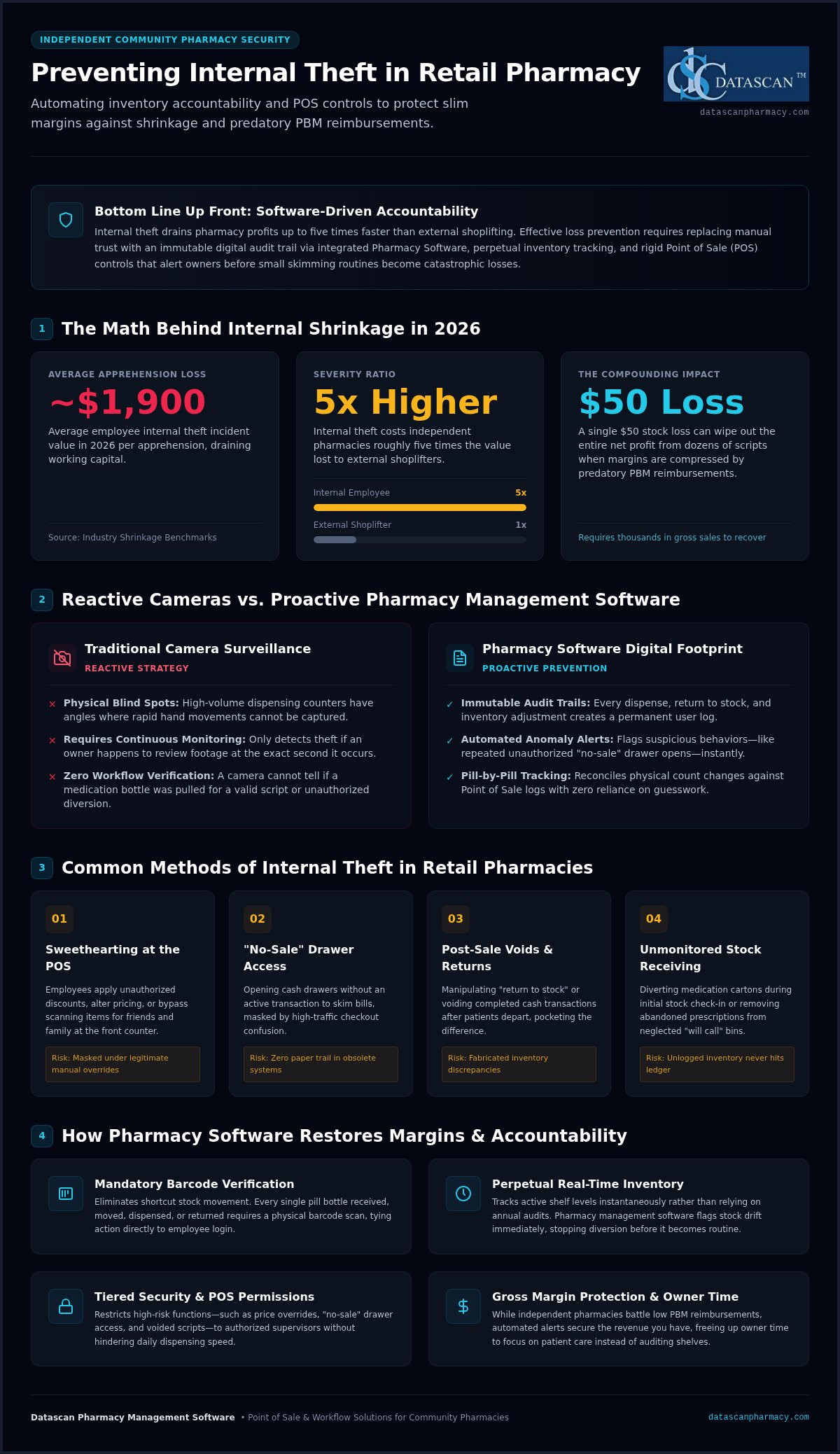
Did you know that internal employee theft incidents in 2026 average nearly $1,900 per apprehension, which is roughly five times the value lost to external shoplifters? Preventing internal theft in a pharmacy requires a strategic shift from emotional trust to automated accountability through integrated pharmacy management software and rigid POS controls. While you likely view your team as family, the reality of unexplained shrinkage in high-value inventory often points toward systemic gaps in your daily workflow. It’s an agonizing position to be in, especially when predatory PBM reimbursements are already squeezing your gross profit margins to the breaking point.
You’ll discover how to identify hidden shrinkage and secure your independent pharmacy using advanced Pharmacy Software that replaces manual oversight with precise, automated alerts. We will show you how to implement a clear system for monitoring transactions and reconciling POS data with actual stock levels. By the end of this guide, you’ll have a roadmap to eliminate hidden losses; moving your business from operational struggle to optimized efficiency while freeing up your time to focus on patient care rather than auditing shelves.
Key Takeaways
Understand why internal theft is often invisible and how it drains your profitability up to five times faster than external shoplifting.
Master the essential strategies for preventing internal theft in a pharmacy by replacing blind trust with automated software alerts and perpetual inventory tracking.
Identify common vulnerabilities like “sweethearting” at the register and see how integrated pharmacy management software closes the gaps between the counter and the script.
Learn to implement tiered security permissions that restrict unauthorized access to high-value inventory and sensitive POS functions without slowing down your workflow.
Discover how securing your inventory serves as a critical defense for your gross profit margins against predatory PBM reimbursements.
What is internal pharmacy theft and how does it impact independent pharmacies?
Internal pharmacy theft is the unauthorized removal of medication, cash, or merchandise by employees, and it is best prevented through strict pharmacy software permissions and perpetual inventory tracking. While external shoplifting is often a visible, one-time event, internal shrinkage is a silent, ongoing drain on your bottom line. It often goes unnoticed because the culprits are trusted team members who understand your daily routines and security gaps. In an era where independent pharmacies are already battling predatory PBM reimbursements, losing inventory to drug diversion or register skimming can be the difference between staying open and closing your doors.
Effective preventing internal theft in a pharmacy requires moving beyond simple trust. Dishonest employees often use legitimate workflows to mask their actions, such as manipulating “return to stock” procedures or voiding sales after a customer leaves. This makes the theft invisible to the naked eye. Your pharmacy management software must serve as an immutable audit trail, tracking every pill and every penny with total precision. By creating a digital footprint for every action, you eliminate the “gray areas” where theft typically thrives.
The true cost of shrinkage in 2026
A $50 loss in inventory doesn’t just cost you $50. It wipes out the net profit of dozens of prescriptions. Because independent margins are so thin, you might need to generate thousands of dollars in new sales just to recover from a single instance of theft. This math is especially brutal when you consider the compounding effect of low PBM reimbursements. When you’re fighting for every cent, you cannot afford to have your gross profit cannibalized from within. Unmonitored front-end sales are a common vulnerability, as small, repetitive skimming incidents add up to significant annual losses. Utilizing an integrated Datascan Point of Sale (POS) ensures that every transaction is accounted for, protecting your cash flow while you focus on navigating PBM reform.
Why traditional security cameras are not enough
Security cameras have blind spots, particularly in high-volume dispensing areas where hands move faster than a lens can capture. Relying on video surveillance is a reactive strategy; it only works if you happen to be watching the footage at the exact right moment. A digital audit trail doesn’t blink. While a staff member might hide a bottle to avoid a camera, they can’t hide a dispense that wasn’t logged or a “no sale” that wasn’t authorized in the Pharmacy Software. Transitioning from reactive “catching” to proactive prevention means using your pharmacy computer system to flag suspicious activity before it becomes a pattern. Digital logs provide the transparency and accountability that physical hardware simply cannot match.
What are the most common methods of internal theft in a retail pharmacy?
Internal theft in retail pharmacies typically manifests through point-of-sale manipulation, inventory diversion during check-in, and exploiting unmonitored “will call” bins. Success in preventing internal theft in a pharmacy relies on closing these specific workflow loopholes with integrated software that requires barcode verification for every stock movement. If your current system allows for “shortcuts” or manual overrides without a digital paper trail, you’re essentially providing a roadmap for dishonest behavior.
Point of Sale (POS) manipulation
The “sweethearting” technique is one of the most pervasive threats at the front counter. This occurs when an employee gives unauthorized discounts or simply doesn’t scan items for friends and family. Without strict controls in your pharmacy point of sale, these losses are often buried under the guise of legitimate price overrides or employee benefits. Another red flag is the “no-sale” drawer opening. This trick allows staff to access the cash drawer without a transaction record, a move that modern systems should immediately flag for owner review. Similarly, voided transactions and post-sale edits are frequently used to mask cash skimming after a customer has already walked out the door with their receipt.
Inventory and “Will Call” loopholes
Medication diversion often begins the moment a wholesaler delivery arrives. If your check-in process isn’t digitized and verified tablet-by-tablet, it’s easy for high-value bottles to go “missing” before they ever reach the shelf. The “will call” bin represents another significant risk. When prescriptions sit for extended periods, they become targets for incremental theft. An employee might “pinch” a few pills from a bottle before processing a return to stock, assuming the discrepancy won’t be noticed. Because these losses involve controlled substances, they trigger strict DEA theft and loss reporting guidelines, which can lead to heavy fines if your records don’t match your physical counts. Utilizing a customizable workflow that forces barcode verification at every step is the only way to ensure total accountability. Implementing these tech-driven barriers is the most effective way of preventing internal theft in a pharmacy while protecting your hard-earned margins. If you suspect your current workflow has these gaps, it’s time to reach out for a security audit of your technology stack.
Myth vs. Reality: Why trusting your staff isn’t a substitute for pharmacy system security
Trusting your staff is a vital part of a healthy workplace culture, but it’s never a substitute for the objective security of preventing internal theft in a pharmacy through automated system controls. Professional theft is rarely a one-time heist; it’s usually an incremental, slow-moving process performed by those who know your system’s blind spots better than you do. Relying on “gut feelings” or personal relationships to manage inventory is a dangerous gamble in an industry where razor-thin margins can’t absorb even small losses.
Many independent owners fall into the trap of believing long-term tenure equals immunity to dishonesty. In reality, employees with years of experience are often the most capable of exploiting manual gaps because they’ve mastered every workaround. They don’t typically “grab and run”; they skim slowly, taking a few tablets here or a few dollars there. Without robust Pharmacy Software that forces accountability, these small variances are easily dismissed as rounding errors or wholesaler mishaps. Furthermore, the “chaos” of a disorganized back-end provides the perfect cover for these activities. A lack of integrated pharmacy workflow software creates the very environment that thieves thrive in, as it’s impossible to pin down where a discrepancy occurred.
The “Family-Owned” trap
Independent pharmacies pride themselves on a family-oriented culture, but this warmth becomes a liability if it leads to “blind trust.” You can maintain a supportive partnership with your team while still requiring professional accountability. “Trust but verify” isn’t just a slogan; it’s a survival strategy when battling underwater PBM reimbursements. In manual environments, “trusted” employees can easily manipulate paper logs or bypass unforced steps, knowing there’s no digital audit trail to challenge them. By the time you notice the shrinkage, the financial damage is often irreparable.
Standardizing safety to protect your team
Implementing clear, tech-driven protocols in your pharmacy management software removes the “temptation” factor entirely. Honest employees actually prefer systems that track their accuracy because it provides concrete, irrefutable proof of their integrity. When every transaction is verified and every pill is tracked through barcode verification, your team doesn’t have to worry about being blamed for unexplained shrinkage. This level of precision doesn’t just protect your bottom line; it also saves you the immense emotional stress of investigating a team you care about. By automating these checks, you’re preventing internal theft in a pharmacy while simultaneously freeing up your time to focus on clinical services and PBM reform.
How can you use pharmacy software to prevent internal theft?
Pharmacy owners can stop shrinkage by implementing tiered user permissions, setting automated transaction alerts, and utilizing perpetual inventory system for pharmacy tracking within their pharmacy management software. These digital controls create an immutable audit trail that makes it nearly impossible for internal theft to go undetected. While traditional security measures like cameras offer a visual record, your software provides the data-driven proof needed to identify and stop dishonest behavior before it cripples your bottom line.
Permission-based POS security
Restricting access is your first line of defense. By using your Pharmacy management software to assign specific roles, you ensure that only authorized personnel can perform high-risk actions. For example, “Price Override” and “Tax Exempt” buttons should be restricted to management only. This prevents the unauthorized discounting and price manipulation that often mask theft at the front counter. You can also configure the system to require dual-verification for dispensing high-value medications. Every time a cash drawer opens without a completed sale, the system must log a “Drawer Open” event. This allows you to review a precise list of every time the till was accessed without a transaction, removing the anonymity that thieves rely on.
Leveraging business intelligence dashboards
Data is a powerful ally in preventing internal theft in a pharmacy. Modern Pharmacy software provides business intelligence dashboards that highlight suspicious patterns in real-time. By calculating pharmacy gross profit regularly, you can spot downward margin trends that might indicate inventory skimming or cash register manipulation. You should look for “outlier” employees whose transaction patterns differ from the team. If one technician has ten times more voids or overrides than others, your system will flag this for immediate investigation. Reconciling inventory against wholesaler invoices automatically ensures that every bottle you pay for actually reaches your shelves. These automated alerts for voids, overrides, and controlled substance access turn your pharmacy computer system into a 24/7 security guard. If you’re ready to lock down your inventory and protect your margins, contact our team for a software demonstration today.
Why Datascan Pharmacy Management Software is the ultimate defense against shrinkage
Datascan provides an integrated ecosystem of Pharmacy management software and POS tools that eliminate security gaps by forcing compliance through customizable workflows. This system ensures every pill and penny is tracked with an immutable audit trail, making it the most effective solution for preventing internal theft in a pharmacy while protecting your gross profit from predatory PBM reimbursements. When your dispensing and sale processes are perfectly synced, the “invisible” losses that plague manual systems become impossible to hide.
The primary vulnerability in many pharmacies is a lack of communication between the filling counter and the register. With the Datascan Point of Sale, every transaction is tied directly to the prescription record, closing the loopholes that allow for “sweethearting” or unauthorized voids. Our customizable workflow allows you to mandate barcode verification at every stage of the process. This forces your staff to follow your specific security protocols, eliminating the shortcuts that often lead to diversion or cash skimming. By automating these barriers, you aren’t just catching theft; you’re preventing it from ever starting.
Built for independent pharmacy owners, by family owners
We’ve been family-owned since 1981, which means we understand the specific pressures you face as an independent owner. We know that with PBM reform still a work in progress, you don’t have the luxury of losing even 1% of your inventory to shrinkage. Our non-cloud, locally-hosted approach offers superior reliability and data control, ensuring your security systems stay active even if your internet connection wavers. Our US-based technical support team is always available to help you interpret security reports and configure alerts, giving you the tools of a large corporation with the personal touch of a private partner. This technology acts as a time-multiplier, freeing you from the burden of manual auditing so you can focus on clinical growth.
Take control of your pharmacy’s future
Securing your business shouldn’t feel like an uphill battle against your own team. By shifting from a culture of vulnerability to one of total operational control, you protect your honest employees and your bottom line simultaneously. The peace of mind that comes with a fully audited dispensing process allows you to lead with confidence, knowing your inventory is safe and your business is optimized for maximum profitability. Don’t let hidden shrinkage undermine your hard work. It’s time to see the difference that the right Pharmacy software can make for your community pharmacy. Schedule a demo of Datascan Pharmacy Management Software today.
Reclaim Your Profits with Total Operational Control
Internal theft shouldn’t be an inevitable cost of doing business. By implementing rigid workflows and tiered permissions, you transform your pharmacy management software into a 24/7 security partner. We’ve explored how professional theft exploits the gaps in manual systems, making integrated POS and Rx tracking essential for any independent owner fighting thin PBM margins. Preventing internal theft in a pharmacy is about more than just catching a culprit; it’s about building a culture of accountability that protects your honest staff and your hard-earned gross profit.
Since 1981, Datascan has been a family-owned ally for independent pharmacies, providing US-based expert support and the most comprehensive POS and Rx integration in the industry. It’s time to stop the invisible drain on your bottom line and focus on your business growth. Protect your pharmacy with Datascan Management Software today. You have the power to reclaim your time and your profits with a system built to support your independence.
Frequently Asked Questions
What is the most common sign of internal theft in a pharmacy?
Unexplained inventory shrinkage is the most frequent indicator that internal theft is occurring within your pharmacy. This often manifests as discrepancies between your physical stock and the records in your pharmacy management system, especially regarding high-value or controlled medications. You should also watch for patterns of excessive “no-sale” drawer openings or frequent voided transactions at the register. Monitoring these red flags through automated software alerts is the most effective way of identifying dishonest behavior early.
Can pharmacy software really track individual pill discrepancies?
Yes, modern pharmacy management software utilizes perpetual inventory system for pharmacy tracking to monitor every single tablet from the moment it is checked in from the wholesaler. By requiring barcode verification during the dispensing process, the system maintains a real-time count of your on-hand stock. This level of precision is essential for preventing internal theft in a pharmacy because it allows owners to pinpoint exactly when a discrepancy occurred and which staff member was logged into the station.
How often should I audit my POS transaction logs?
You should review high-risk transaction alerts daily and conduct a more comprehensive audit of your POS logs every week. Daily reviews should focus on immediate red flags like price overrides, tax-exempt sales, and cash drawer openings that aren’t tied to a completed transaction. Weekly audits help you identify broader trends or outlier behaviors among specific employees. Utilizing integrated business intelligence tools simplifies this process by highlighting suspicious patterns automatically, saving you hours of manual work.
Is it legal to use software to monitor employee sales patterns?
It is entirely legal and considered a standard industry practice to monitor employee transactions within your pharmacy management software for security and compliance purposes. Most employment agreements and pharmacy regulations allow for the tracking of transaction logs, login timestamps, and inventory adjustments to ensure patient safety and business integrity. These digital audit trails are necessary for meeting federal reporting requirements and protecting your gross profit. It’s always wise to outline these monitoring policies clearly in your employee handbook.
What should I do if my pharmacy management system flags a suspicious transaction?
You should immediately investigate the flagged event by reviewing the digital audit trail and comparing it against your staff schedule and security footage. Start by identifying the specific user ID associated with the transaction and look for a history of similar overrides or voids. If the discrepancy involves controlled substances, you must follow mandatory DEA protocols for reporting significant losses within the required timeframe. Having US-based support can help you pull the detailed reports needed to verify the data before taking action.
How does perpetual inventory help prevent employee theft?
Perpetual inventory creates a continuous, real-time record of every stock movement, leaving no room for the “invisible” shrinkage that thieves rely on. When preventing internal theft in a pharmacy, this system forces accountability by requiring a digital footprint for every pill added or removed from your shelves. Since the software calculates the expected on-hand balance after every dispense, any shortage becomes immediately apparent during cycle counts, which discourages staff from attempting to divert medication or manipulate stock levels.
Will implementing strict software permissions slow down my pharmacy workflow?
While tiered permissions add a layer of verification, a high-quality pharmacy management system integrates these security checks seamlessly into your existing workflow. Forcing a manager’s authorization for high-risk actions like a price override only takes a few seconds but protects thousands of dollars in potential profit. Most independent pharmacy owners find that the time saved by avoiding manual inventory reconciliations and theft investigations far outweighs the minimal time spent on secure authorization steps during the day.
How much does internal theft typically cost an independent pharmacy?
Internal employee theft incidents in 2026 average nearly $1,900 per apprehension, which is roughly five times the cost of an average external shoplifting incident. For an independent pharmacy operating on thin margins, a single $2,000 loss can require $100,000 in new sales just to recover the lost profit. These financial drains are particularly dangerous when combined with low PBM reimbursements, making robust, software-driven security a critical requirement for maintaining your business’s solvency and long-term health.
Did you know that while your prescription margins have bottomed out at a 10-year low of roughly 20%, your front-end retail items could be generating gross margins as high as 50% or more? It’s no secret that PBM reimbursements and upfront price concessions are squeezing the life out of independent pharmacies, leaving many owners wondering how to sustain their legacy in 2026. You’re likely feeling the weight of declining profits and high DIR fees that eat away at your hard-earned revenue every single day.
The good news is that you don’t have to be at the mercy of PBMs to thrive. By implementing data-driven front-end sales strategies for pharmacies, you can transform your retail floor into a high-margin revenue engine that offsets reimbursement cuts. This article will show you how to leverage your pharmacy management software and integrated pharmacy point of sale technology to automate inventory and boost gross profit per visit. We’ll preview the specific tools you need to reclaim your time and diversify your income streams, ensuring your independent pharmacy remains a cornerstone of your community for years to come.
Key Takeaways
Offset declining PBM reimbursement rates by reclaiming high-margin retail profits that can reach gross margins of 50% or higher.
Implement data-driven front-end sales strategies for pharmacies by using integrated software reports to identify “Top Movers” and cross-link patient needs with OTC products.
Learn how to build a high-margin OTC department through a perpetual inventory system that sets automated stocking levels and eliminates costly “dead stock.”
Discover the critical difference between a basic cash register and a sophisticated pharmacy point of sale system that communicates with your management software in real-time.
Free up hours of administrative time each week by automating retail management tasks, allowing you to focus on patient consultations and business growth.
Why are front-end sales strategies vital for independent pharmacies in 2026?
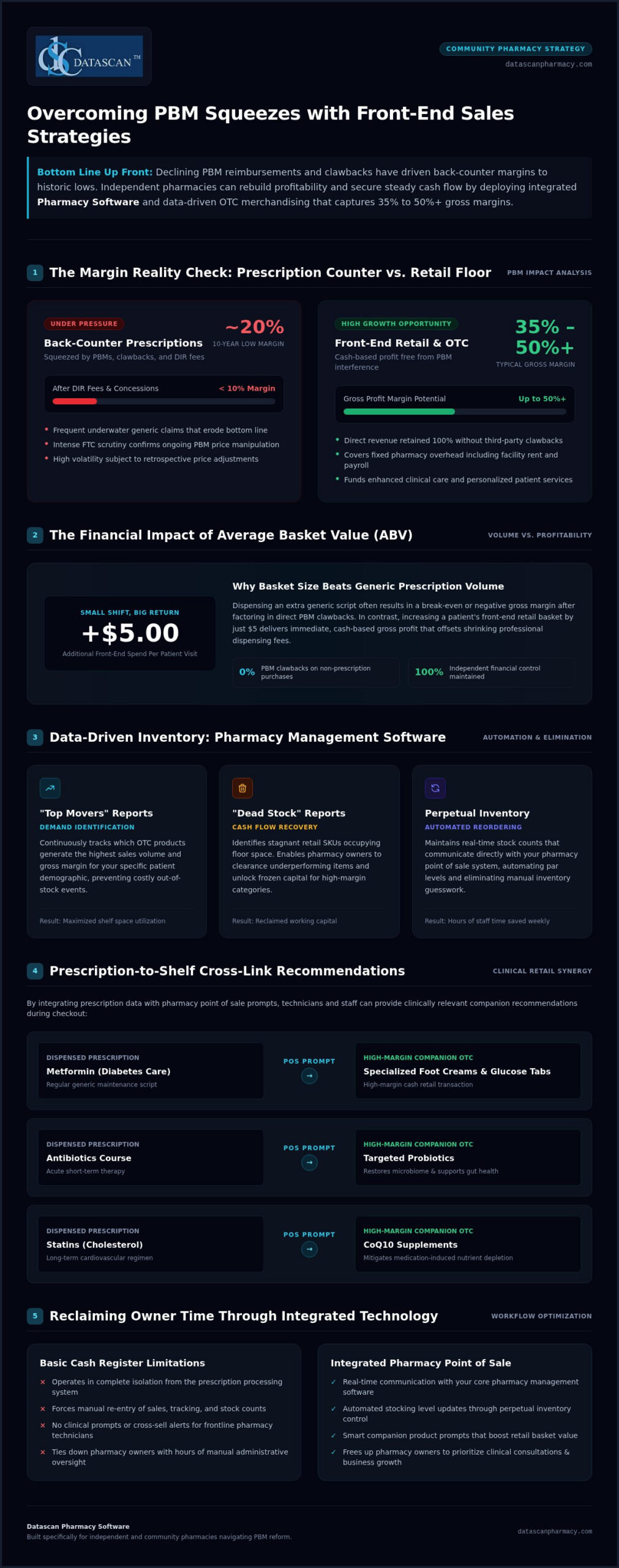
Front-end sales strategies for pharmacies are the retail tactics used to maximize non-prescription revenue, providing a critical high-margin buffer against declining PBM reimbursements. In 2026, relying solely on prescription volume is a dangerous gamble. With average overall gross margins hitting 10-year lows of around 20% and PBMs like Caremark and Express Scripts under intense FTC scrutiny for squeezing independents, the front-end is no longer optional. While your back-counter margins often dip below 10% after DIR fees and clawbacks, your front-end retail items consistently deliver 35% to 50% gross margins. Shifting your focus ensures you aren’t just “counting pills” but building a sustainable business. High-margin retail profit allows you to invest in the clinical services patients actually need, turning a struggle for survival into a streamlined success.
How do PBM reimbursements impact your retail focus?
Shrinking reimbursements make every square foot of your floor space more valuable than ever. When PBMs slash your professional fees, your front-end revenue must step up to cover fixed overhead like rent and staffing. By utilizing robust pharmacy management software, you can identify which aisles are actually paying the bills. By refining your front-end sales strategies for pharmacies, you can effectively insulate your business from the volatility of the insurance market. This strategic shift transforms your store from a simple dispensing hub into a community health and retail destination. It empowers you to spend more time on clinical care because you’ve secured the financial foundation of the business through high-margin OTC sales. When your front-end is optimized, you don’t have to chase volume just to break even on underwater generic claims.
The financial benefit of the “basket size” mentality
Success in 2026 requires a focus on Average Basket Value (ABV). Increasing a patient’s spend by just $5 in the front-end is often more profitable than dispensing a generic prescription with a negative margin. To manage this effectively, you need a perpetual inventory system integrated into your Datascan Point of Sale. This technology ensures you never miss a sale due to out-of-stocks. Our advanced Pharmacy Software allows you to track these trends in real-time, helping you stock the products your specific patient demographic demands. You can learn more about how these numbers impact your bottom line in our guide on how to calculate pharmacy gross profit. Every additional OTC item in the basket is a cash-based transaction free from PBM interference. This isn’t just about selling more; it’s about reclaiming the independence that PBMs have spent decades trying to erode.
How can data from your pharmacy management software drive retail growth?
Your pharmacy management software is more than a prescription processor; it’s a goldmine of consumer insights that identifies exactly what your patients need before they even leave the store. By analyzing purchasing patterns, you can eliminate the guesswork that leads to “dead stock” and instead focus on high-margin items that actually move. Data-driven front-end sales strategies for pharmacies rely on “Top Movers” reports to ensure your best-selling items are always in stock while using “Dead Stock” reports to clear out underperforming inventory, immediately freeing up vital cash flow for more profitable ventures.
Mining your Rx data for OTC opportunities
The most effective way to boost your bottom line is to link what happens at the script counter to what’s available on your shelves. Cross-link reporting allows you to see exactly what your diabetic patients are buying, or more importantly, what they aren’t. For example, a patient picking up metformin is a prime candidate for specialized foot creams or glucose tabs. You can set up automated prompts within your Datascan Point of Sale to remind staff to suggest clinically relevant companion products, such as probiotics with antibiotics or CoQ10 with statins. As highlighted in a recent FTC report on pharmacy reimbursement pressures, the financial squeeze on independents makes these cash-based companion sales essential for survival. This approach ensures you’re buying what sells rather than just buying what you like, protecting your margins from the unpredictability of PBMs.
Leveraging patient apps for front-end awareness
Modern Pharmacy Software extends your reach far beyond the four walls of your building. By utilizing the MobileScripts patient app, you can push retail-only coupons and monthly “front-end specials” directly to a patient’s smartphone. When a patient opens the app to request a refill, it’s the perfect opportunity to drive “in-app” browsing of your OTC departments. You’re not just providing a convenience; you’re creating a digital storefront that keeps your retail offerings top-of-mind. This level of engagement turns a routine refill into a personalized shopping experience, driving foot traffic and increasing the average basket value. If you’re ready to see how these integrated reports can work in your specific store, you can reach out to our team for a personalized walkthrough of our system’s capabilities.
What are the most effective examples of pharmacy front-end sales strategies?
Effective front-end sales strategies for pharmacies focus on transforming your retail floor into a solution-oriented environment that prioritizes high-margin products over low-profit commodities. By grouping items by ailment rather than brand, you create “Problem-Solution” endcaps that guide patients toward complete care. A patient suffering from a cold doesn’t just need medicine; they need tissues, vitamin C, and sanitizing wipes. Placing these items together increases your average basket value without requiring extra effort from your staff. Implementing private label programs is another powerful tactic. These allow independent pharmacies to compete with big-box pricing while maintaining gross margins of 50% to 70%, effectively insulating your cash flow from PBM volatility.
Strategic impulse buy zones and niche health services further diversify your revenue. You should optimize your checkout line with low-cost, high-margin items like professional-grade lip balms or healthy snacks that appeal to waiting patients. For stores looking to specialize, incorporating Durable Medical Equipment (DME) or utilizing compounding solutions can attract a loyal patient base that specifically seeks out your expertise. These specialized services are often cash-based or have better reimbursement rates than traditional retail scripts, making them essential for a modern, profitable pharmacy model.
Optimizing the OTC aisle layout
Your retail layout must follow the “Eye-Level is Buy-Level” rule to ensure your most profitable products are the first things patients see. Use professional signage to educate patients on the clinical benefits of premium supplements, as many shoppers are willing to pay more for quality when they understand the value. To keep the retail experience fresh for your regulars, dedicate a small section to “New Products” and rotate it monthly. For more detailed merchandising frameworks, you can explore NCPA’s Front-End Overhaul strategies, which provide actionable tips for independent community pharmacies looking to revitalize their floor space.
Implementing a loyalty program that actually works
A successful loyalty program goes beyond simple points; it should offer tiered rewards that encourage consistent front-end spending. By using your pharmacy management software to track participation, you can identify your most valuable customers and offer them exclusive benefits. For instance, creating a “Gold Member” tier that provides a 5% discount on all OTC items has been shown to significantly increase total annual spend per patient. This automated approach, managed through your Pharmacy Software, rewards loyalty while providing you with the data needed to refine your marketing efforts. When your technology handles the tracking, you save time and ensure no patient is overlooked in your quest for retail growth.
How do you build a high-margin OTC department with a perpetual inventory system?
Building a high-margin OTC department requires moving away from guesswork and implementing a perpetual inventory system for pharmacy that tracks every item in real-time. This technology ensures your shelves stay stocked with high-demand products while preventing “dead stock” from tying up your working capital. By integrating your retail floor with your Pharmacy Software, you can automate your replenishment cycle and focus your energy on patient care. These front-end sales strategies for pharmacies are essential for maintaining a healthy cash flow in a market where every dollar of retail profit counts.
To establish a truly efficient system, follow these five critical steps:
Step 1: Conduct a baseline inventory audit to clean up your pharmacy system software database, ensuring every SKU is accurately recorded.
Step 2: Set minimum and maximum (Min/Max) stocking levels for every retail SKU based on historical sales data.
Step 3: Enable automated ordering through your primary wholesaler so that your system triggers a purchase order the moment stock hits a minimum threshold.
Step 4: Use barcode scanning for every transaction at your Datascan Point of Sale to maintain real-time accuracy and prevent manual entry errors.
Step 5: Review “Shrinkage” reports weekly to identify discrepancies between your physical stock and your digital records.
The financial impact of perpetual inventory
Reducing “overstock” on slow-moving items can put thousands of dollars back into your bank account almost immediately. When your pharmacy management software alerts you to items that haven’t sold in 90 days, you can stop ordering them and repurpose that shelf space for higher-margin goods. This level of precision is also vital for retail compliance, particularly when managing FSA and HSA card processing for eligible OTC items. Manual inventory counts are the biggest time-waster for independent owners; automating this process through your POS saves hours of labor every week and eliminates the human error that leads to missed sales opportunities. To understand the full financial impact of implementing this approach, explore our comprehensive pharmacy perpetual inventory profitability guide for a detailed breakdown of how real-time stock accuracy translates directly to improved gross margins.
Preventing internal theft with smart POS security
A transparent, data-backed system is your best defense against preventing internal theft in a pharmacy and “sweethearting.” By using employee-specific logins, you can track every “No Sale,” “Voided” transaction, or price override in real-time. Your POS should be configured to set up alerts for suspicious front-end activity, ensuring that you’re notified of irregularities before they become a major financial drain. When your staff knows that every transaction is logged and audited within the Pharmacy Software, it creates a culture of accountability. This security doesn’t just protect your inventory; it protects your bottom line. If you’re ready to see how automated inventory can transform your store, you can contact our team for a personalized demonstration of our retail management tools.
Why is the right pharmacy point of sale system the key to retail success?
A true pharmacy POS system serves as the central nervous system of your retail operation, acting as the essential bridge between patient data and profitable transactions. Unlike a basic cash register that merely tallies totals, a sophisticated Datascan Point of Sale system integrates directly with your Pharmacy Software to ensure every retail decision is backed by real-time clinical and financial data. This integration is vital for independent pharmacies in 2026, as it allows for seamless inventory tracking, automated clinical prompts, and secure financial processing all within a single, unified platform. By choosing a system built specifically for the industry, you empower your staff to execute complex front-end sales strategies for pharmacies with total confidence.
When your POS “talks” to your pharmacy management software in real-time, you eliminate the manual entry errors that drain your time and profit. This synergy allows you to implement advanced retail tactics, such as automated loyalty rewards and targeted supplement recommendations, without adding to your staff’s administrative workload. Furthermore, the importance of US-based support cannot be overstated. When your retail system faces a technical hurdle during a busy holiday rush, you need immediate, expert assistance from a team that understands the unique pressures of the independent market. Reliable technology ensures your store remains operational and profitable, even during peak hours.
Streamlining the checkout experience
Speed and accuracy at the register are critical for maintaining patient satisfaction and protecting your margins. Integrated credit card processing speeds up your lines and significantly reduces the risk of manual entry errors that can lead to costly chargebacks. Your system should also capture digital signatures for HIPAA and delivery compliance directly at the point of sale, keeping you audit-ready without the burden of a paper trail. By leveraging workflow software, you can prevent bottlenecks at the register, ensuring that the transition from the script counter to the retail checkout is friction-free for every patient.
Extending the front-end with delivery and mobile tools
Your retail reach shouldn’t stop at your front door. By utilizing an electronic delivery system, your drivers can sell OTC items and capture secure payments right on the patient’s doorstep. This effectively transforms your delivery vehicle into a mobile storefront, allowing you to capture high-margin retail sales that might otherwise go to a big-box competitor. Additionally, offering Curbside Pickup for retail items via your patient app caters to the modern demand for convenience and speed. Technology doesn’t just manage your pharmacy; it actively grows it by meeting patients wherever they are. If you’re ready to modernize your retail operation, you can contact us today to see how our integrated solutions can drive your success.
Reclaim Your Pharmacy’s Independence and Profitability in 2026
The landscape for independent pharmacies is shifting rapidly, but the path to long-term success is clear. By prioritizing front-end sales strategies for pharmacies, you’re not just stocking shelves; you’re building a high-margin shield against declining PBM reimbursements. We’ve explored how leveraging integrated inventory management and real-time data allows you to reclaim hours of administrative time while maximizing every square foot of your retail space. It’s time to stop letting “dead stock” and inefficient manual counts drain your working capital.
Datascan has been family-owned since 1981, and we remain dedicated to providing the tools you need to thrive. Our integrated POS and pharmacy management software are backed by US-based technical support, ensuring you’re never alone in your quest for growth. You can transform your store into a streamlined, profit-driven destination that prioritizes both patient care and business health. See how Datascan POS can transform your front-end profitability today. We’re here to help you future-proof your legacy with precision and confidence.
Frequently Asked Questions
How can I increase front-end sales without hiring more staff?
You can increase front-end sales by automating your marketing and merchandising efforts through integrated technology. By setting up automated prompts in your pharmacy point of sale system, your current staff is reminded to suggest companion products during checkout without requiring extra training. Additionally, using a patient mobile app allows you to push digital coupons and specials directly to customers, driving retail traffic without manual outreach or additional payroll expenses.
What are the highest margin OTC categories for independent pharmacies?
Private label wellness products and professional grade supplements typically offer the highest margins, often reaching 50% to 70% gross profit. Unlike brand name commodities found in big box stores, these curated items allow you to leverage your clinical expertise to justify a premium price point. Other high margin categories include specialized wound care and durable medical equipment, which provide essential solutions for your local patient base while diversifying your non PBM revenue streams.
Does a pharmacy POS system really help with PBM reimbursements?
While a POS doesn’t change PBM contract rates, it acts as a critical financial shield by capturing the high margin cash revenue needed to offset reimbursement cuts. By using sophisticated front-end sales strategies for pharmacies, you can ensure that every patient visit contributes to your bottom line, even when prescription margins are underwater. The right system also provides the data needed to analyze which departments are effectively subsidizing your professional dispensing services.
How do I prevent internal theft in my pharmacy retail section?
Preventing internal theft requires a transparent system that tracks every retail action through employee specific logins. Your POS should provide detailed reports on No Sale instances, voided transactions, and price overrides to highlight suspicious patterns immediately. When your staff knows that the pharmacy management software logs every transaction and generates weekly shrinkage reports, it creates a culture of accountability that naturally discourages theft and sweethearting at the register. For a comprehensive breakdown of security protocols and common misconceptions, see our full guide on preventing internal theft in a pharmacy.
What is a perpetual inventory system and why does my pharmacy need one?
A perpetual inventory system is a continuous tracking method that updates your stock levels in real-time as items are scanned at the point of sale. Your pharmacy needs this to eliminate the manual labor of hand-counting and to prevent dead stock from tying up your cash. By setting automated min/max levels, your pharmacy system software ensures you never miss a high margin sale due to an out-of-stock item while keeping your inventory lean.
Can I sell front-end items through my pharmacy delivery service?
Yes, you can effectively extend your retail floor to the patient’s doorstep by utilizing a mobile delivery app. This technology allows your drivers to process OTC sales and capture secure payments remotely, turning every delivery into a potential retail transaction. Offering front-end items during the delivery process provides a high level of convenience for homebound patients while capturing revenue that would otherwise go to online retailers or big box chains.
How do I use my pharmacy software to find cross-selling opportunities?
You can identify cross-selling opportunities by using cross-link reports that analyze your prescription data to suggest relevant OTC products. For example, your pharmacy software can automatically prompt staff to recommend CoQ10 when a statin is dispensed or probiotics alongside an antibiotic. This data-driven approach ensures your recommendations are clinically sound and personalized, which builds patient trust while significantly increasing the average basket value of every visit.
What is the average gross profit margin for a pharmacy front-end?
The average gross profit margin for a pharmacy front-end typically ranges between 35% and 50%, which is significantly higher than the average prescription margin. Private label items and niche wellness categories can push these numbers even higher, sometimes exceeding 70%. In 2026, maintaining these healthy retail margins is essential for independent pharmacies to remain profitable and offset the financial pressure from PBM clawbacks and low reimbursement rates.
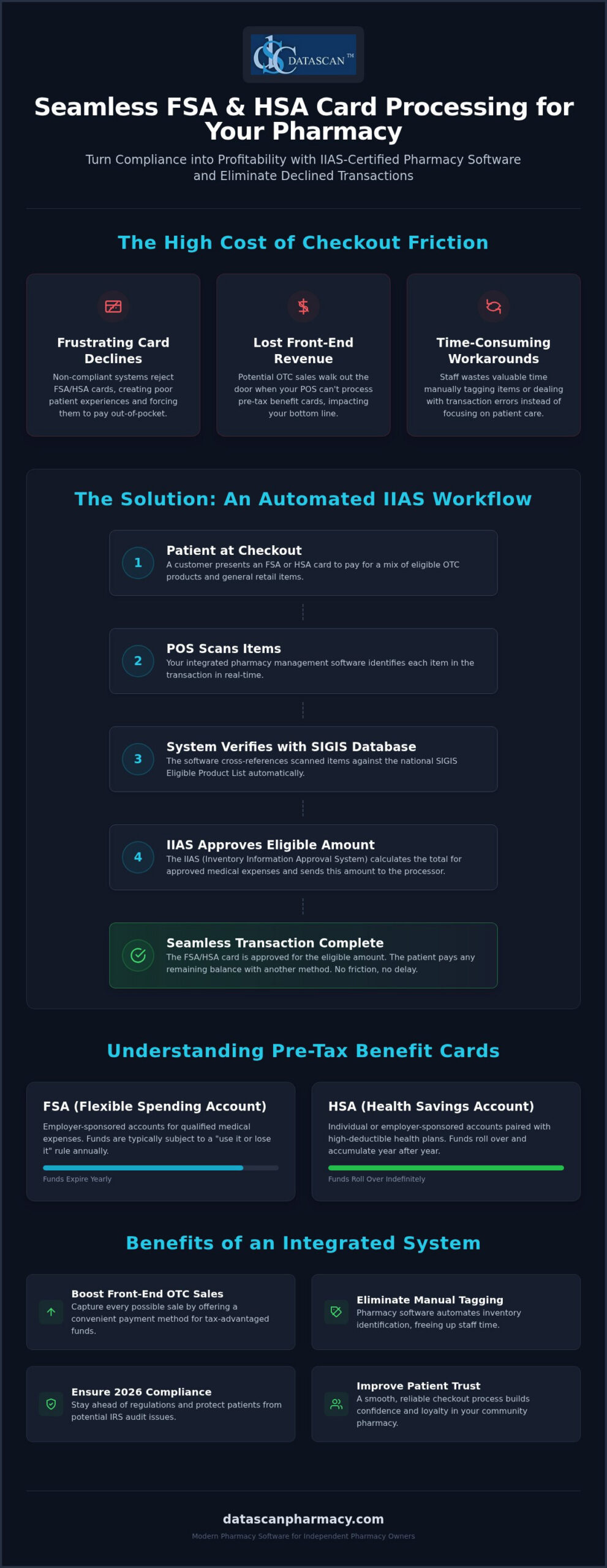
What if the biggest barrier to your front-end profitability isn’t your competition, but the “decline” message appearing on your credit card terminal? To maintain compliance and capture every possible sale, effective FSA and HSA card processing for pharmacy must be handled through an Inventory Information Approval System (IIAS) that’s built directly into your pharmacy management software. This integration ensures that eligible items are identified at the point of sale automatically, preventing the friction of manual tagging and the embarrassment of rejected transactions.
We know that independent pharmacy owners are already fighting uphill against PBM reimbursement pressures and administrative burnout. It’s frustrating to watch potential revenue walk out the door because your system isn’t communicating with SIGIS standards correctly. This guide will teach you how to implement a seamless, IIAS-compliant workflow that improves patient convenience while protecting your bottom line. We’ll break down the 2026 compliance landscape, show you how to automate your inventory identification, and demonstrate how modern technology can finally free up your time to focus on patient care instead of register errors.
Key Takeaways
Automate the identification of eligible medical expenses to eliminate time-consuming manual tagging and reduce frustrating checkout delays.
Ensure your pharmacy software and POS are IIAS-certified to prevent card declines and maintain strict regulatory compliance for 2026.
Streamline FSA and HSA card processing for pharmacy by integrating your inventory with a compliant SIGIS database to protect patients from IRS audits.
Follow a clear roadmap for auditing your current hardware and inventory systems to support seamless, pre-tax benefit card transactions.
Leverage specialized technology designed for independent pharmacies to reclaim lost time and drive higher profitability through increased front-end OTC sales.
FSA and HSA card processing for pharmacy allows independent pharmacies to accept pre-tax benefit cards for eligible medical expenses through an IIAS-certified point of sale system. This specialized technology ensures your pharmacy software automatically validates IRS-qualified items at checkout, which prevents transaction declines and eliminates the need for your staff to manually tag inventory. By implementing this system, you create a frictionless experience that protects your patients from tax penalties while driving higher front-end sales.
When you prioritize robust FSA and HSA card processing for pharmacy, you’re doing more than just adding a payment method; you’re investing in a tool that captures revenue and builds long-term patient trust. Success in the retail space depends heavily on your Merchant Category Code (MCC), which for pharmacies is 5912. This code signals to card issuers that your business is a legitimate healthcare provider. When your Datascan Point of Sale (POS) is correctly configured with this code and integrated with your pharmacy management software, you open the door to a seamless path to purchase that community members value.
What are FSA and HSA cards?
FSA (Flexible Spending Account) and HSA (Health Savings Account) cards are financial tools linked to employer-sponsored or individual tax-advantaged accounts. While FSAs generally operate on a “use it or lose it” basis within a plan year, HSAs allow funds to roll over and accumulate indefinitely. Both accounts are strictly reserved for IRS-qualified medical expenses, which means they can’t be used for non-medical retail items like snacks or greeting cards. Because these cards are restricted to specific healthcare-related merchants, the card issuer verifies your MCC to ensure the transaction is happening at a legitimate pharmacy.
Why do pharmacies need special processing for these cards?
Standard credit card processing falls short for benefit cards because the IRS mandates the use of an Inventory Information Approval System (IIAS). This requirement means your pharmacy software must verify the eligibility of every individual item in a transaction at the moment of sale. If your POS system cannot confirm that the patient is purchasing qualified products, the plan administrator will automatically decline the card to prevent tax non-compliance. Advanced pharmacy management software automates this complex verification by checking items against a national database, allowing your staff to process transactions quickly without manual intervention.
How does IIAS certification work in pharmacy management systems?
IIAS certification ensures that your pharmacy POS system automatically distinguishes between qualified medical expenses and standard retail items at the moment of checkout. This certification is essential for FSA and HSA card processing for pharmacy because it provides the technical validation that card administrators require to approve a transaction instantly. Without this certified system, benefit cards will simply decline at the register, forcing patients to pay out of pocket and file for reimbursement later.
The Datascan Point of Sale (POS) transforms this complex requirement into a background task by utilizing an integrated database that syncs directly with your core pharmacy software. Independent pharmacy owners often struggle with shrinking margins due to unfair PBM reimbursements; you can’t afford to lose additional front-end revenue because of technical checkout friction. By automating the identification of qualified items, you ensure that every OTC sale is captured efficiently. This high-level integration eliminates the need for your staff to manually override transactions, which not only saves time but also reduces the risk of human error during an audit.
What is the role of SIGIS in pharmacy processing?
SIGIS (Special Interest Group for IIAS Standards) functions as the central authority for benefit card compliance. They maintain an extensive “Eligible Product List” that serves as the industry standard for what counts as a medical expense. A robust pharmacy management software system will pull these updates automatically on a regular schedule. This means your inventory remains accurate even as regulations change or new products hit the market. It’s a “set it and forget it” solution that empowers you to compete with big-box chains while maintaining the personal touch of a community pharmacy.
How does the POS identify eligible items?
When a staff member scans a barcode, the system instantly cross-references the UPC against the SIGIS database. If the item is qualified, the POS flags it for benefit card payment. Modern systems utilize “dual-purse” technology to split a single transaction into two distinct totals: the amount covered by the FSA or HSA card and the remaining balance for non-eligible items. The patient can pay for their prescriptions and health supplies with their benefit card and then use a separate card or cash for everything else in one go. If you want to see how this workflow can benefit your store, connect with us today to learn more.
What are the requirements for accepting FSA and HSA cards?
To maintain compliance, an independent pharmacy must utilize an IIAS-certified POS, register with SIGIS, and maintain a Merchant Category Code (MCC) of 5912. These requirements ensure that FSA and HSA card processing for pharmacy remains secure and that every transaction stands up to IRS scrutiny. By meeting these standards, you protect your patients from potential tax penalties and ensure that their benefit cards work exactly as intended at the register.
Compliance isn’t a one-time setup; it’s an ongoing commitment to data accuracy and record-keeping. You must ensure your pharmacy software is properly configured to generate and store digital receipts for a minimum of 90 days, though many experts recommend retaining these records for several years to satisfy potential tax inquiries. Because the lists of eligible items are constantly shifting, your system must perform regular updates to stay current with SIGIS standards. This automation protects your patients from the headache of an IRS audit while keeping your checkout line moving quickly, allowing you to focus on clinical care rather than administrative hurdles.
How do I become SIGIS certified?
Becoming certified involves a few strategic steps that your pharmacy software vendor can help you navigate. First, you’ll need to join SIGIS as a merchant member to gain access to the national eligible product list. After joining, you complete a self-certification process that confirms your POS system meets the technical IIAS standards. Most payment processors won’t enable benefit card acceptance without this membership, so it’s a foundational piece of your technology stack that bridges the gap between your inventory and the card issuer’s requirements.
What items are generally eligible for FSA/HSA funds?
The scope of eligible items is broader than many realize, especially after the 2020 CARES Act expanded the list. Standard eligible categories include prescription drug copays, insulin supplies, and medical equipment like crutches or blood pressure monitors. The expansion also added menstrual care products and OTC medications, such as pain relievers and allergy pills, without the need for a prescription. While most health-related items are covered, “dual-purpose” products like certain vitamins or specialized supplements may still require a Letter of Medical Necessity (LMN). Your pharmacy management software should flag these nuances automatically, ensuring your staff doesn’t have to make judgment calls during a busy shift.
How do I set up FSA and HSA card processing at my pharmacy?
To set up FSA and HSA card processing for pharmacy, you must implement an IIAS-certified point of sale system that integrates directly with your pharmacy management software and a compliant SIGIS inventory database. This technical alignment ensures that every transaction is validated in real time, preventing the “card declined” messages that frustrate patients and slow down your checkout line. By following a methodical setup process, you can transform a complex compliance requirement into a streamlined workflow that protects your revenue and saves your staff valuable time.
Implementing this system involves five critical steps designed to ensure your pharmacy is ready for 2026 standards:
Step 1: Audit your current POS hardware to confirm it supports the data transmission protocols required for IIAS compliance.
Step 2: Ensure your pharmacy management software is linked to a compliant inventory database that receives regular updates.
Step 3: Register as a SIGIS member, which is a mandatory requirement for most independent pharmacies to access the national “Eligible Product List.”
Step 4: Train your staff on how to manage “mixed” baskets where some items are eligible and others require standard payment.
Step 5: Run test transactions with a specialized test card to verify that the system splits totals and processes approvals correctly before going live.
Why should I integrate my POS with my pharmacy management software?
A siloed POS system that doesn’t communicate with your core Rx software creates unnecessary manual work and increases the risk of accounting errors. When you use integrated workflow software, prescription copays are automatically flagged as eligible medical expenses, pulling data directly from the patient’s profile. This high-level integration provides centralized reporting that’s indispensable during tax season or a plan audit. It allows you to prove compliance with a few clicks, freeing you up to focus on clinical services rather than digging through disparate paper records. A fully integrated POS also plays a critical role in preventing internal theft in a pharmacy by creating an automated, auditable trail of every transaction that makes it far harder for discrepancies to go undetected.
How can I train my staff to handle benefit card transactions?
Staff training is the key to maintaining a professional environment when technical hurdles arise. Your team should be prepared to explain benefit card declines professionally, often pointing to plan-specific restrictions rather than system errors. You can also use this technology to drive front-end sales by training staff to remind patients they can use their remaining FSA funds on OTC essentials. If a patient’s plan requires additional verification, your team must know how to pull a detailed, IIAS-compliant receipt immediately to satisfy the request. If you’re ready to modernize your checkout experience, contact our team today to get started.
Why is the Datascan POS the best choice for independent pharmacies?
Datascan is the premier choice for independent pharmacies because it offers a fully integrated, IIAS-certified solution that transforms complex compliance into a competitive advantage. Our system is built to ensure that FSA and HSA card processing for pharmacy is automated and error-free, allowing you to capture every possible front-end sale without the administrative burden. As a family-owned company since 1981, we don’t answer to shareholders or private equity; we answer to the community pharmacists we’ve championed for decades.
When you encounter a payment processing issue, you need immediate answers, not a ticket in a global queue. Datascan provides 100% U.S.-based support, ensuring that you speak with experts who understand the nuances of your pharmacy management software and the specific pressures of the retail environment. This partnership is vital as independent pharmacies face aggressive PBM reform challenges and shrinking reimbursements. By driving profitable front-end OTC sales through seamless benefit card acceptance, we help you diversify your revenue streams and stay ahead of market trends.
Streamlining operations to free up time
Automated IIAS updates within our pharmacy software eliminate the need for manual inventory tagging, which is often a major time-sink for understaffed teams. This technical precision ensures your inventory is always current with SIGIS standards, freeing up your staff to focus on high-value clinical services and patient counseling. If you’re currently using a legacy system that feels like a burden, a pharmacy software conversion to Datascan is a direct investment in your store’s future efficiency.
Protecting your bottom line and profitability
In an era of low PBM reimbursements, every dollar of front-end revenue is critical for calculating pharmacy gross profit and maintaining a healthy business. Datascan empowers you to compete with big-box chains by offering the same sophisticated payment technology they use, delivered with the personal accountability of a private partner. Our Datascan Point of Sale (POS) doesn’t just process cards; it acts as a strategic tool to maximize your margins and improve patient retention. We invite you to see the difference for yourself. Connect with us today for a personalized demo of how our technology can transform your daily operations.
Future-Proof Your Front-End Revenue
Mastering FSA and HSA card processing for pharmacy is a strategic move that does more than just satisfy a compliance checklist; it transforms your register into a high-efficiency revenue engine. By automating IIAS and SIGIS updates within your pharmacy management software, you eliminate the friction of manual overrides and ensure your patients can use their pre-tax funds without the frustration of unexpected declines. This technical precision is essential for independent owners who need to reclaim their time and diversify their income in the face of evolving PBM reimbursement challenges.
Since 1981, Datascan has operated as a family-owned ally for independent pharmacies, providing the U.S.-based expert support you need to navigate complex operational shifts. Our seamless POS integration helps you capture every possible sale while maintaining the personal touch that defines community pharmacy. Don’t let technical barriers hold back your growth or patient loyalty. Take the next step toward a more profitable and streamlined operation by choosing a partner that’s fiercely loyal to your success. Request a Demo of Datascan Pharmacy POS Today and see how we can empower your business for 2026 and beyond.
Frequently Asked Questions
Do I need a special merchant account to process FSA and HSA cards?
You don’t necessarily need a brand-new merchant account, but your existing payment processor must be configured to recognize your pharmacy’s specific Merchant Category Code (MCC 5912). Most importantly, your pharmacy software must be IIAS-certified to communicate effectively with the card issuer. Without this technical bridge, the processor cannot verify that the funds are being used for qualified medical expenses, leading to automatic declines at your register.
Why do some HSA cards work at my pharmacy but others get declined?
Declines typically occur because different plan administrators have varying levels of security and compliance requirements. Some cards utilize a “90% Rule” while others strictly require an IIAS-certified POS system to validate every item. If your pharmacy management software isn’t properly synced with the latest SIGIS eligible product list, the system may fail to vouch for an item’s eligibility, causing the transaction to fail even if the product is technically covered.
Is SIGIS membership mandatory for independent pharmacies?
While not a government law, SIGIS membership is effectively mandatory for independent pharmacies that want to automate their checkout workflow. Membership gives you access to the national “Eligible Product List,” which your POS uses to identify qualified items instantly. Without this membership, you’d have to manually identify and tag every eligible item in your store, which is an impossible task for a busy community pharmacy owner looking to save time.
How does the 2020 CARES Act affect what I can sell via FSA cards?
The 2020 CARES Act significantly expanded the range of items you can sell through FSA and HSA card processing for pharmacy. It permanently reinstated the eligibility of over-the-counter (OTC) medications without a doctor’s prescription and added menstrual care products to the list of qualified expenses. This expansion is a major opportunity for independent pharmacies to increase their front-end OTC sales by promoting these now-eligible everyday health essentials to their patients. To make the most of this opportunity, explore proven front-end sales strategies for pharmacies that can help you turn expanded FSA eligibility into measurable retail profit.
Can I process FSA cards for prescriptions only without an IIAS system?
You can technically use the “90% Rule” if 90% of your gross sales come from prescriptions and eligible medical items, but this requires a complex annual registration and manual record-keeping. It’s much more efficient to use an IIAS-certified pharmacy system software. This automation ensures that every transaction is compliant at the line-item level, which protects your patients from IRS audits and eliminates the administrative burden of manual reporting for your staff.
How long should a pharmacy keep records of FSA and HSA transactions?
You should maintain detailed digital records of all benefit card transactions for a minimum of 90 days to satisfy immediate plan administrator requests. However, for tax and audit protection, many experts recommend retaining these records for up to seven years. A robust pharmacy management software system will store these IIAS-compliant receipts automatically, ensuring you can pull them instantly if a patient or an auditor needs verification of a past healthcare purchase.
What happens if a patient tries to buy non-eligible items with an HSA card?
When a patient brings a “mixed” basket to the register, a modern POS system will utilize “dual-purse” technology to handle the transaction. The system automatically calculates the total for eligible medical items and charges that amount to the HSA card. It then prompts the clerk to collect a second form of payment, such as cash or a standard credit card, for the remaining non-eligible items like snacks or greeting cards in a single transaction.
Can I accept FSA cards through my pharmacy mobile app?
Yes, you can accept these cards through your mobile platform if your pharmacy software provider offers an integrated solution like the MobileScripts Patient Mobile App. The app must be linked to the same IIAS-certified inventory database as your in-store POS to ensure that only eligible prescription copays or OTC items are charged to the benefit card. This integration provides the same level of compliance and convenience for home delivery or mobile refills.
Did you know that after a recent spike in performance standards, there was a 35% decrease in health plans achieving a 4-Star Rating or better? For independent owners, this shift means the margin for error has vanished, making the right technology for improving star ratings your most critical asset. You can’t manually track every patient’s Proportion of Days Covered (PDC) while fighting complex PBM reimbursement models. To protect your bottom line, you need Datascan Pharmacy Management Software to automate clinical interventions and patient outreach before your scores slip.
We understand that the pressure of high DIR fees and the constant burden of paperwork can make you feel like you’re losing the “independent” in independent pharmacy. It’s frustrating to spend more time on spreadsheets than with the patients who rely on your care. This guide reveals how modern pharmacy software and tools like the MobileScripts Patient Mobile App directly influence Star Rating metrics to boost your performance and profitability. We’ll explore the specific 2026 adherence thresholds for diabetes and hypertension and show you how to reclaim your time through automated workflows that turn operational struggles into streamlined successes.
Key Takeaways
Learn how technology for improving star ratings automates patient outreach and real-time tracking to identify care gaps before they impact your performance scores.
Discover how medication synchronization and automated refill reminders within your pharmacy management software stabilize patient behavior to meet 2026 PDC thresholds.
Streamline clinical interventions by integrating MTM platforms directly into your workflow, transforming complex operational burdens into streamlined successes.
Empower your patients and strengthen the pharmacist-patient relationship through the MobileScripts Patient Mobile App and secure messaging tools.
Understand the financial advantage of partnering with a family-owned software vendor that prioritizes independent pharmacy profitability and provides dedicated U.S.-based support.
How does technology improve pharmacy Star Ratings?
Technology for improving star ratings automates patient outreach, tracks medication adherence in real-time, and identifies gaps in care before they impact your performance scores. By 2026, your pharmacy management software isn’t just a dispensing tool; it’s the central hub for protecting your revenue. PBMs use these ratings to determine your value in their network. If your scores aren’t competitive, you’ll face aggressive DIR fees that eat into your margins. Because Star Ratings are primarily used to evaluate Medicare Part D plans, your performance directly influences the quality bonus payments those plans receive, making you a vital partner or a financial liability.
What metrics do Star Ratings actually measure?
Performance is largely driven by the “Triple-A” clinical metrics, which focus on medication adherence for diabetes, hypertension, and cholesterol. For the 2026 Star Ratings, the thresholds are higher than ever. To help a plan achieve a 5-star rating, your patients must maintain a Proportion of Days Covered (PDC) of at least 92% for diabetes and 93% for hypertension and cholesterol. Beyond adherence, CMS measures Medication Therapy Management (MTM) completion rates and Comprehensive Medication Reviews (CMR). While patient experience and access measures were reduced to a 2x weight for 2026, they still account for a significant portion of the overall score. Using Datascan Pharmacy Management Software allows you to monitor these specific clinical outcomes through a single, integrated dashboard.
Why is manual tracking no longer viable in 2026?
Relying on manual tracking or monthly PBM reports is a recipe for financial disaster. PBM performance windows are complex. Waiting for trailing data means you’re reacting to problems that have already damaged your score. Manual tracking is prone to human error, and even a handful of missed adherence interventions can result in thousands of dollars in lost revenue. You need a system that updates your clinical metrics daily. Modern technology identifies at-risk patients immediately, allowing your staff to intervene when it actually matters. By automating the identification of care gaps, you free up your team to focus on clinical care instead of drowning in spreadsheets. High-performing pharmacies use automation to stay ahead of PBM reimbursement changes and ensure their independence remains profitable.
Pharmacy management software directly increases patient medication adherence by automating the repetitive tasks that keep patients on track with their chronic therapies. When you implement Datascan Pharmacy Management Software, you’re not just filling bottles; you’re deploying a proactive clinical engine. This technology for improving star ratings identifies at-risk patients who are late for refills, allowing your staff to intervene before a missed dose impacts your performance metrics. According to the 2025 Medicare Advantage and Part D Star Ratings data, adherence measures remain a cornerstone of plan evaluation, making these automated tools essential for your survival against aggressive PBM reimbursement models.
How does Medication Synchronization drive scores?
Medication synchronization, or Med Sync, is the most effective way to stabilize patient behavior and secure your pharmacy’s financial health. By aligning all chronic medications to a single monthly pickup date, you eliminate the friction of multiple trips to the pharmacy, which is a major barrier to adherence. This consistency naturally increases the Proportion of Days Covered (PDC). For the 2026 rating cycle, achieving an 80% PDC or higher is the standard for success. Beyond clinical scores, Med Sync improves your internal workflow efficiency by allowing you to prepare prescriptions during slow periods. It also optimizes inventory management, ensuring you aren’t tying up capital in stock that sits on the shelf for weeks. It transforms a chaotic dispensing schedule into a predictable, high-performing operation that frees up your time for clinical care.
What are automated adherence alerts?
Automated adherence alerts act as a safety net for your most vulnerable patients. Your pharmacy software can generate real-time notifications for your staff to call patients who have fallen behind on high-weighted drug classes, such as those for diabetes, hypertension, and cholesterol. These text and email reminders keep the patient engaged with their therapy without requiring hours of manual phone calls from your technicians. You can customize these alerts to prioritize patients with the lowest PDC scores, ensuring your interventions have the maximum impact on your Star Ratings. Integrating barcode verification into this process ensures that every refill is accurate and safe, further protecting your pharmacy’s reputation for quality care. If you want to see how these tools can transform your daily operations, it might be time to reach out for a workflow assessment.
Which software features are most effective for improving Star Ratings?
The most effective software features for improving Star Ratings include automated MTM prompts, integrated e-care plans, and real-time performance dashboards that allow you to document clinical interventions without leaving your dispensing screen. By utilizing Pharmacy Workflow Optimization Software, you ensure that every technician and pharmacist is working toward the same performance goals during their standard shifts. Investing in the right technology for improving star ratings means choosing tools that turn clinical care into a billable, documented reality rather than a manual administrative burden.
To maximize your scores in 2026, your pharmacy management software should prioritize these high-impact features:
Automated MTM triggers integrated with platforms like OutcomesMTM.
Real-time PDC tracking for diabetes, hypertension, and cholesterol medications.
Electronic Care Plan (e-care) documentation for audit-proof record keeping.
Performance dashboards with goal-setting and PBM reimbursement alignment.
Customizable clinical alerts that prompt staff for interventions at the point of sale.
How do I integrate MTM tasks into my daily dispensing workflow?
Managing Medication Therapy Management (MTM) tasks shouldn’t require your staff to log into multiple external portals or juggle separate spreadsheets. Your pharmacy software should serve as a bridge, surfacing Comprehensive Medication Review (CMR) and Targeted Medication Review (TMR) opportunities directly within the patient profile. This technology for improving star ratings ensures that when a pharmacist is already reviewing a patient’s record, they’re prompted to complete the necessary clinical documentation in one seamless motion. By documenting these interventions in real-time, you maintain the high completion rates PBMs demand while freeing up your time to focus on complex patient consultations instead of redundant data entry.
Which metrics should my pharmacy performance dashboard show?
A performance dashboard is only valuable if it provides actionable data that links directly to your bottom line. Your dashboard should visualize your current standing in the Triple-A adherence categories, comparing your actual PDC scores against the 2026 5-star thresholds of 92% and 93%. It’s critical to have a system that identifies underperforming categories instantly, allowing you to prioritize outreach efforts where they’ll have the greatest impact on your overall score. High-performing independent pharmacies use these dashboards to link clinical success to PBM reimbursement reports, providing a clear view of how improved adherence reduces DIR fees. This level of transparency empowers you to act as a champion for your business, ensuring your independence is backed by data-driven precision.
How do mobile patient apps influence Star Rating performance?
Mobile patient apps influence Star Rating performance by directly improving medication adherence and patient experience scores through streamlined communication and automated refill reminders. As PBMs increasingly scrutinize patient engagement, deploying a dedicated app is a vital piece of technology for improving star ratings. By putting the pharmacy in the patient’s pocket, you remove the barriers that lead to therapy gaps and poor clinical outcomes. This digital connection ensures your pharmacy remains the primary healthcare hub for your community, especially as you look toward promoting a new pharmacy mobile app to patients to drive long-term growth.
How does the MobileScripts Patient Mobile App drive results?
The MobileScripts Patient Mobile App empowers your patients to take ownership of their health by providing a transparent view of their entire medication profile. Within the app, patients can set custom dose reminders and receive push notifications when it’s time to request a refill. This functionality is critical for maintaining a high Proportion of Days Covered (PDC), as it prevents the “out-of-sight, out-of-mind” mentality that often leads to non-adherence. Because the app integrates directly with your pharmacy management software, refill requests are processed instantly, reducing the administrative burden on your staff and ensuring that patients never face a gap in their chronic therapy. Reducing friction in the refill process is one of the fastest ways to stabilize your performance metrics.
How does secure messaging build patient trust?
Trust is a measurable component of the Medicare Star Rating system, particularly within the Consumer Assessment of Healthcare Providers and Systems (CAHPS) surveys that measure patient experience. Using secure messaging with patients app features allows you to answer clinical questions in real-time, providing the personalized care that big-box competitors simply can’t match. This two-way communication builds a stronger relationship between the pharmacist and the patient, which translates into higher satisfaction scores and better retention. When patients feel supported and informed, they’re more likely to stick with their prescribed regimens and provide positive feedback during PBM-mandated surveys. To see how these tools can strengthen your patient relationships while protecting your bottom line, schedule a demo of our patient engagement suite.
How can the right pharmacy software vendor help you manage PBM reimbursements and Star Ratings?
The right pharmacy software vendor helps you manage PBM reimbursements by providing transparent data auditing tools and automated reporting that identifies underpaid claims. This strategic partnership ensures your technology for improving star ratings isn’t just a clinical tool but a financial defense system against unfair DIR fees. Choosing a family owned partner like Datascan ensures your specific operational needs aren’t ignored by a massive corporation. When you have a vendor that understands the pressures of the independent market, you gain access to innovative features designed specifically for your profitability and long term success.
A high quality vendor provides several key advantages for independent owners:
Direct Advocacy: They act as a champion for the independent rather than answering to corporate shareholders.
U.S. Based Support: You receive help from experts who understand the American regulatory and PBM landscape.
Continuous Innovation: They frequently update features to combat evolving PBM reimbursement models.
How do I use my data to challenge unfair DIR fees and underpayments?
Independent pharmacies face a constant battle against complex PBM reimbursement models and unpredictable DIR fees. Your pharmacy management software should serve as a defensive shield, providing granular data that allows you to audit every claim for accuracy. By leveraging real-time performance data, you can identify discrepancies in how PBMs apply performance based fees and use that evidence to challenge unfair clawbacks. A vendor that focuses on independent pharmacy profitability will continuously update their system to keep pace with PBM reform, ensuring you have the reporting tools needed to negotiate better contract terms. This data driven approach is essential for any pharmacy patient retention strategies, as it ensures you remain financially viable enough to continue serving your community.
Operational Area
Impact of Modern Pharmacy Software
PBM Auditing
Real-time identification of underpaid claims
DIR Fees
Lower fees through optimized performance scores
Staff Burnout
Reduced workload through automated clinical prompts
Patient Care
More face-to-face time for clinical consultations
Can automated workflows really prevent pharmacist burnout?
One of the most significant benefits of sophisticated pharmacy software is its ability to reclaim your most valuable resource: time. Automating mundane tasks like refill reminders, inventory tracking, and clinical documentation allows you to step away from the computer and back to the counter. This shift is critical for preventing pharmacist burnout while maintaining the high standards required for 5 star performance. When your workflow is streamlined, you finally have the bandwidth to focus on PBM reform advocacy and high level business growth. U.S. based support from a family owned company means that when you do have questions about complex Star Rating data, you’re talking to experts who understand your business personally. Technology is the ultimate tool for the modern independent pharmacy champion, transforming operational struggles into a competitive advantage that protects your legacy and your bottom line.
Secure Your Pharmacy’s Financial Future in 2026
The strategic shift toward clinical outcomes in the 2026 CMS Star Ratings means your operational success is now inseparable from your digital capabilities. By automating medication adherence tracking and leveraging patient engagement tools like the MobileScripts Patient Mobile App, you protect your business from the revenue draining impact of poor performance scores. Implementing high performance technology for improving star ratings isn’t just about compliance; it’s about reclaiming your time and ensuring your independence remains profitable in a landscape dominated by PBM pressures.
Datascan has been a dedicated partner to independent pharmacies since 1981. As a family owned and operated company, we provide the built in Med Sync and MTM tools you need to excel, backed by industry leading U.S. based support. You don’t have to face complex reimbursement models alone when you have a visionary ally in your corner. Our pharmacy management software is designed to transform your operational burdens into streamlined successes.
Your commitment to patient care is your greatest strength. Let our technology handle the paperwork so you can stay focused on the clinical care that your community deserves.
Frequently Asked Questions
How do Star Ratings affect independent pharmacy profitability?
Star Ratings directly impact independent pharmacy profitability by determining the level of DIR fees and quality bonus payments you receive. High performance scores lead to lower clawbacks and better reimbursement rates, while poor scores result in aggressive financial penalties. For independent owners, these ratings are often the difference between a healthy margin and a loss. Utilizing specialized pharmacy management software helps you monitor these metrics to protect your bottom line against PBM pressures.
What is the most important technology for improving medication adherence?
Medication synchronization is the most critical tool for improving medication adherence and stabilizing patient behavior. By aligning all chronic prescriptions to a single pickup date, you ensure patients have a consistent supply of medication, which naturally raises their Proportion of Days Covered. This technology for improving star ratings is built into Datascan systems to help you meet the 2026 PDC thresholds for diabetes and hypertension without increasing your staff’s manual workload.
Can my pharmacy management software help reduce DIR fees?
Yes, your pharmacy software reduces DIR fees by identifying clinical care gaps and adherence issues before they negatively impact your performance scores. Since many DIR fees are tied to Star Rating metrics, using automated alerts and real-time dashboards allows you to intervene with at-risk patients immediately. This proactive approach ensures you maintain the high scores required to qualify for lower fee categories or performance incentives offered by many PBM networks.
How often should I check my pharmacy’s Star Rating performance?
You should check your performance metrics daily to ensure you aren’t missing critical intervention windows for your patients. Waiting for monthly PBM reports means you’re reacting to old data that’s already damaged your scores. Modern pharmacy system software provides real-time business intelligence dashboards that visualize your standing against 2026 goals. Frequent monitoring allows you to prioritize outreach for high-weighted drug classes like cholesterol and diabetes medications before the performance window closes.
Does a patient mobile app really improve my Star Rating?
A patient mobile app significantly improves Star Ratings by reducing friction in the refill process and enhancing communication scores in patient surveys. Tools like the MobileScripts Patient Mobile App represent vital technology for improving star ratings by empowering patients with dose reminders. These easy refill requests directly increase medication adherence. Additionally, secure messaging features build the trust measured in CAHPS surveys, helping your pharmacy outperform competitors who lack a personalized digital touchpoint.
What should I look for in a pharmacy software vendor regarding Star Ratings?
Look for a vendor that offers integrated clinical tools, real-time data dashboards, and reliable U.S. based support. You need a partner that understands the specific pressures of independent pharmacies and continuously adds features to combat PBM reimbursement challenges. A family owned vendor like Datascan, which has been operating since 1981, provides the historical perspective and personal accountability required to build future proof solutions. Don’t use vendors that treat clinical performance as an afterthought.
Is medication synchronization difficult to implement with current pharmacy software?
Implementation’s straightforward when you use a system with a built in, customizable workflow designed for Med Sync. Modern pharmacy management software automates the identification of eligible patients and simplifies the alignment of refill dates. This technology allows your team to move away from chaotic, reactive filling to a predictable, organized schedule. By streamlining this process, you reduce staff burnout while simultaneously boosting the adherence scores that PBMs use to calculate your reimbursements.
How does MTM integration impact my pharmacy’s performance scores?
MTM integration boosts performance scores by prompting pharmacists to perform Comprehensive Medication Reviews during the standard dispensing process. Instead of logging into external portals, your pharmacy software should surface these clinical opportunities automatically. This seamless workflow ensures high completion rates for PBM mandated interventions. Documenting these services within your e-care plans not only improves your clinical standing but also creates opportunities for billing for professional services, further diversifying your revenue streams.