Is the lowest monthly subscription fee actually the most expensive mistake your independent pharmacy could make in 2026? When you evaluate the cost of PioneerRx vs Datascan, it’s easy to get lost in base pricing and overlook the predatory hidden fees that erode your bottom line. You’ve likely felt the sting of shrinking margins, especially as specialty drugs now account for over half of net drug spending. We know that every dollar spent on pharmacy software must be an investment in your survival, not just another line item on your overhead.
This comparison moves beyond the sticker price to reveal the total cost of ownership and the strategic value differences that separate these platforms. You’ll discover how choosing the right pharmacy management software can provide better tools to fight PBM underpayments and recover lost revenue following the latest 2026 legislative reforms. We’ll preview the essential features that automate complex workflows, giving you back the time needed to focus on business growth. By the end of this analysis, you’ll have a clear roadmap to selecting a partner that champions your independence and protects your profitability in a volatile market.
Key Takeaways
Define the true Total Cost of Ownership (TCO) by identifying hidden integration and support fees that often mask the real price of a system.
Compare the cost of PioneerRx vs Datascan by analyzing the long-term ROI of a corporate-driven model against a stable, family-owned partnership.
Discover how specialized Pharmacy management software tools can help you identify underpaid claims and navigate aggressive PBM reimbursement tactics.
Learn to utilize advanced Pharmacy Software workflows to automate manual tasks and reclaim hours of ownership time each week for business growth.
Follow a step-by-step audit process to calculate the financial impact of a software conversion based on transparent, all-inclusive pricing structures.
Beyond the Sticker Price: Understanding Pharmacy Software Costs
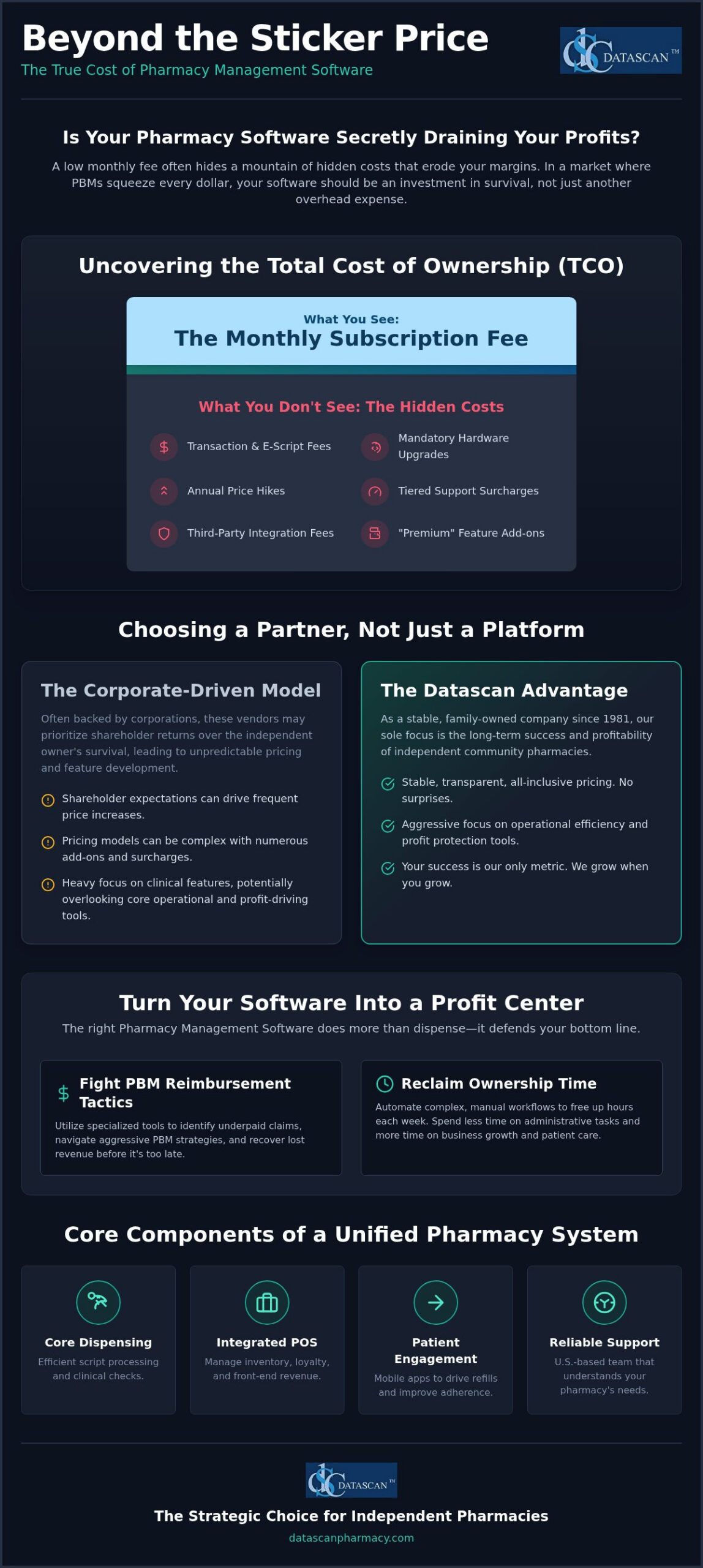
Evaluating the cost of PioneerRx vs Datascan requires a fundamental shift in perspective from “what I pay today” to “what I lose tomorrow.” Most owners look at the monthly license fee as the primary metric. This sticker price is often just the tip of the iceberg. A low entry price frequently masks a cascade of secondary expenses that can cripple a pharmacy’s budget over time. When Pharmacy Software is backed by massive corporations with shareholders to satisfy, annual price hikes become a standard operational hazard. These corporations often prioritize profit margins over the survival of the independent owner.
You are already fighting Pharmacy Benefit Managers (PBMs) for every cent of reimbursement. Your software vendor shouldn’t be another entity draining your bank account through aggressive “nickel and dime” tactics. Total Cost of Ownership (TCO) includes everything from hardware maintenance and support contracts to the third-party integrations required to keep your doors open. If these costs aren’t transparent from day one, your profitability will suffer. It is vital to audit your vendor’s history of price stability before signing any long-term agreement.
There is also the heavy burden of opportunity cost. If a system is so complex that it requires weeks of intensive training for every new hire, you are losing valuable time. This is time that should be spent on clinical services, patient counseling, or strategic business development. Efficiency is the only way to overcome the labor shortages and administrative bloat currently facing community pharmacies. A system that is too difficult to navigate effectively raises your labor costs even if the monthly software bill seems low.
The Components of a Modern Pharmacy System
A complete Pharmacy management software solution isn’t just a dispensing engine; it must integrate several moving parts to be truly effective. Independent pharmacies need a unified ecosystem to compete with the big chains.
Core dispensing licenses for daily script processing and clinical checks.
An integrated Point of Sale (POS) system to manage inventory, loyalty programs, and front-end revenue.
Reliable, U.S.-based support that understands the unique pressures of the American healthcare landscape.
Hidden Fees to Watch for in Pharmacy Software Contracts
When comparing the cost of PioneerRx vs Datascan, look specifically at the fine print regarding transaction-based billing. Many vendors lure you in with a competitive base rate but then charge extra for features that are essential for modern practice.
Transaction fees for every e-prescription or insurance claim processed through the system.
Support surcharges for access to help desk tiers, hardware troubleshooting, or software updates.
Monthly fees for adding “premium” features like medication synchronization, delivery tracking, or document management.
By choosing a partner with all-inclusive pricing, you eliminate the budget volatility that comes with hidden contract clauses. This allows you to forecast your overhead with precision and focus your energy on patient care instead of invoice auditing.
PioneerRx vs. Datascan: Comparing Value and ROI
When you weigh the cost of PioneerRx vs Datascan, you aren’t just comparing lines of code; you’re choosing a business philosophy. PioneerRx operates within a corporate driven model where shareholder expectations often dictate pricing and development priorities. In contrast, Datascan has maintained family owned stability since 1981. This independence allows us to prioritize the needs of community pharmacies over quarterly profit reports. While PioneerRx focuses heavily on clinical features, Datascan balances innovation with an aggressive operational and profit focus. We believe your Pharmacy Software should be a tool that actively protects your bottom line, not just a platform for documentation.
The financial health of your pharmacy depends on how your vendor responds to industry shifts. Recent federal scrutiny has highlighted how PBMs impose unfair, arbitrary, and harmful contractual terms on independent owners. You need a partner that updates its Pharmacy management software to combat these specific threats. While corporate entities might move slowly or prioritize features that benefit their data partners, Datascan rapidly deploys tools designed to help you navigate reimbursement challenges and PBM reform. This agility is a core component of your long term return on investment.
Workflow Efficiency and Time Savings
Labor is your largest controllable expense. Every extra click in your dispensing process is a drain on your profitability. High performance Datascan workflow software is engineered to reduce the number of steps required per script, allowing your staff to fill more prescriptions in less time. Automated refill management serves as a secondary labor saving tool, handling the heavy lifting of patient outreach without manual intervention. By integrating your management system with our proprietary Point of Sale (POS), you eliminate the reconciliation errors and double entry common with third party systems.
Support Models: Corporate Call Centers vs. Expert Ally
Downtime is a silent killer of pharmacy revenue. If your system goes down and you’re stuck in a corporate call center queue, you’re losing more than just time; you’re losing patient trust. Corporate support models often rely on tiered help desks where the first person you speak with lacks the authority to solve complex issues. Datascan provides US-based pharmacy software support that treats your pharmacy like a partner, not a ticket number. This level of accountability is essential when executing a Pharmacy Software Implementation Plan or troubleshooting critical billing issues. You can connect with our team to see how a dedicated support ally can transform your daily operations.
How Pharmacy Management Software Fights PBM Margin Squeeze
The true cost of PioneerRx vs Datascan isn’t just the price you pay for a license; it’s the revenue you lose when your system fails to flag an underpaid claim. PBMs rely on opaque pricing and complex fee structures to compress your margins. If your technology doesn’t provide real-time visibility into these tactics, you’re essentially flying blind. Effective Pharmacy Software must act as a financial shield, identifying scripts that fall below your required margin before the patient even leaves the counter. Automated PBM reconciliation is no longer a luxury in 2026. It’s a non-negotiable requirement for survival.
Recent legislative shifts, including the Consolidated Appropriations Act of 2026, have mandated higher transparency for manufacturer rebates. While these reforms are a step forward, PBMs continue to use arbitrary contractual terms to squeeze independent owners. You need Pharmacy management software that tracks DIR fees with precision and helps you navigate these shifting reimbursement landscapes. Specialty drugs now account for 52% of total drug spending despite making up only 2% of prescriptions. This massive concentration of spend means that even a small error in reimbursement tracking can result in thousands of dollars in lost profit every month.
Reclaiming Revenue with Advanced Reporting
Stop guessing which prescriptions are actually profitable. Advanced reporting within Datascan Pharmacy Management Software allows you to identify high-margin versus low-margin scripts instantly. By monitoring profit margins at the point of dispensing, you can make informed decisions about inventory and clinical priorities. This level of granular data helps you fight back against “spread pricing” and ensures every transaction contributes to your pharmacy’s long-term viability. When you can see your net profit after all fees are accounted for, you gain the upper hand in a competitive market.
Freeing Up Time for Clinical Services
Profitability in 2026 requires moving beyond the pill bottle. You need to free up time for higher-reimbursement e-care plans and clinical services. Automating mundane administrative tasks is the only way to reclaim the hours needed for patient counseling and medication synchronization. These programs create predictable revenue streams and improve patient adherence simultaneously. Efficiency tools, like the Datascan Electronic Delivery System, streamline your logistics so your staff can focus on growth-oriented tasks. By letting technology handle the repetitive workflows, you transform your pharmacy from a dispensing hub into a high-performance clinical center.
Calculating the ROI of a Pharmacy Software Conversion
Deciding to switch your Pharmacy Software is a significant operational move that requires a cold, hard look at the numbers. When you analyze the cost of PioneerRx vs Datascan, you aren’t just looking at a monthly bill; you’re calculating the return on investment for your store’s future. Start by auditing your current monthly fees and per-transaction costs. Many owners are shocked by how much they actually pay once e-prescribing surcharges, claim fees, and “premium” support tiers are added up. Next, estimate the value of staff time saved through a better workflow. If your current system requires ten clicks for a refill that should take three, you’re hemorrhaging labor costs every single day.
The third step involves calculating potential revenue gains from integrated PBM reconciliation tools. In an era where middlemen use opaque tactics to squeeze independent pharmacies, a system that flags underpaid claims in real-time is a revenue generator, not an expense. Finally, factor in the stability of your vendor. Corporate mergers in the software space often lead to forced migrations, sunsetting of features, or sudden price hikes to satisfy shareholders. Choosing a family-owned partner provides a level of accountability and long-term pricing security that massive conglomerates simply cannot match. This stability is a core component of your ROI that often goes overlooked during the initial sales pitch.
The Cost of “Staying Put”
Sticking with outdated technology has a price tag that doesn’t show up on a traditional balance sheet. Patients expect modern conveniences like mobile refills and digital notifications. If your current Pharmacy management software lacks these features, you’re likely losing younger demographics to competitors who offer a more streamlined experience. “Free” or cheap software often costs more in the long run due to lost efficiency, patient churn, and the inability to fight back against reimbursement compression. For a deeper dive into what your system should be doing for you, read The Ultimate Guide to Pharmacy Management Software in 2026.
Mitigating the Risk of Migration
The fear of downtime often keeps owners trapped in bad contracts. Datascan eliminates this risk by handling the entire pharmacy software data migration process with precision, ensuring your pharmacy remains operational throughout the transition. Specialized training during the implementation phase is vital to ensure your staff hits the ground running without a dip in productivity. Our US-based pharmacy software support is critical during those first 30 days, providing immediate answers from experts who understand your specific business needs. Don’t let the fear of change hold your pharmacy back from peak profitability. You can schedule a consultation with our experts today to see how a conversion can pay for itself through recovered revenue and improved efficiency.
Why Datascan is the Strategic Choice for Independent Pharmacies
Choosing a partner for your Pharmacy Software is one of the most critical decisions you’ll make for your business’s longevity. When you evaluate the cost of PioneerRx vs Datascan, the real differentiator is accountability. Since 1981, Datascan has remained a family-owned enterprise dedicated exclusively to the success of independent community pharmacies. We don’t answer to venture capitalists or distant shareholders who demand quarterly price hikes. Instead, we answer to you. This independence allows us to offer a “best-of-both-worlds” experience: the high-performance capabilities you expect from a market leader delivered with the personal touch and responsiveness of a private, family-run business.
Our focus remains laser-targeted on the issues that actually impact your bank account, specifically PBM reimbursements and operational efficiency. While corporate-owned competitors may focus on feature bloat to justify high monthly fees, we prioritize the tools that help you fight back against unfair PBM tactics. By streamlining your workflow, our Pharmacy management software frees up your time to focus on patient care and business growth. This clarity of purpose is what separates family-owned stability from corporate complexity.
Empowering the Underdog
We view ourselves as the champion of the independent pharmacy owner. Our philosophy is built on the idea that the “underdog” deserves the same technological advantages as the big-box chains without the predatory pricing. We provide continuous innovation that is future-proof, ensuring your store is ready for the clinical shifts of 2026 and beyond. Whether you are managing complex compounding or high-volume retail, our solutions are designed to optimize every aspect of your operation. We don’t just sell software; we build a foundation for your independence.
Take the Next Step Toward Profitability
Beyond software, independent owners can also leverage physical automation to stay competitive; for example, ReadyLockers provides a universal smart locker platform that allows pharmacies to offer secure, 24/7 pickup options similar to those found at national chains.
This philosophy of empowering independent businesses with precision tools is universal; for instance, electrical contractors can discover Best Bid to access specialized estimating software that helps them compete effectively in their own industry.
The journey to a more profitable pharmacy starts with a simple evaluation. We invite you to see a personalized demo of the Datascan system to experience firsthand how our integrated tools can transform your daily workflow. Beyond dispensing, we can show you how optimizing the pharmacy POS system can drive front-end revenue and improve patient retention. Don’t settle for a vendor that treats you like a ticket number in a corporate database. Contact us today for a custom quote tailored to your specific volume and discover the value of a partner that’s as invested in your success as you are.
Take Control of Your Pharmacy’s Financial Destiny
Choosing between vendors is more than a technical decision; it’s a commitment to your store’s long-term survival. Evaluating the cost of PioneerRx vs Datascan reveals that true value lies in more than just a monthly license fee. You need Pharmacy management software that provides specialized tools to recover PBM underpayments and a workflow that gives you back the time needed to grow your business. By moving away from corporate-driven complexity, you gain the clarity of a family-owned ally that has championed independent pharmacies for over 40 years.
With our 100% US-based support team and a deep focus on your profitability, Datascan ensures you never have to fight the PBM margin squeeze alone. It’s time to stop paying for hidden fees and start investing in Pharmacy Software built for your success. Schedule a Demo to See How Datascan Maximizes Your Pharmacy Profitability today. Your community relies on your independence, and we’re here to help you protect it.
Frequently Asked Questions
How much does Datascan pharmacy software cost compared to PioneerRx?
Datascan focuses on a total cost of ownership model that often results in lower long-term overhead. While PioneerRx may offer tiered monthly pricing based on user counts, their additive costs for integrations can quickly inflate your bill. Datascan provides an all-inclusive approach that simplifies budgeting. By consolidating dispensing and management tools, you avoid the sticker shock common with corporate vendors who charge for features we consider standard.
Does Datascan charge extra for US-based technical support?
Expert US-based technical support is included in your standard agreement with Datascan. We believe that reliable assistance shouldn’t be a premium add-on or a tiered luxury. Our support team is located entirely within the United States to ensure clear communication and deep industry knowledge. This model eliminates the frustration of corporate call centers and helps you resolve operational issues quickly to minimize downtime in your pharmacy.
Is the cost of data migration included when switching to Datascan?
Data migration is a standard part of our implementation process, and we work to make the transition as financially seamless as possible. While some competitors treat migration as a major profit center, our priority is getting your store up and running with zero downtime. We handle the heavy lifting of moving your patient and prescription records so you can focus on serving your community during the software conversion process. To understand exactly what this involves, review our comprehensive pharmacy software data migration process checklist built specifically for independent pharmacies in 2026.
Can Datascan help reduce my pharmacy’s DIR fees?
Yes, our Pharmacy management software includes specialized tools designed to track and help mitigate the impact of DIR fees. By providing real-time visibility into your reimbursements and identifying underpaid claims, we empower you to make data-driven decisions that protect your margins. These tools are essential for navigating the complex PBM landscape of 2026 and ensuring that your pharmacy remains profitable despite aggressive reimbursement compression.
Are there hidden transaction fees in a PioneerRx vs Datascan comparison?
Transparency is a key differentiator when evaluating the cost of PioneerRx vs Datascan. Many corporate-owned systems rely on transaction-based billing for e-prescribing or claims processing, which can lead to unpredictable monthly expenses. Datascan advocates for a flat-fee model that covers essential operations. We avoid the nickel and dime tactics that erode your bottom line, providing a predictable overhead that allows for better financial forecasting and business planning.
How long does it take for a pharmacy software conversion to pay for itself?
Most pharmacies see a return on investment within the first year by leveraging recovered PBM revenue and improved staff efficiency. When you switch to high-performance Pharmacy Software, the reduction in manual clicks and automated refill management lowers your labor costs immediately. By identifying underpaid scripts at the point of dispensing, the system helps you reclaim lost profits that would otherwise go unnoticed under an outdated or inefficient platform.
Does Datascan offer integrated POS for the same cost as the management system?
Our Datascan Point of Sale (POS) is a separate, fully integrated module designed to work in perfect harmony with our dispensing software. While it is an additional component, the value of having a unified system outweighs the cost of managing disparate third-party tools. This integration eliminates double entry and reconciliation errors, which saves your staff hours of administrative work each week and improves the accuracy of your financial reporting.
Why does family ownership matter for the cost of my pharmacy software?
Family ownership ensures that your software vendor is accountable to you, not to corporate shareholders or venture capital firms. Large corporations often implement aggressive price hikes to meet quarterly profit targets, but Datascan has maintained pricing stability for over 40 years. This independence allows us to invest in long-term innovation that benefits independent owners rather than focusing on short-term financial gains that increase your operational burden.
Your current technology is either a catalyst for growth or a silent drain on your pharmacy’s bottom line. For many independent owners, the fear of data loss or disrupted PBM reimbursements makes sticking with an outdated system feel like the safer choice, even as staff burnout climbs. However, executing a strategic pharmacy software implementation plan is the only way to reclaim your time and protect your margins in a competitive market. You don’t have to sacrifice operational stability to gain the competitive edge of modern pharmacy management software.
This guide provides a roadmap to master your next pharmacy software conversion with confidence. We’ll show you how to transition to a system that prioritizes your independence, offering a step-by-step approach to maximize profitability and minimize downtime. You’ll learn how to leverage advanced technology to overcome PBM challenges, backed by the reliability of a family-owned partner that provides dedicated, US-based technical support every step of the way.
Key Takeaways
Choose a family-owned partner that offers the accountability and US-based support needed to protect your independent pharmacy’s unique operational needs.
Identify and eliminate existing bottlenecks by conducting a comprehensive system audit before you begin the transition to a more modern workflow.
Protect your critical patient and prescription records by following a rigorous pharmacy software implementation plan during the data migration phase.
Reduce staff burnout and improve dispensing accuracy by prioritizing training on high-impact features like barcode verification and automated refill workflows.
Transform your pharmacy management software into a profit center by using advanced reporting tools to overcome PBM reimbursement challenges.
Selecting the Right Pharmacy Management Software Partner
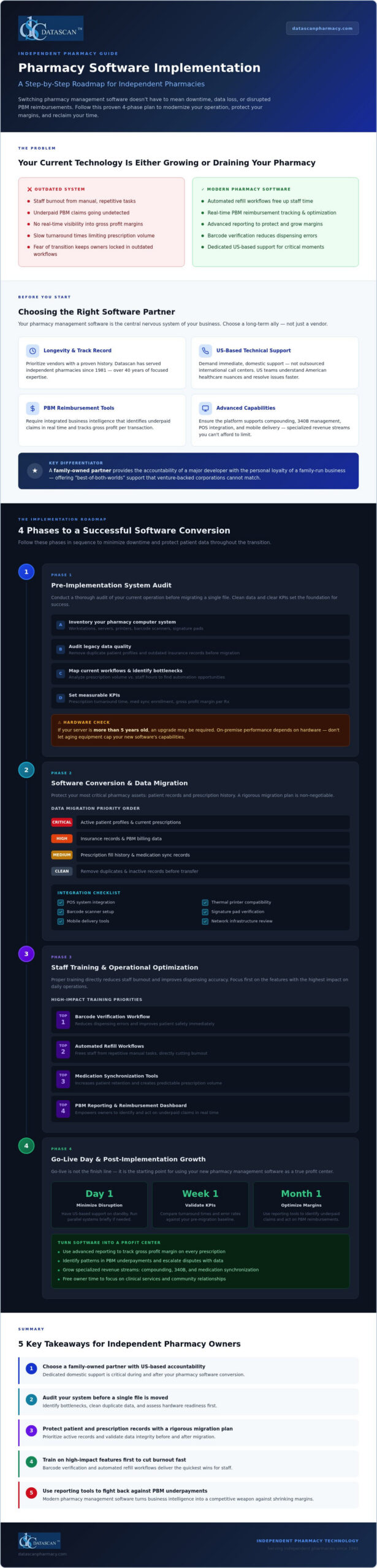
Your pharmacy management software functions as the central nervous system of your independent business. It doesn’t just dispense prescriptions; it manages patient safety, financial health, and operational flow. Choosing the right partner is the most critical step in your pharmacy software implementation plan because you’re selecting a long-term ally rather than just a software vendor. While many venture-backed corporations prioritize short-term profits and shareholder returns, a family-owned partner offers a level of accountability that’s becoming rare in the industry.
Independent pharmacies need tools that handle more than just the basics. Whether you are managing complex compounding solutions or navigating the intricacies of 340B management, your software must be robust enough to support these specialized revenue streams. Evaluating software for pharmacies based on these advanced capabilities ensures you aren’t limited by your technology as your business evolves.
Prioritizing PBM Reimbursement and Profitability Tools
In an era of shrinking margins and aggressive PBM tactics, your technology should be your first line of defense. Don’t settle for a system that leaves money on the table. Your next system must include integrated business intelligence that identifies underpaid claims in real time. It’s not enough to simply process prescriptions. You need to track gross profit margins on every transaction. Understanding how to calculate pharmacy gross profit with precision is essential, as independent pharmacy gross profit margins have plummeted to a ten-year low in 2026. Modern pharmacy software empowers you to fight back against unfair PBM practices by providing the data needed to optimize reimbursements and protect your pharmacy’s financial future. Before committing to any platform, it’s worth reviewing a detailed cost of PioneerRx vs Datascan breakdown to understand the true total cost of ownership beyond base subscription pricing.
Assessing Vendor Support and Longevity
A successful pharmacy software conversion depends heavily on the quality of technical support you receive. You should prioritize vendors that offer immediate, US-based pharmacy software support rather than those that outsource their help desks to international call centers. Domestic support teams understand the specific nuances of the American healthcare landscape and can provide faster resolutions during critical moments. When you’re in the middle of a system switch, you can’t afford to wait on hold.
Ask potential partners about their ownership history. A company like Datascan has served the independent pharmacy community since 1981, providing a unique “best-of-both-worlds” experience. You get the cutting-edge capabilities of a major developer with the personal touch and loyalty of a family-run business. This longevity ensures that your pharmacy software implementation plan is backed by decades of industry expertise and a deep commitment to your success.
Phase 1: The Pre-Implementation System Audit
Success begins long before the first file is transferred. A robust pharmacy software implementation plan requires a transparent look at your current operation to ensure your new technology isn’t hindered by old problems. Before you transition to a modern pharmacy management software, you must conduct a thorough inventory of your existing pharmacy computer system. This isn’t just about counting workstations; it’s about identifying the specific bottlenecks that drain your staff’s energy and eat into your gross profit margins.
Reviewing your legacy data quality is equally vital. Migrating “junk” data, such as duplicate patient profiles or outdated insurance records, only complicates your new workflow. By cleaning your database now, you ensure that your new system operates at peak efficiency from day one. Setting clear Key Performance Indicators (KPIs), such as reducing prescription turnaround time or increasing medication synchronization enrollment, will help you measure the true ROI of your new technology.
Hardware and Infrastructure Evaluation
Your pharmacy software is only as reliable as the hardware it runs on. Since we prioritize stable, high-performance on-premise solutions rather than relying on an internet connection for core functions, your server and workstations must be up to the task. Assess the compatibility of your current thermal printers, barcode scanners, and signature pads. If your server is more than five years old, an upgrade may be necessary to guarantee the speed and security your patients expect.
Don’t forget to plan for peripheral integrations. If you intend to utilize a Datascan Point of Sale (POS) system or mobile delivery tools, your network infrastructure must support these devices seamlessly. Ensuring your hardware is ready now prevents frustrating delays during the go-live phase.
Workflow Mapping for Efficiency
For specialized medical environments that require more than standard office equipment, Synergy Medical Inc. offers high-performance surgical and radiology displays designed for clinical precision.
For pharmacies that also manage their own delivery vehicles or equipment maintenance, a field service tool like Repair-CRM can help digitize those external operations and keep them organized alongside your main system.
Analyze your current prescription volume against your staff hours to find where automation can take over. Many independent owners find that their team is bogged down by manual tasks that a modern system could handle in seconds. Implementing workflow software allows you to standardize the dispensing process, which significantly reduces the risk of errors and helps prevent pharmacist burnout.
This is also the ideal time to plan for medication synchronization. By aligning patient refills to a single date each month, you can stabilize your daily volume and free up your staff to focus on clinical services and PBM reimbursement recovery. If you’re unsure if your current hardware can support these advanced features, it’s a good idea to consult with a technical expert to review your specific needs.
Phase 2: Pharmacy Software Conversion and Data Migration
Moving your data is the most sensitive part of any pharmacy software implementation plan. Unlike generic IT migrations, a pharmacy software conversion involves high-stakes clinical information that directly impacts patient safety. You aren’t just moving files; you’re transferring the lifeblood of your practice. Most conversions follow a methodical timeline, starting with a test conversion to verify how your legacy records map to the new database. During this period, maintaining HIPAA compliance and data integrity is non-negotiable. You’ll often run dual systems briefly to ensure no prescription delays occur while your team gets acclimated to the new pharmacy management software interface.
Precision during this phase prevents the loss of critical patient history and ensures your PBM reimbursement cycles remain uninterrupted. By working with an experienced partner, you can avoid the common pitfalls that lead to “dirty data” or missing insurance profiles. It’s about ensuring a seamless transition where your staff feels confident that the information on their screen is accurate and actionable from the very first day.
Managing Historical Patient and Prescription Records
You don’t need to move every single record from the last twenty years. Focus on active prescriptions, detailed patient profiles, and current insurance information. Archiving old data keeps your new pharmacy software lean and fast. Our dedicated conversion team works closely with you to validate this data, ensuring that every sig code and allergy warning transfers accurately. This meticulous approach prevents dispensing errors and protects your reputation as a trusted community provider. To see how a community-focused pharmacy prioritizes patient education alongside safety, learn more about Sage Creek Pharmacy and their commitment to family health resources. Validating migrated data early allows you to catch mapping issues before they affect your live workflow.
A seamless transition also means ensuring your niche revenue streams remain uninterrupted. If your pharmacy specializes in custom medications, setting up compounding solutions within the new system should happen early in the migration phase. Similarly, pharmacies serving long-term care facilities must configure their nursing and assisted living modules to maintain strict medication administration schedules. Finally, verify that your Datascan Point of Sale is fully synced with your new inventory records to prevent discrepancies in your financial reporting. This integration ensures that every transaction, from a complex compound to a front-end sale, is captured accurately for your gross profit analysis.
Phase 3: Staff Training and Operational Optimization
Technology is only as effective as the people operating it. A successful pharmacy software implementation plan requires a tiered training approach that respects the high-pressure environment of a community pharmacy. Instead of a single, overwhelming session, you should break training down by role. Pharmacists need to master clinical reporting and PBM reconciliation, while technicians should focus on the speed and accuracy of the dispensing queue. This targeted strategy ensures that every team member feels empowered rather than overwhelmed by the transition.
Modern pharmacy management software should serve as an extra set of hands for your business. By automating repetitive, manual tasks, you’re not just improving your pharmacy’s efficiency; you’re actively reducing the mental load that leads to staff burnout. When your team isn’t bogged down by clunky workflows, they can spend more time on patient care and revenue-generating clinical services. For parents who want to apply this same principle of centralized organization to their children’s education, you can check out DormWay to see how a Student OS simplifies academic scheduling.
The first step to optimization is configuring barcode verification at every stage of the fill process. This isn’t just a safety feature. It’s a workflow optimizer that prevents the costly rework associated with dispensing errors. You should also set up automated refill workflows to ensure prescriptions are ready before the patient even reaches the counter, creating a smoother experience for both staff and customers.
Integrating MobileScripts into your daily routine is a game changer for operational flow. By moving refill requests and status inquiries to a mobile app, you drastically reduce the volume of incoming phone calls. This allows your technicians to stay focused on production and helps stabilize your daily prescription volume through better patient adherence.
Empowering Staff with Clinical Tools
Independent pharmacies are increasingly shifting toward clinical service models to offset the challenges of poor PBM reimbursements. You must train your pharmacists to utilize integrated e-care plans and MTM features within the pharmacy software. These tools turn your dispensing system into a clinical revenue generator, allowing you to document and bill for services that go beyond the vial.
Encourage staff buy-in by demonstrating how integrated task management software handles daily chores and compliance tracking. When your team sees that the new system eliminates manual logbooks and redundant paperwork, they’ll quickly embrace the change. If you’re ready to see how these automated tools can transform your daily operations and free up your time, schedule a workflow consultation with our US-based experts today.
Phase 4: Go-Live Day and Post-Implementation Growth
Go-live day represents the culmination of your pharmacy software implementation plan, where months of preparation meet the reality of daily operations. The goal is a transition so smooth that your patients don’t even notice a change occurred. To achieve this, follow a rigid checklist that covers hardware connectivity, label printing, and real-time claim adjudication before the first customer arrives. The first 48 hours are critical. You need the assurance that comes with dedicated, US-based pharmacy software support to handle any unforeseen troubleshooting without delay. You shouldn’t have to navigate technical hurdles alone while trying to serve your community.
Once the initial transition period passes, your focus should pivot from technical stability to financial optimization. Your new pharmacy management software is designed to do more than just fill bottles; it’s a tool for reclaiming your time and improving your bottom line. By transitioning your attention to PBM reconciliation and workflow efficiency, you transform a technical upgrade into a strategic business advantage. Maximizing every claim’s profitability becomes an achievable daily task rather than a monthly struggle.
Immediate Post-Go-Live Priorities
In the first few days, prioritize your pharmacy’s financial health by running your first PBM reimbursement reports. These tools are essential for identifying underpaid claims that often slip through the cracks in legacy systems. You should also ensure your electronic delivery system is fully operational for HIPAA-compliant signature capture and real-time tracking. Use your new system’s advanced dashboards to review the first week’s gross profit margins. This immediate feedback allows you to make data-driven decisions about your inventory and pricing strategies right away. For a deeper understanding of the formulas and benchmarks behind these numbers, review our comprehensive guide on calculating pharmacy gross profit in 2026 to ensure your reporting is as accurate as possible.
Long-Term Success with Your Pharmacy System
A modern pharmacy software system is an evolving asset. Establish a routine for regular software updates and stay engaged with new feature releases to ensure you’re always using the latest tools for efficiency. Building a long-term partnership with your US-based support team provides a layer of accountability that venture-backed vendors can’t match. As you evaluate your platform’s long-term value, a thorough cost of PioneerRx vs Datascan comparison for independent pharmacies can help you confirm you’re maximizing your return on investment. As you look toward the future, stay informed by reading The Ultimate Guide to Pharmacy Management Software in 2026 to ensure your business remains at the cutting edge of the industry. This proactive approach ensures your technology continues to serve as the “Champion of the Independent” for years to come.
Take Control of Your Pharmacy’s Future
A successful pharmacy software implementation plan is more than a technical upgrade; it’s a strategic pivot toward long-term independence and financial stability. By conducting a thorough system audit and executing a meticulous data migration, you protect your patient records while eliminating the bottlenecks that cause staff burnout. Modern pharmacy management software empowers you to fight back against unfair PBM reimbursements by providing the transparency and profitability tools you need to survive in a challenging market.
You don’t have to navigate this transition alone. Partnering with a family-owned and operated company that’s served the industry since 1981 ensures you have an advocate in your corner. With our US-based technical support team and decades of industry experience, we provide the expertise needed to transform your operational struggles into streamlined successes. It’s time to reclaim your time and maximize your gross profit margins with pharmacy software built specifically for the independent pharmacist. Your journey toward a more efficient, profitable pharmacy starts with the right partner by your side.
How long does a typical pharmacy software conversion take?
A typical pharmacy software conversion generally spans four to six weeks from the initial system audit to the final go-live day. This timeline allows for a thorough data migration test, staff training, and hardware configuration. By following a methodical pharmacy software implementation plan, you ensure that the actual transition happens in a single day, preventing extended operational downtime and protecting your patient care continuity.
Will I lose my historical patient data when switching pharmacy management systems?
You won’t lose your critical records when transitioning to a modern pharmacy management software if you follow a rigorous migration protocol. We prioritize the transfer of active prescriptions, patient profiles, and insurance information to ensure clinical safety. While some extremely old or “dirty” data might be archived to improve system speed, your essential historical records remain accessible and intact throughout the entire conversion process.
Do I need to buy all new hardware for a pharmacy software implementation?
You don’t necessarily need to replace all your existing equipment for a new pharmacy software implementation. During the pre-implementation audit, we assess your current thermal printers, barcode scanners, and workstations for compatibility. While older servers might require an upgrade to ensure on-premise stability and speed, many pharmacies can utilize their existing peripheral hardware, provided it meets the technical requirements for modern dispensing workflows and security standards.
How does modern pharmacy software help with PBM reimbursements?
Modern technology helps you fight back against unfair PBM practices by providing real-time visibility into claim profitability. Our software includes advanced reconciliation tools that automatically identify underpaid claims and track your gross profit margins on every transaction. Instead of waiting for monthly statements, you can use these integrated business intelligence features to optimize your reimbursements and protect your independent pharmacy’s financial health daily.
Is staff training included in the pharmacy software implementation plan?
Comprehensive staff training is a fundamental part of every pharmacy software implementation plan we design. We utilize a tiered approach that targets the specific needs of pharmacists, technicians, and front-end staff. This ensures that your team feels confident using high-impact features like barcode verification and automated refill workflows before the system goes live, which drastically reduces the stress and errors often associated with new technology.
Can I manage compounding and retail prescriptions in the same pharmacy system?
You can absolutely manage both retail and specialized prescriptions within a single, unified pharmacy system. Our platform includes dedicated modules for compounding and 340B management, allowing you to streamline diverse revenue streams without switching between different programs. This integration ensures that your inventory, patient records, and PBM billing are all centralized, providing a total solution for independent pharmacies that offer clinical or specialty services.
What kind of support can I expect during the go-live phase?
You can expect immediate, US-based technical support during the critical go-live phase of your transition. Our team provides real-time troubleshooting to resolve hardware or data issues within the first 48 hours of operation. Since we don’t outsource our help desk, you’ll speak with experienced professionals who understand the American pharmacy landscape, ensuring that your doors stay open and your patients remain well-served throughout the switch.
How does technology help reduce pharmacist burnout in independent pharmacies?
Technology reduces pharmacist burnout by automating the repetitive, manual tasks that drain your staff’s energy and time. Features like medication synchronization, automated refill workflows, and mobile patient engagement tools eliminate constant phone interruptions and stabilize daily prescription volume. By streamlining the dispensing process with pharmacy workflow optimization software, our pharmacy software allows you to spend less time on paperwork and more time on clinical services and growing your business profitably.
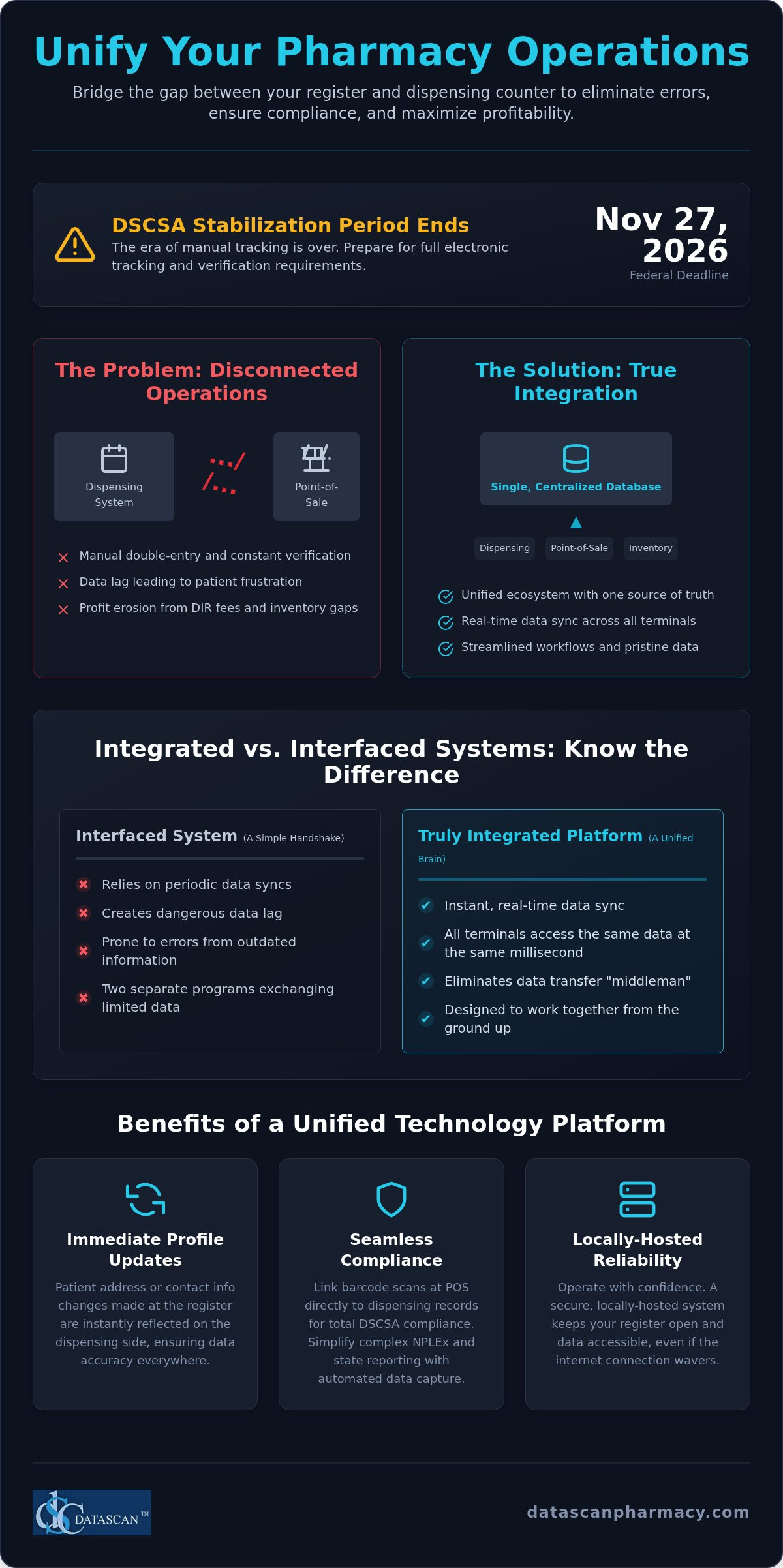
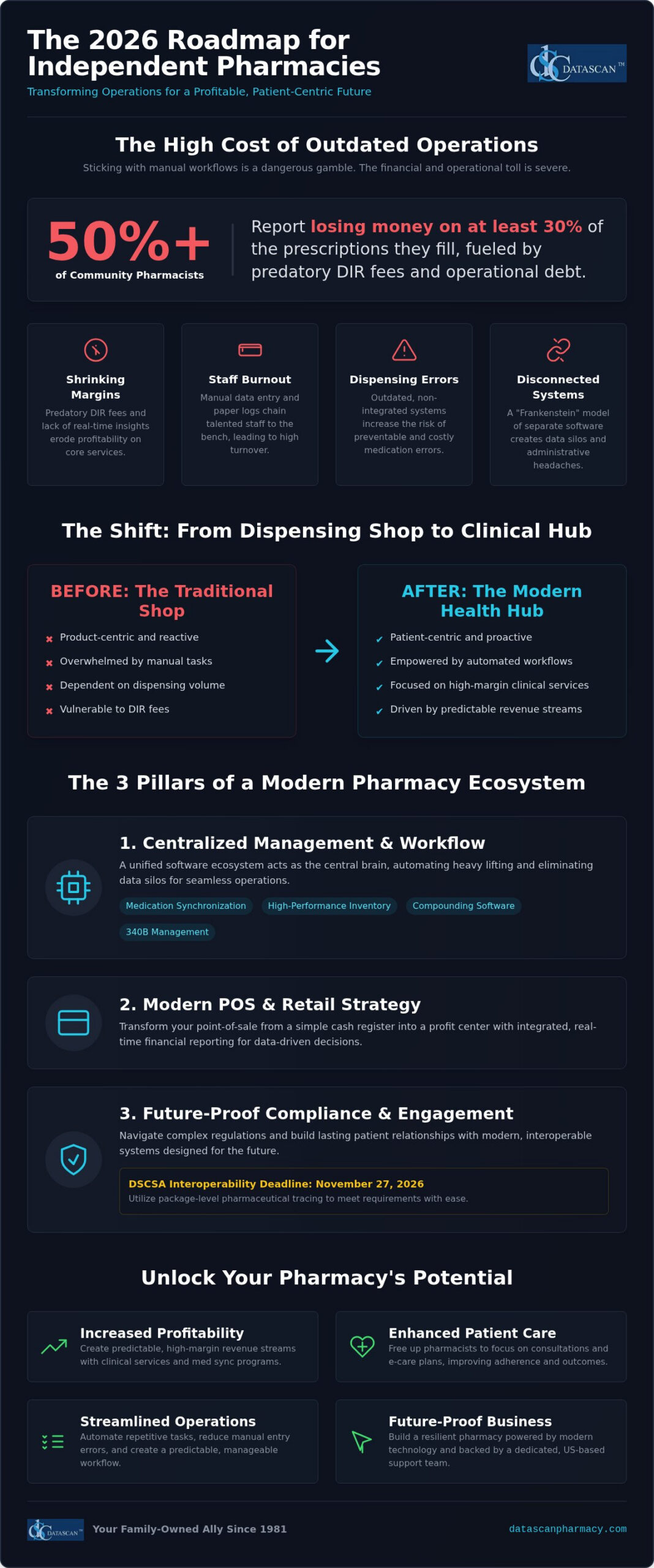
Is your pharmacy operating as two separate businesses under one roof, or is it a truly unified healthcare hub? With the federal stabilization period for the Drug Supply Chain Security Act (DSCSA) ending on November 27, 2026, the era of manual tracking and siloed systems is officially over. Many independent owners still struggle with disjointed data between the register and the dispensing counter, watching high DIR fees and inventory gaps quietly erode their bottom line. It’s frustrating to feel like your technology is a hurdle rather than a high-performance tool.
This guide will show you how to master integrated pharmacy pos software workflows to bridge that gap, ensuring your front-end and back-end operations work in perfect synchronization to drive maximum retail profitability. We’ll explore how real-time patient data sync, automated inventory management, and modern loyalty tools can transform your daily operations. By the end of this article, you’ll understand how to turn complex operational burdens into streamlined successes that empower your staff and protect your independence in a competitive market.
Key Takeaways
Understand why a unified database between your management and point-of-sale systems is the only way to truly eliminate the friction and errors of manual double-entry.
Learn to identify specific checkout bottlenecks and manual update cycles that are currently leaking profit and frustrating your patients at the counter.
Explore the strategic roadmap for implementing integrated pharmacy pos software, from conducting thorough data audits to deploying high-performance hardware.
Discover how to leverage real-time sales data to automate inventory replenishment and simplify complex compliance requirements like NPLEx and state reporting.
Find out how partnering with an independent, family-owned technology leader provides the continuity and US-based support your business needs to thrive.
True integration isn’t just a connection; it’s a unified ecosystem where your pharmacy management system and point of sale share a single, centralized database. Many independent owners are sold on the idea of connectivity, but they often end up with fragmented tools that don’t actually talk to each other in real time. When you deploy integrated pharmacy pos software, you’re investing in a single brain for your business. This architecture eliminates the tedious and error-prone need for double-entry of patient information or prescription details. When a technician enters data at the dispensing counter, it’s instantly available at the register, ensuring that your workflow remains fluid and your data remains pristine.
The Difference Between Integrated and Interface Systems
It’s vital to distinguish between a simple interface and a truly integrated platform. An interface acts like a handshake between two separate programs. While it allows for some data exchange, it often relies on periodic syncs that create a dangerous data lag. If a co-pay changes or an insurance override occurs, an interfaced system might not reflect that update immediately at the register, leading to patient frustration and lost time. Integrated software is a unified platform designed to work together from the ground up. This eliminates the middleman of data transfer, providing a seamless experience where every terminal in your pharmacy has access to the exact same information at the exact same millisecond.
Why Real-Time Data Sync Matters in 2026
In the current regulatory environment, speed and precision are no longer optional. Following the full implementation of DSCSA requirements in late 2026, every medication package must be electronically tracked and verified. True integrated pharmacy pos software makes this possible by linking barcode scans at the point of sale directly to the dispensing record. This ensures total compliance without adding extra steps to your checkout process. Beyond compliance, real-time sync manages these critical functions:
Immediate Profile Updates: Changes to patient addresses or contact info made at the register reflect instantly on the dispensing side.
Counseling Requirements: Automatic flags notify the clerk if a pharmacist must speak with the patient before the transaction is finalized.
Prescription Status: Staff can see exactly which prescriptions are ready for pickup across all terminals, reducing search times and bottlenecks.
We also emphasize the importance of a secure, locally-hosted system. While many providers push internet-dependent alternatives, these systems leave you vulnerable to external outages. A locally-hosted system provides superior reliability, ensuring that even if your internet connection wavers, your register stays open and your patient data remains secure and accessible. It’s about empowering independent pharmacies with technology that is as resilient as they are.
Assessing Your Pharmacy’s Need for Unified Technology
Efficiency isn’t just a buzzword; it’s the lifeblood of your independent pharmacy. If your staff feels like they’re fighting their tools instead of using them, you’re likely leaking profit through operational friction. Assessing your current setup requires a cold, hard look at your daily movement. Are your technicians constantly walking between the register and the filling station to verify a co-pay? This movement represents lost time. High-performance integrated pharmacy pos software solves this by centralizing data, ensuring that what happens at the counter is immediately reflected in your management system.
Identifying Workflow Bottlenecks
Think about the “ready” status of a script. Nothing kills patient trust faster than a customer arriving to pick up a medication that is “ready” on their app but “unprocessed” at the register. These gaps happen when systems don’t talk. You can evaluate your own setup by timing how long it takes to resolve a simple insurance override at the point of sale. If it requires a trip back to the dispensing terminal, your workflow is broken. Exploring advanced workflow software can help you visualize where these handoffs fail and where unified technology could bridge the gap.
Financial Health Check: Inventory and DIR Fees
Profitability in 2026 demands granular control. You can’t manage what you don’t measure. Does your current POS identify which over-the-counter (OTC) items are high-margin, or are you flying blind on front-end sales? Beyond the front end, the back end is under constant pressure from DIR fees. A unified system allows you to track these fees at the transaction level, giving you a real-time view of your true net profit. Using integrated pharmacy pos software ensures that your financial reporting is accurate and accessible without manual reconciliation.
Inventory management is another area where manual updates create risk. With the DSCSA stabilization period ending on November 27, 2026, your system must electronically track every medication package. If your inventory management is still a manual process, you’re at risk of non-compliance. Managing “will-call” aging is also critical; unclaimed prescriptions are tied-up capital. If your system isn’t automatically flagging aged bags for return-to-stock, you’re losing money on inventory and labor. For pharmacies handling specialized services, the ease of generating reports for 340B or compounding audits is a major indicator of system health.
Data privacy is paramount. In an era of increasing cyber threats, relying on external servers can feel risky. Secure, locally-hosted data storage ensures you maintain total control over patient privacy protocols without depending on a constant internet connection. If you’re unsure where your data sits or how vulnerable your workflow is, it might be time to speak with a technology consultant who understands the independent landscape.
How to Transition to an Integrated POS System
Transitioning to a modern ecosystem is a strategic maneuver that requires more than just a software swap. It’s a structured process designed to transform your pharmacy’s efficiency from the ground up. The first step is a comprehensive data audit. You must scrub your existing patient and inventory records to ensure that only clean, accurate data enters your new environment. Once your data is ready, you’ll choose hardware built for the high-volume pharmacy environment to support your integrated pharmacy pos software. This isn’t the place for consumer-grade tablets; you need industrial barcode scanners and high-speed thermal printers that can handle back-to-back transactions without failure.
Data Migration and Hardware Setup
Success during this transition hinges on the secure movement of your historical records. We work as your partner to ensure patient histories and insurance details migrate without loss or corruption. Because we prioritize data integrity and speed, we utilize a secure local server rather than internet-dependent storage. This keeps your data under your roof and accessible even if your internet service provider fails. Selecting durable signature pads and high-performance scanners ensures that your physical infrastructure is as resilient as your software.
After the physical setup, you’ll schedule staff training sessions to ensure a smooth “go-live” day. We recommend executing a phased rollout to minimize disruption to patient care. By starting with a single terminal, your team can acclimate to the new integrated pharmacy pos software workflows in a controlled environment before expanding to the full store. This methodical approach reduces stress and protects the patient experience during the transition.
Staff Training and Change Management
Empowerment comes through mastery of the tools. Your front-end staff must be trained on new loyalty programs and OTC margin-tracking features to drive retail profitability. Simultaneously, your pharmacists need to understand how every transaction at the register automatically updates the pharmacy management software. Clear communication and set expectations during this period help maintain morale and ensure everyone is aligned toward the goal of optimized efficiency.
The journey doesn’t end once the system is live. You must leverage ongoing support to optimize the system post-installation. As you gather real-time sales data, you’ll find new opportunities to automate inventory replenishment and refine your workflows. With US-based technical support available, you’re never navigating these changes alone. This continuous optimization ensures your technology evolves alongside the industry and your specific business needs.
Leveraging Integrated Data for Better Inventory and Compliance
Data is the engine of a modern pharmacy, but it only provides value when it’s actionable. In an independent setting, you don’t have time to manually reconcile sales with stock levels. High-performance integrated pharmacy pos software transforms every transaction into a strategic data point, allowing your systems to think ahead of your needs. This unified approach ensures that your front-end retail strategy and back-end clinical operations move in lockstep, protecting your margins while satisfying regulatory demands. Integrating specialized monitoring systems like CAPTEMP further strengthens this strategy by providing real-time data on critical storage environments, ensuring that high-value inventory is always protected.
Automated Inventory Management
Eliminate the guesswork of ordering. By utilizing Datascan Point of Sale, you can set dynamic par levels that update automatically as prescriptions and OTC items are sold. This real-time visibility prevents the common headache of “dead stock,” where capital is tied up in slow-moving products that eventually expire. The software identifies these laggards through automated reporting, allowing you to pivot your retail space toward high-margin items that actually move. Your inventory should be an asset, not a storage problem.
Maintaining Compliance and Reducing Audit Risk
Compliance is a non-negotiable burden for independent owners. Integrated systems simplify this by ensuring every transaction is logged for immediate audit readiness. When it comes to controlled substances and pseudoephedrine, our system features automatic block or allow triggers based on integrated NPLEx and state reporting requirements. This removes the risk of human error at the register, ensuring you stay within legal limits without slowing down the checkout line. It’s about building a defensive perimeter around your license while maintaining a fast, professional service environment.
Managing financial compliance is equally critical. An IIAS-certified system simplifies FSA and HRA transactions, ensuring that eligible items are correctly identified and processed. This accuracy extends to HIPAA and insurance requirements; our hardware captures and stores patient signatures directly within the local database. You won’t have to hunt for paper logs during an audit because the digital record is already tied to the transaction. If you’re ready to secure your pharmacy’s future with these advanced tools, schedule a consultation with our team today to see the technology in action.
Optimizing Your Pharmacy’s Future with Datascan
Independence is your greatest strength. In an industry dominated by massive chains and impersonal software conglomerates, your ability to provide personalized care is what keeps patients loyal. To maintain that edge in 2026, you need technology that mirrors your own commitment to excellence. Datascan serves as your visionary ally, providing integrated pharmacy pos software designed specifically to empower the independent owner. We don’t just provide tools; we provide a future-proof ecosystem that allows you to outpace the competition through precision, speed, and operational efficiency.
The Power of a Family-Owned Partner
Choosing a technology partner is a long-term investment in your business’s stability. Since 1981, Datascan has remained a family-owned and operated enterprise, bucking the industry-wide trend of consolidation and private equity acquisitions. This independence allows us to focus entirely on our clients rather than shareholders. When you encounter a technical challenge, you aren’t routed to an offshore call center or a generic ticketing queue; you’re connected to our US-based technical support team. This level of direct accountability ensures that your integrated pharmacy pos software remains a reliable asset, backed by a seasoned team that understands the specific pressures of independent pharmacy operations.
Expanding Services with Integrated Modules
True optimization goes beyond the register. To compete with the chains, you must offer the modern conveniences patients now expect. This starts with the MobileScripts app, which synchronizes directly with your management system to provide real-time refill requests and secure communication. For pharmacies looking to diversify their revenue streams, our compounding solutions provide specialized tools for high-margin, custom medications without the need for separate, siloed software.
Logistics are equally critical in the 2026 market. Our electronic delivery system allows you to manage home deliveries with the same precision as your in-store transactions, capturing patient signatures and tracking delivery routes in real time. By integrating advanced medication synchronization and e-care plans, you drive better patient outcomes while maximizing your internal efficiency. We provide the cutting-edge innovation you need to transform your pharmacy from a traditional dispensary into a comprehensive, high-margin healthcare destination. This commitment to your success ensures your business thrives for decades to come, even as the retail landscape continues to evolve.
Securing Your Competitive Edge in the 2026 Market
The landscape of independent pharmacy is shifting, but your technology shouldn’t be a source of friction. By unifying your front-end and back-end operations with integrated pharmacy pos software, you eliminate the costly errors of double-entry and gain real-time control over your inventory and compliance. We’ve explored how a single-database architecture protects your margins against rising DIR fees and ensures you’re ready for the full implementation of DSCSA tracking requirements.
You deserve a partner that mirrors your own independence and commitment to patient care. Since 1981, our family-owned team has provided the tools and dedicated US-based support needed to transform operational burdens into streamlined successes. This isn’t just about a new register; it’s about building a resilient business that thrives in any market. Our system offers seamless integration with Datascan Pharmacy Management Software to keep your data secure and your workflows fluid.
Take the first step toward a more profitable and efficient future. Request a Demo of Datascan’s Integrated POS Solution and see how our technology can empower your pharmacy today. You’ve built a legacy of care, and we’re here to help you protect it.
Frequently Asked Questions
How does integrated pharmacy POS software reduce DIR fees?
Integrated pharmacy pos software reduces DIR fees by providing granular, transaction-level visibility into your true net profit. Instead of waiting for monthly statements, you can identify which prescriptions are incurring high fees in real time. This allows you to adjust your clinical focus and medication synchronization efforts to optimize reimbursements. By linking front-end sales data with back-end dispensing records, you maintain a clear picture of your pharmacy’s financial health and avoid unexpected losses.
Is it difficult to migrate data from my old pharmacy system?
Data migration is a structured process that we manage as your partner to ensure your historical patient and prescription records move securely. We specialize in scrubbing and transferring complex data from older systems into our unified environment. Because we utilize secure local servers, your information remains under your control throughout the transition. This methodical approach minimizes downtime and protects the integrity of your patient histories, ensuring a smooth go-live day for your staff.
Can I use my existing hardware with Datascan POS?
While some existing hardware may be compatible, we typically recommend industrial-grade components designed for high-volume pharmacy use. Consumer-grade tablets often lack the durability required for back-to-back retail transactions. Our team evaluates your current scanners, signature pads, and thermal printers to determine if they meet the performance standards needed for our unified platform. Utilizing matched, high-performance hardware ensures maximum reliability and reduces the risk of technical bottlenecks at the checkout counter.
Does integrated software help with HIPAA compliance?
Yes, integrated systems strengthen HIPAA compliance by centralizing patient data and automating the capture of required signatures. Digital signature pads record HIPAA acknowledgments and insurance receipts directly into the local database, creating an unalterable audit trail. This eliminates the risks associated with paper logs and manual filing. By maintaining all sensitive information on a secure, locally-hosted system, you maintain total control over patient privacy protocols without relying on external internet-dependent storage solutions.
Can I manage multiple pharmacy locations with one integrated system?
You can absolutely manage multiple locations through a centralized database that provides real-time visibility across your entire enterprise. This allows for seamless inventory transfers between stores and unified reporting for all transactions. Whether you’re tracking high-margin OTC sales or managing staff permissions, the system provides a single point of control. This scalability ensures that as your business grows, your technology remains a cohesive engine for efficiency rather than a fragmented collection of siloed tools.
How does the system handle delivery and bedside checkout?
The system handles off-site transactions through the Datascan Mobile Delivery App and specialized bedside checkout tools. These mobile applications sync directly with your management software, allowing drivers or bedside technicians to capture signatures and process payments securely. Transaction data reflects instantly in your records, ensuring that will-call status and inventory levels are always accurate. This flexibility allows you to extend your pharmacy’s reach beyond the physical counter while maintaining perfect data synchronization.
What kind of support is available for independent pharmacies?
Independent owners receive dedicated, US-based technical support from a team that understands the unique pressures of the industry. As a family-owned company since 1981, we prioritize personal accountability and long-term partnership over generic ticketing systems. You’ll work with experts who are familiar with your specific setup and business goals. This advocacy for the independent owner ensures you have a reliable ally to help you optimize your workflows and resolve technical issues quickly.
Can an integrated POS help with front-end inventory management?
An integrated pharmacy pos software system is essential for modern front-end inventory management. It allows you to set automated par levels that trigger replenishment orders based on real-time sales data. You can easily identify slow-moving dead stock and pivot your shelf space toward high-margin retail products. By automating these tedious tasks, your staff spends less time counting bottles and more time engaging with patients, ultimately driving higher retail profitability and better customer retention. To ensure your supply chain remains robust with reliable cargo movement across North America, learn more about professional freight forwarding solutions.
In 2026, your retail pharmacy POS is no longer just a place to process transactions; it’s the primary clinical and financial safeguard standing between your independent business and total margin erosion. You’ve likely felt the crushing weight of shrinking reimbursements and those unpredictable DIR fees that eat into your bottom line before the patient even leaves the store. It’s a frustrating reality where inventory bloat and complex regulatory hurdles like DSCSA can make even a successful day feel like an uphill battle. We understand that as an independent pharmacist, you’re looking for more than just a tool; you’re looking for a partner that protects your legacy.
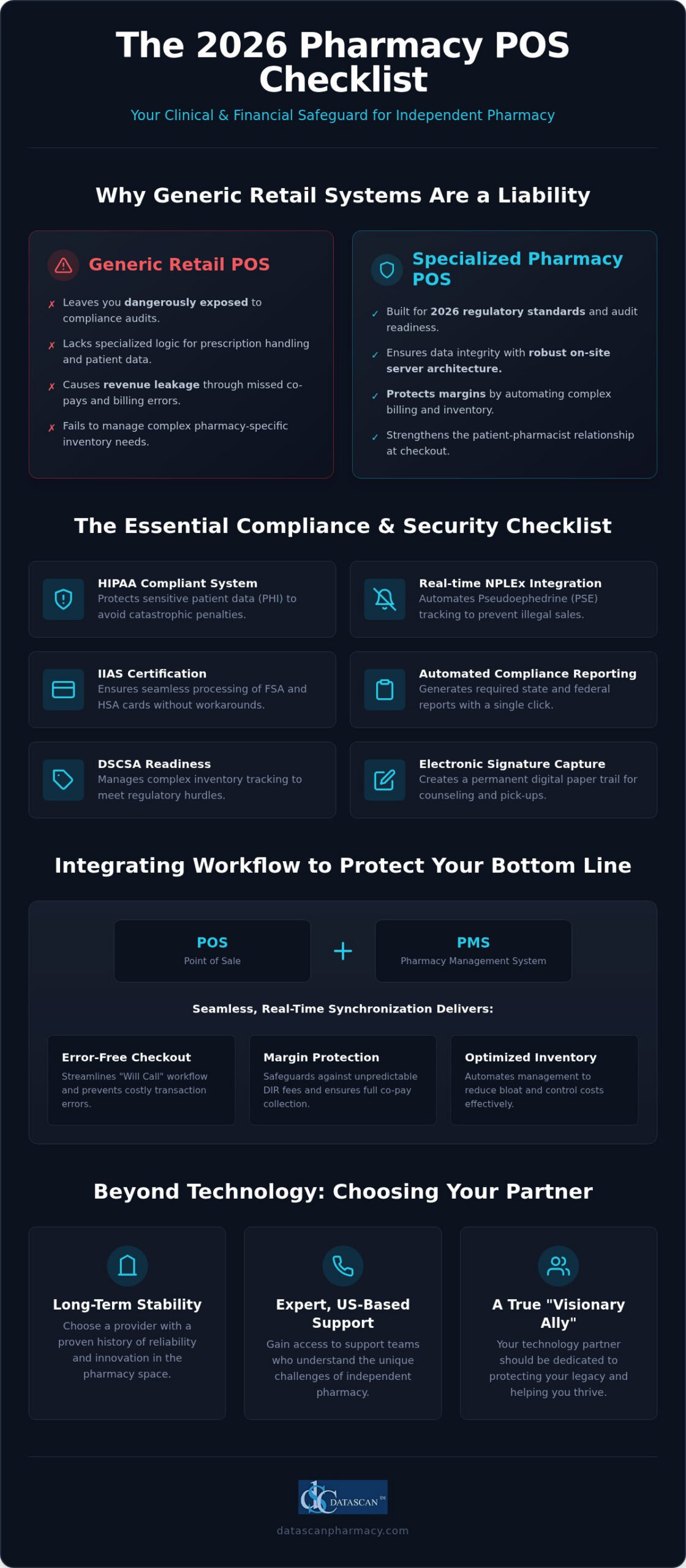
This checklist will reveal the critical features and compliance standards your hipaa compliant pharmacy pos system must meet to protect your margins and simplify patient care. By the end of this guide, you’ll know exactly how to achieve a streamlined checkout process and automated inventory management through a seamless integration between your POS and pharmacy management system. We’ll explore the essential technical requirements and real-time tracking capabilities that turn operational burdens into a modern, high-performance workflow built for the future of independent pharmacy.
Key Takeaways
Understand why generic retail systems leave you vulnerable to audits and why a specialized POS hub is mandatory for 2026 regulatory standards.
Secure your patient data and maintain strict regulatory readiness by choosing a hipaa compliant pharmacy pos system that utilizes robust on-site server architecture.
Streamline your “Will Call” workflow and prevent costly checkout errors through seamless synchronization between your POS and Datascan Pharmacy Management Software.
Safeguard your margins against rising DIR fees by leveraging automated inventory management and specialized billing tools for compounding and 340B programs.
Evaluate your technology partners based on long-term stability and the availability of expert, US-based support teams that understand the independent pharmacy landscape.
Beyond the Cash Register: Why Retail Pharmacies Need Specialized POS Technology
A retail pharmacy POS isn’t just a place to swipe cards; it’s the nerve center where clinical data, financial precision, and regulatory mandates converge. In 2026, the front counter has evolved into a high-acuity touchpoint. Patients now expect clinical consultations and specialized services right at the point of purchase, moving the pharmacy far beyond simple pill dispensing. Generic retail systems designed for coffee shops or boutiques leave independent pharmacies dangerously exposed to audits because they lack the specialized logic required for prescription handling. We believe your technology should act as a Visionary Ally, transforming these complex operational burdens into streamlined successes that protect your legacy.
Choosing a system built specifically for this niche industry is the only way to safeguard your margins against corporate consolidation. While big-box chains have massive IT budgets, independent pharmacies need a partner that understands their specific pressures. A specialized system doesn’t just record a sale. It validates the transaction against clinical records and ensures that every interaction strengthens the patient-pharmacist relationship. This level of specialization is what allows the “underdog” to not only survive but thrive in a competitive market. Furthermore, as you expand your digital footprint to attract new patients, staying informed on the foundational online growth strategies established by experts like 216digital ensures your pharmacy remains visible in an increasingly crowded local search environment.
The High Stakes of Pharmacy Compliance
Regulations don’t take a day off, and neither should your software. Every transaction involving a patient record must occur within a hipaa compliant pharmacy pos system to ensure data integrity and avoid the catastrophic penalties associated with data breaches. Specialized systems automate the heavy lifting by integrating directly with NPLEx for real-time Pseudoephedrine (PSE) tracking, which prevents illegal sales before they’re finalized. These tools also capture and store electronic signatures for counseling and prescription pick-ups, creating a permanent digital paper trail. This ensures that when auditors arrive, you have every necessary record at your fingertips, turning a high-stress event into a routine verification.
The Profitability Gap in Independent Pharmacy
Profitability in 2026 lives or dies at the checkout line. If your software doesn’t communicate fluently with your Pharmacy management system, you’re likely leaking revenue through missed co-pays and unbilled clinical services. By utilizing the Datascan Point of Sale, you close this gap through real-time synchronization that identifies billing opportunities and ensures every dollar owed is collected. The front-end is your primary area for margin growth this year. Your POS serves as the final line of defense against uncollected co-pays and lost inventory, ensuring that your hard work actually translates into bottom-line results.
The Essential Compliance & Security Checklist for Pharmacy POS Systems
Maintaining regulatory readiness in 2026 requires a shift from passive record-keeping to active, real-time data fortification. Your pharmacy isn’t just a retail storefront; it’s a healthcare facility handling highly sensitive protected health information (PHI). A hipaa compliant pharmacy pos system must act as your digital sentry, ensuring that every transaction meets the rigorous standards of federal law while protecting your business from the financial devastation of a data breach. Beyond simple encryption, your system needs to manage the complex interplay of Inventory Information Approval System (IIAS) requirements to ensure seamless processing of FSA and HSA cards, which helps you capture every possible sale without manual workarounds.
Mandatory Regulatory Integrations
Regulatory bodies don’t accept “system downtime” as an excuse for non-compliance. To stay ahead of audits, your checklist must include these non-negotiable features:
Real-time NPLEx Integration: Automated tracking of Pseudoephedrine (PSE) sales ensures you never exceed legal limits and prevents illicit transactions before they are finalized.
Automated Compliance Reporting: Your system should generate state and federal reports with a single click, removing the risk of human error during manual data entry.
Secure Electronic Signature Capture: Capturing signatures for HIPAA acknowledgments and PMP requirements must be integrated directly into the checkout flow to ensure a complete audit trail.
Data Ownership and System Reliability
While many vendors push remote hosting models, we believe independent pharmacies deserve the stability of physical data ownership. A locally-hosted database provides zero-downtime reliability, ensuring your registers stay open even if your internet connection fails. This architecture is a cornerstone of meeting the HIPAA Security Rule, as it keeps your patient data within your four walls rather than on a distant server you don’t control. By utilizing the Datascan Point of Sale, you benefit from end-to-end encryption for credit card processing that functions without external dependencies, securing your finances and your patients’ trust simultaneously.
Internal security is just as vital as external protection. Robust user permission levels allow you to restrict access to sensitive financial data or inventory adjustments based on employee roles. This granular control is your best defense against internal shrinkage and accidental data exposure. If you’re ready to fortify your operations against the complexities of 2026, it’s time to reach out to our team for a personalized compliance assessment. Protecting your legacy starts with choosing a system that values your independence as much as you do.
Workflow Integration: Why Your POS and Pharmacy Management Software Must Speak
A POS system is only as powerful as its communication with your central Datascan Pharmacy Management Software. If these systems don’t share a single source of truth, you risk dispensing errors and wasted labor hours that your independent pharmacy simply can’t afford. A hipaa compliant pharmacy pos system ensures that patient profiles are updated instantly across your entire operation, eliminating the friction of manual data entry and protecting sensitive information. This real-time synchronization means that a change in a patient’s record at the pharmacy counter is reflected immediately at the register, maintaining the high standards required for HIPAA compliance in the pharmacy.
Safety remains the cornerstone of patient care, and barcode scanning at the register serves as your final line of defense. By scanning the prescription at the point of sale, the system verifies that the correct medication is being handed to the correct patient. This simple yet critical step prevents catastrophic dispensing errors that could damage your reputation and threaten your license. We believe your technology should empower your staff to work with total confidence, knowing the system is actively preventing mistakes before they happen. To see how integrated pharmacy pos software workflows can eliminate the gap between your front-end and back-end operations, explore our in-depth guide on mastering these systems in 2026.
The Will Call Management Checklist
Efficiency at the front counter starts with a robust Will Call workflow. Your POS should offer specialized features that go beyond simple transaction recording to optimize the patient experience. Use this checklist to evaluate your current system’s capabilities:
Prescription Batching: The ability to link multiple prescriptions for the same patient under a single barcode for faster, more professional checkouts.
Real-time Status Updates: Knowing exactly where a prescription is in the workflow—whether it’s filled, verified, or ready for pickup—directly from the register terminal.
Automated Return to Stock: System-generated alerts for unclaimed prescriptions after a set period, ensuring your shelves stay clear and your inventory remains accurate.
Inventory Synchronization Best Practices
Profitability in 2026 relies on lean, precise inventory management that reacts to sales data in real time. Your POS should trigger automatic reordering from your wholesalers based on actual sales, preventing both stockouts and the “inventory bloat” that ties up your cash flow. A unified database for front-end and back-end items is essential for maintaining a clear picture of your pharmacy’s financial health. If you operate multiple locations, your system must provide multi-store inventory visibility, allowing you to transfer stock between sites and optimize your assets across the entire enterprise. This level of optimization turns your inventory from a liability into a competitive advantage.
Profitability Features: Protecting Margins and Retaining Patients
In 2026, protecting your independent pharmacy’s bottom line requires a strategic shift from simple sales to clinical profitability. A modern hipaa compliant pharmacy pos system does more than process payments; it serves as a sophisticated financial engine that handles complex compounding solutions and specialized billing tasks that generic systems ignore. By integrating these high-margin services directly into your checkout flow, you ensure that every custom medication is billed accurately and every clinical service is captured. This level of detail is vital for maintaining the financial health of your business while staying within the strict boundaries of healthcare regulations.
Pharmacists often struggle with shrinking reimbursements, but the right technology helps you fight back by turning every interaction into a value-added opportunity. Unlike big-box retailers, your loyalty programs should focus on clinical outcomes rather than just commercial volume. For example, your system can identify nutrient depletion, where certain medications strip the body of essential vitamins, and prompt staff to suggest supplements at the register. This approach doesn’t just increase your basket size; it improves patient outcomes and reinforces your role as a trusted advisor. Achieving this level of performance depends on having truly integrated pharmacy pos software that unifies your clinical and retail data into a single, actionable workflow.
The Margin Protection Checklist
To survive the current economic climate, you need visibility into every transaction. Your POS should provide these essential tools to keep your business lean and profitable:
Real-time Margin Analysis: View profitability by product category to identify underperforming stock and optimize your front-end mix.
DIR Fee Tracking: Automated estimation of DIR fees at the point of sale prevents end-of-quarter financial surprises.
340B Management Tools: Contract pharmacies need these tools to ensure compliance and maximize reimbursement without manual reconciliation.
Patient Retention and Engagement
Keeping patients loyal means meeting them where they are. Integration with a patient mobile app allows for seamless pick-up notifications that drive foot traffic back into your store. Additionally, managing delivery logistics via an electronic delivery system ensures that even your homebound patients receive top-tier service. A truly hipaa compliant pharmacy pos system also ensures that these retention efforts never compromise patient privacy. By offering customizable loyalty points that reward health-conscious purchases, you build a community of patients who value your expertise over a chain’s convenience. If you’re ready to see how these profitability features can transform your business, contact our team today for a personalized walkthrough.
Selecting Your Partner: Why Support and Longevity Matter in Pharmacy Tech
Choosing a technology partner in 2026 is one of the most consequential decisions you’ll make for your independent pharmacy. While a feature list provides a baseline, the true value of a hipaa compliant pharmacy pos system lies in the company standing behind it. In an era of aggressive corporate consolidation, many software vendors have become distant entities prioritizing shareholder returns over pharmacist success. Selecting a family-owned partner that has been operational since 1981 provides a level of stability and accountability that massive corporations simply can’t replicate. You aren’t just buying software; you’re securing a visionary ally dedicated to your long-term growth.
Immediate, expert assistance is non-negotiable when your registers are down or a compliance audit is underway. We’ve seen the frustration that occurs when pharmacies are forced to deal with offshore call centers that don’t understand the nuances of the US healthcare market. US-based support teams ensure that you’re speaking with experts who understand your specific pressures and can provide immediate troubleshooting. This support structure is why the Datascan Point of Sale remains the logical choice for independent owners who refuse to be treated like just another ticket number in a corporate queue.
Vendor Evaluation Checklist
Before signing any contract, you must look past the sales pitch to evaluate the vendor’s actual track record. Use these questions to separate the true partners from the mere providers:
Market Longevity: How long has the company been serving the independent pharmacy market specifically? Look for decades of experience, not just years.
Support Accessibility: Is the support team located in the US and available during your most critical pharmacy hours?
Innovation History: Does the company have a documented history of consistent, innovative feature updates that respond to market trends?
The Implementation and Migration Process
A seamless transition is vital to ensuring your pharmacy doesn’t skip a beat during a system upgrade. You must demand a comprehensive data migration plan that guarantees no patient history or clinical record is lost in the move. High-touch training for your staff is equally important, as even the most powerful hipaa compliant pharmacy pos system is useless if your team doesn’t know how to leverage its full potential. Your partner should also provide a clear roadmap for future developments, such as e-care plans and enhanced clinical modules. This forward-thinking approach ensures that your technology remains a competitive advantage rather than a legacy burden, allowing you to focus on what matters most: your patients. To further support their wellness journey, you might suggest they check out BioNavs for personalized metabolic and longevity coaching.
The landscape of independent pharmacy in 2026 demands more than just endurance; it requires a proactive shift toward specialized technology that treats your front counter as a clinical hub. You’ve seen how a generic register isn’t enough to protect you from audits or shrinking margins. A true hipaa compliant pharmacy pos system must integrate deeply with your management software to automate compliance and capture every missed billing opportunity. This level of synchronization is what transforms a simple transaction into a safeguarded clinical interaction.
Choosing a partner is about more than a feature list; it’s about finding an ally that shares your values. At Datascan, we’ve been family-owned and operated since 1981, providing the specialized US-based support you need to navigate mission-critical operations with confidence. We’ve built our tools specifically for independent pharmacy success, ensuring you have the precision and speed to thrive against corporate competition. Don’t let outdated systems hold your business back. It’s time to Empower your independent pharmacy with Datascan POS solutions and take control of your financial future. Your legacy is worth protecting, and we’re here to help you lead the way.
Frequently Asked Questions
What is a retail pharmacy POS system?
It’s a specialized transaction hub that bridges the gap between retail sales and clinical pharmacy management. Unlike standard registers, it handles prescription pick-ups, pseudoephedrine tracking, and electronic signatures while maintaining health data security. It acts as the final clinical check before a patient leaves the store, ensuring that patient records and financial data remain synchronized and accurate within a single, secure environment that prioritizes patient safety.
Can I use a regular retail POS for my pharmacy?
No, using a generic retail system leaves your independent pharmacy vulnerable to massive compliance failures and audit penalties. Regular systems don’t have the specialized logic to track NPLEx data, manage “Will Call” bins, or capture required HIPAA signatures. A specialized hipaa compliant pharmacy pos system is mandatory because it understands the complex regulatory nuances of the healthcare industry, protecting your license and your bottom line from avoidable errors.
How does a pharmacy POS help with HIPAA compliance?
A pharmacy POS secures Protected Health Information (PHI) by using encrypted local databases and strictly controlled user access levels. It automates the capture of electronic signatures for privacy acknowledgments and keeps a permanent, auditable digital paper trail of every patient interaction. This ensures that your staff follows federal guidelines during every transaction, significantly reducing the risk of data breaches or accidental disclosures of sensitive patient medical history.
What is IIAS and why does my pharmacy need it?
IIAS stands for Inventory Information Approval System, a technical standard that allows your POS to automatically identify FSA and HSA eligible items. Without it, you can’t accept these health-related payment cards for over-the-counter products, which frustrates patients and leads to lost sales. Implementing IIAS ensures your pharmacy can process these transactions seamlessly, capturing revenue from patient healthcare spending accounts while meeting strict IRS requirements for substantiation at the register.
Does a pharmacy POS integrate with insurance billing?
Yes, a specialized POS system communicates directly with your pharmacy management software to pull the exact co-pay amounts determined during the adjudication process. This prevents manual entry errors at the register and ensures you collect the correct amount from the patient. It also helps track uncollected co-pays, acting as a financial safeguard that ensures your hard-earned insurance reimbursements aren’t undermined by losses at the point of sale.
How does inventory management work in a pharmacy POS?
Inventory management works through real-time synchronization between front-end sales and back-end stock levels. When an item is scanned at the register, the system immediately decrements your inventory and can trigger automatic reorders from wholesalers based on your custom par levels. This prevents both stockouts and inventory bloat, ensuring your cash flow isn’t tied up in stagnant products while keeping your most profitable items on the shelves for your patients.
Why is US-based support important for pharmacy software?
US-based support is critical because pharmacy operations are time-sensitive and governed by complex domestic regulations. When a register goes down or an auditor walks in, you don’t have time to explain US pharmacy law to an offshore call center. Having a team of experts who understand the American healthcare landscape ensures faster resolution times and higher accuracy, keeping your pharmacy operational and compliant during high-stakes situations where every second counts.
Can a POS system help reduce DIR fees?
While a POS cannot eliminate DIR fees entirely, it helps mitigate their impact by providing real-time tracking and estimation at the point of sale. By identifying high-DIR transactions and monitoring patient adherence through your hipaa compliant pharmacy pos system, you can make more informed decisions to protect your margins. This visibility allows you to adjust your business strategy and avoid the “clawback” surprises that often cripple independent pharmacy finances.
Did you know that over half of community pharmacists now lose money on at least 30% of the prescriptions they fill? It’s a staggering reality fueled by predatory DIR fees and the crushing weight of manual data entry that keeps your staff chained to the bench. You didn’t become a pharmacist to spend your day fighting disconnected systems or wrestling with paper logs. To survive and thrive, you must modernize pharmacy operations and pivot from a simple dispensing shop to a high-margin clinical health hub. At Datascan Pharmacy Software, we understand the pressure you’re under as an independent. As a family-owned ally since 1981, we’ve spent decades championing the underdog against corporate giants who want to see your margins disappear.
This 2026 roadmap reveals how to reclaim your time and profitability by leveraging a unified digital ecosystem. You’ll discover how to streamline workflows to free up your team for revenue-generating clinical services and med sync programs. We’ll explore the critical steps needed to meet the November 27, 2026, DSCSA interoperability deadline while maximizing patient retention through modern mobile engagement. By the end of this guide, you’ll have a clear strategy to transform your pharmacy from a manual operation into a streamlined, future-proof powerhouse.
Key Takeaways
Shift your business model from a product-centric shop to a clinical health hub to combat shrinking margins and DIR fees.
Implement a unified software ecosystem to modernize pharmacy operations, effectively removing the manual bottlenecks that cause staff burnout.
Leverage automated medication synchronization and clinical service tools to create predictable revenue streams and improve patient adherence.
Navigate the 2026 DSCSA requirements with ease by utilizing interoperable tracking systems that simplify package-level pharmaceutical tracing.
Build a future-proof business with a dedicated, US-based support team that prioritizes the unique needs of independent pharmacy owners.
Why Modernizing Pharmacy Operations is Essential in 2026
Modernization isn’t just a buzzword; it’s a survival strategy for the independent pharmacist. To modernize pharmacy operations effectively, you must integrate digital tools that automate the manual, repetitive tasks that drain your staff’s energy. Many pharmacies currently struggle with “operational debt,” a state where legacy, non-integrated systems force teams to work harder, not smarter. This friction prevents you from competing with large corporate chains that have deep pockets for tech. We’ve seen this cycle before since we started in 1981. It starts with a new regulation and ends with the chains pulling ahead while independents scramble to catch up. By choosing a unified software ecosystem, you transform these operational burdens into a distinct competitive advantage.
The Cost of Doing Nothing
Sticking with manual workflows is a dangerous gamble in 2026. When your team is bogged down by paper logs and disconnected databases, preventable dispensing errors become more likely. To mitigate these risks by digitizing physical records, you can explore Premium App Subscription Fees for professional mobile utilities that help transition your pharmacy to a paperless workflow. The financial toll is equally severe. Research from the NCPA Digest shows that more than half of community pharmacists report losing money on at least 30% of the prescriptions they fill. Without real-time insights into DIR fees and acquisition costs, your margins continue to shrink. This environment doesn’t just hurt your bottom line; it drives staff turnover. Talented technicians won’t stay in an environment where they feel like data entry clerks rather than healthcare professionals. You can’t afford to let your most valuable assets walk out the door because of outdated technology.
From Dispensing to Clinical Excellence
The future of pharmacy lies in clinical services, not just dispensing volume. Automation is the key that unlocks this transition. When your software handles the heavy lifting, your pharmacists can spend their time on e-care plans and patient consultations. This evolution aligns with the principles found in this Health Informatics Overview, which details how information technology improves patient safety and health outcomes. With tools like Datascan Pharmacy Management Software, you can easily implement med sync programs that drive adherence. In 2026, Medicare Part D beneficiaries face a $2,100 out-of-pocket maximum, making adherence and clinical guidance more critical than ever. Modernized operations empower you to lead your community’s health while securing your pharmacy’s financial future. You’re no longer just a pill dispenser; you’re a vital healthcare hub.
The Three Pillars of a Modern Digital Pharmacy Ecosystem
A truly modernized pharmacy isn’t just a collection of separate tools; it’s a living, breathing ecosystem where every component communicates in real time. To modernize pharmacy operations effectively, you must move away from the “Frankenstein” model of bolting together disconnected software from different vendors. This fragmented approach creates data silos, leading to synchronization errors and administrative headaches. A single-vendor ecosystem ensures that patient data flows seamlessly from the management system to the register and out to the patient’s mobile device. This level of integration preserves data integrity while providing you with a 360-degree view of your business health.
Centralized Management and Workflow
The Datascan Pharmacy Management Software acts as the central brain of your operation. It’s designed to automate the heavy lifting that usually eats up your staff’s time. Built-in medication synchronization software is a non-negotiable feature for 2026. It allows you to align refills and create a predictable, manageable workflow. High-performance inventory management tools prevent you from tying up capital in overstock while ensuring you never face a stockout on critical medications. For pharmacies offering specialized services, integrated Compounding Pharmacy Software and 340B Management Tools are essential. This level of sophisticated automation is highlighted in the Future of Pharmacy Automation, which emphasizes how digital integration directly improves medication safety and operational efficiency.
Modern POS and Retail Strategy
Your Datascan Point of Sale (POS) system should be viewed as a profit center rather than a simple cash register. Integrated POS software provides real-time financial reporting, giving you the clarity needed to make data-driven decisions about your front-end inventory. Customer loyalty programs built directly into the POS help you compete with the big chains by rewarding your most frequent shoppers. Additionally, local logistics have become a key differentiator for independents. By using the Datascan Mobile Delivery App, you can track every package from your store to the patient’s doorstep, ensuring accountability and professional service for your homebound patients.
Digital Patient Engagement
To stay relevant, you must meet patients where they spend their time: on their smartphones. MobileScripts facilitates instant refill requests, which significantly slashes the volume of time-consuming phone calls your staff handles daily. Secure, HIPAA-compliant messaging allows you to provide high-touch care without the security risks of standard SMS. These mobile tools also play a vital role in clinical care, allowing you to capture e-care plan data right at the point of care. If you’re ready to see how these integrated pillars can work for you, you can explore our full software suite and start building your digital foundation today.
Optimizing Clinical and Retail Workflows for Profitability
Profitability in 2026 requires more than just filling scripts; it demands a surgical focus on workflow optimization. To modernize pharmacy operations, you must leverage data to combat the shrinking margins caused by DIR fees and rising operational costs. Proactive adherence monitoring within your Datascan Pharmacy Management Software allows you to identify patients at risk of non-compliance, protecting your performance scores and your bottom line. This isn’t just about clinical care. It’s about financial defense. By using advanced reporting and analytics, you can pinpoint high-margin opportunities and eliminate the “operational debt” that comes from manual, unmonitored processes.
Mastering Medication Synchronization
Med Sync is the foundation of a predictable pharmacy day. By grouping a patient’s refills into a single monthly pickup, you eliminate the constant interruptions of reactive, daily fills. Our software automates the identification and synchronization process, which saves your staff hours of manual labor. This streamlined approach doesn’t just save time. It drives revenue. Pharmacies using automated med sync often see a measurable increase in annual prescription volume because patients stay on their therapies longer. You’re turning a chaotic workflow into a structured, high-volume engine that runs with minimal intervention.
Advanced Delivery Management
Logistics represent a significant overhead that many independents fail to track effectively. The Datascan Mobile Delivery App transforms this expense into a streamlined, professional service. Automated routing ensures your drivers take the most efficient paths, which reduces fuel costs and vehicle wear. Beyond the road, mobile tracking builds patient trust by providing real-time updates on their medication’s status. If you’re looking to expand your reach, bedside delivery software facilitates transitions of care by allowing you to deliver meds to patients before they even exit a hospital or clinic. This captures business that would otherwise go to a chain competitor.
Finally, don’t view the upcoming DSCSA requirements as just another regulatory hurdle. The November 27, 2026, deadline for small dispensers to implement package-level tracing is a firm mandate, but it also offers a hidden benefit. The interoperable systems required for compliance provide unprecedented inventory transparency. You’ll know exactly what’s on your shelves at all times, reducing waste and ensuring you never tie up capital in dead stock. You’re turning a mandatory compliance task into a powerful tool for inventory optimization and profit protection.
A Step-by-Step Transition Plan for Independent Pharmacies
Transitioning to a digital-first model isn’t an overnight task. It’s a methodical process that begins with an honest operational audit to identify your most restrictive bottlenecks. Are your technicians spending hours on the phone for refills? Is your pharmacist bogged down by manual inventory counts? Once you pinpoint these friction points, you can modernize pharmacy operations in logical, manageable phases. We recommend starting with your core management platform to stabilize your dispensing and clinical workflows. Once that foundation is secure, you can layer on integrated point of sale and mobile engagement tools to extend your reach directly to the patient’s smartphone.
Selecting the Right Partner
The software you choose is only as good as the team standing behind it. During a transition, US-based support is critical; you can’t afford to wait for a call back from a different time zone when your script queue is backing up. When evaluating providers, consider the difference between a venture-backed firm looking for an exit and a family-owned partner like Datascan Pharmacy Software that has been in the trenches since 1981. If you’re weighing your options against legacy systems, our WinRx software comparison reveals why agile, pharmacist-focused platforms are outpacing the industry’s biggest names in 2026. You need a partner that prioritizes data migration security to ensure your historical records remain accurate and accessible. A visionary ally doesn’t just sell you a license. They provide the historical perspective and personal accountability needed to build a future-proof business.
Training and Cultural Change
Your staff are the ones who will ultimately drive the success of your new ecosystem. To turn them into tech-savvy advocates, you must involve them in the process early and incentivize the adoption of new digital workflows. Instead of overwhelming the team, set realistic KPIs for the first 90 days. Focus on small, measurable wins like increasing med sync enrollment or reducing the volume of manual refill entries. Creating a feedback loop allows your technicians to suggest process improvements, making them feel like stakeholders rather than just employees. This cultural shift ensures that your investment in technology translates into actual operational efficiency and long-term profitability.
If you’re ready to move away from manual struggles and embrace a high-profit digital future, schedule a personalized demo to see our transition roadmap in action.
Choosing a Visionary Ally: The Datascan Advantage
Selecting the right technology partner is the single most important decision you’ll make as you modernize pharmacy operations. You need more than just a software vendor; you need a Visionary Ally who understands that your independence is your greatest strength. Since 1981, Datascan Pharmacy Software has operated as a family-owned enterprise, and that heritage defines our approach to personal accountability. Unlike venture-backed corporations focused on short-term gains, we measure our success by the longevity and profitability of our clients. Our US-based technical support team ensures that when you need assistance, you’re speaking with an expert who understands the urgency of your daily workflow.
The power of our ecosystem lies in its total integration. By combining our management platform, point of sale, MobileScripts, and delivery tools into a single suite, we eliminate the friction of data silos. This innovation-first mindset extends to specialized needs with our Compounding Pharmacy Software and 340B Management Tools. Datascan Pharmacy Software doesn’t just provide tools. We provide a roadmap for clinical and retail excellence. Our focus on DIR fee reduction and e-care plans ensures that your pharmacy remains a profitable pillar of your community.
Tailored Solutions for Independent Growth
We specifically design our features for the underdog. Because our system is built by pharmacy experts rather than just generic coders, every button and report serves a tangible business purpose. We know that independent pharmacies face unique pressures from PBMs and chains, so we build the tools you need to fight back and win. For independents evaluating their current platform, a thorough WinRx software comparison against Datascan makes clear why pharmacist-focused innovation consistently outperforms legacy corporate systems. A Visionary Ally is a partner that blends cutting-edge technical precision with the heart of a dedicated guide. This combination allows us to deliver the sophisticated capabilities of a large corporation with the personal touch of a family business.
Ready for the Future of Pharmacy
The regulatory environment of 2026 demands constant innovation. Whether it’s meeting the latest DSCSA tracing requirements or managing complex Medicare Part D changes, our platform evolves alongside the industry. When you choose Datascan Pharmacy Software, you’re joining a community of successful, modernized independent pharmacies that refuse to be left behind. Our continuous updates ensure you’re always ahead of the curve, turning regulatory hurdles into operational advantages. It’s time to stop struggling with manual processes and start building the high-profit digital powerhouse your community deserves.
The window to transition from a manual dispensing shop to a high-profit clinical health hub is narrowing as the 2026 regulatory deadlines approach. You’ve seen how the path to profitability lies in a unified digital ecosystem that eliminates data silos and streamlines staff workflows. By now, it’s clear that the shift toward clinical services and med sync isn’t just a trend; it’s the only sustainable way to combat shrinking margins and DIR fees. You have the clinical expertise to lead your community’s health, but you need the right tools to execute that vision without burning out your team.
It’s time to modernize pharmacy operations with a partner that has advocated for the underdog for over four decades. Since 1981, Datascan has remained a family-owned ally, providing a comprehensive integrated suite and reliable US-based support that large corporations simply can’t match. You don’t have to navigate these complex industry shifts alone.
How long does it take to modernize a pharmacy’s software system?
A full software transition typically takes 30 to 90 days depending on the complexity of your data migration and staff readiness. We prioritize a phased approach to ensure your team isn’t overwhelmed during the learning curve. Starting with core management software allows you to stabilize dispensing before adding advanced features like mobile apps. This methodical pace ensures data integrity while minimizing disruptions to your daily patient care and retail operations.
Will modernizing my operations actually help reduce DIR fees?
Yes, modernizing your operations directly impacts DIR fees by improving the performance metrics that PBMs use to calculate clawbacks. When you modernize pharmacy operations, you gain access to real-time adherence monitoring tools that identify non-compliant patients early. Improving Star Ratings through automated med sync and targeted outreach helps protect your margins from predatory retroactive fees. This proactive strategy turns clinical care into a financial defense mechanism for your business.
Is it better to buy pharmacy software from a large corporation or a family-owned business?
Choosing a family-owned partner provides a level of personal accountability and specialized industry knowledge that large corporations often lack. Datascan has been a champion of the independent pharmacist since 1981, offering the stability of a long-standing heritage. You get the benefit of US-based support and a software suite built by experts who understand your specific pressures. Venture-backed firms often prioritize shareholder exits over the long-term success of your pharmacy.
Can modern pharmacy software help with DSCSA compliance?
Modern pharmacy software is essential for meeting the enhanced DSCSA requirements that take full effect for small dispensers on November 27, 2026. These systems provide the electronic, interoperable tracing needed to track pharmaceutical products at the package level. Beyond simple compliance, these tools offer better inventory transparency. You’ll reduce waste and ensure that every item on your shelf is fully accounted for within a secure, digital chain of custody that protects your license.
How do patient mobile apps improve pharmacy profitability?
Patient mobile apps like MobileScripts increase profitability by automating the refill process and reducing the administrative burden on your staff. When patients request refills via their smartphones, your team spends less time on the phone and more time on high-margin clinical services. These tools also improve patient retention by offering a convenient, modern experience that rivals big-box competitors. Better engagement leads to higher adherence and more consistent prescription volume throughout the year.
What is the ROI of implementing medication synchronization software?
The return on investment for medication synchronization comes from increased prescription volume and significantly improved workflow efficiency. Patients enrolled in med sync programs are more likely to stay on their therapies, which can lead to a measurable increase in annual fills per patient. By grouping refills into a single monthly pickup, you also reduce the labor costs associated with multiple deliveries and chaotic, reactive filling schedules. It’s a proven strategy for building predictable revenue.
Do I need separate vendors for pharmacy management and POS systems?
It’s highly recommended to use a single-vendor ecosystem for both pharmacy management and point of sale to ensure data integrity. When you modernize pharmacy operations with an integrated suite, your financial reporting and patient records talk to each other in real time. This eliminates the errors and silos that occur when trying to bridge disconnected systems. A unified platform provides a clearer view of your business health while simplifying your technical support needs, much like how specialized ERP solutions like Flowgres help small businesses maintain tight control over their sales and budgets.
Mobile delivery tracking software reduces overhead by optimizing driver routes and providing real-time accountability for every package. Automated routing ensures that your delivery staff takes the most efficient paths, saving on fuel and vehicle maintenance costs. It also reduces the time spent handling patient inquiries about delivery status. By professionalizing your logistics, you can expand your service area and capture new business without a proportional increase in your administrative staffing costs.