Independent pharmacies are losing thousands of dollars every month to opaque PBM reimbursements and predatory DIR fees that they simply don’t have the time to track manually. Pharmacy business intelligence dashboards solve this by transforming your raw prescription data into immediate, actionable insights that highlight underpaid claims and protect your bottom line. By integrating these tools directly into your pharmacy management software, you can stop guessing about your margins and start making data-driven decisions that ensure your store’s survival in an increasingly hostile market.
You’ve likely felt the frustration of watching your hard-earned profits vanish into the “black box” of PBM spread pricing and clawbacks. We understand that as a community pharmacist, your focus should be on patient care, not spending hours buried in complex spreadsheets. In this guide, you’ll learn how to leverage advanced pharmacy software to automate claim identification and gain real-time visibility into your profitability. We’ll walk through the essential KPIs every owner needs to monitor and show you how streamlined workflows can finally free up your schedule to grow your business.
Key Takeaways
Discover how pharmacy business intelligence dashboards convert complex prescription data into visual charts that expose profit leaks in real time.
Identify the critical KPIs, including gross profit at the point of sale and inventory turnover, that directly impact your pharmacy’s financial health.
Learn how to proactively flag underpaid PBM claims by automatically comparing reimbursements against your actual acquisition costs to protect your margins.
Evaluate why integrated reporting within your pharmacy management software is superior to cumbersome third-party add-ons for saving time and reducing overhead.
Streamline your workflow to reclaim hours spent on manual reporting, allowing you to focus on high-margin services and patient care.
What are pharmacy business intelligence dashboards and why do independent owners need them?
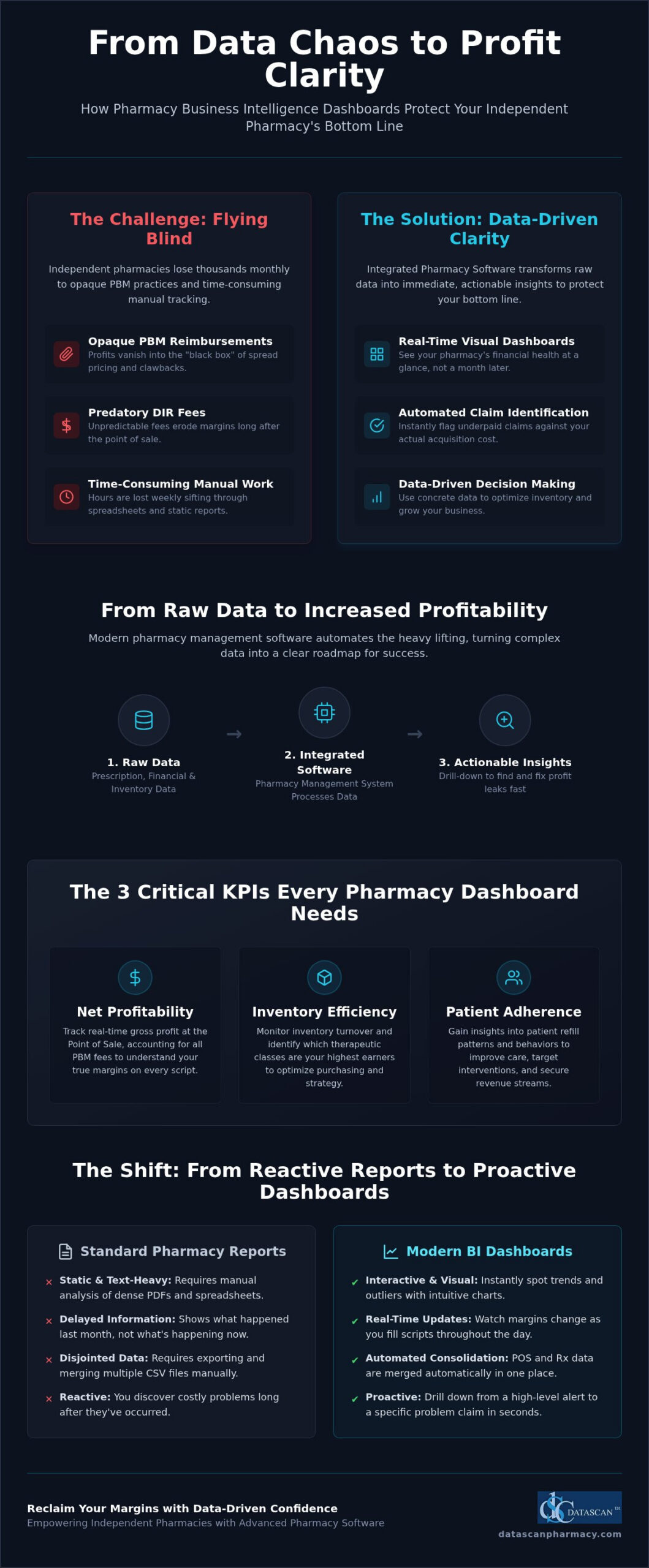
Pharmacy business intelligence dashboards are visual reporting tools that consolidate prescription, financial, and inventory data into real-time charts to help owners identify profit leaks. Instead of sifting through dozens of disjointed reports, you get a unified view of your store’s health at a single glance. This technology represents a fundamental shift from “looking at what happened” to “seeing what is happening now.” For independent owners, this visibility is the difference between catching a negative margin claim today and discovering a thousand dollar loss during next month’s reconciliation.
The concept of Business intelligence has historically been reserved for large retail chains with dedicated analyst teams. However, modern pharmacy management software now brings these sophisticated tools to the community level. Without real-time data, independent pharmacies operate at a severe disadvantage. You’re essentially flying blind while PBMs use advanced algorithms to squeeze your reimbursements. BI simplifies complex data sets into intuitive visuals, ensuring that even non-technical owners can spot trends without needing a degree in data science.
How do dashboards differ from standard pharmacy reports?
Standard pharmacy reports are often static, text-heavy PDFs that require manual analysis to find useful information. If you’re still relying on manual spreadsheet entries, you’re losing hours of valuable time every week. Dashboards offer interactive, real-time visualizations that allow you to drill down from a high-level overview directly into a specific problematic claim. This interactivity transforms your data from a record of the past into a roadmap for the future.
Interactive Drill-Down: Click a “red flag” on your chart to see the exact NDC and PBM responsible.
Real-Time Updates: Watch your margins shift as you fill prescriptions throughout the day rather than waiting for month-end.
Automated Consolidation: Stop exporting CSV files; let your software do the heavy lifting by merging POS and Rx data automatically.
Why is data-driven decision making critical in 2026?
The pharmacy industry reached a tipping point in 2026. With the overall pharmacy trend seeing double-digit cost increases and PBMs managing over 90% of claims, guessing isn’t an option. You need to know your exact cost-to-dispense at all times to survive. When you use technology to automate the “business” side of the business, you reclaim the time needed for high-margin clinical services and direct patient care. Real-time visibility isn’t just a luxury; it’s a survival mechanism that empowers you to stand your ground against reimbursement pressure.
What are the most important KPIs for a pharmacy dashboard?
Effective pharmacy business intelligence dashboards focus on the “Big Three” metrics: net profitability, inventory efficiency, and patient adherence. A dashboard is only as good as the metrics it tracks, and for the independent owner, these data points represent the difference between a thriving business and one struggling to keep the lights on. By consolidating this information into a single view, you can stop guessing about your store’s health and start making decisions based on cold, hard facts.
How do you track pharmacy profit margins effectively?
Monitoring your net profit requires looking past the initial reimbursement to account for PBM take-backs and DIR fees. In 2026, branded drug prices have seen a median increase of approximately 4%, which means your margins are under constant pressure. Your dashboard should provide real-time gross profit tracking at the Datascan Point of Sale, allowing you to see exactly what you’re making on every transaction before the patient leaves the counter.
You also need the ability to identify which therapeutic classes are your highest earners. If specialized medications or specific generics are driving your bottom line, you need to know so you can adjust your inventory and marketing strategies accordingly. Learning how to calculate pharmacy gross profit accurately in this new regulatory environment is the first step toward reclaiming your agency as an owner. If you’re ready to see these insights in action, you can schedule a demo with our team to explore our integrated reporting tools.
Which operational metrics save the most time?
Operational KPIs are designed to help you run a leaner, more efficient business. One of the most impactful metrics is prescription volume by hour. By visualizing when your store is busiest, you can optimize staffing levels to ensure you aren’t overstaffed during lulls or overwhelmed during rushes. This data-driven approach to scheduling directly reduces labor waste and improves the patient experience.
Med-Sync Enrollment: Track your medication synchronization progress to move prescriptions to predictable pick-up dates, which smooths out your customizable workflow.
Inventory Turn Rates: Identify “dead stock” that is sitting on your shelves and tying up valuable capital that could be reinvested into growth.
Delivery Efficiency: Monitor driver performance and delivery turnaround times to ensure your off-site patients are receiving the same level of care as those in-store.
Focusing on patient adherence rates is equally critical. With Star Ratings directly impacting your reimbursement levels and network access, using pharmacy business intelligence dashboards to flag non-adherent patients allows your staff to intervene before it affects your scores. This proactive management turns your data into a tool for both better clinical outcomes and higher pharmacy profitability.
How can dashboards help you identify underpaid pharmacy claims?
Automated claim flags prevent financial loss by instantly identifying every transaction where the reimbursement falls below your actual acquisition cost. Pharmacy Benefit Managers (PBMs) often rely on the fact that independent owners don’t have the bandwidth to audit thousands of individual claims manually. By utilizing pharmacy business intelligence dashboards, you turn the tables. These tools act as a 24/7 digital auditor, flagging reimbursements that fall below the Wholesale Acquisition Cost (WAC) to ensure you aren’t paying for the “privilege” of dispensing medication to your community.
The “Red Flag” system is a critical component of modern pharmacy management software. It automates the detection of claims with negative margins, allowing your staff to address issues at the moment of dispensing rather than discovering them weeks later. This level of precision simplifies the reconciliation of PBM payments and third-party aging, transforming a once-arduous task into a streamlined, manageable workflow. When your software does the heavy lifting, you reclaim the time needed to focus on patient outcomes and business growth.
How do you combat PBM reimbursement issues with data?
Combatting PBMs requires more than just anecdotes; it requires aggregated data that proves patterns of underpayment over time. In an environment where the top ten PBMs managed over 90% of total prescription claims volume in 2025, your data is your only real leverage. Dashboards allow you to visualize the cumulative impact of DIR fees on your monthly cash flow with a single chart, providing a clear picture of your actual net earnings. For a comprehensive look at navigating these challenges, explore our guide on managing pharmacy DIR fees.
What is the “Bottom Line Up Front” for claim auditing?
Automated claim flags prevent financial loss by catching negative margin scripts before they’re even dispensed. While many systems offer end-of-month reporting, real-time integration with your Datascan Point of Sale is superior because it stops the bleeding immediately. There’s a significant difference between estimated and actual reimbursement tracking; dashboards bridge that gap by pulling in electronic remittance advice (ERA) to show you exactly what was paid versus what was promised. This transparency is essential for maintaining a healthy bottom line in the face of aggressive PBM oversight and shrinking margins.
The best pharmacy management software should empower you with integrated pharmacy business intelligence dashboards that don’t require expensive third-party add-ons or complex manual exports. You shouldn’t have to be a data scientist to run your business; you need a system that lets you see your pharmacy’s health in under 60 seconds. While some systems force you to wait for overnight data refreshes, the most effective tools provide real-time updates that reflect your current inventory and sales. Whether you’re checking margins from the pharmacy counter or reviewing performance from home via mobile access, your data must be accessible and easy to interpret at a glance.
Customization is also vital because every independent pharmacy is unique. If you specialize in compounding or nursing home modules, your reporting needs differ significantly from a standard retail operation. Your reporting tools should allow you to build views that matter to your specific niche rather than forcing you into a one-size-fits-all template. This flexibility ensures you’re tracking the right variables for your specific business model, which is essential for long-term sustainability. If you’re tired of fighting with generic reports that don’t show the full picture, it’s time to request a personalized walk-through of an integrated solution.
Why is US-based pharmacy software support important for BI?
US-based pharmacy software support is a non-negotiable requirement for accurate business intelligence. Pharmacy data in the United States is uniquely complex due to the intricate relationships between PBMs, wholesalers, and state regulations. You need support staff who understand the nuances of the US healthcare system to help you fix data discrepancies before they impact your tax filings or audits. Fast response times from a domestic team ensure that technical glitches don’t leave you flying blind during critical decision-making periods.
What questions should you ask a pharmacy software vendor about data?
When evaluating pharmacy business intelligence dashboards, you need to dig into the specifics of how the vendor handles your information. Don’t settle for vague promises; ask direct questions to ensure the tool actually serves your needs as an independent owner.
Is the BI dashboard included in the base price or is it a separate fee? Many vendors hide these costs in “pro” tiers or monthly add-on subscriptions.
Does the data update in real-time or on a delay? Decisions made on yesterday’s data can be costly in a fast-moving market.
Can I export my data if I need to work with an outside accountant? Ownership of your data includes the ability to move it into other formats for professional financial analysis.
A vendor that is transparent about these points is likely a partner that values your independence. By choosing a system that prioritizes ease of use and real-time visibility, you’re investing in a tool that protects your margins while freeing up your time to focus on what matters most: your patients.
How does Datascan transform your raw data into increased profitability?
Datascan transforms your raw data into increased profitability by providing integrated, real-time pharmacy business intelligence dashboards that expose PBM underpayments and automate complex operational reporting. By merging data from your workflow software and Datascan point of sale, we offer a 360-degree view of your business that corporate analysts can’t replicate. Our tools are designed specifically for the independent owner. We ensure that chain-level technology is delivered with the personal accountability of a family-owned partner that has championed the independent pharmacy since 1981.
Our dashboards specifically target the lack of transparency in PBM reimbursements. While competitors often push external tools that require tedious manual exports, Datascan builds these capabilities directly into your pharmacy management software. This native integration ensures that your data is always accurate and current. You don’t need additional software subscriptions or technical expertise to protect your bottom line. We give you the leverage to fight back against aggressive PBM oversight with facts, not guesses. To understand the full scope of how purpose-built technology can help, our detailed breakdown of software to identify underpaid pharmacy claims walks through exactly how real-time adjudication catches revenue losses at the point of dispensing.
Real-time profitability tracking with Datascan
Profitability tracking shouldn’t be a post-mortem exercise. With Datascan, you see your gross profit on every script before it ever leaves the pharmacy counter. This immediate visibility allows you to flag low-margin claims and inventory anomalies as they happen. You can also track patient engagement through the MobileScripts patient app. You’ll see exactly how digital refills and adherence notifications are impacting your revenue. Automated alerts ensure that you never miss a reimbursement discrepancy. This protects your margins against shrinking spreads and predatory clawbacks. Pairing this real-time profitability data with strong pharmacy accounts receivable management ensures that the revenue you earn is actually collected and reflected in your cash flow.
Freeing up your time to run your business
Technology is most valuable when it gives you back your time. Our automated dashboards typically eliminate 5 to 10 hours of manual reporting per week. This removes the burden of spreadsheet management from your shoulders. Instead of crunching numbers, you can use our data to identify which clinical services, such as e-care plans or specialized med-sync programs, are actually worth your time and resources. This strategic shift allows you to move from a survival mindset to one of growth and optimization. Ready to see your data in a new light? Schedule a Datascan demo today to discover how our pharmacy business intelligence dashboards can secure your store’s future.
Reclaim Your Margins with Data-Driven Confidence
Navigating the complexities of PBM reimbursements and shrinking margins requires more than just hard work; it demands the right technology. By implementing pharmacy business intelligence dashboards, you transition from reactive reporting to proactive management. You’ve seen how real-time visibility into your “Big Three” KPIs, profit, inventory, and adherence, can stop financial leaks before they impact your cash flow.
Datascan has been family-owned and operated since 1981, providing the expert guidance and 100% US-based technical support you need to thrive. Our innovative features, like integrated med-sync and e-care plans, are built into our pharmacy software to ensure your store remains a pillar of the community. Don’t let opaque PBM practices dictate your success. It’s time to empower your independent pharmacy with Datascan’s advanced BI dashboards. We’re here to help you turn raw data into a roadmap for sustainable growth. Your store deserves a partner that fights as hard for your independence as you do.
Frequently Asked Questions
How much does a pharmacy business intelligence dashboard cost?
Costs vary depending on whether the reporting tool is built into your system or requires a third-party subscription. Many vendors charge additional monthly fees for advanced data visualization tiers. Datascan includes robust business intelligence features within our standard pharmacy software licensing to ensure independent owners have the tools they need without hidden overhead. You should always ask if reporting is included in your base price to avoid unexpected costs that eat into your margins.
Do I need a data analyst to use a pharmacy dashboard?
No, you don’t need a specialized analyst to interpret your data when using intuitive pharmacy business intelligence dashboards. Modern systems translate complex financial and prescription metrics into simple visual charts that any owner can understand. This allows you to spot profit leaks and reimbursement trends in seconds. The goal is to provide actionable insights that empower you to make business decisions without requiring a background in data science or accounting.
Can a dashboard help me reduce my DIR fees?
Yes, dashboards help you manage DIR fees by providing visibility into your net profitability on every claim. While you can’t always stop the fees themselves, you can use data to identify high-fee categories and adjust your inventory or clinical focus. By tracking these expenses in real-time, you can predict cash flow more accurately and implement strategies like medication synchronization to improve the metrics that PBMs use to calculate these clawbacks.
How often does the data in a pharmacy BI dashboard update?
The best systems update in real-time to reflect every transaction at the point of sale. Some older pharmacy management software relies on overnight data refreshes, which can leave you making decisions based on outdated information. Real-time updates ensure that if a PBM underpays a claim today, you see the red flag immediately. This allows your staff to address margin issues before the patient even leaves the counter, protecting your daily revenue.
Is my pharmacy data secure in a BI dashboard?
Data security is a top priority, and your information is protected by industry-standard encryption and local access controls. Since our software is not cloud-based, your sensitive business and patient data remains on your local servers under your direct control. We implement rigorous security protocols to ensure that your financial reports and patient records are only accessible to authorized personnel, maintaining full HIPAA compliance while providing the visibility you need to run your store.
Can I track multiple pharmacy locations in one dashboard?
Yes, you can consolidate data from multiple stores into a single, unified view. This “enterprise” visibility is essential for owners who manage several locations but can’t be in two places at once. You can compare performance across your entire organization, identifying which stores are hitting their margin targets and which ones need operational adjustments. This high-level overview helps you standardize best practices and optimize staffing across your entire independent pharmacy group.
What is the best pharmacy management software for data reporting?
The best pharmacy management software is one that provides integrated, real-time business intelligence without requiring third-party exports. Datascan is a top choice because we’ve been family-owned since 1981 and build our tools specifically for the needs of independent owners. Our system combines Rx dispensing, point of sale, and workflow data into one dashboard. This gives you a total view of your profitability and helps you combat predatory PBM reimbursement practices with ease.
How do dashboards improve my pharmacy’s Star Rating?
Dashboards improve Star Ratings by flagging non-adherent patients and tracking medication synchronization enrollment. When you can see exactly which patients are falling behind on their refills, your staff can proactively reach out to improve adherence. These metrics are a primary factor in how PBMs calculate your performance scores. Using pharmacy business intelligence dashboards to drive clinical interventions ensures better patient outcomes and protects your pharmacy from performance-based reimbursement reductions.
What if the elimination of retroactive clawbacks actually made your pharmacy’s cash flow more volatile than before? While the 2024 CMS ruling moved price concessions to the point of sale, many independent owners in 2026 find that PBMs have simply traded one extraction method for another through aggressive audits and opaque reimbursement structures. Managing pharmacy DIR fees in this new environment requires moving beyond manual spreadsheets and embracing a data-driven defense. To protect your profitability, you must utilize high-performance pharmacy management software that offers real-time reconciliation and deep visibility into every claim.
We understand that you’re fighting a lopsided battle against PBMs while trying to keep your doors open. You deserve a predictable bottom line and the freedom to focus on patient care rather than chasing underpaid claims. In this article, you’ll learn how to master modern DIR reconciliation and leverage advanced Pharmacy Software to automate the financial tracking that used to take hours. We will break down the 2026 PBM reform landscape and provide a clear roadmap to higher gross profit margins through better data visibility and streamlined operations.
Key Takeaways
Transition from retroactive tracking to real-time financial reconciliation to successfully navigate the 2026 PBM reimbursement environment.
Learn why managing pharmacy DIR fees now depends on leveraging 835 electronic remittance advice (ERA) files to identify and contest underpaid claims instantly.
Utilize advanced pharmacy management software to transform manual reconciliation into an automated background process that protects your bottom line.
Boost your gross profit margins by optimizing Star Ratings and implementing medication synchronization to create predictable, stable cash flow.
Discover how a dedicated technology partner empowers independent owners to reclaim their time and combat PBM transparency challenges with better data visibility.
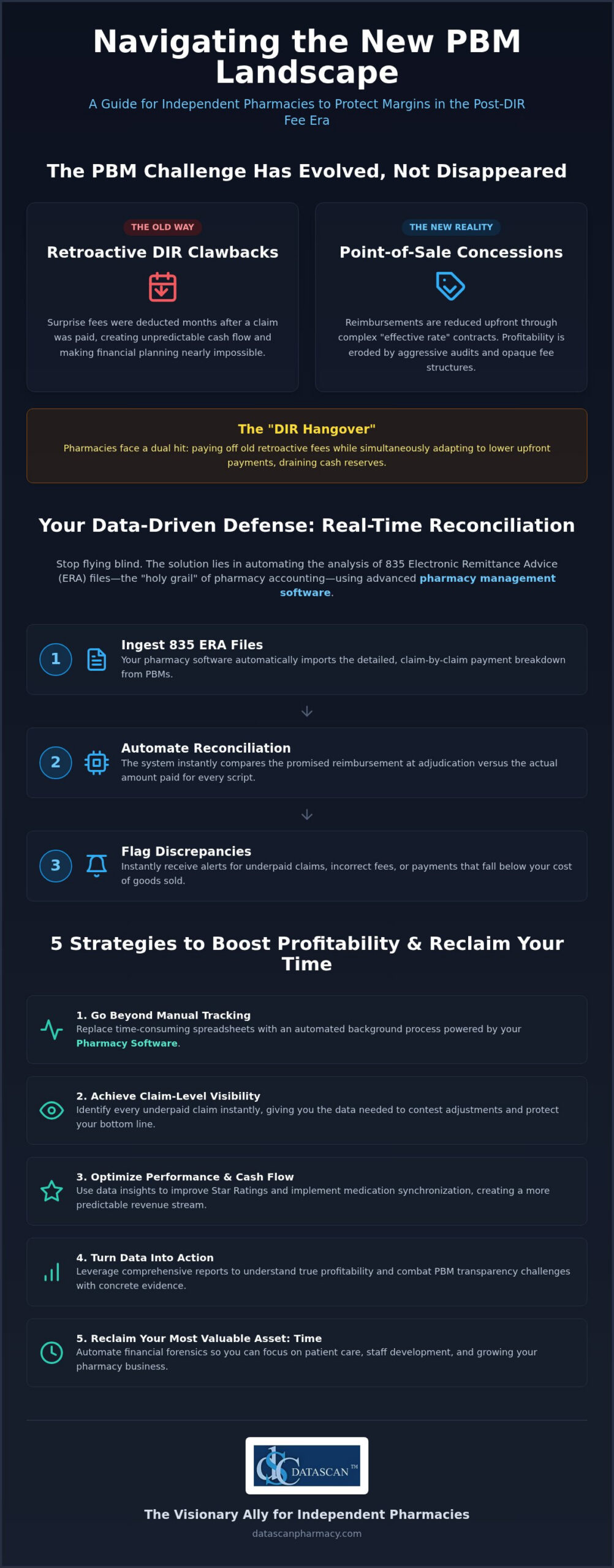
Managing pharmacy DIR fees requires moving from retroactive tracking to real-time financial reconciliation using advanced pharmacy management software. As of 2026, the mechanism of these fees has fundamentally shifted from the surprise retroactive “clawbacks” of previous decades to point-of-sale price concessions. While this transition was intended to provide transparency, it created a lower, less predictable reimbursement environment that continues to challenge independent margins. Today, DIR fees are essentially upfront discounts that PBMs deduct from your reimbursement before the payment even hits your ledger.
The industry is still grappling with the “DIR Hangover,” a period where pharmacies had to pay off residual retroactive fees from previous cycles while simultaneously adjusting to the lower net payments of the new point-of-sale model. This dual financial hit drained cash reserves and made revenue predictability nearly impossible for those without robust data tools. To understand the broader context of these entities, it’s helpful to review the history of Pharmacy Benefit Management and how their fee structures have evolved to prioritize corporate margins over community pharmacy sustainability.
How do DIR fees impact independent pharmacy gross profit?
The shift to point-of-sale transparency hasn’t solved the margin problem; it has simply moved the deduction to the start of the transaction. PBMs now utilize complex “effective rate” contracts, such as Generic Effective Rates (GER), to ensure their reimbursement targets are met. If your pharmacy’s performance doesn’t align with their arbitrary benchmarks, your reimbursement is adjusted downward. Tracking your true earnings is impossible if you aren’t accounting for these deductions at the claim level. For a detailed breakdown of how to navigate these numbers, consult our Calculating Pharmacy Gross Profit: 2026 Guide. High-performance pharmacy management software is essential to reveal these hidden costs that would otherwise stay buried in your PBM contracts.
Why is PBM reform taking so long?
Legislative efforts are finally gaining ground, but the implementation timeline remains a significant hurdle for independent owners. The Consolidated Appropriations Act of 2026 introduced major federal PBM reform, yet many of its most impactful provisions don’t take full effect for several more years. Additionally, while state-level PBM regulation is widespread and many jurisdictions have implemented new licensing deadlines throughout 2026, “transparency” in a contract doesn’t always translate to “fairness” in reimbursement. PBMs are adept at finding new avenues for revenue recovery, often replacing lost fee income with aggressive audit practices. Effectively managing pharmacy DIR fees means recognizing that you cannot wait for government intervention to save your margins; you must use technology to defend your profit today.
How to reconcile PBM payments to spot underpayments?
The most effective way to reconcile PBM payments is through the automated processing of 835 Electronic Remittance Advice (ERA) files within your pharmacy management software. These digital files act as the “holy grail” of pharmacy accounting; they provide a granular, claim-by-claim breakdown of what the PBM actually paid versus what was promised during initial adjudication. Without this level of detail, you’re essentially flying blind, unable to see where “effective rate” adjustments or undisclosed fees are eating your margins. Managing pharmacy DIR fees in 2026 requires this precise visibility to ensure your bank deposits match your ledger.
Identifying the gap between promised reimbursement and actual payment is critical because PBMs often use post-adjudication adjustments to recoup funds. When you import 835 files into your Pharmacy Software, the system automatically flags discrepancies. This allows you to spot claims that have fallen below your cost of goods sold (COGS) instantly. If you want a deeper look at how these mechanisms work, you can find DIR fees explained in industry white papers that highlight the shift from retroactive to point-of-sale concessions. By mastering this reconciliation, you transform your pharmacy from a passive recipient of payments into an active auditor of your own revenue.
What is the best way to track underpaid claims?
Tracking underpaid claims effectively requires a shift from manual spreadsheets to automated, claim-level alerts. High-performance Pharmacy Software allows you to set specific “negative margin” triggers. If a PBM pays less than the cost of the drug plus your required dispensing fee, the system should notify you immediately. This data visibility lets you identify patterns; perhaps a specific PBM is consistently underpaying on a particular therapeutic class. Generating audit-ready reports from these findings gives you the ammunition needed to contest unfair reimbursements or make informed decisions about dropping unprofitable contracts. To learn more about the tools available for this purpose, explore our comprehensive guide on software to identify underpaid pharmacy claims and how real-time adjudication can stop financial losses at the point of sale. If you’re ready to see how these tools work in practice, reach out to our team for a personalized walkthrough of our reconciliation features.
How often should a pharmacy reconcile its payments?
You should aim for daily or, at the very least, weekly reconciliation cycles to maintain a healthy cash flow. Waiting until the end of the month creates a “panic” scenario where you’re chasing hundreds of discrepancies all at once. Daily reconciliation, made possible by modern pharmacy management software, turns a massive chore into a five-minute background task. It ensures that you catch errors while the claims are still fresh, making it easier to resolve issues with the PBM or your PSAO. This consistency frees up your time, allowing you to move away from the back office and focus on growth-oriented tasks like clinical services or patient consultations.
How does pharmacy management software help manage DIR fees?
Pharmacy management software automates the financial oversight required to survive PBM reimbursement challenges by turning reconciliation into a background process. While earlier sections highlighted the need for data visibility, the practical reality is that you don’t have hours to spend on manual ledger entries. Modern pharmacy management software solves this by linking your dispensing data directly with electronic remittance advice. This automation ensures that managing pharmacy DIR fees isn’t a separate, exhausting task but a standard part of your daily digital workflow.
One of the most powerful tools in this fight is medication synchronization. By aligning patient refills, you create a predictable dispensing schedule that stabilizes cash flow and improves adherence metrics. These metrics are often used by PBMs to determine the performance component of Medicare Direct and Indirect Remuneration (DIR). When your system automates this process, you’re not just saving time; you’re actively defending your reimbursement rates and simplifying the burden of managing pharmacy DIR fees. Integrating your Pharmacy Software with your POS system also allows you to see the true net profit of every transaction, accounting for both the cost of goods and the PBM’s point-of-sale deductions. For a full breakdown of these tools, explore our Pharmacy Management Software Features.
Can workflow automation reduce operational costs?
Operational efficiency is your best defense against shrinking margins. Every minute your staff spends on redundant data entry or searching for paper records is a minute you’re paying for without a return. Implementing robust Workflow Software for Pharmacies allows your team to process prescriptions with surgical precision. This efficiency reduces the overhead costs that make PBM fees feel so burdensome. When your workflow is optimized, your staff can pivot toward high-value clinical services that provide revenue streams PBMs can’t easily touch, transforming your business model from volume-based to value-based.
Why is US-based support critical for software implementation?
Dealing with complex US financial regulations requires a technology partner that actually speaks the language of the independent pharmacist. Offshore support teams often lack a fundamental understanding of the PBM struggle or the nuances of state-level reform. At Datascan, our family-owned heritage means we have the independent “DNA” required to build future-proof solutions. We act as your Visionary Ally, providing US-based technical support that understands exactly why a reconciliation error or a negative margin claim is a crisis for your business. We don’t just sell software; we offer a partnership built on decades of advocacy for the community pharmacy.
What are the 5 best strategies for managing pharmacy DIR fees?
The most effective strategies for managing pharmacy DIR fees in 2026 focus on proactive data analysis and operational agility rather than passive acceptance of PBM terms. By implementing real-time claim monitoring, you can identify discrepancies immediately after adjudication, ensuring that underpayments don’t compound over months of unverified claims. Success in this area requires shifting your business model to prioritize high-margin services and utilizing Pharmacy management software that provides a clear window into your net profitability. Use these five tactics to protect your bottom line:
Implement real-time claim monitoring: Use your Pharmacy Software to catch underpayments at the point of sale before they negatively impact your monthly cash flow.
Maximize Star Ratings: Optimize patient adherence metrics to move your pharmacy into lower variable DIR fee tiers.
Diversify revenue streams: Reduce your dependency on PBM-controlled prescriptions by expanding into compounding, high-margin OTC products, and clinical services.
Audit PBM contracts annually: Work with a contract specialist to identify “effective rate” traps and hidden language that allows for aggressive post-adjudication audits.
Prioritize profitability dashboards: Invest in a system that displays net profit after all anticipated fees, rather than just gross reimbursement. Pharmacy business intelligence dashboards can transform your raw prescription data into immediate, actionable insights that highlight underpaid claims and protect your bottom line.
Adopting these strategies transforms your pharmacy from a price-taker into a data-empowered business. If you’re tired of guessing your actual margins, contact our team to see how our profitability dashboards can give you back control over your finances.
How do Star Ratings affect your DIR fees?
Patient outcomes directly dictate the variable fee tiers applied by many PBMs; high performance in adherence often leads to lower concessions. Your pharmacy management software should serve as an early warning system, identifying “at-risk” patients who are falling behind on their medication schedules. By using the MobileScripts patient app, you can send automated reminders and drive the adherence levels necessary to maintain a high Star Rating. This proactive intervention ensures you aren’t penalized for patient behaviors that are within your power to influence through better technology.
Is diversifying into compounding worth the effort?
Compounding remains one of the most effective ways to bypass the “race to the bottom” of PBM reimbursements. These specialized prescriptions offer significantly higher margins and allow you to serve a niche market that isn’t solely dependent on insurance contracts. While compliance can be complex, utilizing Compounding Solutions for Pharmacies makes the process seamless. Integrated software handles the formulas, logs, and regulatory requirements, allowing you to focus on building a profitable service line that PBMs cannot easily claw back.
Why is Datascan the visionary ally for independent pharmacies?
Datascan is the visionary ally for independent pharmacies because we provide a locally hosted, high-performance ecosystem designed to neutralize PBM threats and maximize operational efficiency. Our Pharmacy management software isn’t just a dispensing tool; it’s a financial fortress built on over four decades of advocacy for the community pharmacist. We understand that managing pharmacy DIR fees is a matter of survival, which is why our technology is engineered to transform complex operational burdens into streamlined, profitable successes.
Since 1981, we’ve remained a family-owned enterprise, giving us a unique perspective on the independent “DNA” that corporate vendors simply can’t replicate. We’ve watched the industry evolve for decades and used that historical perspective to build future-proof solutions. Our total solution approach ensures that your Datascan Point of Sale, patient apps, and electronic delivery tools all work in harmony. This integration allows you to see the true net profit of your business in real time, accounting for every PBM deduction and operational cost without the need for manual spreadsheets. For independent owners looking to go further, our pharmacy business intelligence dashboards guide shows how to turn that real-time data into strategic decisions that protect your margins.
What makes Datascan different from ‘Big Tech’ pharmacy vendors?
While many competitors have pivoted toward rigid, corporate-driven models, Datascan remains fiercely loyal to the individual owner. We offer personalized, US-based technical support where you speak to a human who understands your workflow, rather than forcing you through an automated ticket system. Our commitment to innovation focuses on delivering tangible business results without the bloated corporate overhead. We empower you to reclaim your time and your profit by automating the technical burdens that often pull you away from your patients and your growth strategies.
How to get started with a stress-free software conversion?
Many owners stick with “good enough” systems because they fear the downtime of a data migration, but 2026 is the year to stop settling and start protecting your margins. Our conversion roadmap is purposeful and methodical, ensuring your patient records and financial data are moved with surgical precision. We provide a logical and organized training breakdown for your staff, so you can transition to our Pharmacy Software with total confidence. You don’t have to fight the PBMs alone. It’s time to Schedule a Demo with Datascan Today and experience the accountability and personal touch of a partner who is truly invested in your success.
Secure Your Margins in the New Era of PBM Reimbursement
The shift to point-of-sale concessions in 2026 has fundamentally changed the landscape, making real-time data visibility more critical than ever. Successfully managing pharmacy DIR fees requires a move away from manual tracking toward automated reconciliation that catches underpayments the moment they occur. By leveraging Pharmacy management software to maximize Star Ratings and diversifying into high-margin services like compounding, you can finally break the cycle of PBM dependency and stabilize your cash flow. Your expertise is needed at the patient counter, not buried in a back-office spreadsheet.
You don’t have to navigate these complex financial pressures alone. Datascan has been a fierce champion of the independent pharmacy since 1981, providing the sophisticated Pharmacy Software needed to transform operational burdens into streamlined successes. With our 100% US-based support and family-owned perspective, we offer the accountability and expertise your business deserves to thrive in a competitive market. Reclaim your pharmacy’s profitability with Datascan’s advanced management software. We are ready to help you build a more secure and profitable future for your community pharmacy today.
Frequently Asked Questions
How do I calculate the impact of DIR fees on my gross profit?
Subtract the total price concessions from your gross reimbursement to find your true net earnings. Since 2024, these fees are applied at the point of sale, but “effective rate” adjustments still create a gap between adjudicated prices and actual payments. Use your pharmacy software to compare initial claims with 835 electronic remittance advice. This data allows you to identify which plans are hurting your margins and adjust your contract strategies accordingly.
Can I appeal a DIR fee clawback from a PBM?
You can contest discrepancies if your reconciliation data shows an underpayment or an incorrect fee application. While traditional retroactive clawbacks were largely eliminated in 2024, PBMs now use aggressive audits to recoup funds. Success requires meticulous documentation and audit-ready reports from your pharmacy management system. Having clear data visibility allows you to challenge discrepancies through your PSAO or directly with the PBM’s appeals department to protect your revenue.
What is the difference between a DIR fee and a GER fee?
A DIR fee is a price concession applied to Medicare Part D claims, while a GER (Generic Effective Rate) is a contractual target for generic drug reimbursement. PBMs use GER to reconcile payments across all generic claims over a specific period. If your average reimbursement exceeds the agreed GER, the PBM recoups the difference. Both mechanisms require careful oversight within your pharmacy management software to ensure your net margins remain sustainable and predictable.
Does every pharmacy management software have PBM reconciliation tools?
No, many legacy systems lack the sophisticated tools needed for automated 835 ERA file reconciliation. Basic software might only show initial adjudication, leaving you to manually track actual payments. Advanced pharmacy management software, like the suite offered by Datascan, integrates these financial tools into your daily workflow. This automation is vital for managing pharmacy DIR fees and spotting negative margin claims without spending hours on manual data entry or spreadsheets.
How will PBM reform in 2026 change the way I manage my pharmacy?
The Consolidated Appropriations Act of 2026 mandates greater transparency, but many provisions, like the ban on spread pricing, won’t take full effect until 2028. In the meantime, managing pharmacy DIR fees requires focusing on upfront contract analysis and real-time claim monitoring. The focus has shifted from surviving surprise clawbacks to managing lower point-of-sale reimbursements. Successful owners are using technology to diversify revenue and protect their cash flow from ongoing PBM volatility.
Is it possible to eliminate DIR fees entirely by going ‘cash only’?
Going “cash only” eliminates PBM-related fees but also removes your access to the majority of patients who rely on insurance. A more balanced strategy involves using software to identify underpaid pharmacy claims to pinpoint and drop the most unprofitable plans while growing your cash-based services. Diversifying into compounding or high-margin OTC products reduces your dependency on PBM contracts without alienating your core patient base or sacrificing your essential community presence.
How do adherence apps like MobileScripts help lower my DIR fees?
Adherence apps improve your pharmacy’s Star Ratings, which directly influences the variable fee tiers set by many PBMs. High performance in patient adherence often leads to lower price concessions. By using the MobileScripts Patient Mobile App, you can send automated refill reminders and identify at-risk patients for intervention. This proactive approach ensures your performance metrics remain high, effectively reducing the percentage of reimbursement lost to performance-based deductions and protecting your bottom line.
What should I look for in a pharmacy software vendor when it comes to financial reporting?
Look for a vendor that provides real-time profitability dashboards and automated 835 reconciliation. Your system should display net profit after all anticipated fees rather than just gross reimbursement. US-based support is also critical for navigating complex financial regulations. A family-owned partner like Datascan understands the independent struggle and builds tools that prioritize your bottom line, helping you reclaim your time and your profit through better data visibility.
Imagine it’s 4:30 PM on a busy Tuesday, your waiting area is reaching capacity, and your pharmacy management software suddenly hits a snag with a complex reimbursement claim. Do you really have forty minutes to languish on hold for a scripted response from someone who doesn’t understand the nuances of current PBM reform? High-quality, US-based pharmacy software support is no longer a luxury; it’s a critical financial safeguard for owners who can’t afford to lose time to workflow disruptions. For many independent owners, scripted delays are a daily operational bottleneck that drains profitability. You deserve a technology partner that acts as a fierce advocate for your business rather than a distant utility provider.
We understand that every second spent troubleshooting technical glitches is a moment stolen from your patients and your community. This article reveals why expert-led, US-based pharmacy software support is the secret weapon for pharmacies navigating the volatile landscape of 2026. You’ll discover how localized expertise reduces hold times, ensures your pharmacy software stays ahead of PBM compliance, and ultimately frees you to focus on clinical care. We will break down the essential differences between a mere vendor and a dedicated support team that treats your independent pharmacy’s success as their own priority.
Key Takeaways
Understand the distinction between generic technical help and true industry advocacy that recognizes the unique operational pressures of the American healthcare landscape.
Discover how US-based pharmacy software support serves as a financial safeguard by helping you identify underpaid claims and navigate PBM reimbursement challenges.
Learn why a robust feature list in your pharmacy management software is only effective when backed by a team that offers family-owned accountability and expert-led implementation.
Identify specific ways to leverage technology to automate repetitive tasks, effectively reducing the learning curve for new staff and reclaiming your workday.
See how a dedicated, long-term partnership with a US-based provider ensures your pharmacy software remains a tool for growth rather than a source of technical friction.
Defining US-Based Pharmacy Software Support in 2026
In 2026, US-based pharmacy software support represents far more than a technical help desk located within domestic borders. It is a strategic partnership where the support staff functions as an extension of your pharmacy team. True domestic support means working with experts who live and breathe the same regulatory environment you do, from the intricacies of state Medicaid changes to the evolving pressures of PBM reform. While basic technical help fixes a printer connection, industry advocacy ensures your pharmacy management software is optimized to protect your bottom line against predatory reimbursement practices.
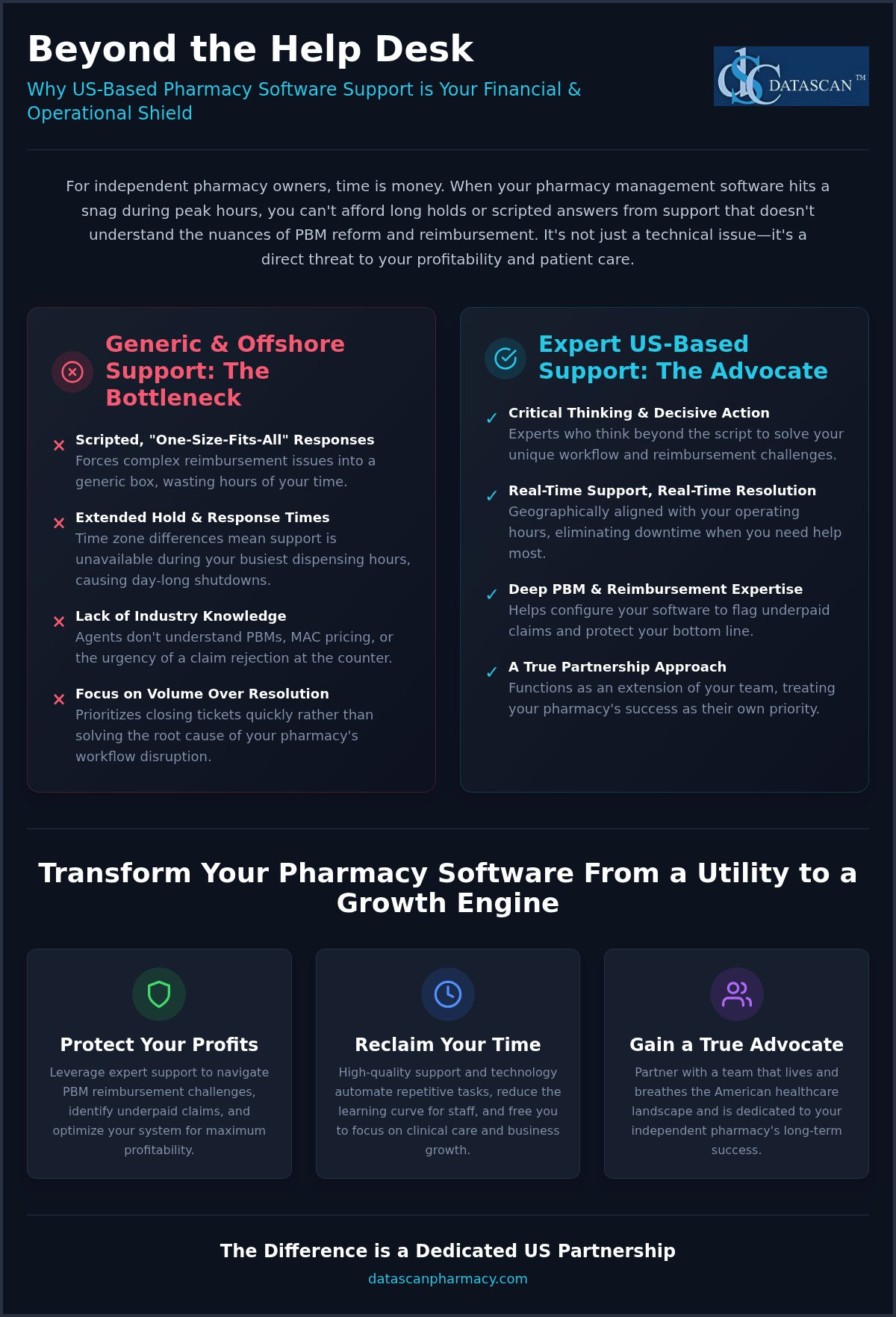
Offshore call centers often prioritize volume over resolution, leading to a disconnect that can be catastrophic during peak dispensing hours. When you call for help, you shouldn’t have to explain what a Payer Sheet is or why a specific rejection code is stalling your workflow. Localized support removes these cultural and professional barriers, providing a level of accountability that only comes from a team that shares your industry’s stakes. Choosing a partner with US-based pharmacy software support ensures that the person on the other end of the line understands the urgency of a patient waiting at your counter.
Why Scripted Support Fails Independent Pharmacies
Scripted support is the enemy of the independent pharmacist. These “one-size-fits-all” responses are designed for generic software issues, yet workflow software in a pharmacy setting is anything but generic. A script cannot account for the unique nuances of your community pharmacy’s specific patient care model or the way you handle local provider relationships. Relying on a predetermined flow chart often results in hours of wasted time as you try to force a complex reimbursement issue into a box that doesn’t fit. You need a partner who can think critically and act decisively without reading from a manual. This level of expertise is essential when dealing with high-stakes PBM structures that don’t follow a predictable script.
The Impact of Geographic Alignment on Response Times
Time is your most valuable resource. When your pharmacy software encounters a critical error at 10:00 AM on a Monday, you cannot wait for an offshore center to wake up or cycle through an overnight shift. Localized support creates a direct line to experts who resolve issues in real time, effectively eliminating the downtime that occurs when your peak hours don’t align with a vendor’s support schedule. Matching support availability to high-volume pharmacy operating times ensures that real-time remote assistance is available when your waiting room is full. This geographic synchronicity allows for immediate intervention during critical dispensing errors, preventing minor technical hitches from snowballing into day-long operational shutdowns.
The Technical Advantage: Navigating PBM Reform and Reimbursements
Independent pharmacies face a relentless squeeze from Pharmacy Benefit Managers (PBMs). Your pharmacy management software shouldn’t just be a tool for labeling bottles; it must be a financial shield. Technical support plays a pivotal role here. When your US-based pharmacy software support team understands the nuances of the American reimbursement landscape, they can help you configure your system to flag underpaid claims before they vanish into a ledger. This isn’t just about fixing bugs. It’s about optimizing your software to protect every cent of your gross profit margin.
Generic tech support often fails to grasp why a specific claim rejection or a low reimbursement rate is a crisis. In contrast, a domestic team acts as an advocate. They help you navigate the complexities of MAC (Maximum Allowable Cost) pricing and ensure your system is utilizing the most current data feeds. This specialized knowledge allows you to adjust your purchasing and dispensing strategies based on actual financial data rather than guesswork. By aligning your software settings with your specific business goals, you transform a standard utility into a high-performance engine for profitability.
Expert Guidance on PBM Reimbursement Recovery
Tracking every claim is impossible without automation. Expert support staff help you leverage your pharmacy management software to identify patterns in underpayment and interpret complex PBM financial reports that are often designed to be opaque. This level of assistance ensures you aren’t just reacting to losses but actively preventing them.
Identify DIR fee impacts and potential clawbacks in real-time to maintain cash flow.
Dispute underpaid claims using integrated reporting tools and historical data.
Automate reimbursement tracking to save hours of manual labor each week.
By working with a team that knows these financial pressures, you turn your technology into a recovery asset. This proactive approach ensures you aren’t leaving money on the table due to simple configuration errors or missed reporting deadlines.
Adapting to PBM Reform in Real-Time
PBM reform is moving fast. State and federal laws are shifting, and your technology must keep pace. A domestic vendor prioritizes updates that reflect these legislative changes because they’re directly impacted by them too. Your software vendor is your first line of defense against aggressive PBM audits. They ensure your documentation is compliant and your system is ready for scrutiny. If you have questions about how these changes affect your daily operations, you can reach out for expert guidance to stay ahead of the curve. This partnership empowers you to focus on patient outcomes while knowing your margins are protected by cutting-edge technical advocacy.
Evaluating Pharmacy Software Vendors: Support Quality vs. Feature Lists
Don’t be fooled by a shiny interface or an endless list of bells and whistles. A feature list is only as valuable as the team standing behind it. If your staff can’t navigate a new reimbursement tool during a busy afternoon, that feature provides zero return on investment. High-quality US-based pharmacy software support ensures you actually extract value from your pharmacy management software rather than letting expensive tools sit idle. Real-world functionality depends on having an expert just a phone call away who can guide you through complex setups in real time.
Many independent owners choose their technology based on a checklist of capabilities, only to realize later that the implementation phase is where most systems fail. Without a dedicated partner to help you configure your workflow software, you’ll likely struggle with the same bottlenecks you were trying to solve. To avoid these common pitfalls, it’s essential to follow a structured Pharmacy Software Implementation Plan that prioritizes support quality and staff training from day one.
Corporate Call Centers vs. Family-Owned Advocacy
Equity-backed “Big Tech” vendors often prioritize quarterly shareholder reports over the daily struggles of a community pharmacist. When a company is beholden to venture capital, support is usually the first department to see budget cuts or offshoring. This creates a massive disconnect between the software developers and the pharmacists using the tools. While developers in many high-tech industries rely on specialized behavioral research from companies like Ergoneers to optimize how users interact with complex systems, the pharmacy software world requires a more direct connection. In contrast, family-owned companies with a 45-year history in the industry maintain a legacy of direct accountability. There’s a profound difference in service when the people running the company have a vested interest in your long-term survival and treat your business like a partnership instead of a line item.
Low-cost or “free” software packages frequently hide their true expense in the form of operational friction. When you’re forced to wait hours for a response from an offshore agent who doesn’t understand US pharmacy law, you’re losing more than just time. You’re losing prescriptions. Patients won’t wait indefinitely at the counter while you struggle with a technical glitch. The Total Cost of Ownership for pharmacy software must include the financial impact of support downtime and the potential for lost revenue when technical issues prevent you from processing claims during peak hours. Poorly trained support staff lead to staff frustration and decreased productivity, which eventually erodes your pharmacy’s bottom line. Independent owners who feel trapped by a corporate system’s limitations often find that exploring the best McKesson pharmacy software alternative reveals how much purchasing flexibility and margin protection they’ve been missing.
How High-Quality Support Frees Up Time for Pharmacy Owners
Time is the one resource pharmacy owners can’t buy back. If you’re spending your day wrestling with software glitches or explaining American PBM structures to an offshore call center, you aren’t running your business; you’re just putting out fires. This is where US-based pharmacy software support becomes an operational game-changer. It’s about more than just fixing a bug. It’s about having a partner who helps you automate the tedious, repetitive tasks that eat away at your schedule, allowing you to transition from a technician to a true CEO of your enterprise.
When your technology works in harmony with your staff, the entire energy of the pharmacy shifts. You can process more scripts with fewer errors, and the constant hum of technical anxiety disappears. Reliable pharmacy management software, backed by an expert team, ensures that your staff spends less time staring at a computer screen and more time engaging with the patients who rely on your expertise. This efficiency isn’t just about speed; it’s about creating a sustainable business model that protects your mental health and your bottom line.
Streamlining Workflow with Expert-Led Implementation
Implementation isn’t a one-time event. It’s an ongoing process of refinement. When you work with a team that understands the community pharmacy model, they can help you customize your pharmacy management software to match the physical flow of your store. Whether it’s setting up MedSync protocols to bundle patient refills or integrating e-care plans into your daily routine, expert-led guidance ensures these tools actually save you time rather than creating more work. Support teams that know your industry can show you exactly how to automate inventory management, stopping the cycle of losing money on overstock.
This level of precision is also vital when optimizing the pharmacy POS system, ensuring that front-end sales and back-end reporting are perfectly synchronized. When your technology works as intended, the learning curve for new staff drops significantly. This allows you to scale your team and delegate tasks with confidence, knowing the system will guide them through the correct protocols without constant supervision.
Reducing Burnout Through Proactive Troubleshooting
Pharmacist burnout is often the result of “death by a thousand cuts,” those small, persistent technical frustrations that interrupt patient care. A reliable pharmacy computer system, backed by proactive support, provides the peace of mind necessary to focus on clinical excellence. Instead of waiting for a total system failure, a dedicated support team identifies potential issues before they disrupt the patient line. This proactive stance allows you to shift your focus from technical troubleshooting to high-value clinical services and business growth. If you’re ready to reclaim your workday and eliminate technical friction, contact our team today to see how a true partnership can transform your operations.
The Datascan Difference: 45+ Years of Dedicated US Partnership
Choosing a technology partner is one of the most consequential decisions an independent owner can make. Since 1981, Datascan has remained a family-owned and operated leader, providing a level of stability that equity-backed competitors simply cannot match. While other vendors consolidate or move their operations abroad, our commitment to US-based pharmacy software support remains absolute. We never use offshore call centers. This ensures that every time you call for assistance with your Datascan Pharmacy Management Software, you’re speaking with a local expert who understands the specific financial and operational pressures facing community pharmacies today.
Our long-term reliability stems from a deep-seated pride in our independence. We’ve seen the industry evolve over four decades, and we’ve used that experience to build a support structure that values accountability over scripted volume. When you partner with us, you aren’t just buying a license; you’re joining a family that has championed the independent pharmacist for generations. This longevity allows us to offer a “best-of-both-worlds” experience, delivering cutting-edge capabilities with the personal touch of a private enterprise that knows your name and your business goals.
A Legacy of Independent Pharmacy Advocacy
Our independence is your greatest advantage. Because we aren’t beholden to venture capital or corporate chain demands, we can prioritize the features that matter most to local pharmacists. This “Champion of the Independent” persona isn’t just a marketing slogan; it translates into our daily support interactions. We understand that your pharmacy is more than a business; it’s a vital part of your community. Our support staff is trained to act as your advocate, helping you navigate complex PBM reform and reimbursement issues with the same urgency you feel. We use our historical perspective to build future-proof solutions that keep you competitive in an increasingly difficult market.
Integrating the Entire Pharmacy Ecosystem
Efficiency happens when your tools talk to each other. Datascan provides a unified ecosystem where support is integrated across every touchpoint. Whether you’re troubleshooting the MobileScripts Patient App or coordinating routes with our Electronic Delivery System, you’re dealing with the same dedicated US-based team. This holistic approach eliminates the frustration of being bounced between different vendors for your Pharmacy POS and dispensing software. Having one point of accountability ensures that technical issues are resolved quickly, allowing you to focus on clinical care and patient outcomes. Don’t settle for fragmented support from a corporate giant. Experience the difference with a Datascan demo and see how a true partnership can empower your pharmacy’s success.
Empower Your Pharmacy with Strategic Advocacy
The landscape of community pharmacy in 2026 demands more than just functional tools; it requires a partnership built on accountability and deep industry expertise. We’ve explored how the right technology acts as a shield against PBM volatility, but that shield is only effective when backed by a team that understands the stakes. By prioritizing US-based pharmacy software support, you eliminate the operational bottlenecks that lead to staff burnout and lost revenue. You reclaim your time to focus on what matters most: your patients and your community.
As a family-owned leader since 1981, Datascan remains committed to the success of the independent owner. We provide 100% US-based technical support and specialized solutions for both compounding and retail sectors, ensuring your pharmacy management software is always optimized for growth. Don’t let scripted delays or offshore disconnects stall your progress. It’s time to empower your business with a technology partner that treats your success as their own.
Is US-based pharmacy software support included in my monthly fee?
Yes, at Datascan, our support is typically bundled into your monthly maintenance fee. We believe that independent owners shouldn’t be penalized for seeking help or optimizing their pharmacy management software. This approach ensures you have unlimited access to our domestic experts without worrying about per-call charges. It’s part of our commitment to acting as your partner rather than just a vendor, providing predictability for your overhead costs.
How do I know if a pharmacy software vendor uses offshore support?
You can often identify offshore support by asking direct questions about the physical location of their help desk during the sales process. Look for signs like delayed responses that don’t align with US time zones or support staff who seem unfamiliar with American PBM structures. A transparent vendor will proudly state that their US-based pharmacy software support team is in-house. If they use vague terms like global support network, they’re likely outsourcing.
Can high-quality support really help me with PBM reimbursements?
Absolutely, because expert support staff understand how to configure your system to flag low-reimbursing claims. They guide you through using advanced reporting tools to identify DIR fee impacts and MAC pricing discrepancies. Instead of just fixing technical bugs, our team helps you leverage your Pharmacy Software to protect your gross profit margins. This proactive advocacy is essential for navigating the complex and often predatory PBM landscape effectively.
What are the typical response times for US-based pharmacy support?
While industry averages can vary, domestic teams generally provide much faster resolution during your peak operating hours. At Datascan, we prioritize immediate accessibility to ensure your workflow isn’t stalled by technical friction. Because our US-based pharmacy software support team is geographically aligned with your pharmacy, we eliminate the overnight delays common with offshore models. Rapid response times are a critical safeguard that minimizes downtime when your waiting room is reaching capacity.
Does Datascan provide support for compounding and long-term care modules?
Yes, our support team is fully trained to assist with specialized modules, including compounding and nursing home or assisted living features. We recognize that these sectors have unique regulatory and workflow requirements that generic software support cannot address. Whether you’re managing complex formulas or multi-dose packaging, our experts provide the granular guidance necessary to keep your specialized operations running smoothly and profitably within our integrated ecosystem.
How does pharmacy software support help with staff training and turnover?
High-quality support reduces the learning curve for new employees by providing expert-led implementation and troubleshooting guidance. When your staff can get immediate answers from a domestic expert, they feel more confident and less frustrated during their shift. This proactive assistance helps maintain productivity even during periods of high turnover. By making your pharmacy management software easier to master, we help you reduce the operational stress that often leads to burnout.
What happens to my data during a pharmacy software conversion?
During a conversion, our dedicated team manages the secure transfer of your patient records, prescription history, and drug files into the new system. We focus on data integrity to ensure that your clinical and financial information remains accurate and accessible from day one. Our US-based team oversees every step of this transition, providing the accountability needed to minimize disruptions. For a comprehensive roadmap on this process, review our guide on the pharmacy software data migration process to ensure your records are protected at every stage. We treat your data with the same care and precision as you treat your patients.
Why should I choose a family-owned software vendor over a corporate one?
Choosing a family-owned vendor ensures long-term stability and direct accountability that corporate, equity-backed firms often lack. We prioritize your success over shareholder dividends, which allows us to maintain a domestic support team and consistent feature updates. Our heritage as a family business since 1981 means we’ve seen the industry’s challenges firsthand. We act as a champion of the independent, offering a personal touch and loyalty that corporate giants can’t replicate.
Is the lowest monthly subscription fee actually the most expensive mistake your independent pharmacy could make in 2026? When you evaluate the cost of PioneerRx vs Datascan, it’s easy to get lost in base pricing and overlook the predatory hidden fees that erode your bottom line. You’ve likely felt the sting of shrinking margins, especially as specialty drugs now account for over half of net drug spending. We know that every dollar spent on pharmacy software must be an investment in your survival, not just another line item on your overhead.
This comparison moves beyond the sticker price to reveal the total cost of ownership and the strategic value differences that separate these platforms. You’ll discover how choosing the right pharmacy management software can provide better tools to fight PBM underpayments and recover lost revenue following the latest 2026 legislative reforms. We’ll preview the essential features that automate complex workflows, giving you back the time needed to focus on business growth. By the end of this analysis, you’ll have a clear roadmap to selecting a partner that champions your independence and protects your profitability in a volatile market.
Key Takeaways
Define the true Total Cost of Ownership (TCO) by identifying hidden integration and support fees that often mask the real price of a system.
Compare the cost of PioneerRx vs Datascan by analyzing the long-term ROI of a corporate-driven model against a stable, family-owned partnership.
Discover how specialized Pharmacy management software tools can help you identify underpaid claims and navigate aggressive PBM reimbursement tactics.
Learn to utilize advanced Pharmacy Software workflows to automate manual tasks and reclaim hours of ownership time each week for business growth.
Follow a step-by-step audit process to calculate the financial impact of a software conversion based on transparent, all-inclusive pricing structures.
Beyond the Sticker Price: Understanding Pharmacy Software Costs
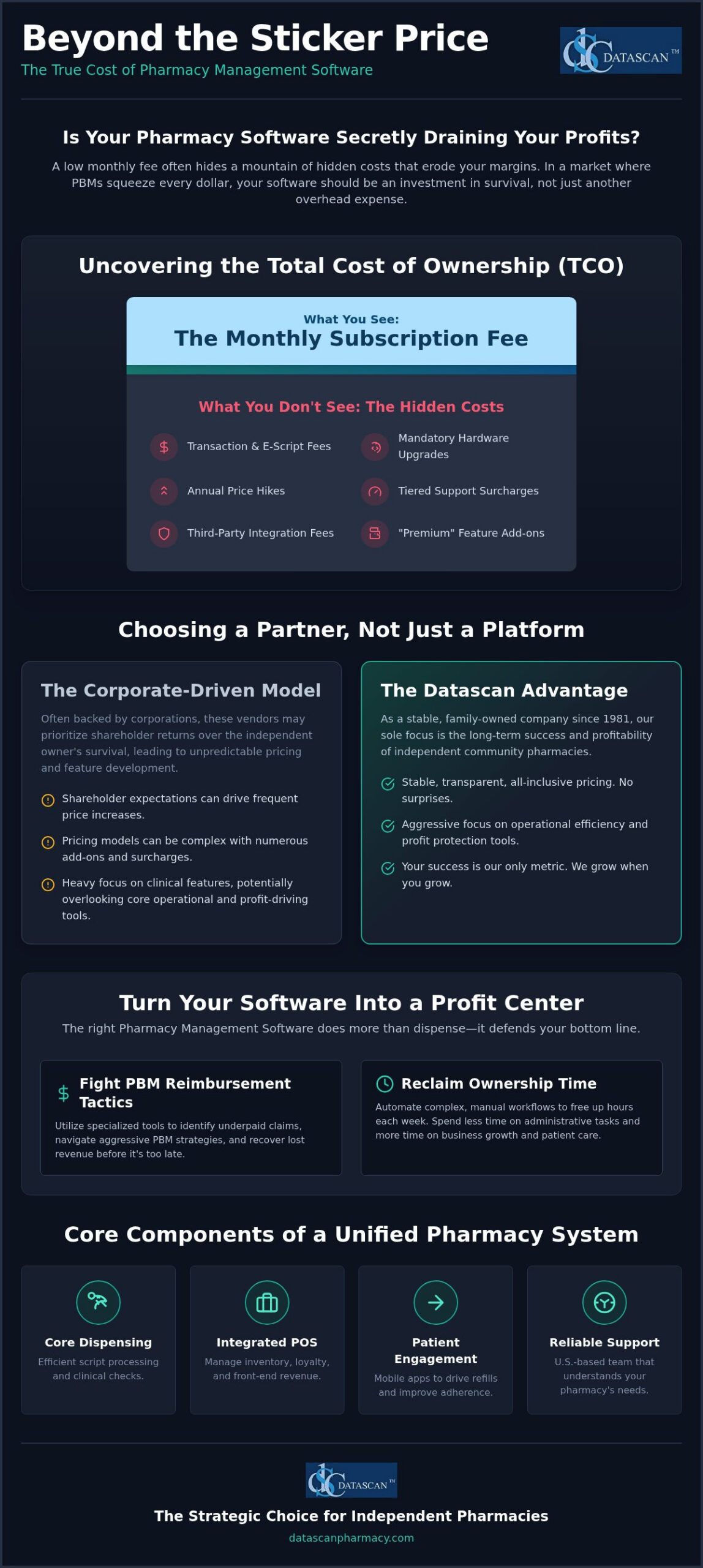
Evaluating the cost of PioneerRx vs Datascan requires a fundamental shift in perspective from “what I pay today” to “what I lose tomorrow.” Most owners look at the monthly license fee as the primary metric. This sticker price is often just the tip of the iceberg. A low entry price frequently masks a cascade of secondary expenses that can cripple a pharmacy’s budget over time. When Pharmacy Software is backed by massive corporations with shareholders to satisfy, annual price hikes become a standard operational hazard. These corporations often prioritize profit margins over the survival of the independent owner.
You are already fighting Pharmacy Benefit Managers (PBMs) for every cent of reimbursement. Your software vendor shouldn’t be another entity draining your bank account through aggressive “nickel and dime” tactics. Total Cost of Ownership (TCO) includes everything from hardware maintenance and support contracts to the third-party integrations required to keep your doors open. If these costs aren’t transparent from day one, your profitability will suffer. It is vital to audit your vendor’s history of price stability before signing any long-term agreement.
There is also the heavy burden of opportunity cost. If a system is so complex that it requires weeks of intensive training for every new hire, you are losing valuable time. This is time that should be spent on clinical services, patient counseling, or strategic business development. Efficiency is the only way to overcome the labor shortages and administrative bloat currently facing community pharmacies. A system that is too difficult to navigate effectively raises your labor costs even if the monthly software bill seems low.
The Components of a Modern Pharmacy System
A complete Pharmacy management software solution isn’t just a dispensing engine; it must integrate several moving parts to be truly effective. Independent pharmacies need a unified ecosystem to compete with the big chains.
Core dispensing licenses for daily script processing and clinical checks.
An integrated Point of Sale (POS) system to manage inventory, loyalty programs, and front-end revenue.
Reliable, U.S.-based support that understands the unique pressures of the American healthcare landscape.
Hidden Fees to Watch for in Pharmacy Software Contracts
When comparing the cost of PioneerRx vs Datascan, look specifically at the fine print regarding transaction-based billing. Many vendors lure you in with a competitive base rate but then charge extra for features that are essential for modern practice.
Transaction fees for every e-prescription or insurance claim processed through the system.
Support surcharges for access to help desk tiers, hardware troubleshooting, or software updates.
Monthly fees for adding “premium” features like medication synchronization, delivery tracking, or document management.
By choosing a partner with all-inclusive pricing, you eliminate the budget volatility that comes with hidden contract clauses. This allows you to forecast your overhead with precision and focus your energy on patient care instead of invoice auditing.
PioneerRx vs. Datascan: Comparing Value and ROI
When you weigh the cost of PioneerRx vs Datascan, you aren’t just comparing lines of code; you’re choosing a business philosophy. PioneerRx operates within a corporate driven model where shareholder expectations often dictate pricing and development priorities. In contrast, Datascan has maintained family owned stability since 1981. This independence allows us to prioritize the needs of community pharmacies over quarterly profit reports. While PioneerRx focuses heavily on clinical features, Datascan balances innovation with an aggressive operational and profit focus. We believe your Pharmacy Software should be a tool that actively protects your bottom line, not just a platform for documentation.
The financial health of your pharmacy depends on how your vendor responds to industry shifts. Recent federal scrutiny has highlighted how PBMs impose unfair, arbitrary, and harmful contractual terms on independent owners. You need a partner that updates its Pharmacy management software to combat these specific threats. While corporate entities might move slowly or prioritize features that benefit their data partners, Datascan rapidly deploys tools designed to help you navigate reimbursement challenges and PBM reform. This agility is a core component of your long term return on investment.
Workflow Efficiency and Time Savings
Labor is your largest controllable expense. Every extra click in your dispensing process is a drain on your profitability. High performance Datascan workflow software is engineered to reduce the number of steps required per script, allowing your staff to fill more prescriptions in less time. Automated refill management serves as a secondary labor saving tool, handling the heavy lifting of patient outreach without manual intervention. By integrating your management system with our proprietary Point of Sale (POS), you eliminate the reconciliation errors and double entry common with third party systems.
Support Models: Corporate Call Centers vs. Expert Ally
Downtime is a silent killer of pharmacy revenue. If your system goes down and you’re stuck in a corporate call center queue, you’re losing more than just time; you’re losing patient trust. Corporate support models often rely on tiered help desks where the first person you speak with lacks the authority to solve complex issues. Datascan provides US-based pharmacy software support that treats your pharmacy like a partner, not a ticket number. This level of accountability is essential when executing a Pharmacy Software Implementation Plan or troubleshooting critical billing issues. You can connect with our team to see how a dedicated support ally can transform your daily operations.
How Pharmacy Management Software Fights PBM Margin Squeeze
The true cost of PioneerRx vs Datascan isn’t just the price you pay for a license; it’s the revenue you lose when your system fails to flag an underpaid claim. PBMs rely on opaque pricing and complex fee structures to compress your margins. If your technology doesn’t provide real-time visibility into these tactics, you’re essentially flying blind. Effective Pharmacy Software must act as a financial shield, identifying scripts that fall below your required margin before the patient even leaves the counter. Automated PBM reconciliation is no longer a luxury in 2026. It’s a non-negotiable requirement for survival.
Recent legislative shifts, including the Consolidated Appropriations Act of 2026, have mandated higher transparency for manufacturer rebates. While these reforms are a step forward, PBMs continue to use arbitrary contractual terms to squeeze independent owners. You need Pharmacy management software that tracks DIR fees with precision and helps you navigate these shifting reimbursement landscapes. Specialty drugs now account for 52% of total drug spending despite making up only 2% of prescriptions. This massive concentration of spend means that even a small error in reimbursement tracking can result in thousands of dollars in lost profit every month.
Reclaiming Revenue with Advanced Reporting
Stop guessing which prescriptions are actually profitable. Advanced reporting within Datascan Pharmacy Management Software allows you to identify high-margin versus low-margin scripts instantly. By monitoring profit margins at the point of dispensing, you can make informed decisions about inventory and clinical priorities. This level of granular data helps you fight back against “spread pricing” and ensures every transaction contributes to your pharmacy’s long-term viability. When you can see your net profit after all fees are accounted for, you gain the upper hand in a competitive market.
Freeing Up Time for Clinical Services
Profitability in 2026 requires moving beyond the pill bottle. You need to free up time for higher-reimbursement e-care plans and clinical services. Automating mundane administrative tasks is the only way to reclaim the hours needed for patient counseling and medication synchronization. These programs create predictable revenue streams and improve patient adherence simultaneously. Efficiency tools, like the Datascan Electronic Delivery System, streamline your logistics so your staff can focus on growth-oriented tasks. By letting technology handle the repetitive workflows, you transform your pharmacy from a dispensing hub into a high-performance clinical center.
Calculating the ROI of a Pharmacy Software Conversion
Deciding to switch your Pharmacy Software is a significant operational move that requires a cold, hard look at the numbers. When you analyze the cost of PioneerRx vs Datascan, you aren’t just looking at a monthly bill; you’re calculating the return on investment for your store’s future. Start by auditing your current monthly fees and per-transaction costs. Many owners are shocked by how much they actually pay once e-prescribing surcharges, claim fees, and “premium” support tiers are added up. Next, estimate the value of staff time saved through a better workflow. If your current system requires ten clicks for a refill that should take three, you’re hemorrhaging labor costs every single day.
The third step involves calculating potential revenue gains from integrated PBM reconciliation tools. In an era where middlemen use opaque tactics to squeeze independent pharmacies, a system that flags underpaid claims in real-time is a revenue generator, not an expense. Finally, factor in the stability of your vendor. Corporate mergers in the software space often lead to forced migrations, sunsetting of features, or sudden price hikes to satisfy shareholders. Choosing a family-owned partner provides a level of accountability and long-term pricing security that massive conglomerates simply cannot match. This stability is a core component of your ROI that often goes overlooked during the initial sales pitch.
The Cost of “Staying Put”
Sticking with outdated technology has a price tag that doesn’t show up on a traditional balance sheet. Patients expect modern conveniences like mobile refills and digital notifications. If your current Pharmacy management software lacks these features, you’re likely losing younger demographics to competitors who offer a more streamlined experience. “Free” or cheap software often costs more in the long run due to lost efficiency, patient churn, and the inability to fight back against reimbursement compression. For a deeper dive into what your system should be doing for you, read The Ultimate Guide to Pharmacy Management Software in 2026.
Mitigating the Risk of Migration
The fear of downtime often keeps owners trapped in bad contracts. Datascan eliminates this risk by handling the entire pharmacy software data migration process with precision, ensuring your pharmacy remains operational throughout the transition. Specialized training during the implementation phase is vital to ensure your staff hits the ground running without a dip in productivity. Our US-based pharmacy software support is critical during those first 30 days, providing immediate answers from experts who understand your specific business needs. Don’t let the fear of change hold your pharmacy back from peak profitability. You can schedule a consultation with our experts today to see how a conversion can pay for itself through recovered revenue and improved efficiency.
Why Datascan is the Strategic Choice for Independent Pharmacies
Choosing a partner for your Pharmacy Software is one of the most critical decisions you’ll make for your business’s longevity. When you evaluate the cost of PioneerRx vs Datascan, the real differentiator is accountability. Since 1981, Datascan has remained a family-owned enterprise dedicated exclusively to the success of independent community pharmacies. We don’t answer to venture capitalists or distant shareholders who demand quarterly price hikes. Instead, we answer to you. This independence allows us to offer a “best-of-both-worlds” experience: the high-performance capabilities you expect from a market leader delivered with the personal touch and responsiveness of a private, family-run business.
Our focus remains laser-targeted on the issues that actually impact your bank account, specifically PBM reimbursements and operational efficiency. While corporate-owned competitors may focus on feature bloat to justify high monthly fees, we prioritize the tools that help you fight back against unfair PBM tactics. By streamlining your workflow, our Pharmacy management software frees up your time to focus on patient care and business growth. This clarity of purpose is what separates family-owned stability from corporate complexity.
Empowering the Underdog
We view ourselves as the champion of the independent pharmacy owner. Our philosophy is built on the idea that the “underdog” deserves the same technological advantages as the big-box chains without the predatory pricing. We provide continuous innovation that is future-proof, ensuring your store is ready for the clinical shifts of 2026 and beyond. Whether you are managing complex compounding or high-volume retail, our solutions are designed to optimize every aspect of your operation. We don’t just sell software; we build a foundation for your independence.
Take the Next Step Toward Profitability
Beyond software, independent owners can also leverage physical automation to stay competitive; for example, ReadyLockers provides a universal smart locker platform that allows pharmacies to offer secure, 24/7 pickup options similar to those found at national chains.
This philosophy of empowering independent businesses with precision tools is universal; for instance, electrical contractors can discover Best Bid to access specialized estimating software that helps them compete effectively in their own industry.
The journey to a more profitable pharmacy starts with a simple evaluation. We invite you to see a personalized demo of the Datascan system to experience firsthand how our integrated tools can transform your daily workflow. Beyond dispensing, we can show you how optimizing the pharmacy POS system can drive front-end revenue and improve patient retention. Don’t settle for a vendor that treats you like a ticket number in a corporate database. Contact us today for a custom quote tailored to your specific volume and discover the value of a partner that’s as invested in your success as you are.
Take Control of Your Pharmacy’s Financial Destiny
Choosing between vendors is more than a technical decision; it’s a commitment to your store’s long-term survival. Evaluating the cost of PioneerRx vs Datascan reveals that true value lies in more than just a monthly license fee. You need Pharmacy management software that provides specialized tools to recover PBM underpayments and a workflow that gives you back the time needed to grow your business. By moving away from corporate-driven complexity, you gain the clarity of a family-owned ally that has championed independent pharmacies for over 40 years.
With our 100% US-based support team and a deep focus on your profitability, Datascan ensures you never have to fight the PBM margin squeeze alone. It’s time to stop paying for hidden fees and start investing in Pharmacy Software built for your success. Schedule a Demo to See How Datascan Maximizes Your Pharmacy Profitability today. Your community relies on your independence, and we’re here to help you protect it.
Frequently Asked Questions
How much does Datascan pharmacy software cost compared to PioneerRx?
Datascan focuses on a total cost of ownership model that often results in lower long-term overhead. While PioneerRx may offer tiered monthly pricing based on user counts, their additive costs for integrations can quickly inflate your bill. Datascan provides an all-inclusive approach that simplifies budgeting. By consolidating dispensing and management tools, you avoid the sticker shock common with corporate vendors who charge for features we consider standard.
Does Datascan charge extra for US-based technical support?
Expert US-based technical support is included in your standard agreement with Datascan. We believe that reliable assistance shouldn’t be a premium add-on or a tiered luxury. Our support team is located entirely within the United States to ensure clear communication and deep industry knowledge. This model eliminates the frustration of corporate call centers and helps you resolve operational issues quickly to minimize downtime in your pharmacy.
Is the cost of data migration included when switching to Datascan?
Data migration is a standard part of our implementation process, and we work to make the transition as financially seamless as possible. While some competitors treat migration as a major profit center, our priority is getting your store up and running with zero downtime. We handle the heavy lifting of moving your patient and prescription records so you can focus on serving your community during the software conversion process. To understand exactly what this involves, review our comprehensive pharmacy software data migration process checklist built specifically for independent pharmacies in 2026.
Can Datascan help reduce my pharmacy’s DIR fees?
Yes, our Pharmacy management software includes specialized tools designed to track and help mitigate the impact of DIR fees. By providing real-time visibility into your reimbursements and identifying underpaid claims, we empower you to make data-driven decisions that protect your margins. These tools are essential for navigating the complex PBM landscape of 2026 and ensuring that your pharmacy remains profitable despite aggressive reimbursement compression.
Are there hidden transaction fees in a PioneerRx vs Datascan comparison?
Transparency is a key differentiator when evaluating the cost of PioneerRx vs Datascan. Many corporate-owned systems rely on transaction-based billing for e-prescribing or claims processing, which can lead to unpredictable monthly expenses. Datascan advocates for a flat-fee model that covers essential operations. We avoid the nickel and dime tactics that erode your bottom line, providing a predictable overhead that allows for better financial forecasting and business planning.
How long does it take for a pharmacy software conversion to pay for itself?
Most pharmacies see a return on investment within the first year by leveraging recovered PBM revenue and improved staff efficiency. When you switch to high-performance Pharmacy Software, the reduction in manual clicks and automated refill management lowers your labor costs immediately. By identifying underpaid scripts at the point of dispensing, the system helps you reclaim lost profits that would otherwise go unnoticed under an outdated or inefficient platform.
Does Datascan offer integrated POS for the same cost as the management system?
Our Datascan Point of Sale (POS) is a separate, fully integrated module designed to work in perfect harmony with our dispensing software. While it is an additional component, the value of having a unified system outweighs the cost of managing disparate third-party tools. This integration eliminates double entry and reconciliation errors, which saves your staff hours of administrative work each week and improves the accuracy of your financial reporting.
Why does family ownership matter for the cost of my pharmacy software?
Family ownership ensures that your software vendor is accountable to you, not to corporate shareholders or venture capital firms. Large corporations often implement aggressive price hikes to meet quarterly profit targets, but Datascan has maintained pricing stability for over 40 years. This independence allows us to invest in long-term innovation that benefits independent owners rather than focusing on short-term financial gains that increase your operational burden.