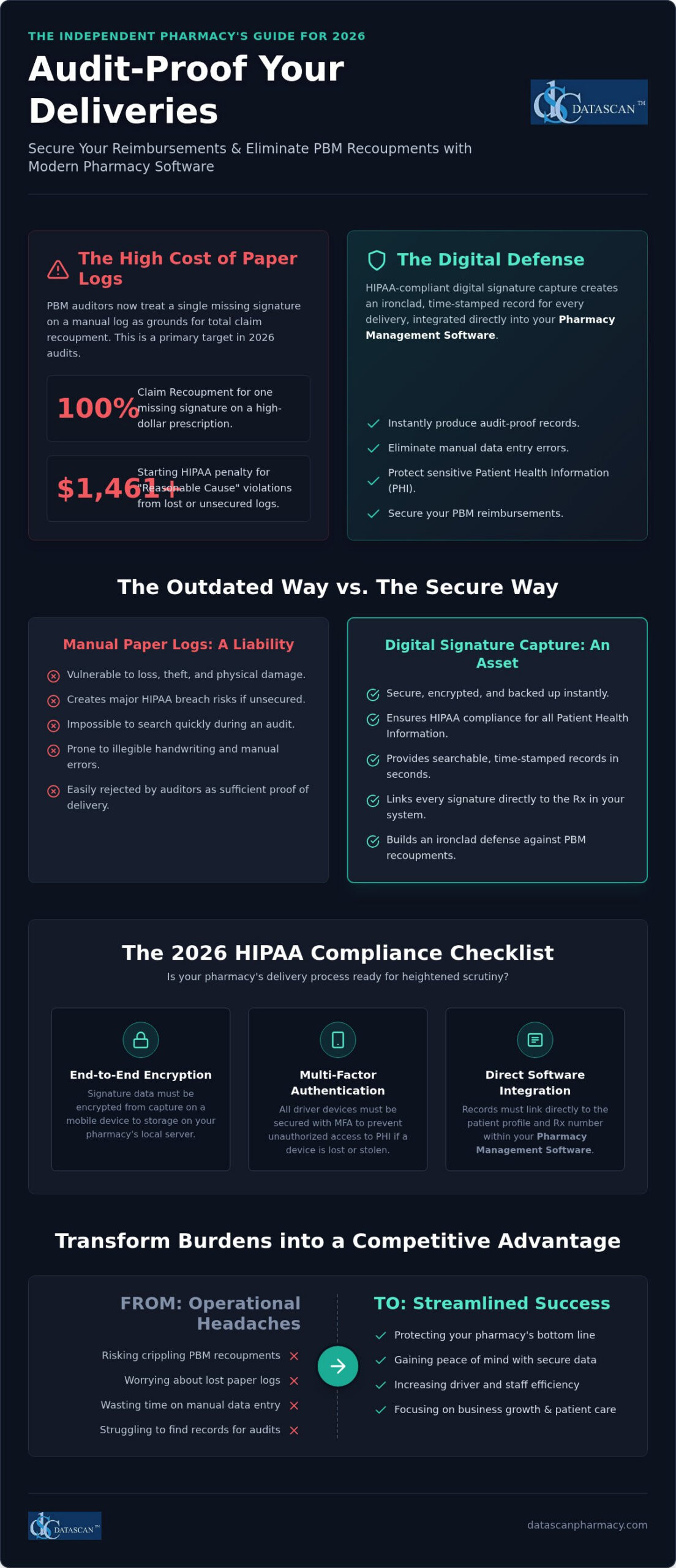
A single missing signature on a manual delivery log can result in the total recoupment of a high-dollar claim during a PBM audit; it’s a financial risk your independent pharmacy simply can’t afford in 2026. To secure your business, you must implement a system for HIPAA compliant delivery signature capture that links every prescription directly to an encrypted, time-stamped record within your pharmacy management software. This strategy ensures you aren’t just meeting privacy standards but are also building an ironclad defense against auditors who no longer accept basic delivery confirmations as proof of service.
We know the pressure of maintaining profitability while managing a mobile workforce is intense, especially with 2026 HIPAA civil penalties for “Reasonable Cause” violations starting at $1,461 and climbing quickly. It’s frustrating when drivers lose paper logs or when you worry about a lost device compromising patient data. This article will show you how to transform these operational burdens into a streamlined, paperless success. You’ll learn how to implement a modern delivery system that improves driver efficiency and stores audit-proof records directly in your Pharmacy Software, giving you the freedom to focus on growth instead of administrative headaches.
Key Takeaways
Protect your pharmacy from total claim recoupments by replacing vulnerable paper logs with an audit-proof digital signature system.
Identify the mandatory 2026 requirements for HIPAA compliant delivery signature capture, including essential encryption standards for mobile devices.
Streamline your daily operations by integrating secure delivery workflows directly into your Datascan Pharmacy Management Software.
Increase driver efficiency and reduce administrative errors using a dedicated mobile delivery app designed specifically for independent pharmacies.
Transform complex compliance burdens into a competitive advantage that secures your reimbursements and frees up valuable time for business growth.
What is HIPAA compliant delivery signature capture?
HIPAA compliant delivery signature capture is the process of securely recording a patient’s acknowledgment of receipt for prescriptions using encrypted digital tools that protect Protected Health Information (PHI). It’s a critical safeguard that replaces outdated paper logs with a verifiable, digital chain of custody. By using this technology, independent pharmacies ensure that every signature is inextricably linked to a specific Rx number and patient profile within their pharmacy management software. This creates an ironclad record that protects your reimbursements during aggressive PBM audits.
The transition from paper logs to digital mobile delivery applications isn’t just about convenience; it’s about survival in a landscape of increasing regulatory scrutiny. In 2026, a simple scribble on a clipboard is no longer enough to satisfy auditors. A truly compliant system requires end-to-end encryption during the transmission of the signature from the driver’s device back to the pharmacy’s local server. This ensures that the data remains protected according to the standards set by the Health Insurance Portability and Accountability Act (HIPAA). Without this level of security, your pharmacy is vulnerable to both HIPAA violations and PBM recoupments.
Why is digital signature capture better than paper logs?
Paper logs are a massive liability for any community pharmacy. If a driver leaves a clipboard in an unlocked vehicle or accidentally loses a log sheet, you’ve potentially triggered a major HIPAA breach. Beyond the security risks, paper is notoriously difficult to manage. Digital capture through a dedicated mobile delivery app allows for:
Immediate, searchable records that can be produced instantly during an unannounced audit.
Significant reduction in manual data entry errors that occur when staff try to transcribe messy handwriting.
Protection against physical damage, such as water stains or tears, which can make paper logs unreadable and useless for defense.
What patient data is considered PHI during delivery?
It’s vital to remember that a delivery route contains a high volume of sensitive data. Patient names, home addresses, and prescription numbers are all classified as PHI. Even the signature itself is a legal acknowledgment that must be handled with the same security as a medical record. To meet 2026 standards, any device used by your drivers must be secured with multi-factor authentication (MFA). This prevents unauthorized access if a device is lost or stolen, ensuring that your pharmacy stays compliant while keeping patient data out of the wrong hands.
How does secure signature capture protect your pharmacy from PBM audits?
Secure signature capture is your primary defense against PBM auditors who treat a single missing signature as grounds for 100% recoupment of a claim’s ingredient cost and dispensing fee. In 2026, PBM audits have shifted focus from clinical accuracy to administrative technicalities, specifically targeting “missing proof of delivery” to claw back profits from independent pharmacies. Implementing a system for HIPAA compliant delivery signature capture ensures that every transaction is backed by ironclad, digital evidence that satisfies even the most aggressive auditor.
By integrating these tools directly into your pharmacy management software, you remove the “low-hanging fruit” that auditors typically exploit. When an auditor demands proof, you don’t need to dig through dusty boxes of paper logs; you can generate a comprehensive report in seconds. These digital records include the signature, a precise timestamp, and metadata that aligns with the HIPAA Security Rule, proving that your pharmacy maintains total control over patient data from the bench to the doorstep.
How does missing delivery documentation impact your pharmacy’s bottom line?
PBMs treat delivery records as a strict condition of payment, which means they use technical flaws in your documentation to justify taking thousands of dollars back. Digital timestamps and GPS coordinates provide vital secondary layers of proof that complement the patient’s signature, making it nearly impossible for an auditor to claim a medication wasn’t delivered. Our integrated pharmacy management software automates this defense by linking every delivery record to the original prescription transaction in real-time. A robust digital record should always include:
The unique prescription (Rx) number.
The date and exact time of the delivery.
The name and signature of the recipient.
GPS coordinates verified at the moment of capture.
Can technology help mitigate DIR fees and improve efficiency?
Streamlining your logistics isn’t just about audit protection; it’s about reclaiming your time and improving your pharmacy’s star ratings. When your delivery process is automated and paperless, your staff spends less time on manual data entry and more time on clinical services that drive profitability. Leveraging the right technology for improving star ratings alongside a secure delivery workflow gives independent pharmacies a powerful edge in competing with mail-order giants while protecting their reimbursements. If you’re ready to secure your workflow and stop audit losses, contact our team to see how we can help you optimize your business.
What is the HIPAA compliance checklist for pharmacy delivery software?
To achieve HIPAA compliant delivery signature capture in 2026, your system must include end-to-end encryption, unique driver credentials, and real-time integration with your central pharmacy database. Your delivery tool needs to function as a secure extension of your pharmacy management software, ensuring that patient data is never vulnerable to interception or unauthorized access. Use this checklist to evaluate your current or future delivery system:
Encryption: Ensure AES-256 encryption is active for data at rest and in transit for all patient information handled on mobile devices.
Automatic Syncing: Signatures must flow directly back to the patient profile without manual intervention, eliminating the risk of lost records or manual entry errors.
Audit Trails: Every driver needs a distinct account to maintain a clear record of who handled which prescription and the exact time of the transaction.
Remote Wipe: Your system must allow you to clear all sensitive data from a device instantly if it’s lost or stolen during a route.
Why is a Business Associate Agreement (BAA) necessary?
You can’t legally share patient data with a software vendor without a signed BAA in place. This document is a legal contract that binds the vendor to the same HIPAA privacy and security standards that you follow as a healthcare provider. Generic, non-healthcare e-sign tools often fail this compliance step because they refuse to sign these agreements, leaving your pharmacy liable for any potential breaches. As a dedicated partner to the independent community, Datascan provides the legal and technical framework required to keep your pharmacy compliant, ensuring your audit defense is built on a solid foundation.
What are the technical requirements for mobile delivery devices?
The hardware your drivers carry into the field must be as secure as the terminals inside your pharmacy. This starts with enforcing multi-factor authentication (MFA) for every login, which is a critical defense against modern hacking trends. Adhering to the Digital Signature Standard ensures that the signatures you capture are legally binding, tamper-evident, and verifiable during a PBM audit. Finally, data should never be stored locally on the device longer than necessary; once a delivery is confirmed and synced to your local server, the PHI should be purged from the mobile unit to minimize the risk of exposure.
How do you implement a secure mobile delivery workflow?
A secure mobile delivery workflow connects your pharmacy management system directly to the patient’s doorstep through an encrypted, verifiable chain of command. By integrating HIPAA compliant delivery signature capture into your workflow software, you ensure that every transaction is documented and stored without the risks associated with manual paper logs. This streamlined approach turns a complex logistical challenge into a repeatable, audit-ready process that protects your bottom line.
To implement this successfully, your pharmacy should follow these five essential steps:
Step 1: Integrate your delivery module with your internal workflow software to ensure data flows seamlessly between the fill station and the driver’s device.
Step 2: Assign prescriptions to specific routes and drivers within the system; this maintains a clear record of who is responsible for each medication at any given time.
Step 3: Drivers use the mobile app to scan the package barcode at the doorstep, which confirms the driver is handing the correct medication to the correct patient.
Step 4: Capture the digital signature and any required co-payments at the point of delivery, ensuring the system records the transaction as a completed, paid event in real-time.
Step 5: The system performs an automatic upload of the signature record to the patient profile for permanent storage, making it instantly retrievable for future audits.
Training your delivery team for compliance
Your drivers are the face of your pharmacy and must be trained to handle PHI with the same care as your in-store technicians. They need to understand that they aren’t just delivering “packages”; they are handling legal documents and sensitive medical information. Best practices include verifying the recipient’s identity without announcing the medication name aloud and maintaining privacy during every interaction. If a patient is not home or refuses to sign, drivers must follow a secure re-delivery protocol that keeps the PHI protected within the delivery vehicle rather than leaving it on a porch or with a neighbor.
Optimizing routes to save time and fuel
Route optimization within your delivery app does more than just save on fuel costs. It gives pharmacy owners back their most valuable asset: time. By automating the delivery sequence, your drivers can complete more stops in less time, while real-time tracking allows your store staff to provide accurate updates to patients. This level of efficiency helps independent pharmacies compete with larger chains while maintaining the personal touch their communities expect. For a deeper dive into maximizing store-wide productivity, read our Pharmacy Workflow Optimization Guide. If you’re ready to secure your delivery operations, contact our support team today for a personalized demonstration.
How does Datascan’s mobile delivery app streamline your pharmacy operations?
Datascan’s mobile delivery app streamlines your workflow by providing a direct, secure bridge between your field drivers and your local pharmacy management system. This specialized tool allows independent pharmacies to achieve HIPAA compliant delivery signature capture while eliminating the friction of manual data entry and fragmented record-keeping. By automating the documentation process, you transform a high-risk operational burden into a streamlined success that protects your reimbursements.
Unlike one-size-fits-all corporate software, our solution is built specifically for the unique pressures of the independent pharmacy owner. We act as the “Champion of the Independent,” delivering technology that prioritizes your profitability by reducing labor costs and shielding you from aggressive PBM audit risks. If a driver encounters a technical hurdle during a late-afternoon route, our US-based support team ensures you get a real person on the phone immediately, not a generic chatbot or an outsourced help desk. This level of accountability is essential for maintaining a reliable delivery service that your community can trust.
Seamless integration with POS and management systems
Efficiency is born from deep integration, and our mobile app ensures that every signature captured in the field appears instantly within your Datascan Point of Sale system. There is no need for complex syncing or reliance on external servers; the app maintains a direct, secure connection to your pharmacy’s local server to keep your data under your own roof. This real-time visibility doesn’t just protect you during audits; it also forms a core part of effective pharmacy patient retention strategies by ensuring your staff can provide accurate, up-to-the-minute delivery status updates to your patients whenever they call.
Future-proofing your pharmacy with Datascan
With a history spanning more than 40 years, Datascan has evolved alongside the independent pharmacy industry, providing stable and innovative solutions that venture-backed corporations simply cannot match. As a family-owned vendor, we are directly accountable to your success, and our longevity proves our commitment to building future-proof tools that help you thrive despite shifting PBM demands. We invite you to see how our mobile delivery app can transform your operations and secure your reimbursements. Schedule a demo today to experience the power of a system designed for the way you actually do business.
Secure Your Pharmacy’s Future with Audit-Proof Delivery
Transitioning to a high-efficiency digital workflow is no longer optional for independent pharmacies facing aggressive PBM audits in 2026. By implementing HIPAA compliant delivery signature capture, you effectively eliminate the risk of total claim recoupments caused by missing or illegible paper logs. This technology doesn’t just protect your hard-earned revenue; it streamlines your entire mobile operation, freeing up your time to focus on patient care and clinical growth. You deserve a system that works as hard as you do to protect your bottom line.
Since 1981, Datascan has remained a family-owned and operated partner to community pharmacies across the country. Our mobile solutions provide direct integration with the Datascan Pharmacy Management System and offer industry-leading, US-based technical support to ensure your drivers always have the help they need. You have the power to overcome PBM challenges and build a more profitable, efficient business for your community. See how Datascan’s Mobile Delivery App can audit-proof your pharmacy and schedule a demo today!
Frequently Asked Questions
Is a digital signature as legally binding as a pen-and-paper signature?
Digital signatures are just as legally binding as traditional ink signatures thanks to the ESIGN Act and the Uniform Electronic Transactions Act. These digital records offer superior protection for your business because they create a tamper-evident record linked to a specific transaction. When integrated with your pharmacy software, these signatures provide a verifiable audit trail that manual logs cannot match. This ensures you meet federal standards while protecting your reimbursements from technical recoupments.
Does HIPAA require a signature for every single prescription delivery?
HIPAA requires a good faith effort to obtain an acknowledgment of receipt for the Notice of Privacy Practices. While the regulation is the foundation, PBM contracts are the primary reason you need a signature for every delivery. PBMs treat a signed delivery log as a strict condition of payment. If you do not have a signature stored in your pharmacy management software, auditors will often claw back the entire cost of the claim.
What happens if my delivery driver loses the mobile device containing patient signatures?
If a driver loses a device, you should immediately initiate a remote wipe through your security management tools. Because a secure mobile delivery app syncs data directly to your local pharmacy management software, the patient signatures are not lost. They are already safely stored on your local server. Multi-factor authentication prevents unauthorized users from accessing any PHI on the lost device, keeping your pharmacy compliant and your patient data protected.
Can I use a standard tablet for HIPAA compliant signature capture?
You can use a standard tablet, but it must be configured with specific safeguards to be compliant. This includes full-disk encryption, phishing-resistant multi-factor authentication, and a secure connection to your pharmacy system software. The hardware itself is just a tool; the compliance comes from the secure application and the administrative policies you implement. Generic tablets without these protections should never be used to handle sensitive patient information or capture signatures.
How long does a pharmacy need to keep delivery signature records for audits?
HIPAA mandates that pharmacies retain compliance-related documentation for at least six years. However, PBMs often have their own lookback periods that can extend beyond that timeframe. It is best practice to store your digital records indefinitely within your pharmacy management software. Since these records do not take up physical space like paper logs, keeping them for the long term is a low-cost way to ensure you are always ready for an audit.
Do PBMs accept digital signatures as proof of delivery?
PBMs absolutely accept digital signatures and often prefer them for their accuracy and metadata. A digital signature captured through a secure app includes a timestamp and GPS coordinates that provide a level of proof paper logs cannot offer. Using a digital system helps you overcome reimbursement challenges by providing the gold standard of proof that auditors look for in 2026, making your records much harder to dispute during a review.
What is the difference between an e-signature and a digital signature under HIPAA?
An e-signature is a general term for an electronic mark, while a digital signature is a specific, encrypted type of e-signature. For HIPAA compliant delivery signature capture, the system uses cryptographic keys to ensure the signature is authentic and has not been altered. This high level of security is what makes digital signatures acceptable for protecting sensitive healthcare data and satisfying the technical requirements of the HIPAA Security Rule.
How can I capture signatures if the patient is not at home during the delivery?
You should not leave the medication if a patient is not home; instead, the driver must return the prescription to the pharmacy. Leaving PHI on a porch is a significant security risk and fails to provide the proof of delivery required by PBMs. Your delivery app should allow the driver to mark the delivery as attempted and return the item to the pharmacy workflow, where it can be rescheduled for a time when the patient is available.
Did you know that more than half of community pharmacists report losing money on at least 30% of the prescriptions they fill? In 2026, specialized pharmacy compliance reporting software is the primary tool to stop these financial drains by automating the rigorous documentation required to defeat PBM audit clawbacks and secure your profit margins. By integrating these reporting tools directly into your pharmacy management software, you can transform hours of manual administrative busy work into a streamlined, automated process that protects your business from predatory PBM practices.
We understand that the constant pressure of shrinking DIR fee transparency and the manual tracking of controlled substances feels like an uphill battle against a system designed to see you fail. You’ve worked too hard to build your legacy to let administrative burnout or unexpected audits strip away your hard-earned revenue. This guide will show you how to leverage modern pharmacy software to navigate the new landscape of the Consolidated Appropriations Act 2026, helping you reclaim your time and safeguard every dollar your pharmacy earns.
We’ll explore how the latest advancements in technology allow you to stay ahead of state-specific regulations, manage quarterly rebate remittances, and prepare for the full implementation of federal PBM reforms. You will discover how to transition from operational struggle to optimized efficiency with ease.
Key Takeaways
Learn how specialized pharmacy compliance reporting software automates mandatory documentation for the DEA and state boards to eliminate manual paper logs and human error.
Discover how integrated reporting acts as a financial shield against PBM audits and clawbacks by flagging compliance gaps during the fill process before they become liabilities.
See how automated workflows within your pharmacy management software reduce administrative burnout, giving you the freedom to focus on high-margin clinical services.
Understand how to track at-risk patients to improve adherence scores and proactively lower DIR fees through precise, real-time data monitoring.
Explore why locally-hosted pharmacy software provides superior data security and control, ensuring you remain the champion of your own independent business operations.
Pharmacy compliance reporting software is a specialized module within a robust pharmacy management software system that automatically generates the documentation required by state boards, the DEA, and PBM auditors. It replaces manual paper logs with digital, timestamped records tied directly to dispensing data, ensuring that every transaction is defensible and accurate. By integrating these tools directly into your primary workflow, you eliminate the need for redundant data entry and minimize the risk of human error during an audit.
Effective reporting tools go beyond simple data storage; they act as a financial shield for your business. This software manages critical documentation such as controlled substance logs, electronic signature captures, and PBM reimbursement reconciliations. When these features are built into your pharmacy software rather than being tacked on as third party add-ons, you gain a seamless flow of information that protects your profit margins. This integration is a core component of modern pharmacy automation systems, transforming compliance from a manual burden into an automated asset.
How does it differ from generic compliance tools?
Generic compliance tools typically focus on broad HR and IT standards, which don’t address the high stakes of prescription dispensing. In contrast, specialized pharmacy compliance reporting software is designed to handle drug pedigree and specific Rx logs. Because it’s integrated with your dispensing data, it provides real-time reporting that generic tools simply can’t match. It addresses unique independent pharmacy pain points, such as DIR fee transparency and specific PBM audit triggers, by linking every report to a verifiable prescription record. This ensures you have the exact data needed to challenge unfair clawbacks without searching through disparate systems.
Why is reporting automation essential in 2026?
PBMs have become increasingly aggressive, and research shows that more than half of community pharmacists lose money on at least 30% of the prescriptions they fill. In 2026, you can’t afford to lose more revenue to administrative oversights. Labor shortages mean your staff shouldn’t spend 10 or more hours every week on manual paperwork. Automation frees your team to focus on high-margin clinical services while creating a “defensive paper trail.” These digital records are significantly harder for auditors to challenge than handwritten logs, giving you the upper hand during inspections. With the Consolidated Appropriations Act 2026 creating new transparency requirements, having automated systems in place is the only way to ensure you’re prepared for the shifting regulatory environment.
Why is automated compliance reporting critical for independent pharmacies in 2026?
Automated compliance reporting is essential because it functions as a financial early warning system that flags underpaid claims and potential audit triggers before they impact your cash flow. In a landscape where PBMs aggressively seek any clerical reason to reclaim funds, having specialized pharmacy compliance reporting software ensures that every prescription meets rigorous standards without requiring hours of manual oversight. This technology allows independent owners to transition from reactive survival to proactive growth by automating the tedious documentation required for DEA compliance requirements and national regulatory standards.
Beyond audit protection, automation is the key to unlocking new revenue streams. When your pharmacy management software handles the heavy lifting of logging and reporting, you and your staff can focus on high-margin clinical services like Medication Therapy Management (MTM). Digital signature capture is another vital component, especially for deliveries, as it provides the undeniable proof of receipt that PBMs often target during clawback attempts. By securing these records digitally, you eliminate the risk of lost paper logs that often lead to thousands of dollars in avoidable losses.
Reducing administrative burnout and staff turnover
Labor shortages remain a significant hurdle for community pharmacies across the country. Automating reporting allows your technicians and pharmacists to work at the top of their license rather than being buried under manual paper logs. This shift significantly reduces “audit anxiety” because the team knows the records are always accurate, timestamped, and ready for review. When you eliminate redundant data entry tasks, you improve daily morale and reduce the turnover that often stems from administrative exhaustion. A streamlined environment where technology handles the repetitive tasks makes your pharmacy a more attractive place to work for high-quality professionals who want to focus on patient outcomes.
Protecting the bottom line from PBM clawbacks
PBMs frequently target high-risk claims, but the right pharmacy compliance reporting software identifies these outliers before they’re even submitted. Real-time reimbursement alerts are crucial for calculating pharmacy gross profit accurately, ensuring you aren’t filling prescriptions at a loss. With federal PBM reforms creating a more stable operating environment, meticulous reporting is your best leverage to prove clinical interventions and justify the reimbursements you’ve earned. If you’re ready to see how automation can shield your margins and simplify your day, you can speak with a specialist at Datascan to learn about our locally-hosted solutions.
What are the essential features of a pharmacy compliance system?
Essential features of a pharmacy compliance system include automated DEA reporting, integrated workflow checks, and digital signature capture for delivery. These tools ensure that compliance is a byproduct of your daily operations rather than a separate, manual task. Effective pharmacy compliance reporting software must offer automated DEA and State Board reporting modules to keep your pharmacy in good standing without constant manual effort. By utilizing integrated workflow software, you can flag compliance gaps during the fill process, such as missing signatures or required identification, before the medication leaves the counter. This proactive approach is bolstered by digital signature capture for both in-store pickups and electronic delivery, providing an airtight audit trail. Additionally, medication synchronization tools group tasks together, which significantly improves adherence reporting and streamlines your daily schedule.
Customizable workflow and task delegation
Your software must adapt to your physical pharmacy layout, not the other way around. A truly effective system allows you to delegate specific compliance tasks to technicians while maintaining total pharmacist oversight. Integrated digital dashboards provide a real-time view of task completion, ensuring that no regulatory requirement falls through the cracks during a busy shift. This level of customization empowers your team to work efficiently without sacrificing the precision required for high-stakes reporting. When your staff knows exactly what’s required at each station, the stress of potential errors is replaced by the confidence of a streamlined process.
Financial reporting: DIR fees and PBM reconciliation
Transparency into DIR fees and net reimbursements is no longer optional; it’s a requirement for survival. Modern reporting tools provide clear insights into these fees, allowing you to see exactly how they impact your bottom line. Automated reconciliation of PBM payments ensures that every penny is collected and accounted for, identifying discrepancies that would otherwise be lost in manual spreadsheets. For pharmacies expanding into clinical services, integrating this data with MTM software ensures that clinical interventions are documented and linked to your financial performance. This holistic view of your pharmacy’s health is what allows you to make data-driven decisions that secure your future in an increasingly competitive market.
How does reporting software help pharmacies fight PBM clawbacks and DIR fees?
Specialized reporting software acts as a defensive financial shield by providing the granular data needed to challenge unfair PBM clawbacks and proactively lower DIR fees. In 2026, independent pharmacies are under constant pressure from middleman tactics that target clinical performance and documentation gaps. Modern pharmacy compliance reporting software allows you to track “at-risk” patients in real-time, enabling your team to improve adherence scores and secure better reimbursement rates before the PBM can penalize your bottom line. By integrating these tools into your pharmacy management software, you gain the ability to flag claims with negative reimbursements the moment they appear, ensuring you never fill a prescription at a loss without knowing it.
PBMs often rely on “lack of proof” as a primary reason for reclaiming funds during an audit. Digital documentation of patient counseling sessions and clinical interventions provides the undeniable evidence required to stop these clawbacks in their tracks. When every interaction is timestamped and stored locally on your own servers, you maintain total control over your data. This independence is vital for community pharmacies that need to prove their value to plan sponsors without relying on the PBM’s own biased reporting systems.
The power of clinical documentation (e-care plans)
Documenting e-care plans transforms compliance from a mandatory chore into a revenue-generating activity. By integrating clinical alerts directly into your daily dispensing workflow, your software ensures that opportunities for billable services are never missed. This allows your pharmacy to participate in performance-based reimbursement programs that reward high-quality patient care. When your technology identifies a gap in therapy or an opportunity for a wellness visit, it creates a digital trail that justifies higher reimbursements and strengthens your position during contract negotiations. It’s about using data to show the PBMs that your clinical expertise is worth every penny.
Winning the PBM audit battle
Having a centralized, digital “paper trail” makes the inevitable PBM audits significantly less disruptive to your daily operations. Instead of scrambling to find paper logs in a back room, you can automate the retrieval of records for desk audits with a few clicks. This speed and precision demonstrate to auditors that your pharmacy is organized and compliant, which often leads to shorter, less aggressive inspections. Because Datascan is family-owned and operated, we prioritize US-based support to help you navigate these complex audit requirements with a partner who actually understands the American pharmacy landscape. If you’re ready to protect your margins with a system built for your success, contact our team today to see our locally-hosted solutions in action.
How does Datascan’s customizable workflow transform pharmacy operations?
Datascan transforms pharmacy operations by providing a locally-hosted pharmacy management software that builds compliance into every step of your customizable workflow. Unlike corporate systems that prioritize their own data access, our platform keeps you in total control of your records while automating the documentation needed for successful audits. This ensures that compliance isn’t an afterthought; it’s a byproduct of your daily dispensing process.
Our pharmacy software is designed to be the backbone of your business, offering integrated tools for compounding solutions and retail POS that communicate in real-time. By utilizing our pharmacy compliance reporting software, you can ensure that every formula, signature, and transaction is logged correctly without adding hours to your staff’s workload. As a family-owned company since 1981, we prioritize the features that help independent pharmacies stay profitable, focusing on the specific pressures of PBM reform and reimbursement transparency that corporate vendors often ignore.
Security and reliability: The non-cloud advantage
Internet outages shouldn’t stop you from serving your patients. Local server installations provide superior speed and data security because your records aren’t traveling through the public web every time you click a button. By housing your data on a local server, you eliminate the latency and security risks inherent in web-based systems while maintaining the high-speed performance required for a busy retail environment. Maintaining total ownership of your patient and financial records is the only way to truly be the champion of your own independent business. You don’t have to worry about a vendor’s server downtime or data breaches affecting your ability to fill prescriptions; your data stays where it belongs: in your pharmacy.
US-based support for the independent pharmacist
We aren’t a corporate call center; we’re a dedicated partner that understands the American pharmacy landscape. Our US-based technical support team helps you navigate software conversion and staff training with a personalized touch that large corporations simply can’t match. We know that switching systems or training new employees is stressful, so we provide the grounded reliability you need to make the transition seamless. Our experts are always available to help you optimize your pharmacy compliance reporting software settings to match your specific state requirements. If you’re ready to see how a truly customizable system can free up your time and protect your profits, contact Datascan today for a personalized software demo.
Secure Your Pharmacy’s Future with Automated Compliance
In 2026, the margin for error in community pharmacy has never been thinner. By implementing specialized pharmacy compliance reporting software, you aren’t just checking a regulatory box; you’re building a financial fortress around your profit margins. You’ve seen how automation eliminates the administrative drag that leads to staff burnout and how digital documentation serves as your primary defense against predatory PBM audits. The transition from manual logs to automated, locally-hosted records is the most effective way to reclaim your time and protect your legacy.
Datascan has been family-owned and operated since 1981, and we’ve dedicated decades to ensuring that independent owners have the same technological advantages as the big chains. Our 100% US-based support team is ready to help you transition to a system built specifically for your unique needs. Don’t let manual paperwork or audit anxiety dictate the success of your business. Take the first step toward a more secure, efficient, and profitable future today. You have the clinical expertise; let us provide the technology to protect it.
What is the best pharmacy software for independent pharmacies?
Datascan is widely considered the best pharmacy software for independent pharmacies because it is built specifically for community owners and remains family-owned and operated. The system is locally hosted for maximum data control, providing features like PBM reimbursement monitoring and customizable workflows that corporate-owned vendors often overlook. This platform prioritizes independent profitability and advocacy, offering a system that adapts to your store’s specific physical layout rather than forcing you into a generic template.
How can reporting software help reduce PBM DIR fees?
Reporting software reduces DIR fees by identifying at-risk patients and tracking adherence metrics in real-time before they impact your performance scores. When you use specialized pharmacy compliance reporting software, you can proactively manage patient compliance through integrated med-sync tools. This allows you to improve your pharmacy’s ratings, which directly impacts the fees assessed by PBMs. By flagging gaps in therapy early, you ensure your pharmacy maintains the high ratings necessary to protect your reimbursements.
Is pharmacy compliance software difficult to implement?
Implementation is a streamlined process when you partner with a vendor that provides dedicated transition support and personalized staff training. Datascan simplifies the software conversion process by offering expert guidance from a US-based technical support team that understands the American market. Because the system is locally hosted, you don’t have to deal with the complexities of external server configurations. The software is designed to integrate seamlessly into your existing workflow, ensuring compliance features are built-in from day one.
Does Datascan offer US-based technical support?
Yes, Datascan provides 100% US-based technical support to ensure you receive expert assistance from professionals who understand the specific pressures of the domestic pharmacy industry. Our support team is not a corporate call center; it’s a group of dedicated specialists who help you navigate everything from software conversion to complex audit requirements. This localized expertise ensures that your questions are answered quickly and accurately, allowing you to focus on patient care instead of troubleshooting technical issues with an outsourced provider.
Can I use this software to manage controlled substance logs?
Yes, the software includes automated modules specifically designed to manage and generate controlled substance logs for DEA and state board compliance. This pharmacy compliance reporting software replaces manual paper logs with digital, timestamped records tied directly to your dispensing data. It automatically tracks every transaction, providing a defensive paper trail that is much harder for auditors to challenge. This automation eliminates human error and ensures you are always audit-ready for unexpected inspections or regulatory reviews.
How does automated reporting improve pharmacy efficiency?
Automated reporting improves efficiency by eliminating hours of manual administrative busy work that typically leads to staff burnout. By automating tasks like signature capture and reimbursement reconciliation, your staff can work at the top of their license. This allows your team to focus on high-margin clinical services like MTM instead of filing paperwork. Technology handles the repetitive logging and data entry, ensuring that your records are accurate and complete without requiring constant manual intervention from your pharmacists.
What is the difference between pharmacy management software and compliance software?
Pharmacy management software is the primary engine for dispensing, while compliance reporting software is the specialized module that handles regulatory documentation and audit protection. In the Datascan system, these aren’t separate third-party tools; they’re integrated into one cohesive platform. While the management software handles the daily fill process and POS, the compliance components focus on tracking drug pedigree, DEA logs, and PBM reimbursement alerts. This integration ensures every prescription filled is automatically compliant with state and federal regulations.
Does Datascan provide a mobile app for patient engagement?
Yes, Datascan offers the MobileScripts Patient Mobile App, which allows your patients to manage refills and engage with your pharmacy directly from their smartphones. This app is part of a suite of digital tools designed to help independent pharmacies compete with large chains. In addition to MobileScripts, we provide a mobile delivery app to track signatures and proof of receipt electronically. These tools improve the patient experience while simultaneously strengthening your compliance records by capturing digital evidence of medication delivery.
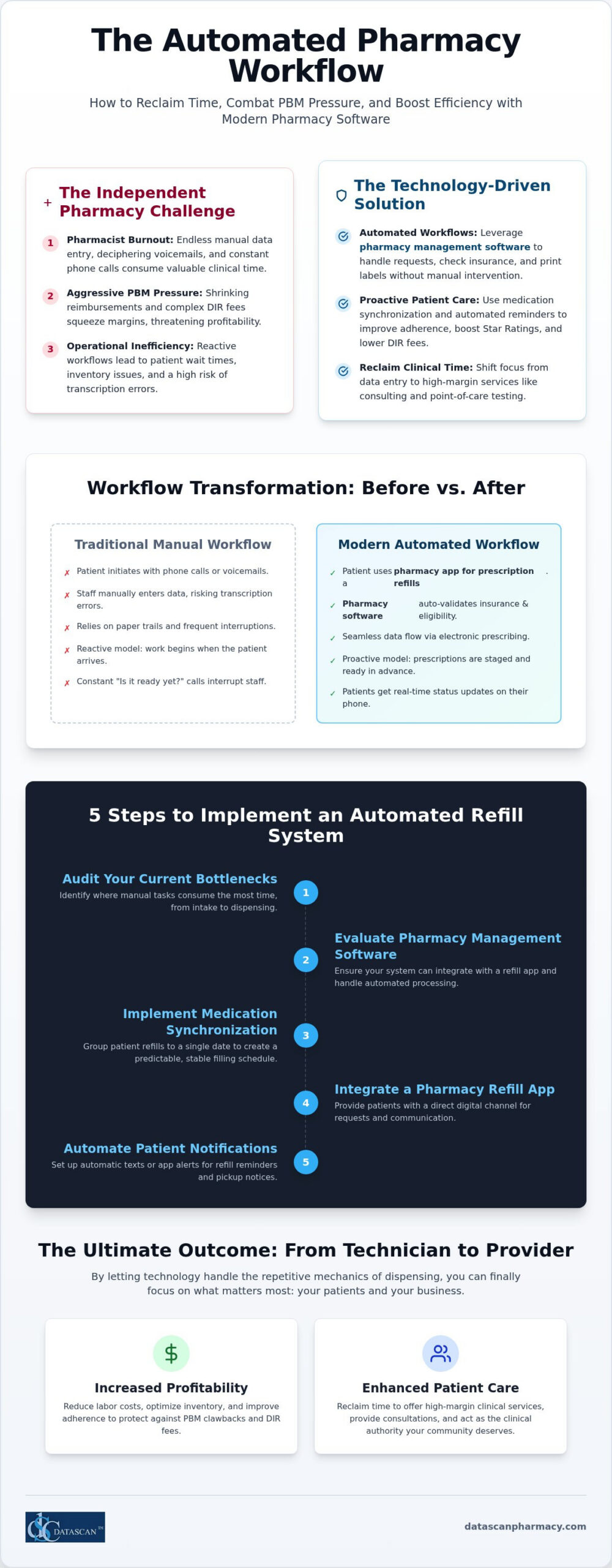
Building a high-efficiency automated prescription refill workflow in 2026 requires a strategic integration between your pharmacy management software and a dedicated pharmacy app for prescription refills that handles patient requests in real-time. By centralizing these communications, you eliminate the manual data entry that leads to pharmacist burnout and reclaim the hours necessary to drive business growth. You didn’t spend years earning your degree to act as a data entry clerk while PBMs aggressively squeeze your margins through complex DIR fees. We understand that even with the latest PBM reforms, the operational burden on independent owners remains immense. This article will show you how to implement a workflow that essentially runs itself, allowing you to act as the clinical authority your community deserves. We will preview the specific steps to optimize your pharmacy software, implement medication synchronization, and automate patient notifications to ensure your business remains profitable and relevant in a rapidly evolving market.
Key Takeaways
Discover how a software-driven automated refill workflow handles everything from requests to labeling, significantly reducing the manual labor that causes pharmacist burnout.
Learn how to combat shrinking PBM reimbursements and lower DIR fees by leveraging medication synchronization and automated adherence reminders.
Evaluate your pharmacy app for prescription refills to ensure it integrates directly with your pharmacy management software for real-time eligibility and insurance checks.
Follow a proven five-step implementation plan to audit your current bottlenecks and transition into a stabilized, automated filling schedule.
Reclaim your identity as a healthcare provider by automating data entry tasks, giving you the time needed to focus on high-margin clinical services and business expansion.
What is an automated prescription refill workflow?
An automated prescription refill workflow is a software-driven process that handles everything from the initial patient request to inventory checks and label printing without manual pharmacist intervention. By leveraging advanced pharmacy management software, this system automatically validates insurance eligibility and checks drug-to-drug interactions before the medication ever hits the tray. It transforms the traditional, reactive pharmacy model into a proactive machine that anticipates patient needs, ensures accuracy, and protects your bottom line from shrinking PBM reimbursements.
In a manual environment, your staff spends hours answering phone calls, deciphering voicemails, and manually typing data into the system. An automated workflow replaces these bottlenecks with digital triggers. When a patient uses a pharmacy app for prescription refills, the request bypasses the front counter and moves directly into the processing queue. This integration allows your workflow software to “auto-fill” medications based on established medication synchronization schedules. Instead of reacting to a line of frustrated patients, your team walks into a pharmacy where the day’s work is already organized and prioritized.
How does automation differ from traditional pharmacy systems?
Traditional systems rely on paper trails and patient-initiated calls, which often lead to transcription errors and workflow interruptions. Modern automation utilizes electronic prescribing standards to ensure that data flows seamlessly from the provider to your dispensing queue. When you implement a pharmacy app for prescription refills, patients receive real-time status updates on their smartphones, which eliminates the “Is it ready yet?” phone calls that plague busy shops. Safety is bolstered through integrated barcode verification, creating a closed-loop system where the software confirms the NDC and patient identity at every critical juncture.
Why is automation critical for independent pharmacies in 2026?
Independent owners are currently facing a “perfect storm” of labor shortages and predatory PBM practices. You can’t afford to pay a pharmacist to perform the tasks of a data entry clerk. Automation allows you to do more with fewer staff members by shifting chronic medication management to a synchronized schedule. This stabilized filling cycle reduces human error in high-pressure retail environments and ensures you have the right inventory on hand. Most importantly, it reclaims the time you need to provide high-margin clinical services, such as point-of-care testing or long-term care consulting. By letting the technology handle the repetitive mechanics of dispensing, you can finally focus on acting as a healthcare provider rather than a technician.
How does automated refill technology improve pharmacy efficiency?
Automated refill technology transforms pharmacy efficiency by eliminating the “wait time” bottleneck and ensuring prescriptions are staged and ready before the patient arrives. This proactive approach relies on a high-performing pharmacy app for prescription refills to capture patient intent early, allowing the backend system to process claims during off-peak hours. By shifting the workload, you don’t just save time; you optimize your entire operational flow to fight back against the shrinking margins imposed by PBMs.
Efficiency gains extend directly to your bottom line through improved inventory management and lower DIR fees. When your system predicts refill dates in advance, you can maintain leaner inventory levels, ordering only what you need for the upcoming week. This precision reduces the capital tied up on your shelves. Additionally, automated reminders sent through your pharmacy app for prescription refills significantly boost patient adherence. In the 2026 regulatory environment, maintaining high adherence is the most effective way to protect your Star Ratings and mitigate the impact of predatory DIR fee structures.
Can technology help overcome PBM reimbursement challenges?
Modern pharmacy management software provides the transparency needed to survive PBM pressures. By integrating automation into your billing workflow, the software can automatically flag low-margin or “under-water” claims before the labels are even printed. This allows you to address reimbursement issues in real-time rather than discovering losses weeks later during reconciliation. Automation also enables more granular tracking of PBM payments, ensuring that every cent owed to your independent pharmacy is accounted for and collected. Pairing this with dedicated pharmacy compliance reporting software gives you the documentation power to defeat PBM audit clawbacks before they strip away your hard-earned revenue.
How does med sync reduce the daily workload?
Medication synchronization is the engine behind a truly efficient pharmacy. Instead of handling ten different phone calls for ten different medications, you bundle a patient’s entire profile into a single monthly pickup. This moves your team from a reactive, “firefighting” mode to a methodical, proactive filling model. You can schedule your heavy filling days during times when foot traffic is low, ensuring your staff remains calm and focused. Implementing a Pharmacy Workflow Optimization Software strategy ensures that your team isn’t just busy, but productive. If you’re ready to see how these tools can transform your daily operations, you can speak with our team about a custom workflow audit.
How do I evaluate pharmacy management software for automated workflows?
To evaluate pharmacy management software for automated workflows, you must prioritize a system that offers a natively integrated mobile patient app and highly customizable dispensing stages. This ensures the technology adapts to your physical store layout rather than forcing you into a rigid, one-size-fits-all model that hinders efficiency. When you evaluate pharmacy management software, start by looking for a system that offers a truly integrated mobile experience for your patients. A standalone pharmacy app for prescription refills that isn’t natively tied to your database often creates data silos. These silos lead to synchronization errors and manual reconciliation tasks that defeat the purpose of automation. You need a solution that allows you to customize the workflow stages to match your store’s unique layout, from the initial intake to the final bagging. If your pharmacy software forces you into a rigid model, it’ll eventually become a bottleneck as your volume grows.
What are the must-have features for refill automation?
Refill automation isn’t just about processing a request; it’s about managing the entire patient lifecycle. Your pharmacy software must include integrated medication synchronization (Med Sync) modules that allow you to align multiple prescriptions into a single monthly event. This proactive approach is supported by automated text and email notifications that keep patients engaged without requiring a phone call from your staff. Utilizing a high-performance pharmacy app for prescription refills like the MobileScripts Rx Refill Application ensures that these requests flow directly into your queue, pre-validated and ready for filling. These features work together to reduce the chaos of “walk-in” refill requests that disrupt your staff’s concentration and lead to errors.
Why is vendor support as important as the software itself?
The strength of your pharmacy management software is only as good as the team standing behind it. In a high-pressure retail environment, hitting a technical snag can halt your entire operation. This is why prioritizing US-based support is vital. You don’t have time for long hold times or scripted responses from people who don’t understand the nuances of independent pharmacy. A family-owned vendor provides a level of accountability and industry perspective that large corporations simply can’t match. When evaluating pharmacy software vendors, look for a partner that treats your success as their own. They should offer the agility needed to adjust technical workflow parameters quickly as PBM pressures and market demands evolve, ensuring your technology remains a tool for growth rather than a burden.
How to implement an automated refill system in 5 steps?
Implementing an automated refill system requires auditing your current manual bottlenecks, enrolling high-volume patients in medication synchronization, and deploying a native pharmacy app for prescription refills to capture requests digitally. By configuring your pharmacy management software to auto-populate the dispensing queue, you eliminate the friction of manual data entry and reclaim hours of staff time every week. This systematic transition ensures your pharmacy operates as a proactive healthcare hub rather than a reactive retail shop.
Step 1 & 2: Building the foundation for automation
The first step is identifying the “high-maintenance” 20% of your patient base that typically consumes 80% of your staff’s phone time. These are often chronic care patients with multiple prescriptions filled at different times throughout the month. Once identified, you must enroll these patients in a robust Med Sync program. When you talk to patients, focus on the convenience of a single monthly pickup and the peace of mind that comes with never running out of medication. This synchronization provides the predictable volume your pharmacy software needs to automate the “auto-fill” process effectively. For a deeper dive into streamlining these early stages, see our guide on automating pharmacy prescription intake.
Step 3, 4 & 5: Launching and refining the loop
Once your foundation is set, deploy a pharmacy app for prescription refills like MobileScripts to move patient communication away from the telephone. You can brand this app specifically for your pharmacy, giving your patients a modern, professional interface to manage their health. Configure your pharmacy management software to automatically move these app-based requests into the filling queue, where they can be checked for insurance eligibility and inventory availability without human intervention.
Safety remains the priority during this acceleration. Train your staff to utilize integrated barcode verification at the point of dispensing to maintain a closed-loop system that prevents errors. With the time saved from answering phones and typing in refills, your pharmacists can finally utilize clinical tools like Medication Therapy Management (MTM) to drive new revenue streams. This shift isn’t just about speed; it’s about repositioning your independent pharmacy as a high-value clinical provider in a competitive market. If you’re ready to transform your operational efficiency, schedule a workflow audit with our team today.
How can automation help me reclaim time to run my business?
Automation reclaims your time by shifting the operational burden from your staff to your pharmacy management software, allowing you to focus on high-level strategy rather than repetitive data entry. By deploying a pharmacy app for prescription refills, you stop the constant interruption of phone calls and start managing your pharmacy as a profitable healthcare enterprise. This transition is essential for survival in 2026, as it moves you away from the role of a technician and back into the role of an executive and healthcare provider.
Technology should work for the owner, not the other way around. When your pharmacy software handles the heavy lifting of insurance adjudication and inventory tracking, you finally have the mental space to negotiate better deals with your primary wholesaler. You can use these saved hours to analyze your gross profit and identify exactly which PBM contracts are costing you money. Additionally, automated systems create cleaner, more organized records, which significantly reduces the stress and preparation time required for board audits or PBM reconciliations. Implementing robust pharmacy compliance reporting software alongside your automated workflow ensures that this documentation is audit-ready at all times, protecting your margins from unexpected clawbacks.
Focusing on profitability and PBM reform
With the passage of the Consolidated Appropriations Act, 2026, the landscape of PBM compensation is shifting. More time in your day allows you to stay informed and advocate for PBM reform at the state level, ensuring your voice is heard as an independent owner. You can spend your afternoons reviewing dashboards to see where your pharmacy is losing money on low-margin reimbursements. Understanding your numbers is the only way to fight back against predatory practices. For a detailed breakdown of how to track these metrics, see our guide on calculating pharmacy gross profit.
The long-term value of a family-owned technology partner
The difference between a corporate vendor and a family-owned partner like Datascan is rooted in accountability. Large corporations often force you into a one-size-fits-all model, but a partner that understands the independent market will provide the flexibility you need to future-proof your business. We pride ourselves on being a visionary ally that helps you navigate the next decade of industry changes with US-based support and customizable tools. Don’t let manual workflows hold your business back from its full potential. You can schedule a demo of Datascan’s automated workflow tools today to see how we can help you reclaim your time and protect your margins.
Reclaim Your Future with Smarter Pharmacy Automation
The journey from a manual, reactive shop to a proactive healthcare hub depends on your ability to leverage the right technology. By integrating a high-performance pharmacy app for prescription refills with your core pharmacy management software, you eliminate the data entry bottlenecks that lead to staff burnout. This strategic shift doesn’t just save time; it provides the operational transparency needed to fight back against predatory PBM reimbursements and rising DIR fees.
Since 1981, our family-owned enterprise has stood as a visionary ally for independent owners. We understand that your success relies on 100% US-based technical support and pharmacy software that actually drives profitability. It’s time to stop acting as a technician and start acting as the executive your business requires. You can see how Datascan’s automated workflow reclaims your time and secures your pharmacy’s place in the 2026 market. The tools for transformation are ready when you are.
Frequently Asked Questions
Is automated prescription refill software safe for patients?
Automated systems actually improve patient safety by integrating barcode verification and real-time drug interaction checks into every dispensing stage. These digital safeguards eliminate the human fatigue and errors associated with manual data entry in high-pressure environments. By utilizing a closed-loop system within your pharmacy management software, you ensure every prescription matches the NDC and patient profile before a label is printed. This creates a more reliable and secure environment for your community.
How much time can a pharmacy owner really save with an automated workflow?
Pharmacy owners often reclaim several hours each day by automating their refill workflows. Instead of spending your morning answering repetitive phone calls or manually typing in refill requests, your staff can focus on high-margin clinical services. Automation handles the administrative heavy lifting, which essentially allows your pharmacy to run its daily dispensing tasks in the background. This newfound time is vital for analyzing gross profit and negotiating better wholesaler contracts to improve your bottom line.
Does automation require me to move my data to the cloud?
No, you don’t need to move your sensitive patient data to an external server to achieve full automation. Our system is designed to provide cutting-edge workflow capabilities without the risks associated with outside hosting. You maintain full control over your local database while still enjoying the benefits of a modern, automated refill system. This approach ensures your pharmacy remains fast, reliable, and secure without relying on a third-party connection for your core dispensing functions.
Can automated workflows help reduce PBM DIR fees?
Automated workflows are a powerful tool for reducing PBM DIR fees because they directly improve patient adherence. By using a pharmacy app for prescription refills to send automated reminders, you ensure patients pick up their chronic medications on time. Higher adherence rates lead to better Star Ratings and performance scores for your store. This proactive management helps protect your reimbursements and mitigates the financial impact of predatory PBM fee structures that penalize poor patient outcomes.
What happens if the insurance rejects an automated refill request?
If an insurance claim is rejected during the automated process, the system immediately flags the prescription and moves it into a manual review queue. This allows your staff to address the specific rejection reason, such as a prior authorization requirement or a refill too soon error, without disrupting the rest of the automated flow. Your pharmacy software ensures no claim is filled at a loss, protecting your margins while maintaining the speed of your daily operations.
Do I need a separate app for my patients to use automated refills?
You don’t need to manage a disconnected third-party tool; instead, you should use a natively integrated pharmacy app for prescription refills. A solution like MobileScripts connects directly to your database, allowing patients to request refills that populate your queue in real-time. This integration prevents data silos and ensures patient requests are accurately reflected in your workflow. It provides a seamless experience for your patients while significantly reducing the administrative burden on your pharmacy staff.
How does medication synchronization fit into an automated workflow?
Medication synchronization acts as the foundational engine for a truly automated workflow. By aligning all of a patient’s chronic medications to a single monthly pickup date, you create a predictable filling schedule. Your pharmacy management software can then auto-populate the queue for these synchronized patients, allowing you to fill prescriptions during off-peak hours. This proactive model eliminates the chaos of random walk-in requests and ensures your inventory is optimized for the specific needs of your patients.
Is it difficult to switch my current pharmacy software to an automated system?
Switching to an automated system is a streamlined process when you partner with an experienced vendor that understands independent pharmacy needs. We handle the complex data migration and training required to move your store from a manual environment to a modern workflow. Since our support is 100% US-based, you have direct access to experts who can troubleshoot technical adjustments quickly. This partnership ensures your transition is smooth and your business remains operational throughout the entire conversion.
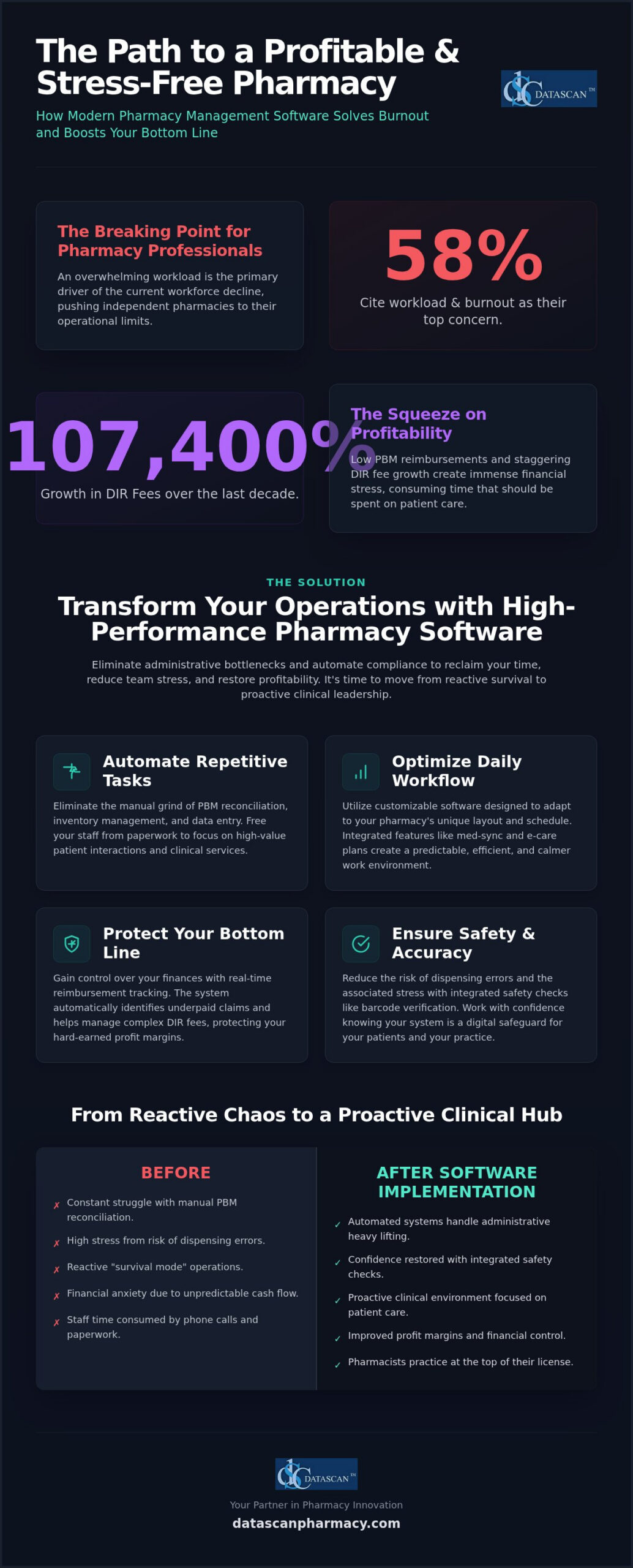
If 58% of pharmacy professionals are citing workload and burnout as the primary drivers of the current workforce decline, how much longer can your independent pharmacy operate on manual processes? Modern pharmacy workflow optimization software is the essential tool for owners who need to eliminate administrative bottlenecks, automate PBM compliance, and restore profitability in an increasingly complex 2026 market. You’ve likely spent too many nights worrying about low reimbursements and the financial stress of DIR fees that grew by a staggering 107,400% over the last decade.
We understand that your time is your most valuable asset, yet it’s often consumed by manual PBM reconciliation and inefficient dispensing workflows that invite errors. This guide reveals how the right pharmacy management software handles these operational burdens for you, allowing you to focus on patient care instead of paperwork. You’ll learn how to leverage advanced pharmacy software to reduce data entry, improve your profit margins through better reimbursement tracking, and finally create a calmer, more efficient environment for your team. It’s time to stop reacting to industry pressures and start leading with a system built for the future of community pharmacy.
Key Takeaways
Automate repetitive administrative tasks like PBM reconciliation to significantly reduce pharmacist burnout and prioritize patient outcomes.
Optimize your daily operations using customizable pharmacy workflow optimization software designed to adapt to your specific pharmacy layout and schedule.
Protect your bottom line with real-time reimbursement tracking and automated tools that identify underpaid claims and manage complex DIR fees.
Streamline your transition to modern pharmacy management software by conducting a workflow audit to pinpoint and eliminate operational bottlenecks.
Leverage the personalized support and industry expertise of a family-owned vendor to transform your independent pharmacy into a high-performance clinical hub.
How can pharmacy workflow optimization software reduce pharmacist burnout in 2026?
Pharmacy workflow optimization software reduces burnout by automating repetitive administrative tasks like PBM reconciliation and inventory management, allowing staff to focus on patient care. By eliminating the manual bottlenecks that clog daily operations, this technology restores a sense of control and professional purpose to the pharmacy team. High-performance pharmacy management software acts as a digital safeguard, ensuring that your staff isn’t buried under a mountain of paperwork while trying to serve their community.
There’s a direct, measurable link between operational efficiency and the mental well-being of independent pharmacy owners. When your team is stuck in a reactive “survival mode,” they’re constantly battling the cognitive overload of multitasking without centralized management. Modern Pharmacy Software transforms this environment into a proactive clinical space. It replaces the exhausting cycle of manual data entry, which is the leading cause of technical errors and staff frustration, with automated systems that handle the heavy lifting of PBM compliance and reimbursement tracking.
What are the main causes of pharmacy staff fatigue today?
Staff fatigue often stems from “hidden” time-wasters that accumulate throughout the dispensing process. In 2026, the emotional toll of navigating declining PBM reimbursements and the ongoing cash flow effects of previous DIR fee rules adds a layer of financial anxiety to an already heavy workload. A June 2026 poll found that 58% of pharmacy professionals attribute the declining workforce primarily to workload and burnout. Without a robust pharmacy management system, pharmacists spend more time fighting with spreadsheets than interacting with patients, leading to a profound sense of professional dissatisfaction.
How does modern pharmacy management software provide immediate relief?
Implementing a comprehensive workflow software solution provides immediate relief by automating task delegation and integrating safety checks. Barcode verification and automated inventory alerts reduce the constant fear of dispensing errors, allowing pharmacists to work with confidence rather than constant apprehension. Additionally, choosing a partner that provides US-based technical support minimizes the frustration of technical downtime. This localized accountability ensures that when issues arise, they’re resolved quickly by experts who understand the unique pressures of the independent market, rather than leaving your staff stranded with unresolved software glitches.
What are the essential features of high-performance pharmacy management software?
High-performance pharmacy management software provides the digital infrastructure required to move from reactive dispensing to proactive clinical management. While competitors often emphasize expensive robotics and hardware, the true drivers of efficiency are software-based logic like medication synchronization, integrated e-care plans, and automated patient notifications. These features eliminate the “invisible” administrative friction that slows down your team. By utilizing a robust pharmacy workflow optimization software, you can ensure that every step of the dispensing process is accounted for, from the moment a script arrives to the final point of sale.
Modern pharmacy workflow optimization software doesn’t just speed up filling; it creates a structured environment where pharmacists can practice at the top of their license. Integrated patient notifications reduce phone call volume and front-end congestion, giving your staff the quiet they need to focus on accuracy. When your system handles the routine communication, your team’s cognitive load drops significantly.
How does medication synchronization save hours every week?
Medication synchronization serves as the foundation of a predictable, stress-free pharmacy schedule by aligning patient refills to a single monthly date. This reduces repetitive administrative calls and stabilizes the daily workload, preventing the “rush hour” stress that leads to staff burnout. Advanced systems use predictive filling to forecast inventory needs, ensuring you have the right stock at the right time without overextending your cash flow. This proactive approach to pharmacy workflow automation allows your staff to manage their time effectively rather than constantly putting out fires.
Can customizable workflows really improve independent pharmacy efficiency?
Every independent pharmacy has a unique physical layout and staffing structure. A one-size-fits-all approach to software rarely works for community-focused businesses. Customizable workflow software allows you to tailor digital stages to match your staff’s specific roles and responsibilities. This ensures that clinical duties aren’t overlooked and that barcode verification is integrated at every critical juncture. By implementing “check twice, fill once” logic automatically, you reduce the risk of errors and the associated stress of potential liability. Integrated e-care plans further streamline this by allowing for clinical documentation without the burden of extra paperwork, and pairing these tools with medication therapy management software can transform those clinical workflows into a significant new revenue stream. If you’re ready to see how these features can transform your daily operations, you can reach out to our team for a personalized walkthrough.
How does technology help pharmacists manage PBM reimbursements and DIR fees?
Pharmacy workflow optimization software provides immediate financial relief by identifying underpaid claims in real-time and automating the complex reconciliation process that previously required hours of manual labor. This proactive technology allows independent owners to stop the “cash flow bleed” caused by PBM spread pricing and hidden fees. By integrating financial oversight directly into the dispensing queue, your team can catch loss-leading prescriptions before they’re ever handed to a patient, transforming your software from a simple filling tool into a profit-protection engine.
Manual bookkeeping and endless spreadsheets are no longer viable in a market where DIR fees grew by a staggering 107,400% between 2010 and 2020. High-performance pharmacy management software replaces these “hidden” time-wasters with automated reconciliation tools that verify every penny against your contracted rates. This level of precision is essential for calculating pharmacy gross profit accurately, ensuring you aren’t operating on guesswork while navigating the transitional period created by the Consolidated Appropriations Act, 2026. When your system handles the financial heavy lifting, you reclaim the mental energy needed to run your business effectively. Independent owners looking to diversify away from PBM-controlled revenue streams are also discovering that pharmacy software for veterinary prescriptions opens access to cash-based pet medication markets with profit margins far exceeding those of typical human claims.
How can you identify underpaid claims automatically?
Identifying underpaid claims shouldn’t be a post-mortem exercise conducted weeks after the sale. Advanced pharmacy workflow optimization software sets up automated alerts for prescriptions filled below cost, flagging them during the adjudication process. You can compare PBM payments against contracted rates instantly using your Pharmacy Software, eliminating the “financial guessing game” that leads to staff anxiety. Integrated profit-tracking dashboards provide a clear view of your margins on every dispense, allowing you to address reimbursement discrepancies the moment they occur rather than months later during a stressful audit.
What role does data play in PBM reform advocacy?
Data is your strongest weapon when fighting back against unfair PBM audits and hidden fees. With the federal ban on spread pricing for new contracts effective as of January 1, 2026, you need software reports that can demonstrate the localized impact of PBM practices on your specific business. Digital record-keeping streamlines the audit response process by providing instant document retrieval, which is critical for meeting new transparency requirements being implemented across the country. Independent pharmacies are using this technology to survive PBM pressures by transforming their internal data into actionable insights for both business survival and legislative advocacy.
What are the best strategies for implementing pharmacy workflow automation?
The most effective strategy for implementing pharmacy workflow automation is a phased approach that begins with a comprehensive operational audit and relies on a vendor with a proven, localized implementation roadmap. By identifying specific bottlenecks before introducing new technology, independent pharmacy owners can avoid the disruption and stress often associated with system changes. Transitioning to modern pharmacy workflow optimization software shouldn’t be a “rip and replace” event; it’s a strategic evolution that should prioritize staff buy-in and clinical continuity.
Successful implementation follows a methodical four-step process designed to minimize downtime and maximize adoption rates. First, conduct a workflow audit to identify your biggest time-wasters, such as manual phone calls or redundant data entry. Second, choose a partner that offers a clear implementation plan tailored to your specific volume and staffing levels. Third, introduce high-impact features like MobileScripts in phases to allow your team to adjust to new digital queues. Finally, train your staff on the “why” behind these systems, ensuring they understand that automation is a tool meant to protect their time and mental well-being.
How do you choose a pharmacy software vendor that supports your team?
Choosing the right partner is about more than just a list of features; it’s about localized accountability and advocacy. You should evaluate the response times and quality of US-based technical support, as a vendor who understands the unique pressures of the independent market will be far more effective than a faceless corporation. The “family-owned” model matters because it ensures you’re a partner rather than just a support ticket. During a pharmacy software conversion, ask detailed questions about data migration and staff training protocols to ensure a smooth transition that doesn’t overwhelm your team.
How can mobile apps reduce the burden on your front-end staff?
Mobile applications are powerful tools for reducing phone call volume and front-end congestion. By allowing patients to request refills via a mobile patient app, you eliminate the constant interruptions of manual script entry. Automated text and push notifications keep patients informed about their order status, which significantly lowers the number of “is it ready yet?” calls. Furthermore, integrating delivery tools allows your staff to manage off-site patient needs efficiently without leaving the pharmacy counter. These digital solutions work together to create a quieter, more focused work environment that also supports stronger pharmacy patient retention strategies by keeping patients engaged and satisfied between visits. If you’re ready to reclaim your time and modernize your workflow, contact our team today for a personalized demonstration of our implementation roadmap.
Why is a family-owned pharmacy software vendor the best partner for reducing staff stress?
A family-owned vendor offers a level of personalized accountability that large corporations can’t match, ensuring your independent pharmacy is treated as a partner rather than just a support ticket. High-performance pharmacy workflow optimization software is most effective when it’s backed by a team that understands the unique financial and operational struggles of community pharmacy owners. When you choose a vendor that prioritizes your success, you gain a visionary ally dedicated to reducing staff stress and maximizing your bottom line through specialized, expert-led design.
One of the most significant benefits of localized pharmacy management software is its inherent reliability. Unlike systems that rely on external servers and leave your business vulnerable to internet outages, localized, non-cloud systems ensure your workflow remains uninterrupted even when your connection fails. This stability eliminates the high-stress scenarios where staff are unable to process prescriptions or access patient records during peak hours. Continuous innovation in these systems is driven by real-world feedback from independent pharmacy owners, not by the demands of corporate shareholders focused on quarterly margins.
What makes Datascan Pharmacy Software different from large corporate pharmacy software companies?
Datascan Pharmacy Software has maintained a fierce advocacy for independent pharmacies since 1981, providing a personal touch that large corporate entities simply cannot replicate. You get direct access to decision-makers and high-level US-based support, ensuring that technical issues are resolved with urgency and expertise. Our suite of tools, including Pharmacy Software, is specifically designed to maximize your profitability and streamline operations, rather than just performing basic pill-counting functions. We focus on the features that matter to your bottom line, such as PBM reimbursement tracking and customizable workflow stages.
How do you get started with a less stressful pharmacy management system?
To transition to a less stressful environment, start by requesting a demo tailored to your specific workflow pains and business goals. You can review our comprehensive roadmap for a stress-free pharmacy software conversion to see exactly how we manage the data migration and staff training process. Taking the first step toward a more efficient, burnout-free pharmacy is simple and requires no long-term disruption to your patient care. Contact us today to reclaim your time, support your staff, and restore your pharmacy’s profitability.
Reclaim Your Time and Restore Your Pharmacy’s Profitability
Transitioning to high-performance pharmacy workflow optimization software is no longer a luxury; it’s a financial and operational necessity for independent owners facing the pressures of 2026. By automating the “hidden” time-wasters like manual PBM reconciliation and complex inventory forecasting, you empower your staff to focus on clinical excellence rather than administrative survival. This shift not only protects your profit margins against rising DIR fees but also fosters a calmer, more professional environment where your team can truly thrive. It’s about moving from a state of constant reaction to a position of strategic control.
As a family-owned and operated partner since 1981, Datascan understands that you need more than just a vendor. You need a visionary ally with a U.S.-based support team that offers decades of experience and localized reliability. Our comprehensive suite of profit-focused automation tools ensures you stay ahead of market trends while maintaining the personal touch your community expects. See how Datascan Pharmacy Software can transform your workflow and reduce burnout; contact us today. You don’t have to navigate these industry changes alone; let’s build a more efficient future for your pharmacy together.
Frequently Asked Questions
How does pharmacy workflow optimization software specifically reduce daily stress?
Pharmacy workflow optimization software reduces daily stress by automating the repetitive administrative tasks that cause cognitive overload. Instead of manually handling PBM reconciliation or inventory tracking, your staff can rely on automated digital queues. This system creates a predictable environment where pharmacists spend less time on paperwork and more time on clinical services. By centralizing management and providing real-time alerts, it eliminates the constant interruptions that typically lead to errors and staff frustration.
Can automation help my pharmacy survive low PBM reimbursements?
Automation is essential for surviving low PBM reimbursements because it identifies underpaid claims before you hand the prescription to the patient. High-performance pharmacy management software provides real-time reimbursement monitoring and profit-tracking dashboards. These tools allow independent owners to identify loss-leading scripts and manage complex DIR fees effectively. By automating the reconciliation process, you can reclaim hours of manual bookkeeping and use that data to advocate for fairer PBM contracts and transparency.
Is it difficult to switch to a new pharmacy software system?
Switching to a new pharmacy software system isn’t difficult when you choose a vendor with a structured implementation roadmap. A methodical, phased conversion process ensures that your data is migrated accurately and your staff is trained on new features without disrupting patient care. By conducting a workflow audit beforehand and introducing high-impact tools in stages, you can avoid the stress of a sudden change and ensure high adoption rates across your entire team.
Do I need expensive hardware to reduce pharmacist burnout?
You don’t need expensive robotics or hardware to significantly reduce pharmacist burnout. While hardware has its place, the primary drivers of efficiency are software-based logic like medication synchronization and automated patient notifications. Modern Pharmacy Software optimizes your existing layout by streamlining the digital dispensing process and reducing phone call volume. Investing in robust software features often provides a much higher return on investment and more immediate relief for staff than bulky hardware solutions.
How does medication synchronization software work to save time?
Medication synchronization software saves time by aligning a patient’s chronic refills to a single monthly date. This process stabilizes your daily workload and prevents the unpredictable “rush hour” that often leads to burnout. It reduces the number of administrative calls and foot traffic, allowing your team to fill prescriptions in batches. Predictive filling tools within the pharmacy management software further forecast inventory needs, ensuring you have the right stock on hand without constant manual checking.
What should I look for in a pharmacy software vendor to ensure long-term support?
Look for a pharmacy software vendor that offers US-based technical support and a history of advocacy for independent pharmacies. Personalized accountability is critical; you want a partner that treats you as a business owner rather than just a support ticket. A family-owned vendor often provides direct access to decision-makers and high-level technical expertise. This ensures that your system receives continuous innovation driven by real-world feedback from pharmacists rather than corporate shareholders focused only on profit.
Can technology help with pharmacy staff retention?
Technology helps with pharmacy staff retention by creating a more organized, less chaotic work environment. When staff have access to efficient Pharmacy Software, they feel empowered to practice at the top of their license rather than being buried in manual data entry. Reducing the risk of technical errors through barcode verification also lowers the anxiety associated with dispensing. A calmer workplace leads to higher job satisfaction, which is the most effective way to keep your talented team members. Learn how automating prescription intake workflow can further protect your margins and reduce staff stress at the front door of your dispensing process.
Effective pharmacy accounts receivable management is the most direct way to stabilize your cash flow and counteract the 21 to 45-day reimbursement delays typically forced by PBMs. By utilizing integrated pharmacy management software to automate your ledger, you can eliminate manual errors and reclaim the administrative hours previously spent on tedious bookkeeping. You’ve likely felt the pressure of managing a business where 30.3% of independent owners are considering closing due to financial strain, and it’s frustrating when the probability of collecting on a delinquent account drops to 51.3% after just six months. We understand that chasing small patient balances feels like a losing battle against your time and profitability.
This guide promises to give you the strategies and tools needed to transform your back office into a streamlined, automated engine for growth. We’ll preview how professional statement generation builds patient trust and how high-performance pharmacy software shares data in real-time to ensure your records are always accurate. By the end of this article, you’ll have a clear roadmap to modernizing your operations, automating your billing, and protecting your independent pharmacy’s bottom line.
Key Takeaways
Master the fundamentals of pharmacy accounts receivable management to clearly distinguish between third-party insurance reimbursements and private-pay house accounts.
Integrate your ledger directly within your pharmacy management software to ensure real-time data sharing between your POS and back-office systems.
Stabilize your operational cash flow and protect your bottom line by automating billing cycles, which allows for more predictable inventory and payroll management.
Improve collection rates and build patient trust by utilizing the MobileScripts patient app for instant balance notifications and convenient digital payment options.
Reclaim hours of administrative time by leveraging customizable statement generation and a unified patient record system that eliminates redundant manual data entry.
Pharmacy accounts receivable (AR) management is the systematic tracking and collection of money owed to the pharmacy by patients, facilities, and third-party payers for prescriptions and services already provided. To fully grasp what is pharmacy accounts receivable management?, you have to distinguish between third-party AR, which covers insurance reimbursements, and private-pay house accounts. Independent pharmacies often rely on charge accounts for long-term care (LTC) and assisted living facility billing. In these settings, medications are dispensed throughout the month, but the facility or patient is billed in a single cycle. Your Pharmacy management software serves as the definitive financial record, ensuring that every dispensed prescription is accurately logged and eventually paid.
Why is AR management critical for independent pharmacies?
Cash flow is the lifeblood of your business, yet PBM reimbursement delays typically force you to wait 21 to 45 days for payment. This delay creates a gap that can jeopardize your ability to manage inventory or meet payroll obligations. Professionalizing your pharmacy accounts receivable management through your Pharmacy Software helps you bridge this gap by ensuring patient and facility payments are collected on time. Beyond daily operations, a well-managed AR system provides the financial transparency required during rigorous PBM audits. It also increases your business value, as clear financial ledgers are a top priority for potential buyers or lenders during a valuation.
Why should you choose automated tracking over manual ledgers?
The “shoebox of receipts” method is a dangerous relic that has no place in a modern pharmacy. Manual tracking leads to double-entry errors, lost invoices, and an incredibly high cost-to-collect for small balances. When you integrate your ledger with a Datascan Point of Sale system, the software handles the heavy lifting. Data shares in real-time, meaning a payment made at the register instantly updates the patient’s balance in the back office. This automation prevents revenue leakage and frees your staff from hours of tedious manual reconciliation. By moving away from manual ledgers, you ensure that your local-server system remains a secure, accurate, and efficient tool for protecting your pharmacy’s profitability.
How do you set up an automated pharmacy AR system?
Setting up an automated system requires integrating your financial ledger directly into your pharmacy management software to ensure every charge is tracked in real-time. This creates a closed-loop environment between your dispensing and point-of-sale workflows, eliminating the need for manual data entry and reducing the risk of human error. By shifting to an automated local-server model, you ensure that pharmacy accounts receivable management becomes a background process rather than a weekend-long chore.
How do you define credit limits and eligibility?
Risk management begins with establishing customized credit limits based on the specific needs of your patient base. Retail patients may only require small limits for occasional co-pays, whereas long-term care (LTC) facilities need larger caps tailored to their total bed count and monthly volume. Your pharmacy management software should automatically flag any account that exceeds its limit, allowing your staff to address the balance before more prescriptions are dispensed. Establishing clear due dates and standard 15-day or 30-day grace periods helps you maintain a predictable cash flow that isn’t dependent on unpredictable PBM reimbursement schedules.
How do you link point-of-sale transactions?
Every pharmacy POS transaction must feed directly into your patient ledger to maintain financial accuracy. When a patient or facility representative chooses to “charge to account,” your system should require a verified signature at the register to ensure you are audit-ready. This real-time integration means that the moment a prescription is picked up, the balance is updated across your entire network. Handling complex scenarios like partial payments or split-tender transactions becomes effortless when your POS and back-office pharmacy software share a single patient record, ensuring your daily books always balance without manual reconciliation.
How do you batch process monthly statements?
Batch processing transforms a tedious administrative burden into a one-click task. Instead of manually printing individual invoices, you can generate hundreds of professional, itemized statements simultaneously. These documents must include Rx numbers, dispense dates, and specific costs to build patient trust and minimize the time your staff spends answering questions about individual charges. Professional branding on these financial communications reinforces your identity as a sophisticated, reliable community healthcare provider. If you’re ready to see how these automated features can transform your back office, you can reach out for a demonstration of our integrated technology.
How does AR management improve independent pharmacy profitability?
Effective pharmacy accounts receivable management improves profitability by capturing every dollar owed, reducing bad debt expenses, and creating a predictable cash flow cycle that offsets PBM reimbursement delays. When you automate your ledger, you stop revenue leakage from uncollected co-pays and facility balances while gaining the financial clarity needed to understand how to calculate pharmacy gross profit accurately. This systematic approach ensures that your pharmacy isn’t just dispensing prescriptions, but actually collecting the revenue those prescriptions generate.
Proactive monitoring of aging reports is essential because the probability of collecting on a delinquent account drops to 51.3% after six months. By identifying past-due balances early through your Pharmacy Software, you can prevent them from becoming bad debt expenses that eat into your margins. Additionally, offering flexible payment options for front-end retail items through your house account system encourages higher basket sizes. Patients are more likely to pick up OTC essentials when they can bundle those purchases with their prescriptions and pay in a single, professional monthly cycle.
How does AR management help combat PBM reimbursement challenges?
PBMs often use reimbursement delays and complex fee structures to squeeze independent margins. Efficient AR tracking provides the granular data required for managing pharmacy DIR fees and identifying underpaid claims before the window for appeals closes. With integrated financial reporting, you can spot trends in insurer behavior and reimbursement lags. This data empowers you to negotiate better terms with wholesalers or local facilities based on hard financial performance rather than guesswork, protecting your bottom line from external volatility.
How does automation free up time for clinical services?
Administrative burnout is a major threat to independent owners who have too little time to run their businesses. By utilizing workflow software to automate the billing cycle, you remove the burden of manual debt collection from your staff. This shift allows your team to focus on high-value clinical services, such as MTM or immunizations, which diversify your revenue streams. Real-time data dashboards let you monitor the health of your accounts in minutes, ensuring you stay in control of your finances without spending your entire weekend on tedious bookkeeping.
What are the best practices for pharmacy billing and collections?
Best practices for pharmacy billing and collections center on maintaining a rigid statement schedule and offering frictionless payment options through integrated digital tools. By reviewing aging reports weekly and automating balance notifications, you can significantly reduce the time spent on manual outreach while keeping your cash flow consistent. This proactive approach ensures that pharmacy accounts receivable management remains an organized business process rather than a reactive crisis.
Consistency is the foundation of any successful financial workflow. You should establish a fixed “statement run” schedule, such as the 1st or 15th of every month, to train your patients and facilities to expect their bills. Offering multiple payment methods, including in-store, mail-in, and digital app payments, ensures that you remove every possible barrier to collection. Reviewing your aging reports weekly allows you to identify accounts that are 30, 60, or 90 days past due before they become uncollectible bad debt.
Leveraging technology for faster payments
Modern pharmacies use the MobileScripts patient app to send push notifications the moment a statement is ready for review. This feature allows patients to view their ledger balance in real-time on their own devices, which often leads to faster payments compared to traditional mail. For nursing homes or assisted living facilities, “card on file” features within your Pharmacy management software allow for recurring, automated payments that eliminate the need for monthly check-chasing and manual reconciliation.
Handling delinquent accounts professionally
Managing debt is a sensitive but necessary component of pharmacy accounts receivable management. Your system should be configured to send automated “friendly reminders” for accounts that are 15 days past due to prompt action without staff intervention. It’s equally important to train your staff on how to have respectful financial conversations, ensuring they can explain itemized charges clearly to build trust. When an account reaches a critical delinquency threshold, you must have a clear, firm policy for stopping credit to protect your pharmacy from further revenue leakage. If you’re ready to modernize your collection process with these integrated tools, schedule a personalized demo with our team today.
How can Datascan software streamline your accounts receivable?
Datascan Pharmacy Software streamlines your pharmacy accounts receivable management by integrating your dispensing and point-of-sale systems into a single, local-server environment that shares one patient record. This total integration ensures that every “charge to account” transaction at the register is instantly reflected in the back-office ledger without manual intervention. By maintaining your data on a secure local-server system, you protect your sensitive financial records and ensure 100% uptime for your business operations. Owners gain immediate visibility into their cash flow through robust tracking tools that provide professional-grade reporting without requiring specialized accounting expertise. Our pharmacy management software also includes customizable statement formats designed specifically for the unique needs of community pharmacies, ensuring your billing is professional and easy for patients to understand.
What features are built specifically for independent pharmacies?
Efficiency in the back office translates directly to better patient care and reduced administrative burnout. Datascan Pharmacy Software allows for one-click statement generation for your entire patient base or specialized billing cycles for nursing and assisted living facilities. When a patient attempts to charge a prescription, real-time credit limit flagging at the POS prevents your staff from extending credit to delinquent accounts. If a patient questions a charge, the detailed transaction history allows for instant resolution by showing the exact date, time, and itemized cost of every dispense. This level of transparency builds long-term trust with your community and reduces the time your staff spends on the phone resolving billing disputes.
Why does US-based expertise matter for your financial stability?
Partnering with a family-owned and operated company since 1981 provides a level of stability and advocacy that large corporations simply cannot match. We’ve spent decades as a “champion of the independent,” evolving our technology to meet the specific challenges of PBM reform and declining reimbursements. Our US-based technical support team doesn’t just fix software; they understand the operational pressures you face every day and offer a grounded, reliable warmth in their service. We prioritize the security of your local-server system, protecting your financial data and ensuring your pharmacy stays operational even if external network connections fail. We continuously release software updates driven by the real-world needs of our clients, ensuring your technology remains a future-proof asset for your business. This commitment to supportive partnership ensures that as the industry changes, your pharmacy has the tools needed to remain profitable and independent.
Take Control of Your Pharmacy’s Financial Future
Mastering pharmacy accounts receivable management is no longer just a back-office task; it’s a vital survival strategy for independent owners facing PBM volatility. By automating your ledger and integrating your POS with your dispensing software, you eliminate manual errors and stop revenue leakage before it impacts your bottom line. You’ve seen how professional statement generation and real-time credit flagging can reclaim hours of your administrative time while building deeper trust with your patients and facilities.
Datascan has been a dedicated partner to the independent community since 1981, offering seamless software integration and expert, US-based technical support. We’re here to ensure your technology works as hard as you do, providing the security of local-server systems and the precision of automated billing. Don’t let administrative burnout or reimbursement delays dictate your success. Streamline your pharmacy’s billing with Datascan’s integrated AR tools today. We’re proud to stand as your visionary ally in building a more profitable, future-proof pharmacy.
Frequently Asked Questions
Is it legal for independent pharmacies to charge interest on patient accounts?
Charging interest on past-due balances is generally legal provided you comply with state-specific usury laws and federal Truth in Lending Act requirements. You must clearly disclose your interest rates and late fee policies in a signed credit agreement before applying any charges to a patient’s ledger. Using an integrated pharmacy management software allows you to automate these calculations based on your specific terms, ensuring consistency and transparency while protecting your business from potential legal disputes.
How do I handle charge accounts for nursing homes or assisted living facilities?
Managing facility accounts requires a specialized workflow where medications are dispensed daily but billed in a single monthly cycle. By using the Datascan nursing and assisted living module, you can group individual patient charges under a single facility master account for streamlined oversight. This setup allows you to generate consolidated statements and track facility-wide balances efficiently. Integrated pharmacy accounts receivable management ensures that high-volume facility billing remains accurate and professional without overwhelming your staff with manual data entry.
What is the difference between third-party AR and patient house accounts?
Third-party AR represents money owed to the pharmacy by insurance companies or PBMs for adjudicated claims, whereas patient house accounts are private-pay balances owed directly by individuals or facilities. Third-party collections are often delayed by PBM reimbursement cycles, while house accounts are managed according to your internal credit policies. Distinguishing between these two within your pharmacy management software is critical for maintaining an accurate financial ledger and understanding your true cash flow position at any given time.
Can I manage my pharmacy accounts receivable without separate accounting software?
You don’t need separate accounting software for daily ledger tracking when using a fully integrated pharmacy system. Datascan’s local-server platform includes built-in AR tools that handle credit limits, statement generation, and payment posting directly within your existing workflow. This integration eliminates the need for double-entry and prevents errors between your dispensing data and your financial records. For high-level tax preparation, you can simply export your clean, organized data for your CPA or external accounting package.
How often should I send out pharmacy charge account statements?
Sending out statements on a consistent monthly schedule, typically the 1st or the 15th, is the industry best practice for maintaining predictable cash flow. Regular billing cycles train your patients and facilities to expect and prepare for their payments, which significantly reduces the number of delinquent accounts. Your software should allow you to automate this process, enabling one-click batch printing or digital notifications through the MobileScripts app to ensure your billing is always delivered on time.
What is an aging report and why is it important for my pharmacy?
An aging report is a financial document that categorizes your outstanding receivables by the length of time they have been unpaid, usually in 30, 60, and 90-day increments. This report is vital because it highlights which accounts are becoming high-risk, allowing you to take action before the probability of collection drops. Monitoring these reports weekly helps you identify trends in revenue leakage and ensures you are proactively protecting your pharmacy’s operational profitability and long-term stability.
How does integrated POS software prevent internal theft on charge accounts?
Integrated POS software prevents internal theft by requiring verified signatures for every “charge to account” transaction and creating a permanent, unalterable audit trail for every ledger adjustment. Because the POS and Rx software share a single patient record, employees cannot manipulate balances in one system without it being reflected in the other. Detailed transaction history and automated credit limit flagging ensure that every charge is legitimate and authorized, providing owners with the oversight needed to secure their assets.
Can I set different credit limits for retail patients versus facility accounts?
You can and should set different credit limits for retail patients versus facility accounts based on their specific risk profiles and purchase volumes. Retail patients may only need a small limit for occasional co-pays, while LTC facilities require much higher thresholds to accommodate monthly billing cycles for dozens of residents. Datascan allows you to customize these limits at the individual or facility level, ensuring that your financial management remains flexible enough to support growth while minimizing your total exposure.