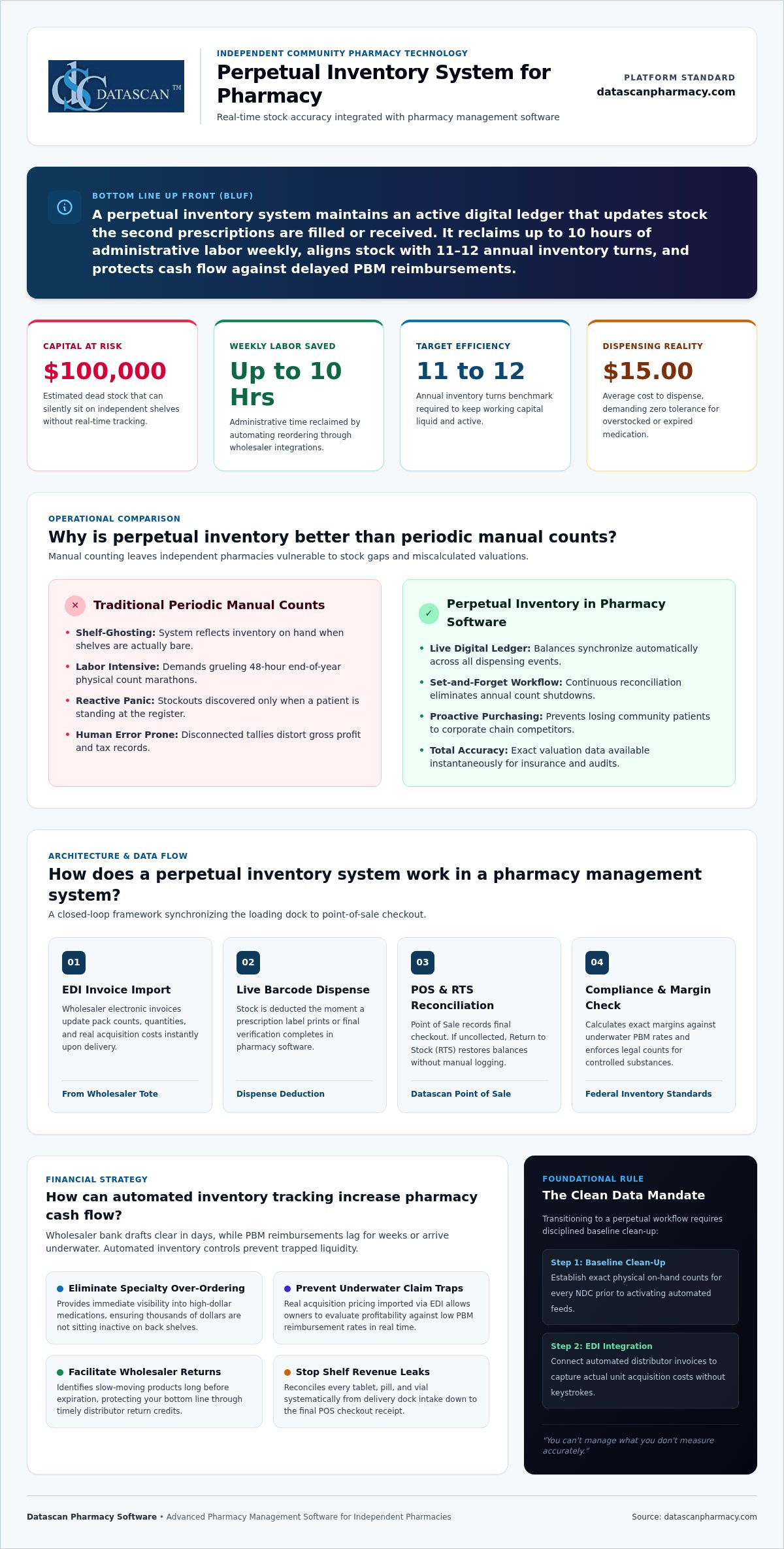
Could your pharmacy be hiding $100,000 in dead stock on its shelves right now? A perpetual inventory system for pharmacy solves this by providing real-time stock accuracy and automated reordering, which allows owners to reclaim up to 10 hours of weekly labor while boosting gross profit margins. By integrating these features into your pharmacy management software, you can align your inventory turns with the 11 to 12 annual benchmark. This ensures your capital isn’t trapped in slow-moving medications while wholesaler drafts clear faster than PBM reimbursements arrive.
We understand the burnout that comes from manual end-of-year inventory counts and the stress of seeing your hard-earned margins swallowed by predatory PBM fee models. You deserve a partner that champions your independence through smarter technology. This guide promises to show you how to transform your operations from reactive guesswork into a streamlined, profitable system. We’ll explore the essential steps to automate your workflow, reduce waste, and use your pharmacy software to fight back against the financial pressures of 2026.
Key Takeaways
Discover how a perpetual inventory system for pharmacy eliminates the need for grueling manual counts by providing real-time accuracy across your entire stock.
Learn to automate your ordering process through direct wholesaler integrations to reclaim up to 10 hours of administrative time every week.
Master the strategy of inventory turns to ensure your cash flow isn’t trapped in slow-moving medications while waiting for PBM reimbursements.
Identify how integrated pharmacy management software stops revenue leaks by reconciling every pill from the loading dock to the point of sale.
What is a perpetual inventory system for pharmacy?
A perpetual inventory system for pharmacy is a software-driven method that updates stock levels in real-time as prescriptions are dispensed and shipments are received. This continuous tracking ensures your on-hand balances are always current, allowing you to manage your largest expense with surgical precision without the need for periodic manual counts. By maintaining a live digital ledger, you gain immediate visibility into exactly what is sitting on your shelves at any given moment.
For the independent pharmacy owner, drug stock isn’t just medicine; it’s liquid capital. In an era where the average cost to dispense has risen to $15.00 and PBM reimbursements continue to lag, letting cash sit idle in overstocked medications is a direct threat to your solvency. A perpetual inventory system acts as the financial heartbeat of your business. It tracks every tablet and vial from the moment it leaves the wholesaler’s tote until it’s handed to the patient. This “always-on” nature means your pharmacy management software is constantly reconciling your physical shelf with your digital records, providing a level of financial clarity that manual systems simply cannot match.
How does it differ from traditional manual counting?
Traditional counting is a reactive nightmare that often results in “shelf-ghosting,” a situation where your system claims you have a drug in stock, but the shelf is actually bare. Manual counts are historically prone to human error and require massive labor investments that pull your staff away from patient care. By contrast, an automated system offers a “set it and forget it” workflow. You move away from the grueling 48-hour end-of-year counts and toward proactive stock management. This shift prevents the panic of realizing you’re out of a critical medication only when a patient is waiting, helping you maintain the high level of service that defines independent community pharmacies.
Why is real-time data critical for independent pharmacies?
Independent pharmacies must be leaner and faster than their corporate counterparts to survive PBM margin compression. Real-time data gives you immediate visibility into high-dollar specialty medications, ensuring you aren’t over-ordering products that tie up thousands of dollars in cash flow. This is especially vital as you aim for the industry benchmark of 11 to 12 inventory turns per year.
Prevent Stockouts: Avoid losing patients to big-box chains because of inaccurate inventory levels.
Financial Accuracy: Know the exact valuation of your inventory for tax and insurance purposes at any second.
Waste Reduction: Identify slow-moving stock before it expires to facilitate wholesaler returns and protect your bottom line.
How does a perpetual inventory system work in a pharmacy management system?
A perpetual inventory system for pharmacy functions as a real-time digital ledger that synchronizes your physical stock with your software records through automated data feeds. It eliminates manual entry by using Electronic Data Interchange (EDI) to import wholesaler invoices and barcode scanning to track every dispense. This creates a closed-loop system where your on-hand balances are adjusted the second a drug enters or leaves your building.
When your daily order arrives, you simply scan the wholesaler invoice or import the EDI file. The pharmacy software automatically updates your quantities and acquisition costs. This ensures your gross profit calculations are based on what you actually paid, helping you identify underwater PBM reimbursements immediately. Stock is then deducted the moment a label is printed or when the transaction is finalized at the Datascan Point of Sale. If a patient doesn’t pick up a medication, the Return to Stock (RTS) function reverses that deduction, keeping your counts precise without manual logs. This level of detail is essential for meeting federal inventory requirements for controlled substances, where accuracy is a legal mandate.
What are the steps to implement a perpetual workflow?
Transitioning to an automated workflow requires a methodical approach to ensure your data remains “clean” from day one. You can’t manage what you don’t measure accurately. Follow these steps to get started:
Baseline Count: Conduct a comprehensive clean-up phase to establish exact on-hand counts for every NDC in your pharmacy.
Define PAR Levels: Set minimum and maximum “periodic automatic replenishment” (PAR) levels to trigger automated reordering when stock hits a specific threshold.
System Integration: Ensure your pharmacy management software is fully synced with your POS to capture every depletion event.
How does barcode verification ensure inventory accuracy?
Barcode verification is the ultimate safeguard against “phantom inventory,” which is stock that exists in your system but isn’t actually on your shelf. By requiring a scan at the filling station, the software confirms the NDC and quantity match the prescription exactly. This prevents quantity errors that skew your financial reports and, more importantly, ensures patient safety. It creates an audit-ready environment where every pill is accounted for, protecting your pharmacy from PBM clawbacks and regulatory fines. If you’re ready to stop the manual guesswork, you can reach out to our team to see how these integrated tools work in a live environment.
Why is perpetual inventory better than periodic manual counts?
Perpetual inventory is superior to periodic counting because it provides a real-time valuation of your pharmacy’s largest asset while eliminating the grueling, 48-hour manual audits that lead to staff burnout. Unlike periodic counts that offer a “snapshot” of a single moment, a perpetual inventory system for pharmacy reflects the actual state of your shelves every second. This continuous accuracy is vital for tax reporting and insurance purposes, ensuring you aren’t overpaying premiums on inventory you don’t actually have. It also allows you to identify wholesaler short-ships or preventing internal theft in a pharmacy by flagging variances the moment they occur.
Relying on manual counts means you’re always working with outdated data. If a high-cost medication is stolen or lost on Monday, you might not realize it until the next scheduled count weeks or months later. With a live system, every pill is accounted for from the moment it’s received until it’s scanned at the point of sale. This creates a culture of accountability and precision that manual systems can’t replicate, protecting your bottom line from the “shrinkage” that often goes unnoticed in independent stores.
How much time can pharmacists save with automation?
Pharmacists often lose 5 to 10 hours every week to manual administrative burdens like shelf-scanning and order generation. By switching to automated par level triggers, you eliminate the need to “guess” what needs to be ordered. Your pharmacy software handles the replenishment logic for you, freeing up your time for higher-margin clinical services and Medication Therapy Management (MTM). Simplifying the “putting away the order” process also reduces staff stress, as the system already knows what’s in the tote, making reconciliation a matter of seconds rather than hours.
How does it reduce “dead stock” on your shelves?
Dead stock is essentially cash that’s been frozen on your shelves, and in 2026, no independent pharmacy can afford that. Research shows that roughly 10% of a retail pharmacy’s inventory value approaches expiration annually. Without proactive tracking, much of this becomes non-returnable, resulting in total financial write-offs. A perpetual system identifies medications that haven’t moved in 60 to 90 days, allowing you to return them for wholesaler credit before they expire. Moving toward an optimal turnover rate of 11 to 12 turns per year ensures your capital is working for you, not gathering dust in a bottle of slow-moving tablets.
How can automated inventory tracking increase pharmacy cash flow?
Automated inventory tracking increases cash flow by ensuring your most expensive assets, your medications, are turning over fast enough to cover wholesaler payments before PBM reimbursements arrive. By using a perpetual inventory system for pharmacy, you stop over-purchasing high-cost brands that sit idle, effectively “taking cash off the shelf” and putting it back into your operating account. This strategy is vital for maintaining an optimal turnover rate of 11 to 12 turns per year, which prevents your capital from being trapped in slow-moving stock.
Independent pharmacies currently face an economic paradox where sales grow while net profitability plummets due to underwater reimbursements and non-transparent fee models. A real-time system allows you to see your true acquisition cost via EDI feeds, which is a critical component for calculating pharmacy gross profit with precision. When you have immediate visibility into your margins, you can optimize your generic-to-brand mix to favor higher-margin items, protecting your business from the volatility of PBM clawbacks and DIR fee impacts.
Can inventory systems help overcome PBM reimbursement challenges?
Wholesaler payment cycles typically range from 7 to 14 days, while PBM claim remittances often take 14 to 30 days or longer. This timing gap creates a liquidity crunch that can sink an independent store. Automated tracking identifies underpaid claims by comparing the actual EDI invoice cost against the PBM remittance in real-time. This transparency lets you identify loss-leader drugs that are draining your resources. Better cash management also gives you the leverage to “buy right” from secondary wholesalers when prices are lower, further padding your bottom line. To see how real-time tracking can stabilize your bank balance, contact our team for a software walkthrough.
How does it help with front-end sales and retail profit?
Profitability isn’t limited to the back-end dispensing area. Your front-end retail space is a vital source of non-PBM revenue that isn’t subject to the same reimbursement delays. By using integrated pharmacy management software, you can track OTC trends and implement front-end sales strategies for pharmacies that drive higher basket totals. The system helps you identify which supplements or health products are moving, allowing for targeted patient engagement and cross-selling. This ensures your front end is just as optimized and profitable as your prescription department.
How does Datascan’s pharmacy software simplify inventory management?
Datascan simplifies inventory management by consolidating your dispensing, POS, and stock tracking into a single, cohesive ecosystem. This ensures that every pill counted at the filling station is instantly reflected at the register and in your reorder queue. As a family-owned company since 1981, we build our perpetual inventory system for pharmacy specifically to empower the independent owner who is fighting against corporate chains and PBM margin compression. We don’t just provide tools; we provide a financial defensive strategy that keeps your capital off the shelf and in your bank account.
Our pharmacy management software removes the technical friction often found in larger, generic vendor systems. We provide a customizable reporting suite that focuses on the metrics that actually matter for your bottom line: gross profit, inventory turns, and dead stock identification. By connecting your Datascan Point of Sale directly to your inventory ledger, we close the loop that often leads to revenue leaks. This integrated approach allows you to manage your business with precision, ensuring that your inventory investment is always optimized for maximum profitability.
What makes our US-based support different?
Independent pharmacy owners don’t have time to wait in a phone queue for a technician who doesn’t understand the nuances of their business. Our US-based support team provides direct access to experts who specialize in the specific pressures of community pharmacy. We handle the heavy lifting of wholesaler EDI setups and invoice mapping, ensuring your acquisition costs are accurate from the very first shipment. We also focus on training your staff to use our Workflow Software effectively, so your team can maintain stock accuracy without adding hours of manual labor to their daily shift.
Ready to take control of your pharmacy inventory?
We position ourselves as your Visionary Ally, offering the cutting-edge capabilities of a major corporation with the personal accountability of a family-run business. Transitioning from an error-prone manual count to a perpetual inventory system for pharmacy is the most impactful step you can take to reclaim your time in 2026. We help you navigate the implementation phase with minimal downtime, turning your complex operational burdens into streamlined successes. Request your personalized demo today to see how our technology can stop your revenue leaks and transform your pharmacy’s cash flow.
Secure Your Pharmacy’s Financial Future with Smarter Inventory
Implementing a perpetual inventory system for pharmacy is no longer just an operational upgrade; it’s a financial necessity in the face of 2026’s PBM pressures. By automating your stock levels and integrating your workflow with dedicated pharmacy management software, you reclaim thousands in “dead stock” capital and eliminate the burnout of manual counting. You’ve seen how real-time data allows you to turn inventory 11 to 12 times per year, ensuring your cash flow remains liquid even when reimbursements lag.
Datascan has been the champion of independent pharmacies since 1981, offering a 100% US-based support team and a fully integrated POS and inventory management ecosystem. We understand that your time is best spent with patients, not spreadsheets. It’s time to transform your pharmacy from a struggle for solvency into a streamlined, profitable success. Request a Datascan Demo to See Our Perpetual Inventory in Action and take the first step toward a more secure bottom line. Your independence is your greatest strength; let’s protect it together.
Frequently Asked Questions
How do I start a perpetual inventory system in my pharmacy?
Begin by conducting a thorough physical count to establish an accurate baseline, then configure your pharmacy software with EDI feeds from your wholesalers. This integration ensures every drug received is automatically added to your on-hand counts. Next, set your par levels for each NDC to allow the system to trigger automated reorders. This moves your team away from manual shelf-scanning and toward a proactive, software-driven workflow that saves hours every week.
Is a perpetual inventory system hard to maintain for a small staff?
No, it actually reduces the workload for small teams by automating the most time-consuming tasks like manual ordering and end-of-year audits. Once your par levels are established, the pharmacy management software handles the daily replenishment logic for you. Your staff simply needs to scan wholesaler invoices upon arrival and verify NDCs at the point of sale. This integrated approach frees up significant time, allowing a lean staff to focus on higher-margin clinical services.
Does perpetual inventory help with PBM audits and DIR fees?
Yes, it provides the precise, real-time documentation required to defend against PBM clawbacks and audit variances. By tracking every pill from receipt to dispense, you can prove exactly what was on your shelf at any given time. This transparency helps you identify underwater claims immediately by comparing acquisition costs from EDI feeds against reimbursements. While it doesn’t stop DIR fees directly, it gives you the data needed to optimize your drug mix and protect your margins.
What is the difference between perpetual and periodic inventory?
Perpetual inventory updates in real-time with every transaction, while periodic inventory relies on manual counts performed at set intervals. Periodic systems are often inaccurate because they only provide a snapshot that quickly becomes outdated as stock moves. A perpetual inventory system for pharmacy ensures your software records always match your physical shelf. This continuous accuracy allows you to manage your cash flow more effectively and identify shrinkage or wholesaler short-ships the moment they occur.
Can I track both Rx and OTC items in the same system?
Yes, Datascan’s integrated pharmacy management software and POS allow you to track both prescription medications and front-end OTC items in one loop. This unified approach provides a total view of your pharmacy’s profitability. You can set par levels for supplements and health products just as you do for Rx stock. Using POS data to track retail trends helps you identify high-margin front-end items, ensuring your retail space contributes significantly to your overall cash flow.
Do I need special hardware to run a perpetual inventory system?
You don’t need complex proprietary hardware; standard barcode scanners and a reliable local server are the primary requirements. Because Datascan is not cloud-based, your inventory data remains secure on your on-premise system, ensuring you can still process transactions and track stock even if your internet connection fluctuates. Most modern pharmacies already have the necessary scanners at the filling stations and the point of sale to facilitate the barcode verification needed for a perpetual workflow.
How does perpetual inventory improve my pharmacy gross profit?
It improves gross profit by maximizing your inventory turns and ensuring you aren’t overpaying for stock that sits idle on the shelf. When you turn your inventory 11 to 12 times per year, you’re effectively using your wholesaler’s money to fund your operations. The pharmacy management software also uses real-time EDI acquisition costs to help you identify and avoid loss-leader prescriptions. This data-driven approach is essential for overcoming the margin compression caused by predatory PBM reimbursement models.
Will this software help me identify expiring medications?
Yes, the pharmacy software identifies slow-moving medications that haven’t turned in 60 to 90 days, which are the items most likely to expire on your shelf. By flagging these NDCs early, the system allows you to return them for wholesaler credit while they are still within the return window. This proactive management prevents the 10% annual inventory shrinkage typically seen in stores that don’t use automated tracking, directly protecting your bottom line from unnecessary financial write-offs.
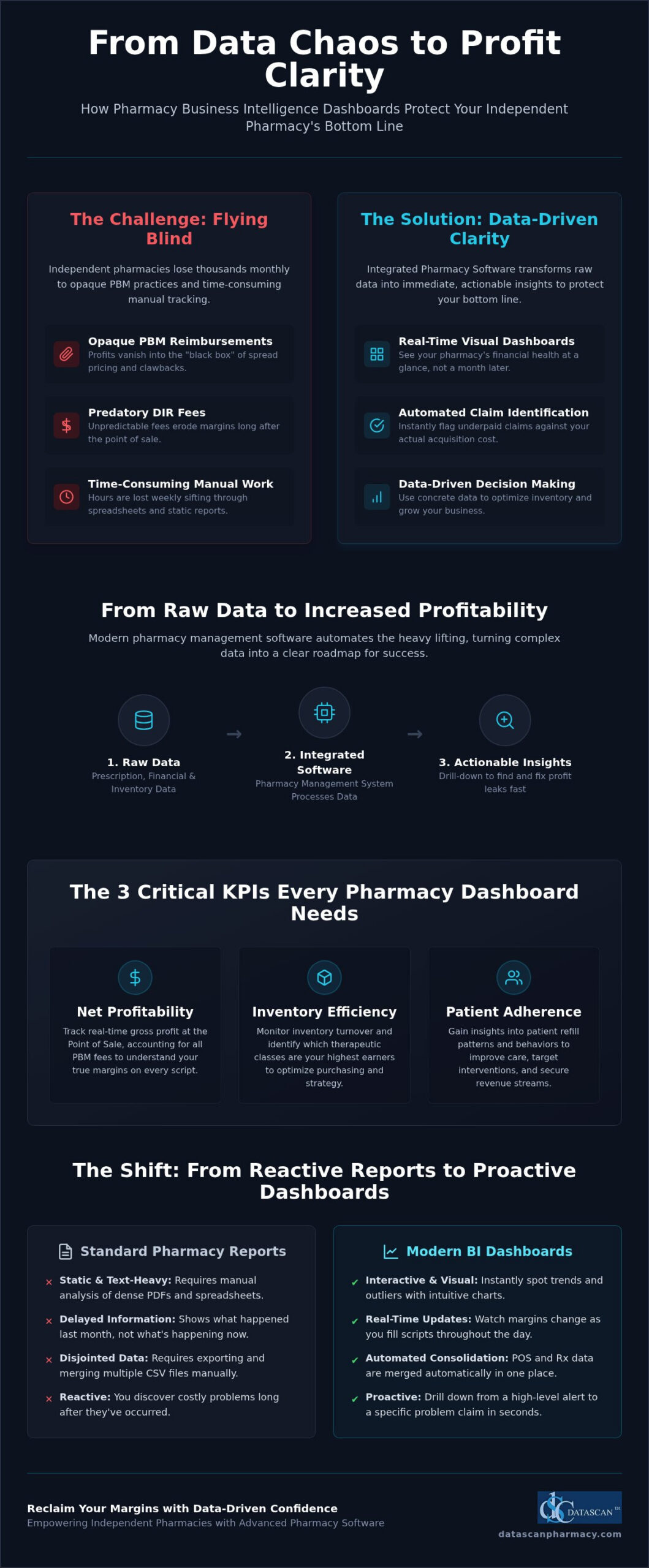
Independent pharmacies are losing thousands of dollars every month to opaque PBM reimbursements and predatory DIR fees that they simply don’t have the time to track manually. Pharmacy business intelligence dashboards solve this by transforming your raw prescription data into immediate, actionable insights that highlight underpaid claims and protect your bottom line. By integrating these tools directly into your pharmacy management software, you can stop guessing about your margins and start making data-driven decisions that ensure your store’s survival in an increasingly hostile market.
You’ve likely felt the frustration of watching your hard-earned profits vanish into the “black box” of PBM spread pricing and clawbacks. We understand that as a community pharmacist, your focus should be on patient care, not spending hours buried in complex spreadsheets. In this guide, you’ll learn how to leverage advanced pharmacy software to automate claim identification and gain real-time visibility into your profitability. We’ll walk through the essential KPIs every owner needs to monitor and show you how streamlined workflows can finally free up your schedule to grow your business.
Key Takeaways
Discover how pharmacy business intelligence dashboards convert complex prescription data into visual charts that expose profit leaks in real time.
Identify the critical KPIs, including gross profit at the point of sale and inventory turnover, that directly impact your pharmacy’s financial health.
Learn how to proactively flag underpaid PBM claims by automatically comparing reimbursements against your actual acquisition costs to protect your margins.
Evaluate why integrated reporting within your pharmacy management software is superior to cumbersome third-party add-ons for saving time and reducing overhead.
Streamline your workflow to reclaim hours spent on manual reporting, allowing you to focus on high-margin services and patient care.
What are pharmacy business intelligence dashboards and why do independent owners need them?
Pharmacy business intelligence dashboards are visual reporting tools that consolidate prescription, financial, and inventory data into real-time charts to help owners identify profit leaks. Instead of sifting through dozens of disjointed reports, you get a unified view of your store’s health at a single glance. This technology represents a fundamental shift from “looking at what happened” to “seeing what is happening now.” For independent owners, this visibility is the difference between catching a negative margin claim today and discovering a thousand dollar loss during next month’s reconciliation.
The concept of Business intelligence has historically been reserved for large retail chains with dedicated analyst teams. However, modern pharmacy management software now brings these sophisticated tools to the community level. Without real-time data, independent pharmacies operate at a severe disadvantage. You’re essentially flying blind while PBMs use advanced algorithms to squeeze your reimbursements. BI simplifies complex data sets into intuitive visuals, ensuring that even non-technical owners can spot trends without needing a degree in data science.
How do dashboards differ from standard pharmacy reports?
Standard pharmacy reports are often static, text-heavy PDFs that require manual analysis to find useful information. If you’re still relying on manual spreadsheet entries, you’re losing hours of valuable time every week. Dashboards offer interactive, real-time visualizations that allow you to drill down from a high-level overview directly into a specific problematic claim. This interactivity transforms your data from a record of the past into a roadmap for the future.
Interactive Drill-Down: Click a “red flag” on your chart to see the exact NDC and PBM responsible.
Real-Time Updates: Watch your margins shift as you fill prescriptions throughout the day rather than waiting for month-end.
Automated Consolidation: Stop exporting CSV files; let your software do the heavy lifting by merging POS and Rx data automatically.
Why is data-driven decision making critical in 2026?
The pharmacy industry reached a tipping point in 2026. With the overall pharmacy trend seeing double-digit cost increases and PBMs managing over 90% of claims, guessing isn’t an option. You need to know your exact cost-to-dispense at all times to survive. When you use technology to automate the “business” side of the business, you reclaim the time needed for high-margin clinical services and direct patient care. Real-time visibility isn’t just a luxury; it’s a survival mechanism that empowers you to stand your ground against reimbursement pressure.
What are the most important KPIs for a pharmacy dashboard?
Effective pharmacy business intelligence dashboards focus on the “Big Three” metrics: net profitability, inventory efficiency, and patient adherence. A dashboard is only as good as the metrics it tracks, and for the independent owner, these data points represent the difference between a thriving business and one struggling to keep the lights on. By consolidating this information into a single view, you can stop guessing about your store’s health and start making decisions based on cold, hard facts.
How do you track pharmacy profit margins effectively?
Monitoring your net profit requires looking past the initial reimbursement to account for PBM take-backs and DIR fees. In 2026, branded drug prices have seen a median increase of approximately 4%, which means your margins are under constant pressure. Your dashboard should provide real-time gross profit tracking at the Datascan Point of Sale, allowing you to see exactly what you’re making on every transaction before the patient leaves the counter.
You also need the ability to identify which therapeutic classes are your highest earners. If specialized medications or specific generics are driving your bottom line, you need to know so you can adjust your inventory and marketing strategies accordingly. Learning how to calculate pharmacy gross profit accurately in this new regulatory environment is the first step toward reclaiming your agency as an owner. If you’re ready to see these insights in action, you can schedule a demo with our team to explore our integrated reporting tools.
Which operational metrics save the most time?
Operational KPIs are designed to help you run a leaner, more efficient business. One of the most impactful metrics is prescription volume by hour. By visualizing when your store is busiest, you can optimize staffing levels to ensure you aren’t overstaffed during lulls or overwhelmed during rushes. This data-driven approach to scheduling directly reduces labor waste and improves the patient experience.
Med-Sync Enrollment: Track your medication synchronization progress to move prescriptions to predictable pick-up dates, which smooths out your customizable workflow.
Inventory Turn Rates: Identify “dead stock” that is sitting on your shelves and tying up valuable capital that could be reinvested into growth.
Delivery Efficiency: Monitor driver performance and delivery turnaround times to ensure your off-site patients are receiving the same level of care as those in-store.
Focusing on patient adherence rates is equally critical. With Star Ratings directly impacting your reimbursement levels and network access, using pharmacy business intelligence dashboards to flag non-adherent patients allows your staff to intervene before it affects your scores. This proactive management turns your data into a tool for both better clinical outcomes and higher pharmacy profitability.
How can dashboards help you identify underpaid pharmacy claims?
Automated claim flags prevent financial loss by instantly identifying every transaction where the reimbursement falls below your actual acquisition cost. Pharmacy Benefit Managers (PBMs) often rely on the fact that independent owners don’t have the bandwidth to audit thousands of individual claims manually. By utilizing pharmacy business intelligence dashboards, you turn the tables. These tools act as a 24/7 digital auditor, flagging reimbursements that fall below the Wholesale Acquisition Cost (WAC) to ensure you aren’t paying for the “privilege” of dispensing medication to your community.
The “Red Flag” system is a critical component of modern pharmacy management software. It automates the detection of claims with negative margins, allowing your staff to address issues at the moment of dispensing rather than discovering them weeks later. This level of precision simplifies the reconciliation of PBM payments and third-party aging, transforming a once-arduous task into a streamlined, manageable workflow. When your software does the heavy lifting, you reclaim the time needed to focus on patient outcomes and business growth.
How do you combat PBM reimbursement issues with data?
Combatting PBMs requires more than just anecdotes; it requires aggregated data that proves patterns of underpayment over time. In an environment where the top ten PBMs managed over 90% of total prescription claims volume in 2025, your data is your only real leverage. Dashboards allow you to visualize the cumulative impact of DIR fees on your monthly cash flow with a single chart, providing a clear picture of your actual net earnings. For a comprehensive look at navigating these challenges, explore our guide on managing pharmacy DIR fees.
What is the “Bottom Line Up Front” for claim auditing?
Automated claim flags prevent financial loss by catching negative margin scripts before they’re even dispensed. While many systems offer end-of-month reporting, real-time integration with your Datascan Point of Sale is superior because it stops the bleeding immediately. There’s a significant difference between estimated and actual reimbursement tracking; dashboards bridge that gap by pulling in electronic remittance advice (ERA) to show you exactly what was paid versus what was promised. This transparency is essential for maintaining a healthy bottom line in the face of aggressive PBM oversight and shrinking margins.
The best pharmacy management software should empower you with integrated pharmacy business intelligence dashboards that don’t require expensive third-party add-ons or complex manual exports. You shouldn’t have to be a data scientist to run your business; you need a system that lets you see your pharmacy’s health in under 60 seconds. While some systems force you to wait for overnight data refreshes, the most effective tools provide real-time updates that reflect your current inventory and sales. Whether you’re checking margins from the pharmacy counter or reviewing performance from home via mobile access, your data must be accessible and easy to interpret at a glance.
Customization is also vital because every independent pharmacy is unique. If you specialize in compounding or nursing home modules, your reporting needs differ significantly from a standard retail operation. Your reporting tools should allow you to build views that matter to your specific niche rather than forcing you into a one-size-fits-all template. This flexibility ensures you’re tracking the right variables for your specific business model, which is essential for long-term sustainability. If you’re tired of fighting with generic reports that don’t show the full picture, it’s time to request a personalized walk-through of an integrated solution.
Why is US-based pharmacy software support important for BI?
US-based pharmacy software support is a non-negotiable requirement for accurate business intelligence. Pharmacy data in the United States is uniquely complex due to the intricate relationships between PBMs, wholesalers, and state regulations. You need support staff who understand the nuances of the US healthcare system to help you fix data discrepancies before they impact your tax filings or audits. Fast response times from a domestic team ensure that technical glitches don’t leave you flying blind during critical decision-making periods.
What questions should you ask a pharmacy software vendor about data?
When evaluating pharmacy business intelligence dashboards, you need to dig into the specifics of how the vendor handles your information. Don’t settle for vague promises; ask direct questions to ensure the tool actually serves your needs as an independent owner.
Is the BI dashboard included in the base price or is it a separate fee? Many vendors hide these costs in “pro” tiers or monthly add-on subscriptions.
Does the data update in real-time or on a delay? Decisions made on yesterday’s data can be costly in a fast-moving market.
Can I export my data if I need to work with an outside accountant? Ownership of your data includes the ability to move it into other formats for professional financial analysis.
A vendor that is transparent about these points is likely a partner that values your independence. By choosing a system that prioritizes ease of use and real-time visibility, you’re investing in a tool that protects your margins while freeing up your time to focus on what matters most: your patients.
How does Datascan transform your raw data into increased profitability?
Datascan transforms your raw data into increased profitability by providing integrated, real-time pharmacy business intelligence dashboards that expose PBM underpayments and automate complex operational reporting. By merging data from your workflow software and Datascan point of sale, we offer a 360-degree view of your business that corporate analysts can’t replicate. Our tools are designed specifically for the independent owner. We ensure that chain-level technology is delivered with the personal accountability of a family-owned partner that has championed the independent pharmacy since 1981.
Our dashboards specifically target the lack of transparency in PBM reimbursements. While competitors often push external tools that require tedious manual exports, Datascan builds these capabilities directly into your pharmacy management software. This native integration ensures that your data is always accurate and current. You don’t need additional software subscriptions or technical expertise to protect your bottom line. We give you the leverage to fight back against aggressive PBM oversight with facts, not guesses. To understand the full scope of how purpose-built technology can help, our detailed breakdown of software to identify underpaid pharmacy claims walks through exactly how real-time adjudication catches revenue losses at the point of dispensing.
Real-time profitability tracking with Datascan
Profitability tracking shouldn’t be a post-mortem exercise. With Datascan, you see your gross profit on every script before it ever leaves the pharmacy counter. This immediate visibility allows you to flag low-margin claims and inventory anomalies as they happen. You can also track patient engagement through the MobileScripts patient app. You’ll see exactly how digital refills and adherence notifications are impacting your revenue. Automated alerts ensure that you never miss a reimbursement discrepancy. This protects your margins against shrinking spreads and predatory clawbacks. Pairing this real-time profitability data with strong pharmacy accounts receivable management ensures that the revenue you earn is actually collected and reflected in your cash flow.
Freeing up your time to run your business
Technology is most valuable when it gives you back your time. Our automated dashboards typically eliminate 5 to 10 hours of manual reporting per week. This removes the burden of spreadsheet management from your shoulders. Instead of crunching numbers, you can use our data to identify which clinical services, such as e-care plans or specialized med-sync programs, are actually worth your time and resources. This strategic shift allows you to move from a survival mindset to one of growth and optimization. Ready to see your data in a new light? Schedule a Datascan demo today to discover how our pharmacy business intelligence dashboards can secure your store’s future.
Reclaim Your Margins with Data-Driven Confidence
Navigating the complexities of PBM reimbursements and shrinking margins requires more than just hard work; it demands the right technology. By implementing pharmacy business intelligence dashboards, you transition from reactive reporting to proactive management. You’ve seen how real-time visibility into your “Big Three” KPIs, profit, inventory, and adherence, can stop financial leaks before they impact your cash flow.
Datascan has been family-owned and operated since 1981, providing the expert guidance and 100% US-based technical support you need to thrive. Our innovative features, like integrated med-sync and e-care plans, are built into our pharmacy software to ensure your store remains a pillar of the community. Don’t let opaque PBM practices dictate your success. It’s time to empower your independent pharmacy with Datascan’s advanced BI dashboards. We’re here to help you turn raw data into a roadmap for sustainable growth. Your store deserves a partner that fights as hard for your independence as you do.
Frequently Asked Questions
How much does a pharmacy business intelligence dashboard cost?
Costs vary depending on whether the reporting tool is built into your system or requires a third-party subscription. Many vendors charge additional monthly fees for advanced data visualization tiers. Datascan includes robust business intelligence features within our standard pharmacy software licensing to ensure independent owners have the tools they need without hidden overhead. You should always ask if reporting is included in your base price to avoid unexpected costs that eat into your margins.
Do I need a data analyst to use a pharmacy dashboard?
No, you don’t need a specialized analyst to interpret your data when using intuitive pharmacy business intelligence dashboards. Modern systems translate complex financial and prescription metrics into simple visual charts that any owner can understand. This allows you to spot profit leaks and reimbursement trends in seconds. The goal is to provide actionable insights that empower you to make business decisions without requiring a background in data science or accounting.
Can a dashboard help me reduce my DIR fees?
Yes, dashboards help you manage DIR fees by providing visibility into your net profitability on every claim. While you can’t always stop the fees themselves, you can use data to identify high-fee categories and adjust your inventory or clinical focus. By tracking these expenses in real-time, you can predict cash flow more accurately and implement strategies like medication synchronization to improve the metrics that PBMs use to calculate these clawbacks.
How often does the data in a pharmacy BI dashboard update?
The best systems update in real-time to reflect every transaction at the point of sale. Some older pharmacy management software relies on overnight data refreshes, which can leave you making decisions based on outdated information. Real-time updates ensure that if a PBM underpays a claim today, you see the red flag immediately. This allows your staff to address margin issues before the patient even leaves the counter, protecting your daily revenue.
Is my pharmacy data secure in a BI dashboard?
Data security is a top priority, and your information is protected by industry-standard encryption and local access controls. Since our software is not cloud-based, your sensitive business and patient data remains on your local servers under your direct control. We implement rigorous security protocols to ensure that your financial reports and patient records are only accessible to authorized personnel, maintaining full HIPAA compliance while providing the visibility you need to run your store.
Can I track multiple pharmacy locations in one dashboard?
Yes, you can consolidate data from multiple stores into a single, unified view. This “enterprise” visibility is essential for owners who manage several locations but can’t be in two places at once. You can compare performance across your entire organization, identifying which stores are hitting their margin targets and which ones need operational adjustments. This high-level overview helps you standardize best practices and optimize staffing across your entire independent pharmacy group.
What is the best pharmacy management software for data reporting?
The best pharmacy management software is one that provides integrated, real-time business intelligence without requiring third-party exports. Datascan is a top choice because we’ve been family-owned since 1981 and build our tools specifically for the needs of independent owners. Our system combines Rx dispensing, point of sale, and workflow data into one dashboard. This gives you a total view of your profitability and helps you combat predatory PBM reimbursement practices with ease.
How do dashboards improve my pharmacy’s Star Rating?
Dashboards improve Star Ratings by flagging non-adherent patients and tracking medication synchronization enrollment. When you can see exactly which patients are falling behind on their refills, your staff can proactively reach out to improve adherence. These metrics are a primary factor in how PBMs calculate your performance scores. Using pharmacy business intelligence dashboards to drive clinical interventions ensures better patient outcomes and protects your pharmacy from performance-based reimbursement reductions.
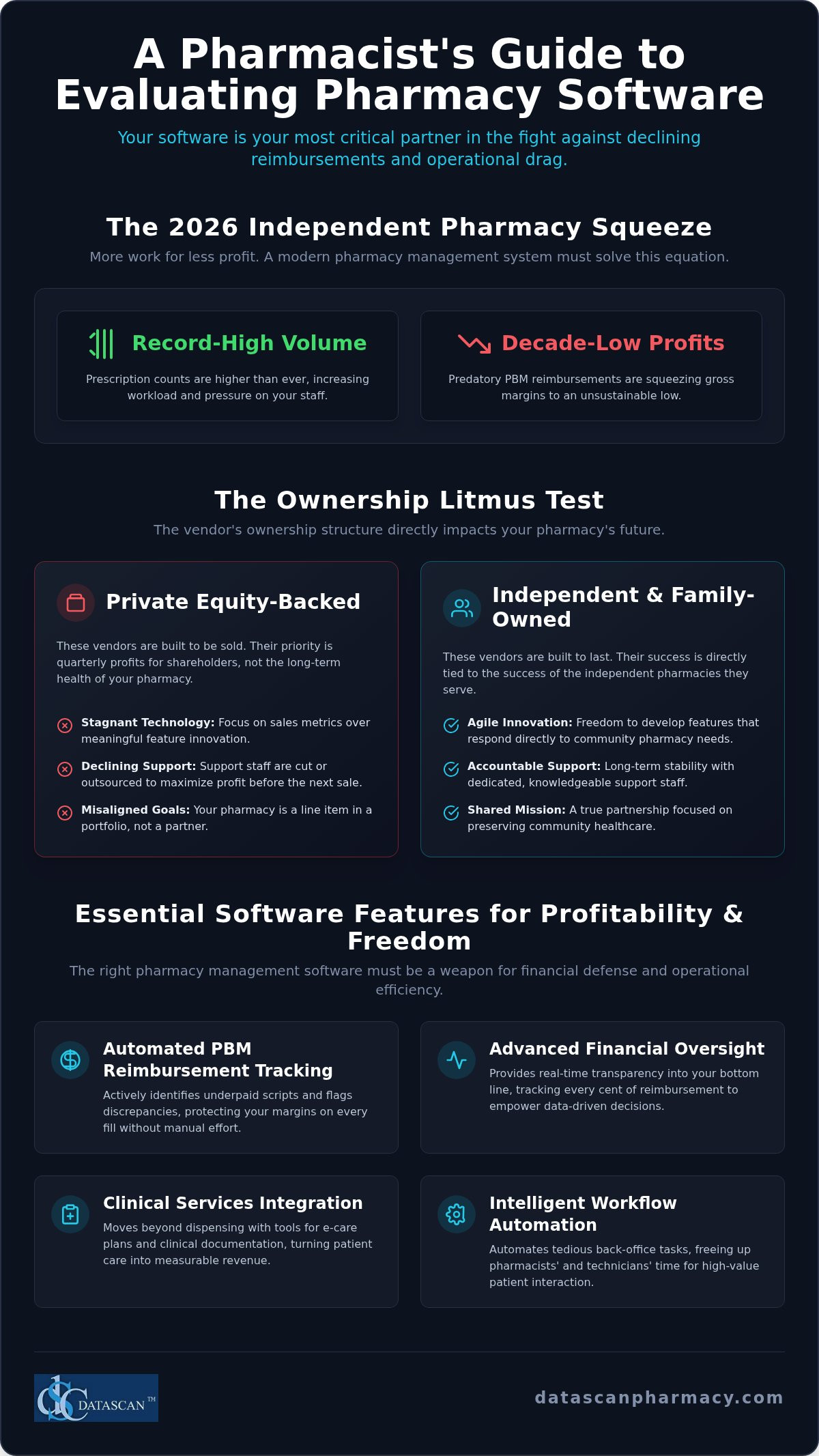
The Consolidated Appropriations Act of 2026 may have finally signed federal PBM reform into law, but for the independent pharmacist standing behind the counter today, those victories feel miles away. You are likely seeing record-high prescription volumes while your gross profits hit decade-long lows, leaving you with more work and less to show for it. When you’re evaluating pharmacy software vendors, you can’t afford to choose a mere utility provider that treats your business like a line item. You need a visionary ally that understands the financial squeeze of predatory reimbursements. The right pharmacy management software should be your strongest advocate, offering the tools you need to reclaim your time and protect your bottom line.
We know you’re tired of waiting on hold for outsourced support or discovering hidden costs buried in complex contracts. This 2026 guide is designed to cut through the noise and help you identify pharmacy software that prioritizes your operational freedom. You will discover how to find a partner that automates tedious reimbursement tracking and provides reliable, US-based support. We’ll explore the critical criteria for selecting a system that transforms your daily workflow from a struggle for survival into a streamlined, profitable success.
Key Takeaways
Understand why your pharmacy management software is your most vital business partnership and how technology requirements have shifted in response to 2026 legislative changes.
Learn why independent, family-owned vendors offer superior accountability and long-term stability compared to private equity-backed firms.
Discover the essential technical features needed to automate PBM reimbursement tracking and protect your pharmacy’s shrinking profit margins.
Simplify the process of evaluating pharmacy software vendors by using a weighted scorecard that prioritizes US-based support and reliable data migration.
Master the art of the live demo to look beyond the sales pitch and find tools that truly free up your time for high-value patient care.
Defining the Stakes: Why Evaluating Pharmacy Software Vendors Matters in 2026
Your choice of technology isn’t just an IT decision. It’s the most critical business relationship you’ll ever form. As we move through 2026, the landscape for community pharmacies has shifted from simple prescription fulfillment to a complex battle for financial survival. When you’re evaluating pharmacy software vendors, you aren’t just buying a tool. You’re choosing an ally. A “utility vendor” might help you print a label, but a “strategic partner” provides the weaponry needed to fight back against declining PBM reimbursements and operational bloat.
This year serves as a pivotal turning point because the industry has reached a breaking point. While federal PBM reforms are finally on the horizon, the immediate reality remains a struggle with record-low gross profits despite increasing prescription volumes. A modern pharmacy management system must do more than just process claims. It must actively protect your margins by identifying underpaid scripts and automating the tedious back-office tasks that steal your time. The right pharmacy management software empowers you to transition from a passive participant in the healthcare system to a proactive, profitable provider.
The Shift from Dispensing to Clinical and Financial Profitability
Survival in 2026 requires a pivot toward clinical services and rigorous financial oversight. Your software must go beyond “lick, stick, and pour” to facilitate e-care plans and clinical documentation that turn patient care into measurable revenue. If a vendor focuses more on their own user-growth metrics than on your pharmacy’s gross profit, they’re a liability. You need integrated tools that prioritize your bottom line by tracking every cent of reimbursement in real time. This level of transparency is essential for overcoming the financial pressure exerted by PBMs and reclaiming your professional autonomy.
Avoiding the Corporate Consolidation Trap
The pharmacy technology market is currently plagued by corporate consolidation. Many vendors have sold out to private equity firms or large wholesalers, which often leads to a sharp decline in support quality and a focus on shareholder returns over feature innovation. When evaluating pharmacy software vendors, prioritize those that maintain their independence to ensure your voice remains heard. Partnering with an independently owned pharmacy software company ensures that your feedback actually matters. You deserve a partner whose success is directly tied to the success of independent pharmacies, not one that views your data as a commodity or treats your support calls as a nuisance to be outsourced.
The Ownership Litmus Test: Why Independent Pharmacies Need Independent Software
Don’t just look at the feature list; look at the boardroom. When you’re evaluating pharmacy software vendors, the most telling metric isn’t the number of lines of code. It’s the ownership structure. Corporate-owned vendors often operate with a looming exit strategy. They’re built to be sold. This creates a culture where quarterly profits for shareholders take precedence over the long-term operational health of your pharmacy. You need a partner whose roadmap is dictated by your needs, not by a private equity firm’s desire to “flip” a tech asset for a quick return.
Ownership directly influences how a company prioritizes its development cycle. An independent vendor has the freedom to innovate rapidly for community needs without waiting for approval from a distant corporate parent. This agility is vital in 2026, as PBM tactics shift faster than ever. When your software provider is an independent entity, they share your “underdog” perspective. They don’t view your pharmacy as a data point or a commodity. They view you as a partner in a shared mission to preserve community healthcare.
Private Equity vs. Family-Owned Stability
Private equity is about the “flip.” These firms buy software companies, lean out the support staff, and inflate growth metrics to attract the next buyer. This cycle leaves you with stagnant technology and a support team that doesn’t know your name. Contrast this with the stability of a family-owned vendor that has served the industry since 1981. A long-term vision allows for continuous investment in pharmacy management software that evolves alongside your business. Stability isn’t just about how long a company has existed; it’s about the consistency of its commitment to your niche.
Advocacy and the Personal Touch
Independence breeds advocacy. A vendor that isn’t beholden to a corporate parent or a wholesaler can speak freely about PBM reform and reimbursement transparency. They become a “Champion of the Independent,” building tools that specifically target underpaid claims because they understand your survival is their survival. This personal touch means you can reach leadership when it matters. It ensures your vendor adheres to the latest health information technology standards for interoperability without charging predatory “integration fees” just to keep their investors happy. If you’re ready to partner with a team that shares your values and understands your daily pressures, it’s time to start a conversation with us to see how we can support your growth.
Choosing an independent software provider ensures that your technology remains a tool for your success rather than a vehicle for someone else’s profit margin. When evaluating pharmacy software vendors, ask about their five-year plan. If that plan involves a merger or acquisition, your pharmacy’s future might be at risk. Secure your operations with a partner that is as committed to independence as you are.
Evaluating Technical Capabilities for PBM Reimbursement and Profitability
When you’re evaluating pharmacy software vendors, the technical specifications shouldn’t just be about processing speed; they must be about financial defense. In 2026, where PBMs continue to squeeze margins despite legislative promises, your Pharmacy Software needs to act as a real-time auditor. It’s about identifying revenue leaks before they become permanent losses. Solving the pharmacy technology puzzle means finding a system that prioritizes your gross profit over mere transaction volume. You need a platform that exposes the spread pricing and underpayments that often hide in plain sight.
Tools to Combat PBM Reimbursement Squeezes
Your Pharmacy management software must flag low-reimbursement claims the moment they are adjudicated. Don’t settle for retrospective reports that tell you how much money you lost weeks ago. You need integrated PBM reconciliation features that track every penny from the initial claim to the final payment. These tools allow independent pharmacies to overcome PBM-driven financial hurdles by providing the granular data needed to challenge underpaid claims or adjust purchasing strategies. Automating medication synchronization is another critical lever. It drives consistent monthly revenue and stabilizes cash flow, ensuring your pharmacy remains a viable healthcare hub in your community.
Workflow Automation for Time-Starved Owners
Time is your most valuable asset, yet most owners are buried in back-office tasks that don’t generate revenue. Implementing high-performance workflow software is the only way to reclaim hours for high-value patient care. Automation should handle the heavy lifting of the dispensing process, reducing the risk of human error and the constant threat of pharmacist burnout. When the system handles routine refills and doctor communications, you’re free to focus on clinical outcomes.
Real-time margin tracking: Know your profit on every script at the point of adjudication.
Automated inventory management: Prevent overstocking and reduce carrying costs with predictive ordering.
Integrated patient engagement: Use technology to drive adherence without manual follow-up calls.
Every second saved by your technology is a second you can spend building patient relationships or exploring new clinical revenue streams. The efficiency of your dispensing process determines your ability to scale without adding expensive overhead. When you choose a partner that values your time, you’re investing in the longevity of your business. If your current system feels like a burden rather than a boost, it’s failing its most basic requirement.
The Service Difference: US-Based Support and the Migration Process
A high-performance system is only as effective as the team standing behind it. When you’re evaluating pharmacy software vendors, response time shouldn’t just be a bullet point on a sales sheet; it should be a binding promise. In the high-stakes environment of 2026, where every minute of downtime translates to lost revenue and frustrated patients, waiting hours for a callback from an offshore call center is unacceptable. You need immediate access to experts who understand the nuances of the American healthcare system and the specific pressures of independent pharmacy operations.
Offshore support often comes with hidden costs that aren’t visible in a contract. Language barriers and a lack of specialized US pharmacy knowledge can turn a simple technical question into a multi-day ordeal. When a vendor outsources their help desk, they’re distancing themselves from your daily struggles. True advocacy means providing a reliable, US-based support team that functions as an extension of your own staff, ensuring your Pharmacy management software remains an asset rather than a liability during peak hours.
The Value of US-Based Technical Support
Talking to a local expert who understands state-specific regulations and PBM complexities is non-negotiable for modern owners. Quality support reduces your daily stress levels and ensures operational continuity, allowing you to focus on patient outcomes rather than troubleshooting. We’ve seen how The Critical Role of US-Based Pharmacy Software Support can be the deciding factor in a pharmacy’s ability to navigate sudden industry shifts. Your vendor should be a partner you can call by name, not a ticket number in a global queue.
Ensuring a Stress-Free Pharmacy Software Conversion
The fear of a messy data migration keeps many pharmacists trapped in outdated systems. However, a structured conversion process can be seamless if your vendor prioritizes record integrity and data mapping. You should demand a clear roadmap that includes comprehensive training for your entire staff before the “go-live” date. To protect your business, always utilize a detailed Data Migration Checklist to ensure no patient records or insurance profiles are lost in transition.
Data Integrity: Verify how historical prescription data and patient notes are preserved.
Staff Training: Ensure your team is proficient with the new Pharmacy software workflow before switching.
Post-Migration Support: Confirm that support staff are on standby during your first week of operation.
Don’t let the threat of a difficult migration stop you from upgrading your technology. If you’re ready to experience a transition backed by decades of experience and a team that actually cares about your success, contact our team today to discuss your custom migration plan. A smooth conversion is the first step toward reclaiming your time and securing your pharmacy’s future.
Final Selection Framework: Choosing the Best Pharmacy Software for Your Future
The final stage of evaluating pharmacy software vendors requires a cold, analytical look at the data you’ve gathered. You shouldn’t just rely on a gut feeling; instead, build a weighted scorecard that ranks each vendor on the pillars of independent success: ownership stability, PBM advocacy tools, and support quality. The best Pharmacy Software isn’t just a product you buy today. It’s a platform that evolves alongside your business to meet the challenges of 2026 and beyond. By quantifying these metrics, you can strip away the marketing gloss and see which partner truly aligns with your long-term profitability goals.
Transparency is the bedrock of a healthy partnership. As you finalize your decision, scrutinize the contract for hidden fees that often plague corporate-owned systems. Look for “integration fees” for wholesalers or “maintenance surcharges” that aren’t clearly defined. A champion of the independent will offer a straightforward agreement that reflects their commitment to your growth rather than their own quarterly dividends. Your Pharmacy management software should be an investment in your freedom, not a financial trap that limits your operational flexibility.
Critical Questions to Ask During Your Demo
The live demo is your opportunity to look beyond the sales pitch and test the software’s real-world utility. Ask about the frequency and cost of future software updates to ensure you won’t be hit with unexpected bills just to keep your system current. Inquire about deep integrations with your existing wholesalers and IVR systems; these connections are vital for maintaining a streamlined workflow. Finally, request references from other independent pharmacies currently using the system. Speaking with a peer who uses the tools daily will provide a level of honesty that no brochure can match.
Calculating Long-Term ROI Beyond the Initial Price
Don’t be blinded by a low entry price that hides a high total cost of ownership. When comparing systems, look at the projected ROI over a 5 to 10-year horizon. Factor in the revenue gains you’ll achieve from improved PBM tracking and the time you’ll reclaim through better workflow automation. For example, a system that identifies just a few underpaid claims per week can pay for itself in months. This analysis helps you understand the true value of a family-owned partner that prioritizes your retention over corporate expansion.
Securing your pharmacy’s future means choosing a partner that understands the high-stakes environment of 2026. When you’re evaluating pharmacy software vendors, remember that you’re choosing the foundation of your business. Select the vendor that offers the best balance of innovative technology, assertive PBM advocacy, and the personal accountability that only an independent company can provide. Your success is the ultimate metric of their performance.
Securing Your Pharmacy’s Legacy in an Evolving Market
The landscape of 2026 demands more than just a software provider; it requires a strategic alliance with a partner that understands the high-stakes reality of independent pharmacy. By prioritizing vendors with an “independent first” mindset, you ensure your technology remains a weapon against PBM pressure rather than a corporate liability. Throughout this guide, we’ve explored how the right pharmacy management software automates reimbursement tracking and provides the US-based support you need to eliminate operational bottlenecks.
When you’re evaluating pharmacy software vendors, remember that your choice defines your pharmacy’s trajectory for the next decade. Datascan has been family-owned and operated since 1981, delivering industry-leading support and built-in tools designed specifically for PBM reimbursement advocacy. Don’t settle for a vendor that views your business as a data point. It’s time to empower your team with technology that prioritizes your gross profit and operational freedom.
Your commitment to your community deserves a technology partner that is just as dedicated to your survival. Take the next step toward a more profitable, streamlined future today.
Frequently Asked Questions
What are the most important features to look for in a pharmacy management software vendor?
Look for tools that prioritize profitability and time management. Essential features include real-time PBM reimbursement auditing, automated medication synchronization, and integrated point-of-sale systems. When evaluating pharmacy software vendors, ensure the platform offers robust reporting that flags underpaid claims at the point of adjudication. It is also vital to select a vendor that provides localized, expert support rather than outsourced call centers. This combination ensures your operations stay efficient while your bottom line remains protected.
How long does the pharmacy software conversion process typically take?
The timeline for a pharmacy software conversion depends on the complexity of your data and the readiness of your team. Typically, the process involves several weeks of preparation, including data mapping and staff training, before the actual “go-live” date. A structured transition ensures that historical prescription records and patient profiles transfer accurately. Working with an experienced vendor that provides a dedicated conversion specialist can significantly minimize downtime and prevent operational disruptions during the switch.
Why should I avoid pharmacy software vendors owned by private equity firms?
Private equity-backed firms often operate with a focus on short-term quarterly gains and eventual exit strategies. This mindset can lead to reduced investment in customer support and stagnant feature development as they look to cut costs to satisfy shareholders. In contrast, family-owned companies maintain a long-term commitment to the industry. They prioritize the success of their clients because their own reputation is tied to the longevity of the independent pharmacies they serve.
Can modern pharmacy software really help me improve my PBM reimbursements?
Yes, advanced pharmacy management software is designed to audit claims in real time. These systems flag underpaid scripts at the point of adjudication, allowing you to address issues before they become permanent losses. By providing granular data on spread pricing and DIR fees, the right technology acts as your strongest advocate against PBM pressure. This level of financial transparency is essential for identifying revenue leaks and protecting your pharmacy’s shrinking margins in a competitive market.
Is US-based support actually better than offshore support for pharmacies?
US-based support is superior because it provides access to experts who understand the specific regulatory and insurance landscape of the American healthcare system. Offshore call centers often struggle with language barriers and a lack of specialized pharmacy knowledge, leading to longer resolution times. When a critical issue arises during peak hours, you need a partner who can communicate clearly and solve technical problems immediately without the frustration of waiting in a global queue.
What should I ask during a pharmacy software demo to ensure it fits my workflow?
During a demo, ask the vendor to show you the exact steps for processing a complex claim or managing a refill request. Inquire about the frequency of software updates and whether there are hidden costs for wholesaler integrations. It is also wise to ask for references from other independent pharmacies. This allows you to verify how the pharmacy system handles real-world pressures and whether the support team is as responsive as the sales pitch suggests.
How does pharmacy software help in reducing pharmacist burnout?
Technology reduces burnout by automating repetitive, time-consuming tasks like medication synchronization and patient refill reminders. When your pharmacy system software handles these routine operations, your staff can focus on high-value clinical services and patient interactions. Streamlined workflows eliminate the click-heavy administrative burdens that lead to mental fatigue. This allows you to run a more efficient business with a smaller, more focused team that isn’t overwhelmed by back-office manual labor.
What is the average cost of switching to a new pharmacy software system?
The cost of switching varies based on your specific needs, including the volume of data being migrated and the number of workstations required. Rather than just looking at the initial licensing fee, evaluate the total cost of ownership over several years. Consider the revenue gains from better PBM tracking and the time saved through automation. A pharmacy software partner that offers transparent pricing without hidden maintenance surcharges often provides the best long-term return on investment.
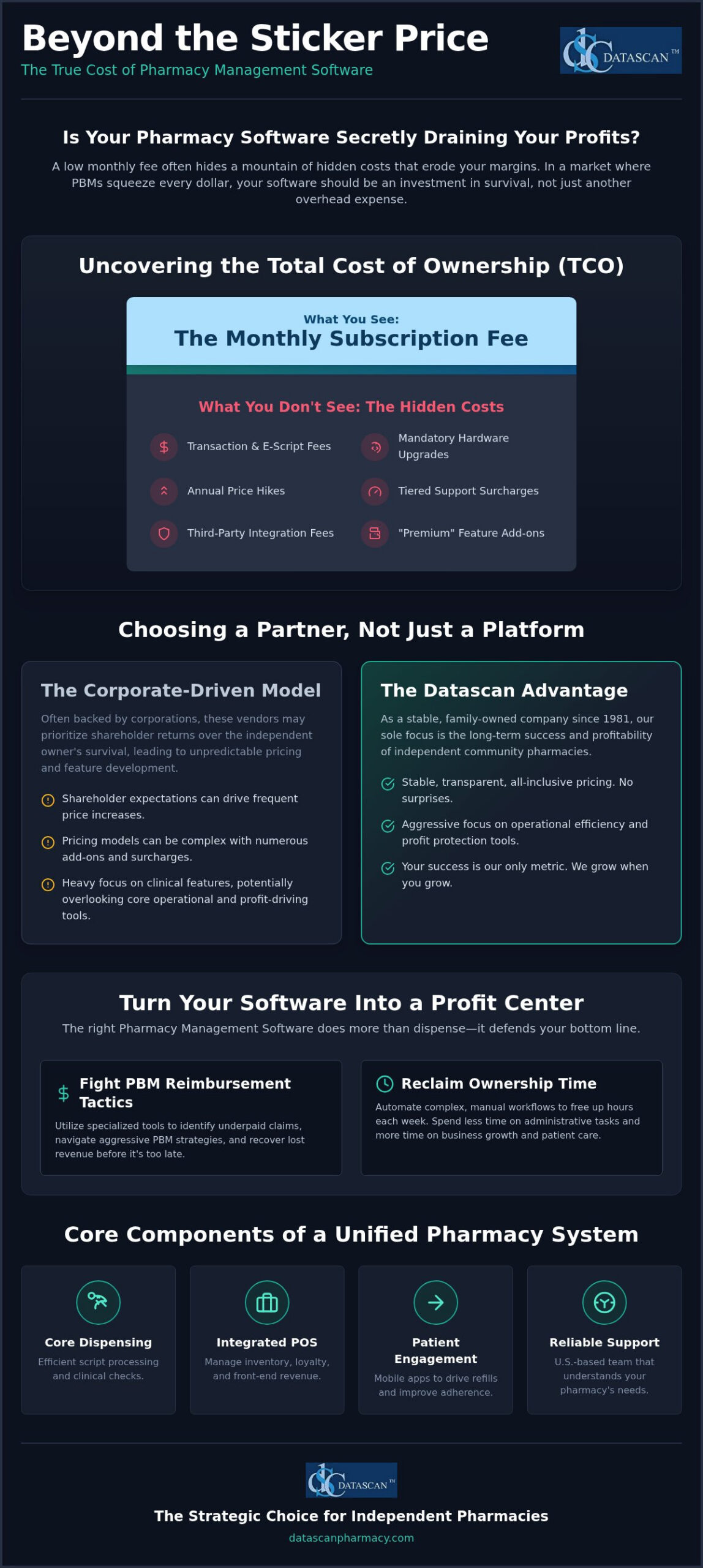
Is the lowest monthly subscription fee actually the most expensive mistake your independent pharmacy could make in 2026? When you evaluate the cost of PioneerRx vs Datascan, it’s easy to get lost in base pricing and overlook the predatory hidden fees that erode your bottom line. You’ve likely felt the sting of shrinking margins, especially as specialty drugs now account for over half of net drug spending. We know that every dollar spent on pharmacy software must be an investment in your survival, not just another line item on your overhead.
This comparison moves beyond the sticker price to reveal the total cost of ownership and the strategic value differences that separate these platforms. You’ll discover how choosing the right pharmacy management software can provide better tools to fight PBM underpayments and recover lost revenue following the latest 2026 legislative reforms. We’ll preview the essential features that automate complex workflows, giving you back the time needed to focus on business growth. By the end of this analysis, you’ll have a clear roadmap to selecting a partner that champions your independence and protects your profitability in a volatile market.
Key Takeaways
Define the true Total Cost of Ownership (TCO) by identifying hidden integration and support fees that often mask the real price of a system.
Compare the cost of PioneerRx vs Datascan by analyzing the long-term ROI of a corporate-driven model against a stable, family-owned partnership.
Discover how specialized Pharmacy management software tools can help you identify underpaid claims and navigate aggressive PBM reimbursement tactics.
Learn to utilize advanced Pharmacy Software workflows to automate manual tasks and reclaim hours of ownership time each week for business growth.
Follow a step-by-step audit process to calculate the financial impact of a software conversion based on transparent, all-inclusive pricing structures.
Beyond the Sticker Price: Understanding Pharmacy Software Costs
Evaluating the cost of PioneerRx vs Datascan requires a fundamental shift in perspective from “what I pay today” to “what I lose tomorrow.” Most owners look at the monthly license fee as the primary metric. This sticker price is often just the tip of the iceberg. A low entry price frequently masks a cascade of secondary expenses that can cripple a pharmacy’s budget over time. When Pharmacy Software is backed by massive corporations with shareholders to satisfy, annual price hikes become a standard operational hazard. These corporations often prioritize profit margins over the survival of the independent owner.
You are already fighting Pharmacy Benefit Managers (PBMs) for every cent of reimbursement. Your software vendor shouldn’t be another entity draining your bank account through aggressive “nickel and dime” tactics. Total Cost of Ownership (TCO) includes everything from hardware maintenance and support contracts to the third-party integrations required to keep your doors open. If these costs aren’t transparent from day one, your profitability will suffer. It is vital to audit your vendor’s history of price stability before signing any long-term agreement.
There is also the heavy burden of opportunity cost. If a system is so complex that it requires weeks of intensive training for every new hire, you are losing valuable time. This is time that should be spent on clinical services, patient counseling, or strategic business development. Efficiency is the only way to overcome the labor shortages and administrative bloat currently facing community pharmacies. A system that is too difficult to navigate effectively raises your labor costs even if the monthly software bill seems low.
The Components of a Modern Pharmacy System
A complete Pharmacy management software solution isn’t just a dispensing engine; it must integrate several moving parts to be truly effective. Independent pharmacies need a unified ecosystem to compete with the big chains.
Core dispensing licenses for daily script processing and clinical checks.
An integrated Point of Sale (POS) system to manage inventory, loyalty programs, and front-end revenue.
Reliable, U.S.-based support that understands the unique pressures of the American healthcare landscape.
Hidden Fees to Watch for in Pharmacy Software Contracts
When comparing the cost of PioneerRx vs Datascan, look specifically at the fine print regarding transaction-based billing. Many vendors lure you in with a competitive base rate but then charge extra for features that are essential for modern practice.
Transaction fees for every e-prescription or insurance claim processed through the system.
Support surcharges for access to help desk tiers, hardware troubleshooting, or software updates.
Monthly fees for adding “premium” features like medication synchronization, delivery tracking, or document management.
By choosing a partner with all-inclusive pricing, you eliminate the budget volatility that comes with hidden contract clauses. This allows you to forecast your overhead with precision and focus your energy on patient care instead of invoice auditing.
PioneerRx vs. Datascan: Comparing Value and ROI
When you weigh the cost of PioneerRx vs Datascan, you aren’t just comparing lines of code; you’re choosing a business philosophy. PioneerRx operates within a corporate driven model where shareholder expectations often dictate pricing and development priorities. In contrast, Datascan has maintained family owned stability since 1981. This independence allows us to prioritize the needs of community pharmacies over quarterly profit reports. While PioneerRx focuses heavily on clinical features, Datascan balances innovation with an aggressive operational and profit focus. We believe your Pharmacy Software should be a tool that actively protects your bottom line, not just a platform for documentation.
The financial health of your pharmacy depends on how your vendor responds to industry shifts. Recent federal scrutiny has highlighted how PBMs impose unfair, arbitrary, and harmful contractual terms on independent owners. You need a partner that updates its Pharmacy management software to combat these specific threats. While corporate entities might move slowly or prioritize features that benefit their data partners, Datascan rapidly deploys tools designed to help you navigate reimbursement challenges and PBM reform. This agility is a core component of your long term return on investment.
Workflow Efficiency and Time Savings
Labor is your largest controllable expense. Every extra click in your dispensing process is a drain on your profitability. High performance Datascan workflow software is engineered to reduce the number of steps required per script, allowing your staff to fill more prescriptions in less time. Automated refill management serves as a secondary labor saving tool, handling the heavy lifting of patient outreach without manual intervention. By integrating your management system with our proprietary Point of Sale (POS), you eliminate the reconciliation errors and double entry common with third party systems.
Support Models: Corporate Call Centers vs. Expert Ally
Downtime is a silent killer of pharmacy revenue. If your system goes down and you’re stuck in a corporate call center queue, you’re losing more than just time; you’re losing patient trust. Corporate support models often rely on tiered help desks where the first person you speak with lacks the authority to solve complex issues. Datascan provides US-based pharmacy software support that treats your pharmacy like a partner, not a ticket number. This level of accountability is essential when executing a Pharmacy Software Implementation Plan or troubleshooting critical billing issues. You can connect with our team to see how a dedicated support ally can transform your daily operations.
How Pharmacy Management Software Fights PBM Margin Squeeze
The true cost of PioneerRx vs Datascan isn’t just the price you pay for a license; it’s the revenue you lose when your system fails to flag an underpaid claim. PBMs rely on opaque pricing and complex fee structures to compress your margins. If your technology doesn’t provide real-time visibility into these tactics, you’re essentially flying blind. Effective Pharmacy Software must act as a financial shield, identifying scripts that fall below your required margin before the patient even leaves the counter. Automated PBM reconciliation is no longer a luxury in 2026. It’s a non-negotiable requirement for survival.
Recent legislative shifts, including the Consolidated Appropriations Act of 2026, have mandated higher transparency for manufacturer rebates. While these reforms are a step forward, PBMs continue to use arbitrary contractual terms to squeeze independent owners. You need Pharmacy management software that tracks DIR fees with precision and helps you navigate these shifting reimbursement landscapes. Specialty drugs now account for 52% of total drug spending despite making up only 2% of prescriptions. This massive concentration of spend means that even a small error in reimbursement tracking can result in thousands of dollars in lost profit every month.
Reclaiming Revenue with Advanced Reporting
Stop guessing which prescriptions are actually profitable. Advanced reporting within Datascan Pharmacy Management Software allows you to identify high-margin versus low-margin scripts instantly. By monitoring profit margins at the point of dispensing, you can make informed decisions about inventory and clinical priorities. This level of granular data helps you fight back against “spread pricing” and ensures every transaction contributes to your pharmacy’s long-term viability. When you can see your net profit after all fees are accounted for, you gain the upper hand in a competitive market.
Freeing Up Time for Clinical Services
Profitability in 2026 requires moving beyond the pill bottle. You need to free up time for higher-reimbursement e-care plans and clinical services. Automating mundane administrative tasks is the only way to reclaim the hours needed for patient counseling and medication synchronization. These programs create predictable revenue streams and improve patient adherence simultaneously. Efficiency tools, like the Datascan Electronic Delivery System, streamline your logistics so your staff can focus on growth-oriented tasks. By letting technology handle the repetitive workflows, you transform your pharmacy from a dispensing hub into a high-performance clinical center.
Calculating the ROI of a Pharmacy Software Conversion
Deciding to switch your Pharmacy Software is a significant operational move that requires a cold, hard look at the numbers. When you analyze the cost of PioneerRx vs Datascan, you aren’t just looking at a monthly bill; you’re calculating the return on investment for your store’s future. Start by auditing your current monthly fees and per-transaction costs. Many owners are shocked by how much they actually pay once e-prescribing surcharges, claim fees, and “premium” support tiers are added up. Next, estimate the value of staff time saved through a better workflow. If your current system requires ten clicks for a refill that should take three, you’re hemorrhaging labor costs every single day.
The third step involves calculating potential revenue gains from integrated PBM reconciliation tools. In an era where middlemen use opaque tactics to squeeze independent pharmacies, a system that flags underpaid claims in real-time is a revenue generator, not an expense. Finally, factor in the stability of your vendor. Corporate mergers in the software space often lead to forced migrations, sunsetting of features, or sudden price hikes to satisfy shareholders. Choosing a family-owned partner provides a level of accountability and long-term pricing security that massive conglomerates simply cannot match. This stability is a core component of your ROI that often goes overlooked during the initial sales pitch.
The Cost of “Staying Put”
Sticking with outdated technology has a price tag that doesn’t show up on a traditional balance sheet. Patients expect modern conveniences like mobile refills and digital notifications. If your current Pharmacy management software lacks these features, you’re likely losing younger demographics to competitors who offer a more streamlined experience. “Free” or cheap software often costs more in the long run due to lost efficiency, patient churn, and the inability to fight back against reimbursement compression. For a deeper dive into what your system should be doing for you, read The Ultimate Guide to Pharmacy Management Software in 2026.
Mitigating the Risk of Migration
The fear of downtime often keeps owners trapped in bad contracts. Datascan eliminates this risk by handling the entire pharmacy software data migration process with precision, ensuring your pharmacy remains operational throughout the transition. Specialized training during the implementation phase is vital to ensure your staff hits the ground running without a dip in productivity. Our US-based pharmacy software support is critical during those first 30 days, providing immediate answers from experts who understand your specific business needs. Don’t let the fear of change hold your pharmacy back from peak profitability. You can schedule a consultation with our experts today to see how a conversion can pay for itself through recovered revenue and improved efficiency.
Why Datascan is the Strategic Choice for Independent Pharmacies
Choosing a partner for your Pharmacy Software is one of the most critical decisions you’ll make for your business’s longevity. When you evaluate the cost of PioneerRx vs Datascan, the real differentiator is accountability. Since 1981, Datascan has remained a family-owned enterprise dedicated exclusively to the success of independent community pharmacies. We don’t answer to venture capitalists or distant shareholders who demand quarterly price hikes. Instead, we answer to you. This independence allows us to offer a “best-of-both-worlds” experience: the high-performance capabilities you expect from a market leader delivered with the personal touch and responsiveness of a private, family-run business.
Our focus remains laser-targeted on the issues that actually impact your bank account, specifically PBM reimbursements and operational efficiency. While corporate-owned competitors may focus on feature bloat to justify high monthly fees, we prioritize the tools that help you fight back against unfair PBM tactics. By streamlining your workflow, our Pharmacy management software frees up your time to focus on patient care and business growth. This clarity of purpose is what separates family-owned stability from corporate complexity.
Empowering the Underdog
We view ourselves as the champion of the independent pharmacy owner. Our philosophy is built on the idea that the “underdog” deserves the same technological advantages as the big-box chains without the predatory pricing. We provide continuous innovation that is future-proof, ensuring your store is ready for the clinical shifts of 2026 and beyond. Whether you are managing complex compounding or high-volume retail, our solutions are designed to optimize every aspect of your operation. We don’t just sell software; we build a foundation for your independence.
Take the Next Step Toward Profitability
Beyond software, independent owners can also leverage physical automation to stay competitive; for example, ReadyLockers provides a universal smart locker platform that allows pharmacies to offer secure, 24/7 pickup options similar to those found at national chains.
This philosophy of empowering independent businesses with precision tools is universal; for instance, electrical contractors can discover Best Bid to access specialized estimating software that helps them compete effectively in their own industry.
The journey to a more profitable pharmacy starts with a simple evaluation. We invite you to see a personalized demo of the Datascan system to experience firsthand how our integrated tools can transform your daily workflow. Beyond dispensing, we can show you how optimizing the pharmacy POS system can drive front-end revenue and improve patient retention. Don’t settle for a vendor that treats you like a ticket number in a corporate database. Contact us today for a custom quote tailored to your specific volume and discover the value of a partner that’s as invested in your success as you are.
Take Control of Your Pharmacy’s Financial Destiny
Choosing between vendors is more than a technical decision; it’s a commitment to your store’s long-term survival. Evaluating the cost of PioneerRx vs Datascan reveals that true value lies in more than just a monthly license fee. You need Pharmacy management software that provides specialized tools to recover PBM underpayments and a workflow that gives you back the time needed to grow your business. By moving away from corporate-driven complexity, you gain the clarity of a family-owned ally that has championed independent pharmacies for over 40 years.
With our 100% US-based support team and a deep focus on your profitability, Datascan ensures you never have to fight the PBM margin squeeze alone. It’s time to stop paying for hidden fees and start investing in Pharmacy Software built for your success. Schedule a Demo to See How Datascan Maximizes Your Pharmacy Profitability today. Your community relies on your independence, and we’re here to help you protect it.
Frequently Asked Questions
How much does Datascan pharmacy software cost compared to PioneerRx?
Datascan focuses on a total cost of ownership model that often results in lower long-term overhead. While PioneerRx may offer tiered monthly pricing based on user counts, their additive costs for integrations can quickly inflate your bill. Datascan provides an all-inclusive approach that simplifies budgeting. By consolidating dispensing and management tools, you avoid the sticker shock common with corporate vendors who charge for features we consider standard.
Does Datascan charge extra for US-based technical support?
Expert US-based technical support is included in your standard agreement with Datascan. We believe that reliable assistance shouldn’t be a premium add-on or a tiered luxury. Our support team is located entirely within the United States to ensure clear communication and deep industry knowledge. This model eliminates the frustration of corporate call centers and helps you resolve operational issues quickly to minimize downtime in your pharmacy.
Is the cost of data migration included when switching to Datascan?
Data migration is a standard part of our implementation process, and we work to make the transition as financially seamless as possible. While some competitors treat migration as a major profit center, our priority is getting your store up and running with zero downtime. We handle the heavy lifting of moving your patient and prescription records so you can focus on serving your community during the software conversion process. To understand exactly what this involves, review our comprehensive pharmacy software data migration process checklist built specifically for independent pharmacies in 2026.
Can Datascan help reduce my pharmacy’s DIR fees?
Yes, our Pharmacy management software includes specialized tools designed to track and help mitigate the impact of DIR fees. By providing real-time visibility into your reimbursements and identifying underpaid claims, we empower you to make data-driven decisions that protect your margins. These tools are essential for navigating the complex PBM landscape of 2026 and ensuring that your pharmacy remains profitable despite aggressive reimbursement compression.
Are there hidden transaction fees in a PioneerRx vs Datascan comparison?
Transparency is a key differentiator when evaluating the cost of PioneerRx vs Datascan. Many corporate-owned systems rely on transaction-based billing for e-prescribing or claims processing, which can lead to unpredictable monthly expenses. Datascan advocates for a flat-fee model that covers essential operations. We avoid the nickel and dime tactics that erode your bottom line, providing a predictable overhead that allows for better financial forecasting and business planning.
How long does it take for a pharmacy software conversion to pay for itself?
Most pharmacies see a return on investment within the first year by leveraging recovered PBM revenue and improved staff efficiency. When you switch to high-performance Pharmacy Software, the reduction in manual clicks and automated refill management lowers your labor costs immediately. By identifying underpaid scripts at the point of dispensing, the system helps you reclaim lost profits that would otherwise go unnoticed under an outdated or inefficient platform.
Does Datascan offer integrated POS for the same cost as the management system?
Our Datascan Point of Sale (POS) is a separate, fully integrated module designed to work in perfect harmony with our dispensing software. While it is an additional component, the value of having a unified system outweighs the cost of managing disparate third-party tools. This integration eliminates double entry and reconciliation errors, which saves your staff hours of administrative work each week and improves the accuracy of your financial reporting.
Why does family ownership matter for the cost of my pharmacy software?
Family ownership ensures that your software vendor is accountable to you, not to corporate shareholders or venture capital firms. Large corporations often implement aggressive price hikes to meet quarterly profit targets, but Datascan has maintained pricing stability for over 40 years. This independence allows us to invest in long-term innovation that benefits independent owners rather than focusing on short-term financial gains that increase your operational burden.